A Persian diary of Georgian London
He arrived in London a stranger.
Eight months later, the whole city knew his name.
In November 1809, an envoy of the Shah of Persia landed at Plymouth, sent to seal an alliance with the British Crown. He did not stay merely a diplomat: he became the most watched person in London, turned as sharp an eye on the English as they turned on him, and wrote it all down.
- Route
- Tehran → Plymouth → London → Portsmouth
- Arrived
- late November 1809
- Departed
- mid-July 1810
IMay — November 1809
A diplomat on his way to an alliance
Mirza Abul Hassan Khan Shirazi left Tehran on 7 May 1809, sent by Shah Fath-Ali Qajar with the title of Envoy Extraordinary and Minister Plenipotentiary. His mission had a concrete stake: to confirm the Anglo-Persian alliance just negotiated by the British envoy Harford Jones. Persia had come out of a collapsed alliance with Napoleon, undone after Tilsit, and was now looking to Britain for a counterweight against Russian expansion in the Caucasus — this was the first time Persia had negotiated directly with the British Crown, rather than through the East India Company.
He reached England by sea, landing at Plymouth in late November 1809. What he could not yet know was that the diplomatic mission was about to be eclipsed, almost at once, by something else entirely: the curiosity of an entire city.
IIDecember 1809 — March 1810
The most watched person in London
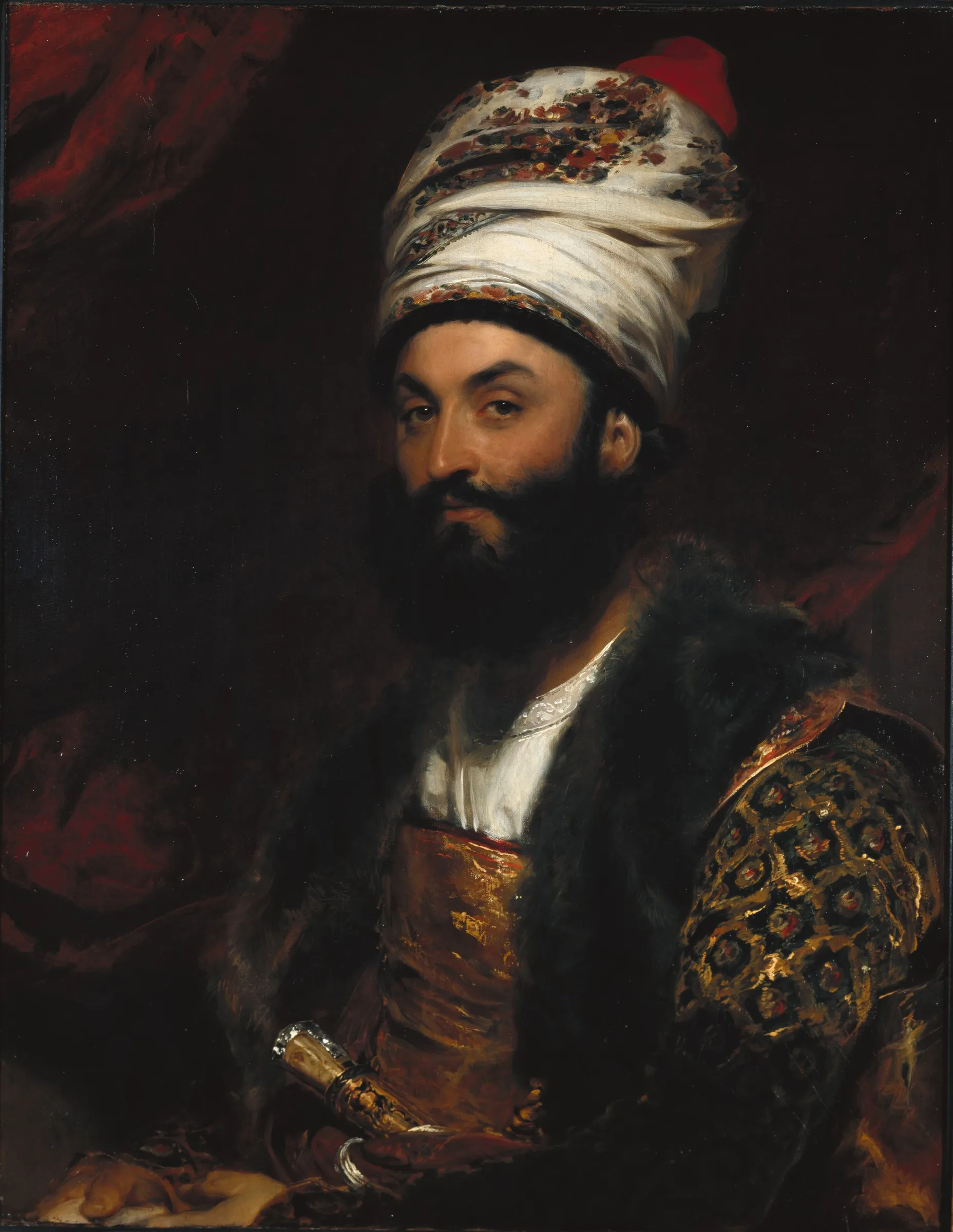
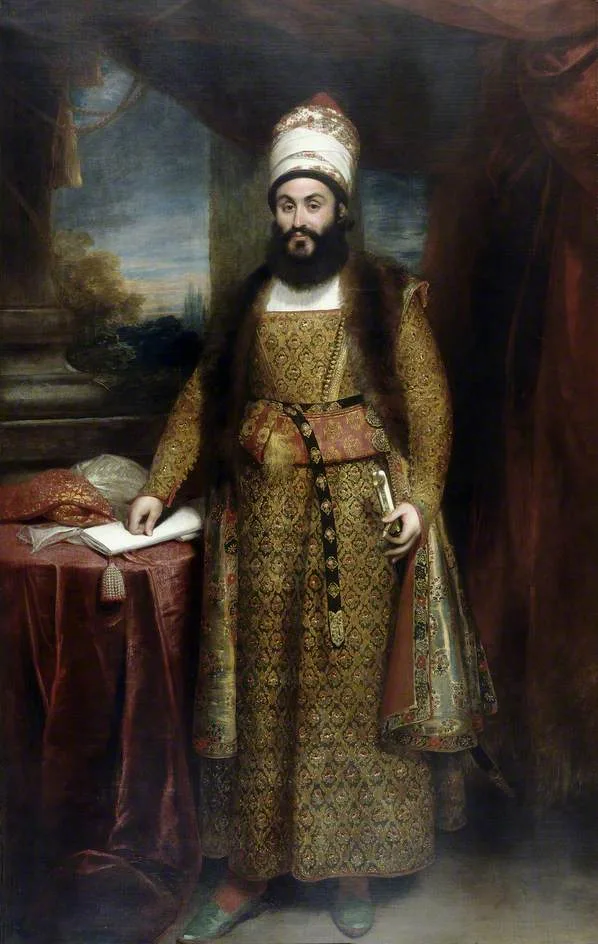
From the moment he reached London, he was mobbed by curious crowds wherever he appeared — at the theatre, out walking, at his own carriage window. One contemporary observer wrote that "the Persian ambassador is the principal thing talked of now." His turban, long beard, and dress, wholly unfamiliar on Georgian streets, made him instantly recognizable, and the press and high society tracked his every public appearance.
Two of the era's finest portraitists asked for sittings. Sir William Beechey painted him in 1809, commissioned by the East India Company. Sir Thomas Lawrence painted him in 1810, commissioned by Sir Gore Ouseley — the British diplomat who, as a direct result of this mission, would become Britain's first ambassador to Tehran. Lawrence, used to painting clean-shaven Regency gentlemen, had to render a turban, a long beard, and a court dagger for the first time, and had only a handful of sittings before his subject left England for good.
IIIDecember 1809 — April 1810
At court, inside a game bigger than him
He was received by King George III on 20 December 1809 — nearly a year before the king's illness became irreversible in the autumn of 1810, so the audience raises no chronology problem. A reception with Queen Charlotte followed on 17 January 1810, then repeated invitations from the Prince of Wales, the future George IV, to Carlton House that January and February.
A larger game was being played behind the scenes: in December 1809, during his very mission, the Marquess Wellesley became Britain's Foreign Secretary — exactly the partner needed to negotiate the anti-Russian alliance Persia was seeking. According to contemporary accounts, on 16 March 1810 the Persian envoy returned the courtesy by hosting a party of his own for roughly five hundred London guests — a number that alone tells you how far his social standing had risen in a few short months. A month later, in April 1810, he reportedly found himself amid another of the city's spectacles: the riots that followed the arrest of the radical MP Francis Burdett.
IVWinter—summer 1810
His verdicts on us
What makes his diary memorable isn't only who received him, but how he looked back. He found the English social gathering — what the era's etiquette called an "assembly" or a "rout" — entirely pointless, a shuffle of pleasantries leading nowhere. Englishmen's trousers struck him as indistinguishable from underdrawers. Ladies' court dresses, fitted tight at the waist and then billowing out below it, looked to him, he wrote, like tents inflated from the waist down.
"A place somewhat smaller than the others I have seen — one might call it the Horse Opera."
On Astley's Amphitheatre, 14 May 1810
He wrote about every corner of London life with the same amused curiosity: at Astley's Amphitheatre, a display of equestrian acrobatics, he remarked that the venue seemed smaller than others he'd seen and deserved to be nicknamed the "Horse Opera" — a joke from a man who, weeks earlier, had been the guest of honour at the real opera. The court, the salons, the London stage had all become, for him, a spectacle just as worth recording as he had been for his hosts.
V
Myth or record?
His fame left behind stories that don't hold up. Pick a claim and turn the card for the verdict.
VIJuly 1810 — 1845
What came after
He left Portsmouth in mid-July 1810, together with James Morier and the newly appointed British ambassador to Tehran, Sir Gore Ouseley. According to one account, a storm blew their ship off course toward South America before they finally reached Bushehr, on the Persian coast, on 1 March 1811 — a detail resting on a single source so far, and worth treating as a striking claim rather than a settled fact.
It was not his last journey north and west. Between 1814 and 1816 he travelled to Russia, trying unsuccessfully to recover territory lost under the Treaty of Golestan. Between 1818 and 1820 he returned to London a second time — the mission that actually produced the satirical prints of his Circassian wife, Delaram, often mistaken for material from this first visit but clearly dated to 1819, nearly a decade after the diary told here.
His friendship with James Morier did not survive the years that followed: when Morier published his novel "The Adventures of Hajji Baba of Ispahan" in 1824 — its character Mirza Firouz recognizably a caricature of his former friend and host — Abul Hassan Khan felt betrayed, and the relationship between them ended.
At home, he remained a central figure in Persian diplomacy: twice Foreign Minister (1823-1834 and 1838-1845), a signatory of the Treaty of Golestan (1813) and the Treaty of Turkmenchay (1828) — both ending wars with Russia in which Persia lost significant territory. He died in 1845. His own Persian diary, known as the "Hayratnameh," or Book of Wonder, survives in manuscript at the British Library and at the Majlis Library in Tehran, and historians now cite it as one of the liveliest surviving records of how Qajar-era Persia looked at Europe.