Dog vision, rebuilt from measurements
What your dog sees of you
Every day your dog watches you: across the room, from the door, up from the floor. Turn on your camera and see yourself through a dog's eye.
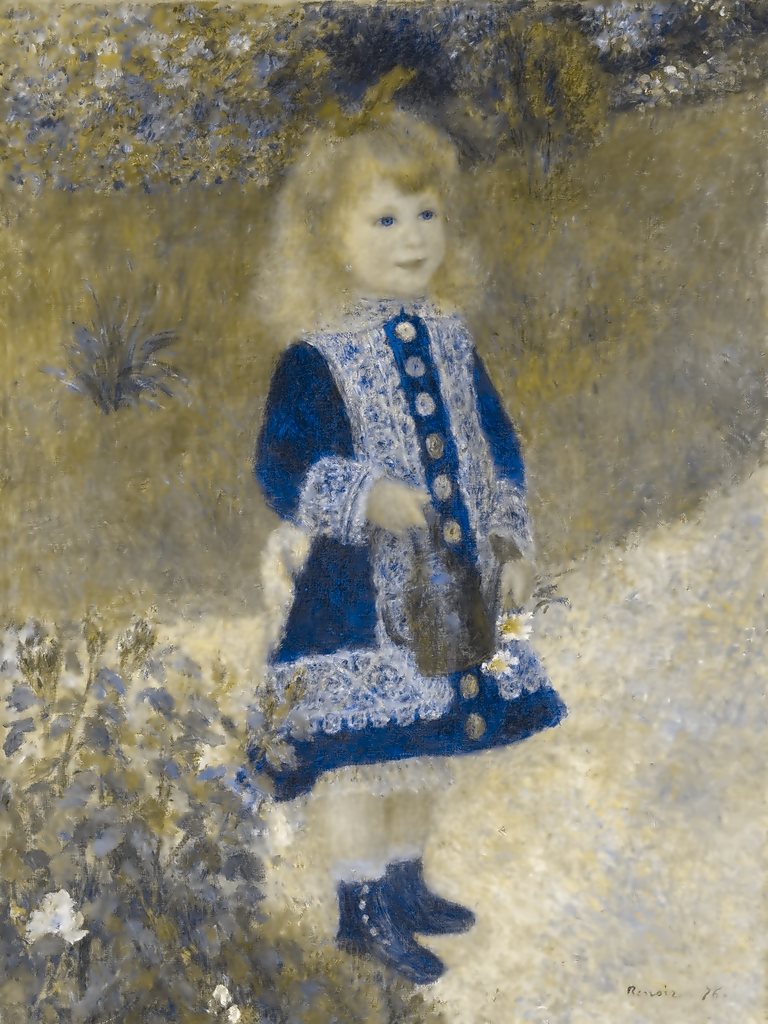
The painting behind these words is already the dog's view. Hold the button at the bottom to see Renoir's colours.
The picture stays on this device. Nothing is recorded or sent.
Not black and white
The popular picture
Ask around and many people will tell you that dogs see in black and white. If that were true, this is all your dog would see.
What the tests found
It is not. In 1989 Neitz and colleagues trained three dogs to pick out coloured lights, and worked out from their choices that their eyes hold two kinds of cone, not the three we have: one most sensitive to violet-blue light, around 429 nm, one to yellow-green, around 555 nm. Four years later, recordings from the eyes of dogs and foxes found the same two.
So a dog sees colour, along one line instead of two: from blue, through grey, to yellow. This is you on that line.
And dogs use it. In 2013 Anna Kasparson and colleagues taught 8 dogs to find food at a yellow or a blue box, one dark and one light, then reversed which was dark and which was light. All of them leaned towards the colour rather than the brightness; for 7 of the 8 the preference was statistically clear.
Hold the button at the bottom (or press on the picture with a mouse) to see it with your own eyes, then let go.
The red ball on the grass
Look at the bow
In the painting, the girl's red bow is the brightest thing in the garden, and the red flowers behind her burn against the green. Through the dog's eye they sink into the lawn.
This is the colour a dog is missing. Red and green differ for us because we have a third cone that tells them apart. For a dog, the whole range from green to red falls on the yellow side of the line, and a red bow and green grass differ mostly in brightness. In this painting both come out a dull yellow; the bow is only a little darker and a little more yellow than the grass.
That is the red ball thrown onto a lawn: bright for you, a yellowish shape on yellowish grass for your dog, told apart by a small difference in brightness and colour, and by its shape. A blue ball on the same lawn stays blue. We found no study that tested toys on grass; this follows from the two cones alone.
There is also one colour that a dog cannot tell from grey at all: a blue-green, around 480 nm in the tests. Here it comes out at 487.
From across the room
How sharp
In 2017 Olle Lind and colleagues in Sweden tested dogs and people in the same set-up, with striped patterns at a distance. In bright light, the dogs saw stripes of 5.5 to 19.5 cycles per degree; the people, 32.1 to 44.2. A dog sees detail roughly three times coarser than you do.
Move the slider to step away. At 2 metres, the finest stripe a typical dog from that range can see (10.4 cycles per degree, the geometric middle) is about 1.7 mm wide; for you, about 0.5 mm.
Dogs differ a lot. In Lind's tests the best was a pug, at 19.5; the lowest scores were about 5.5. Choose one.
Up close, a dog's eye has its own limit: it probably cannot focus much nearer than a third to half a metre, according to a review of dog vision. The face pushed into your dog's nose is a blur.
When the lights go down
Very dim light
Lind's team also turned the light right down, to 0.0087 candela per square metre, about five thousand times dimmer than the first test. The dogs' limit fell to 1.8 to 3.5 cycles per degree. The people's fell too, to 5.9 to 9.9, and they were still ahead.
At this light most vision runs on rods, which do not tell colours apart, so the colour is gone here too. Dogs' eyes are built for dim light, with far more rods than cones (Mowat and colleagues counted about 23 rods to every cone at the centre of a beagle's retina) and a mirror behind the retina. But the one head-to-head test found people still seeing finer detail.
You, in the same light
This is the same room at the same light, through your own eyes as Lind measured them.
What your dog knows you by
1.5 metres
This is your head as your dog sees it from 1.5 metres, the distance used in the study that follows. Hair, the outline of the head against the wall, the dark and light of it: all there. The eyes and mouth are softer.
In 2013 Ludwig Huber and colleagues in Vienna taught dogs to walk up to one of two people and touch their face: the owner, or another person the dog knew well. The two knelt behind a screen, only their heads showing through two holes, about 1.5 metres from the dog.
Of 15 dogs that were trained, 14 learned to pick the right head. Then the real heads were replaced by life-sized photographs of them; 10 dogs managed that too.
Then they hid the hair
In the last stage the photographs got a digital balaclava. It covered the hair and the outline of the head, leaving eyebrows, eyes, nose, cheeks and mouth. Of the 10 dogs, 2 still picked the right person.
This is your face in balaclava mode. Put your face inside the oval.
The authors do not know which cues the dogs had used, but suggest that those who failed had been relying on the whole head: its colour, its brightness, the hairstyle. Two dogs managed every stage, so a dog can learn a face. In 2017 Paolo Mongillo and colleagues found the same limit with real people: dogs went to their owner more often than chance only when the outline of the head was visible.
Not every study agrees. A 2024 preprint on 416 free-ranging dogs reports that they used the inner features. And brain scans disagree about whether dogs have a region for faces at all: two small studies found one; a larger one, of 20 dogs, found none.
Your dog
So this is you, for your dog: a figure on a blue-to-yellow line, softer than you know yourself, recognised in these experiments by the shape of your head more than by the face you see in the mirror. Dogs also connect your face to your voice: in 2007 Ikuma Adachi and colleagues found that dogs looked longer when their owner's voice was followed by a stranger's face.
Your dog has never seen your face the way your mirror shows it. It learned you anyway. Go and stand in the doorway, where it can see you.
How it is made
What the picture does. The image is split into bands of detail, from the coarsest shading to the finest lines. In each band and at each point, the page measures the local contrast and compares it with the smallest contrast a dog is estimated to detect at that size. What falls below the threshold is removed; what rises above it stays. Brightness and colour are handled separately. It is the same engine as The first face, which does this for newborns, with a dog's eye in place of a baby's.
Colour. Two measurements agree: behavioural tests on three dogs (Neitz and colleagues, 1989) and electrical recordings from the eye (Jacobs and colleagues, 1993) put the dog's two cone types at about 429 and 555 nm (the recordings: 430–435 and 555). The page builds both curves from a standard pigment formula at those peaks and converts screen colours into what each cone would catch. Brightness is what the 555 nm cone catches; colour is the balance between the two cones. Red against green is not an axis a dog has, so it is removed. The model puts the colour a dog cannot tell from grey at 487 nm; the value reported from the 1989 tests is about 480 nm. How to show a two-colour world to a three-colour reader is a choice: here the dog's two ends are drawn as blue and yellow.
Sharpness. Lind and colleagues measured it directly in 2017, in dogs and people tested in the same set-up: in bright light, 5.5 to 19.5 cycles per degree for dogs and 32.1 to 44.2 for people; in dim light, 1.8 to 3.5 for dogs and 5.9 to 9.9 for people. The picture shows a typical dog from that range (10.4, the geometric middle of 5.5 and 19.5) unless you choose otherwise. What is assumed: nobody has measured how a dog's sensitivity to contrast changes with the size of detail, the full curve this filter needs. The page takes a typical human curve, slides it down until it ends at the dog's measured limit, and halves its sensitivity, the factor by which dogs did worse than people at telling shades of grey apart (Pretterer and colleagues, 2004, with 3 dogs; a different measure, borrowed here). In the dim-light picture, colour is removed, because at that light most vision runs on rods, which do not tell colours apart.
How far away. Your face in the camera is taken as 16 cm wide and about 45 % of the picture's width, as when you sit close to the screen; the painting as if the girl stood 2 metres away. The picture shows what reaches the dog's eye, not the dog's point of view: a camera on your desk is not at the height of a dog on the floor. Everything runs on this device; the camera image is not recorded or sent.
What this can and cannot show. The picture follows the measured numbers closely; the uncertain part is the numbers themselves, which come from small groups of dogs, a few breeds, and one missing curve filled in by assumption. It shows what the eye lets through, not what a dog makes of it.
Sister pieces: The first face (what a newborn sees of you), what a bee sees and the frames of a second, where dogs' flicker vision is compared with other animals.
Sources and method
- Neitz, Geist & Jacobs (1989). Color vision in the dog. Visual Neuroscience 3:119 (abstract). pubmed.ncbi.nlm.nih.gov/2487095/
- Jacobs, Deegan, Crognale & Fenwick (1993). Photopigments of dogs and foxes and their implications for canid vision. Visual Neuroscience 10:173 (abstract). pubmed.ncbi.nlm.nih.gov/8424924/
- Kasparson, Badridze & Maximov (2013). Colour cues proved to be more informative for dogs than brightness. Proceedings of the Royal Society B 280:20131356. pmc.ncbi.nlm.nih.gov/articles/PMC3730601/
- Miller & Murphy (1995). Vision in dogs. Journal of the American Veterinary Medical Association 207:1623 (review). pubmed.ncbi.nlm.nih.gov/7493905/
- Lind, Milton, Andersson, Jensen & Roth (2017). High visual acuity revealed in dogs. PLoS ONE 12:e0188557. pmc.ncbi.nlm.nih.gov/articles/PMC5716585/
- Pretterer, Bubna-Littitz, Windischbauer, Gabler & Griebel (2004). Brightness discrimination in the dog. Journal of Vision 4:241 (abstract). pubmed.ncbi.nlm.nih.gov/15086313/
- Mowat, Petersen-Jones, Williamson, Williams, Luthert, Ali & Bainbridge (2008). Topographical characterization of cone photoreceptors and the area centralis of the canine retina. Molecular Vision 14:2518. pmc.ncbi.nlm.nih.gov/articles/PMC2610288/
- Huber, Racca, Scaf, Virányi & Range (2013). Discrimination of familiar human faces in dogs. Learning and Motivation 44:258. pmc.ncbi.nlm.nih.gov/articles/PMC3807667/
- Mongillo, Scandurra, Kramer & Marinelli (2017). Recognition of human faces by dogs (Canis familiaris) requires visibility of head contour. Animal Cognition 20:881 (abstract). pubmed.ncbi.nlm.nih.gov/28653115/
- Adachi, Kuwahata & Fujita (2007). Dogs recall their owner's face upon hearing the owner's voice. Animal Cognition 10:17 (abstract). pubmed.ncbi.nlm.nih.gov/16802145/
- Sarkar, Pal, Murmu & Bhadra (2024). Preprint on face recognition in free-ranging dogs. arXiv 2407.07192 (abstract). arxiv.org/abs/2407.07192
- Bunford, Hernández-Pérez, Farkas, Cuaya, Szabó, Szabó, Gácsi, Miklósi & Andics (2020). Comparative brain imaging reveals analogous and divergent patterns of species and face sensitivity in humans and dogs. Journal of Neuroscience 40:8396. pmc.ncbi.nlm.nih.gov/articles/PMC7577605/
- Dilks, Cook, Weiller, Berns, Spivak & Berns (2015). Awake fMRI reveals a specialized region in dog temporal cortex for face processing. PeerJ 3:e1115 (abstract). pubmed.ncbi.nlm.nih.gov/26290784/
- Thompkins, Ramaiahgari, Zhao, Gotoor, Waggoner, Denney, Deshpande & Katz (2018). Separate brain areas for processing human and dog faces as revealed by awake fMRI in dogs. Learning & Behavior 46:561 (abstract). pubmed.ncbi.nlm.nih.gov/30349971/
- Govardovskii, Fyhrquist, Reuter, Kuzmin & Donner (2000). In search of the visual pigment template. Visual Neuroscience 17:509 (the cone-curve formula). doi.org/10.1017/S0952523800174036
- Adams & Courage (1998). Human newborn color vision: measurement with chromatic stimuli varying in excitation purity. Journal of Experimental Child Psychology 68:22 (abstract; the adult threshold). pubmed.ncbi.nlm.nih.gov/9473313/
- CIE 1931 2° colour-matching functions, Colour & Vision Research Laboratory, UCL. cvrl.org/
- Pierre-Auguste Renoir, A Girl with a Watering Can (1876), National Gallery of Art, Washington. Open-access image, CC0. commons.wikimedia.org/wiki/File:Auguste_Renoir,_A_Girl_with_a_Wa
