Barcelona, Barri Gòtic
The wall that kept its wounds
In Barcelona's quietest square, a church wall is full of small holes. You would take them for old stone. They are shrapnel — and the morning that made them comes back if you touch the wall. Put on headphones.
Sound starts as you scroll; the siren stays off until you ask for it.
Scroll
The wall
In the Barri Gòtic, two steps from the cathedral, there is a small square where nothing sounds but the fountain. Plaça de Sant Felip Neri. And on the church wall — holes. Small, dense, in the stone around the door.
You would take them for old stone. They are not.
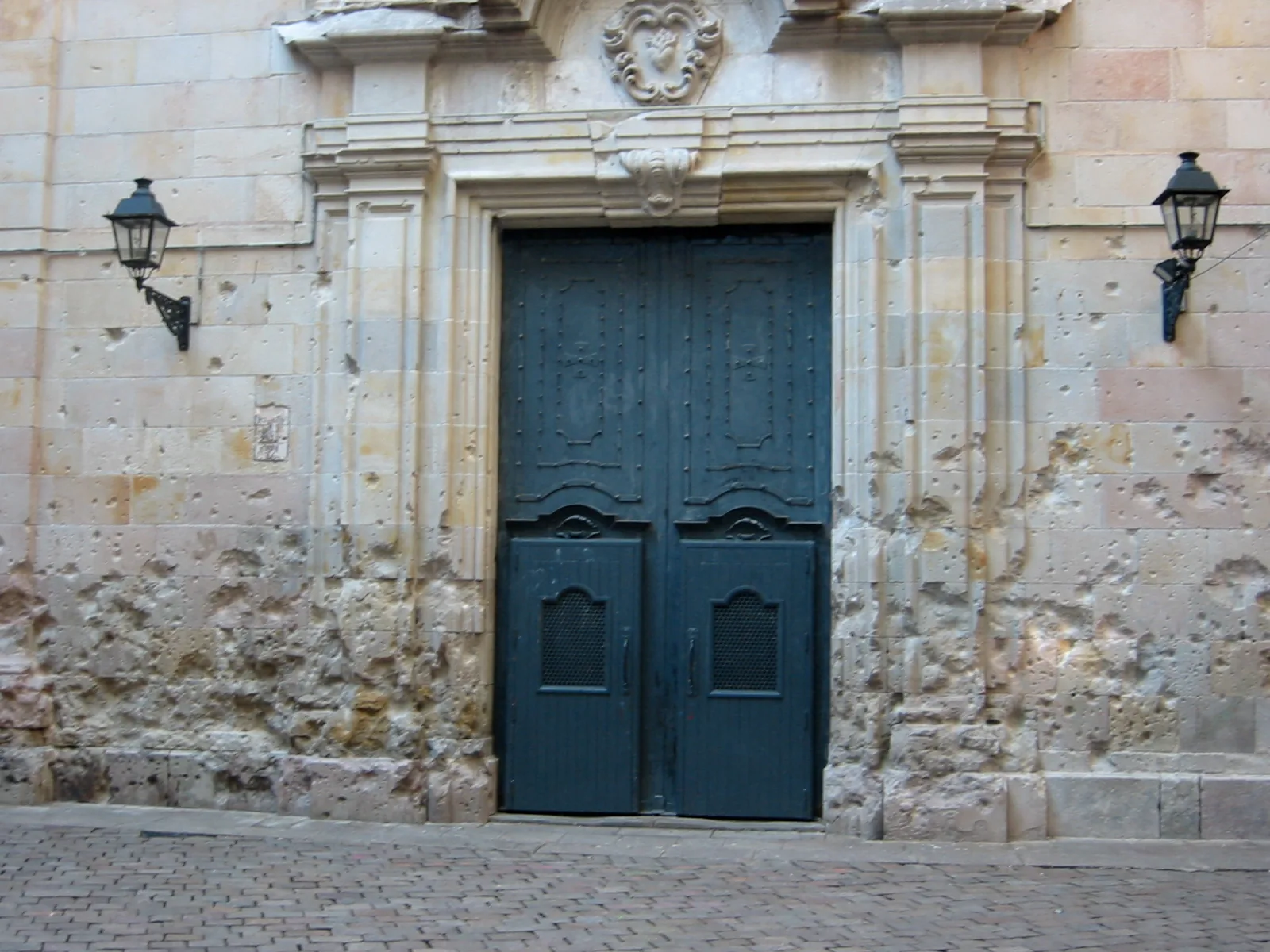

Work on the church began in 1721; it was blessed in 1752. Inside, the image of Christ still holds shrapnel from the bomb that fell on 30 January 1938.
MUHBA, the city's history museum, says it plainly: the shrapnel's effects are still visible on the façade. The wall you are looking at is the only one left standing.
Touch the wall
Five scars, five minutes from the morning of 30 January 1938. Touch them in any order; the clock in the corner keeps pace. The marks on the photograph are schematic.
Touch a scar to release its minute.
Illustrative, synthesised sound; it may disturb. It is off; turn it on only if you want it.
The morning
Sunday, 30 January 1938
MUHBA records two waves that morning, at 8:55 and 11:25: two formations of six Savoia S-79 aircraft of the Italian Aviazione Legionaria, from the Mallorca base, with 36 bombs of 250 kg and 24 of 20 kg on the port and the centre. A Nationalist communiqué presented the raid as reprisal, after a frustrated attack on Salamanca.
One of the 250 kg bombs fell on the square and brought the basement down. The church and convent basement served as an air-raid shelter — but it had never been fitted as one, and the weak structure gave way. Inside were neighbourhood children and child refugees from other parts of Spain. The survivors Frederic and Camil Roig lost their brothers there, Lluís and Hilari.
The S-79s flew by day, from high altitude, over inhabited areas: over 400 km/h, a 1,000 kg load, delivered — says the Girona teaching dossier — on Mussolini's personal order, to be tested in combat.
The lull between the waves
Between the waves, the square filled with rescuers. The Barcelona city council describes the morning as continuous bombing between 9:00 and 11:20 — a municipal framing, beside MUHBA's hours, never merged with them.
The lull was a trap: the second wave caught the rescuers mid-work, among the rubble.
The historian Laia Gallego Vila, in a 2017 study, writes of three air attacks that day — which is why this page never prints a wave count without attribution. Across the city, 87 buildings collapsed or were damaged: 9 streets and 2 squares, plus Morrot station and the Maquinista factory.
The silence
After the war, the Franco regime gave the scars another name: it said they were bullets from firing squads that had shot priests by the wall. The Barcelona city council now calls that version what it was: a cover-up of the massacre.
The press of the day whispered along. La Vanguardia, 18 December 1958: “en la cual estalló una bomba durante la contienda civil, que causó el derrumbamiento de inmuebles y el ensanchamiento de la recoleta plaza” (“Crónica de la jornada. La plaza de San Felipe Neri”, p. 23).
And five years later, in the same paper: “las destrucciones causadas en el edificio y en la plaza por un bombardeo, durante nuestra guerra” (Pedro Voltes, “Otro éxito de la revalorización del barrio gótico…”, La Vanguardia, 23 July 1963, p. 21).
A bombing, in “our” war. That was all that could be said, for so long, about a morning with 42 dead.
The name
In the 1950s, the architect Adolf Florensa remade the square: he did not reconstruct it, he recreated it — with Renaissance elements brought in from other bombed sites, with a fountain, with the look it has today. Of the damage, Florensa writes that the square was cleared of rubble — descombrada — and enlarged. No decision to keep the scars appears in the consulted sources.
So this page says only this: the marks are still there. The wall still shows what the regime tried to rename.
The first homage plaques appeared only in 2007, small and inconspicuous. The lectern was announced in 2018 and inaugurated on 22 October 2018. And on 30 January 2013, the Altraitalia association brought its own homage.
The council's 2007 plaque says, in Catalan: “En memòria de les víctimes del bombardeig de Sant Felip Neri. Aquí varen morir 42 persones –la majoria infants– per l'acció de l'aviació franquista el 30 de gener de 1938.” In memory of the victims: here 42 people died — most of them children — under the Francoist air force.
The Altraitalia plaque adds, in its own letters: 30 of the 42 were child war refugees, sheltered in the convent spaces — and it condemns “bombardeigs de saturació com a crims de lesa humanitat”, saturation bombing as crimes against humanity.
The numbers
In the square: 42 dead, most of them children. Villarroya, cited by Poblet i Feijoo, documents 41 under the rubble, 28 of them children, including three pairs of siblings — many were never identified. Across the city that day: 216 dead and 125 wounded, the only raid with more dead than wounded.
January 1938 brought 8 raids — on the 1st, 7th, 11th, 15th, 19th, 20th, 25th and 30th — with about 600 dead, more raids than in all of 1937 (the Girona dossier; Gallego Vila). On 19 January: about 170 dead and over 200 wounded (Poblet i Feijoo). Across the whole war, Barcelona counted about 2,500 victims, about 200 bombings, over 1,300 inventoried shelters (Poblet i Feijoo; Gallego Vila; the council programme) and — says the Girona dossier — 1,900 bombs fallen on the city. February brought a pause, after British diplomatic pressure (Poblet i Feijoo); then it got worse.
How many
Choose a figure and read where it comes from. Every number carries its source beside it; the drawing is schematic.
Ending
The wall asks nothing of you. It stands in the sun with its small wounds, in a square where today's children run past the fountain.
Touch the wall. It is still warm from the sun. And if you can, call someone who once sheltered you — and thank them.
Sources and method
Every figure on the page comes from the sources below: the two MUHBA waves at 8:55 and 11:25, two formations of six Savoia S-79 aircraft of the Italian Aviazione Legionaria from the Mallorca base (36 bombs of 250 kg and 24 of 20 kg on the port and the centre); 42 dead in the square, most of them children; 216 dead and 125 wounded in the city that day, the only raid with more dead than wounded; 87 buildings hit (MUHBA, the Defensa 1936-39/BCN guide). The Barcelona city council frames the morning as continuous bombing between 9:00 and 11:20, and the historian Laia Gallego Vila writes of three air attacks that day — the page never merges the two framings and never prints a wave count without attribution.
The raid clock shows MUHBA's hours, labelled as waves; the story minutes between them (9:04, 10:10) sit inside the documented spans, while 11:40 is a story minute from after the second wave, and the page says so. The children's figures carry attribution: Villarroya, cited by Poblet i Feijoo, documents 41 under the rubble, 28 of them children, including three pairs of siblings; the 2013 Altraitalia plaque says 30 of the 42 were child war refugees. The photograph is the real façade (Jeremy Keith, CC BY 2.0); the marks on it are schematic overlays, labelled. The sound is synthesised in place — the fountain wash as an illustrative bed, the siren as an illustrative fragment, off by default — and there is no period recording on the page.
The turn is told only as far as the sources go: the marks are still there (MUHBA; the city council). No institutional source attests a deliberate decision to keep the pocks in the 1950s, so the page does not claim one. The regime's story — that the marks were bullets from firing squads — is always rendered as propaganda, never as fact, and the period press euphemisms are quoted verbatim, with full citation.
- MUHBA, Defensa 1936-39/BCN (guiaDEFENSA, Arnabat/Gesalí/Íñiguez) — the wave times, aircraft, bombs, dead, buildings (PDF) barcelona.cat
- Barcelona City Council, Memòria Democràtica — the Sant Felip Neri square page: 9:00–11:20, 42 dead, the regime story as a cover-up ajuntament.barcelona.cat
- Barcelona City Council, “Barcelona bombardejada 1936-1939” — the programme: January 1938, the shelters, the city totals ajuntament.barcelona.cat
- Laia Gallego Vila, “Los bombardeos de Barcelona…”, Índice Histórico Español 130/2017 — the three attacks, the 1950s–60s press quotes, the plaques and lectern (PDF) revistes.ub.edu
- Poblet i Feijoo, 2005 — the Villarroya figures (41 dead, 28 children), 19 January, the February pause; print source
- Ramon Breu, La canalla(da) de Sant Felip Neri — the Girona teaching dossier: the basement shelter, the S-79, January 1938 (PDF) girona.cat
- Society of Architectural Historians, “Resistance and Urban Resilience in Barcelona” (3 May 2022) — the regime's story about the wall sah.org
- Barcino Sacra, Sant Felip Neri Visitor's Guide (Archbishopric of Barcelona) — 1721/1752, the Christ image holding shrapnel (PDF) turisme.esglesia.barcelona
- Jeremy Keith, the scarred church façade (CC BY 2.0) — the photograph on this page, via Wikimedia Commons commons.wikimedia.org
- Enfo, the square's plaques photographed (CC BY-SA 3.0 es) — the 2007 and 2013 texts transcribed, via Wikimedia Commons commons.wikimedia.org
