Chapter 2 · Molecules of lifeLesson 2.2
Carbohydrates and lipids: energy, stores and structures
What do the sugar in the cupboard, the starch in a potato and the paper in your exercise book have in common, and why do animals build their winter stores out of fat?
- Size
- from 0.1 nm to 10 nm
- Level
- atoms and molecules
- Time
- an instant
Before you read: what do you think?
You have a gram of sugar and a gram of oil. How much energy does the oil give compared with the sugar?
See the answer
More than twice as much: a gram of fat gives 9 kcal, and a gram of carbohydrate gives 4 kcal. That is why animals keep their long-term stores as fat: the same energy fits into a smaller mass.
Apart from water, a sheet of paper, a spoonful of sugar and a boiled potato are made mostly of the same kind of molecule: carbohydrates. Sugar dissolves in tea, potato starch thickens in hot water, and paper does not dissolve at all. The difference comes from the way the sugar units are joined together.
Simple carbohydrates: monosaccharides and disaccharides
Carbohydrates (sugars) are organic substances made of carbon, hydrogen and oxygen. Many simple sugars have the general formula (CH₂O)ₙ, a ratio of 1:2:1. Their main role is to supply energy: cells get energy from glucose through cellular respiration.
The smallest carbohydrates are monosaccharides. Glucose, fructose (from fruit and honey) and galactose have the same formula, C₆H₁₂O₆, but their atoms are arranged differently, so they have different properties.
Two monosaccharides can join to form a disaccharide; a molecule of water is removed as they join. Sucrose, table sugar, is made of glucose and fructose. Lactose, the sugar in milk, is made of glucose and galactose. Maltose is made of two glucose molecules.
Polysaccharides: stores and structures
Hundreds or thousands of monosaccharides joined in a chain form a polysaccharide. The same monomer, glucose, gives three polysaccharides with different roles: starch, glycogen and cellulose.
Starch is the glucose store of plants: you find it in potatoes and in grains of wheat and maize. Glycogen is the glucose store of animals and humans, kept mainly in the liver and muscles; when blood glucose falls, the liver releases glucose from glycogen.
Cellulose forms the cell wall of plants and is the most abundant natural biopolymer. Humans cannot digest it; herbivores use it thanks to the microorganisms in their gut. Chitin is a polysaccharide that contains nitrogen: its unit is a glucose derivative carrying a nitrogen group; it makes up the exoskeleton of insects and crayfish and the cell wall of fungi. Starch and glycogen are stores, while cellulose and chitin are structural.
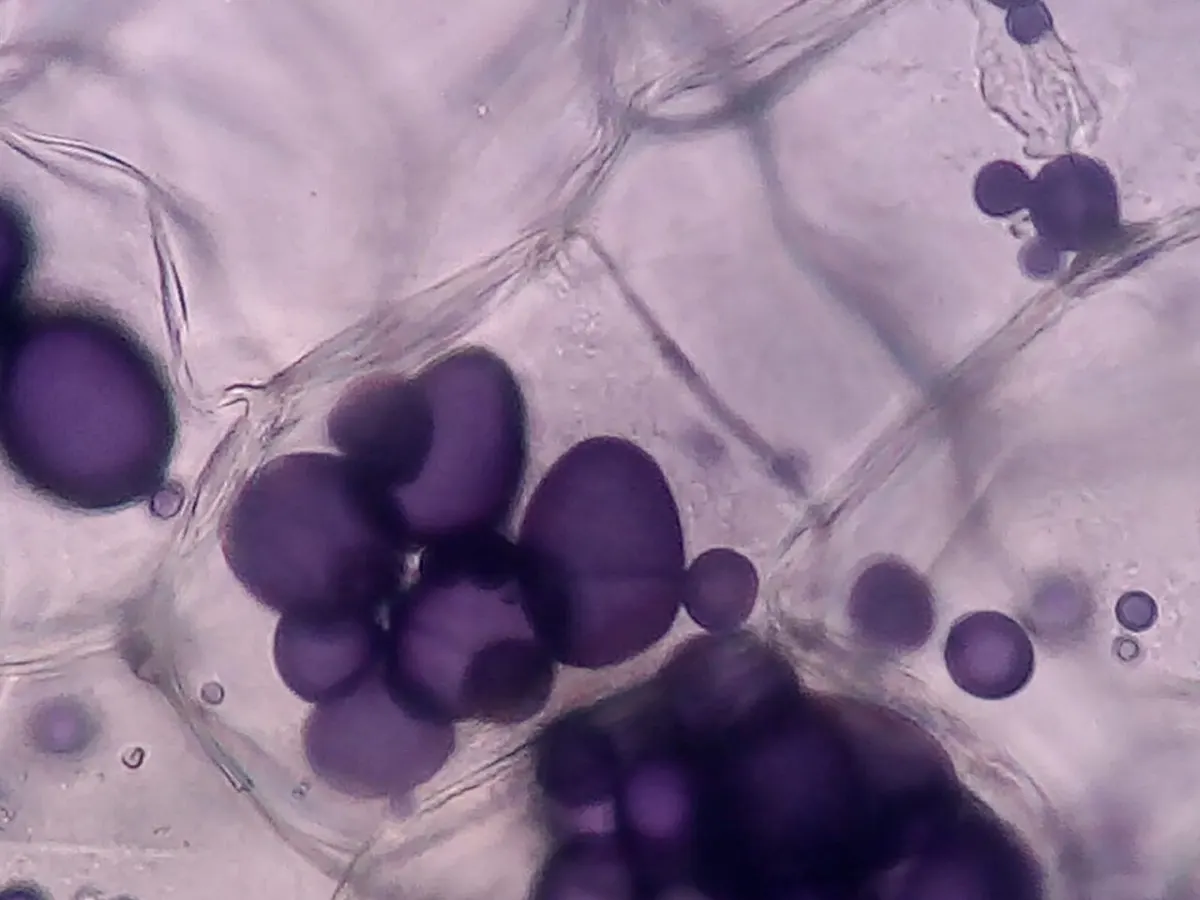
Photo: Ganímedes, CC BY-SA 4.0, source. Resized.

Fats and oils: the energy store
Lipids are organic substances that do not dissolve in water, because their molecules are largely non-polar. You can spot them by the greasy mark they leave on paper and by the way oil floats on water without mixing with it.
Fats and oils are triglycerides: a glycerol molecule joined to three fatty acids. Saturated fatty acids have no double bonds between their carbon atoms; fats rich in them, such as butter and pork fat, are solid at room temperature. Unsaturated fatty acids have one or more double bonds; vegetable oils, rich in them, are liquid.
Triglycerides are the long-term energy store: a gram of fat gives 9 kcal, more than double the 4 kcal of a gram of carbohydrate. In mammals, the fat stored under the skin is also a thermal insulator.
Phospholipids and steroids: membranes and signals
Phospholipids have one part that attracts water (the hydrophilic head, with a phosphate group) and two fatty-acid tails that repel it (hydrophobic). In water they line up in two layers, tails inwards and heads outwards: this lipid bilayer is the basis of every cell membrane.
Steroids have four rings of carbon atoms joined together. The best known is cholesterol, which is part of the membranes of animal cells and from which the body makes hormones (testosterone, oestradiol), vitamin D and bile salts, which are needed to digest fats. The wax that coats leaves and the feathers of some birds is also a lipid, and it repels water.
Worked example
Why the long-term store is fat
An animal has to store 9,000 kcal for a period without food. What would the store weigh if it were all fat, and what if it were all carbohydrate?
Fat: 9,000 kcal ÷ 9 kcal/g = 1,000 g, that is, 1 kg. Carbohydrate: 9,000 kcal ÷ 4 kcal/g = 2,250 g, that is, 2.25 kg.
For the same energy, a carbohydrate store would weigh 2.25 times as much. Glycogen is still useful for energy the body needs quickly: the liver releases glucose from it into the blood, and muscles use it during hard exercise. Fat is the long-term store. The numbers are a worked calculation using the official energy values, not a measurement on a particular animal.
In Romania
Honey, a solution of monosaccharides
Romania is one of the largest honey producers in the European Union, alongside Spain, Hungary, Germany and Italy. The European rules, which also apply to Romanian honey, say what honey must contain to be sold under that name.
Blossom honey must contain at least 60 g of fructose and glucose per 100 g, so it is mostly a mixture of monosaccharides. Sucrose, a disaccharide, may make up no more than 5 g per 100 g; for acacia honey the limit is 10 g. Water may be at most 20%.
A honey label, then, shows the carbohydrate lesson: most of the mass is glucose and fructose, two monosaccharides, and the sucrose in table sugar is exactly these two molecules joined together. Add up the limits and, in a 100 g jar of blossom honey, at least 60 g is monosaccharides and at most 20 g is water.
In short
- Many simple sugars have the general formula (CH₂O)ₙ; the main role of carbohydrates is to supply energy, and some have a structural role.
- Monosaccharides: glucose, fructose, galactose (C₆H₁₂O₆); disaccharides: sucrose (glucose + fructose), lactose (glucose + galactose), maltose (glucose + glucose).
- Storage polysaccharides: starch in plants and glycogen in animals (in the liver and muscles); structural polysaccharides: cellulose in the plant cell wall and chitin in the exoskeleton of arthropods and the cell wall of fungi.
- Lipids do not dissolve in water; triglycerides (glycerol + three fatty acids) are the long-term energy store, with 9 kcal/g against 4 kcal/g for carbohydrates.
- Saturated fats are solid and unsaturated oils are liquid at room temperature; the fat under the skin is also a thermal insulator.
- Phospholipids form the lipid bilayer of membranes; steroids such as cholesterol give rise to hormones, vitamin D and bile salts.
Common mistakes
WrongCellulose has nothing to do with sugar, because it is not sweet.
RightCellulose is a polysaccharide made of thousands of glucose molecules joined in a chain. Polysaccharides are still carbohydrates, even though they do not taste sweet.
WrongAll lipids are fat stores.
RightTriglycerides are an energy store, but phospholipids build membranes, and steroids such as testosterone are hormones.
WrongChitin is a protein, because it makes the hard exoskeleton of insects.
RightChitin is a polysaccharide that contains nitrogen. A supporting role does not decide the chemical group: carbohydrates and proteins can both be structural.
Check yourself
Six questions. For the first five you see the explanation at once, with the paragraph of the lesson that supports it; for the written ones you compare with a good answer.
What is sucrose, table sugar, made of?
Answer
b) Glucose and fructose. Sucrose is a disaccharide of glucose and fructose. Lactose has glucose and galactose, maltose has two glucoses.
Where does the human body store glucose as glycogen?
Answer
c) Mainly in the liver and muscles. Glycogen is the storage polysaccharide of animals. The liver releases glucose from it when blood glucose falls.
Why is sunflower oil liquid and butter solid at room temperature?
Answer
b) Oil has more unsaturated fatty acids, with double bonds. Unsaturated fatty acids have double bonds and give liquid lipids; fats rich in saturated fatty acids are solid.
How many kilocalories does 20 g of fat give?
kcalAnswer
180 kcal. A gram of fat gives 9 kcal: 20 × 9 = 180 kcal.
Choose the main role of each molecule.
Answer
Energy store: Starch in a potato; Glycogen in the liver; Triglycerides in fat tissue.
Structural role: Cellulose in the cell wall; Chitin in a crayfish shell; Phospholipids in a membrane.
Starch, glycogen and triglycerides are stores. Cellulose, chitin and phospholipids build walls, exoskeletons and membranes.
A potato and a pig’s liver both hold glucose stores. Name the polysaccharide in each, and explain why humans can digest the starch in a potato but not the cellulose in its skin, even though both are made of glucose.
A good answer
The potato stores glucose as starch, and the liver stores it as glycogen. Starch and cellulose are made of the same monomer, glucose, but the glucose molecules are joined differently. Humans have enzymes that break the bonds in starch, but no enzymes that break the bonds in cellulose, so cellulose passes through the gut undigested.
A complete answer names starch and glycogen, says that both polysaccharides are made of glucose, and links the difference to the type of bond and to human enzymes.
Terms
- monosaccharide
- A carbohydrate made of a single sugar unit, for example glucose or fructose.
- disaccharide
- A carbohydrate made of two joined monosaccharides, for example sucrose or lactose.
- polysaccharide
- A carbohydrate made of hundreds or thousands of monosaccharides joined in a chain: starch, glycogen, cellulose, chitin.
- glycogen
- The storage polysaccharide of animals and humans, kept mainly in the liver and muscles.
- chitin
- A nitrogen-containing polysaccharide found in the exoskeleton of arthropods and the cell wall of fungi.
- triglyceride
- A lipid made of one glycerol molecule and three fatty acids; the form that fats and oils take.
- phospholipid
- A lipid with a hydrophilic head and two hydrophobic tails, which forms the bilayer of membranes.
- cholesterol
- A steroid in the membranes of animal cells, from which steroid hormones, vitamin D and bile salts are made.
Sources and link to the programme
- OpenStax – Biology 2e, 3.2 Carbohydrates – the formula (CH₂O)ₙ; glucose, fructose, galactose C₆H₁₂O₆; sucrose, lactose, maltose; the bond formed with removal of water; starch, glycogen in the liver and muscles, cellulose (the most abundant natural biopolymer, indigestible for humans), nitrogen-containing chitin
- OpenStax – Biology 2e, 3.3 Lipids – non-polar lipids; triglycerides; saturated and unsaturated fatty acids; insulation; phospholipids and the bilayer; steroids with four rings, cholesterol, hormones, vitamin D, bile salts; waxes
- OpenStax – Biology 2e, 34.2 Nutrition and Energy Production – 4 kcal/g for carbohydrates and 9 kcal/g for fats; glycogen in the liver and muscles; fat stored under the skin, insulation and store
- European Commission – Honey (agriculture) – the EU countries with the largest honey production: Romania, Spain, Hungary, Germany, Italy, Greece, France, Poland
- Council Directive 2001/110/EC relating to honey, Annex II (text on legislation.gov.uk) – fructose + glucose at least 60 g/100 g in blossom honey; sucrose at most 5 g/100 g, 10 g/100 g for acacia (Robinia pseudoacacia); water at most 20%
From the programme: “Water, mineral salts, proteins, carbohydrates, lipids, vitamins, nucleic acids, ATP – main role of each type of substance” (common core). Specific competences addressed: 2.1, 2.2.