Chapter 10 · Humans and the biosphereLesson 10.3
The ecological footprint: footprint and handprint
How many planets would be needed if everyone lived like an ordinary person in Romania?
- Size
- from 6 km to 12,742 km
- Level
- biosphere
- Time
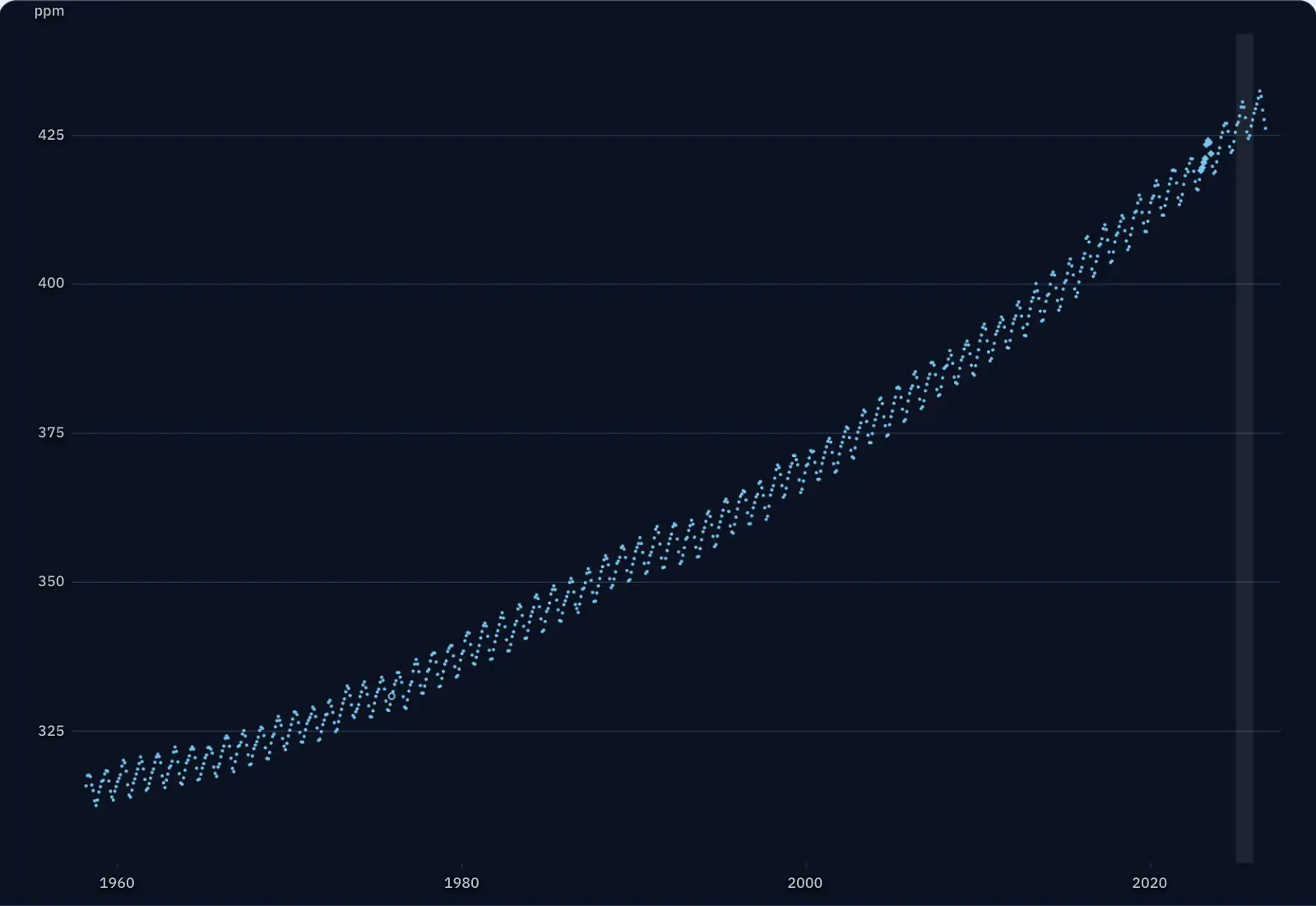
- from 1958 to today
Before you read: what do you think?
If everyone in the world consumed like an average person in Romania in 2023, how many planets like the Earth would humanity need?
See the answer
About two. The ecological footprint of a person in Romania was 3.05 global hectares in 2023, while the Earth could offer only 1.50 global hectares for each person: 3.05 ÷ 1.50 ≈ 2. More than half of Romania’s footprint comes from the forest needed to absorb the CO2 that is emitted and not taken up by the oceans.
In 2026, Earth Overshoot Day fell on 30 July. By that day, humanity had used everything the planet’s ecosystems can regenerate in a whole year. For the rest of the year it lived off stocks: forests felled faster than they grow, fish caught faster than they breed, carbon dioxide piling up in the atmosphere.
The ecological footprint turns consumption into area
The ecological footprint, or footprint for short, is the area of biologically productive land and water that a person, a country or all of humanity needs to produce what it consumes and to absorb the carbon dioxide it emits that the oceans do not take up.
The area is measured in global hectares (gha). A global hectare is a hectare with the planet’s average biological productivity. A hectare of fertile lowland is worth more than one global hectare, and a hectare of desert, less. That is how very different kinds of land can be added together.
The footprint has six components: cropland, grazing land, the forests that supply timber, fishing grounds, built-up land and the forest that would be needed to absorb the CO2 from burning fuels that the oceans do not take up. The last one is called the carbon component. It too is counted in global hectares of forest, not in kilograms of CO2, and it is the largest component in most European countries.
Biocapacity and Overshoot Day
Biocapacity is the productive area available, also in global hectares. In 2023, according to the national ecological footprint accounts (2026 edition), the average footprint of one person was 2.56 gha, while the Earth’s biocapacity was 1.50 gha per person. Humanity therefore used roughly what 1.7 planets would regenerate.
When the footprint is larger than the biocapacity, the difference is called an ecological deficit. Overshoot Day is the date in the year after which humanity’s consumption exceeds what ecosystems can regenerate in that year. The calculation is redone with new data every year, and Global Footprint Network reports that the 2026 date, 30 July, is six days later than the one announced in 2025, mainly because of revised data; the level of overshoot is the highest on record.
For the curious
The ecological footprint does not cover every effect on the environment. Pollution with toxic substances and the loss of species, for example, cannot be turned into hectares and are measured separately.
Handprint: the positive footprint
The handprint (the positive footprint) measures the good effect of an action. The idea was launched in 2007 by India’s Centre for Environment Education, at the fourth UNESCO International Conference on Environmental Education, held in Ahmedabad.
In 2018 the VTT research centre and LUT University in Finland set out the method for carbon: the handprint is the reduction in someone else’s footprint, that of the people who use a product or a service. It is calculated as the difference between the footprint of a baseline, that is, what would have happened without the action, and the footprint after the action. The footprint answers the question “how hard do I press?”, and the handprint, “how much do I ease the pressure of others?”.
How to compare two options fairly
A fair comparison has four conditions: the same unit, the same boundary (the same stages included, from production to disposal), the same service provided and the same period. You do not add kilograms of paper to litres of water, and you do not compare a school year with a week.
An example with figures chosen for the calculation: a class of 28 pupils would buy 28 new atlases in a year. Through a swap with the year above, 22 pupils receive used atlases, and 6 buy new ones. Every pupil still has an atlas, so the service is the same. The handprint of the swap is 28 − 6 = 22 new atlases avoided in that year.
After the swap, the new and used atlases can be counted: these are measurements. The 28 atlases that would have been bought without the swap, however, remain an estimate, because the situation without the swap can no longer be observed. The handprint is therefore calculated from a measurement and an estimate.
Worked example
How many planets for a person in Romania
The data are for 2023: the ecological footprint of a person in Romania, 3.05 gha; Romania’s biocapacity, 2.58 gha per person; the Earth’s biocapacity, 1.50 gha per person.
The number of planets: 3.05 ÷ 1.50 ≈ 2.03. If everyone lived like Romanians, humanity would need about two Earths.
Romania’s ecological deficit: 3.05 − 2.58 = 0.47 gha per person. Romania has a lot of productive land, but its consumption exceeds it.
The carbon share: of Romania’s total footprint of 58.3 million gha, carbon accounts for 31.3 million, that is 31.3 ÷ 58.3 ≈ 54%.
In Romania
Plenty of biocapacity, a large carbon footprint
According to the 2026 edition of the national ecological footprint accounts, published by York University and the Footprint Data Foundation, in 2023 Romania had a biocapacity of 2.58 gha per person, about 1.7 times the world average. Most of it comes from farmland and from forests, which cover almost 7 million hectares.
The average footprint of a person, 3.05 gha, was nevertheless larger than the country’s biocapacity and than the world average of 2.56 gha. More than half of it is the forest needed to absorb the CO2 from energy and transport that the oceans do not take up, and the forests that supply timber make up about a fifth. Global Footprint Network put Romania’s Overshoot Day for 2026 on 19 June, based on the 2025 edition of the accounts, which describes the situation in 2024; with the 2023 values above, the date would come out differently.
In short
- The ecological footprint is the productive area of land and water needed to produce what a population consumes and to absorb the CO2 it emits that the oceans do not take up; it is measured in global hectares.
- Biocapacity is the productive area available; when the footprint exceeds it, there is an ecological deficit.
- In 2023 one person had an average footprint of 2.56 gha, while the Earth offered 1.50 gha per person; in 2026 Overshoot Day fell on 30 July.
- The handprint (the positive footprint) is the reduction in other people’s footprint brought about by an action, compared with a baseline.
- Two options are compared in the same unit, with the same boundary, for the same service and over the same period.
- In 2023 a person in Romania had a footprint of 3.05 gha, against a national biocapacity of 2.58 gha per person; more than half of the footprint is carbon.
Common mistakes
WrongThe ecological footprint shows all my effects on the environment.
RightIt shows only the productive area needed for consumption and for absorbing CO2. Toxic pollution and the loss of species are measured in other ways.
WrongThe handprint means shrinking my own footprint.
RightThe handprint is the reduction in other people’s footprint compared with a baseline, for example the atlases another class no longer has to buy.
WrongIf the new option uses less paper, it is automatically better for the environment.
RightYou have to compare the same service, with the same boundary: if paper is replaced by new devices, these go into the calculation too.
Check yourself
Seven questions. For the first six you see the explanation at once, with the paragraph of the lesson that supports it; for the written ones you compare with a good answer.
What is a global hectare?
Answer
b) A hectare with the planet’s average biological productivity. The global hectare makes it possible to add together land with different productivity.
What is the largest component of Romania’s ecological footprint?
Answer
c) The forest needed to absorb CO2. Carbon accounts for about 54% of Romania’s footprint.
A bicycle repair shop in a town means that 50 people no longer buy new bicycles in a year. What is this effect called?
Answer
c) The shop’s handprint. The shop reduces other people’s footprint, compared with the situation in which they would have bought new bicycles.
Which comparison is fair?
Answer
c) Two options for the same service, in the same unit, with the same boundary and over the same period. The unit, boundary, service and period must be the same.
In 2023 the average ecological footprint of one person was 2.56 gha, and the Earth’s biocapacity 1.50 gha per person. How many planets did humanity need? Round to two decimal places.
planetsAnswer
1.71 planets. 2.56 ÷ 1.50 = 1.7067, or about 1.71 planets.
A class of 30 pupils would buy 30 new workbooks. After a swap with the year above, only 8 pupils buy new workbooks, and the others receive used ones. How many new workbooks did the swap avoid?
workbooksAnswer
22 workbooks. Baseline: 30 new workbooks. After the swap: 8. The handprint: 30 − 8 = 22.
A school wants to replace printed worksheets with new tablets and says this will shrink its ecological footprint. What should a fair comparison include?
A good answer
The same service: every pupil must have the materials. The same period, for example a school year, and the same unit. The same boundary: besides the paper saved, you have to count the making of the tablets, the electricity and what happens to them at the end, spread over the years they are used. The baseline is the paper used until now, and the saving worked out against this baseline remains an estimate, even after the new consumption has been measured.
A complete answer names the service, the period, the unit, the boundary (including the new devices) and the baseline, and separates what can be measured from what remains an estimate.
Practical work for this lesson
- Weigh up the waste problem – Audit of clean materials or case study, 35–45 minutes
- What saving is left once you do the accounting? – A worked classroom calculation, without a personal footprint calculator, 40–50 minutes (CS)
Terms
- ecological footprint
- The productive area of land and water needed to produce what a population consumes and to absorb the CO2 it emits that the oceans do not take up.
- global hectare
- The unit of the ecological footprint: a hectare with the planet’s average biological productivity.
- biocapacity
- The productive area of land and water available, expressed in global hectares.
- ecological deficit
- The amount by which the ecological footprint exceeds biocapacity.
- Overshoot Day
- The date in the year after which humanity’s consumption exceeds what the Earth’s ecosystems can regenerate in that year.
- handprint
- The positive footprint: the reduction in other people’s footprint brought about by an action, compared with a baseline.
- baseline
- What would have happened without the action being assessed; the basis of the comparison.
- boundary
- The set of stages and elements included in a calculation.
Sources and link to the programme
- Earth Overshoot Day – home page (Global Footprint Network) – Earth Overshoot Day 2026: 30 July; the definition of Overshoot Day
- Earth Overshoot Day – Past Earth Overshoot Days – the 2026 date six days later than the 2025 one, mainly because of revised data; the highest level of overshoot on record
- Earth Overshoot Day – Country Overshoot Days 2026 – Romania: 19 June 2026; the countries’ days for 2026 are calculated on the 2025 edition of the accounts and, for most countries, reflect the situation in 2024; the method for calculating a country’s day
- Global Footprint Network – Ecological Footprint – footprint and biocapacity are expressed in global hectares, hectares with world-average productivity
- Global Footprint Network – Glossary – the definitions of biocapacity, the global hectare and the number-of-planets equivalent
- York University / Footprint Data Foundation – National Ecological Footprint and Biocapacity Accounts, Edition 2026 (version 1.0, 22 April 2026, CC BY-SA 4.0) – 2023 (measured data): Romania 3.05 gha consumption footprint and 2.58 gha biocapacity per person; carbon component 31.3 of 58.3 million gha; the carbon component is the forest needed for emissions from fuels, minus the share taken up by the oceans in the same year (columns sheet); world 2.56 gha footprint and 1.50 gha biocapacity per person; definitions of the components; Romania’s 2023 biocapacity by component (cropland 20.7 and forests 21.6 of 49.3 million gha); forest area 6,929,050 ha
- Handprint – Centre for Environment Education (India) – the handprint launched in 2007 by CEE at the fourth UNESCO International Conference on Environmental Education, Ahmedabad
- VTT and LUT – Carbon Handprint Guide (2018) – the carbon handprint is the reduction in customers’ carbon footprint; the difference between the footprints of the baseline system and of the new solution
From the programme: “Climate change – global warming; the ecological footprint – the two perspectives: footprint and handprint (the ecological footprint and the positive ecological footprint)” (common core). Specific competences addressed: 3.1, 3.2, 5.1.