Chapter 3 · The cellLesson 3.6CS
The origin of eukaryotic cells and specialised cells: structure suited to function
Why do the mitochondria in your cells have their own DNA, separate from the DNA in the nucleus?
- Size
- from 5 nm to 100 µm
- Level
- cell
- Time
- a day in the life of a cell
Before you read: what do you think?
The ribosomes in mitochondria and chloroplasts most resemble the ribosomes of:
See the answer
Bacteria. The ribosomes in the cytoplasm of eukaryotic cells are larger (80S), while those in mitochondria and chloroplasts are built like bacterial ribosomes; in chloroplasts they are even the same size, 70S. Viruses have no ribosomes at all. The resemblance is one of the pieces of evidence that these organelles come from bacteria.
In 1967, the American biologist Lynn Margulis published the data behind an unusual idea: mitochondria and chloroplasts were once free-living bacteria. The idea was met with disbelief. Today its core is widely accepted.
Endosymbiotic theory: organelles that were once bacteria
Endosymbiosis is an association in which one organism lives inside another. Endosymbiotic theory says that mitochondria come from an oxygen-consuming bacterium that came to live inside another cell, and chloroplasts from a photosynthetic cyanobacterium. Over time, the two cells became a single organism.
No cell “decided” to swallow a bacterium. The cells that kept one had an advantage, and their descendants multiplied. The oldest fossils that might be eukaryotes are about 2.1 billion years old; chloroplasts appeared later, 1–1.5 billion years ago.
The evidence
Mitochondria and chloroplasts have their own circular DNA, like that of bacteria. They have their own ribosomes, built like bacterial ones and unlike the 80S ribosomes in the eukaryotic cytoplasm. In chloroplasts they are 70S, as in bacteria; in human mitochondria they are smaller, about 55S. They are surrounded by two membranes; the inner one resembles the membrane of a bacterium. The inner membrane of the mitochondrion forms folds called cristae, and in the chloroplast the inner membranes form flattened sacs, thylakoids, arranged in stacks called grana. They multiply by splitting in two, as bacteria do, and arise only from other mitochondria or chloroplasts. The human mitochondrial genome was read in full in 1981: it has 16,569 base pairs.
The organelles can no longer live on their own. Over time, many of the original bacterium’s genes moved into the nucleus of the host cell.
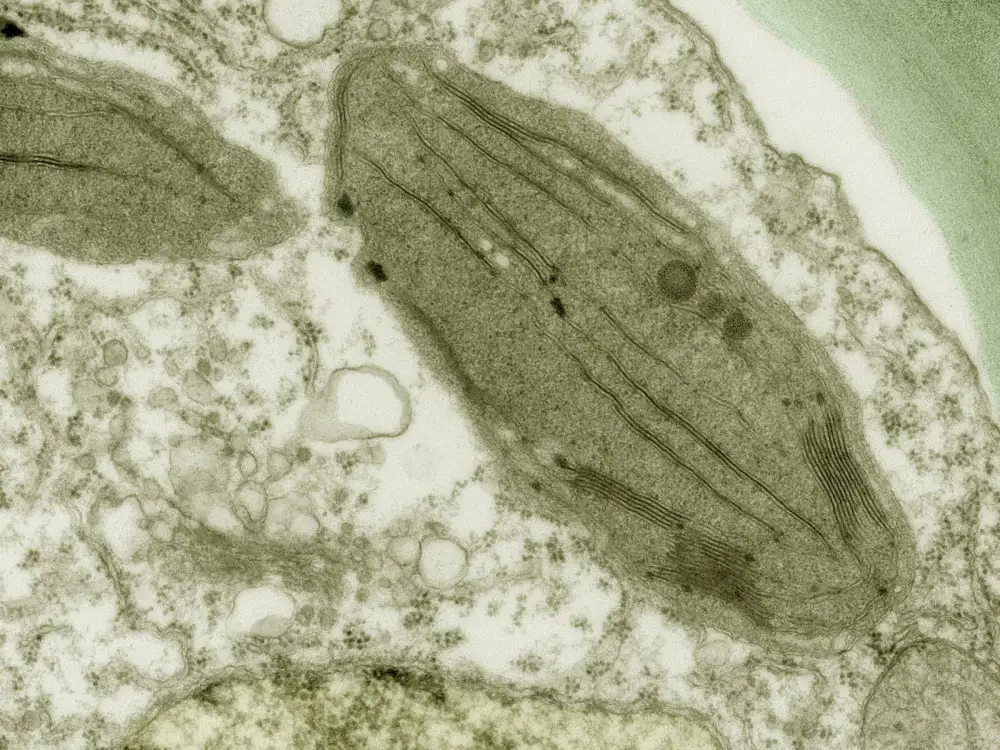
Photo: Kevin Mackenzie, University of Aberdeen (Wellcome Collection B0009849), CC BY 4.0, source. Resized.
What is still being researched: the host cell
The cell that took in the bacterium was related to the archaea, prokaryotes distinct from bacteria: the genes in the eukaryotic nucleus that copy and read DNA most resemble those of archaea. In 2020, after more than a decade of work, Japanese researchers managed to grow in the laboratory an archaeon of the Asgard group, taken from mud on the sea floor. It is a cell about 550 nm across, with no organelles. The exact order in which the nucleus, the mitochondria and the other compartments appeared is still being researched.
Specialised cells: shape suited to function
In plants, the photosynthetic (assimilation) cells of the leaf, arranged in a palisade, are elongated, packed tightly side by side and full of chloroplasts. The conducting cells of the xylem are dead at maturity and have thick, lignified walls: they form tubes through which water rises. Epidermal cells protect the leaf, and pairs of guard cells open and close each stoma. Secretory cells have a well-developed endoplasmic reticulum and Golgi apparatus.
In vertebrates, epithelial cells cover surfaces and line organs, in one or more layers. Muscle cells are elongated and contract. The neuron has extensions: the dendrites receive signals, and the axon transmits them. Connective tissue cells are embedded in a substance they produce themselves, such as the matrix of bone.
Reproductive cells are specialised too. Many fungal spores have tough walls and spread easily. The sperm cell has a flagellum, and the egg cell is a large cell with reserves for the start of development. In flowering plants, the male reproductive cells reach the ovule through the pollen tube.
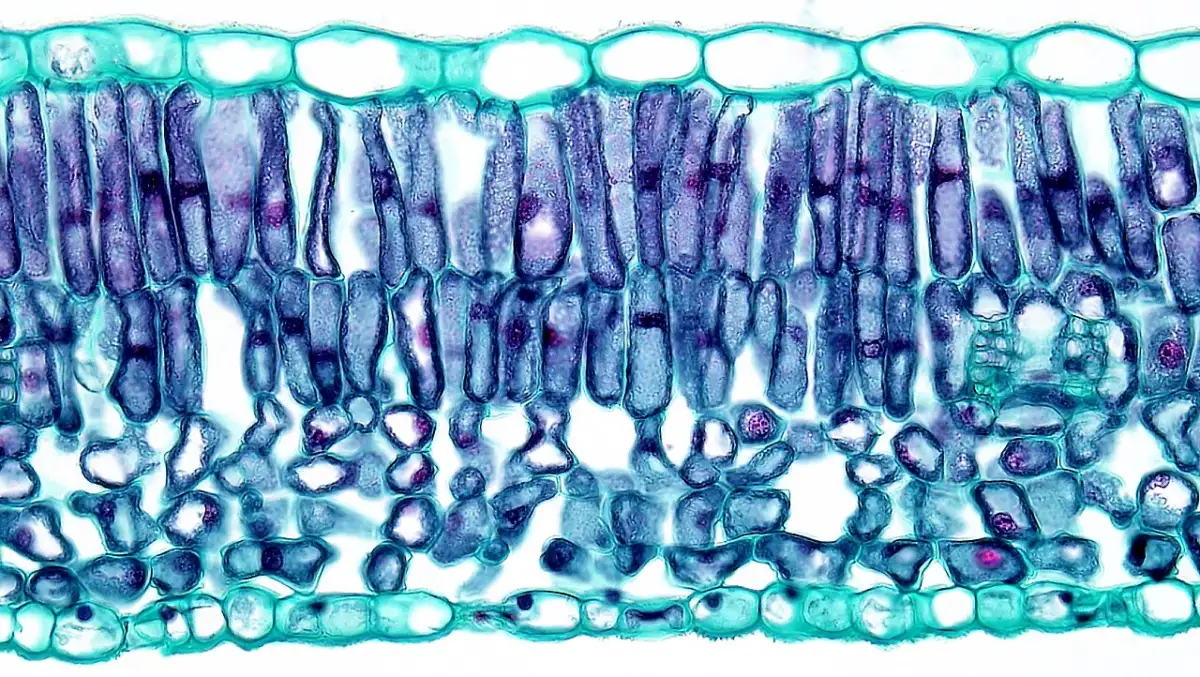
Photo: Berkshire Community College Bioscience Image Library, CC0 1.0, source. Resized.

Worked example
Recognise the cell by its structure
Three cells are described on a worksheet. Cell A has a lot of rough endoplasmic reticulum and a large Golgi apparatus. Cell B has dozens of chloroplasts and is column-shaped. Cell C has a body with a nucleus and several extensions, one of them very long.
A: the rough reticulum has ribosomes that make proteins, and the Golgi apparatus packs them into vesicles. Likely function: protein secretion, as in a gland. B: chloroplasts carry out photosynthesis, and the column shape packs them tightly under the light. Likely function: photosynthesis (assimilation), in the palisade of the leaf. C: the extensions carry signals over a distance. Likely function: a neuron.
Structure suggests function but does not prove it on its own; a reliable identification requires knowing which organism and which tissue the cell comes from.
In Romania
Beech leaves in the old-growth forests
Since 2017, several beech forests (Fagus sylvatica) in Romania have been on UNESCO’s World Heritage List, among them the old-growth forests of Slătioara and Șinca and the forests of the Nera Gorges–Beușnița. They show how beech recolonised Europe after the last ice age, without human intervention.
The same beech tree grows sun leaves, at the top of the crown, and shade leaves, with different structures. The difference is set in the bud, the summer before: at the beginning of August, buds in the light have five layers of cells that will divide and form the inside of the leaf, and buds in the shade have four. A beech that has grown up in shade, if moved into full light before July, forms buds of sun leaves.
All the leaves have the same DNA. Their structure differs according to the conditions in which the bud formed, the summer before.
In short
- Endosymbiotic theory says that mitochondria come from oxygen-consuming bacteria and chloroplasts from cyanobacteria, both of which came to live inside another cell.
- The evidence: their own circular DNA, ribosomes similar to bacterial ones, two membranes, multiplication by splitting in two, a bacterial-type genome.
- The organelles can no longer live on their own, because many of their genes have moved into the nucleus.
- The host cell was related to the archaea; the exact order of events is still being researched.
- Specialised cells have a structure suited to their function: photosynthetic cells with many chloroplasts, dead xylem vessels with thick walls, neurons with extensions, elongated muscle cells.
- Reproductive cells are specialised too: fungal spores with tough walls, the sperm cell with a flagellum, the large egg cell with its reserves.
Common mistakes
WrongA cell decided to swallow a bacterium to get energy.
RightCells do not decide. Some cells kept the bacteria inside them, and these cells had an advantage and multiplied more.
WrongIf a mitochondrion has its own DNA, it can also live outside the cell.
RightMany of the genes the mitochondrion needs have moved into the nucleus, so the organelle can no longer live on its own.
WrongAll the cells of a plant have chloroplasts.
RightChloroplasts are plentiful in the photosynthetic cells of the leaf. Xylem cells are dead at maturity, and root cells hidden in the soil do not carry out photosynthesis.
Check yourself
Seven questions. For the first six you see the explanation at once, with the paragraph of the lesson that supports it; for the written ones you compare with a good answer.
What does endosymbiotic theory state?
Answer
b) Mitochondria and chloroplasts come from bacteria that came to live inside another cell. The theory explains the origin of mitochondria (from oxygen-consuming bacteria) and of chloroplasts (from cyanobacteria).
Which observation is NOT evidence that mitochondria have a bacterial origin?
Answer
d) They are found in large numbers in muscle cells. The large number of mitochondria in muscle reflects the cell’s need for energy, not the origin of the organelle. The other three are evidence of bacterial origin.
Why can a mitochondrion taken out of the cell not survive, even though it has its own DNA?
Answer
b) Because many of the genes it needs have moved into the nucleus. Over time, many genes of the original bacterium moved into the host’s nucleus; the organelle depends on the proteins made from these genes.
Match each structure with the function it serves.
Answer
Transport or conduction: Xylem vessel, dead at maturity, with thick walls; The axon of a neuron.
Photosynthesis: Palisade cell, full of chloroplasts.
Movement or contraction: Elongated muscle cell; Sperm cell with a flagellum.
The xylem vessel conducts water, the axon conducts signals, the palisade carries out photosynthesis, and the muscle fibre and the flagellum produce movement.
On the same beech tree, sun leaves and shade leaves have different structures. What explains the difference?
Answer
b) The conditions in which the bud formed, the summer before. All the leaves of a tree have the same DNA; the structure of a leaf is set in the bud, according to the conditions of the previous summer.
A cell has a lot of rough endoplasmic reticulum and a large Golgi apparatus. What is its most likely function?
Answer
a) Protein secretion. The rough reticulum makes proteins, and the Golgi apparatus packs them into vesicles for export. A reliable identification needs other data too.
A classmate says endosymbiotic theory is “just a guess”. Use two pieces of evidence to explain why biologists consider it well supported, and name a question that remains open.
A good answer
Mitochondria have their own circular DNA, like bacteria, and ribosomes similar to bacterial ones, unlike the 80S ribosomes of the cytoplasm. Like bacteria, they multiply by splitting in two, and they have two membranes. Several independent lines of evidence point to the same origin. What remains open is the exact order in which the nucleus and the mitochondria appeared in the host cell related to the archaea.
A good answer gives at least two concrete pieces of evidence, explains that they support one another, and separates what is established from what is still being researched.
Terms
- endosymbiosis
- An association in which one organism lives inside another.
- endosymbiotic theory
- The theory that mitochondria and chloroplasts come from bacteria that came to live inside another cell.
- archaea
- Prokaryotes distinct from bacteria, related to the host cell from which eukaryotes arose.
- epithelial cells
- Cells that cover the surfaces of the body and line organs, in one or more layers.
- muscle cells
- Elongated cells specialised for contraction.
- neuron
- A nerve cell with dendrites, which receive signals, and an axon, which transmits them.
- connective tissue cells
- Cells embedded in a substance they produce, which support and bind other tissues.
Sources and link to the programme
- OpenStax – Biology 2e, 23.1 Eukaryotic Origins – Lynn Margulis, endosymbiotic theory, the 1967 data, the initial resistance and today’s acceptance; mitochondria from alphaproteobacteria, chloroplasts from cyanobacteria; circular DNA, prokaryotic-type ribosomes, two membranes, division as in bacteria, arising only from existing organelles; transfer of genes to the nucleus and inability to live independently; possible eukaryote fossils 2.1 billion years old; the Archaeplastida endosymbiosis 1–1.5 billion years ago; replication and expression genes related to those of archaea
- OpenStax – Biology 2e, 4.3 Eukaryotic Cells – the mitochondrion with two membranes, its own ribosomes and DNA, the inner membrane with cristae; the chloroplast with thylakoids stacked in grana, and stroma
- OpenStax – Microbiology, 3.4 Unique Characteristics of Eukaryotic Cells – 80S ribosomes in the eukaryotic cytoplasm and prokaryotic-type (70S) ribosomes in mitochondria and chloroplasts, as the textbook form
- Anderson S. et al. (1981) – Sequence and organization of the human mitochondrial genome, Nature 290: 457–465 – the human mitochondrial genome read in full in 1981: 16,569 base pairs
- RNA Biology (2021) – Maintaining mitochondrial ribosome function: the role of ribosome rescue and recycling factors (PMC) – in mammals, the mature mitochondrial ribosome has a sedimentation coefficient of 55S
- Wernegreen J. J. (2004) – Endosymbiosis: lessons in conflict resolution, PLoS Biology (PMC) – endosymbiosis: one partner lives inside the host; the relationship can be mutualistic or parasitic
- Imachi H. et al. (2020) – Isolation of an archaeon at the prokaryote–eukaryote interface, Nature 577 – the culture of the Asgard archaeon Prometheoarchaeum syntrophicum from deep-sea sediment, after more than a decade of isolation work; a cell of about 550 nm, with no organelles
- OpenStax – Biology 2e, 30.4 Leaves – palisade parenchyma with column-shaped, tightly packed cells, in one, two or three layers; the epidermis; guard cells that open and close the stoma
- OpenStax – Biology 2e, 30.2 Stems – tracheids and xylem vessel elements conduct water, are dead at maturity and have lignified walls
- OpenStax – Biology 2e, 33.2 Animal Primary Tissues – epithelial, connective (living cells and matrix), muscle and nervous tissues; the neuron with dendrites that receive and an axon that transmits impulses
- Wikipedia – Ancient and Primeval Beech Forests of the Carpathians and Other Regions of Europe – the 2017 extension with forests in Romania (Slătioara, Șinca, Nera Gorges–Beușnița and others); beech forests undisturbed since the last ice age
- Eschrich W., Burchardt R., Essiamah S. (1989) – The induction of sun and shade leaves of the European beech (Fagus sylvatica L.): anatomical studies, Trees 3: 1–10 – the primordia of sun and shade leaves in beech buds differ from the beginning of August: five layers of meristematic mesophyll cells in the sun leaf, four in the shade leaf; shade trees moved into full light before July form buds of sun leaves (from the abstract)
From the programme: “The origin and diversity of eukaryotic cells”; “Components of the cell – structural details and functions”; “The correspondence between the morphology and structure of eukaryotic cells and their functions: e.g. secretory, conducting, protective, assimilation cells etc. in plants; epithelial, muscle, nerve and connective cells in vertebrates; reproductive cells in fungi, plants and animals” (specialism, Natural Sciences). Specific competences addressed: 1.1, 2.1, 2.2.