Port Said
Port Said opens the route at the Mediterranean. The line in this drawing shows the order of places, not a measured canal centreline.17
Sea passage · Egypt
Two seas, one waterline, no locks.
The pilot raises a hand. The bow enters a dark strip of water; sandy banks slide slowly along the hull.7
Route schematic, not to scale.
Before the modern cut
On the schematic, the waterway leaves the Nile, crosses Wadi Tumilat, and runs down towards the Red Sea. It follows a different route: it does not trace the modern canal or cut directly between the Mediterranean and Red Sea.14
Herodotus says Necho II began the work, then stopped before its end. A stela of Darius I, from the late sixth century BCE, commemorates a Nile–Red Sea link. Ptolemaic, Roman, and Amr ibn al-ʿĀṣ phases followed; the records do not prove one waterway kept open without interruption.234
Some summaries name Senusret III as builder. The evidence here does not support treating that attribution as settled. On the sketch, the lines stop where the certainty stops. Many centuries later, excavation begins along a different line at Port Said.41
25 April 1859 — Port Said
At Port Said, 25 April 1859: the first cut opens the bank for the modern canal. The Compagnie universelle du canal maritime de Suez, led by Ferdinand de Lesseps, starts the site. Early excavation leans heavily on corvée: Egyptian fellahin forced to work.15
Political and legal changes in 1863–64 curtail corvée. Paid labour and mechanical excavation, including steam dredgers, take a growing share of the work. The BnF catalogue lists the Lesseps papers; the Compagnie archive leaves another documentary trace. Two dates outlast the site: first the waters join, then the guests arrive.156
Under the Compagnie universelle du canal maritime de Suez.1
Political and legal changes curtail forced labour; mechanical excavation expands.15
The canal authority dates the joining of the seas to this day.1
Two dates in 1869
The waters join on 18 August 1869. Three months later, on 17 November, the imperial yacht L’Aigle carries Empress Eugénie and de Lesseps in the inaugural procession.19
The ship's name is easy to hear as Aida. Verdi's opera was not performed at the canal opening: Aida premiered in Cairo in December 1871. Leave the procession on the bank and follow one ship south through the lakes.910
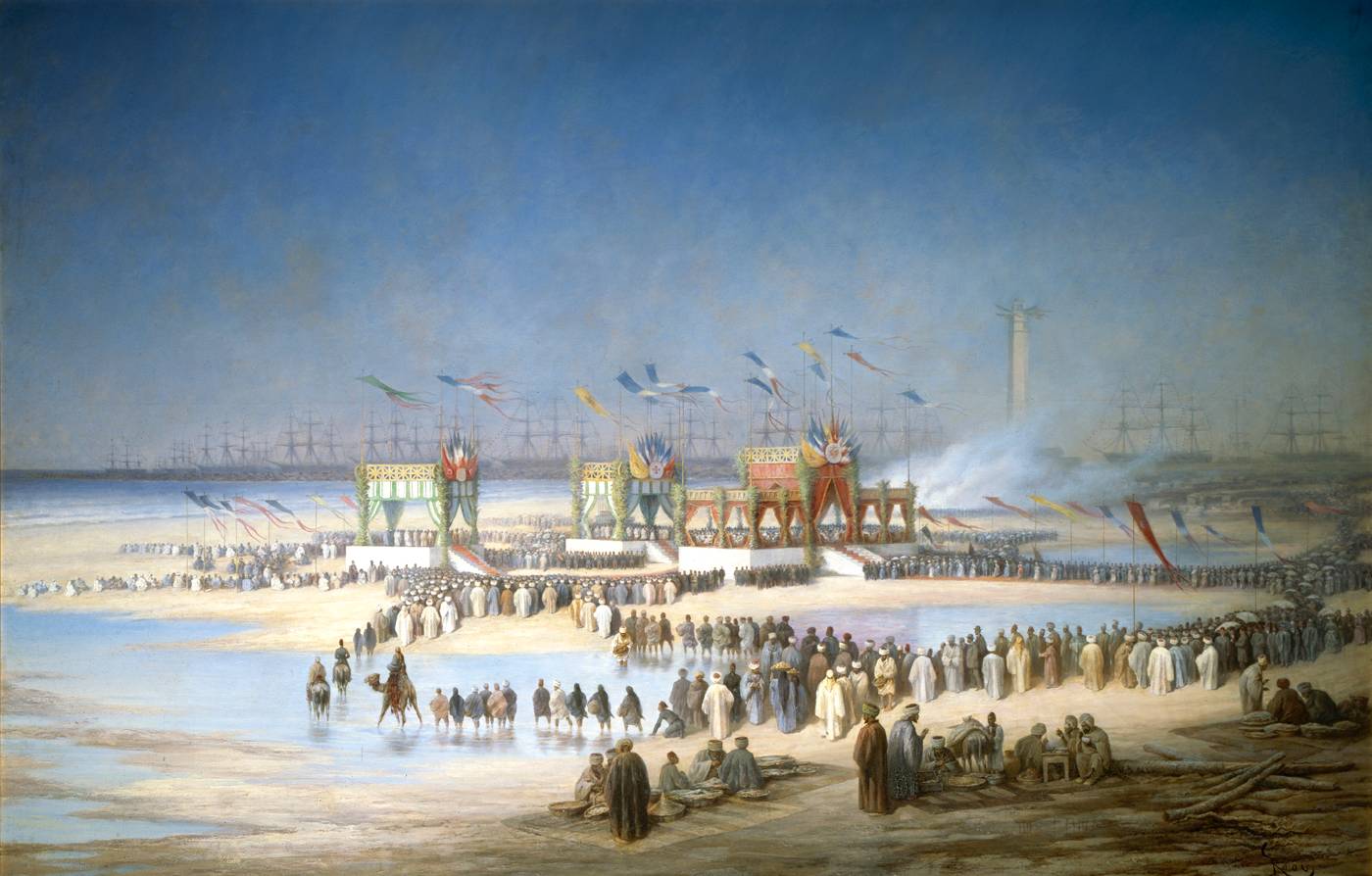
Image: Édouard Riou · 1869 · Public domain · Wikimedia Commons
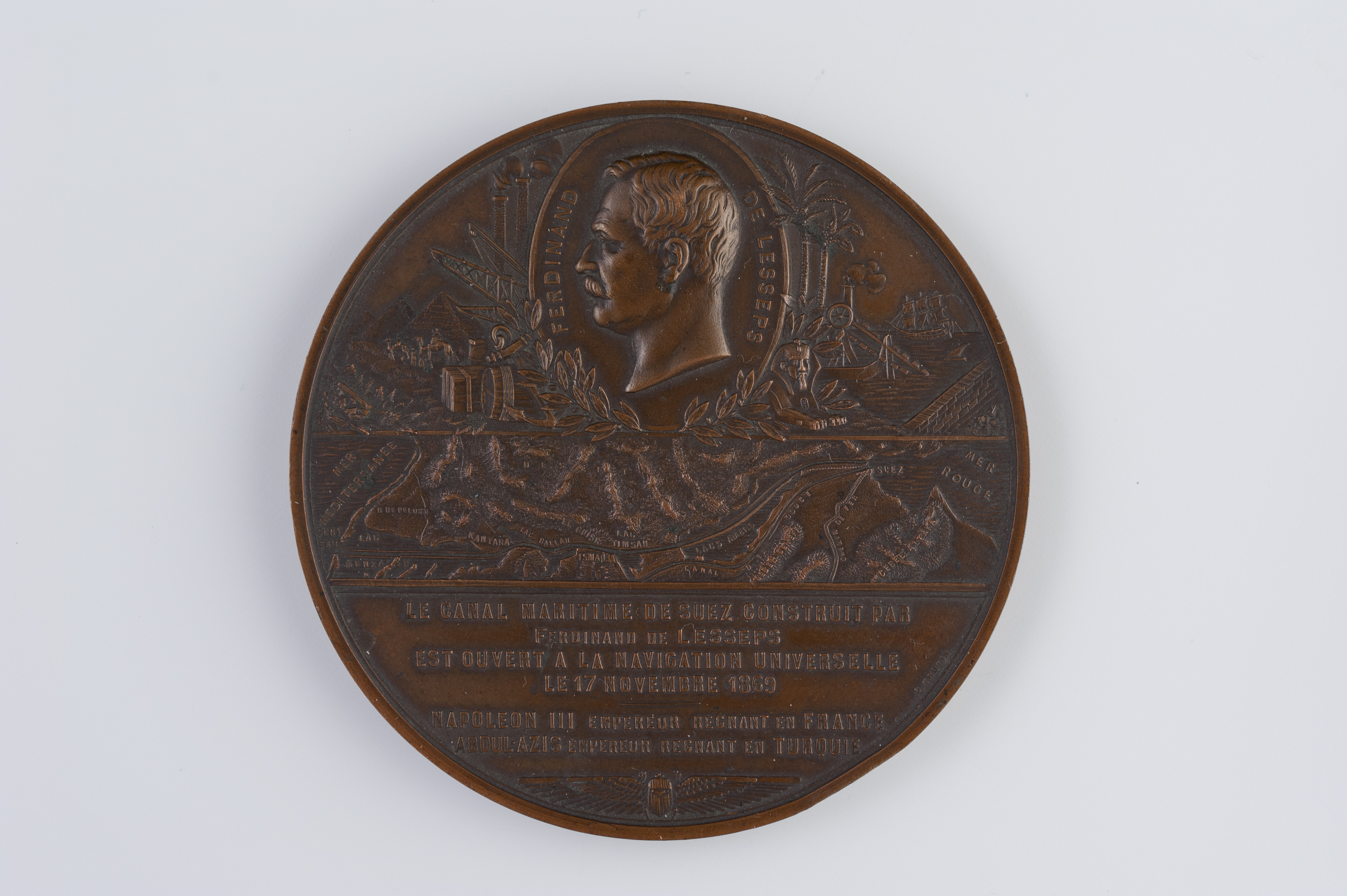
Image: Charles Trotin · c. 1869 · CC0 1.0 · Wikimedia Commons
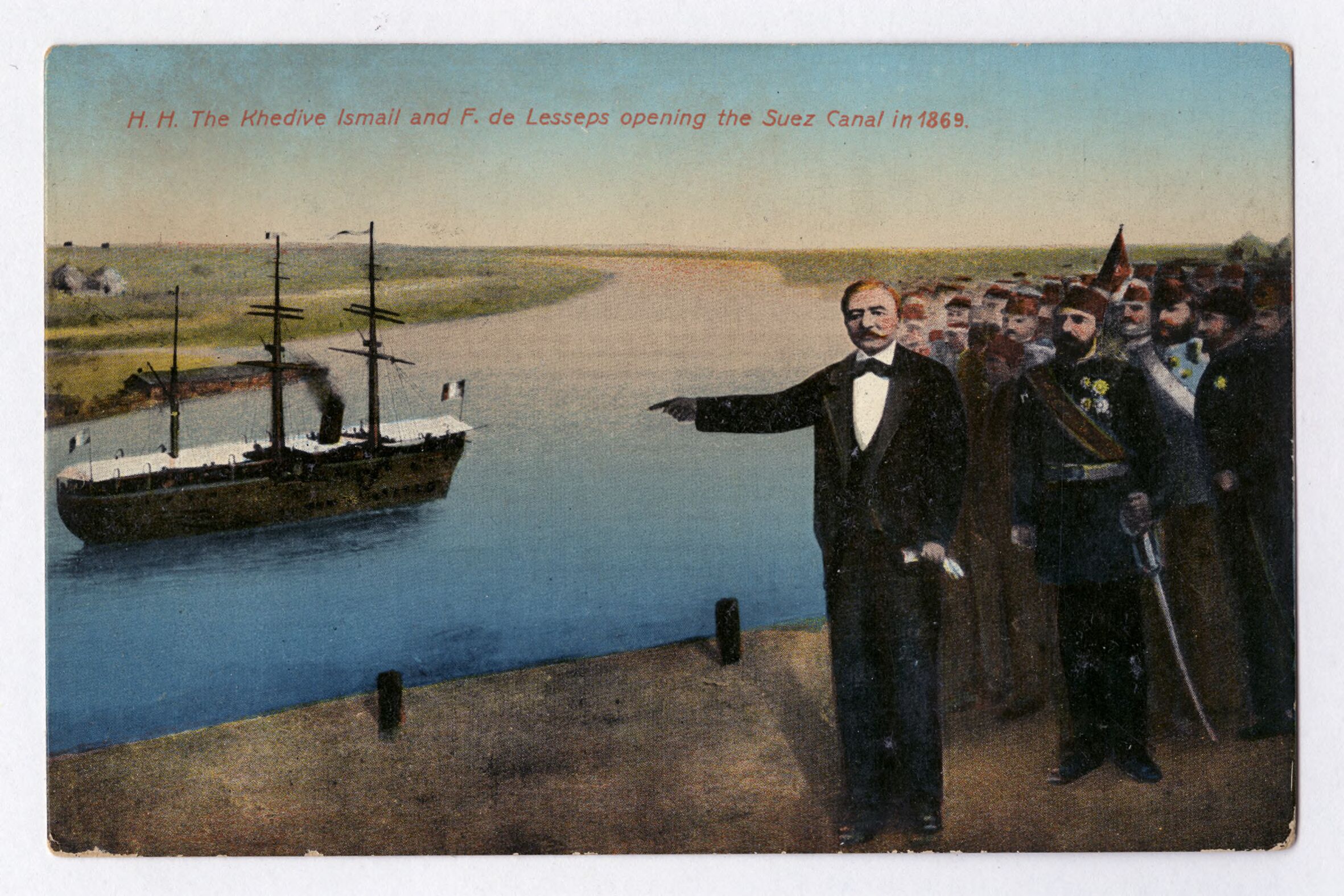
Image: C. Andreopoulos · undated · digitized 24 February 2025 · Public domain · Wikimedia Commons
Port Said → Great Bitter Lakes → Suez
Three stops on a schematic: the northern entrance, the central basin, the southern exit to the Red Sea. Scroll; the ship moves with each step.
Port Said opens the route at the Mediterranean. The line in this drawing shows the order of places, not a measured canal centreline.17
The canal crosses natural lakes connected to this navigation system. The water widens; the lakes are not locks and do not close the ship's path.7
At Suez the route reaches the Red Sea. No lock gates stand between the two seas: the modern canal stays at sea level. The line looks unchanged; the panel’s figures show how the canal has shifted.7
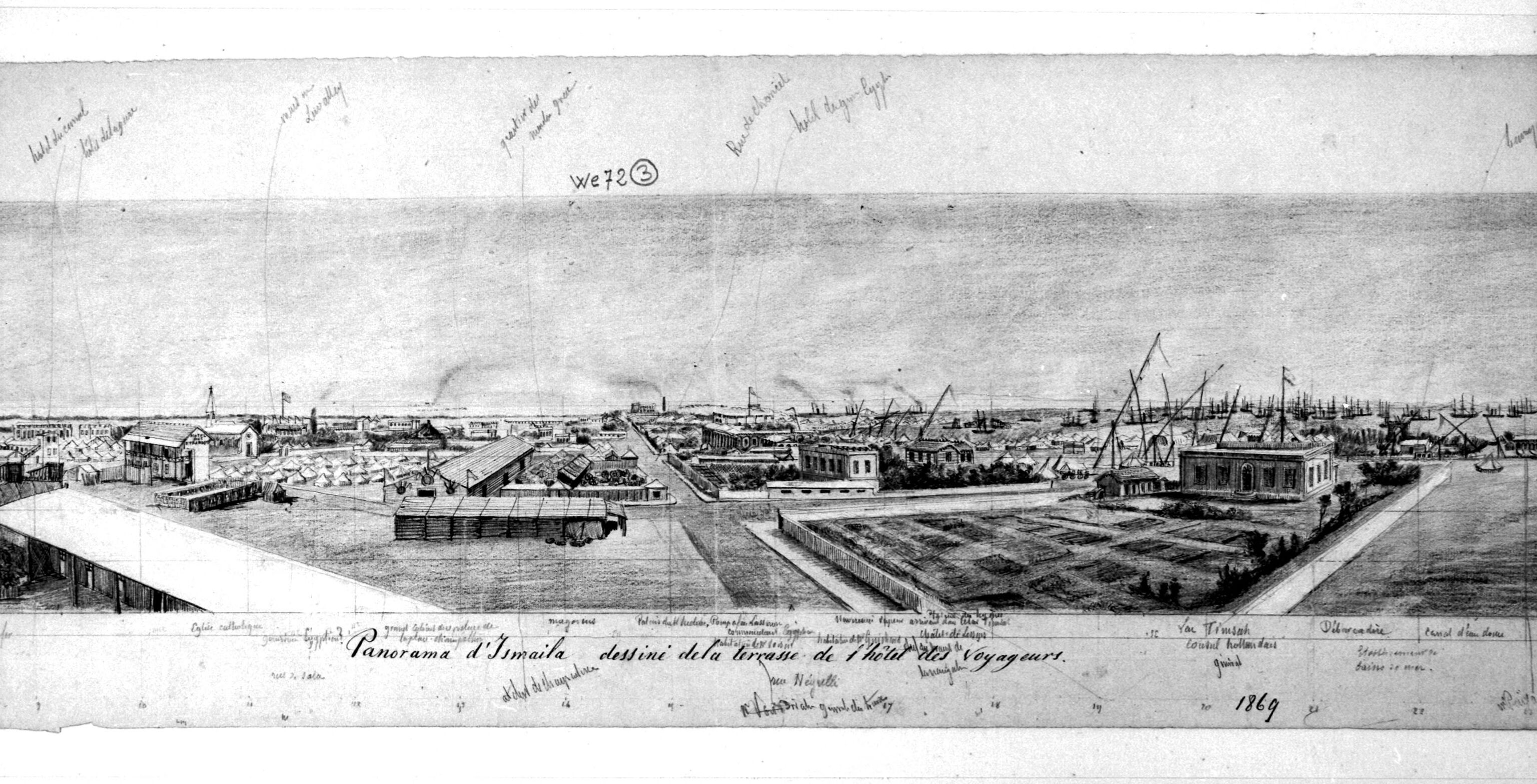
Image: François Edmond Pâris · 1869 · Public domain · Wikimedia Commons
SCA measurements
On the table, 52 m sits beside “surface width”. Start by separating length, water depth, and width: the SCA historical table gives about 164 km, 8 m, and 52 m for the 1869 canal.7
SCA now lists a maximum water depth of 24 m. Permitted draft can reach 66 ft, subject to vessel category and navigation rules. These are different measures: the canal bed and a ship's keel do not sit at the same level. Beyond depth and width sits another question: who owns the company that operates the route?78
Water depth is not a ship's draft. Current rules permit up to 66 ft draft, depending on vessel category and navigation conditions; the staged table's 240,000 DWT capacity is also conditional.
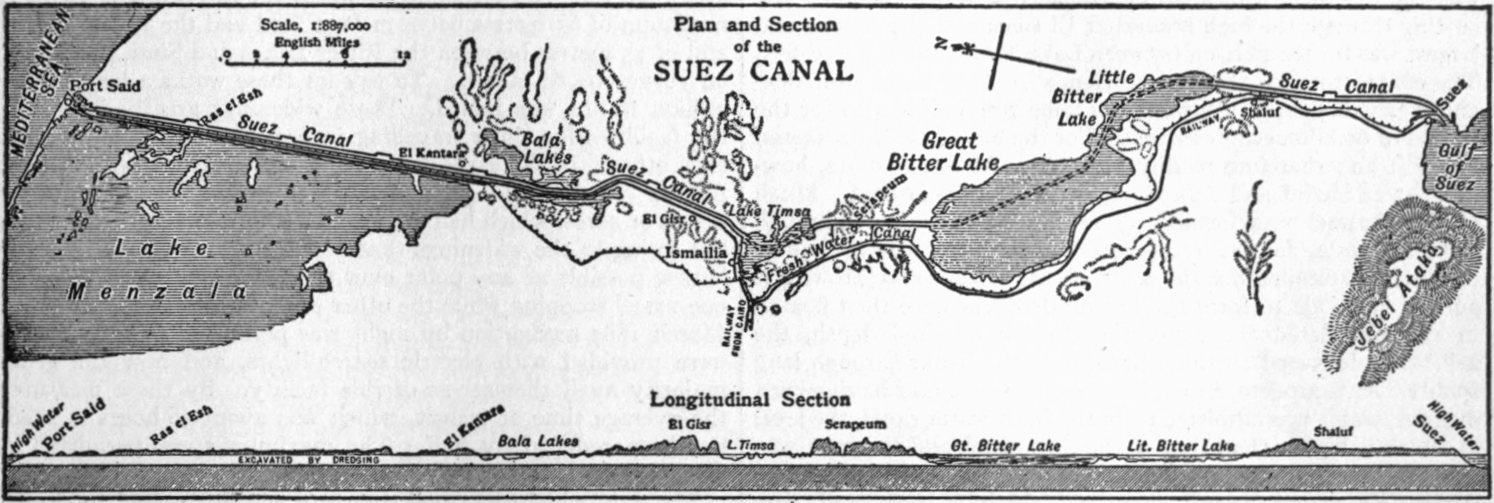
Image: Emery Walker · 1911 · Public domain · Wikimedia Commons
26 July 1956
On 26 July 1956, Nasser announces the nationalization of the Suez Canal Company. The decree transfers the operator, its assets, and its obligations to the Egyptian state. Its subject is the company and what it owns and owes; it does not describe a transfer of foreign sovereignty over the canal.1415
Israel enters Sinai on 29 October; British and French military action follows. The ceasefire takes effect on 6 November. British and French forces withdraw by 22 December, and Israel's withdrawal ends in March 1957. After obstructions are cleared, full traffic resumes on 10 April. A decade later, hostilities close the same route again.1516
1967–1975
Fourteen ships sit in the Great Bitter Lake. A fifteenth, stranded in Lake Timsah, enters the wider count of vessels trapped by the hostilities.1718
Mines, wrecks, and damage hold the canal closed for almost eight years. Clearance begins in 1974. On 5 June 1975, Sadat reopens it. Fourteen in the lake; fifteen in the wider count. The boundary changes the total. Decades later, dredgers return for the works of 2015.11718
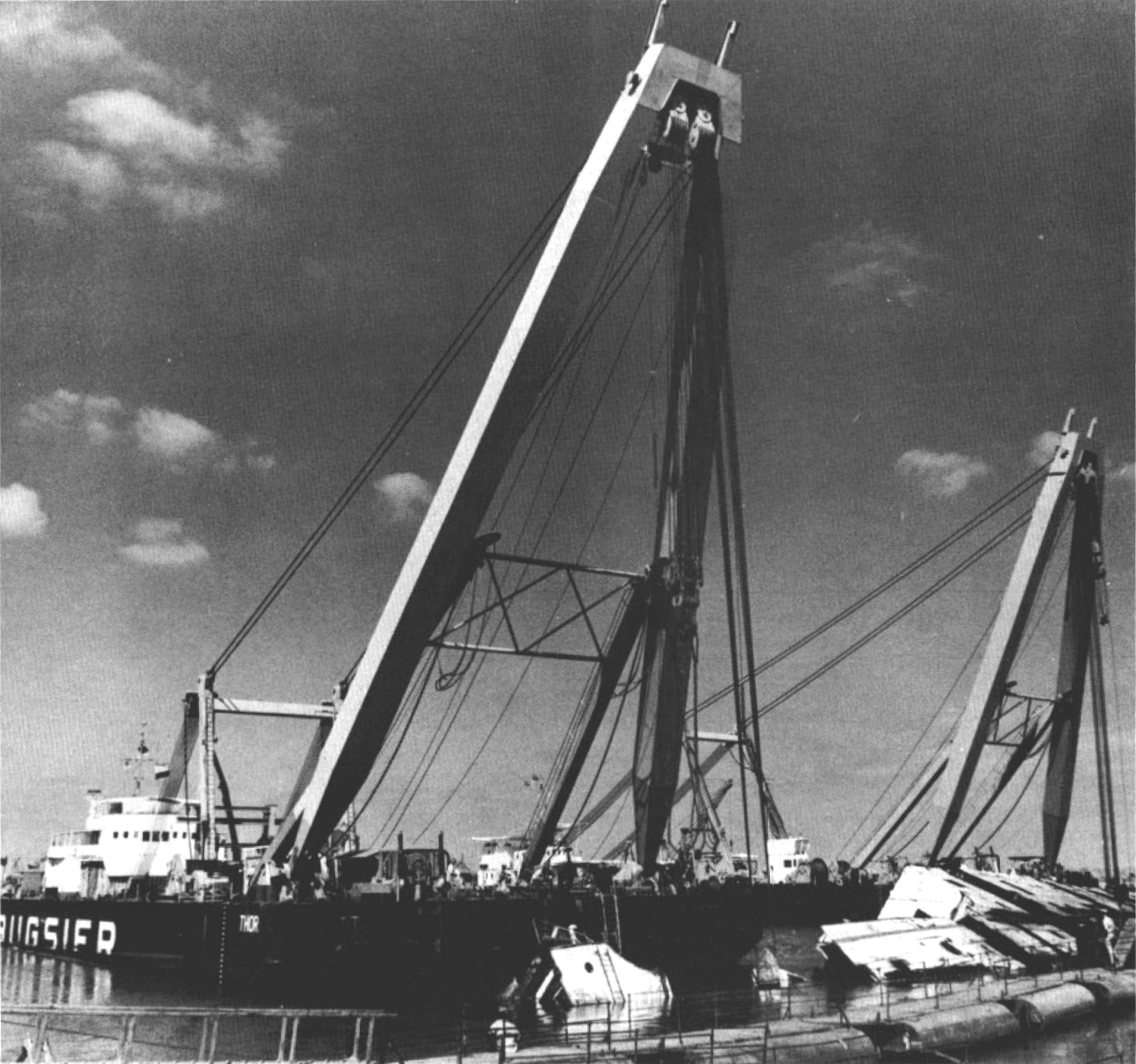
Image: U.S. Navy · 1974 · Public domain · Wikimedia Commons
6 August 2015
On the chart, a new route runs beside the old one. The 2015 works include 35 km of new parallel channel and 37 km of widening or deepening on existing bypasses.192021
Project promotion set a target of 97 ships a day by 2023. SCA's report for that year counts 26,434 transits: an average of 72.4 a day. The published target and the traffic achieved belong on separate lines. In 2021, one vessel stops the canal; freeing it does not immediately reopen both directions.1922
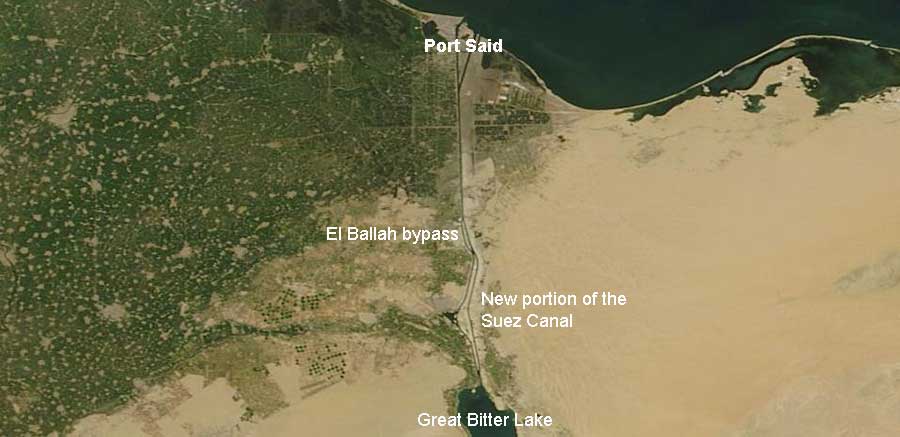
Image: NASA · 18 December 2016 · Public domain · Wikimedia Commons
23–31 March 2021
On 23 March 2021, a 400 m vessel runs aground in the channel. Ever Given floats again on 29 March; only on 31 March does SCA announce two-way navigation.252630
SCA initially sought up to $916 million, then said it had reduced its demand to $550 million. A settlement was signed when the ship was released on 7 July; the final amount was not disclosed. Neither demand is a verified payment.2728
UNCTAD's estimates of the canal's share of world trade and seaborne container trade use different denominators. They do not measure the value of stopped cargo or an economic loss bill. Past the queue, the annual ledger follows traffic on its own calendar.2922
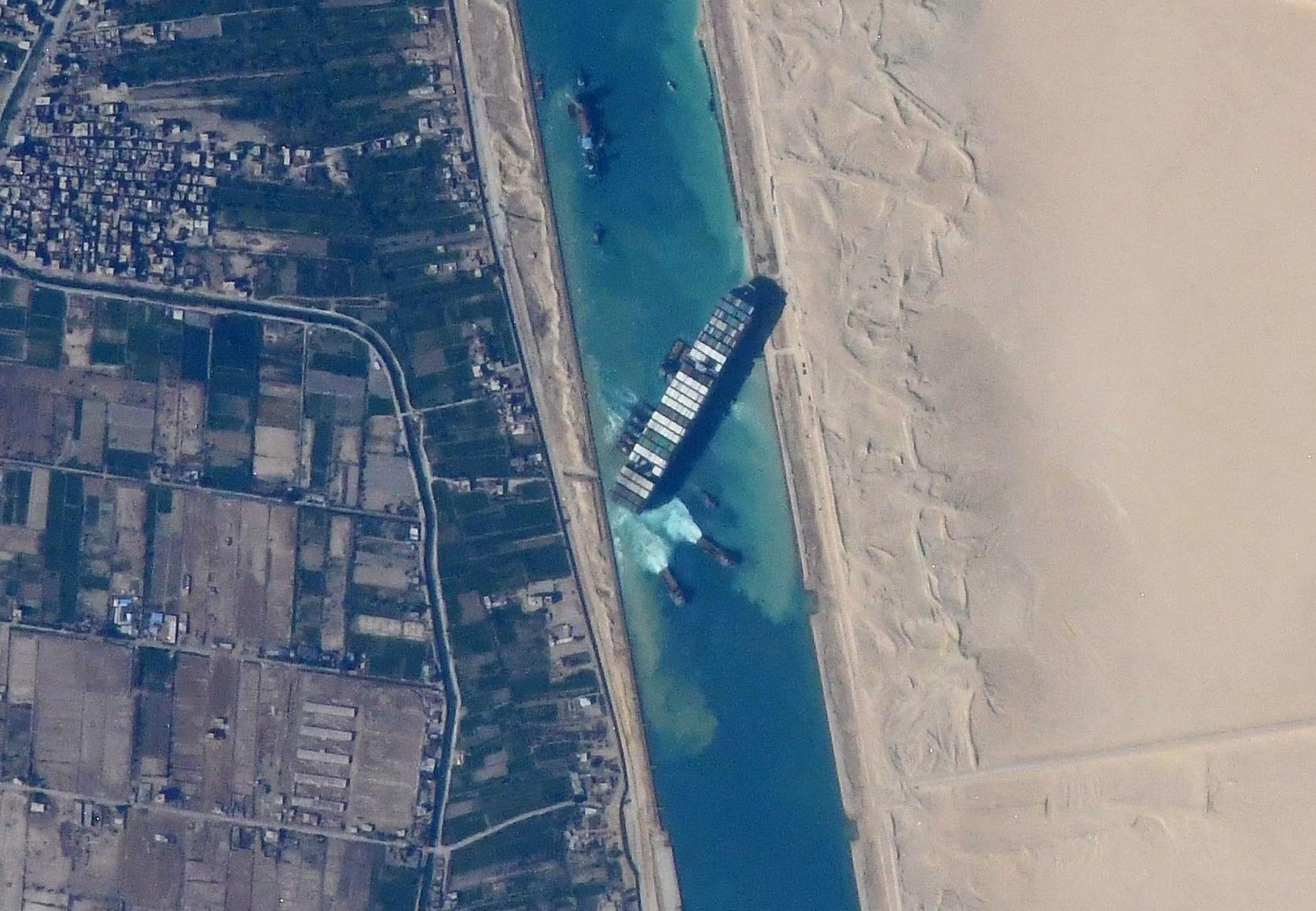
Image: NASA Johnson Space Center · 27 March 2021 · Public domain · Wikimedia Commons
A dated measure and its denominator
The chart opens three full years: 2023, 2024, and 2025. SCA counts 26,434, 13,213, and 12,758 transits in its annual report. Net tonnage, cargo tonnage, and ship counts each measure something different; keep the period and denominator beside the figure. The records behind each comparison follow below.22
Records and measures
Each claim links to its supporting record. The notes give the period behind statistics, identify contemporary accounts, and explain differences in measurement.