Chemistry 9 RO
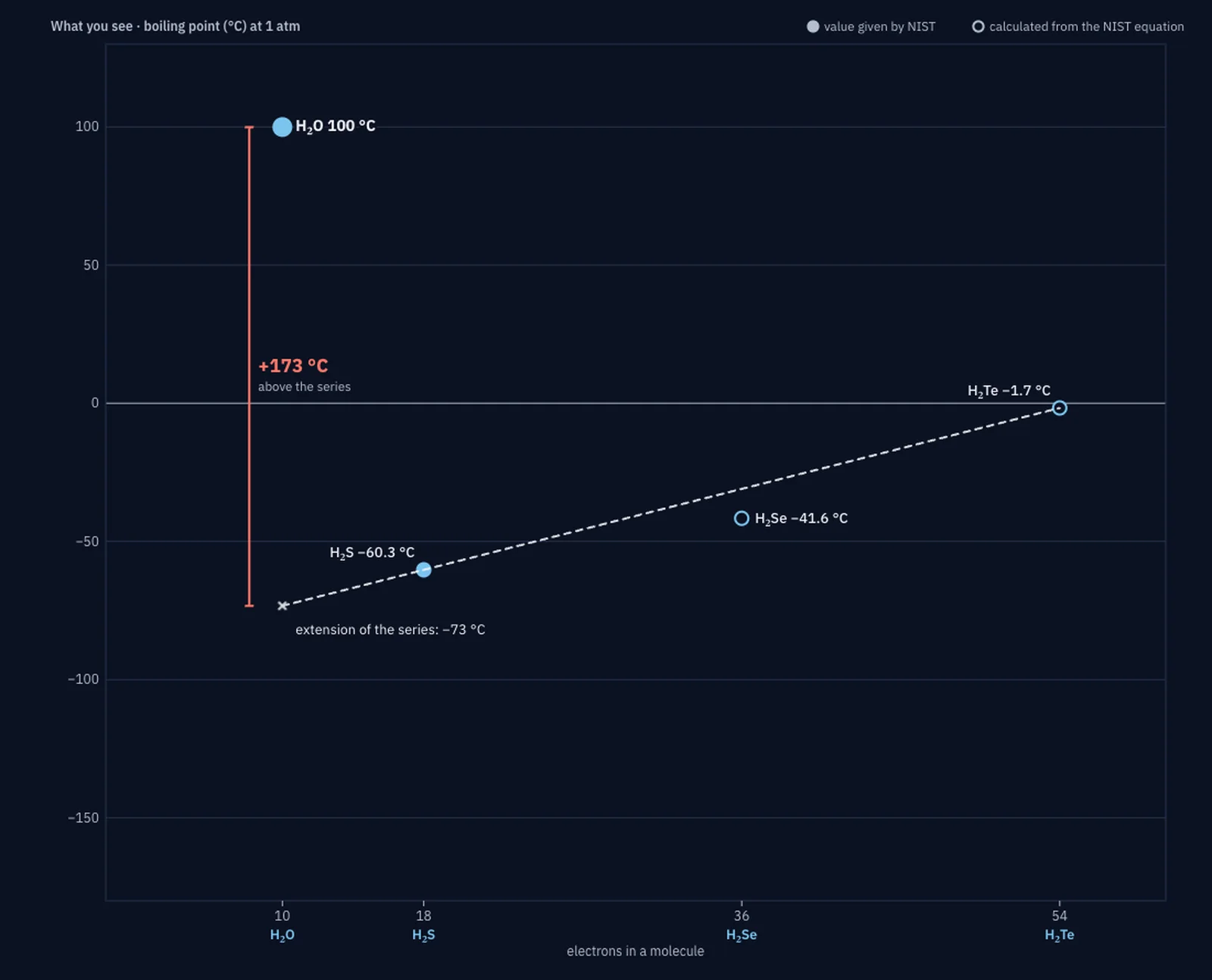
A graph on a dark background: the number of electrons along the horizontal axis, the boiling point up the vertical axis. Three points, H₂S at <span class="n">−60.3 °C</span>, H₂Se at <span class="n">−41.6 °C</span> and H₂Te at <span class="n">−1.7 °C</span>, rise towards the right; water has its own column, with a point far higher, at <span class="n">100 °C</span>, and a dashed line showing where it would have been on the series.

Intermolecular interactions

Chapter 8

Between molecules – why water boils at 100 °C

Why does water boil at 100 °C when its molecules are so small?

Three hydrides from the same family, H₂S, H₂Se and H₂Te, boil at temperatures that rise in order. Water, H₂O, is the fourth in the family, but its place on the graph is empty. Choose where you think it boils, then compare with the measurement. The difference between the two shows what holds water molecules together.

H₂S, H₂Se and H₂Te boil higher and higher, along an almost straight line

The number of electrons in the molecule runs along the horizontal axis; the temperature at which the substance boils at normal pressure runs up the vertical axis. H₂S boils at −60.3 °C, H₂Se at −41.6 °C and H₂Te at −1.7 °C. In this series, the more electrons a molecule has, the stronger the London forces between the molecules.

Water has only 10 electrons, fewer than any of them. Where should it boil, if it followed the series? Drag the point on the H₂O column or choose a zone.

Water boils at 100 °C, which is 173 °C above the extension of the series

The dashed line is a calculation: it joins H₂S and H₂Te and continues down to 10 electrons. The slope is about 1.63 °C per electron, and water has eight electrons fewer than H₂S, so the line gives −73 °C.

The measured value is 100 °C. The difference is 100 − (−73) = 173 °C, almost three times the whole range covered by the three hydrides. The white bar on the graph is your choice, if you made one.

Water does not follow the series. The reason lies in the way the molecules hold on to one another.

Water molecules hold on to one another through hydrogen bonds

A hydrogen bonded to oxygen carries a partial positive charge (δ+), and the neighbouring oxygen has lone pairs with a partial negative charge (δ−). The hydrogen attracts the pair: this is the hydrogen bond, written O–H···O and drawn with dots. The O–H bond inside the molecule is drawn as a line.

The average energy of an O–H bond is about 464 kJ/mol, that of a hydrogen bond about 20 kJ/mol, about 23 times weaker. When water boils, the attractions between molecules break; the molecules stay whole, and the vapour is still H₂O.

Ammonia and hydrogen fluoride stand out from the series like water; methane does not

The same calculation, for three more groups: the line passes through the lightest and the heaviest hydride of period three or higher and is extended down to ten electrons.

NH₃ boils at −33.3 °C, 65 °C above its line, and HF at 19.5 °C, 116 °C above. In both, the hydrogen is bonded to a very electronegative atom (nitrogen, fluorine) and hydrogen bonds form.

CH₄ boils at −161.5 °C, 40 °C below the SiH₄–GeH₄ line. The hydrogen in methane is bonded to carbon, so only London forces act between the molecules. The line is a simple model, and the point for methane falls below it.

The extension of the series predicts −73 °C for water: a gas at 20 °C

A substance that boils below 20 °C, at normal pressure, is a gas at room temperature. H₂S, at −60.3 °C, is a gas. On the extension of the series, water would boil at −73 °C.

So the extension predicts a gas at 20 °C. Measured, with its hydrogen bonds, water is liquid between 0 °C and 100 °C, at 1 atm. The extension is a simple calculation, not a measurement; it shows how much the attractions between molecules matter.

In ice, the same bonds make an open network: 0.917 g/cm³

At 0 °C, ice has a density of 0.917 g/cm³ and liquid water 0.9998 g/cm³. The same mass takes up about 9% more volume as ice: 100 g of ice take up 109 cm³, while 100 g of liquid water take up 100 cm³.

In ice, hydrogen bonds hold the molecules in rings of six, with empty space in the middle. In liquid water, the bonds break and re-form all the time, and the molecules come closer. That is why ice floats. The diagram shows a single ring, in one plane.

Now you explain: ethanol or dimethyl ether?

Ethanol and dimethyl ether have the same formula, C₂H₆O. Which boils higher? Look at where the hydrogens sit in each molecule.

Lesson on the hydrogen bond, with the worked example of ethanol and the ether
Lesson on boiling points and solubility

Measurements, calculation and diagram. The filled points are boiling points given by NIST at normal pressure. The points with an empty ring are calculated from the vapour-pressure equation that NIST fitted to old measurements (Stull, 1947); for H₂Te, PH₃, AsH₃, GeH₄ and HI the temperature falls at most half a kelvin outside the range of the equation. The dashed line and the difference are a calculation: the line passes through the lightest and the heaviest hydride of the group with period three or higher, and is extended down to ten electrons. The molecules are a diagram without a scale: atoms have no colour, and they are drawn greatly enlarged and far fewer than in reality. For SnH₄ and SbH₃ NIST gives no boiling point, so they are missing.

Sources and credits. Values quoted from: NIST Chemistry WebBook, SRD 69 (National Institute of Standards and Technology), pages consulted in 2026 and listed under Sources (the boiling points; the density of liquid water, from the fluid properties). Ethanol and dimethyl ether: PubChem (NIH), compounds 702 and 8254. Density of ice: PubChem, compound 962. Average O–H bond energy: OpenStax, Chemistry 2e, section 7.5.

The same data, as a table
Measurements: boiling points at 1 atm (NIST)
SubstanceGroupElectronsBoils at, °CHow it was obtained
H₂O1610100NIST fluid properties
H₂S1618−60.3given by NIST
H₂Se1636−41.6calculated from the NIST equation
H₂Te1654−1.7calculated from the NIST equation (0.46 K outside its range)
NH₃1510−33.3NIST fluid properties
PH₃1518−87.3calculated from the NIST equation (0.15 K outside its range)
AsH₃1536−61.9calculated from the NIST equation (0.15 K outside its range)
HF171019.5given by NIST
HCl1718−84.8calculated from the NIST equation
HBr1736−66.5calculated from the NIST equation
HI1754−34.6calculated from the NIST equation (0.42 K outside its range)
CH₄1410−161.5NIST fluid properties
SiH₄1418−111.5calculated from the NIST equation
GeH₄1436−88.8calculated from the NIST equation (0.04 K outside its range)
Calculation: the line through the hydrides of period three or higher, extended down to ten electrons
GroupThe line passes throughValue of the line at 10 electrons, °CMeasured, °CDifference, °C
16H₂S and H₂Te−73100+173
15PH₃ and AsH₃−99−33.3+65
17HCl and HI−9619.5+116
14SiH₄ and GeH₄−122−161.5−40
The final case and ice
SubstanceBoils at / density
ethanol, CH₃CH₂–OH78.2 °C
dimethyl ether, CH₃–O–CH₃−24.8 °C
ice at 0 °C, density0.917 g/cm³
liquid water at 0 °C, density0.9998 g/cm³

With 10 electrons, water boils at 100 °C, which is 173 °C above −73 °C, the value of the line through H₂S and H₂Te. Average O–H bond energy: 464 kJ/mol; one hydrogen bond: about 20 kJ/mol.

Lessons of the chapter

Lessons: 1 lesson TC, 3 lessons MI, 1 lesson SN. The badge of each lesson says which profile it belongs to.

Which profile are you on?

  1. 8.1Why chlorine is a gas, bromine a liquid and iodine a solid MI · beyond your profileDipole–dipole attraction, hydrogen bond, London (dispersion) forcesChlorine, bromine and iodine are made of similar molecules. Why is one a gas, another a liquid and the third a solid?
  2. 8.2Why a snowflake has six points MI · beyond your profileDipole–dipole attraction, hydrogen bond, London (dispersion) forcesA snowflake has six points, and liquid water boils at 100 °C, even though its molecules are small. What special attraction exists between water molecules?
  3. 8.3Why water boils at 100 °C and H₂S at −60 °C MI · beyond your profileThe influence of intermolecular interactions on melting point, boiling point and solubilityHydrogen sulfide, H₂S, has larger molecules than water, yet it boils at −60 °C and water at 100 °C. What determines how high a substance’s boiling point is and what dissolves in what?
  4. 8.4Why ice floats and lakes freeze from the top TC · beyond your profilePhysical properties of waterFor almost every substance, the solid sinks in its own liquid. Ice floats on water. What makes water special, and what are the consequences?
  5. 8.5Why 50 mL of ethanol and 50 mL of water make less than 100 mL SN · beyond your profileSolubility of methanol, ethanol and sucrose in water; physical properties of waterMix 50 mL of ethanol with 50 mL of water: do you get 100 mL? And why do ethanol, methanol and sugar dissolve in water, while oil does not?

Test tomorrowten questions from chapter 8For the class: projector, sheets, shared test