Stoichiometric calculations
Chapter 12
Chemistry problems – how much really reacts and how much you get
How much really reacts, and how much do you get?
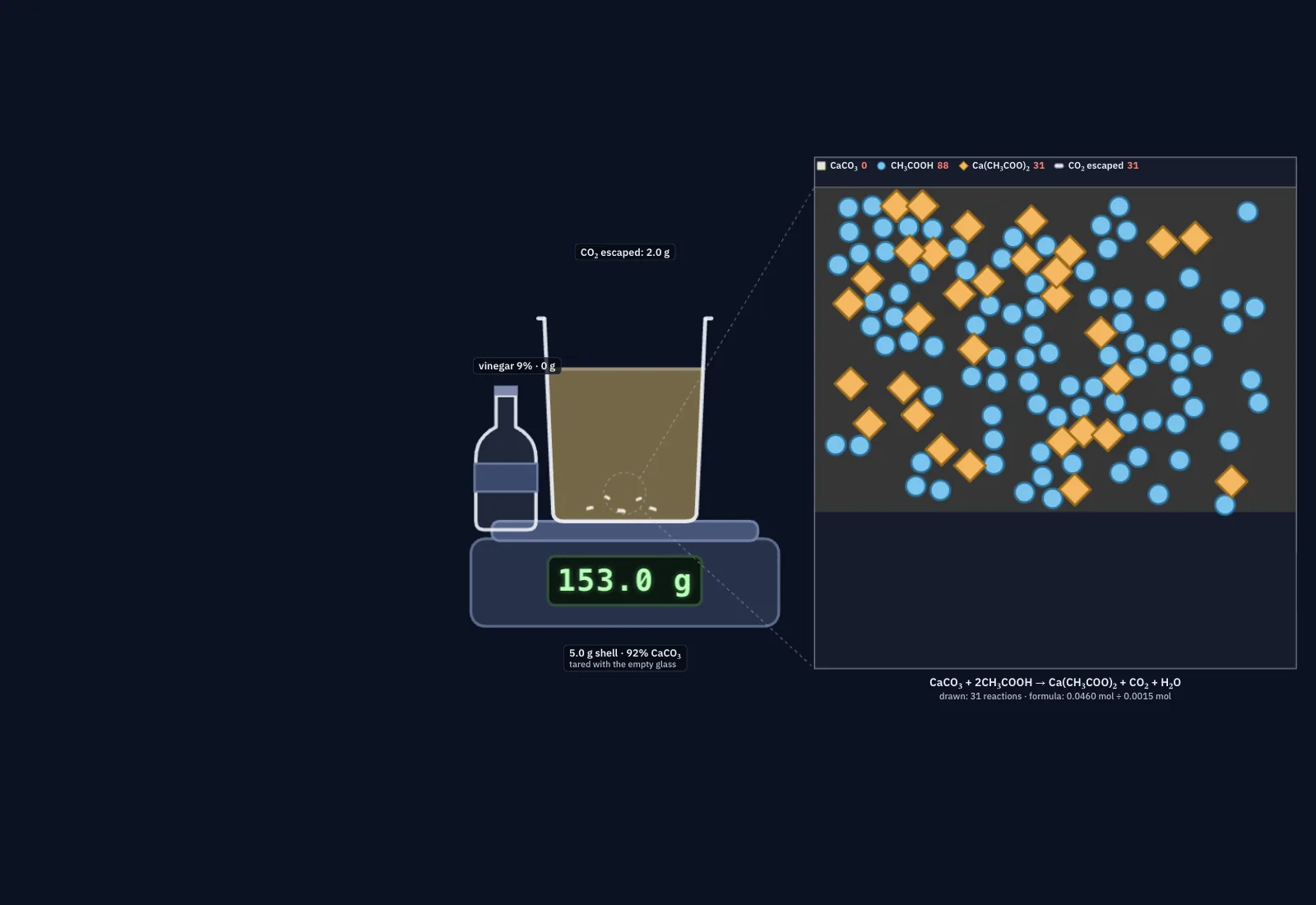
Pour vinegar on eggshell and bubbles appear. If the glass stands on a balance, the reading falls. The picture beside shows the glass and the balance on the left and, on the right, the particles in the glass, counted. Start with a prediction, then pour.
A glass, a balance and an eggshell
An empty glass stands on a kitchen balance, tared: it reads zero. In the glass are 5 g of eggshell broken into pieces, and beside it stands a bottle with 150 g of vinegar. For the calculation, the vinegar has 9% acetic acid by mass; labels in shops say “9%” or “9 degrees”.
You pour all the vinegar on the shell and wait until no more bubbles can be seen. The mass put on the balance is 155 g. What does the balance read at the end?
The balance reads 2.0 g less than you put on
What you see. Bubbles leave the liquid and are lost in the air, and the reading on the balance drops from 155 g to 153.0 g.
What the particles do. In the window on the right, each reaction between one CaCO₃ particle and two CH₃COOH particles makes one CO₂ particle, which leaves the glass. The particles that have left have mass, and their mass is missing from the balance.
The mass has not vanished: of the 155 g, 2.0 g are now in the air. The 153.0 g is a calculation; if some of the CO₂ stays dissolved, the real drop is smaller.
You can see the same thing at home, with a glass, table vinegar, an eggshell broken into pieces and a kitchen balance. Wash your hands afterwards.
The equation says how many particles go into each reaction
How it is written. The balanced equation of the reaction:
CaCO₃ + 2CH₃COOH → Ca(CH₃COO)₂ + CO₂ + H₂O
The coefficients give the ratio in which particles react: one CaCO₃ particle takes two CH₃COOH particles. In the window, one drawn particle stands for 0.0015 mol.
Ten grams of vinegar contain 10 · 9 ÷ 100 = 0.9 g of acetic acid, that is 0.9 ÷ 60 = 0.015 mol, so 10 particles. They make five reactions: five particles of CaCO₃ and 10 particles of CH₃COOH disappear, five particles of Ca(CH₃COO)₂ appear and five particles of CO₂ leave.
From moles to grams: 0.046 mol of CO₂ weigh 2.0 g
How it is written. The shell: 5 · 92 ÷ 100 = 4.6 g of CaCO₃. M(CaCO₃) = 40 + 12 + 3 · 16 = 100 g/mol, so n = 4.6 ÷ 100 = 0.046 mol.
The mole ratio CaCO₃ : CO₂ is 1 : 1, so n(CO₂) = 0.046 mol. M(CO₂) = 12 + 2 · 16 = 44 g/mol, so m = 0.046 · 44 = 2.024 g ≈ 2.0 g.
Check: 4.6 g of CaCO₃ and 5.52 g of acid are used up, 10.12 g in all; 7.268 g of Ca(CH₃COO)₂, 2.024 g of CO₂ and 0.828 g of H₂O are formed, again 10.12 g.
With 10 g of shell, the mass of CO₂ doubles: 4.0 g.
With less vinegar, the acid runs out, not the shell
With only 30 g of vinegar poured: md = 30 · 9 ÷ 100 = 2.7 g of acid, that is 2.7 ÷ 60 = 0.045 mol.
Compare n ÷ coefficient. Acid: 0.045 ÷ 2 = 0.0225. CaCO₃: 0.046 ÷ 1 = 0.046. The smaller value marks the limiting reactant, the one that runs out first: here it is the acid. 0.0235 mol of CaCO₃ is left unreacted from the shell, and the pieces can be seen in the glass.
The drop on the balance is 0.0225 · 44 = 0.99 g ≈ 1.0 g, so the balance reads 34.0 g.
After 61 g of vinegar, the mass of CO₂ that escapes stops growing
The shell runs out when the acid reaches 2 · 0.046 = 0.092 mol, that is 0.092 · 60 = 5.52 g, in 5.52 · 100 ÷ 9 ≈ 61.3 g of vinegar. Beyond that amount, the rest of the acid has nothing left to react with.
With 150 g of vinegar there are 0.225 mol of acid, so 0.225 − 0.092 = 0.133 mol remain, that is 8.0 g of acetic acid in excess. The mass of CO₂ that escaped stays 2.0 g.
CO₂ escaped: 1.0 g with 30 g of vinegar, nearly 2.0 g with 60 g, 2.0 g with 90 g and 2.0 g with 150 g. Once the shell is used up, more vinegar releases no more gas, and the balance rises only by the mass of the vinegar poured.
Real eggshell is not pure CaCO₃
The calculation took 92% of the shell as CaCO₃. The rest, 5 − 4.6 = 0.4 g, is other substances, which do not react in the calculation and stay in the glass: the small pieces in the picture. In the study cited under the picture, the white shells analysed had 91% CaCO₃ and the brown ones 95%.
With 95%, 2.1 g of CO₂ would escape, and with pure shell, 2.2 g. Choose the percentage and follow the mass that escapes.
On a real balance, the measured drop is compared with the calculated one; their ratio, multiplied by 100, is the yield, η = mactual · 100 ÷ m_theoretical, if all the CO₂ left the glass. The picture has no value read from a real balance, so no yield.
Now you explain: limescale in a kettle
10 g of limescale have built up in a kettle. For the calculation, assume pure CaCO₃; a real deposit contains other substances too. The reaction with acetic acid is the same as with the shell. This is a calculation exercise, not a recipe for a kettle.
What mass of 9% vinegar uses up exactly all the limescale? You can check in the glass by pouring 10 g at a time.
Compare with an answer
n(CaCO₃) = 10 ÷ 100 = 0.1 mol, so the acid must be 2 · 0.1 = 0.2 mol. The mass of acid is 0.2 · 60 = 12 g, and the mass of solution is 12 · 100 ÷ 9 ≈ 133.3 g. With less vinegar the acid runs out and limescale is left; with more, acid is left.
The lesson on the multi-step problem · The lesson on the limiting reactant