Chemical bonds
Chapter 6
Ionic and metallic bonds – why salt shatters and copper bends
Why does salt shatter while copper bends?
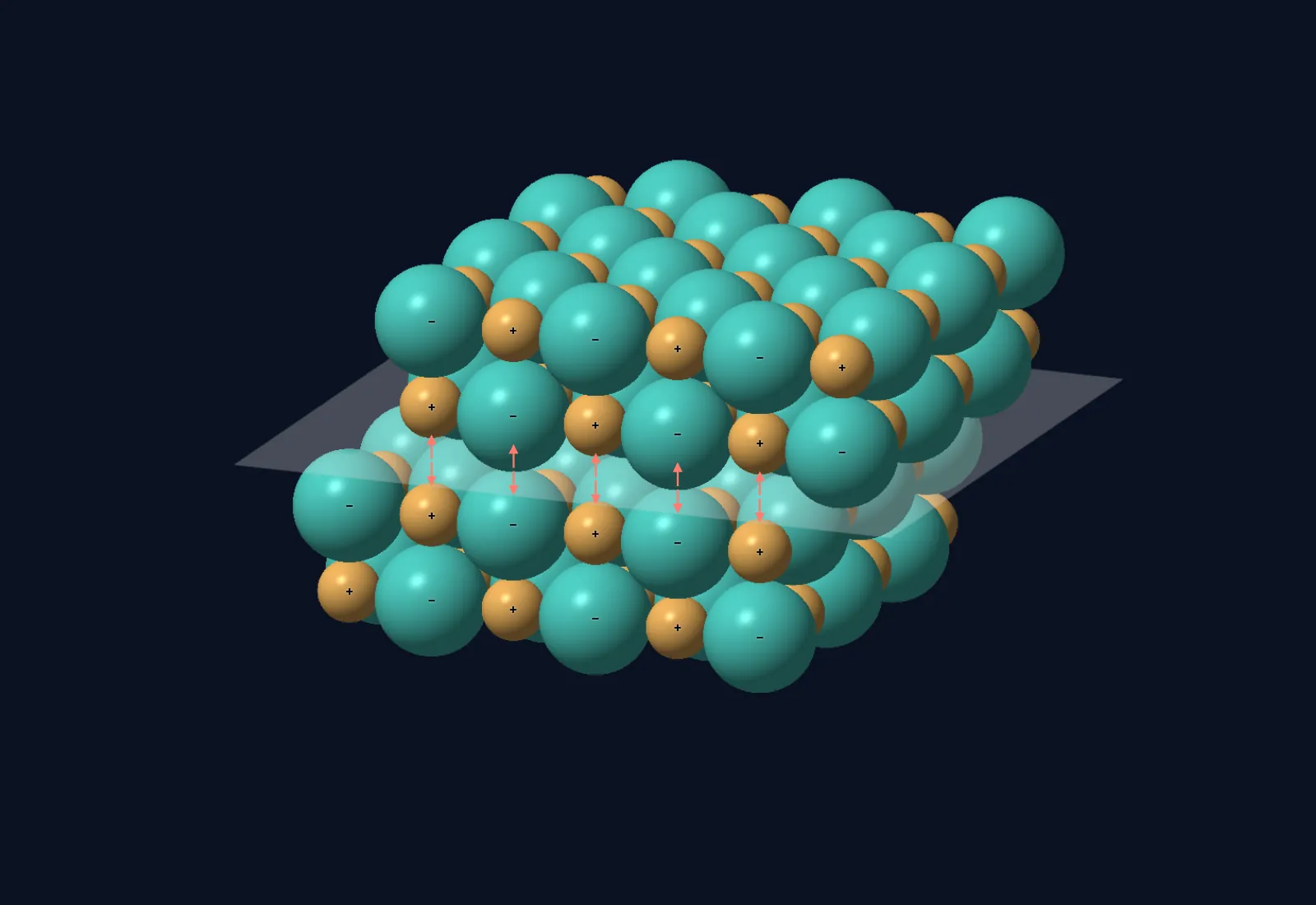
Table salt breaks between two spoons, while a copper wire bends without cracking. The picture shows why, drawn to scale: first a block of salt, then one of copper, each with its own particles. Start with a prediction, then push a layer.
The same hammer, two materials
A salt crystal and a copper wire are hit with the same hammer. The block in the picture is a fragment of a salt crystal: 144 ions, 72 Na⁺ and 72 Cl⁻.
What happens to each material?
Every ion has six neighbours of opposite sign
The block is drawn to scale: Na⁺ has a radius of 102 pm, Cl⁻ 181 pm (1 pm is a billionth of a millimetre). The edge of the unit cell, measured, is 564 pm.
An ion inside touches six ions of opposite sign: four in the same plane, one above and one below. The distance between the centres of two neighbours is 282 pm, half the cell edge. The radii give an edge of 2 · (102 + 181) = 566 pm: close values, not identical.
Push the top layer by half a cell
The top two layers slide along the marked plane. Drag sideways on the picture or use the buttons. At 282 pm, half the cell edge, each ion in the top half sits above an ion of the same sign.
The number in the corner of the picture shows how far you have pushed. The "Energy between the halves" box shows the electrostatic energy in electronvolts (eV; 1 eV is the energy gained by an electron that passes through a potential difference of one volt): at the start it is −15.3 eV. The ions keep their charges; only who sits next to whom changes.
The energy between the halves goes from negative to positive
A top ion is attracted by ions of opposite sign and repelled by ions of the same sign. For the 144 ions drawn, the energy between the two halves is calculated with Coulomb's law, treating the ions as point charges in a vacuum.
Before the push the energy is −15.3 eV: negative, so the halves are bound. It passes through zero at 166 pm, and at 282 pm it is +3.3 eV: positive, so the repulsion between ions of the same sign beats the attraction. The arrows mark the pairs of the same sign that face each other.
The layer rises slightly as it slides, just enough to keep the spheres from overlapping (78 pm at the end). The values are for the block drawn.
Salt does not bend: it splits along a plane
With the layer displaced, ions of the same sign sit face to face. If the halves move apart, the energy falls: from +3.3 eV to almost zero, when the top half is lifted by a further 423 pm. Ions of the same sign repel each other, so the halves tend to separate.
That is why salt is hard but brittle: the attractions between the ions are strong, yet the crystal does not allow a layer to slide. Real salt splits along planes parallel to the faces of the cube: this is an observed property, which the calculation here, with two rigid halves, illustrates.
In copper, the layer lands in positions just like before
Copper has positive ions in a cloud of electrons: one from each atom, 216 ions and 216 electrons in the block. Two neighbouring ions are 255.6 pm apart.
Push the top layer by one distance between neighbours: the ions end up in the same positions relative to one another, and an ion in the pushed layer again has 12 close neighbours (at half a step, 10). The positive ions repel one another, but the shared electrons hold them together: the metal bends without breaking.
In a real metal, defects slide, not whole layers; the drawing shows the simplest version.
Only free particles carry current
What you see. Two plates, one negative and one positive, and a bulb in the circuit. What the particles do. In solid salt the ions stay in place: 0 of 144 are free, and the bulb stays off. In molten salt at 801 °C (a demonstration done by the teacher only; in the picture it is a drawing) all 144 are free: Na⁺ moves towards the negative plate, Cl⁻ towards the positive one. In copper, 216 electrons move among the fixed ions.
How it is written. NaCl(s) → NaCl(l), with the same ions.
Now you explain
An aluminium can is crushed when you step on it, but it does not fall apart into shards. Aluminium is a metal, like the copper in the picture, with the layer pushed two steps.
Explain in a few sentences why the can deforms and does not break, using what you saw about the layer and the electrons.
Compare with an answer
In a metal, one layer of positive ions slides over another and lands in positions just like the ones before. The electrons belong to the whole block and hold the ions together even after the slide, so the metal deforms. In an ionic crystal, the displaced layer brings ions of the same sign face to face; they repel each other, and the crystal breaks.
Lesson: the sodium chloride crystal · Lesson: metallic bonding