Chapter 6 · Ionic and metallic bondsLesson 6.1TC Core curriculum (1 hour a week) · beyond your profile
Classification of chemical bonds
What holds the ions in a salt crystal together
Sodium is a metal that reacts violently with water, and chlorine is a poisonous gas. How can they make the salt on your table?
Before you read: what do you think?
It takes 496 kJ to remove an electron from each atom in a mole of sodium atoms. Chlorine atoms release only 348 kJ when they receive the electrons. With a deficit of 148 kJ, how does salt form?
See the answer
When the crystal forms from gaseous ions, 769 kJ is released per mole of NaCl, more than five times the 148 kJ deficit. The attraction between ions pays for the ionic bond.
Table salt crumbles between two spoons, yet it melts only at 801 °C, over 700 degrees above the temperature at which water boils. Its elements are sodium, a soft metal that reacts violently with water, and chlorine, a poisonous yellow-green gas. Two dangerous substances make a seasoning you could hardly cook without. What holds the particles of salt together?
What holds two particles together
Two particles stay together when moving closer lowers their combined energy. To pull them apart again, the energy released must be supplied back. This is a chemical bond. There are three kinds of bond between atoms.
An ionic bond forms between metal and non-metal atoms through electron transfer. A covalent bond forms between non-metal atoms that share electrons. A metallic bond forms between metal atoms in a lattice with electrons shared by the whole crystal. Metals, on the left and in the middle of the periodic table, give up electrons more readily than non-metals, on the right; this is why transfer goes from metal to non-metal. The first kind is found in table salt.
Sodium plus chlorine: two dangerous substances make a saltWhat you see
Sodium is kept under oil to stop it reacting with air or water. Chlorine is a corrosive, poisonous yellow-green gas. When the two substances react (a demonstration done only by the teacher, under laboratory conditions), they produce white crystals of sodium chloride, or table salt.
The compound is unlike either substance it came from: it dissolves in water without reacting violently and is essential for life.
An electron passes from sodium to chlorineWhat the particles do
A sodium atom has the electron configuration 1s² 2s² 2p⁶ 3s¹: one loosely held electron in its outer shell. A chlorine atom, with the configuration 1s² 2s² 2p⁶ 3s² 3p⁵, needs one electron to make eight in its outer shell. When one electron is transferred, sodium becomes a Na⁺ ion (1s² 2s² 2p⁶, like neon), and chlorine becomes a Cl⁻ ion (1s² 2s² 2p⁶ 3s² 3p⁶, like argon).
Removing the electron from sodium costs 496 kJ per mole of gaseous atoms. A chlorine atom releases 348 kJ when it gains an electron. The transfer itself therefore takes 496 − 348 = 148 kJ/mol. Attraction between the ions recovers the energy: when the crystal forms from gaseous ions, 769 kJ is released per mole of NaCl, more than five times the deficit. Atoms have no goal; the collection of ions has less energy than the separate atoms.
For the curious
The lattice energy, 769 kJ/mol, is not measured directly. It is calculated from an energy cycle called the Born–Haber cycle, which links the energy of formation of the compound from its elements to the sublimation of the metal, the breaking apart of the non-metal molecule, ionisation energy and electron affinity.
The rule “metal + non-metal = ionic bond” is the one taught in class and fits salt. It has exceptions: aluminium chloride, AlCl₃, is not ionic. The gradual transition from ionic to covalent bonding can be seen in electronegativity.
How to write the transfer and what the formula NaCl showsHow it is written
The transfer is written as two half-equations, one for the loss and one for the gain:
Na → Na⁺ + e⁻
Cl + e⁻ → Cl⁻
The electron given up by sodium is the one gained by chlorine, so the two half-equations add up to:
Na + Cl → Na⁺ + Cl⁻
An ionic bond is the electrostatic attraction between oppositely charged ions formed by the transfer of electrons between a metal and a non-metal.
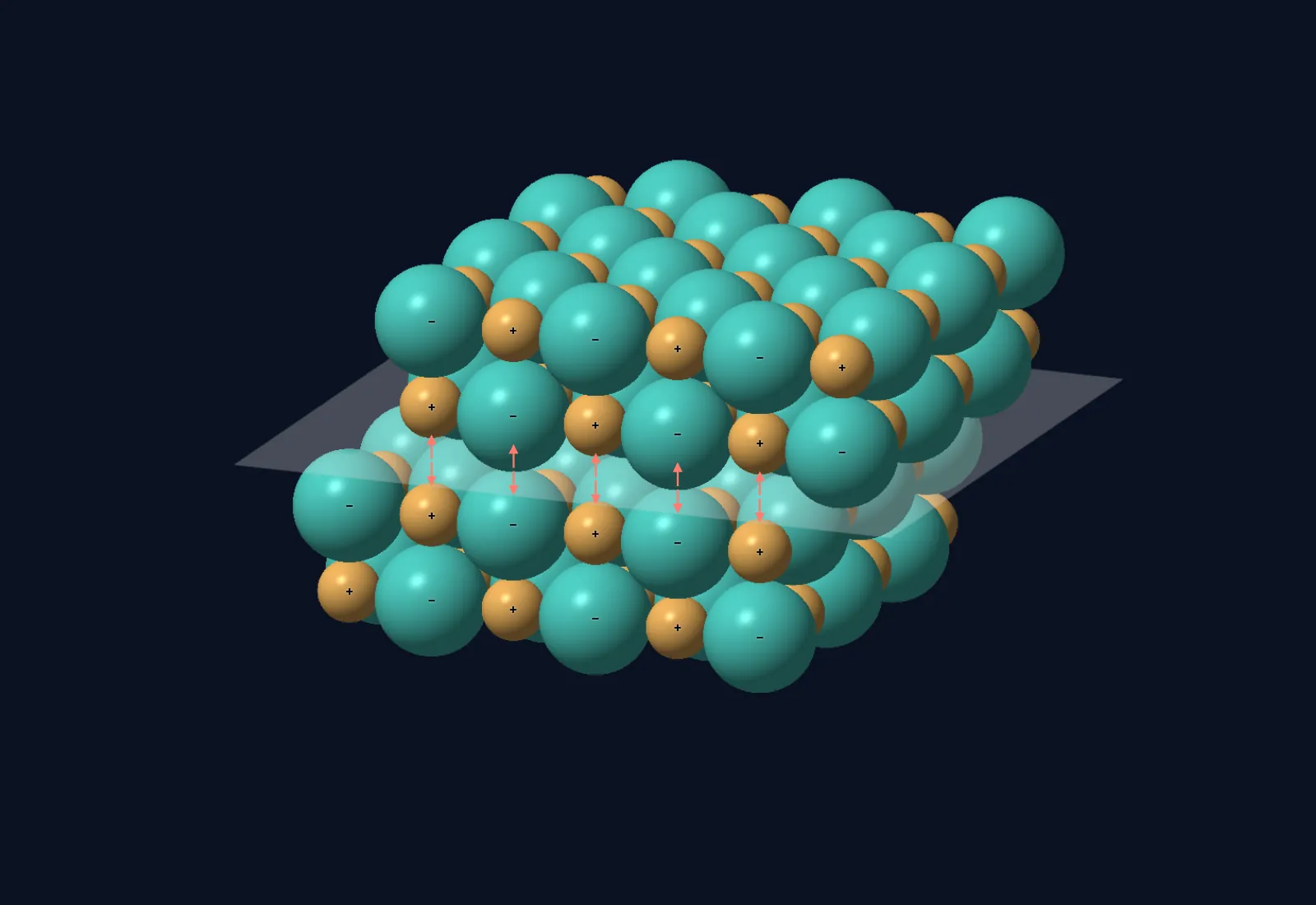
An ion’s electric field is the same in every direction, so a Na⁺ ion attracts Cl⁻ ions from all sides: the ionic bond is non-directional. An ion has no fixed number of “partners”: it attracts as many oppositely charged ions as fit around it, so the ionic bond is unsaturated.
For this reason, NaCl molecules do not form. A crystal lattice forms, in which each Na⁺ ion is surrounded by Cl⁻ ions and vice versa. The formula NaCl shows only the 1 : 1 ratio of the two kinds of ion and is read as a formula unit.
Worked example
How many ions are in a kilogram of rock salt
A bag contains 1 kg of fine rock salt, with at least 97.5% NaCl. What is the minimum number of Na⁺ ions it contains?
Mass of sodium chloride: m = 1,000 · 97.5 ÷ 100 = 975 g.
Molar mass: M(NaCl) = 23 + 35.5 = 58.5 g/mol. Amount of salt: n = 975 ÷ 58.5 ≈ 16.7 mol (one decimal place).
Each NaCl formula unit contains one Na⁺ ion and one Cl⁻ ion, so n(Na⁺) = n(Cl⁻) = 16.7 mol.
Number of ions: N(Na⁺) = 16.7 · 6.022·10²³ ≈ 1.0·10²⁵ ions, with the same number of Cl⁻ ions.
Check: a mole contains approximately 6·10²³ particles, and 16.7 mol, almost 17 times as much, reaches the order of 10²⁵. NaCl molecules: none.
In Romania
The salt palace at Slănic
Societatea Națională a Sării (Salrom), the national salt company, extracts salt at seven sites, including Slănic Prahova, Praid, Târgu Ocna, Ocna Dej and Cacica. At Slănic, visitors travel by minibus to a depth of 208 m in the Unirea mine, where the microclimate stays at 12–13 °C. Excavation removed 2.9 million m³ of salt and left 14 trapezoidal chambers, covering approximately 80,000 m² in total.
Fine rock salt for the food industry contains at least 97.5% NaCl, and substances insoluble in water make up no more than 1.2%. The remaining 2.5% at most consists of other substances, including moisture.
In short
- An ionic bond is the electrostatic attraction between oppositely charged ions formed by the transfer of electrons between a metal and a non-metal.
- Sodium gives up an electron and becomes Na⁺ (1s² 2s² 2p⁶); chlorine gains it and becomes Cl⁻ (1s² 2s² 2p⁶ 3s² 3p⁶): Na → Na⁺ + e⁻ and Cl + e⁻ → Cl⁻.
- The transfer itself takes energy (496 − 348 = 148 kJ/mol); the collection of ions has less energy because of the attraction between ions (769 kJ/mol).
- The ionic bond is non-directional and unsaturated, so it forms crystal lattices rather than molecules.
- NaCl is a formula unit: it shows the 1 : 1 ratio of Na⁺ to Cl⁻ ions.
Common mistakes
WrongThere are NaCl molecules in a salt crystal.
RightThe crystal is a lattice of Na⁺ and Cl⁻ ions. The formula NaCl shows only their 1 : 1 ratio.
WrongThe sodium atom wants to get rid of its electron.
RightAtoms have no goal. The transfer takes 148 kJ/mol; it happens because attraction between the ions releases far more energy.
WrongA Na⁺ ion is bonded to a single Cl⁻ ion.
RightThe ionic bond is non-directional and unsaturated: the ion attracts all the oppositely charged ions around it.
Test yourself
7 questions. For the first 6 you see the explanation at once, with the paragraph of the lesson that supports it; for the written ones you compare with a good answer.
What is an ionic bond?
Answer
c) The electrostatic attraction between oppositely charged ions formed by the transfer of electrons between a metal and a non-metal. The first two options describe covalent and metallic bonding. The last describes a force that does not bond.
Why are there no NaCl molecules in a salt crystal?
Answer
a) An ion attracts as many oppositely charged ions as fit around it, with no fixed number of partners. The ionic bond is unsaturated and non-directional, so an extended lattice forms, with no isolated pairs.
What is the electron configuration of the Cl⁻ ion?
Answer
d) 1s² 2s² 2p⁶ 3s² 3p⁶, like argon. By gaining an electron, chlorine’s outer shell changes from 3s² 3p⁵ to 3s² 3p⁶.
How many moles of ions (Na⁺ and Cl⁻ together) are in 117 g of sodium chloride? Given M(NaCl) = 58.5 g/mol.
molAnswer
4 mol. n(NaCl) = 117 ÷ 58.5 = 2 mol. Each mole of NaCl gives one mole of Na⁺ and one mole of Cl⁻, so 2 + 2 = 4 moles of ions.
Transferring an electron from each atom in a mole of gaseous sodium atoms to a mole of gaseous chlorine atoms takes energy. Calculate, in kJ per mole, the difference between the energy spent (496 kJ) and the energy released (348 kJ).
kJ/molAnswer
148 kJ/mol. 496 − 348 = 148 kJ/mol. Attraction between the ions covers the deficit when the crystal forms.
Place each description under the matching type of bond.
Answer
Ionic bond: Between a metal and a non-metal, through electron transfer; Forms between Na⁺ and Cl⁻ ions in salt.
Covalent bond: Between non-metal atoms that share electrons; Holds hydrogen and oxygen atoms together in a water molecule.
Metallic bond: Between metal atoms, with electrons shared by the whole crystal; Holds the atoms in a copper wire together.
The type of bond depends on the kinds of atom: metal with non-metal, non-metal with non-metal, or metal with metal.
A classmate draws a salt crystal as many isolated pairs, each made of a Na⁺ ion and a Cl⁻ ion. In two or three sentences, explain what her drawing leaves out about ionic bonding.
A good answer
The ionic bond is non-directional and unsaturated: a Na⁺ ion attracts all the Cl⁻ ions around it, not just one. Salt is therefore an extended lattice in which each ion is surrounded by oppositely charged ions, and the formula NaCl shows only the 1 : 1 ratio.
A complete answer says that attraction acts in every direction and there is no fixed number of partners, so there are no isolated pairs.
Terms
- ionic bond
- The electrostatic attraction between oppositely charged ions formed by the transfer of electrons between a metal and a non-metal.
- ion
- An atom or group of atoms with an electric charge, formed by losing or gaining electrons.
- crystal lattice
- A regular arrangement of particles that repeats in every direction in a crystal.
- non-directional
- Describes a bond whose attraction acts equally in every direction, as with ions in a crystal.
- unsaturated
- Describes a bond with no fixed number of partners: the ion attracts all the oppositely charged ions around it.
- formula unit
- The smallest whole-number ratio of ions in an ionic compound, such as 1 : 1 for NaCl.
Sources and link to the programme
- OpenStax – Chemistry 2e, 7.1 Ionic Bonding – definition of the ionic bond, formation of cations and anions, properties of sodium, chlorine and sodium chloride, 769 kJ per mole of NaCl in gaseous ions
- OpenStax – Chemistry: Atoms First, 3.7 Molecular and Ionic Compounds – a metal combined with non-metals usually forms an ionic compound, but not always: aluminium chloride, AlCl₃, is not ionic
- OpenStax – Chemistry 2e, 7.2 Covalent Bonding – ionic bonding between metal and non-metal atoms, covalent bonding through shared electrons
- OpenStax – Chemistry 2e, 7.5 Strengths of Ionic and Covalent Bonds – lattice energy of NaCl, 769 kJ/mol; lattice energy is not measured directly and is calculated using the Born–Haber cycle
- OpenStax – Chemistry 2e, 6.5 Periodic Variations in Element Properties – electron affinity of chlorine, −348 kJ/mol
- NIST – Atomic Spectra Database, ionization energies – ionisation energy of sodium, 5.139 eV, or 496 kJ/mol
- PubChem – Sodium chloride – melting point of sodium chloride, 801 °C
- Salrom – Salina Slănic Prahova – Unirea mine: depth of 208 m, 2.9 million m³ of salt excavated, 14 chambers, approximately 80,000 m², 12–13 °C
- Salrom – Despre Societatea Națională a Sării – the seven salt extraction sites: Slănic Prahova, Râmnicu Vâlcea, Târgu Ocna, Praid, Cacica, Ocna Dej, Ocna Mureș
- Salrom – Sare alimentară iodată/neiodată gemă măruntă, pentru uz industrial – sodium chloride at least 97.5%, substances insoluble in water at most 1.2%, cubic crystals
From the programme: “Classification of chemical bonds”; “Ionic bonding” (TC: Core curriculum (1 hour a week)). Specific competences followed: 1.4, 2.3, 3.4.