Chapter 4 · The atomLesson 4.2TC Core curriculum (1 hour a week) · beyond your profile
Electron configuration by shells for the first 20 chemical elements in the periodic table
How many electrons fit in a shell: the first 20 elements
Sodium loses one electron easily, but the second takes over nine times as much energy. What does that tell you about how the electrons are arranged?
Before you read: what do you think?
You remove electrons one at a time from a sodium atom, which has 11 electrons. The first takes 5.14 eV. How much does the second take?
See the answer
The second electron takes 47.29 eV. The first electron is alone in the outer shell; the second belongs to a full shell, held much more tightly by the nucleus. This jump is measured evidence that electrons are grouped in shells.
Table salt contains sodium, but not the metallic sodium found in the laboratory. A sodium atom has 11 electrons and, in salt, ends up with 10. The first electron leaves easily, yet the second never leaves. The sequence of ionisation energies shows why.
Sodium’s ionisation energies reveal the shells
Ionisation energy is the energy needed to remove an electron from an atom or ion in the gaseous state. It is measured in electronvolts: 1 eV = 1.602·10⁻¹⁹ J, the energy an electron gains when accelerated through a voltage of 1 V.
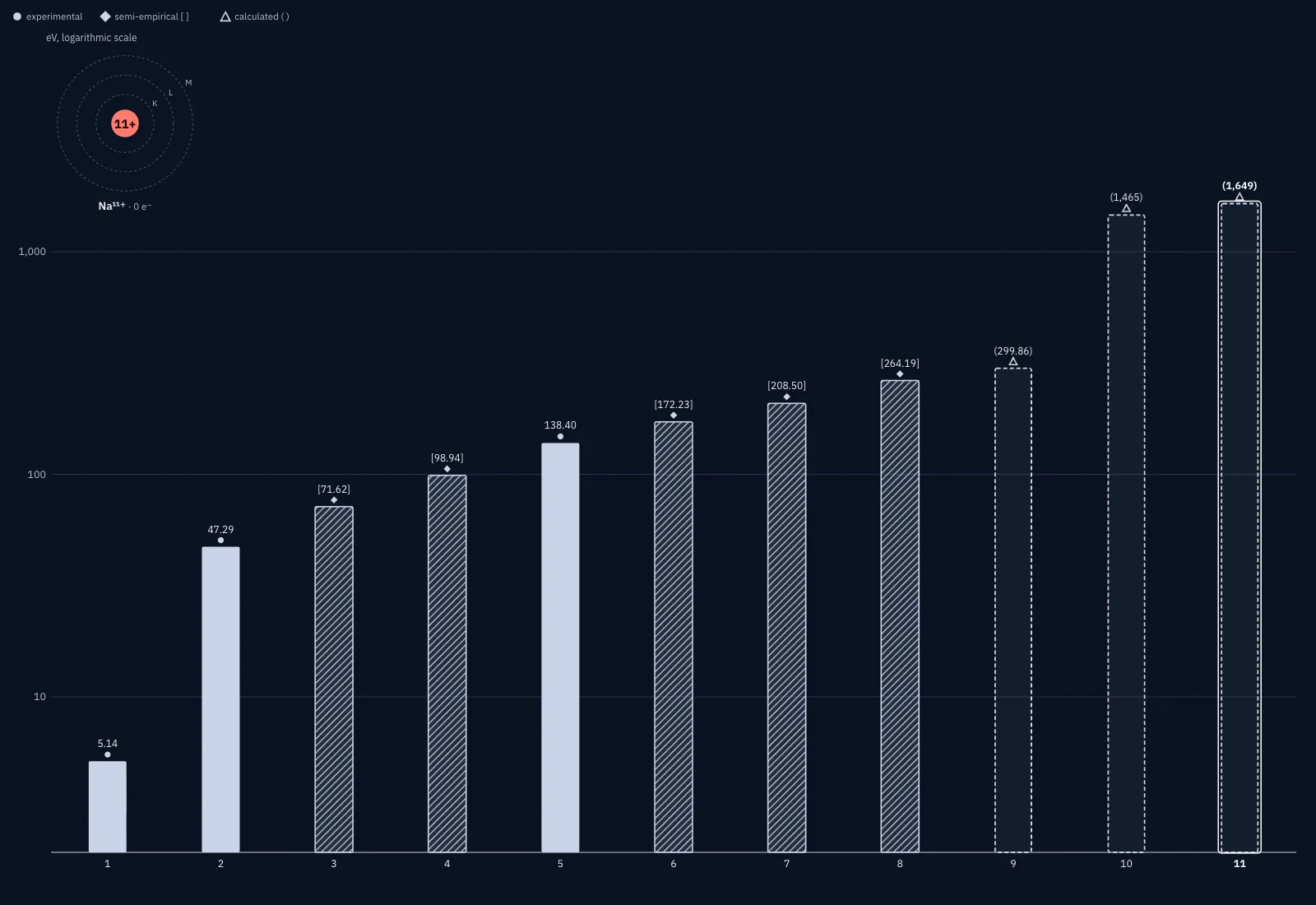
A sodium atom has 11 electrons. Removed one at a time, they take, in eV (NIST values): 5.14; 47.29; 71.62; 98.94; 138.40; 172.23; 208.50; 264.19; 299.86; 1,465.10; 1,648.70. The first electron leaves easily. The next eight take between 47 and 300 eV. The last two take over 1,400 eV.
The two jumps divide the 11 electrons into three groups: 1, 8 and 2. Each group is a shell. Electrons in the same shell are held with similar energies, and there is a jump between shells. The sequence 2, 8, 1 (from the nucleus outwards) is the model that explains these values.
For the curious
The same pattern appears in other elements. In magnesium the jump comes after the second electron (15.04 then 80.14 eV), in aluminium after the third (28.45 then 119.99 eV), in potassium after the first (4.34 then 31.63 eV). The first two sodium values are determined experimentally; those for electrons inside the atom are inferred from spectra and calculations, with the same pattern.
Ionisation energy is also given per mole of atoms. One electronvolt per atom corresponds to 96.5 kJ/mol, so the first sodium electron takes 5.14 · 96.5 ≈ 496 kJ/mol.
| Electron removed | Na | Mg | Al | Si | P | S | Cl | Ar |
|---|---|---|---|---|---|---|---|---|
| 1 | 5.14 | 7.65 | 5.99 | 8.15 | 10.49 | 10.36 | 12.97 | 15.76 |
| 2 | 47.29 | 15.04 | 18.83 | 16.35 | [19.77] | 23.34 | 23.81 | 27.63 |
| 3 | [71.62] | 80.14 | 28.45 | 33.49 | 30.20 | [34.86] | [39.80] | [40.73] |
| 4 | [98.94] | [109.27] | 119.99 | 45.14 | 51.44 | [47.22] | [53.24] | [59.58] |
| 5 | 138.40 | [141.33] | [153.83] | 166.77 | 65.03 | 72.59 | [67.68] | [74.84] |
| 6 | [172.23] | [186.76] | [190.49] | [205.28] | [220.43] | 88.05 | [96.94] | 91.29 |
| 7 | [208.50] | [225.02] | [241.76] | [246.57] | [263.57] | 280.95 | 114.20 | [124.41] |
| 8 | [264.19] | [265.92] | [284.64] | [303.59] | [309.60] | 328.79 | 348.31 | [143.46] |
| 9 | (299.86) | [327.99] | [330.21] | [351.28] | [372.31] | [379.84] | 400.85 | [422.60] |
| 10 | (1,465) | (367.49) | [398.65] | [401.38] | [424.40] | [447.70] | [456.70] | [479.76] |
| 11 | (1,649) | (1,762) | (442.00) | [476.27] | [479.44] | [504.55] | [530.00] | [540.40] |
| 12 | (1,963) | (2,086) | (523.41) | [560.62] | [564.41] | [591.58] | [619.00] | |
| 13 | (2,304) | (2,438) | (611.74) | [651.96] | [656.30] | [685.50] | ||
| 14 | (2,673) | (2,817) | (706.99) | [750.23] | [755.13] | |||
| 15 | (3,070) | (3,224) | (809.20) | [855.50] | ||||
| 16 | (3,494) | (3,658) | (918.38) | |||||
| 17 | (3,946) | (4,121) | ||||||
| 18 | (4,426) |
| Element | First electron | Values exp. / semi-emp. / calc. | First jump | Second jump |
|---|---|---|---|---|
| Na, sodium | Na⁺: 496 kJ/mol | 3 / 5 / 3 | after electron 1: ×9.2 | after electron 9: ×4.9 |
| Mg, magnesium | Mg⁺: 738 kJ/mol | 3 / 6 / 3 | after electron 2: ×5.3 | after electron 10: ×4.8 |
| Al, aluminium | Al⁺: 578 kJ/mol | 4 / 6 / 3 | after electron 3: ×4.2 | after electron 11: ×4.7 |
| Si, silicon | Si⁺: 787 kJ/mol | 5 / 6 / 3 | after electron 4: ×3.7 | after electron 12: ×4.7 |
| P, phosphorus | P⁺: 1,012 kJ/mol | 4 / 8 / 3 | after electron 5: ×3.4 | after electron 13: ×4.6 |
| S, sulfur | S⁺: 1,000 kJ/mol | 6 / 7 / 3 | after electron 6: ×3.2 | after electron 14: ×4.6 |
| Cl, chlorine | Cl⁺: 1,251 kJ/mol | 5 / 9 / 3 | after electron 7: ×3.0 | after electron 15: ×4.5 |
| Ar, argon | Ar⁺: 1,521 kJ/mol | 3 / 12 / 3 | after electron 8: ×2.9 | after electron 16: ×4.5 |
NIST values and diagram. Values from the NIST database (ver. 5.12, queried on 16 November 2026), of three kinds, which NIST marks for each value: experimental (solid bar, circle; values evaluated from measured spectra), semi-empirical (hatched bar, diamond, in square brackets: deduced from experimental values by interpolation, extrapolation or other semi-empirical methods) and calculated (dotted outline, triangle, in round brackets: from theoretical calculation, not from evaluated experimental data). Of the 116 values, 33 are experimental, 59 semi-empirical and 24 calculated. The first jump has experimental values on both sides for six of the eight elements; the second has calculated values on both sides for all eight. The energy is for isolated atoms or ions in the gas state; kJ/mol is calculated from eV with 1 eV = 96.485 kJ/mol. The atom on the left is a diagram of shells: it shows how many electrons are in each shell, not their real position, and electrons do not circle on rings. Atoms and ions have no colour: they are drawn enormously enlarged.
Sources and credits. NIST Atomic Spectra Database (ver. 5.12), “Ground States and Ionization Energies”, A. Kramida, Yu. Ralchenko, J. Reader and NIST ASD Team (2024), source, DOI 10.18434/T4W30F, queried on 16 November 2026; a work of the US government, public domain. Elementary charge and Avogadro number: exact values from the International System of Units, NIST CODATA.
Shells K, L, M, N and how much each holds
The shells are numbered n = 1, 2, 3, 4 and labelled K, L, M, N, from the nucleus outwards. Shell n holds at most 2n² electrons: 2 · 1² = 2 in K, 2 · 2² = 8 in L, 2 · 3² = 18 in M, 2 · 4² = 32 in N.
The shell closer to the nucleus fills first. For the first 20 elements, the rule is: K fills to 2, L to 8, and M takes up to 8 electrons. The outer shell never has more than 8 electrons (at most 2 in K). In potassium and calcium, the next electrons go into N, even though M has room for 10 more. The reason lies in subshells and is explained with orbitals.
Valence electrons are the electrons in the outer shell. Helium, with 2 electrons in a full K shell, has a duplet. Neon and argon, with 8 electrons in the outer shell, have an octet. Noble gases have high ionisation energies (21.56 eV for neon and 15.76 eV for argon, compared with 5.14 for sodium). The octet rule: in compounds, atoms of main-group elements reach 8 electrons in the outer shell (2 for those in the first period).
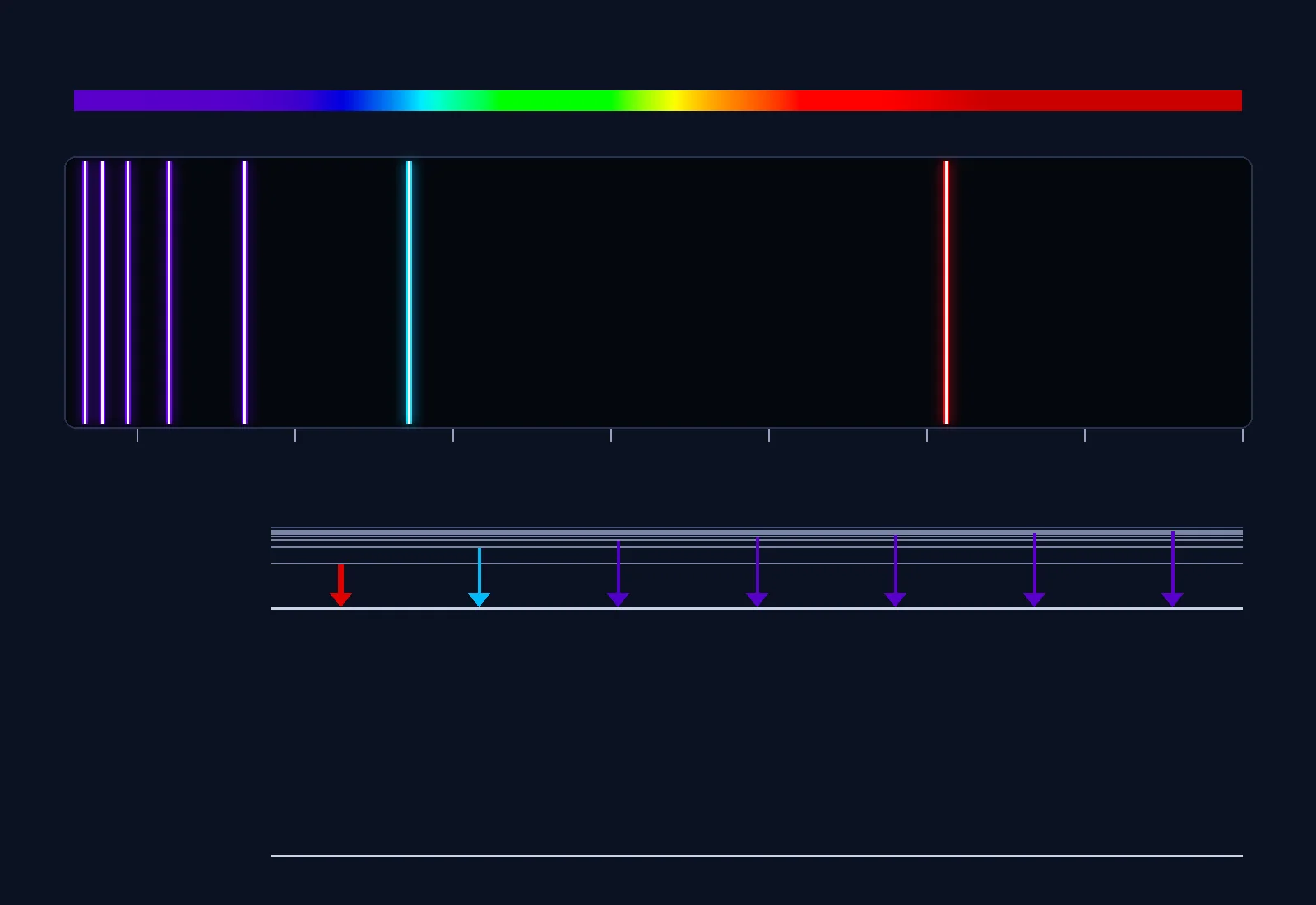
An electron in an atom can have only certain energies. When it moves from a higher energy level to a lower one, the atom emits light of a fixed colour: it depends only on the difference between the two levels. That is why sodium colours a flame yellow (589 nm), while hydrogen shows only a few distinct, well-separated coloured lines.
| Line | Transition | Wavelength in air (nm) | Photon energy (eV) | Colour |
|---|---|---|---|---|
| Hα (hydrogen) | n = 3 → 2 | 656.3 ± 0.003 | 1.89 | red |
| Hβ (hydrogen) | n = 4 → 2 | 486.1 ± 0.005 | 2.55 | blue-green |
| Hγ (hydrogen) | n = 5 → 2 | 434.0 ± 0.0006 | 2.86 | blue-violet |
| Hδ (hydrogen) | n = 6 → 2 | 410.2 ± 0.0006 | 3.02 | violet |
| n = 7 (hydrogen) | n = 7 → 2 | 397.0 ± 0.0006 | 3.12 | violet, at the edge of the visible |
| n = 8 (hydrogen) | n = 8 → 2 | 388.9 ± 0.0006 | 3.19 | violet, at the edge of the visible |
| n = 9 (hydrogen) | n = 9 → 2 | 383.5 ± 0.0006 | 3.23 | violet, at the edge of the visible |
| D₂ (sodium) | 3p → 3s | 588.995 ± 0.000003 | 2.104 | yellow |
| D₁ (sodium) | 3p → 3s | 589.592 ± 0.000003 | 2.102 | yellow |
| Level n | Energy (eV) |
|---|---|
| 1 | 0.00 |
| 2 | 10.20 |
| 3 | 12.09 |
| 4 | 12.75 |
| 5 | 13.05 |
| 6 | 13.22 |
| 7 | 13.32 |
| 8 | 13.39 |
| 9 | 13.43 |
| ∞ (limit: ionised atom) | 13.60 |
Measurements and calculation. The wavelengths are measured: observed values from the NIST database, in air, drawn at their true position on the 380–750 nm scale. The photon energy is calculated from them: the difference between the energies of the two levels (NIST values) multiplied by hc; for hydrogen, 1.89 eV for the red line. The colours are calculated from the wavelength, with a published approximation of the CIE 1931 standard observer, and are approximate: a screen cannot show a pure spectral colour, and the brightness on the screen is not the brightness of the line. The energy scale is a diagram: the levels are to scale, but the electron does not follow an arrow, and the arrows show only the difference between two levels. The grey arrow to n = 1 is calculated from the same levels: its light, about 121.6 nm, is ultraviolet and cannot be seen. The lines with n = 7, 8 and 9 are at the edge of the visible. The two sodium lines are 0.60 nm apart, less than one pixel on the full scale, so the picture shows them with the magnifier.
Sources and credits. NIST Atomic Spectra Database (ver. 5.12), “Lines” and “Ground States and Ionization Energies”, A. Kramida, Yu. Ralchenko, J. Reader and NIST ASD Team (2024), source, DOI 10.18434/T4W30F, queried on 16.11.2026; work of the US government, public domain. The constants h, c and e: exact values of the International System, NIST CODATA. The colours: the approximation of the CIE 1931 colour-matching functions (2° standard observer) with sums of Gaussians, C. Wyman, P.-P. Sloan, P. Shirley, “Simple Analytic Approximations to the CIE XYZ Color Matching Functions”, Journal of Computer Graphics Techniques 2(2), 2013, source.
Configurations of the first 20 elements
A shell configuration is written with the numbers of electrons in each shell, from K outwards, separated by a comma and a space. Sodium is written 2, 8, 1: two electrons in K, eight in L, one in M. The sum equals the atomic number Z.
Z = 1–10: H 1; He 2; Li 2, 1; Be 2, 2; B 2, 3; C 2, 4; N 2, 5; O 2, 6; F 2, 7; Ne 2, 8. Z = 11–20: Na 2, 8, 1; Mg 2, 8, 2; Al 2, 8, 3; Si 2, 8, 4; P 2, 8, 5; S 2, 8, 6; Cl 2, 8, 7; Ar 2, 8, 8; K 2, 8, 8, 1; Ca 2, 8, 8, 2.
The number of occupied shells is the period number, and the number of valence electrons indicates the group: 1 or 2 electrons means group 1 or 2, while 3 to 8 electrons means groups 13 to 18. Sodium, 2, 8, 1, is in period three, group 1; chlorine, 2, 8, 7, is in period three, group 17.
Ions: what changes in the configuration
An ion forms when an atom loses or gains electrons. Metal atoms with 1, 2 or 3 valence electrons lose those electrons, while non-metal atoms with 6 or 7 valence electrons gain electrons.
Na → Na⁺ + e⁻
Mg → Mg²⁺ + 2e⁻
Cl + e⁻ → Cl⁻
O + 2e⁻ → O²⁻
Sodium goes from 2, 8, 1 to 2, 8 in the Na⁺ ion, magnesium from 2, 8, 2 to 2, 8 in the Mg²⁺ ion, chlorine from 2, 8, 7 to 2, 8, 8 in the Cl⁻ ion, and oxygen from 2, 6 to 2, 8 in the O²⁻ ion. Each ion has the configuration of a noble gas: Na⁺, Mg²⁺ and O²⁻ have the configuration of neon, while Cl⁻ has that of argon.
Energy explains the loss. The first electron removed from sodium takes 5.14 eV, while a second would take 47.29 eV.
Worked example
Sulfur and its ion
Write the shell configuration of sulfur (Z = 16), its number of valence electrons and the configuration of the S²⁻ ion.
Step 1: a neutral sulfur atom has 16 electrons. Fill K with 2, then L with 8. That leaves 16 − 10 = 6 electrons, which go into M. The configuration is 2, 8, 6.
Step 2: check: 2 + 8 + 6 = 16 = Z. The outer shell, M, has 6 electrons, so there are 6 valence electrons. Sulfur is in period three, group 16.
Step 3: S²⁻ gains two electrons: 16 + 2 = 18 electrons. The M shell fills to 8, so the configuration is 2, 8, 8, identical to that of argon. The nucleus still has 16 protons, so the ion is not argon.
In Romania
Sodium in table salt
Societatea Națională a Sării (Salrom), the national salt company, produces recrystallised iodised salt at the Cacica salt mine in Suceava County. The salt is extracted through wells from a depth of over 180 m and contains at least 99.7% sodium chloride.
In a 1 kg packet, at least 997 g is NaCl. With M(NaCl) = 58.5 g/mol and the atomic mass of sodium 23, the mass of sodium in the packet is 997 · 23 ÷ 58.5 ≈ 392 g, rounded to the nearest unit. This sodium is not metal: it is in the form of Na⁺ ions, with configuration 2, 8, and the accompanying Cl⁻ ions have 2, 8, 8. There are no sodium atoms with 11 electrons in the salt crystal.
In short
- Jumps in successive ionisation energies show that electrons are grouped in shells: in sodium, 1, 8 and 2.
- Shells K, L, M, N correspond to n = 1, 2, 3, 4 and hold at most 2n² electrons: 2, 8, 18, 32.
- In the first 20 elements, the outer shell holds at most 8 electrons (2 in K); K and Ca have the configurations 2, 8, 8, 1 and 2, 8, 8, 2.
- Valence electrons are those in the outer shell; the number of occupied shells is the period number.
- Losing or gaining electrons forms ions with noble-gas configurations: Na⁺ and Mg²⁺ like neon, Cl⁻ like argon.
Common mistakes
WrongThe third shell holds at most 8 electrons.
RightThe M shell holds 2 · 3² = 18 electrons. In elements up to argon, it takes at most 8 and fills further only later.
WrongThe Mg²⁺ ion is a neon atom because it has 10 electrons.
RightMg²⁺ has the configuration 2, 8, like neon, but its nucleus has 12 protons, not 10. It is a different chemical species, with a different charge.
WrongThe sodium in salt is sodium metal.
RightIn salt, sodium is present as Na⁺ ions with 10 electrons. Neutral sodium atoms, with 11 electrons, form the metal.
Test yourself
8 questions. For the first 7 you see the explanation at once, with the paragraph of the lesson that supports it; for the written ones you compare with a good answer.
What is the shell configuration of a calcium atom, Z = 20?
Answer
b) 2, 8, 8, 2. K fills with 2, L with 8, M takes 8, and the last 2 electrons go into N: 2 + 8 + 8 + 2 = 20.
In the sequence of sodium ionisation energies, what does the small jump from 47.29 eV to 71.62 eV show, compared with the large jump from 5.14 eV to 47.29 eV?
Answer
b) The first electron is alone in the outer shell, while the next electrons are in inner shells. A large jump separates two shells; the differences between electrons in the same shell are small.
What is the configuration of the Cl⁻ ion?
Answer
c) 2, 8, 8. Chlorine, 2, 8, 7, gains one electron and reaches 2, 8, 8, like argon.
The maximum number of electrons in shell N (n = 4) is:
electronsAnswer
32 electrons. Shell n holds 2n² electrons: 2 · 4² = 32.
How many electrons does the Ca²⁺ ion have (Z = 20)?
electronsAnswer
18 electrons. The calcium atom has 20 electrons and loses two, so 20 − 2 = 18.
Put the steps for writing the shell configuration of a sulfur atom in order.
Answer
The correct order:
- Find Z = 16, so there are 16 electrons
- Put 2 electrons in shell K
- Put 8 electrons in shell L
- Put the remaining 6 electrons in shell M
- Check the sum: 2 + 8 + 6 = 16
Shells fill from the nucleus outwards, and the sum must be Z.
Sort the atoms by the ion they usually form.
Answer
Forms a cation: Na (2, 8, 1); Mg (2, 8, 2); K (2, 8, 8, 1).
Forms an anion: Cl (2, 8, 7); O (2, 6); F (2, 7).
Atoms with 1–2 valence electrons lose them; those with 6–7 gain electrons until they reach 8.
Using the configuration and ionisation energies, explain why sodium readily forms the Na⁺ ion, but not the Na²⁺ ion.
A good answer
Sodium has the configuration 2, 8, 1. The first electron is alone in the outer shell and takes only 5.14 eV. The second belongs to the full L shell and takes 47.29 eV, over nine times as much. This energy is not available in ordinary reactions, so Na⁺ remains, with the configuration 2, 8.
A complete answer links the single valence electron to the low energy and the second electron to a full shell and the high energy.
Terms
- electron shell
- The set of electrons with the same number n; labelled K, L, M, N for n = 1, 2, 3, 4.
- valence electrons
- The electrons in the outer shell of an atom.
- ionisation energy
- The energy needed to remove an electron from an atom or ion in the gaseous state.
- octet
- Eight electrons in the outer shell, as in neon and argon.
- duplet
- Two electrons in the K shell, as in helium.
- cation
- A positively charged ion, formed by losing electrons.
- anion
- A negatively charged ion, formed by gaining electrons.
Sources and link to the programme
- Royal Society of Chemistry – Flame colours: a demonstration – sodium salts colour a flame yellow; a demonstration done by the teacher
- OpenStax – Chemistry 2e, 6.2 The Bohr Model – the electron in a hydrogen atom has only certain energies; when it moves to a lower level the atom emits light with fixed energy and wavelength
- OpenStax – Chemistry 2e, 6.1 Electromagnetic Energy – sodium’s yellow light, at 589 nm, and the line spectra of elements
- NIST – Atomic Spectra Database, Ground States and Ionization Energies (sodiu) – the 11 ionisation energies of sodium; the first two are experimental values, values in square brackets are semi-empirical, those in round brackets are calculated
- NIST – ASD Ionization Energy help – the meaning of square and round brackets in the ionisation energy table
- NIST – Atomic Spectra Database, Ground States and Ionization Energies (Mg, Al, K, Ca, Ne, Ar) – successive ionisation energies of magnesium, aluminium, potassium and calcium, and the first ionisation energy of neon and argon
- NIST – Atomic Spectra Database, Ground States and Ionization Energies (H–Ca) – ground-state configurations of atoms from hydrogen to calcium, from which shell configurations are obtained
- NIST – CODATA: electron volt-joule relationship – 1 eV = 1.602 176 634·10⁻¹⁹ J
- Salrom – Sare alimentară iodată recristalizată, pentru consum – sodium chloride at least 99.7%; extraction through wells from over 180 m deep; produced at the Cacica salt mine
From the programme: “Electron configuration by shells for the first 20 chemical elements in the periodic table”; “Correlations between the electron configurations of the first 20 chemical elements and their positions in the periodic table” (TC: Core curriculum (1 hour a week)). Specific competences followed: 1.3, 3.3.