Chapter 4 · The atomLesson 4.3MI Mathematics–informatics (2 hours) · beyond your profile
Orbitals, subshells; electron occupation of shells and subshells
Where are you likely to find the electron: orbitals and subshells
The second shell holds eight electrons. Are all eight bound equally tightly to the nucleus?
Before you read: what do you think?
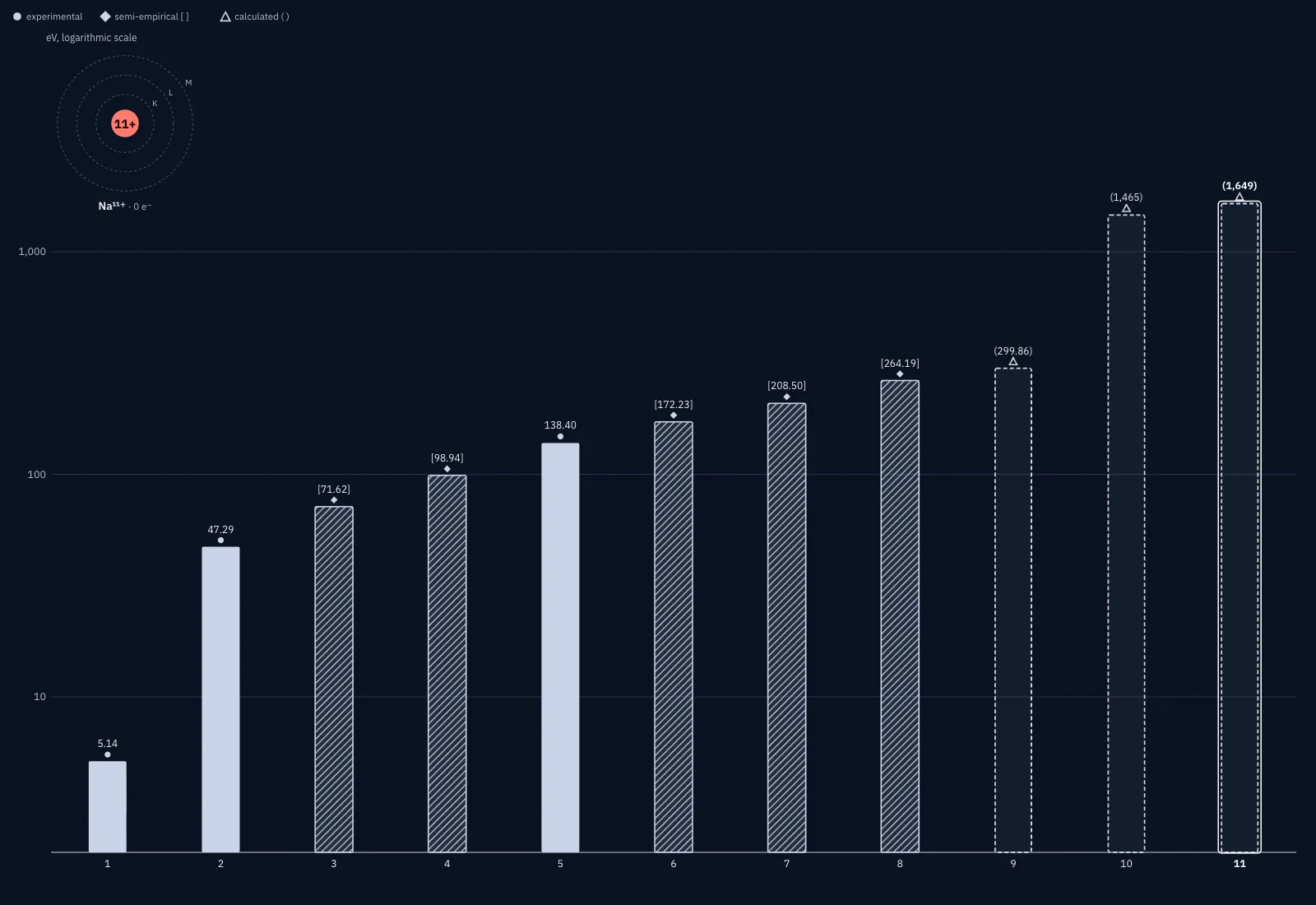
The energy needed to remove the first electron generally rises from one element to the next in the same period. What happens from beryllium (Z = 4) to boron (Z = 5)?
See the answer
For beryllium the measured energy is 9.32 eV, and for boron it is 8.30 eV. Boron’s last electron is in 2p, a subshell with higher energy than 2s. The second shell therefore has at least two parts.
If you remove the first electron from each atom in the second period, from lithium to neon, the measured energies are: 5.39; 9.32; 8.30; 11.26; 14.53; 13.62; 17.42; 21.56 eV. The sequence rises, but falls at boron and oxygen. The second shell does not behave as a single group of eight electrons.
Shells have parts: subshells
The falls at boron and oxygen show that electrons in the same shell have different energies. A shell is divided into subshells, labelled with letters: s, p, d, f. Shell n has n subshells: shell 1 has 1s; shell 2 has 2s and 2p; shell 3 has 3s, 3p and 3d; shell 4 has 4s, 4p, 4d and 4f.
Each subshell contains orbitals: s has 1 orbital, p has 3, d has 5, f has 7. An orbital holds at most 2 electrons, so the subshells hold 2, 6, 10 and 14 electrons. Shell 3 holds 2 + 6 + 10 = 18, and shell 4 holds 2 + 6 + 10 + 14 = 32, or 2n² electrons, as in the lesson on shells.
An orbital is a region of probability
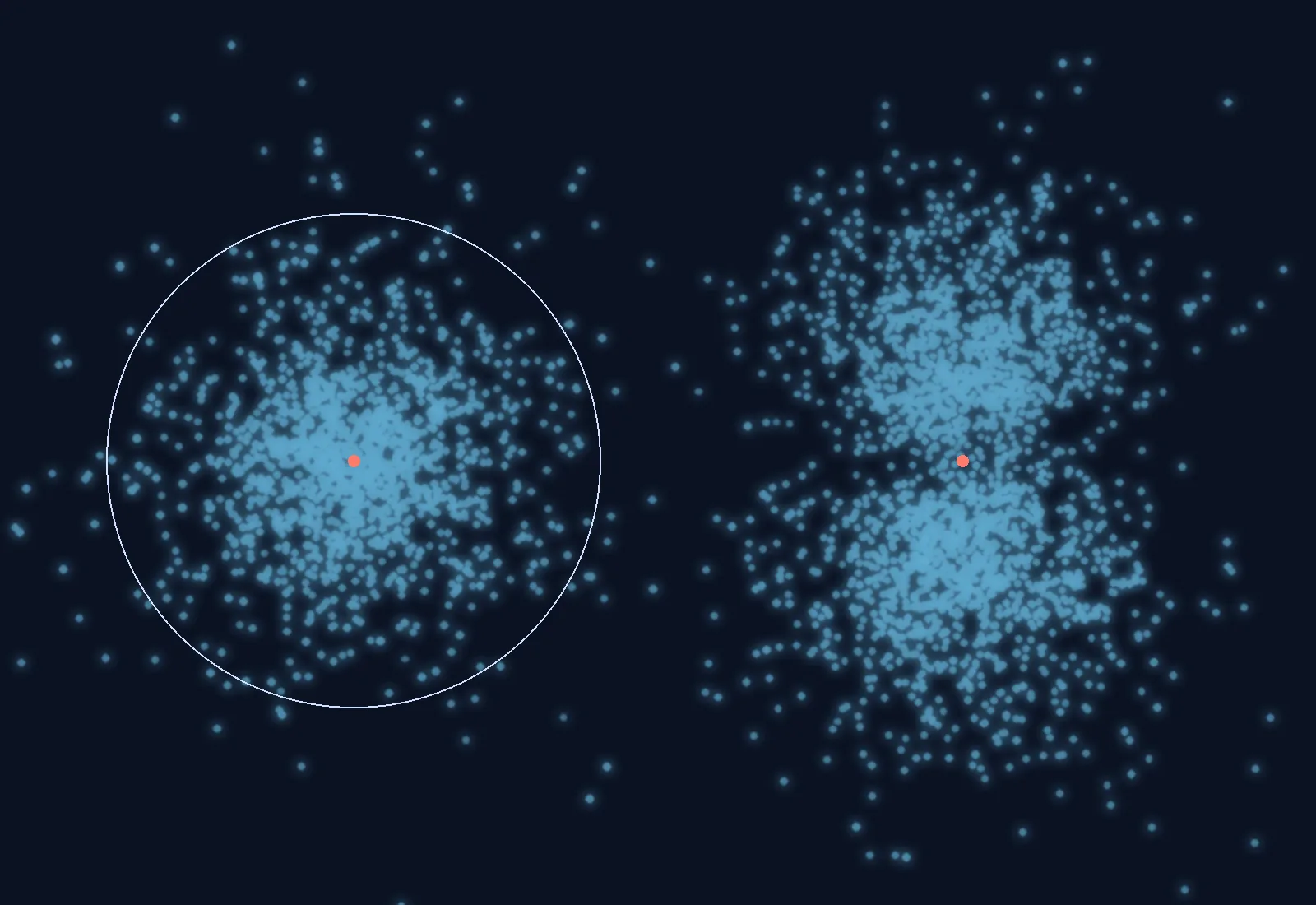
An orbital is the region around the nucleus where the probability of finding an electron is high. The electron has no trajectory, and an orbital is not an orbit. The drawing with concentric shells is a scheme for counting electrons.
In hydrogen, in the 1s state, the most probable distance at which to find the electron is 52.9 pm. It can also be found closer to or farther from the nucleus. If you marked each position where the electron was found in repeated measurements with a dot on paper, the dots would form a cloud, densest at the centre, near the nucleus. Yet the thin shell 52.9 pm from the nucleus would contain the most dots, because a shell’s volume increases with distance.
The shapes of s and p orbitals are required only for natural sciences. An s orbital is spherical. A p orbital has two lobes, one on each side of the nucleus. The three p orbitals in a shell are oriented along the three axes, px, py, pz, and have the same energy. The colours of the lobes in drawings show the sign of the wave function, not electric charges.
| Orbital | Shape | Nodes (spheres or planes of zero probability) | Most probable distance (pm) | Radial node (pm) | Largest distance on the 90% surface (pm) |
|---|---|---|---|---|---|
| 1s | sphere, densest near the nucleus | 0 | 52.9 | — | 140.8 |
| 2s | sphere with an outer shell, separated from the centre by a node | one sphere | 277.1 and 40.4 (the larger peak, then the small one) | 105.8 | 483.2 |
| 2p | two lobes on either side of the nucleus, along one of the x, y or z axes | one plane, through the nucleus, between the lobes | 211.7 | — | 483.1 |
| 3d (for the curious) | two lobes on the z axis and a ring around it (3d z²) | two cones, between the lobes and the ring | 476.3 | — | 1,008.1 |
Each press of “Find the electron” adds a dot. After a few hundred dots, about nine in ten are inside the 90% surface; the exact number is shown on the picture.
Calculation and model. Each dot is a single place where the electron might be found; it is not a path and does not show how the electron moves. The place is chosen at random, with the probability given by the square of the hydrogen wave function, in exact form: the dots are calculated, not measured. The 90% surface is the surface on which the probability density has a value chosen so that the region inside holds 90% of the probability; the number on the right says how many of your dots fall inside. The most probable distance of the 1s electron is 52.9 pm (the Bohr radius). The nucleus is drawn hugely enlarged. The 3d orbital is a curiosity. The shapes are exact for hydrogen only; for other atoms they are an approximation.
Sources and credits. Bohr radius a₀ = 5.291 772 105 44·10⁻¹¹ m (52.9 pm): NIST CODATA 2022, source, public domain. The 1s, 2s and 2p wave functions of hydrogen are exact and 3d is written separately; all are normalised to 1 and solve the radial Schrödinger equation, with radial maxima at a₀, 4a₀ and 9a₀.
Pauli, Hund and the filling order
Pauli’s principle: an orbital holds at most 2 electrons, with opposite spins, drawn as two arrows pointing in opposite directions. Spin is a quantum property of the electron. Hund’s rule: in subshells with several orbitals of the same energy, electrons enter one per orbital first, with parallel spins, and pair up only afterwards.
Subshells fill in order of increasing energy: 1s, 2s, 2p, 3s, 3p, 4s, 3d, 4p. Klechkowski’s rule (n + l) gives this order from the sum n + l, where l = 0 for s, 1 for p, 2 for d. The subshell with the lower n + l fills first; when the sums are equal, the one with the lower n fills first. For 4s, n + l = 4 + 0 = 4; for 3d, n + l = 3 + 2 = 5. The 4s subshell therefore fills before 3d.
The notation 2p⁴ means shell 2, subshell p, four electrons. The superscript counts electrons and is not a power. The n + l rule is a scheme for building configurations, not a fixed energy scale; exceptions appear for elements with 3d.
For the curious
The n + l rule appears in Russian and French textbooks under the name of V. M. Klechkowski, who gave it a theoretical explanation in 1961.
Worked example
Oxygen and potassium
Write the electron configuration of oxygen (Z = 8) and its box diagram, then the configuration of potassium (Z = 19).
Oxygen: 8 electrons. 1s takes 2, 2s takes 2, leaving 8 − 4 = 4 for 2p. The configuration is 1s²2s²2p⁴. Check: 2 + 2 + 4 = 8.
The diagram for 2p⁴: the first three electrons enter the three boxes one at a time (Hund); the fourth pairs with the first. The result is one box with two opposite arrows and two boxes with one arrow each: two unpaired electrons.
Potassium: 19 electrons. 1s²2s²2p⁶3s²3p⁶ contains 18. For the last electron, 4s has n + l = 4, and 3d has n + l = 5, so it enters 4s. The configuration is 1s²2s²2p⁶3s²3p⁶4s¹. Check: 2 + 2 + 6 + 2 + 6 + 1 = 19.
In Romania
Procopiu’s magneton
Ștefan Procopiu (1890–1972), a physicist from Iași, published a calculation in 1913 of the elementary magnetic moment associated with an electron’s motion in an atom, starting from Planck’s quantum theory. In Romanian literature, the unit is called the Bohr–Procopiu magneton.
Bohr also published his model of the atom in 1913; sources disagree about priority in calculating the magneton. Today the unit is called the Bohr magneton and has the value 9.274·10⁻²⁴ J/T.
The electron has a magnetic moment, and spin has two orientations. These are the two arrows in the orbital boxes.
In short
- Shell n has n subshells (s, p, d, f), with 1, 3, 5, 7 orbitals and capacities of 2, 6, 10, 14 electrons.
- An orbital is the region where the probability of finding the electron is high; it is not an orbit. For hydrogen, 1s, the most probable distance is 52.9 pm.
- Pauli: at most 2 electrons in an orbital, with opposite spins. Hund: electrons enter the orbitals of the same subshell one at a time before pairing up.
- Filling order: 1s, 2s, 2p, 3s, 3p, 4s, 3d, 4p; 4s fills before 3d because n + l is 4, compared with 5.
- An s orbital is spherical; a p orbital has two lobes and there are three, px, py, pz (natural sciences).
Common mistakes
WrongThe electron goes round the nucleus along the orbit shown.
RightThe electron has no trajectory. An orbital shows where it is likely to be found: it is a region of probability.
WrongThe four 2p⁴ electrons in oxygen are all paired.
RightFour electrons occupy three orbitals: one with two electrons and two with one each. Oxygen has two unpaired electrons.
WrongThe third shell fills completely, with 18 electrons, before 4s begins to fill.
RightAfter 3p, 4s fills before 3d. In argon, shell 3 has only 8 electrons, and 3d fills only after 4s.
Test yourself
7 questions. For the first 6 you see the explanation at once, with the paragraph of the lesson that supports it; for the written ones you compare with a good answer.
How many electrons can the d subshell hold at most?
Answer
d) 10. The d subshell has 5 orbitals, and each holds at most 2 electrons: 5 · 2 = 10.
What is an orbital?
Answer
b) The region around the nucleus where the probability of finding an electron is high. An orbital is a region of probability, with no trajectory.
What is the correct configuration of a nitrogen atom, Z = 7?
Answer
a) 1s²2s²2p³. The 7 electrons: 2 in 1s, 2 in 2s, 3 in 2p. The sum is 2 + 2 + 3 = 7.
What does Hund’s rule say about three electrons in the 2p subshell?
Answer
b) They enter one per p orbital, with parallel spins. The p orbitals have the same energy, so electrons enter one per orbital before pairing up.
How many electrons are in the configuration 1s²2s²2p⁶3s²3p⁴?
electronsAnswer
16 electrons. Add the superscripts: 2 + 2 + 6 + 2 + 4 = 16.
Put the subshells in the order in which they fill.
Answer
The correct order:
- 2p
- 3s
- 3p
- 4s
- 3d
The order follows the sum n + l, then the lower n. For 4s the sum is 4, and for 3d it is 5.
Calcium (Z = 20) has two electrons beyond the configuration of argon. Say which subshell they occupy and explain why they are not in 3d.
A good answer
The configuration of argon contains 18 electrons, up to 3p. For the 4s subshell, n + l = 4 + 0 = 4, and for 3d, n + l = 3 + 2 = 5, so 4s fills first. Calcium is 1s²2s²2p⁶3s²3p⁶4s².
A complete answer compares the sums n + l and writes the configuration with a sum of 20.
Terms
- orbital
- The region around the nucleus where the probability of finding an electron is high.
- subshell
- A group of orbitals of the same type in a shell: s, p, d or f.
- Pauli’s principle
- An orbital holds at most two electrons, with opposite spins.
- Hund’s rule
- In a subshell, electrons first occupy one orbital each, with parallel spins, and pair up only afterwards.
- spin
- A quantum property of the electron, with two orientations, shown by arrows pointing in opposite directions.
- n + l rule
- Subshells fill in increasing order of the sum n + l; when sums are equal, the one with the lower n fills first.
Sources and link to the programme
- OpenStax – Chemistry 2e, 6.3 Development of Quantum Theory – the orbital as a probability distribution; spherical s, two-lobed p; spin as a quantum property
- OpenStax – Chemistry 2e, 6.4 Electronic Structure of Atoms (Electron Configurations) – Pauli’s principle, Hund’s rule, subshell filling order, configuration notation
- NIST – Atomic Spectra Database, Ground States and Ionization Energies (Li–Ne) – first ionisation energy of the elements from lithium to neon: 5.39; 9.32; 8.30; 11.26; 14.53; 13.62; 17.42; 21.56 eV
- NIST – CODATA: Bohr radius – the Bohr radius, 5.29·10⁻¹¹ m (52.9 pm), the most probable distance of the 1s electron in hydrogen
- NIST – CODATA: Bohr magneton – the Bohr magneton, 9.274·10⁻²⁴ J/T
- Memoirs of the Scientific Sections of the Romanian Academy, 2022 – Ștefan Procopiu (1890–1972) – the 1913 calculation of the magneton, called Bohr–Procopiu; career at the University of Iași; sources differ over priority relative to Bohr
- Wikipedia – Aufbau principle – the n + l rule and the name of V. M. Klechkowski, who gave it an explanation in 1961
From the programme: “Orbitals, subshells; electron occupation of shells and subshells”; “Orbitals, subshells; electron occupation of shells and subshells; geometry of s and p orbitals” (MI: Mathematics–informatics (2 hours)). Specific competences followed: 1.3, 2.3, 3.3.