Chapter 5 · The periodic tableLesson 5.4TC Core curriculum (1 hour a week) · beyond your profile
Non-metallic character; variation in non-metallic character across a group and a period (for chlorine, bromine, iodine and for nitrogen, oxygen, fluorine)
Why chlorine displaces bromine from a salt, but iodine cannot displace chlorine
Chlorine, bromine and iodine are in the same group. Why can one displace another from a salt, but not the other way round?
Before you read: what do you think?
Chlorine water is poured into a potassium bromide solution. What do you see?
See the answer
Chlorine takes electrons from bromide ions and turns them into bromine, which colours the solution orange. With iodine in place of chlorine, the reaction does not occur: iodine is less non-metallic than bromine. This is a demonstration done by the teacher.
The label on table salt says “iodised salt”. The iodine in it is not elemental iodine: it is added as potassium iodate or iodide, in a small amount set by law. Iodine is the least non-metallic of the common halogens, and its place in the group determines which reactions it takes part in and which it does not.
Non-metallic character: the tendency to gain electrons
Non-metallic character is the tendency of an atom to gain electrons and form negative ions. Nitrogen (2,5), oxygen (2,6) and fluorine (2,7) complete shell 2 to eight electrons by gaining three, two and one electron respectively: N³⁻, O²⁻, F⁻.
One number measures this tendency: electronegativity (the Pauling scale) shows how strongly an atom attracts electrons in a bond. The values are: N 3.04; O 3.44; F 3.98, so non-metallic character increases from nitrogen to fluorine. For the halogens: Cl 3.16; Br 2.96; I 2.66, so it decreases from chlorine to iodine.
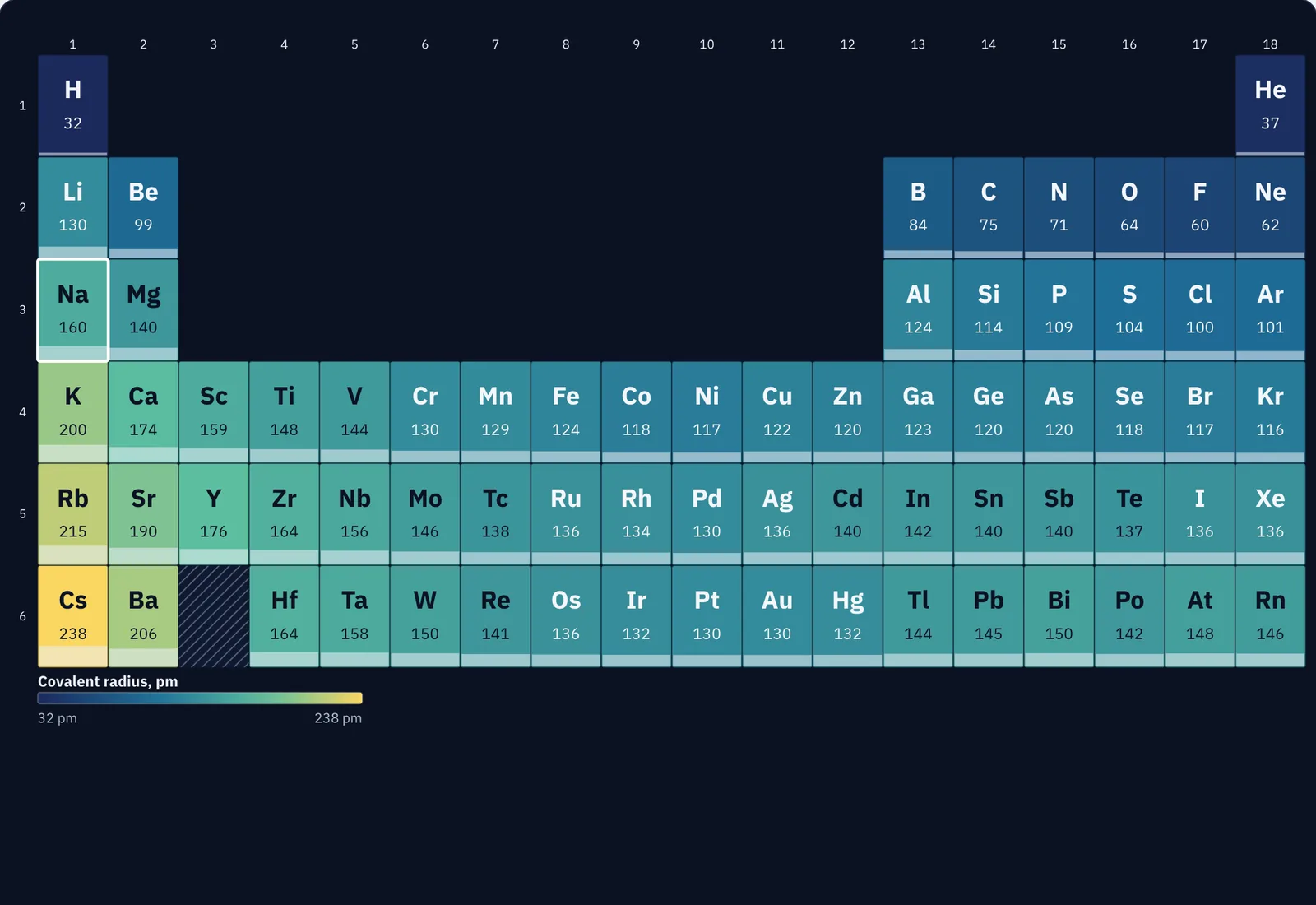
The cause is the same as for atomic radius. From nitrogen to fluorine the number of protons increases, while the new electrons enter the same shell, so the radius decreases (N 71 pm, O 64 pm, F 60 pm) and the nucleus attracts electrons more strongly. In group 17, each step down adds a shell, the radius increases (F 60 pm, Cl 100 pm, Br 117 pm, I 136 pm) and the attraction decreases. Non-metallic character decreases: F > Cl > Br > I.
| Z | Symbol | Element | Period | Group | Covalent radius, pm | First ionisation energy, kJ/mol | Electronegativity (Pauling) |
|---|---|---|---|---|---|---|---|
| 1 | H | hydrogen | 1 | 1 | 32 | 1,312.0 | 2.20 |
| 2 | He | helium | 1 | 18 | 37 | 2,372.3 | – |
| 3 | Li | lithium | 2 | 1 | 130 | 520.2 | 0.98 |
| 4 | Be | beryllium | 2 | 2 | 99 | 899.5 | 1.57 |
| 5 | B | boron | 2 | 13 | 84 | 800.6 | 2.04 |
| 6 | C | carbon | 2 | 14 | 75 | 1,086.5 | 2.55 |
| 7 | N | nitrogen | 2 | 15 | 71 | 1,402.3 | 3.04 |
| 8 | O | oxygen | 2 | 16 | 64 | 1,313.9 | 3.44 |
| 9 | F | fluorine | 2 | 17 | 60 | 1,681.0 | 3.98 |
| 10 | Ne | neon | 2 | 18 | 62 | 2,080.7 | – |
| 11 | Na | sodium | 3 | 1 | 160 | 495.8 | 0.93 |
| 12 | Mg | magnesium | 3 | 2 | 140 | 737.8 | 1.31 |
| 13 | Al | aluminium | 3 | 13 | 124 | 577.5 | 1.61 |
| 14 | Si | silicon | 3 | 14 | 114 | 786.5 | 1.90 |
| 15 | P | phosphorus | 3 | 15 | 109 | 1,011.8 | 2.19 |
| 16 | S | sulfur | 3 | 16 | 104 | 999.6 | 2.58 |
| 17 | Cl | chlorine | 3 | 17 | 100 | 1,251.2 | 3.16 |
| 18 | Ar | argon | 3 | 18 | 101 | 1,520.6 | – |
| 19 | K | potassium | 4 | 1 | 200 | 418.8 | 0.82 |
| 20 | Ca | calcium | 4 | 2 | 174 | 589.8 | 1.00 |
| 21 | Sc | scandium | 4 | 3 | 159 | 633.1 | 1.36 |
| 22 | Ti | titanium | 4 | 4 | 148 | 658.8 | 1.54 |
| 23 | V | vanadium | 4 | 5 | 144 | 650.9 | 1.63 |
| 24 | Cr | chromium | 4 | 6 | 130 | 652.9 | 1.66 |
| 25 | Mn | manganese | 4 | 7 | 129 | 717.3 | 1.55 |
| 26 | Fe | iron | 4 | 8 | 124 | 762.5 | 1.83 |
| 27 | Co | cobalt | 4 | 9 | 118 | 760.4 | 1.88 |
| 28 | Ni | nickel | 4 | 10 | 117 | 737.1 | 1.91 |
| 29 | Cu | copper | 4 | 11 | 122 | 745.5 | 1.90 |
| 30 | Zn | zinc | 4 | 12 | 120 | 906.4 | 1.65 |
| 31 | Ga | gallium | 4 | 13 | 123 | 578.8 | 1.81 |
| 32 | Ge | germanium | 4 | 14 | 120 | 762.2 | 2.01 |
| 33 | As | arsenic | 4 | 15 | 120 | 944.5 | 2.18 |
| 34 | Se | selenium | 4 | 16 | 118 | 941.0 | 2.55 |
| 35 | Br | bromine | 4 | 17 | 117 | 1,139.9 | 2.96 |
| 36 | Kr | krypton | 4 | 18 | 116 | 1,350.8 | – |
| 37 | Rb | rubidium | 5 | 1 | 215 | 403.0 | 0.82 |
| 38 | Sr | strontium | 5 | 2 | 190 | 549.5 | 0.95 |
| 39 | Y | yttrium | 5 | 3 | 176 | 599.9 | 1.22 |
| 40 | Zr | zirconium | 5 | 4 | 164 | 640.1 | 1.33 |
| 41 | Nb | niobium | 5 | 5 | 156 | 652.1 | 1.6 |
| 42 | Mo | molybdenum | 5 | 6 | 146 | 684.3 | 2.16 |
| 43 | Tc | technetium | 5 | 7 | 138 | 702.4 | 2.10 |
| 44 | Ru | ruthenium | 5 | 8 | 136 | 710.2 | 2.2 |
| 45 | Rh | rhodium | 5 | 9 | 134 | 719.7 | 2.28 |
| 46 | Pd | palladium | 5 | 10 | 130 | 804.4 | 2.20 |
| 47 | Ag | silver | 5 | 11 | 136 | 731.0 | 1.93 |
| 48 | Cd | cadmium | 5 | 12 | 140 | 867.8 | 1.69 |
| 49 | In | indium | 5 | 13 | 142 | 558.3 | 1.78 |
| 50 | Sn | tin | 5 | 14 | 140 | 708.6 | 1.96 |
| 51 | Sb | antimony | 5 | 15 | 140 | 830.6 | 2.05 |
| 52 | Te | tellurium | 5 | 16 | 137 | 869.3 | 2.1 |
| 53 | I | iodine | 5 | 17 | 136 | 1,008.4 | 2.66 |
| 54 | Xe | xenon | 5 | 18 | 136 | 1,170.4 | 2.60 |
| 55 | Cs | caesium | 6 | 1 | 238 | 375.7 | 0.79 |
| 56 | Ba | barium | 6 | 2 | 206 | 502.8 | 0.89 |
| 72 | Hf | hafnium | 6 | 4 | 164 | 658.5 | 1.3 |
| 73 | Ta | tantalum | 6 | 5 | 158 | 728.4 | 1.5 |
| 74 | W | tungsten | 6 | 6 | 150 | 758.8 | 1.7 |
| 75 | Re | rhenium | 6 | 7 | 141 | 755.8 | 1.9 |
| 76 | Os | osmium | 6 | 8 | 136 | 814.2 | 2.2 |
| 77 | Ir | iridium | 6 | 9 | 132 | 865.2 | 2.2 |
| 78 | Pt | platinum | 6 | 10 | 130 | 864.4 | 2.2 |
| 79 | Au | gold | 6 | 11 | 130 | 890.1 | 2.4 |
| 80 | Hg | mercury | 6 | 12 | 132 | 1,007.1 | 1.9 |
| 81 | Tl | thallium | 6 | 13 | 144 | 589.4 | 1.8 |
| 82 | Pb | lead | 6 | 14 | 145 | 715.6 | 1.8 |
| 83 | Bi | bismuth | 6 | 15 | 150 | 702.9 | 1.9 |
| 84 | Po | polonium | 6 | 16 | 142 | 811.8 | 2.0 |
| 85 | At | astatine | 6 | 17 | 148 | – | 2.2 |
| 86 | Rn | radon | 6 | 18 | 146 | 1,037.1 | – |
| Germanium | Atomic mass | Density, g/cm³ |
|---|---|---|
| silicon (Si), neighbour | 28.085 | 2.33 |
| gallium (Ga), neighbour | 69.723 | 5.91 |
| arsenic (As), neighbour | 74.922 | 5.75 |
| tin (Sn), neighbour | 118.710 | 7.29 |
| Mean of the four neighbours (calculated) | 72.86 | 5.32 |
| Mendeleev, predicted in 1871 | 72 | 5.5 |
| Winkler, measured in 1886 | 72.3 | 5.469 |
| Today’s value | 72.630 | 5.323 |
| Ion | Ionic radius, pm (Shannon, coordination 6) |
|---|---|
| Li⁺ | 76 |
| Na⁺ | 102 |
| K⁺ | 138 |
| Rb⁺ | 152 |
| Cs⁺ | 167 |
| Mg²⁺ | 72 |
| Ca²⁺ | 100 |
| Al³⁺ | 53.5 |
| O²⁻ | 140 |
| S²⁻ | 184 |
| F⁻ | 133 |
| Cl⁻ | 181 |
| Br⁻ | 196 |
| I⁻ | 220 |
Table values and calculation. Values from tables: the covalent radius and the first ionisation energy are measured, and the Pauling electronegativity is a relative scale, deduced from bond energies; all three are those of the Royal Society of Chemistry table. The atomic masses are CIAAW. The ionic radii (Na⁺ 102 pm, Cl⁻ 181 pm) are the Shannon effective radii for six-fold coordination, deduced from the distances in crystals by a convention. Mendeleev’s prediction (1871) and Winkler’s measurement (1886) are the values printed in 1901; the mean of the four neighbours is a calculation done in front of you. A lighter colour means a larger value, and the height of the bar in the cell shows the same thing. Hatched cells have no value in the table. Melting point follows no simple rule and is not coloured here as a trend. The lanthanides and the seventh period are not in the picture.
Sources and credits. Covalent radius, first ionisation energy, Pauling electronegativity and density: values cited from the element pages of the Royal Society of Chemistry (periodic-table.rsc.org), consulted on 2026-11-16; cross-checked against the PubChem Periodic Table (NIST, a work of the US government). Atomic masses: CIAAW, abridged table 2024. Ionic radii: R. D. Shannon, Acta Crystallographica A32, 751 (1976), database of Imperial College London. Mendeleev (1871) and Winkler (1886): Popular Science Monthly, vol. 59 (1901), p. 162, public domain.
The halogens: four physical states, four colours
At 25 °C, fluorine is a pale yellow gas and chlorine a yellow-green gas. Bromine is a dark red-brown liquid that evaporates easily. Iodine is a violet-black solid with violet vapour. Melting and boiling points rise down the group as the molecules get larger: F₂ −220 °C and −188 °C; Cl₂ −101.5 °C and −34.0 °C; Br₂ −7.2 °C and 58.8 °C; I₂ 113.7 °C and 184.4 °C.
These physical properties change in a regular pattern down the group, but they do not measure non-metallic character. Chemical reactions reveal it.
Evidence 1: reaction with hydrogen
The more non-metallic a halogen is, the more readily it reacts with hydrogen. Fluorine combines explosively with hydrogen even in the cold and in the dark. Chlorine and hydrogen explode in sunlight or in a flame. Bromine reacts with a mild explosion in a flame. Iodine reacts only partly, even with continuous heating, and the product breaks down again: the reaction is reversible.
H₂ + F₂ → 2HF
H₂ + Cl₂ → 2HCl
H₂ + Br₂ → 2HBr
H₂ + I₂ ⇌ 2HI
Nitrogen reacts with hydrogen under much more demanding conditions than fluorine: at high pressure (around 200 atm in industry) and with an iron catalyst, and only about 15% of the mixture is converted in one pass.
N₂ + 3H₂ ⇌ 2NH₃
Evidence 2: a more non-metallic halogen displaces a less non-metallic one
In a potassium bromide solution, chlorine takes electrons from bromide ions: bromine is released and the solution turns orange. Chlorine also displaces iodine from iodide, and bromine displaces iodine from iodide. Only the teacher performs the demonstration, in a fume cupboard.
Cl₂ + 2KBr → 2KCl + Br₂
Cl₂ + 2NaBr → 2NaCl + Br₂
Cl₂ + 2KI → 2KCl + I₂
Br₂ + 2KI → 2KBr + I₂
Iodine displaces no other halogen from its salts, and bromine does not displace chlorine from chloride. Released iodine is identified with starch: a solution of iodine and potassium iodide turns starch blue-black.
Fluorine is so non-metallic that it displaces oxygen even from water, so it cannot be used in solution:
2F₂ + 2H₂O → 4HF + O₂
For the curious
The strength of HX acids does not show non-metallic character. HCl, HBr and HI are strong acids, while HF is a weak acid, although fluorine is the most non-metallic element. Acid strength depends on how HX interacts with water, not on the halogen’s tendency to gain electrons.
Worked example
What mass of bromine is released?
Chlorine in excess is passed through 23.8 g of potassium bromide dissolved in water. What mass of bromine is released?
Chlorine is more non-metallic than bromine, so the reaction takes place: Cl₂ + 2KBr → 2KCl + Br₂.
The molar masses are M(KBr) = 39 + 80 = 119 g/mol and M(Br₂) = 2 · 80 = 160 g/mol.
The amount of bromide is n(KBr) = 23.8 ÷ 119 = 0.2 mol. From the equation, 2 mol of KBr give 1 mol of Br₂, so n(Br₂) = 0.2 ÷ 2 = 0.1 mol.
The mass of bromine is m = 0.1 · 160 = 16 g. Check: the mass of bromine cannot exceed the mass of bromide it came from (16 g < 23.8 g).
In Romania
Iodised salt
Government Decision No. 568/2002 (republished), a Romanian law on salt iodisation, states that only iodised salt is used for human consumption in Romania. Iodine is added as potassium iodate or iodide. The salt must contain 30 mg of iodine per kilogram, with a minimum of 25 mg and a maximum of 40 mg.
The law also gives the equivalent amounts: 30 mg of iodine corresponds to 50.6 mg of potassium iodate, KIO₃, or 39.2 mg of potassium iodide, KI. Check for iodate: M(KIO₃) = 39 + 127 + 3 · 16 = 214 g/mol; the mass of iodate for 30 mg of iodine is 30 · 214 ÷ 127 ≈ 50.55 mg, or 50.6 mg.
In short
- Non-metallic character is the tendency of an atom to gain electrons; it increases from nitrogen to fluorine (N 3.04; O 3.44; F 3.98) and decreases from chlorine to iodine (Cl 3.16; Br 2.96; I 2.66).
- Atomic radius decreases across a period and increases down a group; so the attraction for electrons increases towards fluorine and decreases towards iodine.
- Halogens react less readily with hydrogen from fluorine to iodine: H₂ + F₂ → 2HF is explosive, H₂ + I₂ ⇌ 2HI is reversible.
- A more non-metallic halogen displaces a less non-metallic one from a salt: Cl₂ + 2KBr → 2KCl + Br₂; Cl₂ + 2KI → 2KCl + I₂; Br₂ + 2KI → 2KBr + I₂.
- Physical states at 25 °C: F₂ and Cl₂ are gases, Br₂ is a liquid, I₂ is a solid; iodine turns starch blue-black.
Common mistakes
WrongIodine is more non-metallic than chlorine because it is solid and heavier.
RightPhysical state and mass do not measure non-metallic character. Iodine is less non-metallic: its electronegativity is 2.66 compared with 3.16 for chlorine, and iodine does not displace chlorine from chloride.
WrongHydrofluoric acid HF is a weak acid, so fluorine is less non-metallic than chlorine.
RightFluorine is the most non-metallic element (electronegativity 3.98). The strength of HF acid does not measure non-metallic character.
WrongBromine displaces chlorine from sodium chloride because it is a liquid.
RightBromine is less non-metallic than chlorine, so it does not displace it from chloride. The reaction goes the other way: chlorine displaces bromine from bromide.
Test yourself
7 questions. For the first 6 you see the explanation at once, with the paragraph of the lesson that supports it; for the written ones you compare with a good answer.
Which sequence puts the elements in increasing order of non-metallic character?
Answer
b) N < O < F. From nitrogen to fluorine the number of protons increases, the radius decreases and electronegativity increases from 3.04 to 3.98.
Which reaction takes place?
Answer
c) Cl₂ + 2KI → 2KCl + I₂. Only a more non-metallic halogen displaces a less non-metallic one from its salt, and chlorine is more non-metallic than iodine.
What is the physical state of bromine at 25 °C?
Answer
c) Red-brown liquid. Bromine boils at 58.8 °C and melts at −7.2 °C, so it is a liquid at 25 °C.
What does the reversible reaction H₂ + I₂ ⇌ 2HI show?
Answer
b) That iodine reacts less completely with hydrogen than the other halogens. Iodine is the least non-metallic of the four, so it combines partly with hydrogen.
What mass of bromine, in grams, is released in the reaction Cl₂ + 2KBr → 2KCl + Br₂ when excess chlorine reacts with 23.8 g of potassium bromide? M(KBr) = 119 g/mol, M(Br₂) = 160 g/mol.
gAnswer
16 g. n(KBr) = 23.8 ÷ 119 = 0.2 mol, n(Br₂) = 0.1 mol, m = 0.1 · 160 = 16 g.
Put the halogens in order from most to least non-metallic.
Answer
The correct order:
- F
- Cl
- Br
- I
Non-metallic character decreases from top to bottom of the group because the radius increases.
In a demonstration, the teacher adds iodine to a potassium bromide solution. Does a reaction occur? Explain using electronegativity.
A good answer
No reaction occurs. Iodine has an electronegativity of 2.66, lower than bromine’s (2.96), so it is less non-metallic and cannot take electrons from bromide ions. Only a more non-metallic halogen, such as chlorine, displaces bromine from bromide.
A complete answer compares the two electronegativity values and says that only the more non-metallic halogen displaces the other from its salt.
Terms
- non-metallic character
- The tendency of an atom to gain electrons and form negative ions.
- electronegativity
- A measure of an atom’s tendency to attract electrons in a chemical bond; the Pauling scale reaches 3.98 for fluorine.
- halogens
- The elements in group 17: fluorine, chlorine, bromine, iodine.
- reversible reaction
- A reaction that takes place in both directions, shown by ⇌.
- iodised salt
- Table salt with a small amount of iodine added as potassium iodate or iodide.
Sources and link to the programme
- Royal Society of Chemistry – Nitrogen, oxygen, fluorine, chlorine, bromine, iodine (electronegativitate, rază covalentă) – Pauling electronegativities: N 3.04; O 3.44; F 3.98; Cl 3.16; Br 2.96; I 2.66; covalent radii N 71, O 64, F 60, Cl 100, Br 117, I 136 pm (on the element pages)
- PubChem – Fluorine – fluorine colour and state; boiling point −188 °C; temperatures for chlorine, bromine and iodine are on their pages
- PubChem – Bromine – bromine: dark red-brown liquid, evaporates at room temperature; melting point −7.2 °C, boiling point 58.8 °C
- PubChem – Iodine – iodine: violet-black solid with violet vapour; melting point 113.7 °C, boiling point 184.4 °C
- Chemguide – Assorted reactions of the halogens – halogen reactions with hydrogen: fluorine explosive in the cold and dark, chlorine in sunlight or a flame, bromine with a mild explosion, iodine partly, at equilibrium
- Chemguide – The oxidising ability of the halogens – chlorine displaces bromine and iodine from halides, bromine displaces iodine; solution colours; fluorine oxidises water
- Chemguide – The acidity of the hydrogen halides – HCl, HBr and HI are strong acids, HF is a weak acid
- Chemguide – The Haber process – ammonia synthesis: iron catalyst, approximately 200 atm, about 15% conversion in one pass
- LibreTexts – Starch and Iodine – iodine and potassium iodide turn starch blue-black
- Hotărârea Guvernului nr. 568/2002 (republicată) privind iodarea universală a sării – text FAOLEX – only iodised salt is used for human consumption; 30 mg iodine/kg (limits 25–40 mg); equivalents 50.6 mg KIO₃ and 39.2 mg KI per kg
- FAOLEX / UNEP – Government Decision No. 568 on universal iodization of salt – law record: decision of 5 June 2002, republished, on universal salt iodisation
From the programme: “Non-metallic character; variation in non-metallic character across a group and a period (for chlorine, bromine, iodine and for nitrogen, oxygen, fluorine)” (TC: Core curriculum (1 hour a week)). Specific competences followed: 1.3, 2.3, 4.3, 5.3, 6.3.