Chapter 5 · The periodic tableLesson 5.3TC Core curriculum (1 hour a week) · beyond your profile
Metallic character; variation in metallic character (sodium, magnesium, aluminium)
Why sodium reacts with water but an aluminium pan does not
Sodium, magnesium and aluminium are neighbours in period 3. Why do they behave so differently in water and air?
Before you read: what do you think?
A steel nail rusts after a few days in water, while an aluminium pan spends years in water and detergent without damage. What protects it?
See the answer
Aluminium reacts even in air, but the product, aluminium oxide, forms a thin, tough layer on the surface. The layer stops the reaction from going further. The same layer explains why aluminium reacts slowly with water, even though it has fairly pronounced metallic character.
In a laboratory demonstration, a small piece of sodium placed on water spins on the surface and gives off hydrogen. A very clean magnesium wire placed in cold water produces only a few bubbles. An aluminium pan spends years in water without damage. All three are neighbouring metals in period 3, and the difference between them is explained by electron configuration.
The more easily an atom loses electrons, the more metallic it is
Sodium (2,8,1), magnesium (2,8,2) and aluminium (2,8,3) have one, two and three valence electrons. Losing them forms the ions Na⁺, Mg²⁺ and Al³⁺, all with the configuration 2,8. Metallic character is the tendency of an atom to lose electrons and form positive ions. Here, “tendency” means how little energy it takes to remove the electrons.
The energy needed is measured for one mole of atoms. To turn sodium into Na⁺ takes 496 kJ/mol. To form Mg²⁺ takes 738 kJ/mol for the first electron and 1,451 kJ/mol for the second, a total of 738 + 1,451 = 2,189 kJ/mol. To form Al³⁺ takes 578 + 1,817 + 2,745 = 5,140 kJ/mol. The greater the cost, the weaker the metallic character, so it decreases in the order Na > Mg > Al.
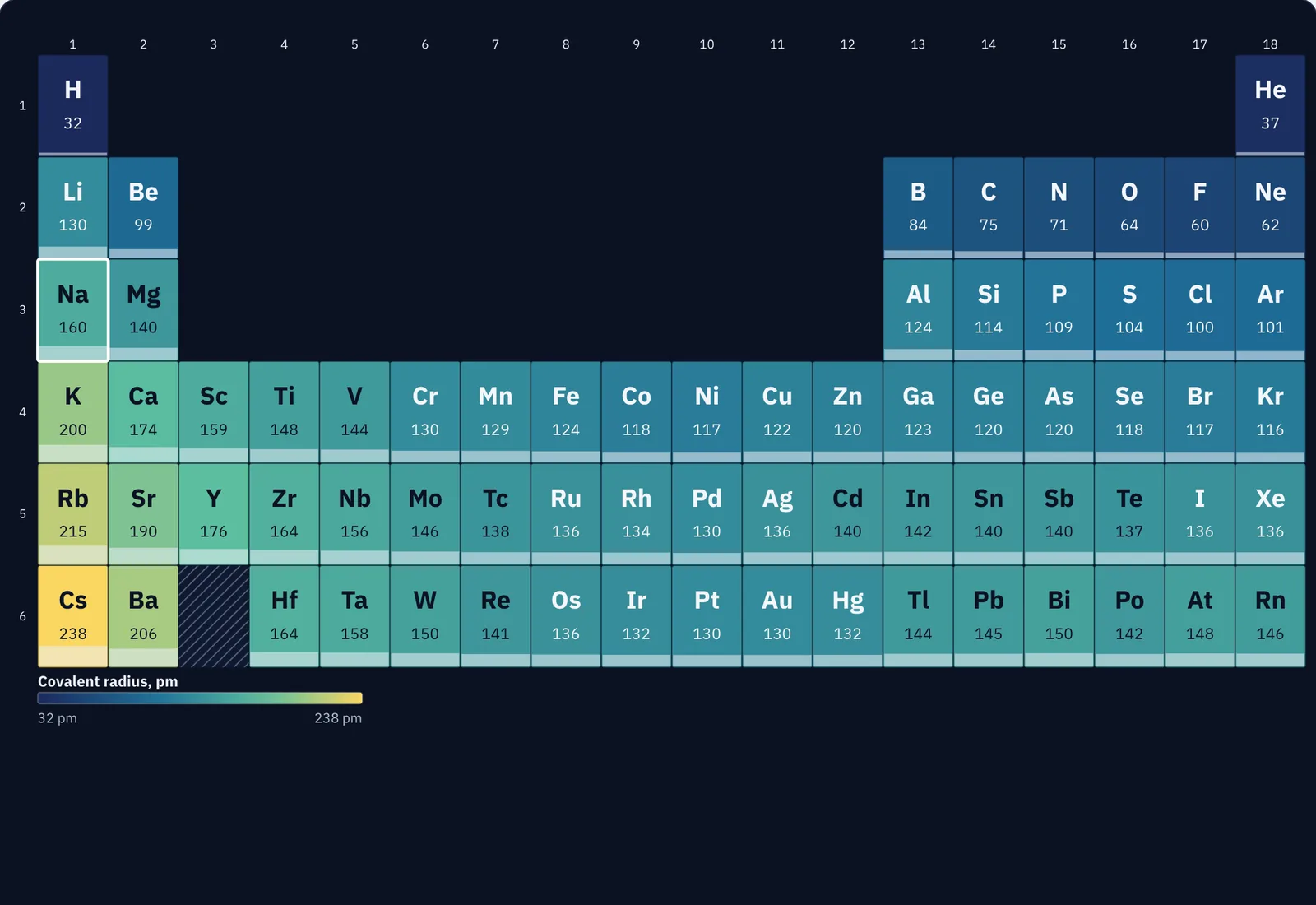
The same pattern appears in the table: elements on the left of a period are the most metallic. Within a group, metallic character increases downwards, because the outer electron is in a shell farther from the nucleus.
For the curious
The first electron removed from aluminium costs less energy (578 kJ/mol) than the first from magnesium (738 kJ/mol), because it is in the more distant 3p subshell. The order Na > Mg > Al emerges from the total cost of forming the usual ions and from the reactions below.
| Z | Symbol | Element | Period | Group | Covalent radius, pm | First ionisation energy, kJ/mol | Electronegativity (Pauling) |
|---|---|---|---|---|---|---|---|
| 1 | H | hydrogen | 1 | 1 | 32 | 1,312.0 | 2.20 |
| 2 | He | helium | 1 | 18 | 37 | 2,372.3 | – |
| 3 | Li | lithium | 2 | 1 | 130 | 520.2 | 0.98 |
| 4 | Be | beryllium | 2 | 2 | 99 | 899.5 | 1.57 |
| 5 | B | boron | 2 | 13 | 84 | 800.6 | 2.04 |
| 6 | C | carbon | 2 | 14 | 75 | 1,086.5 | 2.55 |
| 7 | N | nitrogen | 2 | 15 | 71 | 1,402.3 | 3.04 |
| 8 | O | oxygen | 2 | 16 | 64 | 1,313.9 | 3.44 |
| 9 | F | fluorine | 2 | 17 | 60 | 1,681.0 | 3.98 |
| 10 | Ne | neon | 2 | 18 | 62 | 2,080.7 | – |
| 11 | Na | sodium | 3 | 1 | 160 | 495.8 | 0.93 |
| 12 | Mg | magnesium | 3 | 2 | 140 | 737.8 | 1.31 |
| 13 | Al | aluminium | 3 | 13 | 124 | 577.5 | 1.61 |
| 14 | Si | silicon | 3 | 14 | 114 | 786.5 | 1.90 |
| 15 | P | phosphorus | 3 | 15 | 109 | 1,011.8 | 2.19 |
| 16 | S | sulfur | 3 | 16 | 104 | 999.6 | 2.58 |
| 17 | Cl | chlorine | 3 | 17 | 100 | 1,251.2 | 3.16 |
| 18 | Ar | argon | 3 | 18 | 101 | 1,520.6 | – |
| 19 | K | potassium | 4 | 1 | 200 | 418.8 | 0.82 |
| 20 | Ca | calcium | 4 | 2 | 174 | 589.8 | 1.00 |
| 21 | Sc | scandium | 4 | 3 | 159 | 633.1 | 1.36 |
| 22 | Ti | titanium | 4 | 4 | 148 | 658.8 | 1.54 |
| 23 | V | vanadium | 4 | 5 | 144 | 650.9 | 1.63 |
| 24 | Cr | chromium | 4 | 6 | 130 | 652.9 | 1.66 |
| 25 | Mn | manganese | 4 | 7 | 129 | 717.3 | 1.55 |
| 26 | Fe | iron | 4 | 8 | 124 | 762.5 | 1.83 |
| 27 | Co | cobalt | 4 | 9 | 118 | 760.4 | 1.88 |
| 28 | Ni | nickel | 4 | 10 | 117 | 737.1 | 1.91 |
| 29 | Cu | copper | 4 | 11 | 122 | 745.5 | 1.90 |
| 30 | Zn | zinc | 4 | 12 | 120 | 906.4 | 1.65 |
| 31 | Ga | gallium | 4 | 13 | 123 | 578.8 | 1.81 |
| 32 | Ge | germanium | 4 | 14 | 120 | 762.2 | 2.01 |
| 33 | As | arsenic | 4 | 15 | 120 | 944.5 | 2.18 |
| 34 | Se | selenium | 4 | 16 | 118 | 941.0 | 2.55 |
| 35 | Br | bromine | 4 | 17 | 117 | 1,139.9 | 2.96 |
| 36 | Kr | krypton | 4 | 18 | 116 | 1,350.8 | – |
| 37 | Rb | rubidium | 5 | 1 | 215 | 403.0 | 0.82 |
| 38 | Sr | strontium | 5 | 2 | 190 | 549.5 | 0.95 |
| 39 | Y | yttrium | 5 | 3 | 176 | 599.9 | 1.22 |
| 40 | Zr | zirconium | 5 | 4 | 164 | 640.1 | 1.33 |
| 41 | Nb | niobium | 5 | 5 | 156 | 652.1 | 1.6 |
| 42 | Mo | molybdenum | 5 | 6 | 146 | 684.3 | 2.16 |
| 43 | Tc | technetium | 5 | 7 | 138 | 702.4 | 2.10 |
| 44 | Ru | ruthenium | 5 | 8 | 136 | 710.2 | 2.2 |
| 45 | Rh | rhodium | 5 | 9 | 134 | 719.7 | 2.28 |
| 46 | Pd | palladium | 5 | 10 | 130 | 804.4 | 2.20 |
| 47 | Ag | silver | 5 | 11 | 136 | 731.0 | 1.93 |
| 48 | Cd | cadmium | 5 | 12 | 140 | 867.8 | 1.69 |
| 49 | In | indium | 5 | 13 | 142 | 558.3 | 1.78 |
| 50 | Sn | tin | 5 | 14 | 140 | 708.6 | 1.96 |
| 51 | Sb | antimony | 5 | 15 | 140 | 830.6 | 2.05 |
| 52 | Te | tellurium | 5 | 16 | 137 | 869.3 | 2.1 |
| 53 | I | iodine | 5 | 17 | 136 | 1,008.4 | 2.66 |
| 54 | Xe | xenon | 5 | 18 | 136 | 1,170.4 | 2.60 |
| 55 | Cs | caesium | 6 | 1 | 238 | 375.7 | 0.79 |
| 56 | Ba | barium | 6 | 2 | 206 | 502.8 | 0.89 |
| 72 | Hf | hafnium | 6 | 4 | 164 | 658.5 | 1.3 |
| 73 | Ta | tantalum | 6 | 5 | 158 | 728.4 | 1.5 |
| 74 | W | tungsten | 6 | 6 | 150 | 758.8 | 1.7 |
| 75 | Re | rhenium | 6 | 7 | 141 | 755.8 | 1.9 |
| 76 | Os | osmium | 6 | 8 | 136 | 814.2 | 2.2 |
| 77 | Ir | iridium | 6 | 9 | 132 | 865.2 | 2.2 |
| 78 | Pt | platinum | 6 | 10 | 130 | 864.4 | 2.2 |
| 79 | Au | gold | 6 | 11 | 130 | 890.1 | 2.4 |
| 80 | Hg | mercury | 6 | 12 | 132 | 1,007.1 | 1.9 |
| 81 | Tl | thallium | 6 | 13 | 144 | 589.4 | 1.8 |
| 82 | Pb | lead | 6 | 14 | 145 | 715.6 | 1.8 |
| 83 | Bi | bismuth | 6 | 15 | 150 | 702.9 | 1.9 |
| 84 | Po | polonium | 6 | 16 | 142 | 811.8 | 2.0 |
| 85 | At | astatine | 6 | 17 | 148 | – | 2.2 |
| 86 | Rn | radon | 6 | 18 | 146 | 1,037.1 | – |
| Germanium | Atomic mass | Density, g/cm³ |
|---|---|---|
| silicon (Si), neighbour | 28.085 | 2.33 |
| gallium (Ga), neighbour | 69.723 | 5.91 |
| arsenic (As), neighbour | 74.922 | 5.75 |
| tin (Sn), neighbour | 118.710 | 7.29 |
| Mean of the four neighbours (calculated) | 72.86 | 5.32 |
| Mendeleev, predicted in 1871 | 72 | 5.5 |
| Winkler, measured in 1886 | 72.3 | 5.469 |
| Today’s value | 72.630 | 5.323 |
| Ion | Ionic radius, pm (Shannon, coordination 6) |
|---|---|
| Li⁺ | 76 |
| Na⁺ | 102 |
| K⁺ | 138 |
| Rb⁺ | 152 |
| Cs⁺ | 167 |
| Mg²⁺ | 72 |
| Ca²⁺ | 100 |
| Al³⁺ | 53.5 |
| O²⁻ | 140 |
| S²⁻ | 184 |
| F⁻ | 133 |
| Cl⁻ | 181 |
| Br⁻ | 196 |
| I⁻ | 220 |
Table values and calculation. Values from tables: the covalent radius and the first ionisation energy are measured, and the Pauling electronegativity is a relative scale, deduced from bond energies; all three are those of the Royal Society of Chemistry table. The atomic masses are CIAAW. The ionic radii (Na⁺ 102 pm, Cl⁻ 181 pm) are the Shannon effective radii for six-fold coordination, deduced from the distances in crystals by a convention. Mendeleev’s prediction (1871) and Winkler’s measurement (1886) are the values printed in 1901; the mean of the four neighbours is a calculation done in front of you. A lighter colour means a larger value, and the height of the bar in the cell shows the same thing. Hatched cells have no value in the table. Melting point follows no simple rule and is not coloured here as a trend. The lanthanides and the seventh period are not in the picture.
Sources and credits. Covalent radius, first ionisation energy, Pauling electronegativity and density: values cited from the element pages of the Royal Society of Chemistry (periodic-table.rsc.org), consulted on 2026-11-16; cross-checked against the PubChem Periodic Table (NIST, a work of the US government). Atomic masses: CIAAW, abridged table 2024. Ionic radii: R. D. Shannon, Acta Crystallographica A32, 751 (1976), database of Imperial College London. Mendeleev (1871) and Winkler (1886): Popular Science Monthly, vol. 59 (1901), p. 162, public domain.
Reaction with water and acids: three patterns
Sodium reacts with cold water in a strongly exothermic reaction, producing sodium hydroxide and hydrogen. This is a demonstration done only by the teacher, because the reaction is violent:
2Na + 2H₂O → 2NaOH + H₂
Magnesium reacts very weakly with cold water. The magnesium hydroxide formed covers the metal with a thin layer that stops the reaction:
Mg + 2H₂O → Mg(OH)₂ + H₂
Magnesium burns in steam to produce magnesium oxide, also as a demonstration done by the teacher. Aluminium reacts with water only as a powder heated in steam, and the reaction is slow because the metal already has an oxide layer:
2Al + 3H₂O → Al₂O₃ + 3H₂
With dilute hydrochloric acid, magnesium gives off bubbles of hydrogen and dissolves, in a demonstration done by the teacher:
Mg + 2HCl → MgCl₂ + H₂
Aluminium also dissolves in dilute hydrochloric acid and gives off hydrogen, in a demonstration done by the teacher:
2Al + 6HCl → 2AlCl₃ + 3H₂
Reaction with oxygen: the oxide layer
Sodium burns in oxygen with an orange flame and produces a mixture of sodium oxide and peroxide; in class, the oxide is written, and the peroxide appears in the second equation. Magnesium burns with a very bright white flame, while aluminium burns only as a powder, because the oxide layer on the pieces protects the metal:
4Na + O₂ → 2Na₂O
2Na + O₂ → Na₂O₂
2Mg + O₂ → 2MgO
4Al + 3O₂ → 2Al₂O₃
The aluminium pan lasts because aluminium oxide, formed immediately in air, stays attached to the metal and covers it. This is the effect of the protective layer. The tendency to lose electrons decreases from sodium to aluminium, but the rate of a reaction also depends on what forms at the surface.
The hydroxides: NaOH > Mg(OH)₂ > Al(OH)₃
The more metallic a metal, the stronger its hydroxide is as a base. Sodium hydroxide dissolves very well in water (approximately 111 g per 100 mL of water, at 20 °C) and is a strong base. Magnesium hydroxide is practically insoluble (0.0009 g per 100 mL of water, at 18 °C) and is a weak base. Like any base, it reacts with acids. The hydroxides therefore lie on a scale: NaOH is a strong base, Mg(OH)₂ a weak base, Al(OH)₃ amphoteric.
Mg(OH)₂ + 2HCl → MgCl₂ + 2H₂O
Aluminium hydroxide is insoluble and reacts with both acids and strong bases. A substance that reacts in both ways is called amphoteric.
Al(OH)₃ + 3HCl → AlCl₃ + 3H₂O
Al(OH)₃ + NaOH → Na[Al(OH)₄]
Amphoterism shows that aluminium has weaker metallic character than sodium and magnesium: its hydroxide also has some acidic character.
Worked example
Sodium with water and the volume of hydrogen
Sodium reacts with water. What volume of hydrogen, at normal conditions, comes from 4.6 g of sodium?
The reaction scheme is Na + H₂O → NaOH + H₂. Balance hydrogen and sodium: 2Na + 2H₂O → 2NaOH + H₂. Hydrogen atoms: 4 on the left and 2 + 2 = 4 on the right. Oxygen atoms: 2 and 2. Sodium atoms: 2 and 2.
The amount of sodium is n(Na) = 4.6 ÷ 23 = 0.2 mol. From the equation, 2 mol of Na give 1 mol of H₂, so n(H₂) = 0.2 ÷ 2 = 0.1 mol.
The volume is V = 0.1 · 22.4 = 2.24 L. The order of magnitude fits: 0.1 mol of gas at normal conditions occupies approximately 2 L.
In Romania
Aluminium from Slatina
The ALRO plant in Slatina cast the first batch of Romanian aluminium on 30 June 1965. At first it produced 8,000 tonnes of electrolytic aluminium a year. Today its installed capacity is 265,000 tonnes a year: 265,000 ÷ 8,000 ≈ 33 times as much. Since it was founded, the plant has produced around 11 million tonnes of electrolytic aluminium.
The company calls the metal produced in Slatina “electrolytic aluminium”: it is obtained by electrolysis. In the kitchen, the same metal appears as a pan or foil, covered by the aluminium oxide layer described above.
In short
- Metallic character is the tendency of an atom to lose electrons and form positive ions; it decreases across a period from Na to Al (2,8,1; 2,8,2; 2,8,3) and increases down a group.
- Forming the ions costs 496 kJ/mol for Na⁺, 2,189 kJ/mol for Mg²⁺ and 5,140 kJ/mol for Al³⁺, so Na > Mg > Al.
- Sodium reacts violently with cold water (2Na + 2H₂O → 2NaOH + H₂), magnesium reacts very weakly, and aluminium is protected by its oxide layer.
- Base strength decreases in the order NaOH > Mg(OH)₂ > Al(OH)₃.
- Al(OH)₃ is amphoteric: it reacts with both acids and strong bases (Al(OH)₃ + NaOH → Na[Al(OH)₄]).
Common mistakes
WrongAluminium does not react with oxygen, because it does not rust.
RightAluminium reacts immediately with oxygen and forms a thin layer of aluminium oxide, which stays on the metal and stops the reaction from going further. Aluminium does not rust, because rusting is the reaction of iron.
WrongMore valence electrons mean stronger metallic character.
RightThe reverse is true: sodium, with one valence electron, is more metallic than aluminium with three. An atom with fewer valence electrons loses them more easily.
WrongAluminium hydroxide is a strong base, like sodium hydroxide.
RightAluminium hydroxide is insoluble and amphoteric: it reacts with both acids and strong bases. Of the three, only NaOH is a strong base.
Test yourself
7 questions. For the first 6 you see the explanation at once, with the paragraph of the lesson that supports it; for the written ones you compare with a good answer.
Which sequence puts the metals in decreasing order of metallic character?
Answer
c) Na > Mg > Al. Sodium loses one electron, magnesium two and aluminium three, while the energy cost increases from Na to Al.
Which metal reacts violently with cold water?
Answer
c) Sodium. Sodium loses its valence electron most easily; magnesium reacts very weakly, and aluminium is protected by an oxide layer.
What does it mean that aluminium hydroxide is amphoteric?
Answer
b) It reacts with both acids and strong bases. Amphoteric means that the substance behaves both as a base (with acids) and as an acid (with strong bases).
Why does an aluminium pan survive in water?
Answer
c) A thin layer of aluminium oxide covers the metal. The oxide formed immediately in air stays attached to the metal and stops the reaction from going further.
What volume of hydrogen, at normal conditions, comes from 4.6 g of sodium and water? Round to two decimal places, in litres.
LAnswer
2.24 L. n(Na) = 4.6 ÷ 23 = 0.2 mol and n(H₂) = 0.2 ÷ 2 = 0.1 mol, so V = 0.1 · 22.4 = 2.24 L.
Place each characteristic with the metal it belongs to.
Answer
Sodium: Reacts with cold water in a strongly exothermic reaction; Its hydroxide is a strong, highly soluble base.
Magnesium: Burns in steam to produce an oxide; Its hydroxide is practically insoluble and a weak base.
Aluminium: Burns only as a powder, because an oxide layer protects the pieces; Its hydroxide is amphoteric.
Each characteristic describes the behaviour of the metal towards water, towards oxygen or in its hydroxide.
Aluminium has weaker metallic character than sodium, yet it reacts immediately with oxygen in the air. Explain why an aluminium pan nevertheless survives.
A good answer
Aluminium reacts with oxygen and forms aluminium oxide on the surface. The layer is thin, tough and stays attached to the metal, so oxygen and water can no longer reach the aluminium underneath. The reaction stops once the layer forms.
A complete answer says that the oxide forms immediately, stays on the metal and stops the reaction from going further.
Terms
- metallic character
- The tendency of an atom to lose electrons and form positive ions.
- valence electrons
- Electrons in the outermost shell of an atom.
- strong base
- A base that is very soluble in water and releases hydroxide ions completely in solution (for example NaOH).
- amphoteric
- Describes a substance that reacts with both acids and strong bases.
- oxide layer
- A thin film of oxide formed on the surface of a metal, which can protect it.
Sources and link to the programme
- Royal Society of Chemistry – Sodium, magnesium, aluminium (energiile de ionizare și electronegativitatea) – successive ionisation energies: Na 495.8 and 4562; Mg 737.8, 1450.7 and 7732.7; Al 577.5, 1816.7 and 2744.8 kJ/mol
- Chemguide – Chemical reactions of the Period 3 elements – reaction of sodium with cold water; magnesium reacts very weakly with cold water, hydroxide covers the metal, it burns in steam; aluminium and the oxide layer; burning in oxygen
- Chemguide – Acid-base behaviour of the Period 3 oxides – amphoteric aluminium oxide: reacts with acids and sodium hydroxide (aluminates)
- Chemguide – Reactions of the Group 2 elements with acids – magnesium reacts with dilute hydrochloric acid to produce hydrogen and magnesium chloride
- Chemguide – Core Chemistry 14–16: equations for reactions of acids (aluminium with hydrochloric acid) – 2Al + 6HCl → 2AlCl₃ + 3H₂
- WebElements (University of Sheffield) – Aluminium: chemical reactions – aluminium reacts with dilute hydrochloric acid to produce Al³⁺ ions and hydrogen; the thin oxide layer on the surface
- PubChem – Sodium hydroxide – solubility of sodium hydroxide in water: 111 g per 100 mL, at 20 °C
- PubChem – Magnesium hydroxide – solubility of magnesium hydroxide: 0.0009 g per 100 mL of water, at 18 °C; soluble in dilute acids
- PubChem – Aluminum hydroxide – aluminium hydroxide: insoluble in water, soluble in acids and strong bases
- ALRO – comunicat: 60 de ani de activitate (BVB, 2025) – first batch of Romanian aluminium at Slatina, 30 June 1965; 8,000 tonnes a year at founding; capacity of 265,000 tonnes a year of electrolytic aluminium
- Adevărul – Povestea mastodontului industrial ALRO Slatina, ajuns la 50 de ani – first batch of Romanian aluminium at Slatina, 30 June 1965; capacity of 265,000 tonnes a year
From the programme: “Metallic character; variation in metallic character (sodium, magnesium, aluminium)”; “Metallic character; variation in metallic character across a period (sodium, magnesium, aluminium)” (TC: Core curriculum (1 hour a week)). Specific competences followed: 1.3, 2.3, 4.3, 5.3, 6.3.