Chemistry 9 RO
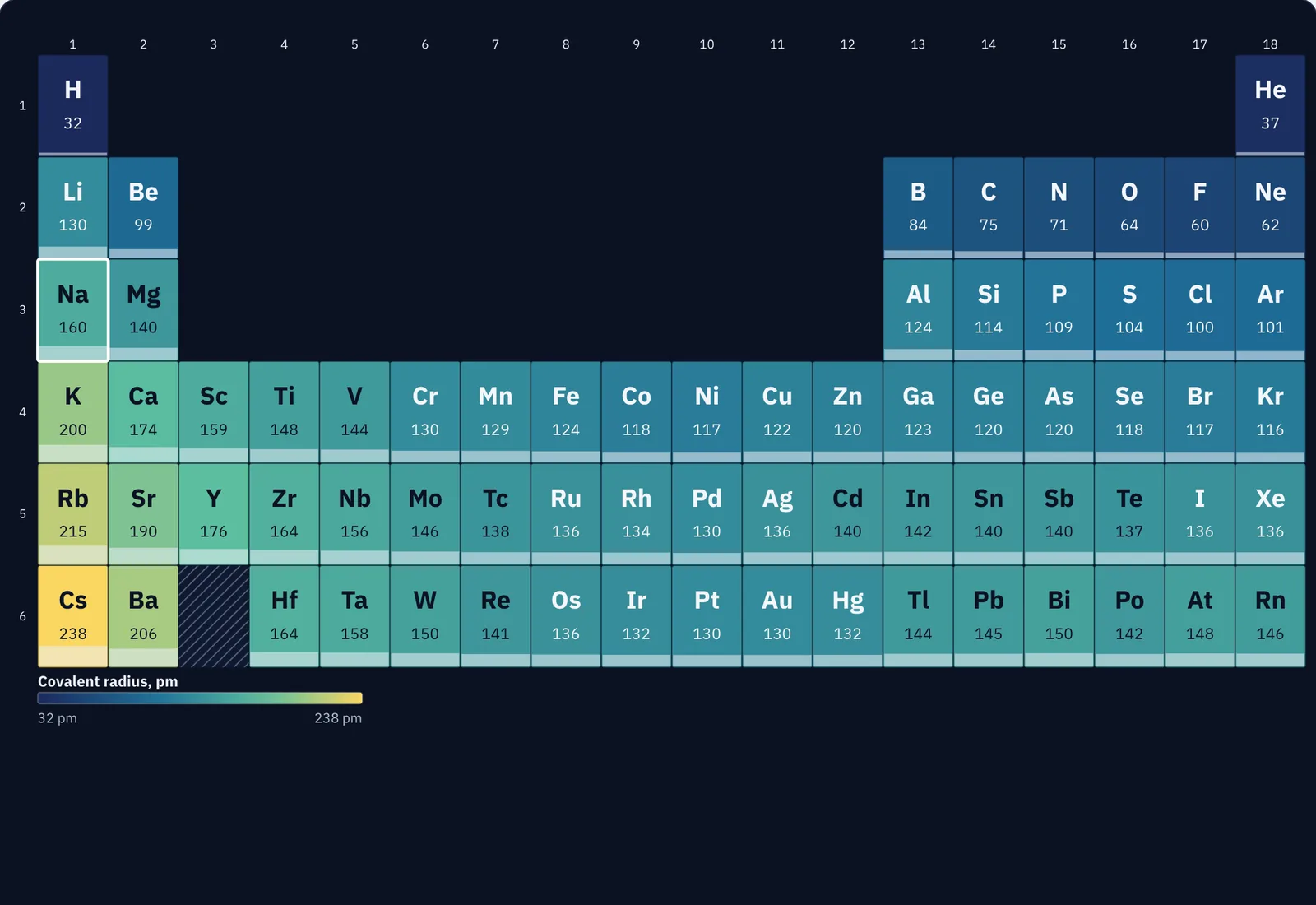
The periodic table as a colour map on a dark background: each element of periods 1–6 is a cell, lighter in colour the larger the value. The covalent radius runs from 32 pm (H) to 238 pm (Cs), and grows towards the left and downwards; ionisation energy and electronegativity grow towards the right and upwards. Below silicon, between gallium and arsenic, the cell of germanium is empty.

The electron structure of the atom. Metallic character. Non-metallic character

Chapter 5

The periodic table – what the place of an element tells you

What does the place of an element in the table tell you?

Below silicon, in Mendeleev’s table, there was an empty place, and he wrote down in advance what the element that would fill it would be like. The picture colours the table by three quantities from tables (radius, ionisation energy, electronegativity), then hides germanium. Start with a prediction, then guess the missing element yourself.

Which atom is bigger, sodium or chlorine?

Sodium and chlorine are in the same period, the third, at opposite ends: sodium in group 1, chlorine in group 17. In the picture their cells are circled, still uncoloured.

Which of the two atoms has the larger radius?

The radius falls towards the right and grows downwards

The cells are coloured by covalent radius: half the distance between the nuclei of two bonded atoms. A lighter colour means a larger radius. The smallest is hydrogen (32 pm), the largest caesium (238 pm).

Sodium has 160 pm, chlorine 100 pm. In group 1 the radius grows from lithium (130 pm) to caesium (238 pm), because a new shell appears at each step.

Ions have different radii from atoms: Na⁺ has 102 pm against 160 pm for the atom, and Cl⁻ 181 pm against 100 pm. Tap the cells to see both values.

Ionisation energy turns the map upside down

The first ionisation energy is the energy needed to tear one electron off an isolated atom, measured for a mole of atoms. Sodium has 495.8 kJ/mol, chlorine 1,251.2 kJ/mol.

Small values are at the left and bottom (the smallest, caesium: 375.7 kJ/mol), large ones at the right and top (the largest, helium: 2,372.3 kJ/mol). Atoms with a small radius hold their outer electrons closer to the nucleus, so it costs more to remove them.

The map is not a smooth scale: aluminium (577.5) has less than magnesium (737.8), because its outer electron is in a different subshell.

Three maps, one pattern: metals on the left, non-metals on the right

Electronegativity (the Pauling scale) shows how strongly an atom attracts the electrons in a bond. The largest is fluorine (3.98), the smallest caesium (0.79). Hatched cells (He, Ne, Ar, Kr, Rn) have no value in the table.

The three maps agree: the alkali metals, from lithium to caesium, have ionisation energies between 375.7 and 520.2 kJ/mol and electronegativities between 0.79 and 0.98; for the halogens, from fluorine to iodine, the energies are between 1,008.4 and 1,681.0 kJ/mol, and the electronegativities between 2.66 and 3.98.

Between the two sides, the elements with a dotted outline (boron, silicon, germanium, arsenic, antimony, tellurium) are semimetals.

The empty place below silicon: what values does germanium have?

The cell in the middle is germanium, hidden. Its neighbours, with atomic mass and density in g/cm³: silicon 28.085 and 2.33, tin 118.710 and 7.29, gallium 69.723 and 5.91, arsenic 74.922 and 5.75.

What atomic mass and what density do you put in the empty cell? Choose the two numbers with the − and + buttons next to the picture. There is no score: at the next step you see them beside Mendeleev’s values.

Mendeleev wrote the values fifteen years earlier

In 1871 Mendeleev predicted for the element he called eka-silicon an atomic mass of 72 and a density of 5.5 g/cm³. He also predicted the formula of its oxide, EsO₂, and its density, 4.7 g/cm³.

In the picture: your values and his, side by side. Nobody had yet seen the element.

Winkler found it in 1886, and the values came out almost the same

In a silver mineral near Freiberg, Winkler discovered germanium and measured an atomic mass of 72.3 and a density of 5.469 g/cm³. Today’s values are 72.630 and 5.323 g/cm³.

Against today’s value, Mendeleev’s prediction differs by −0.9% in mass and by +3.3% in density. The mean of the four neighbours gives 72.86 and 5.32, that is +0.3% and −0.1%.

The mean of the neighbours got the mass and the density right, but not every quantity: germanium melts at 938 °C, while the mean of silicon (1,414 °C) and tin (232 °C) is 823 °C. That is why melting point is not coloured on the map.

Now you explain: selenium

Selenium lies between sulfur and tellurium, in group 16. On the ionisation-energy map its cell is empty. Sulfur has 999.6 kJ/mol, tellurium 869.3 kJ/mol.

What value would you put at selenium? Explain, in a few sentences, why you can guess the value of an element from its neighbours and when you cannot.

Compare with an answer

The mean of sulfur and tellurium is 934.4 kJ/mol, and selenium has 941.0 kJ/mol (−0.7%). Within a group, values usually change gradually, so selenium can be guessed between its neighbours; it is only a trend. For electronegativity the mean gives 2.34, against 2.55 for selenium (−8.2%), and in group 14 the order breaks: carbon 2.55, silicon 1.90, germanium 2.01. For quantities that do not vary gradually, like melting point, guessing does not work.

The lesson on germanium and the periodic table · The lesson on atomic and ionic radius

Table values and calculation. Values from tables: the covalent radius and the first ionisation energy are measured, and the Pauling electronegativity is a relative scale, deduced from bond energies; all three are those of the Royal Society of Chemistry table. The atomic masses are CIAAW. The ionic radii (Na⁺ 102 pm, Cl⁻ 181 pm) are the Shannon effective radii for six-fold coordination, deduced from the distances in crystals by a convention. Mendeleev’s prediction (1871) and Winkler’s measurement (1886) are the values printed in 1901; the mean of the four neighbours is a calculation done in front of you. A lighter colour means a larger value, and the height of the bar in the cell shows the same thing. Hatched cells have no value in the table. Melting point follows no simple rule and is not coloured here as a trend. The lanthanides and the seventh period are not in the picture.

Sources and credits. Covalent radius, first ionisation energy, Pauling electronegativity and density: values cited from the element pages of the Royal Society of Chemistry (periodic-table.rsc.org), consulted on 2026-11-16; cross-checked against the PubChem Periodic Table (NIST, a work of the US government). Atomic masses: CIAAW, abridged table 2024. Ionic radii: R. D. Shannon, Acta Crystallographica A32, 751 (1976), database of Imperial College London. Mendeleev (1871) and Winkler (1886): Popular Science Monthly, vol. 59 (1901), p. 162, public domain.

The same data, as a table
ZSymbolElementPeriodGroupCovalent radius, pmFirst ionisation energy, kJ/molElectronegativity (Pauling)
1Hhydrogen11321,312.02.20
2Hehelium118372,372.3–
3Lilithium21130520.20.98
4Beberyllium2299899.51.57
5Bboron21384800.62.04
6Ccarbon214751,086.52.55
7Nnitrogen215711,402.33.04
8Ooxygen216641,313.93.44
9Ffluorine217601,681.03.98
10Neneon218622,080.7–
11Nasodium31160495.80.93
12Mgmagnesium32140737.81.31
13Alaluminium313124577.51.61
14Sisilicon314114786.51.90
15Pphosphorus3151091,011.82.19
16Ssulfur316104999.62.58
17Clchlorine3171001,251.23.16
18Arargon3181011,520.6–
19Kpotassium41200418.80.82
20Cacalcium42174589.81.00
21Scscandium43159633.11.36
22Tititanium44148658.81.54
23Vvanadium45144650.91.63
24Crchromium46130652.91.66
25Mnmanganese47129717.31.55
26Feiron48124762.51.83
27Cocobalt49118760.41.88
28Ninickel410117737.11.91
29Cucopper411122745.51.90
30Znzinc412120906.41.65
31Gagallium413123578.81.81
32Gegermanium414120762.22.01
33Asarsenic415120944.52.18
34Seselenium416118941.02.55
35Brbromine4171171,139.92.96
36Krkrypton4181161,350.8–
37Rbrubidium51215403.00.82
38Srstrontium52190549.50.95
39Yyttrium53176599.91.22
40Zrzirconium54164640.11.33
41Nbniobium55156652.11.6
42Momolybdenum56146684.32.16
43Tctechnetium57138702.42.10
44Ruruthenium58136710.22.2
45Rhrhodium59134719.72.28
46Pdpalladium510130804.42.20
47Agsilver511136731.01.93
48Cdcadmium512140867.81.69
49Inindium513142558.31.78
50Sntin514140708.61.96
51Sbantimony515140830.62.05
52Tetellurium516137869.32.1
53Iiodine5171361,008.42.66
54Xexenon5181361,170.42.60
55Cscaesium61238375.70.79
56Babarium62206502.80.89
72Hfhafnium64164658.51.3
73Tatantalum65158728.41.5
74Wtungsten66150758.81.7
75Rerhenium67141755.81.9
76Ososmium68136814.22.2
77Iriridium69132865.22.2
78Ptplatinum610130864.42.2
79Augold611130890.12.4
80Hgmercury6121321,007.11.9
81Tlthallium613144589.41.8
82Pblead614145715.61.8
83Bibismuth615150702.91.9
84Popolonium616142811.82.0
85Atastatine617148–2.2
86Rnradon6181461,037.1–
GermaniumAtomic massDensity, g/cm³
silicon (Si), neighbour28.0852.33
gallium (Ga), neighbour69.7235.91
arsenic (As), neighbour74.9225.75
tin (Sn), neighbour118.7107.29
Mean of the four neighbours (calculated)72.865.32
Mendeleev, predicted in 1871725.5
Winkler, measured in 188672.35.469
Today’s value72.6305.323
IonIonic radius, pm (Shannon, coordination 6)
Li⁺76
Na⁺102
K⁺138
Rb⁺152
Cs⁺167
Mg²⁺72
Ca²⁺100
Al³⁺53.5
O²⁻140
S²⁻184
F⁻133
Cl⁻181
Br⁻196
I⁻220

Lessons of the chapter

Lessons: 3 lessons TC, 1 lesson MI. The badge of each lesson says which profile it belongs to.

Which profile are you on?

  1. 5.1How Mendeleev predicted an element no one had seen TC · beyond your profileCorrelations between the electron configurations of chemical elements in periods 1, 2, 3 and 4 and their positions in the periodic tableHow can you find an element’s place in the periodic table from its electron configuration, and what can its place tell you about it?
  2. 5.2Why atoms shrink across a period and ions differ in size from their atoms MI · beyond your profileAtomic radius; variation of atomic radius for elements in the main groupsSodium loses an electron and chlorine gains one. Which ion is larger than the atom it came from, and by how much?
  3. 5.3Why sodium reacts with water but an aluminium pan does not TC · beyond your profileMetallic character; variation in metallic character (sodium, magnesium, aluminium)Sodium, magnesium and aluminium are neighbours in period 3. Why do they behave so differently in water and air?
  4. 5.4Why chlorine displaces bromine from a salt, but iodine cannot displace chlorine TC · beyond your profileNon-metallic character; variation in non-metallic character across a group and a period (for chlorine, bromine, iodine and for nitrogen, oxygen, fluorine)Chlorine, bromine and iodine are in the same group. Why can one displace another from a salt, but not the other way round?

Test tomorrowten questions from chapter 5For the class: projector, sheets, shared test