Chapter 5 · The periodic tableLesson 5.1TC Core curriculum (1 hour a week) · beyond your profile
Correlations between the electron configurations of chemical elements in periods 1, 2, 3 and 4 and their positions in the periodic table
How Mendeleev predicted an element no one had seen
How can you find an element’s place in the periodic table from its electron configuration, and what can its place tell you about it?
Before you read: what do you think?
In 1871 Mendeleev wrote that the unknown element below silicon would have a density of 5.5 g/cm³. In 1886 the chemist Clemens Winkler found the element, germanium, and measured its density. How close was the prediction?
See the answer
Winkler measured 5.469 g/cm³, 0.6% below the predicted value. The prediction came very close, though it was not exact. Today’s accepted value is 5.323 g/cm³, 3% below the prediction; the difference does not change the conclusion.
In 1869 Mendeleev arranged the known elements in a table and left gaps where the sequence did not fit. Below silicon was a gap, and he wrote down the mass, density, colour and compounds of the missing element in advance. In 1886, in a silver mineral near Freiberg in Germany, Winkler found a new element, and his measurements came remarkably close.
Read the period and group from the configuration
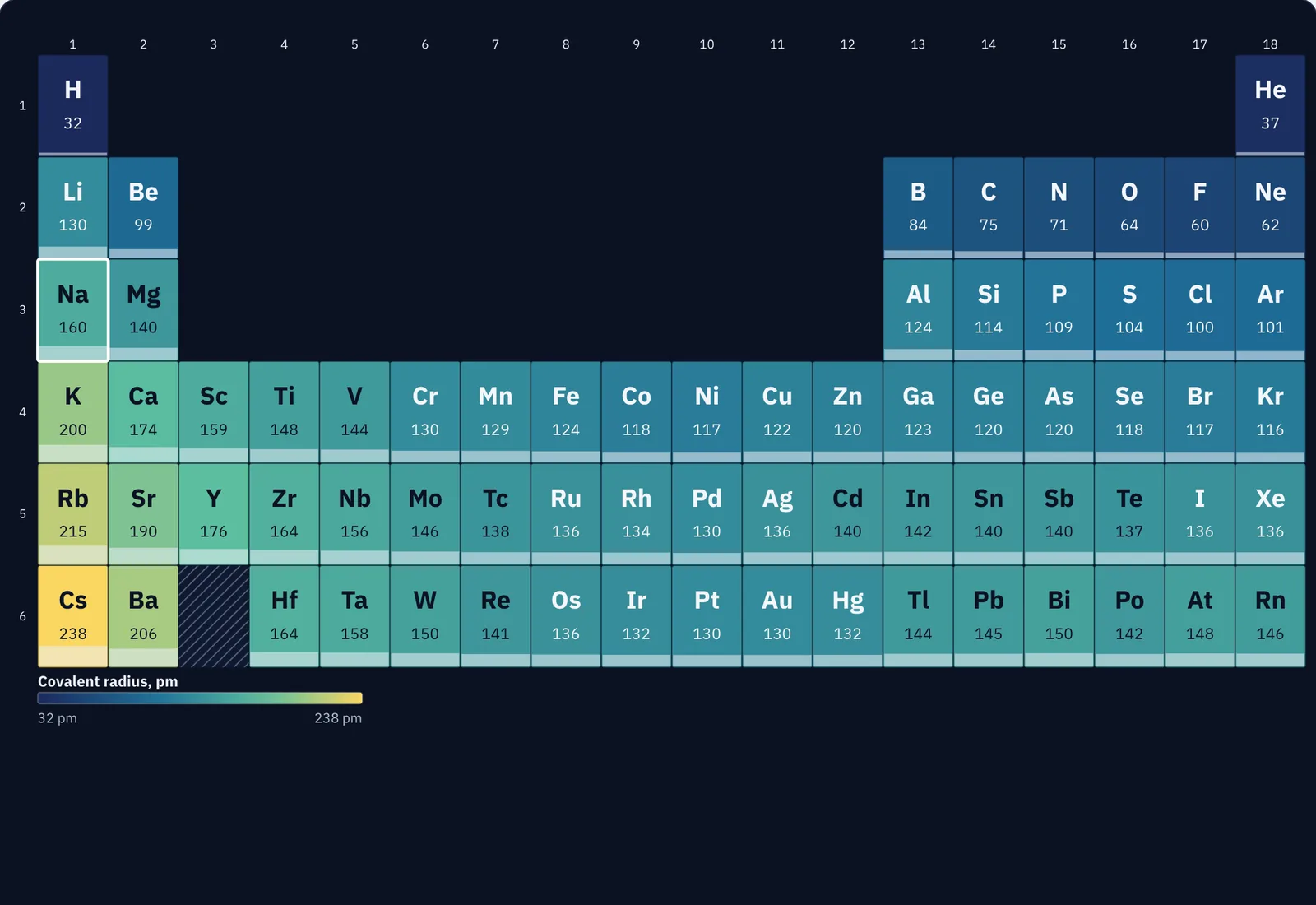
The periodic table arranges elements in increasing order of atomic number Z. The rows are called periods, and the columns groups. Groups are numbered from 1 to 18 (the current notation) or, for the main groups, from I A to VIII A (the older notation used in textbooks).
The period number equals the number of occupied electron shells. Sodium, with the configuration 2,8,1, has three shells: it is in period 3. Potassium, 2,8,8,1, has four shells: period 4.
For the main groups, the number of electrons in the outermost shell (valence electrons) gives the group. Groups 1 and 2 (I A and II A) have one and two valence electrons. Groups 13–18 (III A–VIII A) have three to eight valence electrons, so the group number is the number of valence electrons plus 10. Chlorine, 2,8,7, has seven valence electrons and is in group 17 (VII A).
Helium is the only exception: it has two electrons, but is in group 18 because the first shell is complete with two electrons.
For the curious
Elements in period 4 and beyond also have a set of ten columns, groups 3–12, between group 2 and group 13. These make up the d block, while groups 1 and 2 form the s block. Groups 13–18 form the p block; helium, with the configuration 1s², is the only exception: it sits in group 18, but its last electron enters the s subshell. These blocks belong to the mathematics–informatics and natural sciences profiles: they show which subshell the last electron enters.
Same number of valence electrons, same family
Lithium, sodium and potassium have the configurations 2,1, 2,8,1 and 2,8,8,1: one valence electron each, so they are in group 1. Fluorine (2,7) and chlorine (2,8,7) have seven valence electrons, so they are in group 17. Elements in a group have similar chemical properties, and properties change gradually from one period to the next. This is why there is a periodic law: the properties of elements vary periodically with atomic number.
Metals occupy the left and centre of the table, non-metals the right. A stepped line runs between them. Elements next to it, such as silicon, germanium and arsenic, have properties of both metals and non-metals and are called semimetals (metalloids).
The gap below silicon
Mendeleev ordered his table by atomic mass. When an element did not fit with its chemical neighbours, he moved it: tellurium (atomic mass 127.60) went before iodine (126.904), because tellurium resembles oxygen and sulfur, while iodine resembles chlorine. He left gaps where no known element belonged.
He called the space below silicon, between gallium and arsenic, eka-silicon. In 1871 he wrote what the element would be like: atomic mass 72, density 5.5 g/cm³, grey colour, an oxide with the formula EsO₂ and density 4.7 g/cm³, and a chloride EsCl₄ that boils just below 100 °C and has a density of 1.9 g/cm³.
Winkler found the element in 1886 and named it germanium. He measured an atomic mass of 72.3, a density of 5.469 g/cm³ at 20 °C and an oxide GeO₂ density of 4.703 g/cm³; the chloride GeCl₄ boils at 86 °C and has a density of 1.887 g/cm³. Today’s values are 72.630 for atomic mass and 5.323 g/cm³ for density. Winkler’s measurement was therefore closer to the prediction than today’s value.
You can try a simple prediction today, using the mean of the four neighbours of the gap (silicon, tin, gallium, arsenic). The mean of the four neighbours’ atomic masses is (28.085 + 118.710 + 69.723 + 74.922) ÷ 4 = 72.86, compared with the measured 72.630. Their mean density is (2.33 + 7.29 + 5.91 + 5.75) ÷ 4 = 5.32 g/cm³, compared with the measured 5.323 g/cm³.
The prediction worked because an element’s atomic mass and density lie between those of its neighbours. Germanium has the same outer shell configuration as silicon (four valence electrons, group 14), but one extra shell, and its density and mass lie between those of its neighbours.
For the curious
Mendeleev published the table in 1869 and the detailed predictions for eka-silicon in 1871. The 1871 text (Liebigs Annalen, supplement 8) gives “eka-silicon Es = 72” and a density of 5.5; a 1901 source dates them to 1872, and the RSC germanium page gives the mass as 71. The neighbour-mean rule works for mass and density, but not for melting point: germanium melts at 938 °C, while silicon and tin, its neighbours above and below, melt at 1,414 °C and 232 °C.
| Z | Symbol | Element | Period | Group | Covalent radius, pm | First ionisation energy, kJ/mol | Electronegativity (Pauling) |
|---|---|---|---|---|---|---|---|
| 1 | H | hydrogen | 1 | 1 | 32 | 1,312.0 | 2.20 |
| 2 | He | helium | 1 | 18 | 37 | 2,372.3 | – |
| 3 | Li | lithium | 2 | 1 | 130 | 520.2 | 0.98 |
| 4 | Be | beryllium | 2 | 2 | 99 | 899.5 | 1.57 |
| 5 | B | boron | 2 | 13 | 84 | 800.6 | 2.04 |
| 6 | C | carbon | 2 | 14 | 75 | 1,086.5 | 2.55 |
| 7 | N | nitrogen | 2 | 15 | 71 | 1,402.3 | 3.04 |
| 8 | O | oxygen | 2 | 16 | 64 | 1,313.9 | 3.44 |
| 9 | F | fluorine | 2 | 17 | 60 | 1,681.0 | 3.98 |
| 10 | Ne | neon | 2 | 18 | 62 | 2,080.7 | – |
| 11 | Na | sodium | 3 | 1 | 160 | 495.8 | 0.93 |
| 12 | Mg | magnesium | 3 | 2 | 140 | 737.8 | 1.31 |
| 13 | Al | aluminium | 3 | 13 | 124 | 577.5 | 1.61 |
| 14 | Si | silicon | 3 | 14 | 114 | 786.5 | 1.90 |
| 15 | P | phosphorus | 3 | 15 | 109 | 1,011.8 | 2.19 |
| 16 | S | sulfur | 3 | 16 | 104 | 999.6 | 2.58 |
| 17 | Cl | chlorine | 3 | 17 | 100 | 1,251.2 | 3.16 |
| 18 | Ar | argon | 3 | 18 | 101 | 1,520.6 | – |
| 19 | K | potassium | 4 | 1 | 200 | 418.8 | 0.82 |
| 20 | Ca | calcium | 4 | 2 | 174 | 589.8 | 1.00 |
| 21 | Sc | scandium | 4 | 3 | 159 | 633.1 | 1.36 |
| 22 | Ti | titanium | 4 | 4 | 148 | 658.8 | 1.54 |
| 23 | V | vanadium | 4 | 5 | 144 | 650.9 | 1.63 |
| 24 | Cr | chromium | 4 | 6 | 130 | 652.9 | 1.66 |
| 25 | Mn | manganese | 4 | 7 | 129 | 717.3 | 1.55 |
| 26 | Fe | iron | 4 | 8 | 124 | 762.5 | 1.83 |
| 27 | Co | cobalt | 4 | 9 | 118 | 760.4 | 1.88 |
| 28 | Ni | nickel | 4 | 10 | 117 | 737.1 | 1.91 |
| 29 | Cu | copper | 4 | 11 | 122 | 745.5 | 1.90 |
| 30 | Zn | zinc | 4 | 12 | 120 | 906.4 | 1.65 |
| 31 | Ga | gallium | 4 | 13 | 123 | 578.8 | 1.81 |
| 32 | Ge | germanium | 4 | 14 | 120 | 762.2 | 2.01 |
| 33 | As | arsenic | 4 | 15 | 120 | 944.5 | 2.18 |
| 34 | Se | selenium | 4 | 16 | 118 | 941.0 | 2.55 |
| 35 | Br | bromine | 4 | 17 | 117 | 1,139.9 | 2.96 |
| 36 | Kr | krypton | 4 | 18 | 116 | 1,350.8 | – |
| 37 | Rb | rubidium | 5 | 1 | 215 | 403.0 | 0.82 |
| 38 | Sr | strontium | 5 | 2 | 190 | 549.5 | 0.95 |
| 39 | Y | yttrium | 5 | 3 | 176 | 599.9 | 1.22 |
| 40 | Zr | zirconium | 5 | 4 | 164 | 640.1 | 1.33 |
| 41 | Nb | niobium | 5 | 5 | 156 | 652.1 | 1.6 |
| 42 | Mo | molybdenum | 5 | 6 | 146 | 684.3 | 2.16 |
| 43 | Tc | technetium | 5 | 7 | 138 | 702.4 | 2.10 |
| 44 | Ru | ruthenium | 5 | 8 | 136 | 710.2 | 2.2 |
| 45 | Rh | rhodium | 5 | 9 | 134 | 719.7 | 2.28 |
| 46 | Pd | palladium | 5 | 10 | 130 | 804.4 | 2.20 |
| 47 | Ag | silver | 5 | 11 | 136 | 731.0 | 1.93 |
| 48 | Cd | cadmium | 5 | 12 | 140 | 867.8 | 1.69 |
| 49 | In | indium | 5 | 13 | 142 | 558.3 | 1.78 |
| 50 | Sn | tin | 5 | 14 | 140 | 708.6 | 1.96 |
| 51 | Sb | antimony | 5 | 15 | 140 | 830.6 | 2.05 |
| 52 | Te | tellurium | 5 | 16 | 137 | 869.3 | 2.1 |
| 53 | I | iodine | 5 | 17 | 136 | 1,008.4 | 2.66 |
| 54 | Xe | xenon | 5 | 18 | 136 | 1,170.4 | 2.60 |
| 55 | Cs | caesium | 6 | 1 | 238 | 375.7 | 0.79 |
| 56 | Ba | barium | 6 | 2 | 206 | 502.8 | 0.89 |
| 72 | Hf | hafnium | 6 | 4 | 164 | 658.5 | 1.3 |
| 73 | Ta | tantalum | 6 | 5 | 158 | 728.4 | 1.5 |
| 74 | W | tungsten | 6 | 6 | 150 | 758.8 | 1.7 |
| 75 | Re | rhenium | 6 | 7 | 141 | 755.8 | 1.9 |
| 76 | Os | osmium | 6 | 8 | 136 | 814.2 | 2.2 |
| 77 | Ir | iridium | 6 | 9 | 132 | 865.2 | 2.2 |
| 78 | Pt | platinum | 6 | 10 | 130 | 864.4 | 2.2 |
| 79 | Au | gold | 6 | 11 | 130 | 890.1 | 2.4 |
| 80 | Hg | mercury | 6 | 12 | 132 | 1,007.1 | 1.9 |
| 81 | Tl | thallium | 6 | 13 | 144 | 589.4 | 1.8 |
| 82 | Pb | lead | 6 | 14 | 145 | 715.6 | 1.8 |
| 83 | Bi | bismuth | 6 | 15 | 150 | 702.9 | 1.9 |
| 84 | Po | polonium | 6 | 16 | 142 | 811.8 | 2.0 |
| 85 | At | astatine | 6 | 17 | 148 | – | 2.2 |
| 86 | Rn | radon | 6 | 18 | 146 | 1,037.1 | – |
| Germanium | Atomic mass | Density, g/cm³ |
|---|---|---|
| silicon (Si), neighbour | 28.085 | 2.33 |
| gallium (Ga), neighbour | 69.723 | 5.91 |
| arsenic (As), neighbour | 74.922 | 5.75 |
| tin (Sn), neighbour | 118.710 | 7.29 |
| Mean of the four neighbours (calculated) | 72.86 | 5.32 |
| Mendeleev, predicted in 1871 | 72 | 5.5 |
| Winkler, measured in 1886 | 72.3 | 5.469 |
| Today’s value | 72.630 | 5.323 |
| Ion | Ionic radius, pm (Shannon, coordination 6) |
|---|---|
| Li⁺ | 76 |
| Na⁺ | 102 |
| K⁺ | 138 |
| Rb⁺ | 152 |
| Cs⁺ | 167 |
| Mg²⁺ | 72 |
| Ca²⁺ | 100 |
| Al³⁺ | 53.5 |
| O²⁻ | 140 |
| S²⁻ | 184 |
| F⁻ | 133 |
| Cl⁻ | 181 |
| Br⁻ | 196 |
| I⁻ | 220 |
Table values and calculation. Values from tables: the covalent radius and the first ionisation energy are measured, and the Pauling electronegativity is a relative scale, deduced from bond energies; all three are those of the Royal Society of Chemistry table. The atomic masses are CIAAW. The ionic radii (Na⁺ 102 pm, Cl⁻ 181 pm) are the Shannon effective radii for six-fold coordination, deduced from the distances in crystals by a convention. Mendeleev’s prediction (1871) and Winkler’s measurement (1886) are the values printed in 1901; the mean of the four neighbours is a calculation done in front of you. A lighter colour means a larger value, and the height of the bar in the cell shows the same thing. Hatched cells have no value in the table. Melting point follows no simple rule and is not coloured here as a trend. The lanthanides and the seventh period are not in the picture.
Sources and credits. Covalent radius, first ionisation energy, Pauling electronegativity and density: values cited from the element pages of the Royal Society of Chemistry (periodic-table.rsc.org), consulted on 2026-11-16; cross-checked against the PubChem Periodic Table (NIST, a work of the US government). Atomic masses: CIAAW, abridged table 2024. Ionic radii: R. D. Shannon, Acta Crystallographica A32, 751 (1976), database of Imperial College London. Mendeleev (1871) and Winkler (1886): Popular Science Monthly, vol. 59 (1901), p. 162, public domain.
Worked example
From configuration to position and back
A neutral atom has the configuration 2,8,5. How many electrons does it have, and which period and group is it in?
The number of electrons is Z = 2 + 8 + 5 = 15, so the element is phosphorus. It has three occupied shells: period 3. It has five valence electrons, so it is in group 15 (V A), because 5 + 10 = 15.
Now work backwards: an element is in period 4, group 2 (II A). Period 4 means four occupied shells, and group 2 means two valence electrons. The configuration is 2,8,8,2, and the number of electrons is Z = 2 + 8 + 8 + 2 = 20: calcium.
Check: calcium is a metal, like potassium next to it (2,8,8,1), which has similar properties. This fits its position on the left of the table.
In Romania
Tellurium, found near Zlatna, and its place in the table
In 1782 the mineralogist Franz-Joseph Müller von Reichenstein, a mine inspector in Transylvania, studied a metallic-looking ore from a mine near Zlatna. He concluded that it concealed an unknown metal, which he called “metallum problematicum”. His first papers appeared in 1783, the year some sources (such as the RSC) give for the discovery. In 1798 the German chemist Martin Klaproth in Berlin confirmed that it was a new element, named it tellurium and credited Müller with the discovery.
Tellurium had a greater atomic mass than iodine: 127.60 compared with 126.904. If the table followed atomic mass alone, tellurium would come after iodine. Mendeleev placed it before iodine, in group 16 alongside oxygen and sulfur, and iodine in group 17. The order by atomic number, Z = 52 for tellurium and Z = 53 for iodine, proved him right.
In short
- The period equals the number of occupied electron shells; find the main group from the number of valence electrons (1 or 2 for groups 1 and 2, the number plus 10 for groups 13–18).
- Groups are numbered 1–18, and main groups also I A–VIII A; helium, with two electrons, is in group 18.
- Elements in the same main group have the same number of valence electrons (helium is the exception) and similar properties; the periodic law says that properties vary periodically with atomic number.
- Metals are on the left and in the centre of the table, non-metals on the right, and semimetals beside the stepped line between them.
- Mendeleev left gaps and predicted eka-silicon (mass 72, density 5.5 g/cm³); germanium, found in 1886, has a mass of 72.3 and a density of 5.469 g/cm³.
Common mistakes
WrongThe group number is the number of shells.
RightThe number of occupied shells is the period number. Find the group from the number of valence electrons: sodium, with three shells and one valence electron, is in period 3, group 1.
WrongHelium has two valence electrons, so it is in group 2.
RightHelium is in group 18: the first shell holds at most two electrons, and when it is full, the element is a noble gas, like neon and argon.
WrongMendeleev guessed the missing elements.
RightMendeleev predicted values he deduced from the missing element’s neighbours, and later measurements confirmed them: the prediction could be tested and could have been wrong.
Test yourself
7 questions. For the first 6 you see the explanation at once, with the paragraph of the lesson that supports it; for the written ones you compare with a good answer.
An atom has the configuration 2,8,3. Which period and group is it in?
Answer
a) Period 3, group 13. There are three occupied shells, so it is in period 3. Three valence electrons give group 3 + 10 = 13: it is aluminium.
Why is helium in group 18, although it has two electrons?
Answer
b) Because the first shell is complete with two electrons. The first shell can hold at most two electrons. Helium’s shell is full, like the outer shells of neon and argon.
Mendeleev predicted the element eka-silicon in 1871, and Winkler discovered germanium in 1886. Which statement about the predicted and measured values is correct?
Answer
a) An atomic mass of 72 was predicted, and Winkler measured 72.3. Mendeleev wrote down an atomic mass of 72 and a density of 5.5 g/cm³. Winkler found 72.3 and 5.469 g/cm³. The value 4.7 g/cm³ is the predicted density of the oxide, not the element.
Why did Mendeleev place tellurium before iodine, although tellurium has a greater atomic mass?
Answer
a) Because tellurium resembles oxygen and sulfur, while iodine resembles chlorine. Mendeleev took chemical similarity into account. The order by atomic number (52 and 53) later confirmed his decision.
Estimate the atomic mass of germanium as the mean of its four neighbours in the periodic table (Si 28.085; Sn 118.710; Ga 69.723; As 74.922). Round to one decimal place.
Answer
72.9. The sum of the four masses is 291.44, and dividing by 4 gives 72.86, or 72.9 to one decimal place. The actual value is 72.630.
Place each configuration in the group its element belongs to.
Answer
Group 1: 2,1; 2,8,8,1.
Group 2: 2,8,2; 2,2.
Group 17: 2,8,7; 2,7.
Read the group from the valence electrons: one for group 1, two for group 2, seven for group 17.
A classmate says Mendeleev guessed germanium. Explain in three sentences what separates a prediction from a guess, using the atomic mass and density values (predicted in 1871: 72 and 5.5 g/cm³; measured by Winkler in 1886: 72.3 and 5.469 g/cm³).
A good answer
Mendeleev deduced the values from the element’s position among its neighbours rather than choosing them at random. He wrote down 72 for the atomic mass and 5.5 g/cm³ for the density. Winkler later measured 72.3 and 5.469 g/cm³, so the prediction could be tested and was confirmed.
A complete answer says that the values were deduced from the neighbours, gives at least one predicted–measured pair and shows that the claim could have been disproved.
Terms
- period
- A horizontal row of the periodic table; its number equals the number of occupied electron shells.
- group
- A column of the periodic table, numbered 1–18; elements in a main group have the same number of valence electrons (helium is an exception).
- valence electrons
- Electrons in the outermost occupied shell of an atom.
- periodic law
- The properties of elements vary periodically with atomic number.
- semimetal
- An element next to the stepped line between metals and non-metals, with properties of both (metalloid).
- eka-silicon
- Mendeleev’s name for the unknown element below silicon, later discovered as germanium.
Sources and link to the programme
- Royal Society of Chemistry – Table formation (Mendeleev, 1869) – Mendeleev ordered the elements in February 1869, left gaps and moved tellurium before iodine based on chemical similarity
- Popular Science Monthly, vol. 59 (1901) – The Periodic Law of the Chemical Elements, p. 162 – eka-silicon and germanium table: masses 72 and 72.3; densities 5.5 and 5.469; GeO₂ 4.7 and 4.703; EsCl₄ and GeCl₄ (below 100 °C and 86 °C; 1.9 and 1.887)
- D. Mendeleev, „The Periodic Law of the Chemical Elements” (Liebigs Annalen, supliment 8, 1871, pp. 133–239), traducere în E. Farber (ed.), Milestones of Modern Chemistry, 1966 – 1871 text on eka-silicon: atomic mass Es = 72 and density 5.5
- tellurium.de – History of tellurium – Müller von Reichenstein, 1782, gold-bearing ores from Transylvania, “metallum problematicum”; confirmation and naming by Klaproth, 1798
- Wikipedia – Franz-Joseph Müller von Reichenstein (cu trimiteri la Weeks, J. Chem. Educ. 1932, și la Diemann et al., Chemie in unserer Zeit 2002) – discovery of tellurium in 1782 at Kleinschlatten (Zlatna); papers published in 1783; Klaproth, 1798
- CIAAW – Atomic weights of the elements (standard atomic weights) – atomic masses: Ge 72.630; Si, Ga 69.723; As 74.922; Sn 118.710; Te 127.60; I 126.904
- Royal Society of Chemistry – Germanium – Winkler’s discovery of germanium in 1886 at Freiberg, in the mineral argyrodite; density 5.323 g/cm³
- Royal Society of Chemistry – Tellurium – Müller von Reichenstein’s discovery of tellurium in ore from near Zlatna, confirmation by Klaproth in Berlin; atomic mass 127.60
- Royal Society of Chemistry – Tin (densitate); pagini asemănătoare pentru siliciu, galiu și arsen – densities of germanium’s neighbours: Sn 7.29 g/cm³; Si 2.33, Ga 5.91 and As 5.75 g/cm³ appear on their pages in the same table
- Royal Society of Chemistry – Silicon – density of silicon, 2.33 g/cm³
- Royal Society of Chemistry – Gallium – density of gallium, 5.91 g/cm³
- Royal Society of Chemistry – Arsenic – density of arsenic, 5.75 g/cm³
- OpenStax – Chemistry 2e, 6.4 Electronic Structure of Atoms (Electron Configurations) – relationship between configuration, period and group; valence electrons
- NIST – Atomic Spectra Database: ionization energies – ground-state electron configurations
- PubChem – Periodic Table of Elements – melting points: silicon 1,687 K, tin 505 K, germanium 1,211 K
From the programme: “Correlations between the electron configurations of chemical elements in periods 1, 2, 3 and 4 and their positions in the periodic table”; “Correlations between the electron configurations of chemical elements in periods 1, 2 and 3 and their positions in the periodic table”; “Correlations between the electron configurations of the first 20 chemical elements and their positions in the periodic table” (TC: Core curriculum (1 hour a week)). Specific competences followed: 1.3, 2.3, 4.3, 5.3, 6.3.