Chapter 3 · Redox and cellsLesson 3.7TC Core curriculum (1 hour a week) · beyond your profile
Applications: electrochemical cells (the Daniell cell, lead–acid battery, lithium-ion battery) – construction and operation; conventional representation of the Daniell cell
How to draw current from a reaction across two beakers
In a beaker, zinc gives electrons to copper ions and the beaker warms up. How can you make the same electrons pass through a wire and produce current?
Before you read: what do you think?
In a working Daniell cell, a voltmeter reads about 1.1 V. What carries electrons from zinc to copper?
See the answer
Electrons travel only through metal: from zinc, through the wire, into copper. Ions carry charge through the solutions and bridge, completing the circuit. Break the wire or the bridge and the current stops.
In the laboratory, a zinc strip placed in copper sulfate solution becomes coated with reddish copper, and the blue solution fades. Electrons pass directly from zinc to copper ions, and the reaction’s energy is lost as heat. In 1836, John Frederic Daniell described a cell with two separate solutions, in which the same electrons must take a detour through a wire.
The same reaction, with a wire in the pathWhat you see
In a single beaker, zinc and copper ions react according to the equation Zn + Cu²⁺ → Zn²⁺ + Cu. Electrons pass from zinc atoms to copper ions at the surface of the strip, so they do not stay in the wire and cannot do useful work.
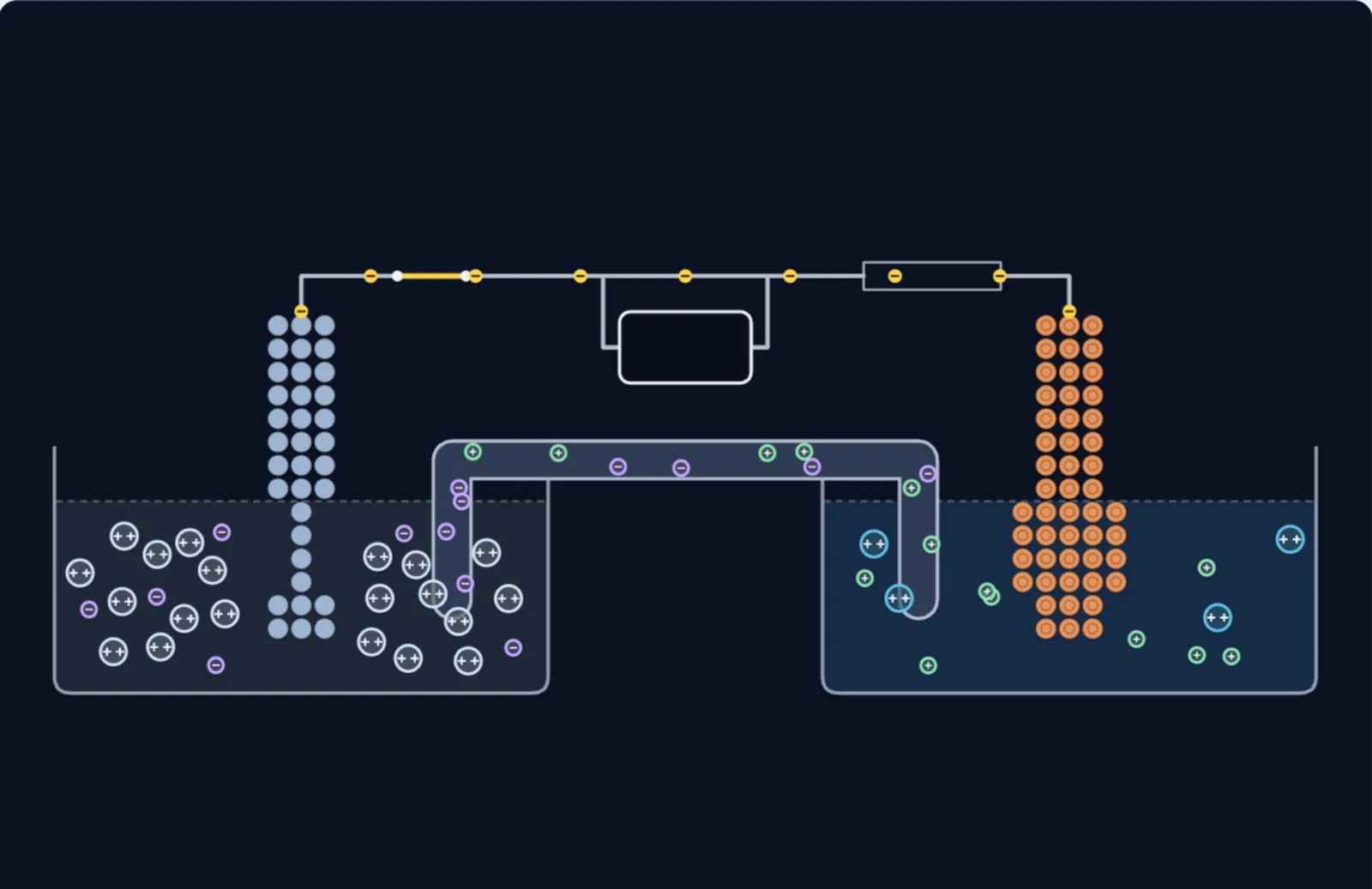
The Daniell cell separates the two halves of the reaction. One vessel holds a zinc strip in zinc sulfate solution; another holds a copper strip in copper sulfate solution. A metal wire connects the strips, and a tube filled with salt solution, called a salt bridge, connects the solutions. In a demonstration done by the teacher, a voltmeter connected between the strips reads about 1.1 V, for solutions of 1 mol/L at 25 °C.
Without the bridge, the voltmeter shows nothing. With the wire to the load open, the voltmeter connected between the strips still reads about 1.1 V, but no current passes through the wire; current flows when the wire completes the circuit. After the cell has worked for a while, the zinc strip is thinner, new copper has formed on the copper strip, and the blue solution in the copper vessel is paler.
For the curious
Daniell was looking for a steady source of current. Older cells formed hydrogen bubbles on the electrode, and the bubbles reduced the current. In his cell, Cu²⁺ ions from the second solution gain electrons and deposit as metal, so hydrogen no longer forms. In 1881, at an international conference of electricians, the unit of voltage was defined so that the Daniell cell would have about 1.0 V, a round value close to the 1.10 V shown by an open-circuit Daniell cell with solutions of 1 mol/L.
What travels through the wire and what through the solutionWhat the particles do
At the zinc strip, atoms at the surface enter the solution as Zn²⁺ ions and each leave two electrons in the metal. These cannot pass through the solution; their only path is the wire, towards the copper strip. There, Cu²⁺ ions from the solution each gain two electrons and deposit as copper atoms.
Each solution must remain neutral. More Zn²⁺ ions appear in the zinc vessel, while Cu²⁺ ions disappear from the copper vessel. Through the salt bridge, anions move towards the zinc vessel and cations towards the copper vessel, compensating for the charges. Without the bridge, the zinc solution would become positively charged, the copper solution negatively charged, and electrons would stop flowing.
The circuit therefore has two kinds of charge carrier: electrons in metals (wire, strips) and ions in the solutions and bridge. Electrons do not pass through the bridge, and ions do not pass through the wire.
The electrode where oxidation takes place is called the anode, and the one where reduction takes place is the cathode. In the cell, the zinc anode is the negative pole because electrons are released there, and the copper cathode is the positive pole. Zinc is oxidised because it gives up electrons more readily than copper: it is more active in the activity series of metals.
Half-reactions, the overall equation and cell notationHow it is written
Each electrode has a half-reaction. The oxidation numbers show what changes: zinc rises from 0 to +2, copper falls from +2 to 0.
Anode (−), oxidation: Zn → Zn²⁺ + 2e⁻
Cathode (+), reduction: Cu²⁺ + 2e⁻ → Cu
The number of electrons given up equals the number gained, so the half-reactions are added without coefficients. The result is the overall equation, which you know from the reaction in the beaker:
Zn + Cu²⁺ → Zn²⁺ + Cu
With the sulfate ions that remain in solution, the same equation is Zn + CuSO₄ → ZnSO₄ + Cu. The oxidising agent is Cu²⁺, which is reduced, and the reducing agent is Zn, which is oxidised.
The conventional representation of the cell puts the anode on the left and the cathode on the right:
(−) Zn | Zn²⁺ || Cu²⁺ | Cu (+)
The single line | marks the boundary between electrode and solution, and the double line || marks the salt bridge. Electrons flow through the external wire from Zn to Cu, and conventional electric current flows in the opposite direction.
For the curious
The voltage of 1.1 V can be calculated from standard electrode potentials: +0.34 V for copper, −0.76 V for zinc, and the difference 0.34 − (−0.76) = 1.10 V. The value applies to solutions of 1 mol/L at 25 °C. As the cell operates, the concentration of Cu²⁺ ions falls, that of Zn²⁺ ions rises, and the voltage drops.
| Metal | Reduction half-reaction | E° (V) | Paired with another metal |
|---|---|---|---|
| Mg | Mg²⁺ + 2e⁻ → Mg | −2.37 (published: −2.372) | negative pole against the metals after it |
| Al | Al³⁺ + 3e⁻ → Al | −1.66 (published: −1.662) | negative pole against the metals after it |
| Zn | Zn²⁺ + 2e⁻ → Zn | −0.76 (published: −0.7618) | negative pole against the metals after it |
| Fe | Fe²⁺ + 2e⁻ → Fe | −0.45 (published: −0.447) | negative pole against the metals after it |
| Ni | Ni²⁺ + 2e⁻ → Ni | −0.26 (published: −0.257) | negative pole against the metals after it |
| Sn | Sn²⁺ + 2e⁻ → Sn | −0.14 (published: −0.1375) | negative pole against the metals after it |
| Pb | Pb²⁺ + 2e⁻ → Pb | −0.13 (published: −0.1262) | negative pole against the metals after it |
| Cu | Cu²⁺ + 2e⁻ → Cu | +0.34 (published: +0.337) | negative pole against the metals after it |
| Ag | Ag⁺ + e⁻ → Ag | +0.80 (published: +0.7996) | positive pole against all the others |
| Table voltage (V): negative pole on the left, positive pole in the top row | Al | Zn | Fe | Ni | Sn | Pb | Cu | Ag |
|---|---|---|---|---|---|---|---|---|
| Mg | 0.71 | 1.61 | 1.92 | 2.11 | 2.23 | 2.25 | 2.71 | 3.17 |
| Al | 0.90 | 1.21 | 1.40 | 1.52 | 1.54 | 2.00 | 2.46 | |
| Zn | 0.31 | 0.50 | 0.62 | 0.64 | 1.10 | 1.56 | ||
| Fe | 0.19 | 0.31 | 0.32 | 0.78 | 1.25 | |||
| Ni | 0.12 | 0.13 | 0.59 | 1.06 | ||||
| Sn | 0.01 | 0.47 | 0.94 | |||||
| Pb | 0.46 | 0.93 | ||||||
| Cu | 0.46 |
| Quantity | Value | How it is obtained |
|---|---|---|
| Voltage of the Zn | Cu cell | 1.10 V | +0.34 − (−0.76), from the table at 1 mol/L and 25 °C |
| Rounding | once, to two decimals | the voltage is the difference of the published values, rounded once; for 7 of 36 pairs it differs by 0.01 V from the difference of the rounded potentials of the first table (Mg–Pb, Al–Pb, Zn–Pb, Fe–Cu, Ni–Cu, Sn–Cu, Pb–Cu) |
| The voltmeter | 1.10 V | connected between the two strips: with the bridge in place it shows the table voltage, whether the switch is open or closed; without the bridge it shows nothing |
| The lemon cell | Zn → Zn²⁺ + 2e⁻ at the zinc; 2H⁺ + 2e⁻ → H₂ at the copper | the zinc is used up, the copper is not; there are no Cu²⁺ ions in the solution, so the voltage is not the one in the table of the Daniell cell |
| Cell notation | (−) Zn | Zn²⁺ || Cu²⁺ | Cu (+) | anode on the left, cathode on the right; | the boundary between electrode and solution, || the bridge |
| Overall equation | Zn + Cu²⁺ → Zn²⁺ + Cu | Zn → Zn²⁺ + 2e⁻ and Cu²⁺ + 2e⁻ → Cu |
| Zinc used up, amount | 0.10 mol | worked example |
| Electrons through the wire | 0.20 mol, about 1.2·10²³ | n(e⁻) = 2 · 0.10 mol |
| Mass of zinc used up | 6.5 g | 0.10 mol · 65 g/mol |
| Mass of copper deposited | 6.4 g | 0.10 mol · 64 g/mol |
| A 3,000 mAh battery (worked example) | 10,800 C, 0.112 mol of electrons, 0.78 g of lithium | Q = 3,000 · 3.6 C; n = Q ÷ F, with F = 96,485 C/mol; m = n · 7 g/mol. Estimate: one electron for each Li⁺ ion and the whole capacity on the label |
| What this lithium is | the lithium that passes from one electrode to the other in one full charge | one Li⁺ ion per electron; it is not all the lithium in the battery |
Calculation and diagram. The voltages and potentials are table values, at 1 mol/L and 25 °C; a real cell with a current through it gives less. The voltmeter in the picture shows the table value, not a measurement. The movement, number and position of the particles are a drawing: each dot stands for billions of particles, and the counters count only what is drawn (eight zinc atoms in one run). The numbers in the battery calculation are worked out in front of you, from the number you type. Atoms and ions have no colour: they are drawn enormously enlarged and far fewer than in reality, and the charge is shown by the sign + or −. In the wire only the electrons that pass are drawn; the sulfate ions in the beakers are not drawn, and the ions in the bridge are drawn generically. A demonstration done by the teacher.
Sources and credits. Standard electrode potentials: nine measured values, cited from OpenStax, Chemistry 2e, Appendix L and checked against the Wikipedia data page “Standard electrode potential”. The reactions at the electrodes of a lemon cell: Wikipedia, “Lemon battery”, cited. The Faraday constant: F = NA · e, with the exact values from the SI definition (NIST, CODATA). School atomic masses: CIAAW, rounded as in the book.
Worked example
What happens to the electrodes
A Daniell cell operates until 0.10 mol of zinc is oxidised. How many electrons pass through the wire and how do the electrode masses change? M(Zn) = 65 g/mol, M(Cu) = 64 g/mol.
Each zinc atom gives up two electrons: n(e⁻) = 2 · 0.10 = 0.20 mol, or 0.20 · 6.022·10²³ ≈ 1.2·10²³ electrons through the wire.
From the equation Zn + Cu²⁺ → Zn²⁺ + Cu, 1 mol of Zn gives 1 mol of Cu: 0.10 mol of copper is deposited.
The mass of the zinc electrode falls by m(Zn) = 0.10 · 65 = 6.5 g. The mass of the copper electrode rises by m(Cu) = 0.10 · 64 = 6.4 g.
Check: for the same number of atoms, the masses are in the ratio of the molar masses, 65 : 64, so they are nearly equal. The difference 6.5 − 6.4 = 0.1 g remains in the solutions, where 0.10 mol of Cu²⁺ has been replaced by 0.10 mol of Zn²⁺.
In Romania
Current for the telegraph in 1854
The “international” Bucharest–Brașov telegraph line appeared in 1854, giving Bucharest a direct connection to Vienna. The Bucharest–Giurgiu line was completed in 1855. Signals travelled along the wire as pulses of direct current.
A telegraph needs a source of direct current. In telegraph offices in the second half of the 19th century, the Daniell cell and its variants gradually replaced the Grove cell, which released nitrogen dioxide vapour. The reaction took place in each vessel: for each mole of copper deposited, one mole of zinc was consumed.
In short
- The Daniell cell has a zinc electrode in ZnSO₄ solution, a copper electrode in CuSO₄ solution, a metal wire between the electrodes and a salt bridge between the solutions.
- At the zinc anode (− pole), oxidation takes place: Zn → Zn²⁺ + 2e⁻; at the copper cathode (+ pole), reduction takes place: Cu²⁺ + 2e⁻ → Cu.
- The overall equation is Zn + Cu²⁺ → Zn²⁺ + Cu; the cell voltage is about 1.1 V.
- Electrons flow through the external wire from zinc to copper; ions move through the solutions and salt bridge and keep the solutions neutral.
- The conventional representation is (−) Zn | Zn²⁺ || Cu²⁺ | Cu (+): the single line is the electrode–solution boundary, the double line is the salt bridge.
- For the same number of electrons, the mass of zinc consumed and the mass of copper deposited are in the ratio 65 : 64.
Common mistakes
WrongElectrons pass through the salt bridge from one solution to the other.
RightThe bridge contains ions, not free electrons. Electrons travel only through the metal wire; ions in the bridge compensate for the charge in the solutions.
WrongThe anode is always the negative pole.
RightThe anode is the electrode where oxidation takes place. In the Daniell cell it is negative, but the sign of the electrodes depends on the device; the definition stays the same.
WrongCopper deposits on zinc, so the zinc electrode gets heavier.
RightCopper deposits on the copper electrode. The zinc electrode is consumed and gets lighter.
Test yourself
7 questions. For the first 6 you see the explanation at once, with the paragraph of the lesson that supports it; for the written ones you compare with a good answer.
What do electrons travel through in a working Daniell cell?
Answer
b) The metal wire, from zinc to copper. Zinc is oxidised and releases its electrons into the metal; the external wire is their only path to copper.
What role does the salt bridge play in a Daniell cell?
Answer
d) It allows ions through and keeps the solutions electrically neutral. Ions pass through the bridge: anions towards the zinc vessel, cations towards the copper vessel. Without them, the solutions would become charged and electron flow would stop.
In the representation (−) Zn | Zn²⁺ || Cu²⁺ | Cu (+), what does the double line mark?
Answer
a) The salt bridge between the two solutions. The single line separates the phases (electrode and solution), while the double line separates the two halves of the cell, joined by the bridge.
In a Daniell cell, 0.050 mol of zinc is oxidised. What mass of copper is deposited? M(Cu) = 64 g/mol. Answer in grams, to one decimal place.
gAnswer
3.2 g. The Zn : Cu ratio is 1 : 1, so 0.050 mol of copper is deposited: 0.050 · 64 = 3.2 g.
A total of 0.40 mol of electrons has passed through the wire of a Daniell cell. What mass of zinc has been oxidised? M(Zn) = 65 g/mol. Answer in grams.
gAnswer
13 g. Each zinc atom gives up two electrons: n(Zn) = 0.40 ÷ 2 = 0.20 mol, and m(Zn) = 0.20 · 65 = 13 g.
Put the path of electrons in a working Daniell cell in order, from zinc to the deposition of copper.
Answer
The correct order:
- Zinc atoms at the negative electrode give up electrons
- Electrons pass through the external wire
- Electrons reach the copper electrode
- Cu²⁺ ions from the solution gain electrons
- Copper atoms deposit on the electrode
Electrons leave the zinc, travel through the wire to the copper and are gained by Cu²⁺ ions, which become copper atoms.
Someone removes the salt bridge from a working Daniell cell, and the voltmeter reads 0 V. Explain why, using the words ions, charge and neutral.
A good answer
Without the bridge, ions can no longer pass between the two solutions. Zn²⁺ ions appear in the zinc vessel and the solution becomes positively charged, while Cu²⁺ ions disappear from the copper vessel and the solution becomes negatively charged. The solutions no longer remain neutral, electrons can no longer flow through the wire and the current stops.
A complete answer says that the bridge completes the circuit through ions, that the solutions must remain electrically neutral, and that without it charge builds up and stops the flow of electrons.
Terms
- electrochemical cell
- A device in which a redox reaction in two separate compartments produces electric current.
- electrode
- A metal conductor in contact with the solution, at which a half-reaction takes place.
- anode
- The electrode where oxidation takes place; in the Daniell cell it is the negative pole.
- cathode
- The electrode where reduction takes place; in the Daniell cell it is the positive pole.
- salt bridge
- A tube containing salt solution through which ions pass between the two solutions, keeping them electrically neutral.
- half-reaction
- The equation for the process at a single electrode: oxidation or reduction, with electrons written explicitly.
- conventional representation
- A shorthand representation of the cell, with the anode on the left, the cathode on the right, | between phases and || for the bridge.
Sources and link to the programme
- Universitatea din Cincinnati, Colecțiile Oesper – The Daniell Cell (Museum Notes, 2013) – Daniell cell described in 1836; Zn oxidised at the anode, Cu(II) reduced at the cathode; voltage of about 1.1 V; in the 1880s the Daniell cell replaced the Grove cell, which released NO₂ vapour, in most telegraph offices
- OpenStax – Chemistry 2e, 17.2 Galvanic Cells – anode = oxidation, cathode = reduction; salt bridge and charge compensation by ions; cell notation with vertical lines
- OpenStax – Chemistry 2e, Appendix L: Standard Electrode (Half-Cell) Potentials – standard potentials Zn²⁺/Zn (−0.76 V) and Cu²⁺/Cu (+0.34 V)
- Wikipedia – Daniell cell – Daniell’s aim (eliminating hydrogen bubbles); connection with the definition of the volt in 1881 (Daniell cell, “about 1.0 V”) and open-circuit voltage of 1.1018 V; potassium nitrate salt bridge
- ANCOM – Scurtă istorie (broșura de 20 de ani) – Bucharest–Brașov telegraph line of 1854, with a direct connection to Vienna; Bucharest–Giurgiu line completed in 1855
From the programme: “Applications: electrochemical cells (the Daniell cell, lead–acid battery, lithium-ion battery) – construction and operation; conventional representation of the Daniell cell”; “Applications: electrochemical cells (the Daniell cell, lead–acid battery, lithium-ion battery) – construction and overall reaction equation; conventional representation of the Daniell cell” (TC: Core curriculum (1 hour a week)). Specific competences followed: 1.2, 2.2, 3.2, 4.2, 5.2.