Chapter 9 · SolutionsLesson 9.1TC Core curriculum (1 hour a week) · beyond your profile
Dissolving ionic substances in water
Where does salt go when it dissolves?
You put salt in water, stir it and can no longer see it. Where did it go?
Before you read: what do you think?
You dissolve 10 g of salt in 90 g of water until no crystals remain visible. What do the scales show?
See the answer
The scales show 100 g. The salt has separated into ions too small to see, and their mass is the same as in the crystal.
Put a teaspoon of salt in a glass of water and stir. After a minute, no crystals are visible and the water is as clear as before. All the salt is still there: you can taste it and find it on the scales.
The crystals disappear, the mass remainsWhat you see
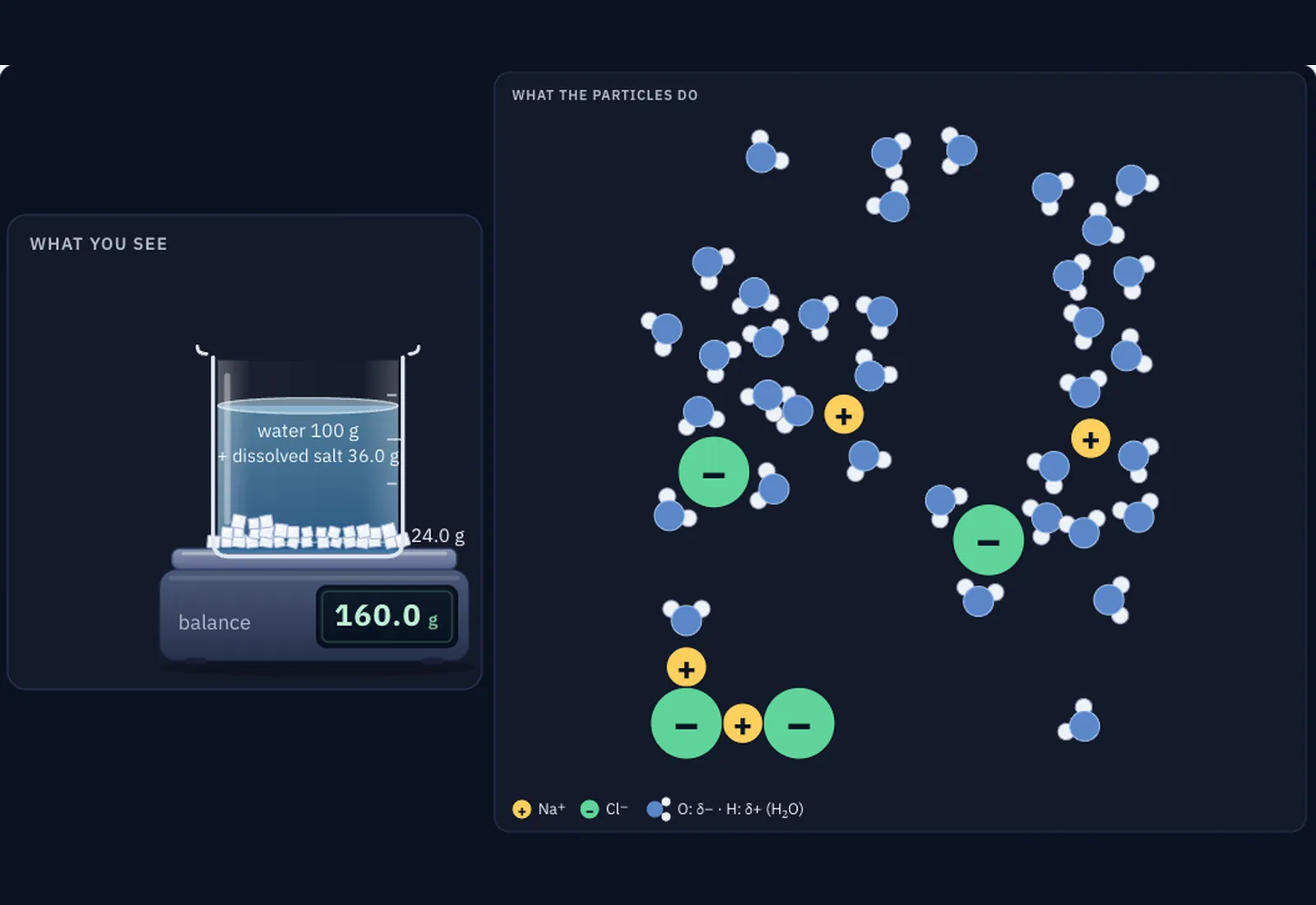
Weigh a glass with 90 g of water and, separately, 10 g of salt. Pour the salt into the water and stir until the last crystal disappears. The scales show 100 g: the mass of the solution is the sum of the masses of the salt and water. Nothing has left the glass and nothing has appeared in it.
The liquid is called a solution: a homogeneous mixture, which has the same composition in every drop. Water, the substance that dissolves the salt, is the solvent. Salt is the dissolved substance (or solute). Dissolving is the spreading of the particles of one substance among those of another until the mixture is homogeneous.
Most liquids in the home are aqueous solutions, solutions in which water is the solvent. Vinegar is a solution of acetic acid, syrup is a solution of sugar, and mineral water contains dissolved salts and carbon dioxide. Saline solution used in hospitals is a 0.9% solution of sodium chloride.
Water takes the crystal apart, ion by ionWhat the particles do
A salt crystal is a lattice of ions: positively charged sodium ions, Na⁺, and negatively charged chloride ions, Cl⁻, arranged alternately and held together by attraction between opposite charges. There are no NaCl molecules in the crystal. The formula shows that there is one Cl⁻ ion for each Na⁺ ion.
A water molecule is polar: the oxygen atom has a small negative charge, and each of the two hydrogen atoms has a small positive charge. At the crystal surface, water molecules turn their oxygen towards Na⁺ ions and their hydrogen towards Cl⁻ ions. Pulled from several sides, the ions at the edge break away one by one and enter the liquid.
In solution, each ion is surrounded by water molecules: it is a hydrated ion, and the process is called hydration. The crystal shrinks layer by layer until it disappears. The solution is clear because the ions are far too small to see and are separated from one another.
For the curious
The 10 g of salt in the glass contains about 10²³ sodium ions and the same number of chloride ions: a 1 followed by 23 zeros. Counting them one per second would take hundreds of thousands of times the age of the Universe.
How to write the dissolving of saltHow it is written
The separation of ions from the lattice under the action of water is called dissociation and is written as an equation:
NaCl(s) → Na⁺(aq) + Cl⁻(aq)
The letter (s) shows that the salt is solid. The notation (aq), from the Latin word aqua, shows that the ions are hydrated in aqueous solution. Water is not written among the reactants because its molecules remain unchanged.
The equation gives a ratio: each NaCl unit yields one Na⁺ ion and one Cl⁻ ion. The solution contains equal numbers of positive and negative charges, so it is electrically neutral.
Dissolving salt is a physical process. If you leave the water to evaporate, the ions arrange themselves in a lattice again and the salt reappears, with the same mass.
| t (°C) | NaCl | KNO₃ | CuSO₄ | KI |
|---|---|---|---|---|
| 0 | 35.6 | 13.6 | 14.2 | 127.3 |
| 10 | 35.7 | 21.4 | 16.8 | 135.8 |
| 20 | 35.9 | 31.9 | 20.0 | 143.9 |
| 25 | 36.0 | 38.3 | 22.0 | 148.1 |
| 30 | 36.1 | 45.6 | 23.9 | 152.5 |
| 40 | 36.4 | 62.9 | 28.5 | 160.4 |
| 50 | 36.7 | 84.2 | 34.0 | 168.8 |
| 60 | 37.0 | 109.2 | 40.4 | 176.2 |
| 70 | 37.5 | 138.1 | 47.9 | 184.1 |
| 80 | 37.9 | 170.3 | 57.0 | 191.5 |
| 90 | 38.5 | 205.8 | 67.5 | 199.4 |
| 100 | 39.0 | 242.5 | 77.0 | 206.7 |
| Spoonfuls | On the balance (g) | Dissolved (g) | On the bottom (g) | c (%) |
|---|---|---|---|---|
| 1 | 105.0 | 5.0 | 0.0 | 4.8 |
| 2 | 110.0 | 10.0 | 0.0 | 9.1 |
| 3 | 115.0 | 15.0 | 0.0 | 13.0 |
| 4 | 120.0 | 20.0 | 0.0 | 16.7 |
| 5 | 125.0 | 25.0 | 0.0 | 20.0 |
| 6 | 130.0 | 30.0 | 0.0 | 23.1 |
| 7 | 135.0 | 35.0 | 0.0 | 25.9 |
| 8 | 140.0 | 36.0 | 4.0 | 26.5 |
| 9 | 145.0 | 36.0 | 9.0 | 26.5 |
| 10 | 150.0 | 36.0 | 14.0 | 26.5 |
Copper(II) sulfate: g of anhydrous CuSO₄. In the drawing, the Na⁺ and Cl⁻ ions are equal in number at every moment.
Measurements and diagram. The solubilities are measured (CRC Handbook, table in mass percent, converted to grams per 100 g of water); the masses, the concentrations and the salt left on the bottom are calculated from them. The particles are a diagram: ions and molecules are drawn millions of times larger (the exact number appears under the picture) and far fewer than in reality; the ionic radii (Na⁺ 102 pm, Cl⁻ 181 pm) and the shape of the water molecule are to scale, the distances between ions and water molecules are schematic, and the leaving and returning of ions at saturation are a model. The colours are chosen: ions have no colour.
Sources and credits. Values quoted from: CRC Handbook of Chemistry and Physics, 91st ed. (D. R. Lide), table "Aqueous Solubility of Inorganic Compounds at Various Temperatures", pp. 8-113–8-117: source. Effective ionic radii (R. D. Shannon, 1976), quoted by OpenStax – Chemistry 2e, 10.6: source. NaCl lattice parameter, 564.02 pm (CRC): source. H–O–H angle, 104.5°, and O–H length, about 96 pm: source.
Two clear glasses, two different solutions
Sugar also dissolves until it can no longer be seen, but in a different way. A sugar crystal is made of molecules, and water separates them without breaking them apart. The sugar solution contains whole molecules with no electric charge.
The difference is visible in a demonstration done by the teacher in the laboratory, with a bulb connected to a battery and two wires dipped in the liquid. In salt water the bulb lights up because the ions move through the solution and carry electric charge. In sugar water the bulb stays off.
Substances that give ions when dissolved in water and conduct electricity are called electrolytes. Substances that dissolve as molecules and do not conduct electricity are called non-electrolytes.
For the curious
There is a limit to how much salt water can dissolve. At 25 °C, at most 36.0 g of sodium chloride dissolves in 100 g of water. Any extra stays on the bottom of the glass, however much you stir.
Worked example
How many ions reach the glass
A total of 11.7 g of sodium chloride dissolves completely in 188.3 g of water. What is the mass of the solution and what amount of ions does it contain?
The mass of the solution is the sum of the masses: ms = 11.7 + 188.3 = 200 g.
The molar mass of sodium chloride is M(NaCl) = 23 + 35.5 = 58.5 g/mol. The amount of dissolved salt is n = 11.7 ÷ 58.5 = 0.2 mol.
From the equation NaCl(s) → Na⁺(aq) + Cl⁻(aq), one mole of NaCl gives one mole of Na⁺ ions and one mole of Cl⁻ ions. The solution contains 0.2 mol of Na⁺ ions and 0.2 mol of Cl⁻ ions, a total of 0.4 mol of ions.
In numbers of particles, 0.2 · 6.022·10²³ ≈ 1.2·10²³ ions of each kind. No atoms have appeared or disappeared: the sodium and chlorine atoms that were in the crystal are now separate, in water.
In Romania
Why the Black Sea is less salty than the ocean
Seawater is a solution in which the most abundant dissolved ions are Na⁺ and Cl⁻, the same as in table salt. A kilogram of ocean water contains an average of 35 g of salts. A kilogram of water from the surface of the Black Sea contains just 17–18 g, because the Danube and other rivers bring in a great deal of fresh water.
In waters near the Romanian coast, the annual average is at most 16 g of salts per kilogram, and off the mouths of the Danube it falls below 14.5 g. If a kilogram of water taken from the open sea evaporated in a vessel, the 17–18 g of salts would remain on the bottom: without water, the ions arrange themselves in crystals again.
In short
- A solution is a homogeneous mixture of a solvent and one or more dissolved substances; in aqueous solutions, water is the solvent.
- The mass of the solution is the sum of the masses of the dissolved substance and the solvent.
- As salt dissolves, polar water molecules pull Na⁺ and Cl⁻ ions from the lattice and surround them; the process is called hydration.
- The dissociation of sodium chloride is written NaCl(s) → Na⁺(aq) + Cl⁻(aq); one mole of NaCl gives one mole of Na⁺ and one mole of Cl⁻.
- Electrolytes give ions in solution and conduct electricity (salt); non-electrolytes dissolve as molecules and do not conduct electricity (sugar).
Common mistakes
WrongThe salt melted in the water.
RightMelting is the change of a solid into a liquid through heating; salt melts only at 801 °C. In the glass, the salt dissolved: its ions spread among the water molecules at room temperature.
WrongNaCl molecules float in salt water.
RightSalt is made of ions, both in the crystal and in solution. In water, separate Na⁺ and Cl⁻ ions are each surrounded by water molecules.
WrongIf you cannot see it, the salt no longer weighs anything.
RightMass is conserved: 10 g of salt and 90 g of water give 100 g of solution.
Test yourself
7 questions. For the first 6 you see the explanation at once, with the paragraph of the lesson that supports it; for the written ones you compare with a good answer.
What particles are found in a solution of sodium chloride in water, apart from water molecules?
Answer
c) Hydrated Na⁺ and Cl⁻ ions. Salt is a lattice of ions; water pulls them apart and surrounds them. There are no NaCl molecules in either the crystal or the solution.
Which way do water molecules turn towards a Na⁺ ion?
Answer
a) With the oxygen atom. The oxygen in a water molecule has a small negative charge and is attracted to the positive Na⁺ ion.
A total of 25 g of salt dissolves completely in 175 g of water. What is the mass of the solution, in grams?
gAnswer
200 g. The mass of the solution is the mass of the dissolved substance plus the mass of the solvent: 25 + 175 = 200 g.
How many moles of Cl⁻ ions enter the solution when 29.25 g of NaCl dissolves completely? Given M(NaCl) = 58.5 g/mol.
molAnswer
0.50 mol. n(NaCl) = 29.25 ÷ 58.5 = 0.5 mol, and each NaCl unit gives one Cl⁻ ion.
Salt or sugar? Place each statement under the right solution.
Answer
Salt solution: Contains ions; The bulb lights up; Is an electrolyte.
Sugar solution: Contains whole, uncharged molecules; The bulb stays off; Is a non-electrolyte.
Salt gives ions that carry electric charge; sugar dissolves as molecules and does not conduct electricity.
Why is water not written among the reactants in the equation NaCl(s) → Na⁺(aq) + Cl⁻(aq)?
Answer
b) Because the water molecules remain unchanged. Water pulls the ions apart and surrounds them, but its molecules do not change. Its presence is shown by the notation (aq).
A classmate says that dissolved salt “no longer exists”. Suggest two observations, without laboratory equipment, that show all the salt is in the glass.
A good answer
First: weigh the water and salt before, then the solution; the mass of the solution is the sum of the two. Second: leave the water to evaporate from a plate; the salt reappears on the bottom, with the same mass. You can also add the salty taste, for solutions made with drinking water and table salt.
A complete answer uses conservation of mass and the fact that dissolving is a physical process from which salt is recovered by evaporating the water.
Terms
- solution
- A homogeneous mixture of a solvent and one or more dissolved substances.
- solvent
- The substance in which the others dissolve; in aqueous solutions, water.
- dissolved substance (solute)
- A substance whose particles spread among those of the solvent.
- hydration
- The surrounding of a dissolved ion or molecule by water molecules.
- dissociation
- The separation of ions in an ionic substance from the lattice during dissolving or melting.
- electrolyte
- A substance that, when dissolved in water or melted, contains mobile ions and conducts electricity.
- non-electrolyte
- A substance that dissolves as molecules and whose solution does not conduct electricity.
Sources and link to the programme
- OpenStax – Chemistry 2e, 11.2 Electrolytes – separation and hydration of ions when an ionic substance dissolves; orientation of water molecules (hydrogen towards the anion, oxygen towards the cation); electrolytes and non-electrolytes distinguished by the conductivity of their solutions
- OpenStax – Chemistry 2e, 11.1 The Dissolution Process – solutions as homogeneous mixtures; solvent and dissolved substance
- PubChem – Sodium chloride – solubility of sodium chloride: 36.0 g per 100 g of water at 25 °C; melting point, 801 °C
- OMS / MSF – Essential drugs: practical guidelines (2016) – saline solution: 0.9% sodium chloride
- NOAA – Why is the ocean salty? – mean ocean salinity, 35 g of salts per kilogram; sodium and chloride ions are the most abundant
- J. W. Murray, Universitatea din Washington – The Black Sea: an overview – surface salinity of the Black Sea, about 18 g per kilogram
- Ministerul Mediului – Studiu privind starea ecologică a ecosistemului marin Marea Neagră – salinity of Romanian waters: annual average up to 14.5 in the Danube influence zone and up to 16 in coastal waters
From the programme: “Dissolving ionic substances in water”; “Dissolving substances with polar molecules in water”; “Aqueous solutions used in everyday life” (TC: Core curriculum (1 hour a week)). Specific competences followed: 1.5, 2.5, 4.5.