Chemistry 9 RO
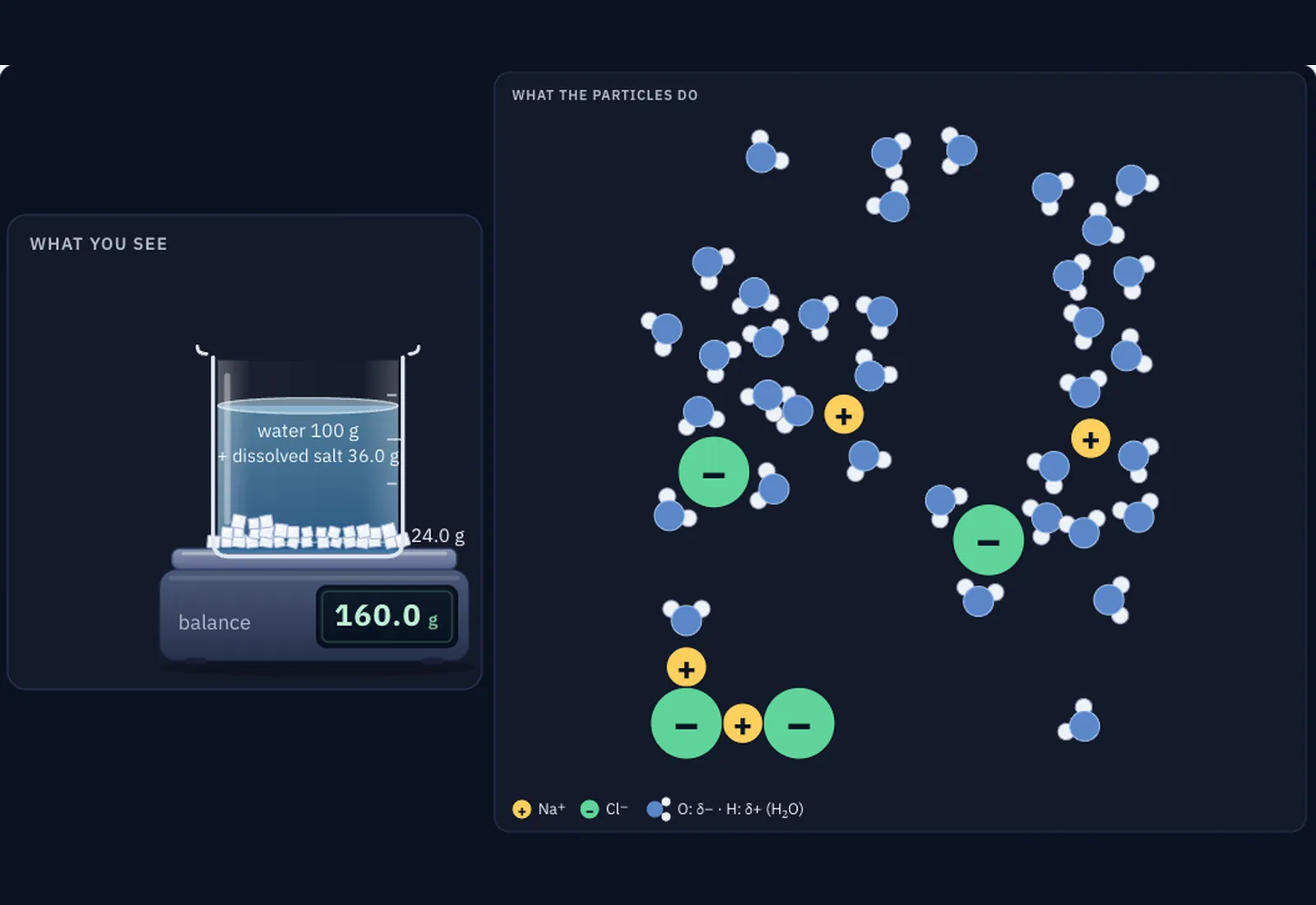
A glass on a balance with 100.0 g of water and dissolved salt, beside a corner of a salt crystal in which Na⁺ and Cl⁻ ions alternate, with water molecules turned with the oxygen towards Na⁺ and the hydrogens towards Cl⁻.

Solutions

Chapter 9

Solutions – where the salt goes

Where does the salt go when you put it in water?

You put a teaspoonful of salt in water, stir, and after a minute the salt can no longer be seen. Is it still in the glass? In the magnifying window you see a corner of a crystal, magnified millions of times, and the balance says how much the whole thing weighs. Start with a guess.

What does the balance show after dissolving?

The glass holds 90.0 g of water. On the dish are 10.0 g of salt. You stir until the last crystal disappears. What does the balance show?

The crystal comes apart ion by ion

The magnifying window shows a corner of the salt crystal: Na⁺ ions, with a + sign, and Cl⁻ ions, with a − sign, arranged alternately. There are no NaCl molecules between them.

The water molecule is polar. Next to a Na⁺ ion it turns with its oxygen (δ−), next to a Cl⁻ ion with its hydrogens (δ+). Pulled from several sides, the ions at the edge leave one at a time, each surrounded by water molecules.

In the solution there are as many + ions as − ions, so the total charge stays zero.

The balance shows 100.0 g

Nothing has left the glass: 90.0 g of water and 10.0 g of salt make 100.0 g of solution. The concentration is c = md · 100 ÷ ms = 10 · 100 ÷ 100 = 10.0%.

Dissolving is written:

NaCl(s) → Na⁺(aq) + Cl⁻(aq)

The letter (s) marks the solid, (aq) marks the ion surrounded by water. Each NaCl unit gives one Na⁺ ion and one Cl⁻ ion: the 10.0 g of salt are 10.0 ÷ 58.5 = 0.171 mol of each ion.

The concentration rises with every spoonful

The glass is new: 100 g of water, at 25 °C. The balance adds exactly the mass you put in. The concentration is calculated from the mass of the solution, not the mass of the water.

After seven spoonfuls (35 g) all the salt is dissolved and c = 25.9%.

After 36.0 g, the salt stays on the bottom

At 25 °C, at most 36.0 g of salt dissolve in 100 g of water. The eighth spoonful, 40 g in all, leaves 4.0 g on the bottom, however much you stir. The solution is saturated: c = 36.0 · 100 ÷ 136.0 = 26.5%. The balance shows 140.0 g, because the crystals on the bottom are weighed too.

The ions do not stand still: ions leave the crystal on the bottom, and ions return from the solution. In the model, at saturation leaving and returning are equally likely, so the crystal does not shrink and the concentration stops rising.

Heat helps table salt a little and potassium nitrate a lot

The same 100 g of water, with 80 g of substance. The values are measured; heating solutions is done by the teacher in the laboratory and is not repeated at home.

Table salt: 37.0 g dissolve at 60 °C, compared with 36.0 g at 25 °C, 1.0 g more. 43.0 g are left on the bottom instead of 44.0 g.

Potassium nitrate: 38.3 g at 25 °C and 109.2 g at 60 °C, 2.85 times as much, 70.9 g more. All 80 g dissolve, and on cooling to 25 °C 41.7 g crystallise again.

On a mineral water label, the charges balance

Mineral water is a solution of ions, and the label gives them in mg/L. Type the values from your own bottle. Each value is divided by the molar mass (Ca 40, Mg 24, Na 23, K 39, HCO₃⁻ 61, SO₄²⁻ 96, Cl⁻ 35.5, NO₃⁻ 62) to give mmol/L; then it is multiplied by the charge of the ion, because Ca²⁺ brings two charges.

The values are not sent and not saved. A difference of up to 5% can come from rounding and from ions not listed on the label. A larger one may point to a missing or wrong value, but the balance does not say which.

Explain: why does a salt lake leave a white crust in August?

The glass stands in for the lake: 100 g of water with 30.0 g of dissolved salt, at 25 °C (a worked example, not a particular lake). Evaporation removes only water; the salt stays. Each press removes 10 g of water.

Use the solubility: the first crystals appear when the mass of the water falls below 30.0 · 100 ÷ 36.0 = 83.3 g. At 80 g of water, 1.2 g are left on the bottom; at 70 g, 4.8 g.

Explain the white crust briefly, with the ions, the water and the solubility. The full lesson: Where does salt go when it dissolves?.

Measurements and diagram. The solubilities are measured (CRC Handbook, table in mass percent, converted to grams per 100 g of water); the masses, the concentrations and the salt left on the bottom are calculated from them. The particles are a diagram: ions and molecules are drawn millions of times larger (the exact number appears under the picture) and far fewer than in reality; the ionic radii (Na⁺ 102 pm, Cl⁻ 181 pm) and the shape of the water molecule are to scale, the distances between ions and water molecules are schematic, and the leaving and returning of ions at saturation are a model. The colours are chosen: ions have no colour.

Sources and credits. Values quoted from: CRC Handbook of Chemistry and Physics, 91st ed. (D. R. Lide), table "Aqueous Solubility of Inorganic Compounds at Various Temperatures", pp. 8-113–8-117: source. Effective ionic radii (R. D. Shannon, 1976), quoted by OpenStax – Chemistry 2e, 10.6: source. NaCl lattice parameter, 564.02 pm (CRC): source. H–O–H angle, 104.5°, and O–H length, about 96 pm: source.

The same data, as a table
Solubility in water, in g of substance per 100 g of water (CRC Handbook, table converted from mass percent)
t (°C)NaClKNO₃CuSO₄KI
035.613.614.2127.3
1035.721.416.8135.8
2035.931.920.0143.9
2536.038.322.0148.1
3036.145.623.9152.5
4036.462.928.5160.4
5036.784.234.0168.8
6037.0109.240.4176.2
7037.5138.147.9184.1
8037.9170.357.0191.5
9038.5205.867.5199.4
10039.0242.577.0206.7
Spoonfuls of 5 g added to 100 g of water, at 25 °C (NaCl, solubility 36.0 g)
SpoonfulsOn the balance (g)Dissolved (g)On the bottom (g)c (%)
1105.05.00.04.8
2110.010.00.09.1
3115.015.00.013.0
4120.020.00.016.7
5125.025.00.020.0
6130.030.00.023.1
7135.035.00.025.9
8140.036.04.026.5
9145.036.09.026.5
10150.036.014.026.5

Copper(II) sulfate: g of anhydrous CuSO₄. In the drawing, the Na⁺ and Cl⁻ ions are equal in number at every moment.

Lessons of the chapter

Lessons: 6 lessons TC, 1 lesson MI, 1 lesson SN. The badge of each lesson says which profile it belongs to.

Which profile are you on?

  1. 9.1Where does salt go when it dissolves? TC · beyond your profileDissolving ionic substances in waterYou put salt in water, stir it and can no longer see it. Where did it go?
  2. 9.2Why iodine dissolves in alcohol but oil does not dissolve in water MI · beyond your profileDissolving ionic substances in waterSugar disappears in water, oil stays on top, and iodine barely dissolves in water but dissolves in alcohol. What determines where each one goes?
  3. 9.3Why one solution warms and another cools as substances dissolve TC · beyond your profileHeat effects of dissolving in waterAn instant cold pack gets cold in seconds, while caustic soda added to water warms the beaker. Why does dissolving have different effects for different substances?
  4. 9.4How much can dissolve in a glass, and what changes the limit TC · beyond your profileSolubility of a substanceYou add spoonfuls of salt to water. After a while, salt stays on the bottom no matter how much you stir. What sets the limit, and how does it change?
  5. 9.5What 0.9% means on a bag of saline TC · beyond your profilePreparing aqueous solutions of given percentage and molar concentrations, including from hydrates (crystal hydrates)A bag of saline says 0.9%, while pickle brine has a different number. How do you compare two salt solutions?
  6. 9.6How many moles are in a litre of solution TC · beyond your profilePreparing aqueous solutions of given percentage and molar concentrations, including from hydrates (crystal hydrates)Blood glucose can be written as 90 mg/dL or 5 mmol/L. How can both be correct?
  7. 9.7From calculation to volumetric flask: preparing and diluting a solution TC · beyond your profilePreparing aqueous solutions of given percentage and molar concentrations, including from hydrates (crystal hydrates)You need 250 mL of a 0.2 mol/L solution. What do you weigh, what do you measure, and in what order?
  8. 9.8Why blue vitriol has water in its formula SN · beyond your profilePreparing aqueous solutions of given percentage and molar concentrations, including from hydrates (crystal hydrates)Blue vitriol is dry to the touch, yet some of its mass is water. How much?

Test tomorrowten questions from chapter 9For the class: projector, sheets, shared test