
Chapter 9 · SolutionsLesson 9.4TC Core curriculum (1 hour a week) · beyond your profile
Solubility of a substance
How much can dissolve in a glass, and what changes the limit
You add spoonfuls of salt to water. After a while, salt stays on the bottom no matter how much you stir. What sets the limit, and how does it change?
Before you read: what do you think?
You have dissolved 36.0 g of table salt in a glass of 100 g of water at 25 °C. You add another 10 g and stir for a long time. What happens to the 10 g?
See the answer
At 25 °C, 100 g of water dissolves at most 36.0 g of sodium chloride. The solution is already saturated, so the 10 g added stays on the bottom. Stirring would have sped up dissolving, but it does not change this limit.
You dissolve salt in water, stirring after each spoonful. The first crystals disappear quickly. Then some salt stays on the bottom, no matter how much you stir. The glass has taken all it can at that temperature.
What you see: the glass has a limitWhat you see
An unsaturated solution can dissolve more substance under the given conditions. A saturated solution contains the maximum amount of dissolved substance at that temperature; you can recognise it by the undissolved substance left in contact with it. A supersaturated solution contains more than a saturated solution and is unstable: if a crystal is added or the solution is stirred, the excess separates out.
The limit is measured by solubility: the maximum mass of substance, in grams, that dissolves in 100 g of water at a given temperature. For sodium chloride, the solubility is 36.0 g per 100 g of water at 25 °C.
Solubility is not percentage concentration. The saturated NaCl solution has a mass of 100 + 36 = 136 g, and its concentration is c = 36 · 100 ÷ 136 ≈ 26.5%. Solubility is based on 100 g of water; percentage concentration is based on 100 g of solution.
Dissolving continues at saturationWhat the particles do
At the surface of the undissolved crystal, ions pass into the solution while other ions return from the solution to the crystal. In a saturated solution, the two processes happen at the same rate, so the amount dissolved no longer changes, though the particles keep moving. This state is called dynamic equilibrium.
Stirring and crushing crystals speed up dissolving: crushing increases the surface area in contact with the water, and stirring brings fresh water beside the crystal. The saturated solution is reached faster, but has the same composition. A substance that dissolves quickly does not dissolve in a greater amount.
What changes solubilityHow it is written
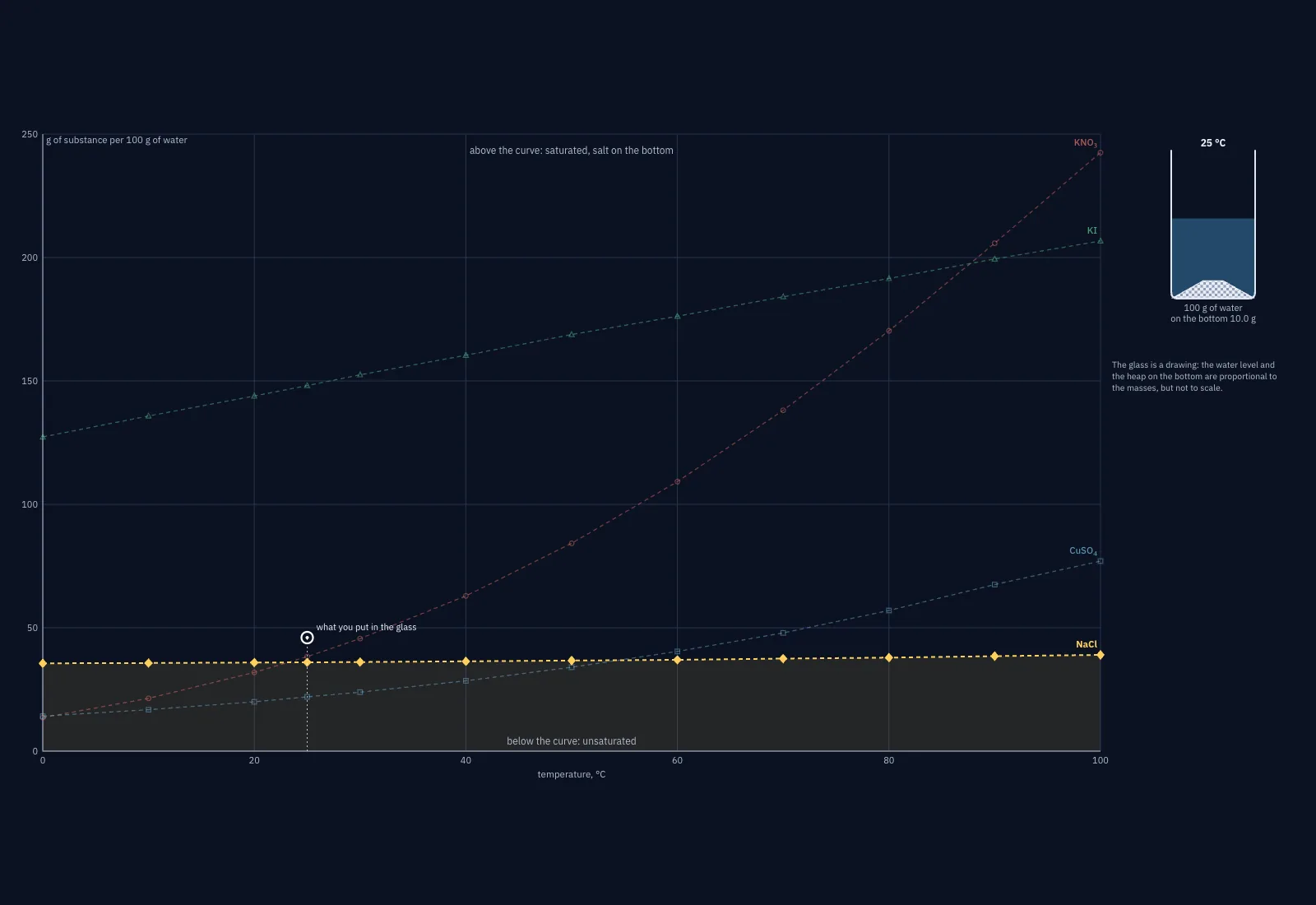
The nature of the substance and the solvent determines what dissolves in what: salt dissolves in water, iodine in ethanol. Temperature changes solubility. For most solids it rises with temperature. For KNO₃, the values in g per 100 g of water are 13.6 at 0 °C, 31.9 at 20 °C, 62.9 at 40 °C, 109.2 at 60 °C, 170.3 at 80 °C and 242.5 at 100 °C. For KI, solubility rises from 127.3 g at 0 °C to 206.7 g at 100 °C.
Copper(II) sulfate rises from 14.2 g at 0 °C to 77.0 g at 100 °C, measured in g of anhydrous CuSO₄ per 100 g of water. Sodium chloride changes very little: 35.6 g at 0 °C and 39.0 g at 100 °C. Lithium carbonate does the reverse, falling from 1.56 g at 0 °C to 0.73 g at 100 °C. The data show the direction of change.
A solubility curve has temperature on the horizontal axis and solubility on the vertical axis. Points on the curve are saturated solutions, points below it are unsaturated solutions, and the steep KNO₃ curve shows a strong dependence on temperature.
For gases, solubility falls as temperature rises and rises with pressure. Carbon dioxide: 171, 88 and 36 mL per 100 mL of water at 0, 20 and 60 °C. A fizzy drink is sealed under pressure; when the bottle is opened, the pressure falls and gas leaves the liquid.
For the curious
Copper sulfate crystallises from water as CuSO₄·5H₂O, and the water in the crystal enters the calculation. These problems are covered in the lesson on hydrates. In supersaturated solutions, such as sodium acetate, a single added crystal triggers crystallisation of the entire excess.
| Temperature, °C | KNO₃ | CuSO₄ | KI | NaCl |
|---|---|---|---|---|
| 0 | 13.6 | 14.2 | 127.3 | 35.6 |
| 10 | 21.4 | 16.8 | 135.8 | 35.7 |
| 20 | 31.9 | 20.0 | 143.9 | 35.9 |
| 25 | 38.3 | 22.0 | 148.1 | 36.0 |
| 30 | 45.6 | 23.9 | 152.5 | 36.1 |
| 40 | 62.9 | 28.5 | 160.4 | 36.4 |
| 50 | 84.2 | 34.0 | 168.8 | 36.7 |
| 60 | 109.2 | 40.4 | 176.2 | 37.0 |
| 70 | 138.1 | 47.9 | 184.1 | 37.5 |
| 80 | 170.3 | 57.0 | 191.5 | 37.9 |
| 90 | 205.8 | 67.5 | 199.4 | 38.5 |
| 100 | 242.5 | 77.0 | 206.7 | 39.0 |
| Substance | Water | You add | At temperature | You cool to | Dissolved when hot | On the bottom when hot | Crystallises |
|---|---|---|---|---|---|---|---|
| NaCl | 100 g | 46.0 g | 25 °C | no cooling | 36.0 g | 10.0 g | — |
| KNO₃ | 200 g | 218.4 g | 60 °C | 20 °C | 218.4 g | 0.0 g | 154.6 g |
| KNO₃ | 100 g | 100.0 g | 60 °C | 20 °C | 100.0 g | 0.0 g | 68.1 g |
| KI | 100 g | 150.0 g | 20 °C | no cooling | 143.9 g | 6.1 g | — |
| NaCl | 100 g | 36.0 g | 100 °C | 0 °C | 36.0 g | 0.0 g | 0.4 g |
| CuSO₄ | 100 g | 40.4 g | 60 °C | 20 °C | 40.4 g | — | — |
For copper(II) sulfate the undissolved and crystallised masses are not given: CuSO₄·5H₂O crystallises from water.
Measurements and calculation. The points are measured solubilities (CRC Handbook), in grams of substance per 100 g of water, at 0, 10, 20, 25, 30, 40, 50, 60, 70, 80, 90 and 100 °C. The dashed line joins the points and is not a measurement; the temperature is chosen only from those measured. From your point the picture calculates what dissolves (at most the limit), what stays on the bottom and, after cooling, what crystallises, that is the difference between what was dissolved when hot and what can stay dissolved when cold. The calculation assumes equilibrium and a fixed mass of water, with no solid holding water. Copper(II) sulfate crystallises from water as CuSO₄·5H₂O, so for it the undissolved and crystallised masses are not given. The glass is a drawing proportional to the masses, not to scale; it shows no particles.
Sources and credits. CRC Handbook of Chemistry and Physics, 91st ed. (D. R. Lide), the table “Aqueous Solubility of Inorganic Compounds at Various Temperatures”, pp. 8-113–8-117, values converted from mass percent to grams per 100 g of water (the same as in the picture of chapter 9); references printed in the table: NaCl, IUPAC Solubility Data Series; KNO₃, CuSO₄ and KI, Söhnel and Novotný, Densities of Aqueous Solutions of Inorganic Substances (1985). Source read: source. Measured values, published with their source.
Worked example
200 g of water, hot and cold
The solubility of KNO₃ is 109.2 g at 60 °C and 31.9 g at 20 °C, per 100 g of water. (a) What mass of KNO₃ saturates 200 g of water at 60 °C, and what is the mass of the solution? (b) For natural sciences: what mass of KNO₃ crystallises if the solution is cooled to 20 °C?
(a) m(KNO₃) = 109.2 · 200 ÷ 100 = 218.4 g. The mass of the solution is 218.4 + 200 = 418.4 g.
(b) At 20 °C, 200 g of water dissolves 31.9 · 200 ÷ 100 = 63.8 g. 218.4 − 63.8 = 154.6 g of KNO₃ crystallises.
Check: the remaining solution has a mass of 200 + 63.8 = 263.8 g, and 263.8 + 154.6 = 418.4 g, the initial mass.
In Romania
Lake Techirghiol
Lake Techirghiol has salty water, with up to 33.7 g of chloride ions per litre in analyses by the Romanian Waters water authority from 2006–2008. In 2020, Cătălin Andrei, an ecologist at the Dobrogea Litoral Water Basin Administration, said salinity had risen from just over 61 g/L in 2008 to nearly 90 g/L, after the lake level had fallen by a metre in a dry summer.
Here water evaporates and the salts remain in the lake, so the solution becomes more concentrated. At 25 °C, a saturated NaCl solution has 36.0 g of salt per 100 g of water, or 360 g per kilogram of water, roughly four times the 90 g/L of salts in the lake. Even if all 90 g/L were NaCl, the lake would be far from saturation.
In short
- Solubility is the maximum mass of substance, in grams, dissolved in 100 g of water at a given temperature.
- Unsaturated solution: can dissolve more; saturated: at the limit (recognised by undissolved substance); supersaturated: above the limit and unstable.
- For solids, solubility usually rises with temperature (KNO₃: 31.9 g at 20 °C and 109.2 g at 60 °C), but NaCl changes little, while Li₂CO₃ falls.
- For gases, solubility falls as temperature rises and rises with pressure.
- Stirring and crushing speed up dissolving and do not change solubility.
- Calculation: m = solubility · m(water) ÷ 100; on cooling, the difference between the amount dissolved hot and the amount dissolved cold crystallises.
Common mistakes
WrongIf I stir harder, more salt will dissolve.
RightStirring speeds up dissolving, but the limit stays the same at the same temperature.
Wrong36 g of NaCl per 100 g of water means a 36% solution.
RightThe solution has a mass of 136 g, so the concentration is 36 · 100 ÷ 136 ≈ 26.5%. Solubility is based on the mass of water.
WrongEvery substance dissolves better when the water is hot.
RightThe data show the direction: KNO₃ rises sharply, NaCl hardly changes, Li₂CO₃ falls, and gases dissolve less when warm.
Test yourself
8 questions. For the first 7 you see the explanation at once, with the paragraph of the lesson that supports it; for the written ones you compare with a good answer.
What does solubility measure?
Answer
b) The maximum mass of substance dissolved in 100 g of water at a given temperature. Solubility is based on 100 g of water, not 100 g of solution, and depends on temperature.
Sugar crystals are crushed to a powder and the glass is stirred. What changes?
Answer
d) The sugar dissolves faster, and its solubility stays the same. Crushing and stirring speed up dissolving. The limit, or solubility, does not change.
At 20 °C, 100 g of water dissolves at most 31.9 g of KNO₃. A glass contains 100 g of water and 40 g of KNO₃ at 20 °C, stirred for a long time. What do you see?
Answer
c) A saturated solution, with approximately 8.1 g of undissolved KNO₃ on the bottom. 31.9 g dissolves, and 40 − 31.9 = 8.1 g stays on the bottom. The solution is saturated.
A bottle of fizzy water warms up in the sun. What happens to the dissolved carbon dioxide?
Answer
a) Its solubility falls, so some gas leaves the liquid. For gases, solubility falls as temperature rises: at 20 °C, 88 mL of CO₂ dissolves per 100 mL of water, but at 60 °C only 36 mL.
The solubility of KNO₃ at 60 °C is 109.2 g per 100 g of water. What mass of KNO₃, in grams, saturates 50 g of water at 60 °C?
gAnswer
54.6 g. m = 109.2 · 50 ÷ 100 = 54.6 g.
100 g of water dissolves 170.3 g of KNO₃ at 80 °C and 31.9 g at 20 °C. What mass of KNO₃, in grams, crystallises when a solution saturated at 80 °C, made with 100 g of water, cools to 20 °C? Round to one decimal place.
gAnswer
138.4 g. The difference between the amount dissolved hot and the amount dissolved cold crystallises: 170.3 − 31.9 = 138.4 g.
Match each action to its effect.
Answer
Speeds up dissolving without changing solubility: Crushing the crystals; Stirring the solution.
Changes solubility: Heating the water, for KNO₃; Lowering the temperature, for CO₂; Increasing the pressure, for CO₂.
Crushing and stirring change only the rate of dissolving. Temperature and pressure change solubility.
In 2020 Lake Techirghiol had nearly 90 g of salts per litre, compared with just over 61 g per litre in 2008. The solubility of NaCl at 25 °C is 36.0 g per 100 g of water. Explain why the lake is far from saturation with NaCl and why salinity rose.
A good answer
A saturated NaCl solution has 36.0 g of salt per 100 g of water, or 360 g per kilogram of water. The lake, with nearly 90 g/L of salts, is far from saturation even if all the salts were NaCl. Salinity rose because water evaporated and the salts stayed in the lake: the same amount of salt is now in a smaller volume of water.
A complete answer compares the 90 g/L with the saturation value for NaCl and says that evaporation removes water, not salt.
Terms
- saturated solution
- A solution containing the maximum amount of dissolved substance at a given temperature; recognised by undissolved substance left in contact with it.
- unsaturated solution
- A solution that can dissolve more substance under the given conditions.
- supersaturated solution
- A solution containing more dissolved substance than a saturated solution; it is unstable.
- solubility (g per 100 g of water)
- The maximum mass of substance, in grams, that dissolves in 100 g of water at a given temperature.
- solubility curve
- A graph of solubility against temperature.
- dynamic equilibrium
- A state in which two opposing processes occur at the same rate, so the composition no longer changes.
Sources and link to the programme
- CRC Handbook of Chemistry and Physics, ediția a 91-a – Aqueous Solubility of Inorganic Compounds at Various Temperatures (copie a paginilor) – solubility of KNO₃, CuSO₄, KI, NaCl, Li₂CO₃ at 0–100 °C, given as mass percentages and converted to g per 100 g of water using r = 100w ÷ (100 − w); CuSO₄ is measured as anhydrous salt
- OpenStax – Chemistry 2e, 11.3 Solubility – saturated and supersaturated solutions; effect of temperature and pressure on solubility; the fizzy drink
- PubChem – Sodium chloride – solubility of NaCl: 36.0 g per 100 g of water at 25 °C, or 360 g per kilogram of water
- PubChem – Carbon dioxide – solubility of CO₂ in water at 760 mmHg: 171 mL per 100 mL of water at 0 °C, 88 mL at 20 °C, 36 mL at 60 °C
- C. E. Telteu – Hydrochemical features of the South Dobrogea's lakes (Universitatea din București, 2012) – chloride ion concentration in Techirghiol, up to 33,737 mg/L, in data from the Romanian Waters authority, 2006–2008
- Digi24 – Situație îngrijorătoare la Techirghiol (25 septembrie 2020) – Lake Techirghiol salinity: just over 61 g/L in 2008 and nearly 90 g/L in 2020; the level fell by one metre; statement by the ABADL ecologist
From the programme: “Solubility of a substance”; “Factors that influence the solubility of a substance; solubility coefficient; calculations” (TC: Core curriculum (1 hour a week)). Specific competences followed: 2.5, 5.5.