
Chapter 9 · SolutionsLesson 9.7TC Core curriculum (1 hour a week) · beyond your profile
Preparing aqueous solutions of given percentage and molar concentrations, including from hydrates (crystal hydrates)
From calculation to volumetric flask: preparing and diluting a solution
You need 250 mL of a 0.2 mol/L solution. What do you weigh, what do you measure, and in what order?
Before you read: what do you think?
You take 20 mL of a 1 mol/L solution, then add water up to 100 mL. What is the final concentration?
See the answer
The concentration is 0.2 mol/L. The amount of substance in the 20 mL stays the same and is divided by the final volume, 100 mL, not by the volume of water added.
A 0.2 mol/L salt solution starts with a calculation before the first weighing. It takes a special vessel, the volumetric flask, which has one mark and measures an exact volume. The same logic applies to dilution: a concentrated solution becomes a weaker one without losing any dissolved substance.
Preparing a solution from a solid, step by step
Start with the calculation. For a solution with molar concentration cM and volume Vs, the amount of substance is n = cM · Vs, and the mass to weigh is m = n · M. For a solution with percentage concentration c and mass ms, the mass of dissolved substance is md = c · ms ÷ 100, and the mass of water is ms − md.
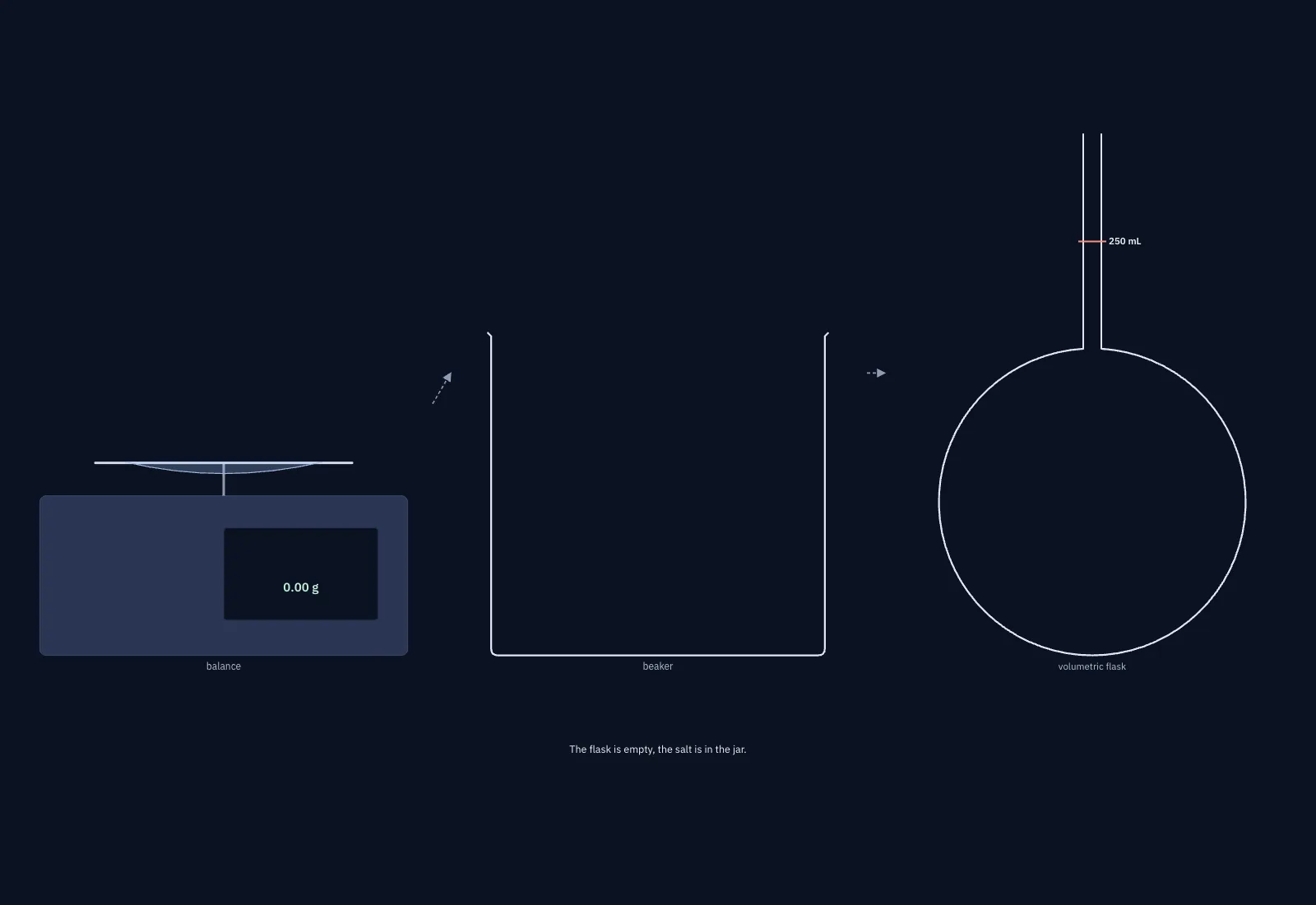
A solution of exact molar concentration is prepared in a volumetric flask: a long-necked flask with an etched mark showing the volume printed on the glass, at the temperature also marked on the glass. The steps are: (1) calculate the mass; (2) weigh the substance on a laboratory balance; (3) dissolve it in a beaker, in less water than the final volume; (4) transfer the solution to the flask, rinsing the beaker and stirring rod so no substance remains on their surfaces; (5) add water until the bottom of the meniscus reaches the mark; (6) stopper and invert the flask several times to make the solution uniform.
Set the final volume at the end. Pouring in the full requested volume of water at the start would give a different solution volume, because volumes do not add exactly.
Percentage solutions do not require a volumetric flask: weigh the substance and the water. For water, 1 mL has a mass of about 1 g, so 170 g of water is about 170 mL, measured with a graduated cylinder.
Dilution preserves the dissolved substance
Dilution means adding solvent to a solution. All the dissolved substance in the portion taken remains in the final solution, so the amount of dissolved substance stays the same: n₁ = n₂. From n = c · V comes the dilution equation:
c₁ · V₁ = c₂ · V₂
V₁ is the volume of concentrated solution taken with a pipette, and V₂ is the volume of the final solution, not the volume of water added. Take 20 mL of a 1 mol/L solution and add water up to 100 mL: c₂ = 1 · 20 ÷ 100 = 0.2 mol/L. The ratio V₂ : V₁ = 5 is called the dilution factor.
For percentage concentrations, the mass of dissolved substance stays the same: c₁ · m₁ = c₂ · m₂. Add water to 200 g of a 10% solution until it reaches 250 g: c₂ = 10 · 200 ÷ 250 = 8%.
Dilute a concentrated acid by pouring the acid into water, never water into acid, because dilution releases a lot of heat; this is a task for the teacher or laboratory technician, wearing protective equipment.
| Step | What you do | Numbers |
|---|---|---|
| 1 | You calculate the mass of salt: m = c · V · M | n = 0.2 · 0.25 = 0.05 mol; m = n · M = 0.05 · 58.5 = 2.925 g |
| 2 | You weigh the salt on the laboratory balance | 2.93 g |
| 3 | You dissolve the salt in a beaker, in about 100 mL of water | about 100 mL of water |
| 4 | You move the solution into the flask and rinse the beaker | all the salt reaches the flask |
| 5 | You top up with water until the meniscus touches the mark | 250 mL, to the mark |
| 6 | You stopper the flask and turn it upside down several times | c = n ÷ V = 0.050 ÷ 0.25 = 0.200 mol/L |
| Wrong order | What happens | Result |
|---|---|---|
| weighing → calculation → dissolving → transfer → topping up → mixing | You weighed before calculating: you did not know how many grams were needed, so nothing guarantees 0.2 mol/L. The calculation comes first. | cannot be said |
| calculation → dissolving → weighing → transfer → topping up → mixing | You dissolved before weighing: there was no salt in the water, and the salt stayed on the balance. Pure water reaches the flask, c = 0. | V = 250 mL, c = 0 mol/L |
| calculation → weighing → transfer → dissolving → topping up → mixing | You moved before dissolving: the beaker held no solution, and the solution was made after that, in the beaker. No salt reaches the flask, c = 0. | V = 250 mL, c = 0 mol/L |
| calculation → weighing → dissolving → topping up → transfer → mixing | You topped up to the mark before moving the solution. The roughly 100 mL in the beaker would be added above the mark: if the volumes added up, the volume would be about 350 mL and c ≈ 0.14 mol/L, below 0.2. In reality the flask fills past the neck and the solution spills. The mark is reached at the end. | if the volumes added up: V = 350 mL, c = 0.14 mol/L |
| calculation → weighing → dissolving → transfer → mixing → topping up | You mixed before topping up: the water added afterwards sits on top and has not mixed. At the bottom there are 100 mL with c ≈ 0.50 mol/L, above them 150 mL of water: there is no single concentration. Stoppering and turning upside down come last. | 100 mL with 0.50 mol/L and 150 mL of water; there is no single value |
| V₁ (mL) | V₂ (mL) | n (mol) | c₂ (mol/L) | factor V₂ ÷ V₁ |
|---|---|---|---|---|
| 10 | 100 | 0.0020 | 0.020 | 10.0 |
| 20 | 100 | 0.0040 | 0.040 | 5.0 |
| 25 | 100 | 0.0050 | 0.050 | 4.0 |
| 25 | 50 | 0.0050 | 0.100 | 2.0 |
| 50 | 100 | 0.0100 | 0.100 | 2.0 |
| 100 | 250 | 0.0200 | 0.080 | 2.5 |
Calculation and diagram. The procedure is the one in the lesson, with sodium chloride solution, no acid and no base. The mass comes from n = c · V and m = n · M, with the school molar mass of 58.5 g/mol; the balance reads hundredths of a gram. The result of each order is calculated from what was done in the steps: the volume and the amount of salt in the flask give c = n ÷ V. Volumes are taken as additive (the water in the beaker adds to the water in the flask), and the beaker holds about 100 mL of water; in reality the volumes differ slightly. The dots in the drawing are equal portions of dissolved salt, not ions: the particles are far smaller and far more numerous, and atoms and ions have no colour. The drawing of the vessels is a diagram.
Sources and credits. Molar mass of NaCl, 23 + 35.5 = 58.5 g/mol, from the school atomic masses of the book (CIAAW, rounded). The relations n = c · V, m = n · M and c₁ · V₁ = c₂ · V₂ are definitions and the conservation of the amount of substance, not measured data.
Mixing two solutions: the rectangle rule
For a solution of concentration c made from a more concentrated solution (c₁) and a more dilute one (c₂), the mass of dissolved substance stays the same: m₁ · c₁ + m₂ · c₂ = (m₁ + m₂) · c. This gives the rectangle rule: the masses of the solutions are in the ratio of the differences taken diagonally, m₁ : m₂ = (c − c₂) : (c₁ − c).
For 300 g of a 10% solution, made from 20% and 5% solutions: m₁ : m₂ = (10 − 5) : (20 − 10) = 5 : 10 = 1 : 2, so use 100 g of 20% solution and 200 g of 5% solution. Check: 20 · 100 ÷ 100 + 5 · 200 ÷ 100 = 30 g of substance in 300 g of solution, and 30 · 100 ÷ 300 = 10%. For dilution with water, c₂ = 0.
Mistakes that change the concentration
If the water goes past the mark, Vs is greater and the concentration is lower than calculated. If some substance remains on the beaker or stirring rod, a smaller n reaches the flask and the concentration is again lower. Use the flask at the temperature marked on it, because the volume of a liquid depends on temperature.
For the curious
Solutions with very low concentrations are prepared in stages: a 0.1 mol/L solution is diluted tenfold to 0.01 mol/L, then once more to 0.001 mol/L. Stages keep measurement errors small, because a pipette cannot accurately take one drop from a litre.
Worked example
250 mL of 0.2 mol/L solution and its dilution
Prepare 250 mL of 0.2 mol/L NaCl solution, then use it to make 100 mL of 0.05 mol/L solution. What mass of salt is weighed, and what volume of concentrated solution is taken?
Vs = 250 mL = 0.25 L, so n = 0.2 · 0.25 = 0.05 mol. M(NaCl) = 23 + 35.5 = 58.5 g/mol, so m = 0.05 · 58.5 = 2.925 g ≈ 2.93 g (rounded to two decimal places).
Weigh 2.93 g of salt, dissolve it in a beaker, transfer it to a 250 mL flask and make up to the mark.
Dilution: c₁ · V₁ = c₂ · V₂, so V₁ = c₂ · V₂ ÷ c₁ = 0.05 · 100 ÷ 0.2 = 25 mL. Take 25 mL of the 0.2 mol/L solution and add water up to 100 mL. The dilution factor is 100 ÷ 25 = 4, and 0.2 ÷ 4 = 0.05 mol/L.
Check: 2.925 g in 0.25 L gives 2.925 ÷ 0.25 = 11.7 g/L, one fifth of the 58.5 g/L in a 1 mol/L solution.
In Romania
From 1 mol/L concentrate to saline concentration
A sodium chloride concentrate for hospitals, with a Romanian-language leaflet, contains 58.44 mg of NaCl and 1 mmol of sodium per millilitre. That is a solution of about 1 mol/L, used only after dilution (Medlife, B. Braun leaflet).
Saline contains 9 g of NaCl per litre, so 9 ÷ 58.5 ≈ 0.154 mol/L. Diluting 20 mL of concentrate gives V₂ = 1 · 20 ÷ 0.154 ≈ 130 mL of solution at the concentration of saline, with a dilution factor of about 6.5. This is a calculation exercise, not preparation guidance: infusion solutions are prepared only under sterile conditions.
In short
- The mass to weigh for a molar solution is m = cM · Vs · M, with Vs in litres.
- Prepare the exact solution in a volumetric flask: dissolve in some of the water, transfer quantitatively, make up to the mark and mix thoroughly.
- Dilution preserves the amount of dissolved substance: c₁ · V₁ = c₂ · V₂, with V₂ the volume of the final solution.
- For percentage concentrations, the mass of dissolved substance stays the same: c₁ · m₁ = c₂ · m₂.
- Rectangle rule: m₁ : m₂ = (c − c₂) : (c₁ − c), with c₁ > c > c₂; for water, c₂ = 0.
- Pour concentrated acid into water, never the reverse; the teacher does this task.
Common mistakes
WrongFor 250 mL of solution, pour 250 mL of water over the substance.
RightSet the solution volume at the end: dissolve the substance in some of the water, then fill the flask to the 250 mL mark.
WrongIn c₁ · V₁ = c₂ · V₂, V₂ is the volume of water added.
RightV₂ is the volume of the final solution. When 80 mL of water is added to 20 mL of solution, V₂ = 100 mL.
WrongMixing 100 g of 20% solution and 100 g of 5% solution gives a 10% solution.
RightEqual masses give the simple mean, 12.5%. For 10%, the masses must be in the ratio 1 : 2: 100 g of 20% solution to 200 g of 5% solution.
Test yourself
7 questions. For the first 6 you see the explanation at once, with the paragraph of the lesson that supports it; for the written ones you compare with a good answer.
What does the mark on the neck of a volumetric flask set?
Answer
a) An exact volume of solution, at the marked temperature. The volumetric flask measures the final volume of solution at the temperature on the glass.
What does V₂ represent in c₁ · V₁ = c₂ · V₂?
Answer
c) The volume of the final solution. After dilution, the amount of substance in the portion taken is in a final volume V₂.
When preparing a solution, the water goes past the flask’s mark. What happens to the concentration?
Answer
c) It is lower than calculated. The same amount of substance is in a larger volume.
What mass of NaCl is weighed for 200 mL of 0.5 mol/L solution? Given M(NaCl) = 58.5 g/mol. Answer in grams, to two decimal places.
gAnswer
5.85 g. n = 0.5 · 0.2 = 0.1 mol, and m = 0.1 · 58.5 = 5.85 g.
You take 25 mL of a 2 mol/L solution and add water up to 250 mL. What is the final concentration, in mol/L?
mol/LAnswer
0.20 mol/L. c₂ = c₁ · V₁ ÷ V₂ = 2 · 25 ÷ 250 = 0.2 mol/L.
Put the steps for preparing a molar solution from a solid in order.
Answer
The correct order:
- Calculate the mass of substance
- Weigh the substance
- Dissolve it in a beaker in a little water
- Transfer the solution to the volumetric flask, rinsing the beaker
- Add water up to the mark
- Stopper the flask and mix thoroughly
Calculation and weighing come first; set the final volume only after transferring the solution to the flask.
A pupil says that adding 100 g of water to 300 g of 10% solution halves the concentration to 5%. Where is the mistake, and what concentration results?
A good answer
Calculate the concentration using the new mass of solution. The dissolved substance is 10 · 300 ÷ 100 = 30 g and stays the same, while the solution has a mass of 300 + 100 = 400 g, so c = 30 · 100 ÷ 400 = 7.5%. The mass of solution has increased by one third, not doubled.
A complete answer keeps md the same and recalculates using the new mass of solution.
Terms
- volumetric flask
- A laboratory flask with a mark on its neck, which measures an exact volume of solution.
- dilution
- Adding solvent to a solution; the amount of dissolved substance stays the same.
- dilution factor
- The ratio of the final solution volume to the volume of concentrated solution taken, V₂ : V₁.
- rectangle rule
- A rule for finding the masses of two solutions to mix for a given concentration, using concentration differences taken diagonally.
- meniscus
- The curved surface of a liquid in a narrow tube; the volume is read at the bottom of the meniscus.
Sources and link to the programme
- OpenStax – Chemistry 2e, 3.3 Molarity – preparing solutions in a volumetric flask and dilution, preserving the amount of dissolved substance
- Medlife – prospect Clorură de sodiu B. Braun 58,5 mg/mL, concentrat pentru soluție perfuzabilă – 58.44 mg of NaCl and 1 mmol of sodium per mL; administered only after dilution
- OMS / MSF – Essential drugs: practical guidelines (2016) – saline: 0.9 g of sodium chloride per 100 mL of solution
- PubChem – Sodium chloride – formula and molar mass of sodium chloride
From the programme: “Preparing aqueous solutions of given percentage and molar concentrations, including from hydrates (crystal hydrates)”; “Preparing aqueous solutions of given percentage and molar concentrations” (TC: Core curriculum (1 hour a week)). Specific competences followed: 3.5, 4.5, 5.5.