Chapter 1 · The language of chemistry and the moleLesson 1.3TC Core curriculum (1 hour a week) · beyond your profile
Stoichiometric calculations will be carried out using the chemical formula and the equation of a chemical reaction, with purity, yield, excess of a reactant, percentage concentration by mass and molar concentration of solutions
How much useful substance is in a sack? Percentage composition from a formula
A sack of ammonium nitrate says “33.5% N”, yet the formula NH₄NO₃ promises more. How do you calculate how much nitrogen a substance actually contains?
Before you read: what do you think?
A Romanian fertiliser’s technical sheet says nitrogen makes up 33.5% of the mass of its ammonium nitrate. What percentage of pure ammonium nitrate, NH₄NO₃, is nitrogen?
See the answer
It is 35%. Two nitrogen atoms weigh 28, and one NH₄NO₃ formula unit weighs 80, so 28 ÷ 80 = 0.35. The number on the sack is slightly lower because the product is not pure ammonium nitrate.
The technical sheet for granulated ammonium nitrate from Azomureș says: total nitrogen 33.5%. The formula NH₄NO₃ gives 35% nitrogen for the same substance. To explain the difference, you need to read a formula in mass percentages.
What a formula tells you about atoms and masses
The subscripts in a formula give the atomic ratio: in H₂O, H and O atoms are in the ratio 2 : 1; in CO₂, C and O atoms are in the ratio 1 : 2. The masses do not follow this ratio, because atoms have different masses. The mass ratio comes from multiplying each subscript by the atomic mass: in water, the mass ratio H : O = 2 · 1 : 16 = 1 : 8. In carbon dioxide, the mass ratio C : O = 12 : 32 = 3 : 8. In calcium carbonate, the mass ratio Ca : C : O is 10 : 3 : 12 (40 g, 12 g and 48 g out of 100 g); the atoms are in the ratio 1 : 1 : 3, while the masses are not.
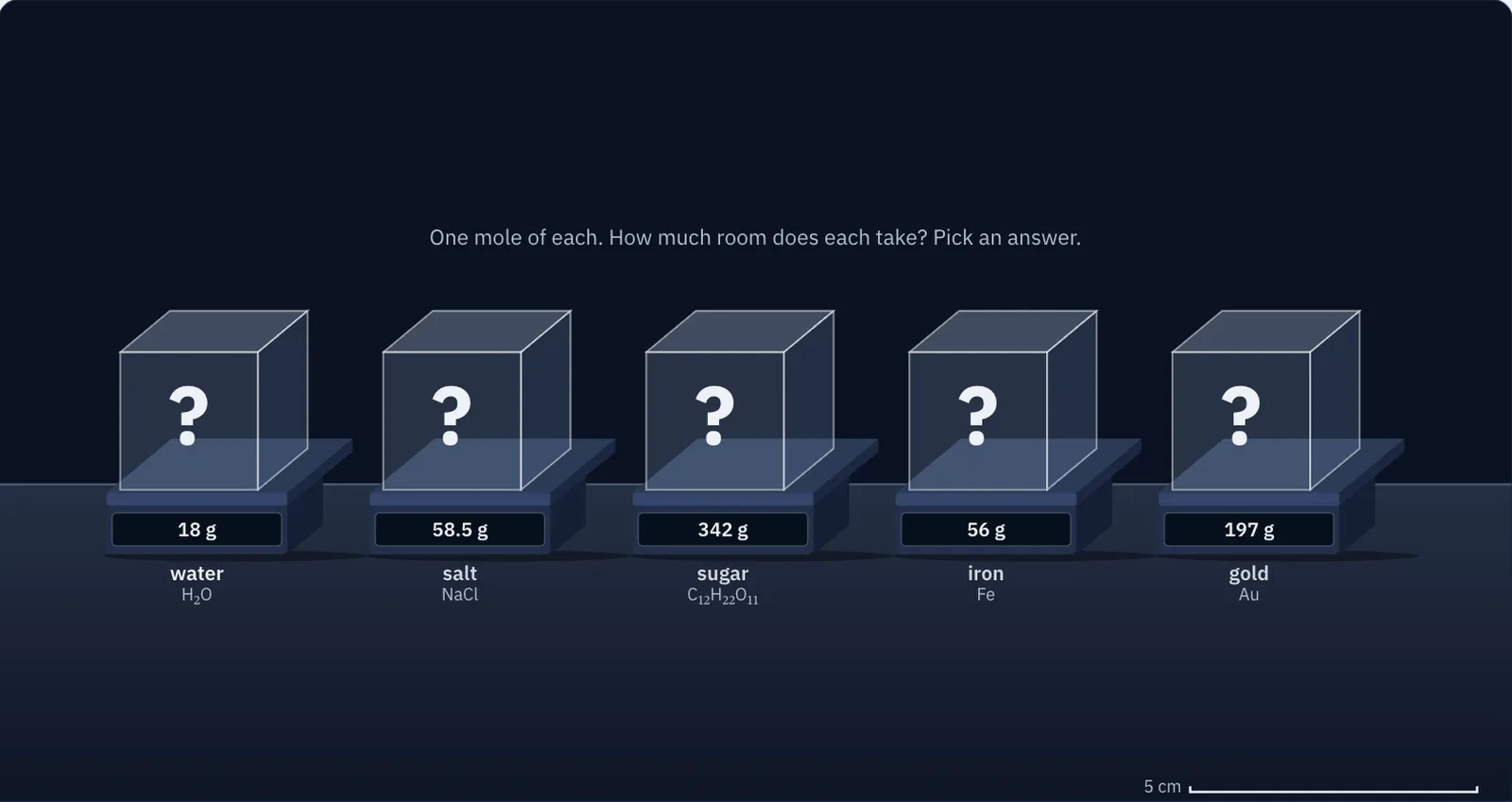
| Substance | Mass of one mole | Density | Volume of one mole | Side of the drawn block | Particles in one mole |
|---|---|---|---|---|---|
| Water, H₂O | 18 g | 1 g/cm³ | 18.0 cm³ | 2.62 cm | 6.022·10²³ molecules |
| Salt, NaCl | 58.5 g | 2.17 g/cm³ | 27.0 cm³ | 3 cm | 6.022·10²³ formula units |
| Sugar, C₁₂H₂₂O₁₁ | 342 g | 1.59 g/cm³ | 215 cm³ | 5.99 cm | 6.022·10²³ molecules |
| Iron, Fe | 56 g | 7.87 g/cm³ | 7.1 cm³ | 1.92 cm | 6.022·10²³ atoms |
| Gold, Au | 197 g | 19.3 g/cm³ | 10.2 cm³ | 2.17 cm | 6.022·10²³ atoms |
The volume of one mole is the molar mass divided by the density (calculated). The side of the block is the side of a cube of that volume. One mole of gold weighs 11 times as much as one mole of water and takes up 10.2 cm³, against 18 cm³. For 9 g of water: n = 9 ÷ 18 = 0.5 mol and N = 3.011·10²³ molecules. For 1 kg of sugar: n = 1,000 ÷ 342 ≈ 2.92 mol.
Calculation. Calculated from atomic masses (the book's own) and measured densities: the volume of one mole is the molar mass divided by the density, and the blocks are drawn to one scale as a compact solid, without the air between crystals (kitchen salt and sugar take up more room). The particles are not to scale: the discs in the picture are a drawing in which the area shows the mass of one particle, and the picture holds a few discs against 6.022·10²³ particles in a mole. Atoms, molecules and ions have no colour.
Sources and credits. Densities: PubChem (water, compound 962: 1.00 g/mL at 3.98 °C; sodium chloride, 5234: 2.17 at 25 °C; sucrose, 5988: 1.59 at 20 °C; iron, 23925: 7.87 g/cm³; gold, 23985: 19.3 g/cm³), values taken from HSDB and CAMEO Chemicals. Atomic masses: CIAAW, rounded as in the book. Avogadro constant: NIST (CODATA). Tablespoon: NIST SP 811, appendix B.8 (14.79 mL). Age of the Universe: NASA / WMAP (13.77 billion years).
How to find mass percentages from a formula
Percentage composition by mass tells you how many grams of each element are in 100 g of a substance. For element E, with nE atoms in the formula and atomic mass AE, the percentage is nE · AE · 100 ÷ M, where M is the molar mass of the substance. The percentages add up to 100.
H₂O (M = 18 g/mol): 2 · 1 · 100 ÷ 18 ≈ 11.11% H and 16 · 100 ÷ 18 ≈ 88.89% O.
CO₂ (M = 44 g/mol): 12 · 100 ÷ 44 ≈ 27.27% C and 2 · 16 · 100 ÷ 44 ≈ 72.73% O.
CaCO₃ (M = 100 g/mol): 40% Ca, 12% C, 48% O.
Fe₂O₃ (M = 160 g/mol): 70% Fe, 30% O.
NH₄NO₃ (M = 80 g/mol): 35% N, 5% H, 60% O.
The percentages do not depend on how much compound you have. They give the mass of an element in a given mass of compound: mass of element = mass of compound · percentage ÷ 100. For example, 200 g of pure CaCO₃ contains 200 · 40 ÷ 100 = 80 g of calcium, 200 · 12 ÷ 100 = 24 g of carbon and 200 · 48 ÷ 100 = 96 g of oxygen; 80 + 24 + 96 = 200 g.
For the curious
Percentages let you compare substances. Magnetite, Fe₃O₄ (M = 232 g/mol), has 3 · 56 · 100 ÷ 232 ≈ 72.41% Fe, more than Fe₂O₃, at 70%. Urea, CO(NH₂)₂ (M = 60 g/mol), has 28 · 100 ÷ 60 ≈ 46.67% N, more than ammonium nitrate, at 35%.
How to find a formula from percentages
Mass percentages lead to the empirical formula, which gives the smallest whole-number ratio of atoms. Assume a 100 g sample, divide the mass of each element by its atomic mass, then divide every result by the smallest. If you get a fraction, such as 1.5, multiply all the values by 2 to get whole numbers.
For example, a compound contains 40% C, 6.67% H and 53.33% O. Atoms: C 40 ÷ 12 ≈ 3.33; H 6.67 ÷ 1 = 6.67; O 53.33 ÷ 16 ≈ 3.33. Divided by 3.33, the values give 1 : 2 : 1, so the empirical formula is CH₂O.
The empirical formula does not tell you how many atoms are in a molecule. If you also know the molar mass of the substance, say 180 g/mol, and the mass of the empirical formula is 12 + 2 · 1 + 16 = 30 g/mol, then 180 ÷ 30 = 6 and the molecular formula is C₆H₁₂O₆.
Worked example
Nitrogen in a sack of ammonium nitrate
What is the percentage composition of ammonium nitrate, and how many kilograms of nitrogen are in a 50 kg sack of the pure substance?
Molar mass: M(NH₄NO₃) = 14 + 4 · 1 + 14 + 3 · 16 = 80 g/mol. There are two nitrogen atoms in the formula: 2 · 14 = 28. Nitrogen percentage: 28 · 100 ÷ 80 = 35%. Hydrogen: 4 · 100 ÷ 80 = 5%, oxygen: 48 · 100 ÷ 80 = 60%. Total: 35 + 5 + 60 = 100%.
Mass of nitrogen in the sack: 50 · 35 ÷ 100 = 17.5 kg. Check: nitrogen makes up a little over a third of the mass, and a third of 50 kg is about 16.7 kg.
In Romania
Why the sack says 33.5% rather than 35%
The technical sheet for ammonium nitrate made by Azomureș in Târgu Mureș lists total nitrogen at 33.5% for the granulated version: 16.75% nitric nitrogen and 16.75% ammoniacal nitrogen. For the prill version, it lists 34%. The formula explains the two equal halves: one of the two nitrogen atoms is in the NH₄⁺ ion (ammoniacal), the other in the NO₃⁻ ion (nitric).
The formula gives 35% nitrogen for the pure substance. The calculation 33.5 ÷ 35 · 100 ≈ 95.7% shows that, if all the nitrogen were in NH₄NO₃, approximately 95.7% of the product’s mass would be ammonium nitrate; for prill, 34 ÷ 35 · 100 ≈ 97.1%. The difference shows that the product is not pure NH₄NO₃. The sheet lists water at a maximum of 0.45%, but does not say what makes up the rest.
In short
- Subscripts give the atomic ratio; multiply each subscript by the atomic mass to get the mass ratio (H : O = 1 : 8 in water).
- The percentage composition by mass is nE · AE · 100 ÷ M for each element, and the percentages add up to 100.
- Values to remember: CaCO₃ has 40% Ca, 12% C, 48% O; Fe₂O₃ has 70% Fe; NH₄NO₃ has 35% N.
- The mass of an element in a mass of compound is mass of compound · percentage ÷ 100.
- To find the empirical formula from percentages, divide the mass of each element by its atomic mass, then by the smallest result; the molecular formula also needs the molar mass.
Common mistakes
WrongCaCO₃ has five atoms, three of them oxygen, so oxygen makes up 60% of its mass.
RightMass percentages account for the mass of the atoms, not their number: in CaCO₃, oxygen makes up 48%, calcium 40% and carbon 12%.
WrongThe nitrogen percentage in a 50 kg sack is greater than in one kilogram of the same fertiliser.
RightThe percentage stays the same; the mass of nitrogen changes. In 1 kg of the pure substance there is 0.35 kg of nitrogen; in 50 kg there is 17.5 kg.
WrongThe empirical formula of glucose is C₆H₁₂O₆.
RightThe empirical formula is CH₂O, the smallest whole-number ratio of atoms. C₆H₁₂O₆ is the molecular formula.
Test yourself
7 questions. For the first 6 you see the explanation at once, with the paragraph of the lesson that supports it; for the written ones you compare with a good answer.
What percentage of calcium carbonate, CaCO₃, is oxygen?
Answer
c) 48%. Three oxygen atoms weigh 48, and M(CaCO₃) = 100 g/mol: 48 · 100 ÷ 100 = 48%.
What is the mass ratio H : O in water?
Answer
b) 1 : 8. Two H atoms weigh 2, one O atom weighs 16, so 2 : 16 = 1 : 8. The ratio 1 : 2 is the ratio of the atoms.
The sack says 33.5% N, while the formula NH₄NO₃ gives 35% N. What does the difference mean?
Answer
a) The product contains other substances; it is not pure NH₄NO₃. The formula calculation is for the pure substance. A lower percentage shows that some of the product’s mass is something else.
What mass of iron, in kilograms, is in 200 kg of pure iron(III) oxide, Fe₂O₃?
kgAnswer
140 kg. Fe₂O₃ is 70% iron: 200 · 70 ÷ 100 = 140 kg.
What percentage of ammonium sulfate, (NH₄)₂SO₄, is nitrogen, given M = 132 g/mol? Round to one decimal place.
%Answer
21.2 %. Two nitrogen atoms weigh 28, so 28 · 100 ÷ 132 ≈ 21.2%.
Put the steps for finding an empirical formula from a percentage composition in order.
Answer
The correct order:
- Assume a 100 g sample, so percentages become grams
- Divide the mass of each element by its atomic mass
- Divide the results by the smallest one
- Round or, for a fraction such as 1.5, multiply all the values to get whole numbers
- Write the empirical formula with these numbers as subscripts
Percentages become grams, then moles of atoms; the whole-number ratio of moles is the ratio of atoms.
One pupil calculates the percentage of nitrogen in NH₄NO₃ starting with 1 kg, another with 50 kg. Will they get different percentages? Explain and state the mass of nitrogen each finds.
A good answer
The percentage is the same, 35%, because it is a ratio of the mass of nitrogen to the mass of the substance and does not depend on the amount. The mass of nitrogen changes: 0.35 kg from 1 kg and 17.5 kg from 50 kg.
A complete answer says the percentage does not depend on the amount and gives both masses, 0.35 kg and 17.5 kg.
Terms
- atomic ratio
- The ratio of the numbers of atoms of the elements in a formula, given by the subscripts.
- mass ratio
- The ratio of the masses of the elements in a formula: the subscripts multiplied by the atomic masses.
- percentage composition by mass
- The mass of each element in 100 g of a substance.
- empirical formula
- The formula that gives the smallest whole-number ratio of atoms in a substance.
- molecular formula
- The formula that gives the actual number of atoms in a molecule.
Sources and link to the programme
- Azomureș – Azotat de amoniu (fișă tehnică, februarie 2024) – total nitrogen 33.5% in the granulated version and 34% in prill; nitric and ammoniacal nitrogen, 16.75% each, in the granulated version; water at most 0.45%
- OpenStax – Chemistry 2e, 3.2 Determining Empirical and Molecular Formulas – percentage composition by mass, empirical formula from percentages and molecular formula from molar mass
- CIAAW – Abridged standard atomic weights 2024 – standard atomic weights, from which the rounded values used in the calculations come
From the programme: “Stoichiometric calculations will be carried out using the chemical formula and the equation of a chemical reaction, with purity, yield, excess of a reactant, percentage concentration by mass and molar concentration of solutions” (TC: Core curriculum (1 hour a week)). Specific competences followed: 5.1.