Chapter 7 · The covalent bondLesson 7.4MI Mathematics–informatics (2 hours) · beyond your profile
Polar covalent bonding; molecules of hydrochloric acid, water, ammonia, methane, carbon dioxide, chloromethane, methylamine and methanol
Why water is polar and carbon dioxide is not, though both have polar bonds
Both water and CO₂ have polar bonds to oxygen. Why is only water polar?
Before you read: what do you think?
CO₂ and H₂O molecules each have three atoms and polar bonds. What is the measured dipole moment of CO₂?
See the answer
The dipole moment of CO₂ is zero. The molecule is linear, and its two equally polar C=O bonds point in opposite directions and cancel.
Rub a plastic comb on dry hair and bring it close to a thin stream of tap water. The stream bends towards the comb. This has to do with the shape and bonds of water molecules: their polar bonds do not cancel.
The dipole of a bond and of a molecule
A polar bond has a δ+ end and a δ− end: it acts as a small dipole. It is drawn as an arrow pointing towards the more electronegative atom. A whole molecule has a dipole moment, written μ and measured in debye (D). It is found by adding the arrows for all its bonds as vectors.
A dipole moment has magnitude and direction, so the arrows are added as vectors: two equal arrows pointing in opposite directions add up to zero, while two equal arrows at an angle of less than 180° add up to a non-zero sum.
A molecule is polar if its dipole moment is non-zero and non-polar if it is zero. For a molecule to be polar, two conditions must be met: it must have at least one polar bond, and the arrows must not cancel.
H₂, Cl₂ and N₂ have non-polar bonds, so their dipole moment is 0. HCl has a single polar bond and nothing to cancel it: μ = 1.09 D.
When polar bonds cancel: CO₂ and CCl₄
In CO₂ each C=O bond is polar, with oxygen δ− (the difference is 0.89). The molecule is linear, so the two arrows are equal in magnitude and point in opposite directions: their sum is zero, and the measured dipole moment is 0 D.
In carbon tetrachloride, CCl₄, four polar C–Cl bonds (difference 3.16 − 2.55 = 0.61) run from the carbon towards the corners of a tetrahedron. The four equal arrows cancel, and the dipole moment is 0 D. The same happens in CH₄: the C–H bond is weakly polar (difference 0.35), and the molecule is non-polar because it is symmetrical.
Polar bonds alone do not make a molecule polar. Symmetry can cancel their combined effect.
When they do not cancel: water, ammonia, methanol, methylamine
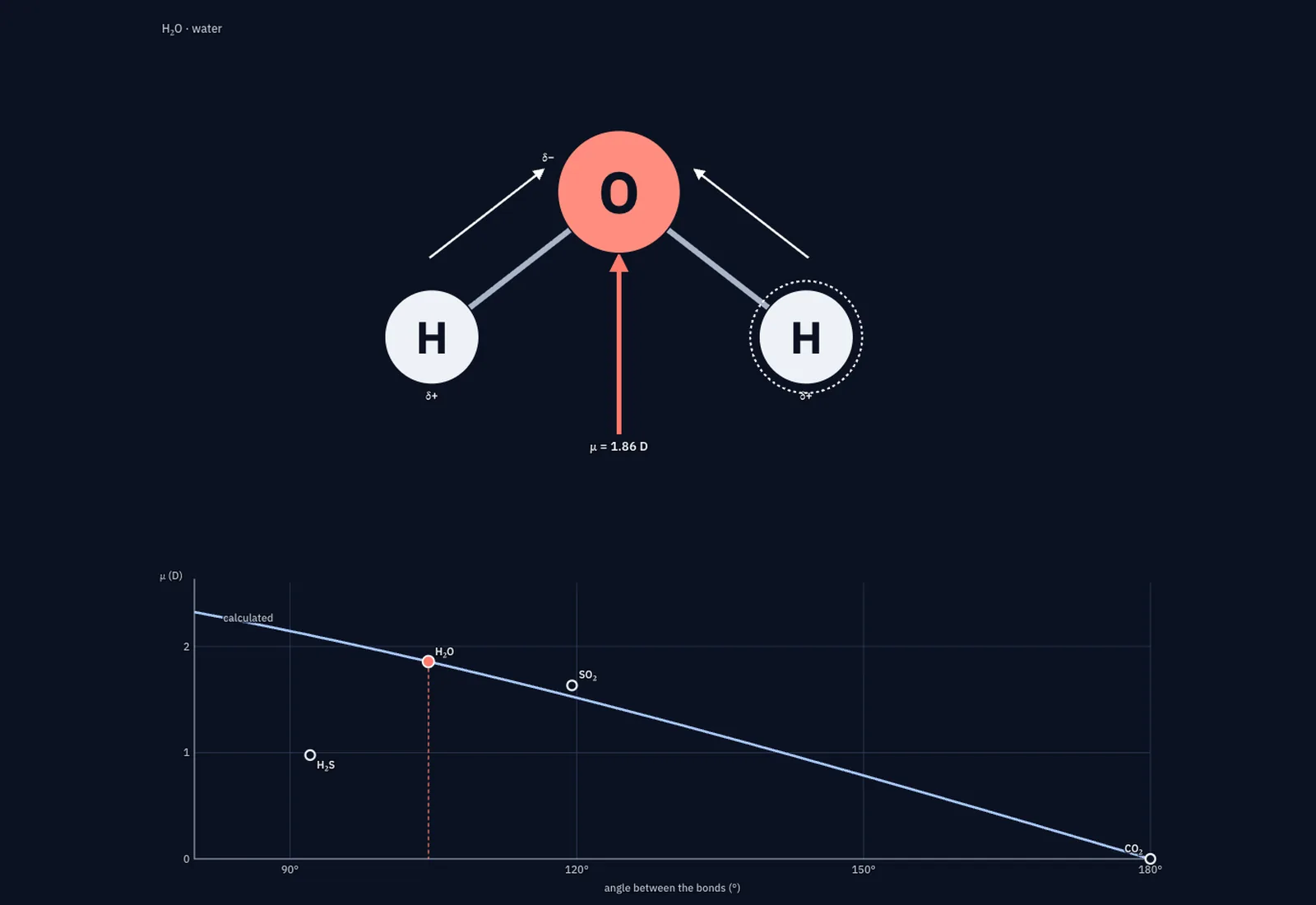
Water is bent, with an H–O–H angle of about 104.5°. The two O–H arrows do not lie on the same straight line, so they do not cancel: their sum points from the hydrogens towards the oxygen. The dipole moment of water is 1.86 D.
Ammonia is a trigonal pyramid. The three N–H arrows add up to a sum pointing towards nitrogen, and the dipole moment is 1.48 D. Methanol, CH₃OH, and methylamine, CH₃NH₂, are asymmetrical and have moments of 1.67 D and 1.31 D, respectively.
In methanol and methylamine, the O–H and N–H groups contribute strongly polar bonds. The rest of the molecule, CH₃, does not cancel them because the two parts of the molecule are not symmetrical with respect to each other.
These values are measured for molecules in the gas state. They show that shape matters as much as bonds: H₂O and CO₂ have the same number of atoms and the same type of polar bonds, but H₂O is bent and CO₂ is linear.
For the curious
The contribution of an O–H bond can be estimated. The two bonds make an angle of 104.5°, and half the angle is 52.25°, with cos 52.25° = 0.612. The sum of two equal arrows μ(O–H) is 2 · 0.612 · μ(O–H) = 1.224 · μ(O–H). From 1.86 ÷ 1.224 = 1.52, μ(O–H) ≈ 1.52 D. The estimate assumes that a bond has the same moment in every molecule and neglects lone pairs, so it is only approximate.
| Molecule | Measured angle | Measured dipole moment | Calculated bond dipole | Curve at this angle |
|---|---|---|---|---|
| CO₂, carbon dioxide | 180° | 0 D | not determined (the sum is zero whatever it is) | 0 D |
| SO₂, sulfur dioxide | 119.5° | 1.63 D | 1.62 D, assuming two equal bonds | 1.53 D |
| H₂O, water | 104.5° | 1.86 D | 1.52 D, assuming two equal bonds | 1.86 D |
| H₂S, hydrogen sulfide | 92.1° | 0.98 D | 0.70 D, assuming two equal bonds | 2.10 D |
| Curve | 80° … 180° | — | 1.52 D (from water) | from 2.32 D at 80°, to 0 D at 180° |
| Molecule | Atoms | Measured dipole moment | Bond arrows | Geometry drawn |
|---|---|---|---|---|
| H₂, hydrogen | 2 | 0 D (non-polar) | 0 | NIST CCCBDB, 0.741 Å |
| Cl₂, chlorine | 2 | 0 D (non-polar) | 0 | PubChem, CID 24526 |
| N₂, nitrogen | 2 | 0 D (non-polar) | 0 | PubChem, CID 947 |
| HCl, hydrogen chloride | 2 | 1.09 D (polar) | 1 | PubChem, CID 313 |
| H₂O, water | 3 | 1.86 D (polar) | 2 | PubChem, CID 962 |
| NH₃, ammonia | 4 | 1.48 D (polar) | 3 | PubChem, CID 222 |
| CH₄, methane | 5 | 0 D (non-polar) | 4 | PubChem, CID 297 |
| CO₂, carbon dioxide | 3 | 0 D (non-polar) | 2 | PubChem, CID 280 |
| CH₃Cl, chloromethane | 5 | 1.87 D (polar) | 4 | PubChem, CID 6327 |
| CH₃NH₂, methylamine | 7 | 1.31 D (polar) | 6 | PubChem, CID 6329 |
| CH₃OH, methanol | 6 | 1.67 D (polar) | 5 | PubChem, CID 887 |
| CCl₄, carbon tetrachloride | 5 | 0 D (non-polar) | 4 | PubChem, CID 5943 |
| C₂H₆, ethane | 8 | 0 D (non-polar) | 6 | PubChem, CID 6324 |
| C₂H₄, ethene | 6 | 0 D (non-polar) | 4 | PubChem, CID 6325 |
| C₂H₂, ethyne | 4 | 0 D (non-polar) | 2 | PubChem, CID 6326 |
| H–O–H drawn / measured | 3 | 104.0° / 104.5° |
The bent molecule: the smaller the angle, the larger the sum of the two arrows (0 D at 180°, 2.14 D at 90°). The charged rod is a drawing: the δ− end turns towards a positive rod, the δ+ end towards a negative one; a straight molecule, with a sum of zero, stays where it is. The C–H bond (difference 0.35, below the 0.4 threshold) is very weakly polar and has a short arrow; in CH₄ the sum is zero.
Calculation and measurements. Between the stops it is a calculation; a bent CO₂ does not exist. The stops (CO₂, SO₂, H₂O, H₂S) have the measured angles and dipole moments. The curve is the vector sum of two identical bonds, each with a dipole of 1.52 D, the value calculated from water, so water lies on it by construction. Real molecules do not all lie on the curve, because their bonds are different (O–H, S=O, S–H) and have different dipoles. The gallery: the geometries are calculated by PubChem, not measured; the dipole moments are measured; the sum arrow has the direction given by the bond arrows (a diagram) and the length of the measured value, 1 D being 0.5 Å. Atoms have no colour: they are drawn enormously enlarged and far fewer than in reality, and the balls have smaller radii than real atoms, so that the bonds show; the bond lengths and the angles are to scale. The charged rod and the rotation of the molecule are drawings.
Sources and credits. Experimental dipole moments, angles and bond lengths: NIST Computational Chemistry Comparison and Benchmark Database (CCCBDB), Standard Reference Database 101, release 22 (May 2022), NIST data used with the source cited; the O–S–O and O–C–O angles from G. Herzberg, 1966, and the H–S–H angle from R. L. Cook, F. C. De Lucia, P. Helminger, J. Mol. Struct. 28, 237 (1975), as CCCBDB gives them. 3D geometries: conformers calculated by PubChem (NCBI, National Library of Medicine), public domain, checked on the PubChem page of each compound. Pauling electronegativities: Wikipedia, "Electronegativities of the elements (data page)", CC BY-SA 4.0.
How to determine a molecule’s polarity
Write the Lewis formula and find the shape of the molecule. Calculate the electronegativity difference for each bond and draw its arrow towards the more electronegative atom. Add the arrows: if the sum is zero, the molecule is non-polar; if it is not, the molecule is polar. In a molecule of two identical atoms there is nothing to add: it is non-polar.
Worked example
CCl₄ and CH₃Cl, two tetrahedra, two answers
Determine the polarity of CCl₄ and CH₃Cl, both with carbon at the centre of a tetrahedron.
Valence electrons in CCl₄: 4 + 4 · 7 = 32. Four C–Cl bonds use 8 electrons, and each chlorine has three lone pairs: 4 · 6 = 24; 8 + 24 = 32.
Electronegativity differences: C–Cl, 3.16 − 2.55 = 0.61, so the bond is polar, with chlorine δ−. In CCl₄ all four are alike and symmetrical: the sum of the arrows is zero, so the molecule is non-polar.
In CH₃Cl the C–Cl bond is also polar (0.61), but the other three bonds are C–H, with a much smaller difference of 2.55 − 2.20 = 0.35. The four arrows are unequal, so they do not cancel: the molecule is polar.
Check against measured data: CCl₄ has 0 D, and CH₃Cl has 1.87 D.
In Romania
In your kitchen: the stream of water and the comb
Rub a dry plastic comb on dry hair about twenty times. Turn on the tap to produce a thin stream and bring the comb to within 1–2 cm of it, without touching the water. The stream bends towards the comb. Keep the comb away from sockets and electrical appliances.
The school explanation: the comb has an electric charge, and the polar water molecules turn their oppositely charged ends towards it and are attracted. The limit of this explanation: a charged object also attracts neutral objects, such as small pieces of paper, by separating their charges. So the bending stream alone does not prove polarity. The evidence comes from measured dipole moments: 1.86 D for water.
In short
- A polar bond is a dipole, with an arrow towards the more electronegative atom; the molecular dipole moment, μ, is measured in debye (D) and is the vector sum of the arrows.
- A molecule is polar if it has at least one polar bond and the arrows do not cancel; it is non-polar if μ = 0.
- Non-polar molecules: H₂, Cl₂, N₂ (non-polar bonds) and CO₂, CCl₄, CH₄ (polar or weakly polar bonds cancelled by symmetry).
- Polar molecules: HCl (1.09 D), H₂O (1.86 D), NH₃ (1.48 D), CH₃OH (1.67 D), CH₃NH₂ (1.31 D).
- Shape matters: bent H₂O is polar, linear CO₂ is non-polar, although they have the same kind of polar bonds.
Common mistakes
WrongA molecule with polar bonds is always polar.
RightShape matters too. In CO₂ and CCl₄ the bonds are polar, but the arrows cancel by symmetry, and the dipole moment is 0.
WrongCO₂ is non-polar because oxygen and carbon have the same electronegativity.
RightTheir electronegativities are different: O has 3.44 and C has 2.55. The molecule is non-polar because it is linear and the two bonds cancel.
WrongThe stream of water bends only because water is polar, so the experiment proves polarity.
RightA charged object also attracts neutral objects, such as pieces of paper, by separating their charges. The experiment is consistent with water’s polarity, but the evidence comes from measured dipole moments.
Test yourself
7 questions. For the first 6 you see the explanation at once, with the paragraph of the lesson that supports it; for the written ones you compare with a good answer.
Which molecule has polar bonds but is non-polar?
Answer
c) CO₂. CO₂ is linear, and the two C=O arrows are equal and point in opposite directions.
Why is a water molecule polar?
Answer
d) Because it is bent and the two O–H arrows do not cancel. The O–H bonds are polar, and the bent shape makes the sum of the arrows non-zero.
What is the dipole moment of CCl₄, and why?
Answer
b) 0 D, because the four equal arrows in a tetrahedron cancel. The C–Cl bonds are polar (difference 0.61), but their sum cancels in the regular tetrahedron.
Calculate the electronegativity difference for the C–Cl bond (C 2.55; Cl 3.16), to two decimal places.
Answer
0.61. 3.16 − 2.55 = 0.61, a value between 0.4 and 1.8, so the bond is polar.
Place each molecule in the right category.
Answer
Polar molecule: HCl; H₂O; NH₃; CH₃OH.
Non-polar molecule: H₂; N₂; CO₂; CCl₄.
The non-polar molecules are those with identical atoms (H₂, N₂) or those that are symmetrical (CO₂, CCl₄). The others have a non-zero dipole moment.
Put the steps for determining whether a molecule is polar in order.
Answer
The correct order:
- Write the Lewis formula and find the shape of the molecule
- Calculate the electronegativity difference for each bond
- Draw each bond’s arrow towards the more electronegative atom
- Add the arrows
- Conclude: a zero sum means a non-polar molecule, a non-zero sum means a polar molecule
You need to know the shape before adding the arrows; the conclusion comes last.
A classmate says: “CH₄ has polar bonds, so it is a polar molecule.” Correct them.
A good answer
The C–H bonds are very weakly polar (difference 0.35), but even if they were polar, methane is a regular tetrahedron and the four equal arrows cancel. The dipole moment of methane is 0 D, so the molecule is non-polar.
A complete answer says that molecular polarity depends on the bonds and the shape, and mentions tetrahedral symmetry.
Terms
- dipole
- A system of two opposite charges a short distance apart; a polar bond acts as a dipole.
- dipole moment
- A vector quantity, written μ and measured in debye (D), that shows the size of the charge separation in a molecule.
- polar molecule
- A molecule with a non-zero dipole moment.
- non-polar molecule
- A molecule with a zero dipole moment, either because of non-polar bonds or because of symmetry.
- debye
- A unit of dipole moment, symbol D.
- molecular symmetry
- An arrangement of atoms in which the arrows of polar bonds cancel one another.
Sources and link to the programme
- NIST CCCBDB – Experimental dipole moments – measured dipole moments: H₂O 1.857 D; NH₃ 1.476 D; HCl 1.093 D; CH₃OH 1.672 D; CH₃NH₂ 1.310 D; CH₃Cl 1.870 D; CO₂, CH₄, CCl₄, H₂, N₂, Cl₂ 0 D
- NIST CCCBDB – Experimental bond angles of type aHOH – the H–O–H angle of water, 104.48°
- OpenStax – Chemistry 2e, 7.6 Molecular Structure and Polarity – dipole moment as the vector sum of bond moments; non-polar CO₂ with polar bonds; symmetrical and asymmetrical molecules
- FLEET – Activity 6: Water Bender – experiment with a rubbed balloon or comb and a thin stream of tap water, 1–2 cm from the stream
- NIST CCCBDB – Experimental bond angles of type aHNH – the H–N–H angle of ammonia, 106.67°
From the programme: “Polar covalent bonding; molecules of hydrochloric acid, water, ammonia, methane, carbon dioxide, chloromethane, methylamine and methanol”; “Non-polar molecules: the molecules of hydrogen, chlorine, nitrogen, carbon dioxide and carbon tetrachloride”; “Polar molecules: the molecules of hydrochloric acid, water, ammonia, methanol and methylamine” (MI: Mathematics–informatics (2 hours)). Specific competences followed: 2.4, 4.4, 5.3, 5.4.