Chapter 7 · The covalent bondLesson 7.3MI Mathematics–informatics (2 hours) · beyond your profile
Electronegativity
Which atom pulls harder on the shared pair of electrons
In a covalent bond, electrons are shared. Are they shared equally?
Before you read: what do you think?
Between hydrogen (2.20) and chlorine (3.16), both atoms attract the shared pair in H–Cl. Where is it?
See the answer
Chlorine has the higher electronegativity, so it attracts the pair more strongly. This leaves chlorine with a partial negative charge, δ−, and hydrogen with a partial positive charge, δ+.
In H₂ the two atoms are identical, so the electron pair sits exactly in the middle. In hydrogen chloride, HCl, the atoms are different, and the pair no longer sits in the middle. Differences of the same kind occur between the atoms in water, ammonia and the methanol once found in windscreen fluids.
Which atom pulls harder on the shared pair
In HCl the shared pair is not in the middle: chlorine attracts it more strongly than hydrogen does. The measure of this attraction is electronegativity: the tendency of a chemically bonded atom to attract shared electrons towards itself.
Electronegativity is calculated on a scale, because an instrument cannot read it directly from an atom. The most widely used is the Pauling scale, built in 1932 from bond energies; its values have no unit. On this scale: F 3.98; O 3.44; Cl 3.16; N 3.04; C 2.55; H 2.20.
The order of the elements is F > O > Cl > N > C > H. Values increase from left to right across a period (Li 0.98; C 2.55; N 3.04; O 3.44) and decrease from top to bottom down a group (Cl 3.16; Br 2.96; I 2.66). Fluorine has the highest electronegativity in the periodic table.
For the curious
Older textbooks round the values: H 2.1; C 2.5; N 3.0; O 3.5; Cl 3.0; F 4.0. With these, nitrogen and chlorine come out equal, and their order is lost. With values to two decimal places, chlorine is slightly ahead of nitrogen.
The electronegativity difference decides the type of bond
The difference between the electronegativities of the two atoms shows how far the shared pair is shifted. In H–H the difference is 0, and the bond is non-polar. In H–Cl the difference is 3.16 − 2.20 = 0.96: the pair sits closer to chlorine, and the bond is polar covalent. In NaCl the difference is 3.16 − 0.93 = 2.23: the pair is shifted so far towards chlorine that the bond is ionic.
The classroom guidelines are: below 0.4, the bond is considered non-polar; between 0.4 and 1.8, polar; above 1.8, ionic. These are guidelines. The change from one bond type to another is gradual, and some substances do not follow the thresholds.
Partial charges: δ+ and δ−
The more electronegative atom in a polar bond has a little more of the shared pair around it and carries a partial negative charge, δ−. The other atom has a little less and carries a partial positive charge, δ+. Hydrogen chloride is written Hδ⁺–Clδ⁻.
A partial charge is not the charge of an ion. In Clδ⁻ chlorine has not gained a whole electron, while in NaCl the ions Na⁺ and Cl⁻ have charges of 1+ and 1−. The numerical values of δ depend on the calculation method; the sign stays the same.
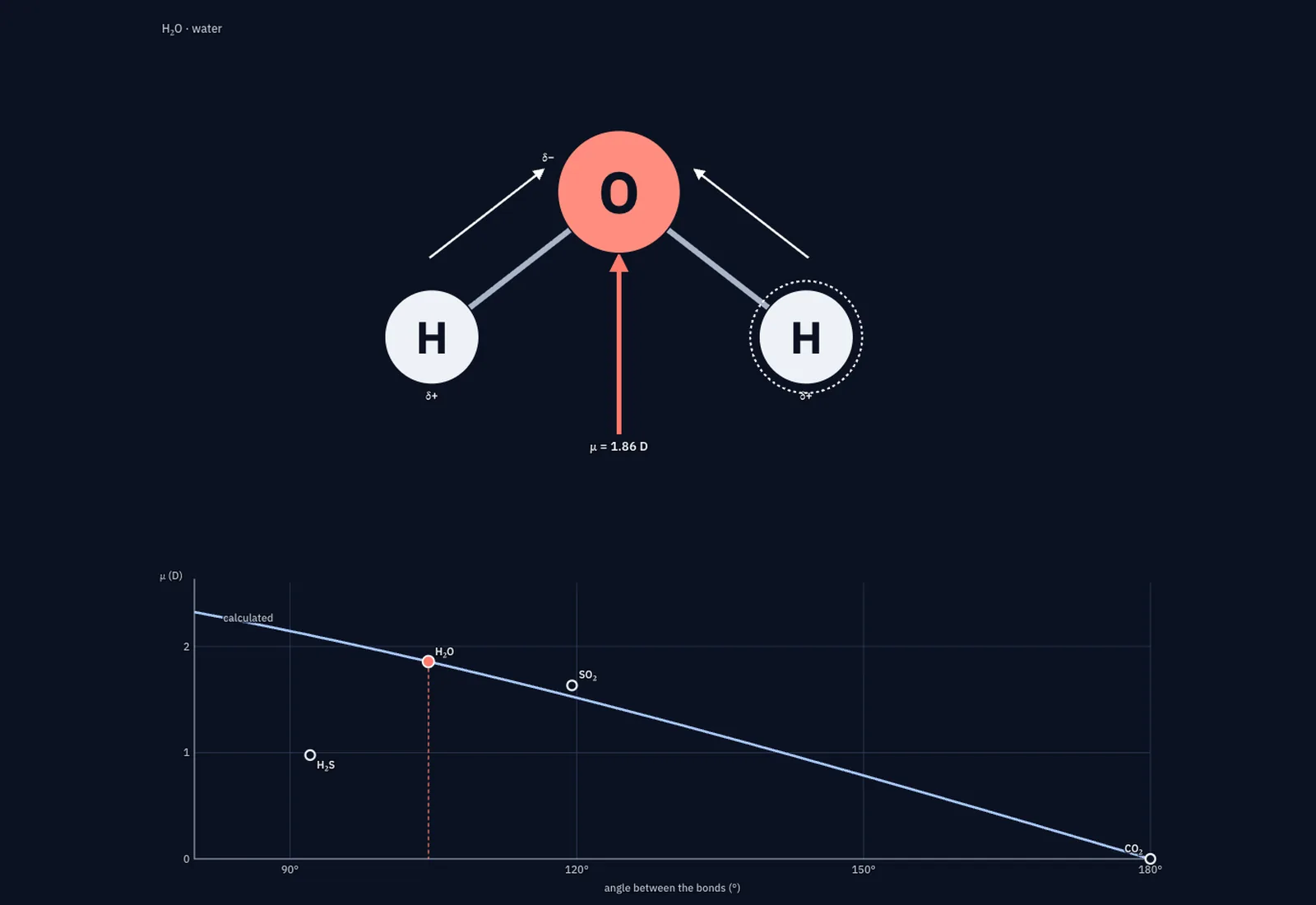
In water, oxygen (3.44) is more electronegative than hydrogen (2.20): the difference is 1.24, so oxygen is δ− and each hydrogen is δ+. In NH₃ nitrogen is δ− (the N–H difference is 0.84), while in CO₂ oxygen is δ− and carbon is δ+ (the C=O difference is 0.89). In CH₄ the C–H difference is 0.35, below the 0.4 threshold: the bond is very weakly polar and is usually treated as non-polar. Both statements are true: the C–H bond is weakly polar, and the CH₄ molecule is non-polar because it is symmetrical.
Bonds in chloromethane, methylamine and methanol
In chloromethane, CH₃Cl, the C–Cl bond has a difference of 3.16 − 2.55 = 0.61: chlorine is δ− and carbon is δ+. In methylamine, CH₃NH₂, the C–N bond has a difference of 3.04 − 2.55 = 0.49, and N–H has 0.84: nitrogen is δ− relative to both neighbours. In methanol, CH₃OH, the C–O bond has a difference of 0.89, and O–H has 1.24, the most polar bond in the molecule. The C–H bonds in all three are very weakly polar.
Worked example
Bond polarity in methanol
Methanol, CH₃OH, has three C–H bonds, one C–O bond and one O–H bond. Find their order of polarity and the signs of the partial charges.
Electronegativities (Pauling): H 2.20; C 2.55; O 3.44.
Differences: C–H: 2.55 − 2.20 = 0.35; C–O: 3.44 − 2.55 = 0.89; O–H: 3.44 − 2.20 = 1.24.
Increasing order of polarity: C–H < C–O < O–H.
Signs: in C–O, oxygen is δ− and carbon is δ+; in O–H, oxygen is δ− and hydrogen is δ+. Oxygen thus receives δ− from two bonds.
Check: 0.35 is below the 0.4 threshold, so C–H is treated as non-polar; 0.89 and 1.24 are between 0.4 and 1.8, so C–O and O–H are polar.
In Romania
Methanol in windscreen fluid
Methanol, CH₃OH, has polar C–O and O–H bonds. It is toxic, and in the European Union, including Romania, windscreen washing or de-icing fluids containing it at a concentration of 0.6% by mass or more have not been placed on the market for the general public since 9 May 2019. The restriction followed cases of poisoning from swallowing these fluids, reported in seven member states.
A container with 5 kg of windscreen fluid can therefore contain less than 5,000 · 0.6 ÷ 100 = 30 g of methanol. Look for the names of substances and hazard pictograms on the label; never put windscreen fluid in drinks bottles.
In short
- Electronegativity is the tendency of a chemically bonded atom to attract shared electrons; on the Pauling scale it has no unit.
- Pauling order: F 3.98 > O 3.44 > Cl 3.16 > N 3.04 > C 2.55 > H 2.20. Electronegativity increases to the right across a period and decreases down a group.
- Electronegativity difference: below 0.4, non-polar bond; between 0.4 and 1.8, polar; above 1.8, ionic; the thresholds are guidelines.
- In a polar covalent bond, the more electronegative atom is δ− and the other is δ+; partial charges are not ionic charges.
- HCl, H₂O, NH₃, CO₂, CH₃Cl, CH₃NH₂ and CH₃OH have polar bonds; in CH₄ the C–H bond, with a difference of 0.35, is very weakly polar, and the molecule is non-polar because it is symmetrical.
Common mistakes
WrongIn Hδ⁺–Clδ⁻ hydrogen has given chlorine an electron and become an ion.
RightThe electron pair remains shared; it simply sits closer to chlorine. δ means a partial charge, much smaller than the 1+ or 1− charge of an ion.
WrongIf the difference is above 1.8, the bond is always ionic.
RightThe thresholds are guidelines. The change from covalent to ionic is gradual, and some substances do not follow the limits.
WrongHydrogen is δ− in O–H because it has gained an electron in the bond.
RightThe sign comes from electronegativity: oxygen (3.44) attracts the pair more strongly than hydrogen (2.20), so oxygen is δ− and hydrogen is δ+.
Test yourself
7 questions. For the first 6 you see the explanation at once, with the paragraph of the lesson that supports it; for the written ones you compare with a good answer.
Which atom has the highest electronegativity?
Answer
c) Fluorine. On the Pauling scale fluorine is 3.98, oxygen 3.44, chlorine 3.16 and nitrogen 3.04.
In the O–H bond in water, what are the signs of the partial charges?
Answer
b) Oxygen δ−, hydrogen δ+. Oxygen is more electronegative, so it attracts the shared pair more strongly and is δ−.
How is the C–H bond in methane, with an electronegativity difference of 0.35, usually treated?
Answer
c) As a non-polar or very weakly polar bond. 0.35 is below the guideline threshold of 0.4.
Calculate the electronegativity difference for the H–Cl bond (H 2.20; Cl 3.16), to two decimal places.
Answer
0.96. Subtract the smaller value from the larger: 3.16 − 2.20 = 0.96. The value is between 0.4 and 1.8, so the bond is polar.
Place each bond in the right category according to its electronegativity difference.
Answer
Non-polar or very weakly polar (below 0.4): H–H (difference 0); C–H (difference 0.35).
Polar covalent (0.4–1.8): N–H (difference 0.84); O–H (difference 1.24).
Ionic (above 1.8): Na–Cl (difference 2.23).
Compare each difference with the guidelines 0.4 and 1.8.
Put the elements in increasing order of electronegativity.
Answer
The correct order:
- H
- C
- N
- Cl
- O
- F
The Pauling values are H 2.20; C 2.55; N 3.04; Cl 3.16; O 3.44; F 3.98.
HCl and NaCl both contain chlorine. Why is the bond in HCl polar covalent and the one in NaCl ionic?
A good answer
The electronegativity difference is 3.16 − 2.20 = 0.96 in H–Cl, between 0.4 and 1.8, so the electron pair is shared and shifted towards chlorine. In NaCl it is 3.16 − 0.93 = 2.23, above 1.8, and the pair is shifted so far towards chlorine that the bond is considered ionic. The thresholds are guidelines.
A complete answer calculates both differences, compares them with the guidelines 0.4 and 1.8, and states that the thresholds are guidelines.
Terms
- electronegativity
- The tendency of a chemically bonded atom to attract shared electrons towards itself; it is expressed on a scale, such as the Pauling scale.
- polar covalent bond
- A covalent bond between different atoms in which the shared pair is shifted towards the more electronegative atom.
- non-polar covalent bond
- A covalent bond between identical atoms or atoms with very similar electronegativities.
- partial charge
- An electric charge smaller than that of an ion, written δ+ or δ−, arising from the shift of the shared pair.
- electronegativity difference
- The difference between the electronegativity values of two bonded atoms; it indicates bond polarity.
- Pauling scale
- A scale of electronegativity with no unit, built from bond energies; hydrogen has a value of 2.20.
Sources and link to the programme
- L. Pauling – The Nature of the Chemical Bond. IV (J. Am. Chem. Soc. 54, 3570, 1932) – the electronegativity scale built from single-bond energies, published in 1932
- Universitatea din Sydney – Pauling Electronegativity Values – Pauling values for H 2.20; Li 0.98; Na 0.93; C 2.55; N 3.04; O 3.44; Cl 3.16; Br 2.96; I 2.66
- Wikipedia – Electronegativities of the elements (data page) – the Pauling value for fluorine, 3.98, alongside the other values to two decimal places
- OpenStax – Chemistry 2e, 7.2 Covalent Bonding – definition of electronegativity; the 0.4 and 1.8 guidelines and their limits; partial charges in HCl
- OpenStax – Chemistry 2e, 7.6 Molecular Structure and Polarity – CO₂ has polar bonds; bond and molecular polarity
- Regulamentul (UE) 2018/589 al Comisiei, privind metanolul în Anexa XVII la REACH – methanol is not placed on the market for the general public after 9 May 2019 (the date corrected by the corrigendum published in OJ L 102, 23.4.2018, p. 99), in windscreen washing or de-icing fluids at 0.6% by mass or more; cases of poisoning in seven member states
From the programme: “Electronegativity”; “Polar covalent bonding; molecules of hydrochloric acid, water, ammonia, methane, carbon dioxide, chloromethane, methylamine and methanol” (MI: Mathematics–informatics (2 hours)). Specific competences followed: 1.4, 5.4.