Chemical bonds
Chapter 7
The covalent bond – why molecules have a shape
Why do molecules have a shape, and what changes it?
Water and carbon dioxide each have three atoms and two polar bonds. One molecule has a positive end and a negative end; the other does not. Bend a molecule and see when the two ends appear, then go through the molecules of the programme, one at a time. Start with a prediction.
Two molecules with polar bonds
In CO₂ and in H₂O, oxygen pulls the shared pairs harder than carbon or hydrogen does. Each bond has a δ+ end and a δ− end, and its arrow points towards the oxygen.
Which of the two molecules has a positive end and a negative end? You can look at each in turn; the sum of the arrows stays hidden until the next step.
A polar bond is an arrow
In HCl, chlorine (3.16) pulls the shared pair harder than hydrogen (2.20) does. The difference is 0.96. Chlorine carries δ−, hydrogen δ+, and the arrow points towards chlorine.
With a single bond, the arrow of the bond is the arrow of the molecule. The measured dipole moment of HCl is 1.09 D, and the length of the arrow in the picture is proportional to it.
Two equal arrows on a straight line cancel
In CO₂, each C=O bond is polar (difference 0.89), with oxygen δ−. The molecule is linear: the O–C–O angle is 180°.
The two arrows have the same length and opposite directions, so their sum is zero. The measured dipole moment of CO₂ is 0 D: the molecule has polar bonds and no ends.
Bend the molecule and the sum appears
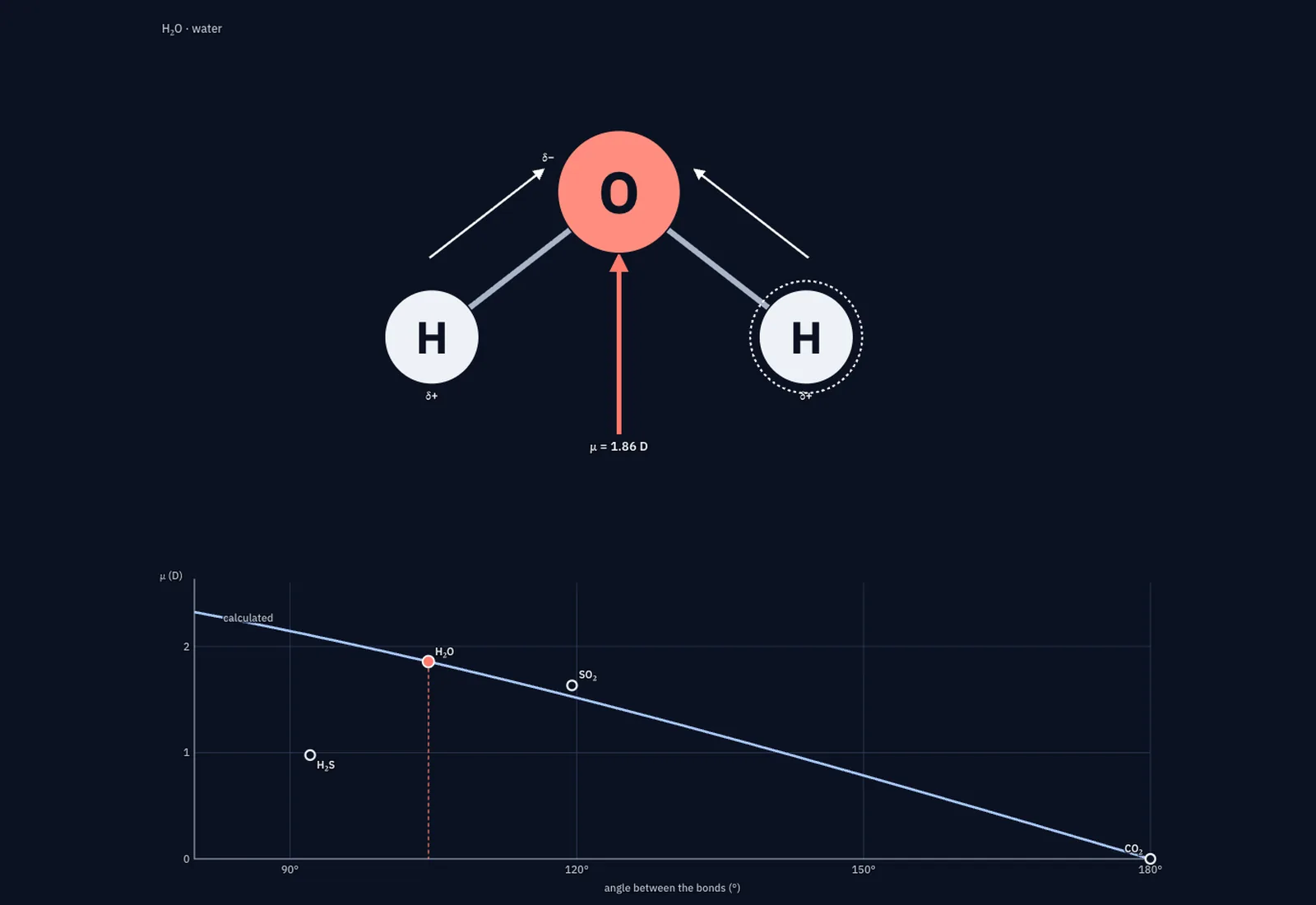
Here both bonds have the same dipole, 1.52 D, derived from the measured moment of water. Drag the right-hand atom or use the buttons: as the molecule bends, from 180° to 90°, the sum of the two arrows grows from 0 D to 2.14 D.
Bring up a charged rod. The δ− end turns towards a positive rod, the δ+ end towards a negative one. A straight molecule stays where it is, because it has no ends. The full rotation is a drawing; in a gas, the motion of the molecules prevents it.
For the curious. The sum is calculated with the formula μ = 2 · 1.52 D · cos(angle ÷ 2); the graph shows its values.
Real molecules have their own values
The four stops are real molecules, with the angle and the dipole moment measured: CO₂ (180°, 0 D), SO₂ (119.5°, 1.63 D), H₂O (104.5°, 1.86 D) and H₂S (92.1°, 0.98 D).
The curve uses a single bond dipole, 1.52 D, while the S=O and S–H bonds have other dipoles. That is why at 119.5° the curve gives 1.53 D, while SO₂ measures 1.63 D; at 92.1° the curve gives 2.10 D, while H₂S measures 0.98 D. Water lies on the curve, because the bond dipole was derived from it.
Four polar bonds, no polar molecule
In CCl₄, each C–Cl bond is polar (difference 0.61). The four arrows start at the carbon and point to the corners of a tetrahedron, all the same length. Their sum is zero, and the measured dipole moment is 0 D.
Rotate the molecule: from any side, the four arrows cancel one another. The shape decides the sum, not the number of polar bonds.
The fifteen molecules of the programme
Go through the molecules with the ‹ and › buttons in the picture. Each polar bond has an arrow towards the more electronegative atom; their sum gives the direction of the thick arrow, and its length comes from the measured value: 1 D is an arrow of 0.5 Å.
The C–H bond (difference 0.35, below the threshold of 0.4) is very weakly polar and has a short arrow; in CH₄ the sum stays zero. The direction of the sum is a diagram: for methanol and methylamine, the real dipole also depends on the lone pairs.
Sum zero, measured: H₂, Cl₂, N₂, CH₄, CO₂, CCl₄, C₂H₆, C₂H₄, C₂H₂. Molecules with ends: HCl, H₂O, NH₃, CH₃Cl, CH₃NH₂, CH₃OH; their moments appear below the picture.
Now you explain
Chloromethane, CH₃Cl, has four bonds: one C–Cl (difference 0.61) and three C–H (difference 0.35, very weakly polar, with short arrows towards the carbon).
Is CH₃Cl polar? Explain in a few sentences, using what you saw with CCl₄ and with water; then show the sum.
Compare with an answer
Yes: the measured dipole moment is 1.87 D. In CCl₄, the four equal arrows cancel by symmetry. In CH₃Cl, a chlorine atom takes the place of a hydrogen, the symmetry is gone, and the C–Cl arrow and the three short C–H arrows point the same way, towards the chlorine, so they add up. The molecule has a δ− end at the chlorine and a δ+ end at the hydrogens.