Chapter 6 · Ionic and metallic bondsLesson 6.3TC Core curriculum (1 hour a week) · beyond your profile
The sodium chloride crystal: characterisation
Why salt is hard but brittle
A grain of salt breaks without bending, yet salt melts only at 801 °C. How are its ions arranged to make this happen?
Before you read: what do you think?
A salt crystal is made of electrically charged ions. If a bulb is connected to a battery through a dry salt crystal, what happens (a demonstration done by the teacher)?
See the answer
The ions are present in the crystal, but each stays in its place in the lattice and cannot carry charge through the material. In molten or dissolved salt, the ions move freely and the bulb lights.
Put a few grains of salt on a black sheet and look at them through a magnifying glass: each is a tiny cube. Strike a crystal like this and it breaks into pieces; it does not flatten like a metal. It melts only at 801 °C and does not conduct electricity. All this comes from the way its ions are arranged.
How the ions are arranged in the crystalWhat the particles do
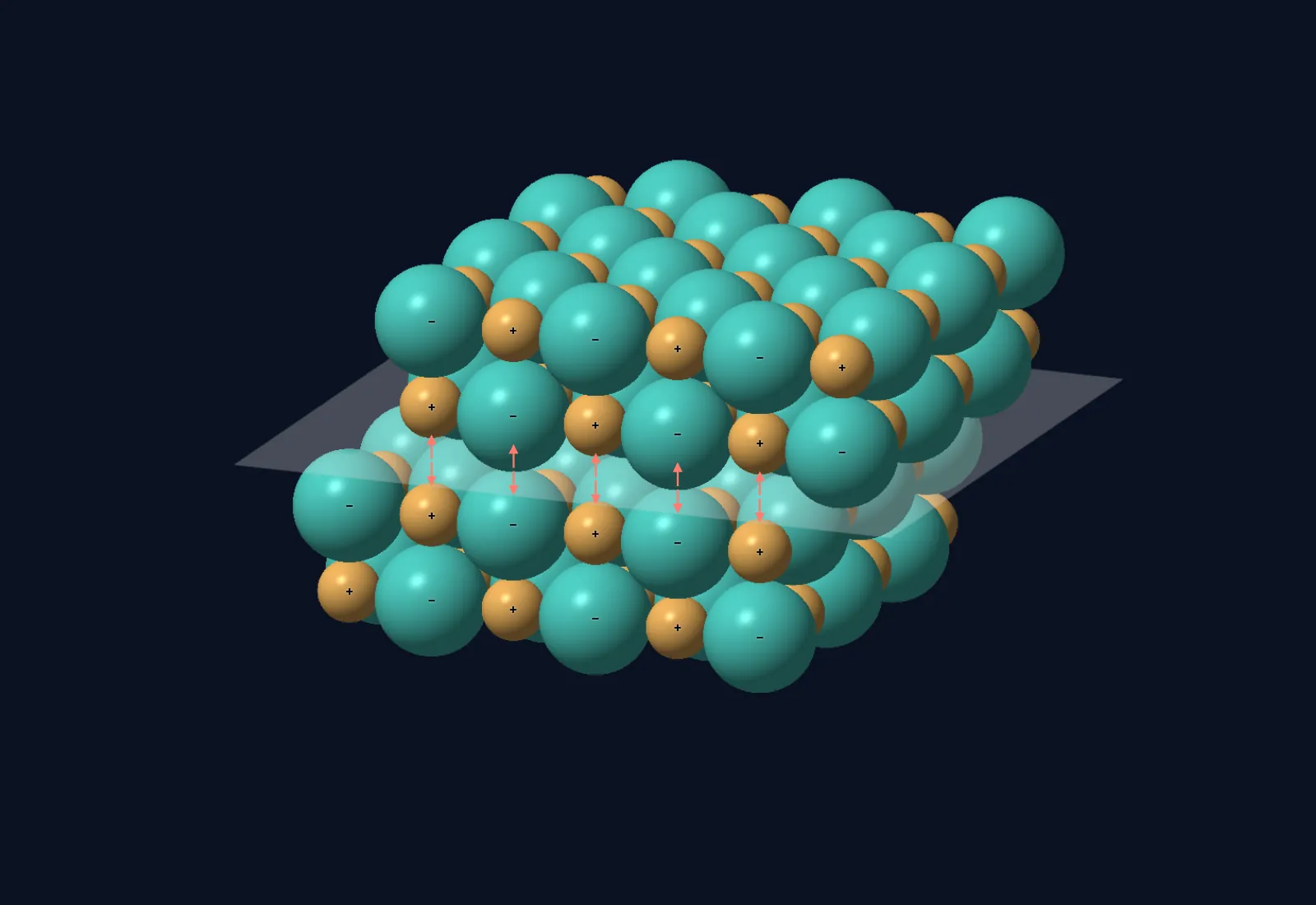
Cl⁻ ions are larger than Na⁺ ions: their radii are 181 pm and 102 pm. Cl⁻ ions occupy the corners and face centres of a cube, while Na⁺ ions sit between them, at the midpoints of the edges and at the centre of the cube. The arrangement is called a face-centred cubic lattice. The cube that repeats in every direction is the unit cell.
Each ion is surrounded by six oppositely charged ions at equal distances: four in the same plane, one above and one below. The number of nearest neighbouring ions is the coordination number, 6 here for both ions.
Cl⁻ and Na⁺ ions touch along the edge of the cell. The edge measured by X-rays is 564 pm (564.02 pm), and the sum of the radii gives 2 · (102 + 181) = 566 pm: close values, though not identical. The unit cell contains 4 Cl⁻ ions and 4 Na⁺ ions, or four formula units. The eight ions do not form molecules: each belongs to the lattice that continues in every direction, and the formula NaCl shows only their 1 : 1 ratio.
What you observe in solid saltWhat you see
At room temperature sodium chloride is a solid, in the form of white cubic crystals. It melts at 801 °C and boils at 1,465 °C. It dissolves in water (36.0 g per 100 g of water at 25 °C) and hardly at all in ethanol (0.065 g per 100 g of ethanol).
As a solid, it does not conduct electricity. Molten, it conducts. Dissolved in water, it conducts. When struck, the crystal breaks into pieces.
For the curious
Some tables and textbooks give the boiling point of sodium chloride as 1,413 °C, others as 1,465 °C. The HSDB database, through PubChem, gives 1,465 °C; that is the value used here.
Why salt conducts only when molten or dissolved, and why it breaksWhat the particles do
In the crystal, ions vibrate around their positions in the lattice, but cannot move from place to place. Without charged particles that can move, current cannot pass. On melting, the lattice comes apart and the ions move freely; on dissolving, water pulls the ions out of the lattice and surrounds them. In both states, Na⁺ ions move towards the negative electrode and Cl⁻ ions towards the positive one, carrying charge. Ions are present in all three states; what differs is their freedom to move.
Melting takes a lot of energy because each ion is attracted to many oppositely charged ions. Breaking apart the lattice means overcoming the attraction between all the ions, so 801 °C is a high temperature: completely separating one mole of NaCl into gaseous ions takes 769 kJ. On melting, the ions remain in contact and lose only their fixed positions.
When struck, one layer of ions slips by one position relative to the next, the distance between two neighbouring ions (282 pm, half the cell edge). Ions with the same charge come face to face and repel, and the crystal breaks along the plane of slip. The crystal is hard because the attractions are strong, but brittle because it cannot accommodate the slipping of layers.
| Quantity | Value | How it is obtained |
|---|---|---|
| NaCl unit cell edge | 564.02 pm | measured |
| Edge from the sum of the ionic radii | 566 pm | calculated: 2 · (102 + 181) |
| Distance between a Na⁺ and a neighbouring Cl⁻ | 282 pm | half the measured edge |
| Radius of Na⁺, radius of Cl⁻ | 102 pm, 181 pm | Shannon, coordination number 6 |
| The block drawn | 144 ions: 72 Na⁺, 72 Cl⁻ | four layers of 6 × 6 |
| Electrostatic energy between the halves of the block, before the push | −15.3 eV | calculated: negative, the halves are bound |
| Push at which the energy passes through zero | 166 pm | calculated |
| Energy after a push of 282 pm | +3.3 eV | calculated: positive, ions of the same sign face to face |
| Cu unit cell edge | 361.5 pm | measured |
| Distance between two neighbouring copper ions | 255.6 pm | the edge divided by √2 |
| Nearest neighbours of a copper ion | 12, before and after a push of 255.6 pm | counted in the block drawn |
| Neighbours of a copper ion in the pushed layer, at half a step | 10 | counted in the block drawn |
| Free particles: solid salt, molten salt, copper | 0 of 144 ions; 144 of 144 ions; 216 electrons of 216 copper ions | drawing of the motion, numbers from the block |
| Melting point of NaCl | 801 °C | measured |
Diagram and calculation. Diagram to scale: the positions of the ions come from the measured cell edges (NaCl 564 pm, Cu 361.5 pm), and the radii of Na⁺ and Cl⁻ are the Shannon ionic radii (102 and 181 pm). The electrostatic energy between the halves is calculated for the 144 ions drawn, as point charges in a vacuum, with no other forces, and the halves are rigid; so that the spheres do not overlap, the top half is lifted as far as it needs to be, a choice of the drawing. The cleavage of salt is an observed property; the calculation illustrates it, it does not prove it. The copper cores are drawn smaller than in reality, so that the electrons show, and the molten salt is a drawing, not a calculation. In a real metal, defects slide, not whole layers. Atoms and ions have no colour: they are drawn enormously enlarged and far fewer than in reality. Salt is melted only as a demonstration done by the teacher.
Sources and credits. NaCl unit cell edge: 564.02 pm, value quoted from Wikipedia, "Sodium chloride", and checked in the Crystallography Open Database (entries 9003308 and 7132177, public domain). Cu unit cell edge: 361.5 pm (Swanson and Tatge, National Bureau of Standards, in the Crystallography Open Database, entry 5000216, public domain). Ionic radii: R. D. Shannon, Acta Crystallographica A32, 751 (1976), Imperial College London database. Vacuum permittivity: CODATA, NIST. Melting point of NaCl: PubChem.
How to write the three states of saltHow it is written
The letters in brackets show the state of matter: (s) for solid, (l) for liquid, (aq) for hydrated ions in aqueous solution. Melting does not change the particles; it only frees them:
NaCl(s) → NaCl(l)
Molten salt contains mobile Na⁺ and Cl⁻ ions. Dissolving in water is written with hydrated ions:
NaCl(s) → Na⁺(aq) + Cl⁻(aq)
Worked example
Ions in the unit cell and the density of salt
How many ions are in the NaCl unit cell, and what density follows from the measured edge of 564 pm?
Cl⁻ ions: 8 corners · 1/8 + 6 faces · 1/2 = 4. Na⁺ ions: 12 edges · 1/4 + 1 in the centre = 4. The cell has 4 formula units.
Cell mass: m = 4 · 58.5 ÷ (6.022·10²³) = 234 ÷ (6.022·10²³) ≈ 3.886·10⁻²² g.
Volume: 564 pm = 5.64·10⁻⁸ cm, so V = (5.64·10⁻⁸)³ ≈ 1.794·10⁻²² cm³.
Density: ρ = m ÷ V = (3.886·10⁻²²) ÷ (1.794·10⁻²²) ≈ 2.17 g/cm³.
The measured density is also 2.17 g/cm³. Using the edge of 566 pm calculated from the radii gives 2.14 g/cm³: the density agrees better with the measured edge.
In Romania
Cubic crystals in a bag of salt
Salrom, the national salt company, sells fine rock salt as white cubic crystals, 0–2 mm in size, and recrystallised salt, also in cubic crystals, of 0.1–0.8 mm. The first contains at least 97.5% NaCl, the second at least 99.7%.
A cubic crystal with an edge of 1 mm has a volume of 0.001 cm³ and a mass of m = 2.17 · 0.001 = 0.00217 g. Amount of salt: n = 0.00217 ÷ 58.5 ≈ 3.7·10⁻⁵ mol, or N = 3.7·10⁻⁵ · 6.022·10²³ ≈ 2.2·10¹⁹ formula units and approximately 4.5·10¹⁹ ions.
In short
- The NaCl crystal is a face-centred cubic lattice: Cl⁻ ions occupy the corners and face centres, Na⁺ ions the edge midpoints and the centre.
- Each ion has six oppositely charged neighbours (coordination number 6); the unit cell contains 4 Na⁺ ions and 4 Cl⁻ ions.
- NaCl is solid at room temperature, melts at 801 °C, boils at 1,465 °C and dissolves in water.
- As a solid, it does not conduct electricity because the ions cannot move; molten or dissolved, it conducts because the ions are mobile.
- The crystal is brittle: when struck, a layer slips, ions with the same charge come face to face and repel, and the crystal breaks.
Common mistakes
WrongSolid salt does not conduct electricity because it contains no ions.
RightSolid salt contains ions, but they are fixed in the lattice. Current passes only if the ions can move, as in molten or dissolved salt.
WrongSalt breaks easily, so the attraction between its ions is weak.
RightThe attraction is strong, which is why salt melts at 801 °C. Brittle means a layer cannot slip without ions of the same charge repelling each other.
WrongA Na⁺ ion has just one neighbouring Cl⁻ ion, with which it forms a pair.
RightEach ion has six oppositely charged neighbours. A flat drawing shows only four: the other two are above and below.
Test yourself
7 questions. For the first 6 you see the explanation at once, with the paragraph of the lesson that supports it; for the written ones you compare with a good answer.
How many oppositely charged ions are the nearest neighbours of an ion inside a NaCl crystal?
Answer
c) Six. The coordination number of both ions in NaCl is 6: four in the plane, one above and one below.
Why does solid salt not conduct electricity, even though it contains ions?
Answer
b) The ions are fixed in the lattice and cannot carry charge. Current needs charged particles that can move. In the crystal the ions only vibrate.
What happens when a layer of ions slips in a salt crystal?
Answer
c) Ions with the same charge come face to face and repel, and the crystal breaks. A slip of one position, the distance between two neighbouring ions, brings ions with the same charge face to face.
How many Na⁺ ions does the sodium chloride unit cell contain? Start with 12 ions at the edge midpoints, each belonging one quarter to the cell, and 1 ion at the centre.
ionsAnswer
4 ions. 12 · 1/4 + 1 = 3 + 1 = 4 Na⁺ ions in a cell.
What is the mass of the four formula units in the unit cell, in units of 10⁻²² g? Given M(NaCl) = 58.5 g/mol and NA = 6.022·10²³ mol⁻¹; round to three decimal places.
·10⁻²² gAnswer
3.886 ·10⁻²² g. m = 4 · 58.5 ÷ (6.022·10²³) = 234 ÷ (6.022·10²³) ≈ 3.886·10⁻²² g.
Does salt conduct electricity? Place each state in the right category.
Answer
Conducts electricity: Molten salt; Salt dissolved in water.
Does not conduct electricity: Solid salt crystal; Dry grains of salt.
Salt conducts electricity only in the states where its ions can move: molten and dissolved.
A copper wire bends without breaking, while a salt crystal shatters. Explain the difference in terms of what happens when a layer of particles slips.
A good answer
In a salt crystal, a slipping layer brings ions with the same charge face to face. They repel, so the crystal breaks. A copper wire bends; the explanation, involving electrons shared across the whole crystal, appears with the metallic bond.
A complete answer says that, after slipping, ions of the same charge repel in salt, so the crystal is brittle.
Terms
- unit cell
- The smallest portion of a crystal that, repeated in every direction, reproduces the whole crystal.
- coordination number
- The number of nearest neighbouring particles to a particle in a crystal; in NaCl it is 6.
- face-centred cubic lattice
- An arrangement in which particles occupy the corners and face centres of a cube, with others between them.
- brittle
- Describes a solid that breaks when struck instead of bending.
- electrical conductivity
- The ability of a substance to let electric current pass through it.
Sources and link to the programme
- OpenStax – Chemistry 2e, 10.6 Lattice Structures in Crystalline Solids – Na⁺ (102 pm) and Cl⁻ (181 pm) radii; face-centred cubic lattice; 4 Na⁺ ions and 4 Cl⁻ ions in the unit cell; counting ions at corners, faces and edges
- OpenStax – Chemistry 2e, 10.5 The Solid State of Matter – ionic solids are hard and brittle, do not conduct electricity as solids, and conduct when molten or dissolved
- OpenStax – Chemistry 2e, 7.1 Ionic Bonding – each ion is bonded to six neighbouring ions in NaCl; ionic solids are brittle, with high melting points; mobile ions in the melt and in solution
- PubChem – Sodium chloride – melting point 800.7 °C, boiling point 1,465 °C, density 2.17 g/cm³, solubility in water 36.0 g per 100 g at 25 °C and in ethanol 0.065 g per 100 g (HSDB data)
- NIST-JANAF Thermochemical Tables – Sodium chloride (cr,l) – crystal–liquid transition at 1,073.8 K, or 800.7 °C, at the standard pressure of 0.1 MPa
- Wikipedia – Sodium chloride (from the CRC Handbook of Chemistry and Physics) – sodium chloride cubic lattice constant: 564.02 pm (unit cell edge)
- Salrom – Sare alimentară iodată/neiodată gemă măruntă, pentru uz industrial – white cubic crystals of 0–2 mm, at least 97.5% NaCl
- Salrom – Sare alimentară iodată/neiodată recristalizată, pentru uz industrial – white cubic crystals of 0.1–0.8 mm, at least 99.7% NaCl, produced at Cacica salt mine
From the programme: “The sodium chloride crystal: characterisation”; “Physical properties of sodium chloride: state of matter, melting point, electrical conductivity, behaviour when struck” (TC: Core curriculum (1 hour a week)). Specific competences followed: 2.4, 3.4, 4.4, 5.3, 5.4.