The electron structure of the atom. Metallic character. Non-metallic character
Chapter 4
The atom – where the electrons sit
Where do the electrons sit in an atom?
From an atom of sodium you can tear electrons one after another, and each one needs a different energy. The series of these energies shows how the electrons are grouped in the atom. Start with a prediction, then remove electrons.
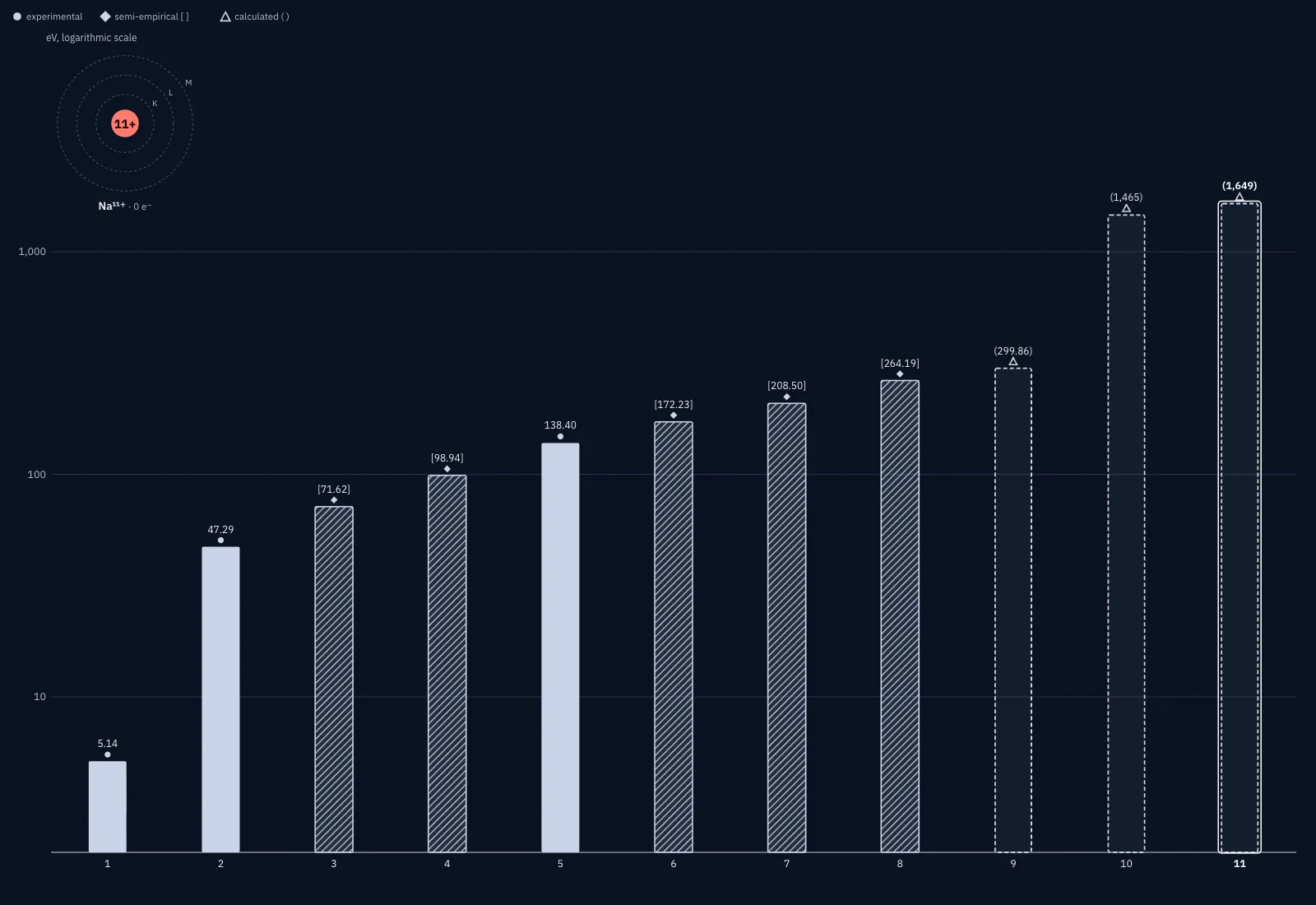
The first electron of sodium needs 5.14 eV
An atom of gaseous sodium has 11 electrons. Tearing off the first needs 5.14 eV, that is 496 kJ/mol (one electronvolt per atom is 96.485 kJ per mole of atoms).
The bar in the picture has a circle above it: the mark of an experimental value. The scale is logarithmic: each numbered line is ten times higher than the one before.
How much does the second electron need?
The second electron needs 9.2 times more
The second bar rises to 47.29 eV (4,562 kJ/mol), against 5.14 eV for the first. After the first electron the atom has become the ion Na⁺, with 10 electrons; after the second it is Na²⁺, with nine electrons.
On a logarithmic scale, a jump of 9.2 times takes up almost a whole line of the grid, which means a factor of ten. The numbers in the white bubble and in the reading boxes give the real size.
The second electron is taken from a full shell close to the nucleus. Its value is experimental too.
The 11 electrons split into groups of 1, 8 and 2
Remove them all. After the first jump, the next eight electrons need between 47.29 and 299.86 eV, with no other big jump. The tenth needs 1,465.10 eV, 4.9 times more than the ninth.
The colours and brackets show the groups: shell M with 1, shell L with 8, shell K with 2. The groups are part of the diagram; the jump is in the values.
NIST states the kind of each value. Solid bar and circle: experimental value. Hatched bar, diamond and square brackets: semi-empirical, deduced from experimental values by interpolation or other methods. Dotted outline, triangle and round brackets: calculated. For sodium, three are experimental, five semi-empirical and three calculated.
The jump moves one step along with each element
Choose an element. The first jump comes at magnesium after electron 2 (5.3 times), aluminium after electron 3 (4.2 times), silicon after electron 4 (3.7 times). Its place is the number of electrons in the outer shell.
The second jump, towards shell K, comes after electron Z − 2. The last three values of each element are calculated, not experimental: NIST has no values from spectra for them.
The place of the first jump is the number of valence electrons
The picture shows all eight elements. Each row is an element, each column an electron torn off, the colour shows the energy (warmer, more) and the shape shows the kind of value.
The solid white line comes after the valence electrons: Na 1, Mg 2, Al 3, Si 4, P 5, S 6, Cl 7, Ar 8. The dotted line separates shell L from shell K. Tap a cell to see its value.
For the main-group elements, the number of valence electrons is the group number for groups 1 and 2 and the group number minus ten for groups 13–18.
The first jump rests on experimental values for six of the eight elements, the second on calculated ones
Only the experimental values are left bright. For six elements of the eight, both values beside the first jump are experimental. For phosphorus and argon, one of them is semi-empirical: P: 65.03 → 220.43 eV; Ar: 143.46 → 422.60 eV.
The second jump, towards shell K, has calculated values on both sides for all eight elements. Here the jump comes out of calculation, not out of spectra.
Ionisation energies do not show the shells directly; they show a series with jumps, and the shells are the explanation of it. The more experimental values lie on both sides of a jump, the better the explanation is supported.
Within one period, the first energies do not rise in a straight line
For mathematics–informatics and natural sciences
The first energies of the elements from sodium to argon, in eV: Na 5.14; Mg 7.65; Al 5.99; Si 8.15; P 10.49; S 10.36; Cl 12.97; Ar 15.76. All are experimental. Aluminium (5.99) is below magnesium (7.65), and sulfur (10.36) below phosphorus (10.49).
The explanation needs subshells: in aluminium the electron torn off is a 3p one, less tightly held than 3s, and in sulfur, in the 3p⁴ subshell, two electrons in the same box repel each other and one leaves more easily. Subshells are a model; the dips are in the values.
Now you explain
One element has the first jump of its ionisation energies after the fourth electron. Look through the rows in the picture and find it.
Say, in a few sentences, which element it is, how many valence electrons it has and between which two values the jump lies.
Compare with an answer
It is silicon. The first jump comes after the fourth electron: from 45.14 eV to 166.77 eV, that is 3.7 times. Silicon has four valence electrons, the configuration 2, 8, 4, and is in group 14.
The lesson on electron shells · The lesson on the configurations from hydrogen to argon