Scînteia, 1962–1989
Ceaușescu's cult, counted: how often Romania's party daily printed his name, day by day
On 24 November 1989, a month before he was overthrown, Scînteia, the daily newspaper of Romania's Communist Party, printed the name of Nicolae Ceaușescu, the country's leader since 1965, 451 times in 16 pages. In the years 1962 to 1964, when he was one of several Central Committee secretaries, five issues in six did not print it at all.
Histories of communist Romania describe a personality cult that grew. One measure of it is how often the party's paper printed his name. All 9,105 issues of Scînteia (“The Spark”) from 1962 to 1989 that survive in the scanned collection of the county library in Deva, a town in Transylvania, were read by machine, word by word: 196 million words, in which the surname Ceaușescu appears 314,057 times (279,608 of them his, 32,510 those of his wife Elena). In the calendar below, each row is a year and each cell is one issue of the paper; the darker the cell, the more often his name is printed in it.
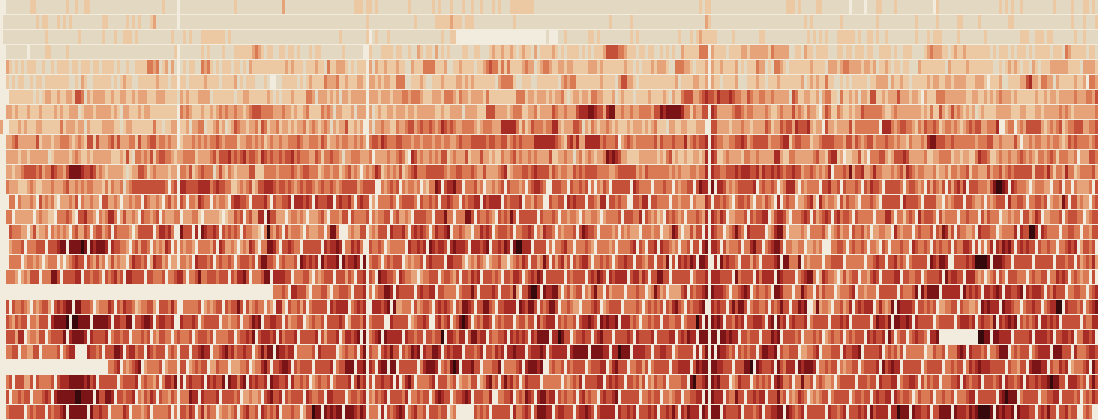
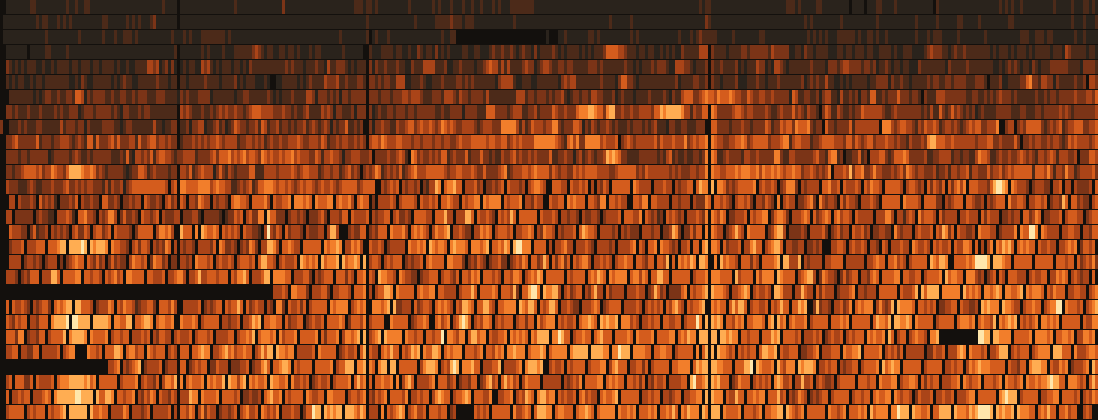
Mentions of Nicolae Ceaușescu in one issue:01–45–1415–2930–5960–99100–199200+no scanned issue
The paper of one particular day
A birthday, an anniversary, today's date: the same day across the 28 years, then the paper of one year, with a link to the scanned pages.
26 January, his birthday, in each year
Issues on this date: 24. The name Ceaușescu appears in them 1,782 times; most often in 1983, 208 times.
When did it really begin?#
Scînteia was the newspaper of the party's Central Committee, its governing body, and the press was subordinated to the party.[2] The count measures what the party chose to print, not what readers believed.
Until March 1965, Nicolae Ceaușescu is one of the secretaries of the Central Committee. Between 1962 and 1964 his name appears in 17% of issues, most often in a list of leaders. The name of Gheorghe Gheorghiu-Dej, the party's leader, appears in 66% of issues, 2.6 times per issue on average.
Elected to lead the party on 22 March 1965, he averages 4.3 and 4.4 mentions per issue in 1966 and 1967, against 2.6 for Gheorghiu-Dej in 1962–1964. Then the average rises from one year to the next: 9.0 in 1968, 15.3 in 1969, 24.8 in 1971, 5.6 times that of 1967.
Historians have proposed several beginnings. Manuela Marin, in a 2008 book cited by the researcher Alexandra Ormenișan, ties the beginning of the cult to the speech of 21 August 1968, when Ceaușescu condemned the Soviet-led invasion of Czechoslovakia; Cristian Culiciu writes that “the real turn” would have come in 1971, with the July Theses, his programme for tighter ideological control, after the visit to China and North Korea.[2][3] A count cannot say when a name printed often becomes a cult. It shows that the name was being printed more and more often before 1971: the average doubles in 1968 and rises by about 70% in 1969. The months with the most mentions up to then are July and August 1969: party conferences in the counties ask for his re-election, then the 10th Congress, the party's national meeting, is held. When the July Theses of 1971 appear, the average per issue was already four times that of 1967.
The name of Nicolae Ceaușescu in one issue of the paper, year by year
Average per issue. The thin blue bars show the name of Gheorghiu-Dej, his predecessor. The numbered lines are the dates listed under the chart.
- 22 March 1965: elected First Secretary of the party, three days after the death of Gheorghiu-Dej.
- 9 December 1967: also becomes President of the State Council, the collective body that acted as head of state.
- 21 August 1968: the speech against the invasion of Czechoslovakia.
- 6–12 August 1969: the party's 10th Congress.
- 6 July 1971: the “July theses”, on his return from China and North Korea.
- 28 March 1974: elected President of the Republic.
- 26 January 1978: the celebration of his 60th birthday.
- 20–24 November 1989: the 14th Congress, the last.
The paper itself grew longer: from four pages in 1962–1965 to six, on most days, from 1966. The rise remains when measured against its length: per 10,000 words, his name appears 2.4 times in 1966 and 28.3 times in 1989. In the last year the surname, his or hers, is printed once every 300 words on average.
Over the long run the average rises, with falls: 33.6 per issue in 1975, 61.0 in 1984, 50.8 in 1987 and 69.5 in 1989. In 1989 the average per issue is 27 times that of Dej in 1962–1964 (18 times, measured against the length of the paper), and 19% of issues print his name at least 100 times.
How the birthday of 26 January grew in print#
Nicolae Ceaușescu's birthday was celebrated on 26 January. In the first years of his rule his birthday barely registers in the paper: in January 1966 the issue with the most mentions around the day has four mentions. In 1968, when he turned 50, it has 43 mentions; in 1973, at 55, 150 mentions; in 1978, at 60, 201 mentions; in 1988, at 70, 207 mentions.
January, in each year
Each cell is the paper of one day in January. Framed: 7 January, Elena Ceaușescu's birthday, and 26 January, his.
Mentions of Nicolae Ceaușescu in one issue:01–45–1415–2930–5960–99100–199200+no scanned issue
With time the celebration widens from a day to a week and more. In January 1973 the issues with at least 100 mentions number four; in 1983 there are 11, and in 1988, 12. Telegrams, meetings and homage volumes are published for days on end, before and after the 26th.
Alexandra Ormenișan, who read the issues around 26 January in ten different years, noticed that the issue of 26 January 1974 has no article about the birthday.[2] Around that day, the issue with the most mentions has 32 mentions. In the 1970s the January counts are higher around his 55th and 60th birthdays than in the years between; from 1982, in every year whose January survives, the issue with the most mentions around the day has at least 99 mentions.
7 January is the birthday of Elena Ceaușescu, his wife. The researcher Annemarie Sorescu-Marinković dates her first nationwide birthday celebration to 7 January 1979.[5] In the issue with the most mentions around that day her name appears 46 times; in 1980, twice. From 1982 the stripe in the calendar returns in every year whose January survives: 117 times in 1984, 102 times in 1989.
When Elena Ceaușescu appears beside him#
Until 1969 Elena Ceaușescu's name is almost absent: it appears in at most 7% of a year's issues. The first printing found is from 13 July 1965, and not as a wife: “ing. Elena Ceaușescu, directorul institutului” (engineer Elena Ceaușescu, the director of the institute) opens a symposium of the Institute of Chemical Research. As his wife she appears from 19 April 1966, when she hosts a tea in honour of Jovanka Broz, the wife of Yugoslavia's leader Tito. The change comes with the official visits, on which she is named beside him: “împreună cu tovarășa Elena Ceaușescu”, together with Comrade Elena Ceaușescu. Her name appears in 21% of issues in 1971, in 44% in 1973, in 66% in 1979 and in 86% in 1989.
In how many issues out of 100 Elena Ceaușescu's name appears
The share of each year's issues that print it at least once.
Her name per 100 mentions of his
All the issues of a year together.
In 1972 she joins the Central Committee, in 1973 its Executive Committee, the party's inner leadership, and in 1980 she becomes First Deputy Prime Minister.[5] The title “tovarășa academician doctor inginer Elena Ceaușescu” (Comrade Academician Doctor Engineer) appears written in full from 5 February 1975, in a report of an honorary title received in Ecuador; abbreviated, “acad. dr. inginer”, from March 1974. After 1989 it emerged that the scientific papers published under her name had been written by others.[5] From 1980 to 1989, her name appears 10.8 to 17.7 times for every 100 mentions of his (leaving out 1981, whose first quarter is missing). The issue with the most is that of 7 January 1984: 117 times.
Which praise formulas were really printed#
Each formula below was searched for in every issue, and its earliest printings were read one by one, to see whom it is about. Some were in the paper before they were applied to him: “cel mai iubit fiu” (the most beloved son) and “mult stimate și iubite” (much esteemed and beloved) each appear once about Gheorghiu-Dej, “genial” (brilliant, of genius) about Lenin, “cîrmaci” (helmsman) about the party. A few enter the paper as the words of foreigners: “conducător eminent” (eminent leader) in a message from Cambodia (1968), “un geniu al diplomației” (a genius of diplomacy) in a French commentary (1970), “principalul arhitect” (the main architect) in a foreign newspaper (1972), “titan” in the title of a book published in Calcutta (1984). The English of each formula is given under it.
| Formula | First printing found, about him | Issues | Occurrences | By year |
|---|---|---|---|---|
| “cel mai iubit fiu”the most beloved son: of the people, of the working class, of the nation | 12 July 1969“the most beloved son of our working class”; once about Gheorghiu-Dej, on 16 January 1965 | 1,182 | 2,262 | 19621989 |
| “mult stimate și iubite”much esteemed and beloved: the form of address; also “mult iubite și stimate” | 18 October 1968once about Gheorghiu-Dej, on 19 March 1965 | 1,751 | 12,469 | 19621989 |
| “conducător” with an epithetleader: beloved, brilliant, experienced, wise; in the singular | 26 January 1968“experienced leader”, in the Central Committee's letter on his 50th birthday; “the beloved leader”, on 17 October 1968 | 2,257 | 5,124 | 19621989 |
| “ctitor”founder, as of a church: of modern Romania, of the country | 28 January 1973“founder of socialist Romania”, in the messages for his 55th birthday | 2,313 | 5,819 | 19621989 |
| “erou între eroi”hero among heroes | 26 January 1973in a poem from the Pioneers, the children's organisation, on his 55th birthday | 370 | 796 | 19621989 |
| “Epoca Ceaușescu”the Ceaușescu Era, also “Epoca Nicolae Ceaușescu” | 25 January 1978“as is often said in the world” | 1,353 | 4,664 | 19621989 |
| “epoca de aur”the golden age | 29 November 1979about his years; about the present in general, from 24 June 1966 | 325 | 424 | 19621989 |
| “primul bărbat al țării”the country's foremost man; also “întîiul”, “cel dintîi bărbat” | 31 December 1972“cel dintîi bărbat al țării”, in a New Year's greeting in verse | 29 | 31 | 19621989 |
| “arhitect”architect: of modern Romania, of peace | 23 July 1972“the main architect of this imposing development plan”, in a foreign commentary quoted by the paper; “gifted architect of material civilisation”, on 21 December 1973 | 43 | 43 | 19621989 |
| “tribun”tribune: of the people, of the nation | 21 November 1979“the great tribune of the nation”, at the 12th Congress | 5 | 5 | 19621989 |
| “cîrmaci”helmsman, in the spelling of the time | 22 July 1969“such a helmsman in the person of the General Secretary” | 376 | 494 | 19621989 |
| “geniu”, “genial”genius, brilliant: leader, strategist, architect, founder | 20 June 1970“a genius of diplomacy”, in a French commentary quoted by the paper; “brilliant promoter”, on 22 February 1977 | 343 | 589 | 19621989 |
| “titan”titan | 19 October 1984the title of a volume published in Calcutta: “Nicolae Ceaușescu, Titan of Our Time” | 47 | 48 | 19621989 |
| “geniul Carpaților”the Genius of the Carpathians | not foundonly after his fall, from 24 December 1989 | 0 | 0 | 19621989 |
| “Dunărea gîndirii”the Danube of Thought | not found | 0 | 0 | 19621989 |
| “academician doctor inginer”Elena Ceaușescu's title: academician, doctor, engineer | 5 February 1975abbreviated, “acad. dr. inginer”, from 5 March 1974 | 1,297 | 3,659 | 19621989 |
| “savant de renume”scientist of world or international renown | 23 April 1975about Elena Ceaușescu: “scientist of world renown” | 913 | 1,785 | 19621989 |
…pe cel mai iubit fiu al poporului nostru, tovarășul Gheorghe Gheorghiu-Dej…
Scînteia, 16 January 1965, about Gheorghe Gheorghiu-Dej: “the most beloved son of our people” [1]Să trăiască tovarășul Nicolae Ceaușescu, cel mai iubit fiu al clasei noastre muncitoare!
Scînteia, 12 July 1969, about Nicolae Ceaușescu: “the most beloved son of our working class” [1]“Geniul Carpaților”, the Genius of the Carpathians, was not found in the text of any issue read from Ceaușescu's years. It first appears in Scînteia poporului (“The People's Spark”) of 24 December 1989, in the appeal of the Democratic Union of Hungarians in Romania, which denounces the forced assimilation of minorities, then three more times in Adevărul (“The Truth”) of the following days:
…ideologia șovină a omogenizării naționale, ridicată de „marele conducător, de geniul Carpaților, de eroul neamului românesc, de ctitorul de țară” — titluri abuziv însușite de Nicolae Ceaușescu — la rangul politicii de stat…
Scînteia poporului, 24 December 1989: the chauvinist ideology of national homogenisation, raised to state policy by “the great leader, the Genius of the Carpathians, the hero of the Romanian nation, the founder of the country”, “titles abusively assumed by Nicolae Ceaușescu” [1]Epithets of this kind were in circulation before 1989, however. In February 1989 Dan Ionescu compiled an A to Z of them for Radio Free Europe, the American-funded station that broadcast to Romania from Munich, with the source of each: the weekly Săptămîna (“The Week”), the 1978 volume Omagiu (“Homage”), literary magazines, Scînteia.[7] In Scînteia the most frequent are a few fixed formulas: “mult stimate și iubite”, in one word order or the other, appears in 1,751 issues.
The issues with the most mentions#
The issue in which his name appears most often is that of 24 November 1989: 451 times in 16 pages. It reports the fourth day of the party's 14th Congress, four weeks before he fled. Of the first ten issues, nine are from congresses or a national conference of the party; the tenth reports a working visit with mass rallies. The issues of 9–21 November 1984, with the opening of the 13th Congress, are missing from the collection.
- 24 November 198914th Congress451
- 22 November 198413th Congress422
- 22 November 197912th Congress396
- 23 November 198413th Congress: re-elected General Secretary392
- 21 November 197912th Congress354
- 22 November 198914th Congress352
- 23 November 198914th Congress334
- 23 November 197912th Congress327
- 18 December 1982National Conference of the party313
- 21 June 1978working visit to Harghita and Mureș counties, with mass rallies289
At the 12th Congress, in November 1979, Constantin Pîrvulescu, one of the party's founders, was the only delegate who openly criticised Ceaușescu.[6] In the text of the issues from the days of the congress the name Pîrvulescu was found once, in a list of names in the issue of 20 November. In those of 21–25 November it was not found, and Ceaușescu's name appears 1,472 times.
At the other end, in 1,199 issues his name does not appear at all in the text read. The last is from 11 February 1974. From 1972 all of them are Monday editions, and from May 1974 the paper appears on Mondays only on special occasions. Between 1975 and 1989, every issue read contains his name.
Before and after: Gheorghiu-Dej, then “the Ceaușescu dictatorship”#
Gheorghe Gheorghiu-Dej led the party until his death on 19 March 1965. In his last three years the paper prints his name 2.6 times per issue on average. The issue with the most mentions of him is from the days of his funeral, 23 March 1965: 152 times. In 1966 the average falls to 0.8 per issue; in 1989 his name still appears in 6% of issues, for instance as the name of the town of Gheorghe Gheorghiu-Dej, today's Onești.
Ceaușescu's end shows in the last cells of the calendar. The last issue titled Scînteia is that of 22 December 1989, the day he fled Bucharest, the capital, during the revolution that ended communist rule. The library keeps in the same collection the issues the newsroom put out in the following days, under the titles Scînteia poporului and Adevărul. In that of 24 December 1989 the name Ceaușescu appears 52 times: “dictatura Ceaușescu”, “clanul Ceaușescu”, the Ceaușescu dictatorship, the Ceaușescu clan.
How the count was made, and how wrong it can be#
The source is the collection of Scînteia scanned by the “Ovid Densusianu” County Library of Hunedoara-Deva, which carries machine-read text from 1962 onwards.[1] The library's list holds 9,106 issues from 1962–1989; 9,105 issues were read, and one file is missing from the library's server. 225 serial numbers are missing from the run, most of them from June 1964, January–March 1981, 9–21 November 1984 (with the opening of the 13th Congress) and January 1986.
A mention is the surname printed once, anywhere in the paper: in headlines, articles, telegrams, lists. When the first name Elena stands before it, the mention is hers; when another first name of the family, or of someone else with the same surname, stands there, it is set aside (1,939 mentions in all, including those of the paper's own correspondent Florea Ceaușescu). The rest, 279,608 mentions, are counted as his. Photographs are not counted.
Machine reading of old print makes mistakes. On 50 pages chosen at random from 1965–1989 and on the front page of six festive issues, the library's text was compared with a second, independent machine reading of the image: of 547 occurrences of the name found by at least one of the readings, the library's text has 542; of the five occurrences it lacks, four are in headlines set in capitals. Large headlines are the weak part: on the image of the front page of eight issues, of 14 occurrences of the name in headlines the library's text has nine. In these checks, most of the occurrences missed are in headlines. Each check was made once.
The date of each issue is the one printed under the title, accepted only if the weekday printed beside it agrees with the calendar; for 278 issues the date was inferred from the paper's serial number. The “first printing” of a formula means the first found in the text of the issues read: an earlier one in a missing issue or in a misread headline cannot be ruled out. Quotations are transcribed from the machine-read text, with evident misreadings corrected, or from the page image where the columns come out mixed.
Nobody seems to have published such a series before. The studies found analyse chosen dates: the issues around 26 January in ten years,[2] the issues of national holidays,[3] the photographs,[6] the myth of the young revolutionary.[4] The search covered scholarship in Romanian, English, French and German; if a continuous count exists, it was not found.
The table by year
| Year | Issues read / listed | His name per issue | Per 10,000 words | On the front page | Issues with the name | Issues with 100+ | Elena per issue | Issues with Elena | Dej per issue |
|---|---|---|---|---|---|---|---|---|---|
| 1962 | 360 / 360 | 0.2 | 0.1 | 0.2 | 15% | 0% | 0.0 | 0% | 3.9 |
| 1963 | 364 / 364 | 0.2 | 0.1 | 0.1 | 13% | 0% | 0.0 | 0% | 1.6 |
| 1964 | 331 / 331 | 0.3 | 0.2 | 0.2 | 23% | 0% | 0.0 | 0% | 2.3 |
| 1965 | 359 / 359 | 2.6 | 1.6 | 1.1 | 56% | 0% | 0.0 | 1% | 3.1 |
| 1966 | 361 / 361 | 4.3 | 2.4 | 2.1 | 82% | 0% | 0.0 | 3% | 0.8 |
| 1967 | 357 / 357 | 4.4 | 2.1 | 1.9 | 84% | 0% | 0.0 | 1% | 0.6 |
| 1968 | 361 / 361 | 9.0 | 3.8 | 3.5 | 95% | 0% | 0.0 | 1% | 0.4 |
| 1969 | 360 / 360 | 15.3 | 6.5 | 4.9 | 98% | 3% | 0.2 | 7% | 0.3 |
| 1970 | 354 / 354 | 15.8 | 6.9 | 5.6 | 97% | 0% | 0.5 | 17% | 0.4 |
| 1971 | 359 / 359 | 24.8 | 10.3 | 7.2 | 100% | 1% | 0.7 | 21% | 0.4 |
| 1972 | 358 / 358 | 17.5 | 7.6 | 5.5 | 99% | 1% | 1.1 | 23% | 0.1 |
| 1973 | 360 / 361 | 27.4 | 12.2 | 8.8 | 99% | 1% | 2.9 | 44% | 0.3 |
| 1974 | 324 / 324 | 33.7 | 15.2 | 9.3 | 100% | 2% | 2.4 | 48% | 0.2 |
| 1975 | 306 / 306 | 33.6 | 16.2 | 10.8 | 100% | 0% | 4.7 | 58% | 0.3 |
| 1976 | 312 / 312 | 28.1 | 12.8 | 9.0 | 100% | 2% | 2.9 | 53% | 0.3 |
| 1977 | 307 / 307 | 35.4 | 15.8 | 9.9 | 100% | 5% | 3.5 | 53% | 0.2 |
| 1978 | 300 / 300 | 48.0 | 21.4 | 11.9 | 100% | 9% | 5.7 | 60% | 0.2 |
| 1979 | 306 / 306 | 47.5 | 21.4 | 11.5 | 100% | 9% | 6.8 | 66% | 0.2 |
| 1980 | 310 / 310 | 45.2 | 20.3 | 11.3 | 100% | 5% | 5.0 | 69% | 0.2 |
| 1981 | 235 / 235 | 52.5 | 22.6 | 10.8 | 100% | 11% | 3.5 | 66% | 0.1 |
| 1982 | 308 / 308 | 52.0 | 23.1 | 12.6 | 100% | 11% | 7.6 | 69% | 0.1 |
| 1983 | 308 / 308 | 59.8 | 26.7 | 12.4 | 100% | 14% | 7.8 | 80% | 0.1 |
| 1984 | 298 / 298 | 61.0 | 28.0 | 13.1 | 100% | 13% | 7.3 | 78% | 0.1 |
| 1985 | 307 / 307 | 59.1 | 26.3 | 13.2 | 100% | 14% | 6.4 | 79% | 0.1 |
| 1986 | 280 / 280 | 58.3 | 24.5 | 12.5 | 100% | 16% | 7.7 | 79% | 0.1 |
| 1987 | 311 / 311 | 50.8 | 21.7 | 13.8 | 100% | 9% | 9.0 | 86% | 0.1 |
| 1988 | 311 / 311 | 52.2 | 21.9 | 14.2 | 100% | 10% | 9.3 | 84% | 0.1 |
| 1989 | 298 / 303 | 69.5 | 28.3 | 14.7 | 100% | 19% | 11.7 | 86% | 0.1 |
Download the data: every issue (CSV) · by year (CSV).
Sources#
- Scînteia, daily of the Central Committee of the Romanian Communist Party (until July 1965 the party was called the Romanian Workers' Party), the scanned collection with machine-read text of the “Ovid Densusianu” County Library of Hunedoara-Deva; the issues of 1962–1989. bibliotecadeva.ro
- Alexandra Cătălina Ormenișan, “The Evolution of Nicolae Ceaușescu's Cult of Personality in Scânteia Newspaper”, Studia Universitatis Babeș-Bolyai Ephemerides, 64 (2), 2019, pp. 81–103. studia.reviste.ubbcluj.ro
- Cristian Culiciu, “Cultul personalității lui Nicolae Ceaușescu reflectat în marcarea unor sărbători naționale și internaționale”, Plural, 4 (2), 2016, pp. 140–155. Plural journal (PDF)
- Manuela Marin, “The Myth of the Young Revolutionary: The Case of Nicolae Ceaușescu”, Transylvanian Review, XVII (2), 2008, pp. 22–53. dspace.bcucluj.ro
- Annemarie Sorescu-Marinković, “Elena Ceauşescu's Personality Cult and Romanian Television”, Balcanica, 48, 2017, pp. 343–360. doiserbia.nb.rs
- Daniel Ursprung, Herrschaftslegitimation zwischen Tradition und Innovation. Repräsentation und Inszenierung von Herrschaft in der rumänischen Geschichte in der Vormoderne und bei Ceauşescu, Heidelberg / Brașov, 2007. daniel-ursprung.ch
- Dan Ionescu, “An A to Z of the Personality Cult in Romania”, Radio Free Europe Research, Romania Situation Report, 2 February 1989, pp. 9–14 (Open Society Archives, HU OSA 300-8-47-213-1). OSA archive (Wayback copy)
- Romania in China's People's Daily: eighty years of Romania–China relationsThe same method, applied to the People's Daily; in the mirror, China in Scînteia.
- Romania in the President's Daily Brief, 1961–1977The same years read from Washington; for August 1968, beside that day's front page of Scînteia.
- How independent of Moscow was Romania? What 70 years of UN votes showThe same years in the General Assembly's votes.
- 1989 in China's People's Daily: the fall of communism in Eastern Europe, day by dayThe last year, seen from Beijing.
- Bucharest's old cinemas, 1964–2026The cinemas in the listings Scînteia printed in 1964 and 1986, and what became of each.