CIA · President's Daily Brief · declassified 2015–2016
Romania in the President's Daily Brief, 1961–1977
From 1961 to 1977 the CIA wrote a few top-secret pages about the world, almost every day, for Presidents Kennedy, Johnson, Nixon and Ford. Declassified in 2015 and 2016, they name Romania, then a communist country of some 20 million people in Moscow's military alliance, on 379 days. Every paragraph is here as it was typed, with white boxes over the lines that are still secret.
379 days out of 4,885 · 178 with an item about Romania · 85 with text withheld
Saturday, 31 August 1968, item 1 of Lyndon Johnson's brief. The white box covers the start of the sentence; the code 50X1 in the margin stands for “intelligence source or method”. President's Daily Brief, 31 August 1968, page 2.
On the evening of Friday, 30 August 1968, speaking in San Antonio, Texas, Lyndon Johnson said: “So, let no one unleash the dogs of war.” Ten days earlier Soviet-led troops had entered Czechoslovakia. The next morning, at his ranch, the first item in the brief the CIA had prepared for him was Romania.
The President's Daily Brief is a booklet of a few pages that the CIA writes every day except Sunday for the president of the United States. Kennedy first received it on 17 June 1961, under the name President's Intelligence Checklist; the present name dates from December 1964. It sets out briefly, one paragraph to a subject, what the agency has learned from all its sources: people, intercepted communications, satellite photographs, the press.
The CIA released the briefs written for Kennedy and Johnson in September 2015 and those written for Nixon and Ford in August 2016: almost 5,000 documents. Lines still considered secret were covered with white boxes, marked in the margin with a code.
Romania is named on 379 days out of the 4,885 on which a brief appeared, about one in 13. On 178 of them it has an item of its own. On 85, part of that item, sometimes all of it, lies under a white box.
August 1968, day by day: the president's brief beside Romania's party newspaper#
On the night of 20–21 August 1968, troops of the Soviet Union and four other Warsaw Pact states entered Czechoslovakia. Romania, a member of the same alliance, took no part. On 21 August Nicolae Ceaușescu, Romania's communist leader since 1965, condemned the intervention before a crowd in Palace Square in Bucharest.
In the days that followed, Romanian diplomats and the American government asked the same question: is Romania next? What follows is the paragraph written for Lyndon Johnson and the front page of that day's Scînteia, the party newspaper: every day with a brief from 21 August to 4 September, then 6 and 9 September, the next two days on which the brief names Romania. Where it helps, a note underneath says what was happening in Washington that day, from the diplomatic documents the State Department publishes as Foreign Relations of the United States (FRUS).
Of the 17 briefs that appeared between 21 August and 9 September, 11 name Romania.
Wednesday, 21 August 1968
The night before, the troops entered Czechoslovakia.
What the president was told
In the brief of 21 August the first item is Czechoslovakia. Romania is not named on any page of the released text. Two of the six items are entirely covered by white boxes.
What Romanians could read
Vizita conducătorilor de partid și de stat în zone industriale ale municipiului Pitești
The invasion is not in this issue. The front page is about the car factory at Pitești (“Visit of the party and state leaders to industrial areas of the city of Pitești”). On page 3 Ceaușescu, back three days earlier from Prague, says that “the destinies of the Czechoslovak people are in safe hands”.
The same day in WashingtonThe evening before, at 8:15 p.m., the Soviet ambassador, Anatoly Dobrynin, had brought President Johnson the news of the intervention. FRUS 1964–1968, XVII, doc. 93
Thursday, 22 August 1968
What the president was told
The brief of 22 August opens with a late item on Czechoslovakia. Romania is not named on any page of the released text.
What Romanians could read
Comunicat · Adunarea populației din Capitală în Piața Palatului Republicii
Almost the whole front page is the crisis: the communiqué of the party and state leadership, the rally in Palace Square, Ceaușescu's speech. “Nothing can justify this act, the military occupation of socialist Czechoslovakia,” the communiqué says.
Ceaușescu announces “the formation of armed patriotic guards, made up of workers, peasants and intellectuals” and says: “the whole Romanian people will allow no one to violate the territory of our homeland”.
Rumanian Embassy officials in Bonn and Washington have expressed fears of a possible Soviet invasion of their country. Ceausescu is reported to have announced yesterday that "we are now in a state of full mobilization." The previous day he announced the establishment of "armed guards of workers, peasants, and intellectuals" to defend national independence.
Lucrările sesiunii extraordinare a Marii Adunări Naționale · Trăiască 23 August
The Grand National Assembly, Romania's parliament, adopts a declaration on foreign policy. On page 2: “The Warsaw Treaty Organisation cannot be used or invoked for military actions against any socialist country.”
Page 7 prints the national-day telegrams: from the Soviet leaders, from Tito and from Lyndon Johnson, who sends “the congratulations and good wishes of the people of the United States of America”.
The same day in WashingtonThe secretary of state, Dean Rusk, tells Ambassador Dobrynin that in the last few hours there have been “a number of alarming rumors about a possible Soviet invasion of Romania”, and stresses that they did not come from the Romanians. Dobrynin replies that he has “neither seen nor heard any indication whatever of any contemplated Soviet action against Romania”. FRUS 1964–1968, XVII, doc. 87
Saturday, 24 August 1968
What the president was told
The Rumanians are deeply concerned over the possibility of a Soviet invasion.
Parada militară și demonstrația oamenilor muncii din Capitală
The front page is the 23 August parade (“Military parade and demonstration of the working people of the capital”). On page 2, under the heading “The patriotic guards, the armed arm of the people”, the guards march “in blue overalls, with tricolour armbands and with combat weapons”.
The same day in WashingtonAt the State Department the bureau for Europe sends Rusk a memorandum on what the United States might do “in the event of Soviet invasion of Romania”: from visibly raising NATO's vigilance to returning to Europe American forces then being withdrawn. FRUS 1964–1968, XVII, doc. 164
Monday, 26 August 1968
No brief appeared on Sunday, 25 August.
What the president was told
Relations between Eastern Europe's independent-minded and orthodox Communist regimes have been severely damaged by the invasion of Czechoslovakia. Tito told Ambassador Elbrick on 23 August that Yugoslav-Soviet relations from now on would be devoid of the trust and confidence that had been slowly building up.
Rumanian leader Ceausescu has for the first time been attacked by name by the Soviet and Hungarian press. Mostly low-level Soviet bloc types showed up for Rumanian National Day celebrations at various diplomatic posts last Friday.
Tito and Ceausescu met Saturday at a Yugoslav border town, presumably to coordinate contingency plans concerning the Czech crisis. They will probably not risk provoking the Soviets by overdramatizing their position. Rumanian Premier Maurer does not see any "immediate" danger of Soviet armed intervention. There is, in fact, still no hard evidence that the Soviets intend to carry their intervention in Eastern Europe beyond Czechoslovakia.
Toate eforturile, către țelul major: întărirea unității și prieteniei țărilor socialiste
On Saturday Ceaușescu had met Tito at Vršac, just across the Yugoslav border. Sunday's Scînteia announced the meeting at the top of the front page, with one sentence on its content: “an exchange of views on bilateral relations and on current international problems of interest to the two countries”.
Monday's issue has on its front page a leading article on the unity of the socialist countries (“All efforts toward the major goal: strengthening the unity and friendship of the socialist countries”) and a short notice: Ceaușescu received the ambassador of the Soviet Union, “at his request”. On page 3 the leading article says that in the press of some of the countries that sent troops into Czechoslovakia, articles have appeared which “present Romania's position in a distorted way”, and that the party does not mean to be drawn “down the slope of ripostes and polemics”.
Romania is not named on any page of the released text. Two of the brief's six items are entirely covered.
What Romanians could read
Vizita conducătorilor de partid și de stat în județele Brașov, Covasna și Harghita
The leadership has left on a tour of Transylvania (“Visit of the party and state leaders to Brașov, Covasna and Harghita counties”). At Brașov Ceaușescu says that “nothing can prevent the good collaboration, the friendship between Romania and the Soviet Union”. In another speech, printed on page 6: “we are just as determined not to allow anyone, on any ground, to violate our national sovereignty”.
Vizita conducătorilor de partid și de stat în municipiul Odorheiul Secuiesc
On the front page János Fazekas, speaking at a rally in Odorheiu Secuiesc, a largely Hungarian-speaking town in Transylvania, says the invasion is disapproved also “by the Hungarians of Romania”, and attacks the journalists who, “whether in Hungary, in Budapest, or in other countries”, accuse the party of nationalism.
The patriotic guards, named in Scînteia on 22, 23, 24, 25 and 27 August, do not appear again in any of the issues read from here on.
Declarația Comitetului Executiv al Comitetului Central al Partidului Comunist Român
The declaration of the party's Executive Committee asks for the “complete” withdrawal of the troops from Czechoslovakia “in the shortest time”, and adds that “it is imperative that absolutely nothing be undertaken that would sharpen these relations”. On the same page: Ceaușescu has received a delegation of the Soviet–Romanian friendship association and Dezső Nemes, a member of the Hungarian party's leadership.
Romania is not named in the released text. The brief has five items, followed by a page with three white boxes and no heading.
What Romanians could read
Adunarea festivă consacrată aniversării a 20 de ani de la înființarea Securității Statului
The front page is the twentieth anniversary of the Securitate, the state security police. The enemy named in Ceaușescu's speech is the one “from outside”, “the agents of imperialism”. On page 6, an item from New York: the foreign minister, Corneliu Mănescu, has met the American ambassador to the United Nations, George Ball. What they discussed the paper does not say.
The same day in WashingtonIn the evening, in San Antonio, Johnson adds to his speech a passage on Eastern Europe: “There are even rumors late this evening that this action might be repeated elsewhere in the days ahead in Eastern Europe. […] So, let no one unleash the dogs of war.” At 9 p.m. in Washington Rusk sees Dobrynin, who had asked for an appointment the next day, and tells him that “in the last 24 hours we had received a number of reports of troop movements, incidents on the frontier, etc.” If action against Romania is contemplated, he asks “in the name of all humanity” that it not be done. The speech · FRUS 1964–1968, XVII, doc. 165
Saturday, 31 August 1968
The item is marked “As of 5:00 AM EDT”: the situation at five in the morning, Washington time.
What the president was told
the movement of some Soviet forces toward the Rumanian border. It is too early to say whether this is meant as a pressure tactic or in fact indicates an intent to move into the country.
Vizita tovarășului Nicolae Ceaușescu și a altor conducători de partid și de stat în județul Cluj
On the front page: the leaders' visit to Cluj county, productivity in mining, ships delivered ahead of schedule. Czechoslovakia is not named on this page. Johnson's speech was not found in the text of this issue.
The same day in WashingtonThe Romanian ambassador, Corneliu Bogdan, asks at the State Department what new evidence lay behind the speech. He is told that the “military-type evidence remained inconclusive”. In the evening Dobrynin brings Rusk Moscow's answer: “fears and rumors regarding Soviet military moves against Rumania were completely without foundation”. The message reaches Johnson's ranch at 11:01 p.m. Texas time. FRUS 1964–1968, XVII, doc. 166 · doc. 167
Monday, 2 September 1968
What the president was told
The situation remains unchanged with no abnormal Soviet or Bulgarian military moves Bucharest is calm. Yesterday Associated Press carried a story alleging that Ceausescu had proposed a series of concessions to the Soviets including a formal declaration of loyalty to the Warsaw Pact and increased trade with Eastern Europe. We have seen nothing as yet to confirm it.
Moscow has not reacted publicly to the President's statement. The Polish party paper, however, said yesterday any suggestion that further intervention in Eastern Europe might be contemplated was "completely fabricated."
Se impune un înalt nivel de organizare și eficiență în toate întreprinderile pentru mecanizarea agriculturii
A front page about the mechanisation of farming, with a football photograph. In the whole issue the Soviet Union appears in one place only, in the phrase “Soviet-Czechoslovak agreement”.
The situation is quiet. have not been able to find any evidence of troop concentrations near the Rumanian border. Military activity in northeast Bulgaria is limited to a training exercise. The Rumanians, with their most recent careful commentary on Czechoslovakia, seem to be trying to avoid provoking the Soviets.
Tensions in Czechoslovakia continue to subside slowly. The press reports that some Polish, Hungarian, and Bulgarian troops have left for home. Soviet soldiers have withdrawn from some important buildings in Prague.
Deputy Premier Sik, a liberal who has long been anathema to Moscow, resigned yesterday shortly after being vilified in Izvestia. Izvestia also criticized Foreign Minister Hajek in terms which suggest it expects him to follow suit.
There is still no indication that the Soviets or their associates are getting ready to move against Rumania or Yugoslavia.
The same day in WashingtonThe National Security Council meets at the White House. Johnson: “If we speak out about a threatening situation and the situation does develop, we are accused of over-reacting.” General Wheeler says that “19 Soviet divisions could move into Romania with two or three days notice.” FRUS 1964–1968, XVII, doc. 93
Friday, 6 September 1968
What the president was told
The nine-day truce in Soviet press attacks on Rumania was broken Wednesday when Pravda let it be known Moscow is still displeased with Bucharest's criticism. There are no new military developments relating to Rumania, however. The Bulgarians continue a military exercise; Yugoslav and Rumanian troops remain on alert.
Vizita conducătorilor de partid și de stat în întreprinderi industriale din Capitală
At the Vulcan works in Bucharest Ceaușescu speaks of “the difficult situation created in relations between the socialist countries”, without naming any country. No Soviet newspaper is named anywhere in the issue.
During a recent talk with Ambassador Davis, Foreign Minister Manescu said the "danger is not entirely over," but his remarks and manner suggested a calmer view of the situation. Manescu stressed the point that Rumania's leaders considered President Johnson's 30 August statement as having had a "cooling" effect on a dangerous trend.
The Bulgarian military exercise near the Rumanian border ended last Friday. Rumania and Yugoslavia, however, apparently have not reduced the alert status of their armed forces.
On the front page: irrigation machinery, the Iron Gates hydroelectric dam on the Danube, a telegram of congratulation to Bulgaria's leaders. On page 3, a protocol notice: the British foreign secretary, Michael Stewart, has arrived in Bucharest.
Johnson's statement of 30 August, which Mănescu had told the American ambassador had a “cooling” effect on a dangerous trend, was not found in any of the issues of Scînteia read for the days after it.
Read together, the two papers say different things. The American president is told of the Romanian diplomats' fears, of the army's alert and of Soviet troops moving toward the border. The reader of Scînteia learns, until 27 August, of the patriotic guards and the resolve to defend the country; after that the paper still calls for the troops to leave Czechoslovakia, but the guards vanish from its pages, and working visits, the harvest and telegrams of support take their place. None of the 17 issues read for these days mentions foreign troops on Romania's borders.
How much of what Johnson was told was true cannot be told from these pages: the sources are under the white boxes. What can be told is what the CIA itself did not know. On 31 August it wrote that it was “too early to say” whether the movement of troops was pressure or preparation for an invasion, and at the State Department the military evidence was judged “inconclusive”.
Each square is a day on which a brief appeared, from June 1961 to January 1977; each row is a year, with the days of the week from top to bottom. The dark squares are the days on which the brief names Romania.
Choose a day to read its paragraph, move from day to day with the arrows, or type a date: the day you were born, for instance, if it fell between 1961 and 1977.
In the brief's first months Romania appears rarely and only in passing. On 26 August 1961 Kennedy's brief says that Gheorghe Gheorghiu-Dej, Romania's communist leader, has told the American chargé in Bucharest, the capital, that he plans to “visit New York” in the autumn. A Romanian credit of 50 million dollars to Indonesia follows, and Raúl Castro passing through Bucharest, apparently on his way to Moscow. The first item headed “Rumania”, the spelling American officials then used, comes only on 1 November 1962. It is one sentence long.
Reports of rural disturbances stemming from food shortages and harsh treatment of the peasantry are beginning to appear more substantial.
From the spring of 1963 the tone changes. Romania resists the plans of CEMA, the Soviet bloc's economic organisation (Comecon), for each member to specialise in certain products, fearing they would hold back its industry and leave it a supplier of farm goods and raw materials. On 6 May the CIA tells the president that it has collected enough “bits and pieces” to wonder how Romanian-Soviet relations now stand.
a. We have a mounting collection of bits and pieces which have led us to wonder about the status of Rumanian-Soviet relations.
b. Rumanian resistance to certain CEMA plans for an integration of the Rumanian economy with that of the bloc. Rumania has threatened to withdraw from CEMA over the issue.
c. We note a present willingness by Bucharest to criticize certain Soviet World War II political actions.
d. In contrast to the other satellites, Rumania has been relatively mum on the Sino-Soviet dispute and may even be playing footsy with the Chinese--new agreements have upped Rumanian trade with China and Albania a notch, and Rumania returned an ambassador to Albania in late March.
In June the Soviet leader Nikita Khrushchev pays an unannounced visit to Bucharest. The brief follows it for two days running without being able to confirm it, and on 9 July notes that Moscow “is still trying to cover up” the trip. In September, an item of two sentences:
Russian has been dropped as a mandatory language in Rumanian schools this year. Instead, it is now an elective along with French and English.
The year ends, on 24 December, with “yet another gesture of independence from the USSR”: Romania will supply China with aviation fuel and jet fuel, products Peking had until then obtained only from the Soviets.
On Sunday, 26 April 1964, Scînteia (“The Spark”), the daily newspaper of Romania's ruling party, gives its whole front page to one text, which runs on to page 3: a “Declaration on the position of the Romanian Workers' Party on the problems of the international communist and workers' movement”. Page 3 says: “There is not and cannot be a ‘parent’ party and a ‘son-party’.” On Tuesday, 28 April, the statement reaches Lyndon Johnson's brief, at letter G:
The Rumanian party has issued a major statement of policy. On first reading it appears to be no less than a Rumanian "declaration of independence" from the USSR. While it represents a serious defeat for Khrushchev, it does not line Bucharest up with Peiping, but rather places it on the road of national Communism.
The quotation marks are the CIA's. The Romanian title speaks of the party's “position”, and in the text independence appears as a principle, beside national sovereignty and equal rights. In the brief the phrase catches on quickly: on 19 May it appears without quotation marks, “last month's declaration of independence”.
In May the party explains the declaration at meetings held throughout the country. The brief of 19 May notes that Khrushchev is called there a “thief” and a “corn and pig specialist” who lectures Romanian farmers without knowing what he is talking about. On 30 May the brief tells the president how Romanians have taken the meetings:
A. THE ROUND OF ANTI-KHRUSHCHEV, ANTI-SOVIET RALLIES IS HAVING AN EXTRAORDINARY IMPACT ON THE RUMANIAN MAN IN THE STREET.
B. ACCORDING TO WHAT THE US LEGATION HEARS, THE RUMANIANS HAVE REACTED WITH "ELATION, INCREDULITY AND ADMIRATION" FOR THE WAY THE GOVERNMENT IS EXPRESSING ITS INDEPENDENCE.
C. GRATIFYING AS THIS MUST BE, THE GOVERNMENT IS STILL A BIT DISTURBED SINCE THE RESPONSE IN SOME CASES HAS BEEN STRONGER THAN WAS DESIRED.
D. THE LEGATION FEELS THAT THIS COULD LEAD THE AUTHORITIES TO BEAT A TACTICAL RETREAT TO TAKE SOME OF THE EDGE OFF. WE WOULD NOT EXPECT, HOWEVER, THAT THEY WILL GO SO FAR AS TO ABANDON THEIR PROUD NEW INDEPENDENT COURSE.
E. THAT COURSE IS ALREADY HAVING AN IMPACT IN OTHER EAST EUROPEAN STATES. WE HEAR, FOR EXAMPLE, THAT VOICES ARE BEING RAISED IN HIGH CZECH CIRCLES IN FAVOR OF SOME PUBLIC SHOW OF INDEPENDENCE FROM THE USSR.
The brief of 22 June reports that Tito, the leader of neighbouring Yugoslavia, told the American ambassador the previous week that the Romanians were “going much too far” in attacking the Soviets, and that Western encouragement could bring them “dangerous” consequences. In 1964 Romania is named on 45 days, more than in any other year before 1968.
1965–1968
Ceaușescu, the Warsaw Pact and the tanks Israel captured#
On 22 March 1965 the party's Central Committee elects Nicolae Ceaușescu first secretary in place of Gheorghiu-Dej. Scînteia announces the election the next day, under the headline “Communiqué”. Johnson's brief has it on 22 March itself, in item 6:
Nicolae Ceausescu has been elected as the new party first secretary to succeed Gheorghiu-Dej. Ceausescu will probably follow the independent line of his predecessor in foreign affairs and may introduce some relaxation of hard-line policies at home. The rapidity of his selection suggests the top party leadership remains strongly unified.
In June 1965 come two items about the Warsaw Pact, the military alliance led by Moscow, to which Romania belonged. The first, on 14 June:
The Rumanians are exploring ways to end their membership in the Warsaw Pact.
The Rumanian ambassador in Paris has formally asked the French Foreign Office for precise information on how France proposes to "disassociate" itself from the North Atlantic Treaty Organization while maintaining its Western alliance. Bucharest, he says, wants to "get rid of the Warsaw Pact" while keeping its alliance with the Soviets.
Rumania has been unhappy with the Pact for some time, but this is the first time they have indicated an interest in terminating this tie.
The second, on 29 June, begins: “Rumania has told the USSR that its armed forces are no longer considered directly subordinate to the Warsaw Pact command”. The rest of the sentence is under a white box. Further down, the CIA reports that Marshal Grechko, the alliance's Soviet commander, had come to Bucharest in mid-June to complain of “Rumania's insubordination”.
In 1966 and 1967 Romania appears mostly through what it does outside the bloc: it receives the Chinese premier Zhou Enlai (16 June 1966), establishes diplomatic relations with West Germany (in the briefs of 3, 8 and 11 February 1967), and its prime minister, Ion Gheorghe Maurer, goes to Hanoi again and again: “four trips there in four years” (27 September 1967). On 26 January 1968 the brief says these journeys may be Maurer's attempt to bring the Vietnam war to the negotiating table.
On 5 April 1968, an item of three sentences:
Large amounts of Soviet-made armor which the Israelis captured last summer have been bought by Rumania. Moscow has been reluctant to supply hardware to the unreliable Rumanians recently. That Bucharest has found a way around the problem is going to be especially irritating to the Russians.
After August: satellite photographs and a night meeting#
The alarm of late August does not end with the Soviet ambassador's assurances. On 23 September Romania is again the first item in the brief:
Satellite photography of mid-September shows that an army in the Odessa Military District, near the Rumanian border, has been mobilized. At least one of the army's three divisions has been brought to full combat strength and deployed to a training area near its home garrison. Signs of mobilization were also apparent at other places in the district.
The next day the CIA writes that the Romanians “may be learning to live with” the Soviet forces mobilised near their border. In November the alarm returns. On 22 November the brief tells the president that a watch committee of the American intelligence agencies met the evening before and concluded that “an invasion is unlikely, though the necessary military deployments could be carried out without our observing them”. The day after:
The leadership in Bucharest continues a "business-as-usual" appearance; no alarming military moves have been noted in or around Rumania.
On 15 January 1969, five days before Richard Nixon takes the oath, the brief carries an annex on “Soviet military pressures on Rumania and Yugoslavia”. Its conclusion: “The chances of extreme military action against either are not great.” The same annex appears again on 29 January, in the new president's brief.
Until 12 June 1969 the CIA writes “Rumania”. From 18 June it writes “Romania”, and so it stays to the end of the collection, with a single slip in 1972. On 2 August 1969 Richard Nixon lands in Bucharest.
In the weeks before, the brief mostly watches Moscow's reaction. On 8 July it notes that nothing shows a visit by Soviet warships to Cuba to be a response to “President Nixon's upcoming trip to Romania”. The brief of 11 July finds the Soviet foreign minister, Gromyko, in a speech the day before, “seeming to swallow any displeasure”. The brief of 12 July reports that the Soviet leaders have postponed their own visit to Bucharest. On 15 July, about the hosts:
In anticipation of the President's upcoming visit, Bucharest has made a few friendly moves, particularly in the cultural field, to prepare the way. USIA Director Shakespeare was received with unusual courtesy during his recent unofficial visit and due notice was paid to his presence in the press. In contrast, former director Marks got only perfunctory treatment and no publicity during a visit in 1967. Shakespeare was treated as a VIP by the Foreign Office, even though the trip was unofficial, as well as by the State Committees for Art and Radio and Television. He was guest at several social functions and was invited back for an official visit by the First Deputy Foreign Minister.
In talks with Shakespeare, the Romanians seemed ready to reach agreement on the questions of establishing a US library in Romania and exchanging magazines. Both of these issues have been under negotiation for some time, and Bucharest would probably like to formalize agreements on them during the President's visit.
In the briefs of 1, 2, 4 and 5 August Romania is not named in the released text; on Sunday, 3 August, no brief appeared. On 6 August the CIA summarises for the returning president an article in the Soviet magazine New Times, Moscow's “sharpest comment yet” on the visit.
Scînteia of 3 and 4 August gives the visit its whole front page. At the departure, “tens of thousands of Bucharesters, along the route”, greet the motorcade. Of the subjects of the talks the paper names European security, disarmament, Vietnam and the Middle East. China does not appear in either issue.
What Nixon said in Bucharest is in another file. In the record of the conversation of 2 August, published by the State Department, he tells Ceaușescu and Maurer:
“We have no interest in creating a bloc or other arrangements in Asia which can be interpreted as fencing off Communist China.”
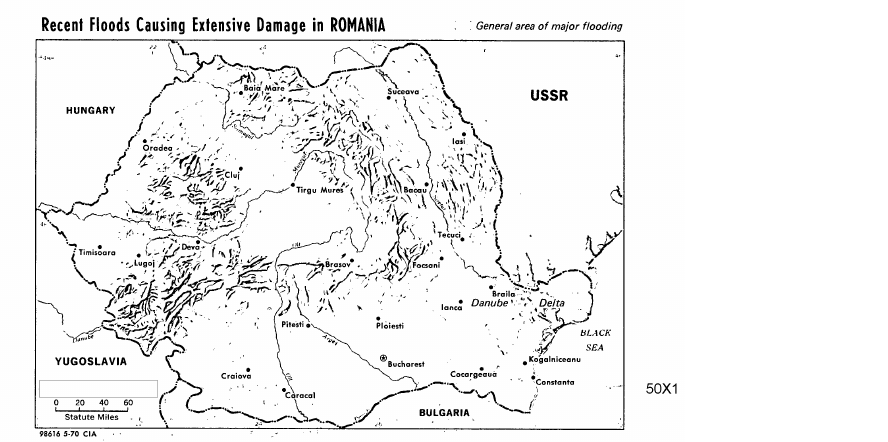
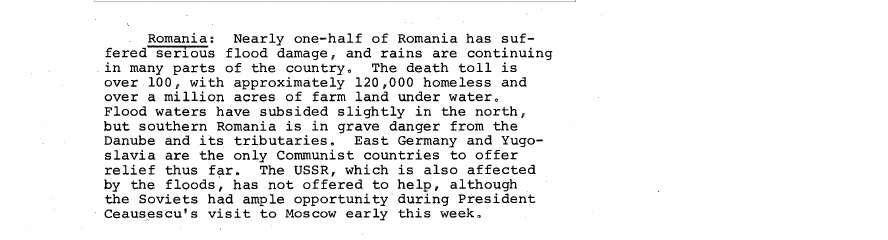
Nearly one-half of Romania has suffered serious flood damage, and rains are continuing in many parts of the country. The death toll is over 100, with approximately 120,000 homeless and over a million acres of farm land under water. Flood waters have subsided slightly in the north, but southern Romania is in grave danger from the Danube and its tributaries. East Germany and Yugoslavia are the only Communist countries to offer relief thus far. The USSR, which is also affected by the floods, has not offered to help, although the Soviets had ample opportunity during President Ceausescu's visit to Moscow early this week.
Scînteia of Monday, 25 May, runs the headline “A new wave of floods” and counts the towns under water and the hectares covered, with no death toll at all. About American aid it is open: “93 tents […] from the USA” have arrived by air at Alba Iulia, a town in Transylvania. Soviet aid does not appear in this issue.
Two days before the note in the brief, an aide to Henry Kissinger, the president's national security adviser, had written to him that the American ambassador had offered emergency help and the Romanians had answered with “a long shopping list”: seeds and construction machinery as well as tents and blankets. On 20 June Kissinger proposes to the president a package of 8.5 million dollars, noting that the announcement should be timed with Brezhnev's visit to Bucharest in mind.
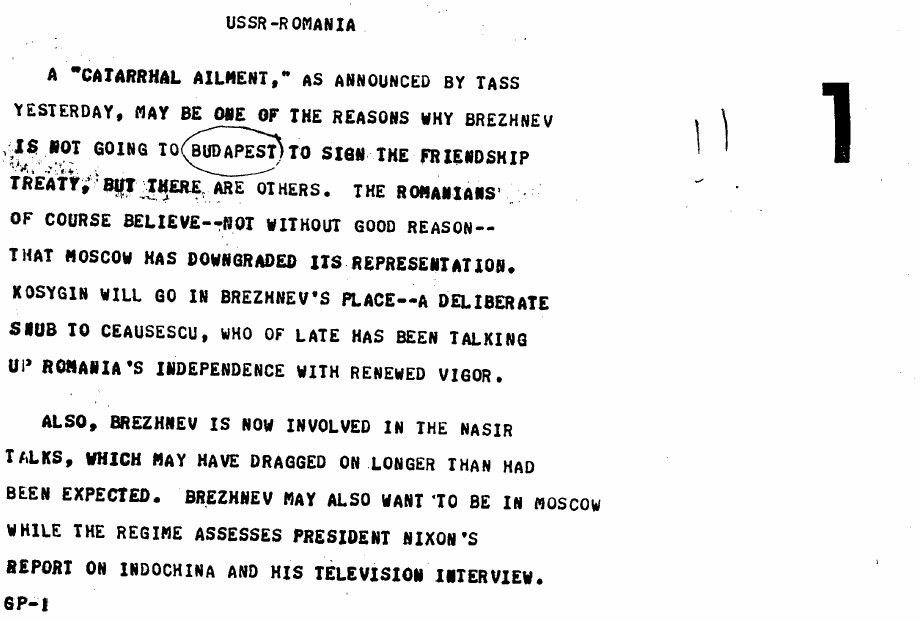
That visit does not take place. On 5 July, on a page typed entirely in capitals, like a telegram, the brief explains why the Soviet leader Leonid Brezhnev is not coming to sign the Soviet-Romanian friendship treaty. Except that the text sends him to Budapest, the capital of Hungary. Someone has circled the word by hand.
A "CATARRHAL AILMENT," AS ANNOUNCED BY TASS YESTERDAY, MAY BE ONE OF THE REASONS WHY BREZHNEV IS NOT GOING TO BUDAPEST TO SIGN THE FRIENDSHIP TREATY, BUT THERE ARE OTHERS. THE ROMANIANS' OF COURSE BELIEVE--NOT WITHOUT GOOD REASON-- THAT MOSCOW HAS DOWNGRADED ITS REPRESENTATION. KOSYGIN WILL GO IN BREZHNEV'S PLACE--A DELIBERATE SNUB TO CEAUSESCU, WHO OF LATE HAS BEEN TALKING UP ROMANIA'S INDEPENDENCE WITH RENEWED VIGOR.
ALSO, BREZHNEV IS NOW INVOLVED IN THE NASIR TALKS, WHICH MAY HAVE DRAGGED ON LONGER THAN HAD BEEN EXPECTED. BREZHNEV MAY ALSO WANT TO BE IN MOSCOW WHILE THE REGIME ASSESSES PRESIDENT NIXON'S REPORT ON INDOCHINA AND HIS TELEVISION INTERVIEW.
The Chinese loan, the July Theses and a summer of watching the border#
On 5 January 1971 the source of an item about China and Romania is named openly: the Romanian ambassador in Washington.
The Romanian ambassador in Washington says that the long-term, interest-free credit extended Bucharest by Peking last November amounts to $100 million in convertible currency.
A $100-million cash loan would be the largest China has ever extended. It comes at an appropriate time for the Romanians, who face substantial repayment commitments to a number of countries over the next several years. The Soviets will take further umbrage at this latest instance of Romanian independence, but Bucharest believes the economic benefits outweigh the credit's political risks.
The ambassador was Corneliu Bogdan. Six days later, on 11 January, the same man brings Kissinger a message from the Chinese premier Zhou Enlai, received by way of Bucharest. The conversation is recorded in a memorandum from Kissinger to Nixon, published by the State Department:
“If the U.S. has a desire to settle the issue and a proposal for its solution, the PRC will be prepared to receive a U.S. special envoy in Peking.”
In the 14 paragraphs naming Romania in the briefs of October 1970 – July 1971, the message and its route through Bucharest do not appear.
In June Ceaușescu visits China, North Korea and North Vietnam. On his return the party leadership adopts the proposals known ever since as the “July Theses”. On 10 July the CIA reads them as a gesture made for Moscow: the call for “ideological and cultural orthodoxy” “appears to stem from uncertainty over relations with Moscow following Ceausescu's recent Asian tour” and “seems designed to remove grounds for any Soviet questioning of Ceausescu's commitment to Communism”.
August 1971 has nine days naming Romania out of 27, level with September 1968: the most in the whole collection. The Soviet leaders meet all their East European allies except Romania, and the Soviet press sets it beside the “Balkan heretics”, Albania and Yugoslavia. The brief of 28 August brings an answer from a satellite:
Warsaw Pact: Satellite photography through strengthens the conclusion that there is no military activity in western USSR that could be construed as an imminent threat to Romania. The photography shows no signs of troop concentrations or alerts. At military installations, there was no massing of civilian trucks indicative of a mobilization, nor were there any concentrations of military transport aircraft similar to those photographed prior to the Czech invasion of 1968. Photography showed preparations then under way for the exercises now taking place in Bulgaria, but there was nothing unusual near the Bulgarian-Romanian border, and military activity appeared normal elsewhere in Eastern Europe, including Romania.
After 1971 Romania appears in the brief mostly as the state that does what its allies do not. The brief of 5 April 1972 reports that Ceaușescu and the Egyptian president, Sadat, “talked past one another” in Cairo three days earlier: the guest insists on the “integrity and sovereignty of all states”, which, the CIA notes, by implication includes Israel. On 6 March 1973:
Romania has become the first Warsaw Pact country to buy US passenger aircraft. A contract for the purchase of three Boeing 707-320C long-range jet airliners, spare parts, and spare engines, valued at $45 million was signed last week. One of the aircraft will be configured for VIP service.
On 26 June 1973 an item that opens with a white box describes ten “Chinese-designed” gunboats under construction at the shipyard of Mangalia, on Romania's Black Sea coast: “Romania's first non-Warsaw Pact arms since World War II”. The brief of 6 November, after the Arab-Israeli war of October, describes a visit to Bucharest by the Israeli foreign minister, Abba Eban, at the Romanians' invitation, for “urgent talks”. On 3 December Ceaușescu “arrives in Washington at a time when his country is uncomfortably prominent in international affairs”.
About life inside the country the brief says little. One of the exceptions, on 12 July 1974:
Factory workers set at least one industrial fire in Romania recently, the first confirmed case in some time of serious worker-instigated sabotage. Further incidents could mean that Ceausescu faces some of the most serious popular discontent in his nearly ten years of rule. The regime's main response has been to tighten security at industrial facilities. Ceausescu's emphasis on developing heavy industry at the expense of improved living conditions and the production of consumer goods is an important factor in worker dissatisfaction. Romania's living standard is the lowest in Eastern Europe, except for Albania.
Ford in Bucharest, a bruised ego at Helsinki and the rumours of May#
Gerald Ford arrives in Bucharest on Saturday, 2 August 1975. The next day's Scînteia speaks, in its headline, of “hundreds of thousands of Bucharesters” who came out to greet him. The day before he lands, the brief tells the president that the timing of the visit, “in Bucharest's view”, “could scarcely be better”: Congress has just opened the way to most-favoured-nation tariff status, and Romania, hit by floods again, “needs an economic shot in the arm”.
On 10 September, a note about Ceaușescu at the Helsinki conference on European security, with six white boxes:
Romanian President Ceausescu suffered a bruised ego at the Helsinki summit Ceausescu-- was upset because he was not in the spotlight at Helsinki. He was annoyed by the Romanian Foreign Ministry's failure to line up more talks for him with other chiefs of state. the East European leaders tended to ignore him and treated him like an outsider.
In May 1976 the rumour in Bucharest is that reservists are being called up.
There are rumors in Bucharest that Romania is calling up reservists because of a fear of Soviet intervention.
There is no evidence that a general mobilization of Romanian forces is in progress, but some reservists may have been called up to participate in regular spring field training exercises. There has been no indication of any unusual Soviet military activity along the Romanian border. President Ceausescu, when faced with increased pressure from Moscow in the past, has used the tactic of pointing to a magnified Soviet menace in order to strengthen his country's resolve and show national unity.
The current spate of rumors has caused some panic buying by Romanian citizens.
Two days later the brief clears it up: it had been an “unannounced but planned mobilization and alert exercise”.
The last item about Romania is dated 26 November 1976, after Brezhnev's first official visit to Bucharest. The last mention, on 16 December, concerns fishing in the waters of the European Community. The two released collections end on 20 January 1977, the day Jimmy Carter became president.
How often Romania appears, and how much is still hidden#
The count below is of days, because on some days two documents appeared. A day “with Romania” is a day on which at least one paragraph of the released text names Romania, a Romanian town or a Romanian leader. Labels on maps were not counted.
379days on which the brief names Romania, out of 4,885
409paragraphs, transcribed from the scan
187paragraphs about Romania
89of them have text withheld; 27 are withheld entirely
Days per year on which the brief names Romania. Black: an item about Romania. Red: about Romania, with text withheld. Grey: named in passing in another item.
The busiest years are 1968, with 57 days, and 1964, with 45. By president:
President
Days with a brief
Days with Romania
Share
About Romania
With text withheld
Kennedy (from 17 June 1961)
766
29
3.8 %
12
3
Johnson
1,607
161
10.0 %
77
40
Nixon
1,760
137
7.8 %
65
32
Ford
752
52
6.9 %
24
10
Romania beside the other communist states of Europe
How often does Romania appear beside the other communist states of Europe? The table counts, for each, the days on which the brief writes its name or the name of its capital, by the same rule and in the same machine transcription of all the briefs, the one published by Carson, Min and Van Nuys. That is why the figure for Romania, 355, is a little lower than the one above, which comes from reading the scans.
Days per year on which the brief names each state (the country or its capital), in the Carson–Min–Van Nuys transcription. Bold: the state named most often that year.
Year
East Germany
Czechoslovakia
Poland
Romania
Yugoslavia
Hungary
Bulgaria
Albania
1961
65
13
17
2
26
3
3
27
1962
99
33
24
4
34
7
16
22
1963
39
33
29
16
36
13
8
8
1964
55
27
36
40
24
18
20
3
1965
22
7
9
13
3
3
3
2
1966
19
10
21
18
16
5
4
10
1967
12
26
16
22
7
16
1
2
1968
59
203
85
57
30
41
29
7
1969
63
81
37
38
16
21
3
2
1970
49
21
36
11
12
12
5
5
1971
46
10
32
23
21
7
9
6
1972
48
31
23
19
17
11
7
2
1973
25
27
19
30
24
25
18
3
1974
15
8
12
18
17
10
5
3
1975
10
6
19
26
23
6
2
1
1976
10
6
32
18
40
5
6
1
1977
3
0
3
0
2
0
0
0
1961–1977
639
542
450
355
348
203
139
104
Over the whole period Romania is fourth by number of days, after East Germany, Czechoslovakia and Poland. Of the eight it was the one named most often in 1973, 1974 and 1975. East Germany appears often because of Berlin, and Czechoslovakia collects more days in 1968 than Romania in any three years together.
How much of what the president was told about Romania is still withheld
Of the 187 paragraphs about Romania, 89 have at least one white box inside them or directly after the text: 48 per cent. In 27 cases only the heading is left: the president was told something about Romania that day, and half a century later what it was is still not known.
Beside the boxes, in the margin, is a code such as 50X1 or 25X1. The digit 1 points to the first category in the American rules on declassification: text that would reveal an intelligence source or method, that is, who said it and how it was learned. The 50 and the 25 are the years beyond which the text stays secret. On 31 August 1968 the sentence is left but not its beginning; on 24 August, one sentence followed by a column of boxes; on 29 August, only the heading, “Bulgaria-Rumania”. Every statement on this page that the brief “does not say” something refers to the released text.
The archive: every paragraph about Romania, year by year#
All 409 paragraphs that name Romania, in the order in which they were written. Under each scan is its transcription, made from the image, and a link to the whole document.
The collection is published by the CIA in its Electronic Reading Room, in two series: 1961–1969 and 1969–1977. The CIA's site does not answer automated requests for documents, so the pages were read from the copy at the Internet Archive, which keeps the CIA's PDFs under their document numbers. After duplicates are removed the copy holds 5,034 documents from 4,885 days, between 17 June 1961 and 20 January 1977. Every paragraph above links to its document on the CIA's site.
How the days with Romania were found
The PDFs are photographs of pages, with no text. Two independent machine transcriptions were used: the one made by the Internet Archive and the one published by Carson, Min and Van Nuys, who divided all the briefs into paragraphs for a different study. Each was searched for “Rumania”, “Romania”, “Bucharest”, “Ceausescu”, “Gheorghiu-Dej”, “Maurer” and a few other names. The first transcription found 397 documents, the second 380; 372 are common to both.
All 405 documents found by at least one transcription were then read page by page, on the image. In 385 of them there is indeed a paragraph that names Romania. In the other 20 the word was only a label on a map. The first transcription had missed eight of the confirmed documents, the second five. A document missed by both could not have been found; given how rarely each one failed, such cases should be very few, but the number of days on this page remains a lower bound. The eight briefs said here not to name Romania (21, 22, 27 and 30 August 1968; 1, 2, 4 and 5 August 1969) were read whole, page by page, on the image.
Transcriptions and translations
The text of each paragraph was transcribed from the scan, not taken from the machine transcriptions: capitals, the spelling “Rumania” and typing errors were kept, and each white box is marked where it stands. Words divided at a line end were joined. The quotations in the chapters above are checked automatically, word for word, against these transcriptions.
Scînteia
The issues of Scînteia were read in the scans of the Hunedoara-Deva County Library in Romania: 17 issues for August–September 1968 (21–31 August and 1, 2, 3, 4, 6 and 9 September) and seven for the other moments. Whether a president read a given page cannot be known from the briefs; this page says only what was written for him. Front-page headlines were read on the image. Quotations from inner pages, and statements that a subject is absent, rest on the scan's machine-read text, searched for several words; a report printed in other words could have been missed. The brief and the newspaper are compared on the same calendar date. In summer Bucharest was then six hours ahead of Washington, so the Romanian paper reached its readers a few hours before the brief reached the president.
What already exists
A few of these pages have been cited before: the briefs of 23 and 24 August 1968 in a 2019 study of the American reaction to the invasion of Czechoslovakia, and Carson, Min and Van Nuys counted every country in the briefs for research on the CIA's language. On the day of publication, 4 October 2026, searches in Romanian and English found no other page that follows Romania through the whole collection, day by day.