One country, three spellings, 1859–2019
Roumania, Rumania, Romania: how English spelled one country's name, year by year
English has printed the name of Romania, the country on the Black Sea in south-eastern Europe, in three ways. Counted year by year in the books scanned by Google and in a sample of American newspapers, the spellings show when each gave way, and that Bucharest, Romania's capital, asked for different spellings at different times.
English books, 1940: Roumania 28% · Rumania 67% · Romania 5%
Each of the two letters is filled by the share of the spellings that contain it.
Which spelling, in which year#
Each ribbon below is one source. Blue is Roumania, yellow is Rumania, red is Romania; the thickness of a colour in a year is that spelling's share of the three. In the word at the top, the O and the U are filled like a slice of the ribbon for the chosen year. The O is in Roumania and Romania, so it carries their blue and red; the U is in Roumania and Rumania, and carries blue and yellow. Where a letter is pale, that is the share of the spelling that does without it.
Choose a year with the slider or the year box, or press on a ribbon. The diamonds are dated decisions and open a short account; the bars underneath show the spelling each institution used.
What each institution used. A bar is a period stated by the source; a dot is a single dated document.
| Roumania | Rumania | Romania | |||||
|---|---|---|---|---|---|---|---|
| British books | 36% | 61% | 4% | no data | |||
| American books | 18% | 77% | 5% | no data | |||
| American newspapers | 9% | 87% | 4% | outside the newspaper sample, or too few newspapers | |||
In 1940 the Romanian legation in London was Romanian on its letterhead, Rumanian on the brass plate by its front door and Roumanian in the London telephone directory.[6] All three spellings were in print in English that year, and the argument between them had another fifty years to run.
The usual account is short: English borrowed Roumania from French, moved to Rumania, and after the Second World War let it fall out of use “in favour of the name used officially”, Romania, as Wikipedia's article on the name puts it[7]. Counted year by year, the change has sharper dates and more actors. Washington's names board prescribed Roumania by 1905 and Rumania by 1920. Bucharest, Romania's capital, told its own legations to write Romania in 1932. America's news agencies adopted Romania in April 1944, and their newspapers changed within a week. The British Foreign Office wrote Roumania until 1963, then took Rumania, mainly at Bucharest's request according to the British names committee's own account, and accepted Romania in 1970. The New York Times printed Rumania in its news headlines until 3 February 1990.
Here the three spellings are counted: in the books scanned by Google, British and American separately, for every year from 1859 to 2019; in a sample of American newspapers from 1862 to 1963; and in the headlines of The New York Times. Every dated ruling of a government, a names committee, a news agency or a newspaper is set on the same line of years.
The whole difference is one vowel, and the same choice between o and u runs through the country's name in other languages. Of the 278 living languages that have a name for the country in Wikidata, 131 say it with an o and 133 with a u.
The curve in brief. Roumania, modelled on French Roumanie, takes over in the 1860s and holds between 81% and 91% of the three spellings through the 1880s and 1890s, in British and American books alike. American books move to Rumania around the First World War: it leads from 1919. British books keep Roumania a generation longer; Rumania leads there for good only from 1949. Romania becomes the most common spelling in American books in 1971 and in British books in 1973.
American newspapers moved earlier than books, and less tidily. In the sample read here, where each newspaper counts once, Rumania overtakes Roumania in 1915. In April 1944 most of them went over to Romania within a week. By the late 1950s Rumania was ahead again, and the newspapers of the one state that can be followed further, Georgia, stay divided until the 1980s.
to 1866
Why does “Romania” appear in English books before the modern state took that name?#
Until 1859 there was no state of that name. There were two self-governing principalities under Ottoman suzerainty, Wallachia and Moldavia, and English books named them separately or together as the Danubian Principalities. In January 1859 both elected the same prince, Alexandru Ioan Cuza; in 1862 they were given one government; the constitution of 1866 called the state România.
“Romania” was already an English word, with another meaning. Historians used it for the lands of the Eastern Roman empire and for the Latin empire that the crusaders set up at Constantinople in 1204. Between 1800 and 1855 it appears about 0.40 times in every million words of English books. Between 1870 and 1900, with the new country in the news, the spelling Romania appears 0.16 times in a million, which is less. At that rate the older word alone could fill the red at the left of the ribbons, where it has the majority only because the other two spellings barely exist yet.
The new name overtook the old ones within a generation. In English books the three spellings together overtake Wallachia and Moldavia together from 1876, on the eve of the war of 1877–1878, during which Romania declared its independence; the powers recognised it at Berlin in 1878.
One name replaces two
1859–1914
Roumania: the spelling came through French#
French was the language in which western Europe read about the principalities, and French wrote the people's name with ou. Jean-Alexandre Vaillant, a French teacher in Bucharest, published a Grammaire roumâne à l'usage des Français there in 1840[27]. Four years later, in Paris, he titled a three-volume history La Romanie, with an o; that form did not last. The linguist Vasile Arvinte, who traced these first uses, gives the reason the ou prevailed: roumain could not be mistaken for romain, “of Rome”[8].
The two letters record a sound. In French, ou is how the vowel of English “moon” is written, and that was the vowel of rumân, the form of the people's name used in Wallachia and the regular outcome of Latin romanus. The form with o, român, which Arvinte calls Moldavian and Latinist, replaced it among Wallachian writers just after 1840, and became the name of the nation and the state. The page on rumân and român follows the two forms.
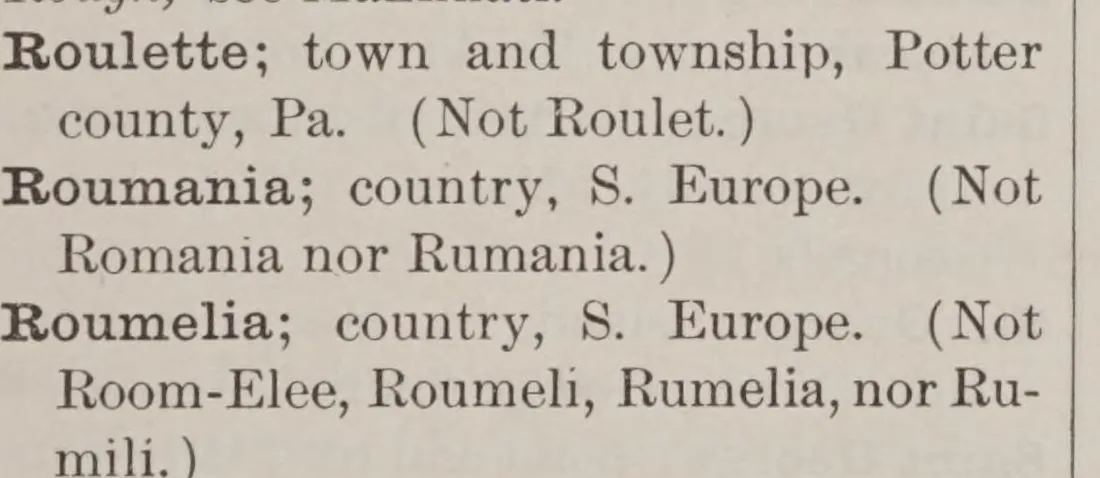
English modelled its spelling on the French one: Roumania for Roumanie. By 1870 Roumania has 82% of the three spellings in British books and 79% in American ones; in 1890, 89% and 87%. By 1905 it was a rule in Washington. The third report of the United States Board on Geographic Names, sent to the President on 29 November of that year, lists every decision the board had taken since 1890, and among them:
German, meanwhile, wrote Rumänien, with a plain u.
1905–1940
Rumania: American books changed around the First World War, British books a generation later#
The plain u arrived in English before the war. In American books Rumania has 16% of the three spellings in 1905 and 38% in 1914. The Encyclopaedia Britannica of 1911 files the country under “RUMANIA, or Roumania [România]”[12], and in the headlines of The New York Times read here, Roumania is the more frequent spelling for the last time in 1911 and Rumania from 1913 on[3].
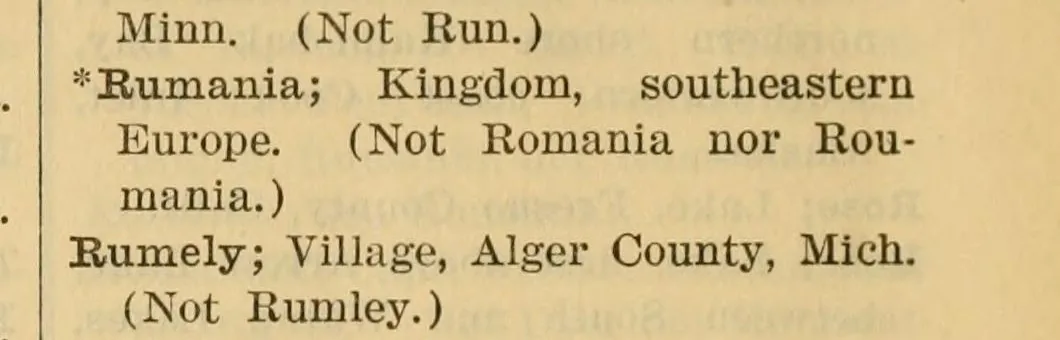
The country entered the war in August 1916, and was written about as never before: the three spellings together are 3.7 times as frequent in English books of 1916–1919 as in those of 1905–1909. In those years American usage tipped. Rumania passes Roumania in American books in 1919, and Washington's names board, which still prescribed Roumania in its report of 1916[10], reverses itself by 1920:
British books did not follow. Roumania still has 60% of the three spellings there in 1925 and 58% in 1935; Rumania takes the lead for the first time in 1938, and for good only in 1949. Welsh newspapers had moved much earlier: in those digitised by the National Library of Wales, 593 articles of 1915 print Rumania and 262 print Roumania[28]. According to Woodman, The Times used Rumania from the 1920s, and its atlas of 1922 did too[6]. The Foreign Office stayed with Roumania.
American newspapers changed in the same years. In the sample read here, where each newspaper counts once, Rumania overtakes Roumania in 1915.
1923–1947
Romania: Bucharest's choice from 1932, the American news agencies' from April 1944#
The spelling with o had official backing in Britain from the 1920s. The Permanent Committee on Geographical Names, which advises the British government on foreign names, recommended “România” in 1923 and “Romania” in 1926. The Foreign Office did not follow, and Paul Woodman, who wrote the committee's account of the question, gives its reason: the country's own legation in London signed its letters “Roumanian”[6].
In 1932, Woodman writes, the Romanian government told its legations in London and Washington to use Romania. The one in Washington did. The one in London asked to keep Roumania, since the Foreign Office used it. By 1940 it had new letterheads, and the government announced the change in its English-language bulletin:
In 1926 the Permanent Committee on Geographical Names for British Official Use (British Royal Geographical Society) decided that Romania was the correct spelling in English instead of the other two forms used, Rumania and Roumania. On the advice of the Romanian Royal Academy of Letters and the Royal Romanian Geographical Society, this new spelling has been adopted by the Royal Romanian Legations in London and Washington.
Romanian Bulletin, 8 August 1940, as quoted by Paul Woodman[6]
The reason given is the British committee's own ruling. Neither Rome nor the Latin origin of the language is mentioned in the passage, and at the legation's door the brass plate still said Rumanian.
April 1944
The change that reached readers came from another direction. The National Geographic Society printed foreign names as the countries themselves wrote them, and in April 1944, with the Red Army crossing into the country, the three American news agencies adopted its style, with exceptions of their own:
Among the national geographic usages adopted are Romania instead of Rumania, Yugoslavia instead of Jugoslavia, Manchuria instead of Manchukuo, and Dnepr and Dnestr Rivers instead of Dnieper and Dniester.
Associated Press dispatch, New York, 8 April 1944, as printed in The Pampa News (Texas), 9 April 1944, p. 3[13]
The dispatch is dated 8 April and the new style took effect the next day. The count shows the change in the week it happened. In the week that began on Monday 3 April 1944 the newspapers of the collection printed Rumania in 155 articles and Romania in three. In the week that began on 10 April they printed Romania in 52 and Rumania in 37.
Over the ninety days before 9 April, Romania has 1.6% of the three spellings; over the ninety days after, 73%. In all, 13 newspapers printed at least ten articles with the name on each side of that date, and in 10 of them Romania became the most common spelling.
The change did not hold everywhere. With each newspaper counted once, Romania has 50% of the three spellings in 1950 and Rumania 38%; in 1958 Rumania is ahead again, with 58% to 33%. Why so many papers went back was not established here.
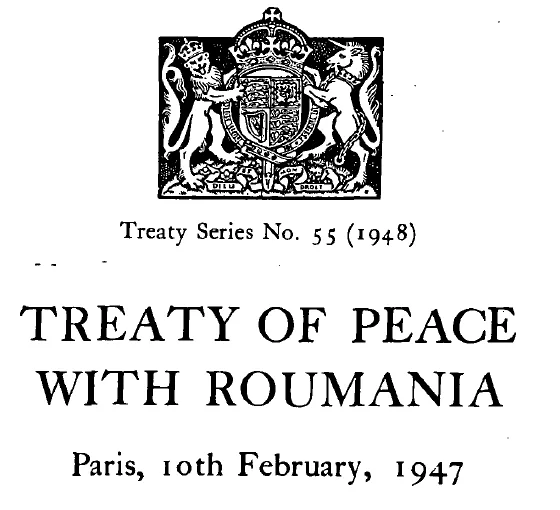
Books moved far less. In American books Romania goes from 5% of the three spellings in 1941 to 16% in 1949 and then stays near 20% until the mid-1960s; in British books it has 4% in 1941 and 4% in 1949. Governments did not move at all: the peace treaty signed in Paris on 10 February 1947 is a “Treaty of Peace with Roumania”, and spells the name so throughout its English text, in the British edition and in the American one[14][15].
1953–1965
Romînia at home, and a request for Rumania#
On 16 September 1953 Romania's government decided to change the spelling of Romanian: from 1 April 1954 the letter â was abolished and î written everywhere, so that the country became Romînia and its people romîni[16]. The change was in the fourth letter, and English, which has no such vowel, had nothing to change. The country joined the United Nations in December 1955 as Romania in English and Roumanie in French[17].
It mattered to the argument in London. The committee's first advice, România in 1923, had rested on its rule that a name written in the Roman alphabet keeps its own spelling; after 1953 that spelling was Romînia, and the rule could no longer be cited for Romania. By the early 1960s, Woodman writes, British usage seemed to have settled on Rumania. In November 1963 the committee gave way, and in December the Foreign Office at last gave up Roumania:
It did so, however, principally on the basis of requests from the Romanian government itself which, surprisingly perhaps, favoured the spelling “Rumania” for the English language at this time.
Paul Woodman, of the Permanent Committee on Geographical Names, on the Foreign Office's decision of December 1963[6]
The state's own journal hardly registered the change. In the London Gazette, notices with Roumania outnumber those with the other two spellings together in every year from 1915 to 1971, eight years after the Foreign Office gave the spelling up; Romania leads there from 1972[25].
The books show the Foreign Office joining a change already under way. In British books Roumania has 37% of the three spellings in 1955, 32% in 1963 and 18% in 1967. Rumania reaches its highest share there, 70%, in 1966.
1965–1975
Romania: Washington by 1966, London in 1970, and books already on the move#
The Romanian Academy restored â in one family of words, român and România, by a decision that the sources date to 1964 or to 1965[16]. In Scînteia (“The Spark”), the daily of the ruling Romanian Workers' Party, the change falls within three days: issue 6605, of 30 April 1965, prints romîn 45 times and român never; issue 6607, of 3 May, prints român 37 times and romîn once[26]. The one issue between them, No. 6606, is missing from the scans read. The constitution of 21 August 1965 gave the state the name Republica Socialistă România[18]. Nicolae Ceaușescu had become the party's leader that March. Woodman records that Bucharest then went back on its preference for Rumania and renewed its pre-war campaign to persuade English-speaking countries to accept Romania, raising the spelling when trade agreements and communiqués with Britain were signed[6].
Washington was ahead of London. In the State Department's Bulletin the name appears as Rumania 62 times in the volumes for 1964 and 1965 and as Romania twice; in the volume for the first half of 1966 it appears as Romania nine times and as Rumania twice[19]. A year later the Government Printing Office records the preference while still printing the old form:

London, having changed in 1963, was unwilling to change again so soon, Woodman writes. It did so in 1970: the names committee in July, the Foreign Office in September[6][21].
Books were already moving. In American books Romania has 22% of the three spellings in 1965, 27% in 1967, 37% in 1969 and leads from 1971. In British books it has 10% in 1965, 15% in 1967 and 31% in 1970, the year of London's decision, and leads from 1973. Woodman notes that British commercial publishers, among them the atlases of The Times, had begun to use Romania before the Foreign Office did, and suggests one more reason for its change of mind: a wish, perhaps, to support Romania's presentation of itself as a Latin country set apart from the Soviet bloc.
1975–2019
The New York Times changes on 4 February 1990#
Catalogues came next. The United States National Library of Medicine indexed research under RUMANIA until 1978[22]; by the summer of 1985 the Library of Congress's table of country names for its cataloguers read “Rumania see Romania”[23].
Newspapers had been divided since 1944. The newspapers of the state of Georgia, digitised by its university libraries, run to the 1990s[24]. In them Romania has 1% of the three spellings in 1940 and 52% in 1950, and after that the two spellings stay close to level for thirty years: Rumania still has 53% in 1980. Romania leads there for good from 1981.
One newspaper kept to Rumania throughout. In the days read between 1945 and November 1989, the headlines of The New York Times have Rumania 98 times and Romania never. It reported the fall of Ceaușescu in December 1989 under the running heading “Upheaval in the East: Rumania”. In the paper's index the last news headline with that spelling is dated 3 February 1990, and the first with the new one 4 February:
Upheaval in the East: Rumania; Question in Bucharest: Who's in What Party? — Upheaval in the East; Romania Council Out; Multiparty Unit Is In
The New York Times, headlines of 3 February and 4 February 1990[3]
Of the days read after 10 March 1990, none has a headline with Rumania.
In books the older spellings have not disappeared. In the last years of the corpus, 2015–2019, Rumania still has 5.2% of the three spellings in British books and 5.6% in American ones.
The documents, side by side
Did Romania ask for the o? Before the war and again after 1965; in 1963 it asked for the u#
The short account is right about the order and silent about the actors. The documents add them:
| When | Who | Which spelling | Evidence |
|---|---|---|---|
| by 1905 | US Board on Geographic Names | Roumania | its Third Report |
| by 1920 | US Board on Geographic Names | Rumania | its Fifth Report |
| 1926 | British names committee (advice) | Romania | Woodman 2008 |
| 1932 | Romanian government, to its own legations | Romania | Woodman 2008 |
| 8 Aug 1940 | Romanian government, in print | Romania | Romanian Bulletin, quoted by Woodman |
| 9 Apr 1944 | Associated Press, United Press, International News Service | Romania | the agencies' dispatch |
| 10 Feb 1947 | Peace treaty, British and American editions | Roumania | the treaty texts |
| Dec 1963 | British Foreign Office, mainly at Bucharest's request | Rumania | Woodman 2008 |
| after Aug 1965 | Romanian government, to English-speaking governments | Romania | Woodman 2008 |
| by Jan 1966 | US State Department | Romania | its Bulletin |
| by Jan 1967 | US Board on Geographic Names | Romania | GPO Style Manual |
| Sep 1970 | British Foreign Office | Romania | Woodman 2008; UK government timeline |
| 4 Feb 1990 | The New York Times, news headlines | Romania | its index of headlines |
Three things follow. Bucharest's own choice of Romania is older than communism: Woodman dates the instruction to its legations to 1932, and the government announced it in print in 1940, citing the British committee's ruling and the advice of its own Academy. Its preference was not constant: in 1963, when the country wrote itself Romînia, it asked London for Rumania, and after 1965 for Romania again.
And the counts show the order of events, not their cause. American newspapers changed in the week the news agencies did. The State Department's Bulletin changes at the turn of 1966, and Romania rises in American books from 1967. In British books it rises from 1967 as well, three years before London's decision. The New York Times changes its headlines on 4 February 1990. The one passage seen from a Romanian announcement, that of 1940, does not mention Rome.
Can a spelling date a headline?#
Because the paper changed its spelling twice, at dates that can be found, the spelling in a headline is a rough date stamp. These are real headlines of The New York Times, read from the paper's own index[3]. Pick the period each was printed in.
- “RUMANIA WEIGHS HER MIGHT” The New York Times — from 1913 to 3 February 1990. Rumania is the paper's usual spelling from 1913, and that of its news headlines until 3 February 1990. This one is from 7 January 1940.
- “U.S. Paid Romania for Soviet Arms, Report Says” The New York Times — after 3 February 1990. The paper's news headlines have had Romania since 4 February 1990. This one is from 6 May 1990.
- “Romania Seeks to Reduce Abortions” The New York Times — after 3 February 1990. The paper's news headlines have had Romania since 4 February 1990. This one is from 17 January 1991.
- “Rumania Needs Long Credits” The New York Times — from 1913 to 3 February 1990. Rumania is the paper's usual spelling from 1913, and that of its news headlines until 3 February 1990. This one is from 4 January 1920.
- “ROUMANIANS SPURN BRIBES” The New York Times — before 1913. In the days read, Roumania is the paper's usual spelling until 1911. This one is from 26 July 1892.
- “OPPOSITION GAINS IN ROMANIA VOTE” The New York Times — after 3 February 1990. The paper's news headlines have had Romania since 4 February 1990. This one is from 25 February 1992.
- “RUMANIAN KING VERY ILL” The New York Times — from 1913 to 3 February 1990. Rumania is the paper's usual spelling from 1913, and that of its news headlines until 3 February 1990. This one is from 10 January 1914.
- “The Peace Conference--The Abdication of Prince Charles of Roumania Postponed” The New York Times — before 1913. In the days read, Roumania is the paper's usual spelling until 1911. This one is from 4 April 1871.
- “RUMANIAN WOMEN SLOW” The New York Times — from 1913 to 3 February 1990. Rumania is the paper's usual spelling from 1913, and that of its news headlines until 3 February 1990. This one is from 19 January 1930.
- “ROUMANIA'S UNQUIET TIME” The New York Times — before 1913. In the days read, Roumania is the paper's usual spelling until 1911. This one is from 27 April 1888.
Did other languages argue over the same vowel?#
Some did, each in its own decade. The same count on the French, Italian and Spanish books of Google's corpus[1] shows three more arguments about the first syllable, and one about where the stress falls. German is absent because it hardly hesitated: Rumänien has more than nine tenths of the German forms counted (Rumänien, Romänien, Rumanien) in every decade since the 1860s.
French: Romanie, then Roumanie
Italian: Rumenia against Romania
Italian, the people: rumeno or romeno
Spanish: Rumania or Rumanía
What is the country called in the world's languages today?#
Wikidata, the database behind Wikipedia, holds a name for the country under 321 language codes[4]. Setting aside constructed and historical languages and regional or script variants leaves 278 living languages. In 131 of them the first syllable has an o, as in Romanian România. In 133 it has the sound u: 114 write it with the letter u and 19 with two letters, as French does in Roumanie, Dutch in Roemenië and Greek in Ρουμανία. In 13 the script writes o and u with the same letter, and one, Navajo, describes the country instead of borrowing its name.
On the maps each point is a language, placed where Glottolog locates it[5] and coloured by that first vowel. The colours are the ones used above: red for o, yellow for u, blue for u written with two letters.
The split does not follow language families. Among the Romance languages, Italian and Portuguese have the o, French and Spanish the u. Among the Slavic languages nearly all have the u, and Slovene (Romunija) and Macedonian (Романија) the o. Korean has both: 루마니아 (Rumania) in the South and 로므니아 (Romŭnia) in the North. Chinese writes 罗马尼亚, Luómǎníyà, and its first two characters are the ones it uses for Rome, 罗马.
A dictionary states the route for only some of these names. Vasmer's etymological dictionary of Russian derives румын from Romanian român[30]. The Treccani dictionary gives Italian both romeno and rumeno, “from Romanian român or rumân, which is Latin Romanus”[31]. For most languages the table records only what the form shows, its first vowel, and makes no claim about the language it came through.
| Language | Name of the country | First vowel | Notes |
|---|---|---|---|
| Abkhazian | Румыниа | u | |
| Acehnese | Rumania | u | |
| Adyghe | Румание | u | |
| Afrikaans | Roemenië | u, written with two letters | |
| Akan | Romania | o | |
| Albanian | Rumania | u | |
| Amharic | ሮማንያ Romanya | o | |
| Amis | Romania | o | |
| Angika | रोमानिया Romāniyā | o | |
| Arabic | رومانيا Rūmāniyā | u | |
| Aragonese | Rumanía | u | |
| Armenian | Ռումինիա Ṙuminia | u, written with two letters | |
| Aromanian | Romãnia | o | |
| Asturian | Rumanía | u | |
| Atayal | Romania | o | |
| Avaric | Румыния | u | |
| Awadhi | रोमानिया Romāniyā | o | |
| Aymara | Rumanya | u | |
| Azerbaijani | Rumıniya | u | |
| Balinese | Romania | o | |
| Bangla | রোমানিয়া Romāniẏā | o | |
| Banyumasan | Rumania | u | |
| Bashkir | Румыния | u | |
| Basque | Errumania | u | |
| Bavarian | Rumänien | u | |
| Belarusian | Румынія | u | |
| Betawi | Ruméni | u | |
| Bhojpuri | रोमानिया Romāniyā | o | |
| Bikol | Romanya | o | |
| Bishnupriya Manipuri | রোমানিয়া Romāniẏā | o | |
| Bislama | Romania | o | |
| Bosnian | Rumunija | u | |
| Breton | Roumania | u, written with two letters | |
| Bulgarian | Румъния | u | |
| Buriat | Румын | u | |
| Burmese | ရိုမေးနီးယားနိုင်ငံ Rome:ni:ya: (naingngan = country) | o | |
| Cantonese | 羅馬尼亞 lo4 maa5 nei4 aa3 | o | |
| Catalan | Romania | o | |
| Cebuano | Romania | o | |
| Central Kurdish | ڕۆمانیا Romanya | o | |
| Chamorro | Rumania | u | |
| Chavacano (Zamboanga) | Rumanía | u | |
| Chechen | Румыни | u | |
| Cherokee | ᎶᎹᏂᏯ Lo-ma-ni-ya | o | |
| Chinese | 羅馬尼亞 Luómǎníyà | o | |
| Chuvash | Румыни | u | |
| Cornish | Roumani | u, written with two letters | |
| Corsican | Romania | o | |
| Crimean Tatar | Romaniya | o | |
| Croatian | Rumunjska | u | |
| Czech | Rumunsko | u | |
| Dagbani | Romania | o | |
| Danish | Rumænien | u | |
| Divehi | ރުމޭނިއާ Rumēni'ā | u | |
| Doteli | रोमानिया Romāniyā | o | |
| Dutch | Roemenië | u, written with two letters | |
| Dzongkha | རོ་མ་ནི་ཡ། Ro ma ni ya | o | |
| Eastern Min Chinese | Romania | o | |
| Egyptian Arabic | رومانيا Rūmāniyā | the script does not tell o from u | |
| Emilian-Romagnol | Rumanî | u | |
| English | Romania | o | |
| Erzya | Румыния Мастор | u | |
| Estonian | Rumeenia | u | |
| Ewe | Romania | o | |
| Extremaduran | Rumania | u | |
| Faroese | Rumenia | u | |
| Fiji Hindi | Romania | o | |
| Filipino | Romania | o | |
| Finnish | Romania | o | |
| Franco-Provençal | Roumanie | u, written with two letters | |
| French | Roumanie | u, written with two letters | |
| Friulian | Romanie | o | |
| Fula | Romaniya | o | |
| Gagauz | Romıniya | o | |
| Galician | Romanía | o | |
| Ganda | Romania | o | |
| Georgian | რუმინეთი Rumineti | u | |
| German | Rumänien | u | |
| Ghanaian Pidgin | Romania | o | |
| Gilaki | رۊمانيا Rumaniya | u | |
| Goan Konkani | रोमेनिया Romeniyā | o | |
| Greek | Ρουμανία Roumanía | u, written with two letters | |
| Guarani | Rrumaña | u | |
| Guianan Creole | Roumani | u, written with two letters | |
| Gujarati | રોમાનિયા Romāniyā | o | |
| Haitian Creole | Woumani | u, written with two letters | |
| Hakka Chinese | Romania | o | |
| Hausa | Romainiya | o | |
| Hawaiian | Romānia | o | |
| Hebrew | רומניה Romanya | the script does not tell o from u | |
| Hindi | रोमानिया Romāniyā | o | |
| Hungarian | Románia | o | |
| Iban | Romania | o | |
| Icelandic | Rúmenía | u | |
| Igbo | Romania | o | |
| Iloko | Romania | o | |
| Inari Sami | Romania | o | |
| Indonesian | Rumania | u | |
| Irish | an Rómáin | o | |
| Italian | Romania | o | |
| Jamaican Creole | Rumienia | u | |
| Japanese | ルーマニア Rūmania | u | |
| Javanese | Rumèni | u | |
| Jju | Romaniya | o | |
| Kabardian | Румыниэ | u | |
| Kabiye | Rumaanii | u | |
| Kabuverdianu | Románia | o | |
| Kabyle | Rumanya | u | |
| Kalaallisut | Rumænia | u | |
| Kalmyk | Румудин Орн | u | |
| Kannada | ರೊಮಾನಿಯ Romāniya | o | |
| Kara-Kalpak | Rumıniya | u | |
| Karachay-Balkar | Румыния | u | |
| Kashmiri | رومانیہ Rūmāniya / Romāniya | the script does not tell o from u | |
| Kashubian | Rumùńskô | u | |
| Kazakh | Румыния | u | |
| Khmer | រូម៉ានី Rumani | u | |
| Kildin Sami | Румыния | u | |
| Kinyarwanda | Romaniya | o | |
| Komering | Romania | o | |
| Komi | Румыния | u | |
| Komi-Permyak | Ромыния | o | |
| Kongo | Romania | o | |
| Korean | 루마니아 Rumania | u | |
| Kurdish | Romanya | o | |
| Kyrgyz | Румыния | u | |
| Ladin | Romania | o | |
| Ladino | Rumania | u | |
| Lak | Руминия | u | |
| Lao | ປະເທດຣູມານີ Pathet Rumani (pathet = country) | u | |
| Latgalian | Rumuneja | u | |
| Latvian | Rumānija | u | |
| Lezghian | Румыния | u | |
| Ligurian | Romania | o | |
| Limburgish | Roemenië | u, written with two letters | |
| Lingala | Rumania | u | |
| Lithuanian | Rumunija | u | |
| Livonian | Rumāņmō | u | |
| Livvi-Karelian | Rumiinii | u | |
| Lombard | Rumania | u | |
| Low German | Rumänien | u | |
| Lower Sorbian | Rumuńska | u | |
| Lule Sami | Romádna | o | |
| Luxembourgish | Rumänien | u | |
| Macedonian | Романија | o | |
| Madurese | Romania | o | |
| Maithili | रोमानिया Romāniyā | o | |
| Malagasy | Romania | o | |
| Malay | Romania | o | |
| Malayalam | റൊമാനിയ Ṟomāniya | o | |
| Maltese | Rumanija | u | |
| Manipuri | ꯔꯣꯃꯥꯅꯤꯌꯥ Romaniya | o | |
| Manx | y Romaan | o | |
| Māori | Romeinia | o | |
| Marathi | रोमेनिया Romeniyā | o | |
| Mari | Румыний | u | |
| Mazanderani | رومانی Romāni | the script does not tell o from u | |
| Min Nan Chinese | Romania | o | |
| Minangkabau | Rumania | u | |
| Mingrelian | რუმინეთი Rumineti | u | |
| Mirandese | Roménia | o | |
| Moksha | Румыния | u | |
| Mongolian | Румын | u | |
| Moroccan Arabic | رومانيا Rūmāniyā | the script does not tell o from u | |
| Mossi | Romania | o | |
| Nahuatl | Rumania | u | |
| Nauru | Romania | o | |
| Navajo | Tséhonoojí Dineʼé Bikéyah | descriptive name | |
| Neapolitan | Rumania | u | |
| Nepali | रोमानिया Romāniyā | o | |
| Newari | रोमानिया Romāniyā | o | |
| Norman | Roumanie | u, written with two letters | |
| Northern Frisian | Rumänien | u | |
| Northern Luri | رومانی Romāni | the script does not tell o from u | |
| Northern Sami | Romania | o | |
| Norwegian Bokmål | Romania | o | |
| Norwegian Nynorsk | Romania | o | |
| Obolo | Romania | o | |
| Occitan | Romania | o | |
| Odia | ରୋମାନିଆ Romāniā | o | |
| Oromo | Romaaniyaa | o | |
| Ossetic | Румыни | u | |
| Pa'O | ရိုမေးနီးယားခမ်းထီ Rome:ni:ya: (khamti = country) | o | |
| Pampanga | Romania | o | |
| Pangasinan | Romaniya | o | |
| Papiamento | Romania | o | |
| Pashto | رومانیا Rūmāniyā / Romāniyā | the script does not tell o from u | |
| Pennsylvania German | Rumeenie | u | |
| Persian | رومانی Romāni | the script does not tell o from u | |
| Picard | Roumanie | u, written with two letters | |
| Piedmontese | Romanìa | o | |
| Pitkern-Norfuk | Romainya | o | |
| Polish | Rumunia | u | |
| Pontic Greek | Ρουμανία Roumanía | u, written with two letters | |
| Portuguese | Roménia | o | |
| Punjabi | ਰੋਮਾਨੀਆ Romānīā | o | |
| Quechua | Rumanya | u | |
| Romanian | România | o | |
| Romansh | Rumenia | u | |
| Romany | Rumuniya | u | |
| Russian | Румыния | u | |
| Rusyn | Румуньско | u | |
| Sakizaya | Romania | o | |
| Samoan | Romania | o | |
| Samogitian | Romunėjė | o | |
| Santali | ᱨᱳᱢᱟᱱᱤᱭᱟ Romaniya | o | |
| Sardinian | Romania | o | |
| Saterland Frisian | Rumänien | u | |
| Scots | Romanie | o | |
| Scottish Gaelic | Romàinia | o | |
| Serbian | Румунија | u | |
| Shan | မိူင်းရူဝ်ႇမေးၼီးယႃး Möng Ro-me-ni-ya (möng = country) | o | |
| Shona | Romania | o | |
| Sicilian | Rumanìa | u | |
| Silesian | Růmůńijo | u | |
| Sindhi | رومانيہ Rūmāniya / Romāniya | the script does not tell o from u | |
| Sinhala | රුමේනියාව Rumēniyāva | u | |
| Skolt Sami | Romania | o | |
| Slovak | Rumunsko | u | |
| Slovenian | Romunija | o | |
| Somali | Romania | o | |
| South Azerbaijani | رومانی Romāni | the script does not tell o from u | |
| Southern Sami | Rumäänia | u | |
| Southern Sotho | Romania | o | |
| Spanish | Rumania | u | |
| Sranan Tongo | Romenikondre | o | |
| Standard Moroccan Tamazight | ⵕⵓⵎⴰⵏⵢⴰ Rumanya | u | |
| Sundanese | Romania | o | |
| Swahili | Romania | o | |
| Swati | IRomaniya | o | |
| Swedish | Rumänien | u | |
| Swiss German | Rumänie | u | |
| Tachelhit | Rumanya | u | |
| Tajik | Руминия | u | |
| Talysh | Rumıniyə | u | |
| Tamil | உருமேனியா Urumēṉiyā | u | |
| Tarantino | Romanie | o | |
| Taroko | Romania | o | |
| Tatar | Румыния | u | |
| Telugu | రొమేనియా Romēniyā | o | |
| Tetum | Roménia | o | |
| Thai | ประเทศโรมาเนีย Prathet Romania (prathet = country) | o | |
| Tibetan | རོ་མ་ནི་ཡ། Ro ma ni ya | o | |
| Tigrinya | ሮማንያ Romanya | o | |
| Tok Pisin | Romenia | o | |
| Tongan | Lomēnia | o | |
| Tumbuka | Romania | o | |
| Turkish | Romanya | o | |
| Turkmen | Rumyniýa | u | |
| Tyap | Romaniya | o | |
| Udmurt | Румыния | u | |
| Ukrainian | Румунія | u | |
| Upper Sorbian | Rumunska | u | |
| Urdu | رومانیہ Rūmāniya / Romāniya | the script does not tell o from u | |
| Uyghur | Ruminiye | u | |
| Uzbek | Ruminiya | u | |
| Venetian | Romania | o | |
| Veps | Romanii | o | |
| Vietnamese | România | o | |
| Võro | Rumeeniä | u | |
| Walloon | Roumaneye | u, written with two letters | |
| Waray | Rumania | u | |
| Welsh | Rwmania | u | |
| West Flemish | Roemenië | u, written with two letters | |
| Western Armenian | Ռումանիա Ṙumania | u, written with two letters | |
| Western Balochi | رومانیا Rūmāniyā / Romāniyā | the script does not tell o from u | |
| Western Frisian | Roemeenje | u, written with two letters | |
| Western Punjabi | رومانیا Rūmāniyā / Romāniyā | the script does not tell o from u | |
| Wolof | Romaani | o | |
| Wu Chinese | 罗马尼亚 lu-ma-gni-ia | u | |
| Xhosa | Romaniya | o | |
| Yakut | Румыния | u | |
| Yiddish | רומעניע Rumenye | u | |
| Yoruba | Románíà | o | |
| Zaza | Romanya | o | |
| Zeelandic | Roemenië | u, written with two letters | |
| Zhuang | Romania | o | |
| Zulu | IRomaniya | o | |
| American English | Romania | o | regional or script variant |
| Aramaic | ܪܘܡܢܝܐ Rwmny' | the script does not tell o from u | historical language |
| Austrian German | Rumänien | u | regional or script variant |
| Belarusian (classical orthography) | Румынія | u | regional or script variant |
| Brazilian Portuguese | Romênia | o | regional or script variant |
| British English | Romania | o | regional or script variant |
| Canadian English | Romania | o | regional or script variant |
| Chinese (China) | 罗马尼亚 Luómǎníyà | o | regional or script variant |
| Chinese (Taiwan) | 羅馬尼亞 Luómǎníyà | o | regional or script variant |
| Church Slavic | Роумꙑнїꙗ | u, written with two letters | historical language |
| Code “mo” (retired): Romanian in Cyrillic script | Ромыния | o | regional or script variant |
| Crimean Tatar (Latin) | Romaniya | o | regional or script variant |
| Crimean Tatar (Romanian spelling) | Rumaniye | u | regional or script variant |
| Esperanto | Rumanio | u | constructed language |
| Goan Konkani (Devanagari) | रोमेनिया Romeniyā | o | regional or script variant |
| Goan Konkani (Latin) | Romania | o | regional or script variant |
| Gothic | 𐍂𐌿𐌼𐌰𐌽𐌾𐌰 Rumanja | u | historical language |
| Ido | Rumania | u | constructed language |
| Interlingua | Romania | o | constructed language |
| Interlingue | Rumania | u | constructed language |
| Interslavic (Cyrillic) | Румунија | u | constructed language |
| Interslavic (Latin) | Rumunija | u | constructed language |
| Korean (North Korea) | 로므니아 Romŭnia | o | regional or script variant |
| Kotava | Romania | o | constructed language |
| Latin | Romania | o | historical language |
| Lingua Franca Nova | Romania | o | constructed language |
| Literary Chinese | 羅馬尼亞 Luómǎníyà | o | historical language |
| Lojban | romanias | o | constructed language |
| Low Saxon (Netherlands) | Roemenië | u, written with two letters | regional or script variant |
| Malay (Arabic script) | رومانيا Rūmāniyā | the script does not tell o from u | regional or script variant |
| Novial | Rumania | u | constructed language |
| Old English | Rumǣnia | u | historical language |
| Pali | रोमानिया Romāniyā | o | historical language |
| Serbian (Cyrillic script) | Румунија | u | regional or script variant |
| Serbian (Latin script) | Rumunija | u | regional or script variant |
| Serbo-Croatian | Rumunija | u | regional or script variant |
| Simplified Chinese | 罗马尼亚 Luómǎníyà | o | regional or script variant |
| Swiss High German | Rumänien | u | regional or script variant |
| Tatar (Latin) | Rumıniä | u | regional or script variant |
| Toki Pona | ma Lomani | o | constructed language |
| Traditional Chinese | 羅馬尼亞 Luómǎníyà | o | regional or script variant |
| Tunisian Arabic (Arabic script) | رومانيا Rūmāniyā | the script does not tell o from u | regional or script variant |
| Volapük | Rumän | u | constructed language |
Wikidata labels are written by volunteers. A label can lag behind a language's own standard, and for small languages it often copies the English form. Spanish is listed here as Rumania; the Spanish Academy accepts both Rumania and Rumanía[32].
The older names: Wallachia, Moldavia, Transylvania#
Before there was one state with one name, foreigners had names for the lands it was later made of, and several of those names are still in use. Turkish has Eflak for Wallachia and Boğdan for Moldavia; Hungarian has Havasalföld and Polish Wołoszczyzna, both for Wallachia; English kept Wallachia, from the Germanic word for a speaker of a Romance language, the same word that gave Wales. Each has its own page, with its sources:
- The Welsh are the Wallachians of BritainWallachia, Eflak, Havasalföld, Transalpina: one Germanic word for the Romance-speaking neighbour.
- Where does the name Moldova come from, and why was it called Bogdan?Boğdan, Kara Boğdan, Bogdania: the principality named after its founder.
- Where do the names Transylvania, Erdély, Ardeal and Siebenbürgen come from?Four names for one province.
- The serf named RomanRumân and român: how the people's own name split in two, and what the u form came to mean.
How fast does English change a country's name?#
The same count for other names shows what a quick change looks like. Shares are within each pair, in all English books of the corpus[1].
Servia → Serbia
Jugoslavia → Yugoslavia
Persia → Iran
Siam → Thailand
Peking → Beijing
Rumania → Romania
Serbia overtakes Servia in English books in 1915, the second year of the First World War; Washington's names board had made the same change in its report of 1916, the one that still prescribed Roumania[10]. The British government adopted Iran for Persia in 1935 and Thailand for Siam in 1939[21]; in books Iran leads from 1942 and Thailand from 1950. Beijing leads Peking from 1981.
Romania leads Rumania in English books from 1971: 39 years after Bucharest's instruction to its legations, 27 years after the American news agencies adopted it and one year after London did. For most of that time the British committee advised Romania, the Foreign Office wrote Roumania and American books wrote Rumania.
The dated decisions, in order#
Each entry is a document that can be opened, or, where marked, Paul Woodman's account of documents not seen here.
by 29 November 1905
Washington's rule: Roumania, “not Romania nor Rumania”
The United States Board on Geographic Names, set up in 1890 to give federal maps and documents one spelling for each place, sends its third report to the President on 29 November 1905. The report lists every decision since 1890, without dates, and among them: “Roumania; country, S. Europe. (Not Romania nor Rumania.)”[9] The same list has “Bucharest; capital of Roumania” and “Servia”. In American books of 1905 Roumania has 78% of the three spellings.
1911
The Encyclopaedia Britannica files the country under Rumania
The eleventh edition opens its article “RUMANIA, or Roumania [România], a kingdom of south-eastern Europe”[12]. In British books of that year Rumania has 14% of the three spellings.
between 1916 and 1920
Washington reverses itself: Rumania, “not Romania nor Roumania”
The Board's fourth report (1916) still prescribes Roumania[10]. The fifth, which covers decisions to 1920, has “Rumania; Kingdom, southeastern Europe. (Not Romania nor Roumania.)”, with the asterisk that marks a revised decision[11]. American books had been moving for a decade: Rumania passes Roumania there in 1919.
1923 and 1926
The British names committee advises Romania; the Foreign Office keeps Roumania
The Permanent Committee on Geographical Names, founded in 1919 to advise the British government, recommended “România” in 1923 and “Romania”, without the circumflex, in 1926. The Foreign Office did not follow: the letters it received from the country's own legation in London were signed by the “Roumanian chargé d'affaires”. The Times had by then adopted Rumania. The account is that of Paul Woodman, of the committee, in an article of 2008[6].
1932
Bucharest tells its legations to write Romania
According to Woodman, the Romanian government instructed its legations in Britain and the United States to follow the committee's advice of 1926. Washington complied. The legation in London asked to keep Roumania, because that was the Foreign Office's spelling: each side, it seems, believed it was deferring to the other[6]. In British books of 1932 Romania has 3% of the three spellings.
8 August 1940
The Romanian government announces the spelling Romania
Its English-language Romanian Bulletin, quoted by Woodman, says that on the advice of the “Romanian Royal Academy of Letters” and the Royal Romanian Geographical Society “this new spelling has been adopted by the Royal Romanian Legations in London and Washington”[6]. The reason given is the British committee's ruling of 1926. Rome is not mentioned in the passage quoted.
8 and 9 April 1944
The American news agencies adopt Romania
A dispatch of 8 April reports that the Associated Press, the United Press and the International News Service have adopted “in general” the National Geographic Society's style for foreign names, with exceptions of their own, “effective tomorrow”: “Romania instead of Rumania, Yugoslavia instead of Jugoslavia”[13]. The Pampa News of Texas, the newspaper in which the dispatch was found, prints it on page 3; the headline across its front page that day is “Reds 40 Miles Inside Rumania, Reach Czech Border”.
In the American newspapers of the collection, Romania goes from 1.6% of the three spellings in the ninety days before 9 April to 73% in the ninety days after.
10 February 1947
The peace treaty is a Treaty of Peace with Roumania
The treaty signed in Paris between the Allied powers and the country spells it Roumania throughout its English text, in the British edition and in the American one alike[14][15]. In British books of 1947 Roumania is again the most common of the three spellings, with 50%.
16 September 1953
At home the name becomes Romînia
A decision of Romania's Council of Ministers replaces the letter â with î in every word, from 1 April 1954: “romîn, Romînia”[16]. The first vowel does not change, and nothing changes in English. The country joins the United Nations on 14 December 1955 as ROMANIA in the English text and ROUMANIE in the French[17].
November and December 1963
London moves from Roumania to Rumania, mainly at Bucharest's request
In November the names committee gives up Romania, which it had advised since 1926, and recognises Rumania as British usage. In December the Foreign Office abandons Roumania for Rumania, “principally on the basis of requests from the Romanian government itself which, surprisingly perhaps, favoured the spelling ‘Rumania’ for the English language at this time”[6]. In British books of 1963 the three spellings stand at Roumania 32%, Rumania 60%, Romania 8%.
1964–1965
România returns, and with it the request for Romania
The Romanian Academy restores â in the word român and its family[16]; Scînteia, the daily of the ruling Romanian Workers' Party, goes from romîn to român between its issues of 30 April and 3 May 1965[26]. The constitution of 21 August 1965 names the state Republica Socialistă România[18]. Woodman records that Bucharest then went back on its preference for Rumania and renewed its pre-war campaign for Romania, raising the spelling when trade agreements and communiqués with Britain were signed[6].
January 1966 and January 1967
Washington prefers Romania
In the State Department's Bulletin the name appears as Rumania 62 times in the volumes for 1964 and 1965 and as Romania twice; in the volume for January to June 1966 it appears as Romania nine times and as Rumania twice[19]. The Government Printing Office's style manual of January 1967 still prints Rumania in its tables, with a footnote: “The State Department and Board on Geographic Names preference for these countries are Romania and Viet-Nam.”[20] In American books Romania has 27% of the three spellings in 1967 and 48% in 1971.
July and September 1970
London adopts Romania
The names committee advises Romania in July and the Foreign Office adopts it in September, seven years after choosing Rumania[6][21]. Woodman gives one reason, pressure from Bucharest, and a possible second: a wish to support Romania's presentation of itself as a Latin country apart from the Soviet bloc. He adds that British atlases and the American names board had already changed. In British books Romania has 31% of the three spellings in 1970 and leads from 1973.
1979 and 1985
The catalogues follow
The United States National Library of Medicine files research under RUMANIA until 1978 and under Romania from 1979[22]. By the summer of 1985 the Library of Congress's table of country names for its cataloguers reads “Rumania see Romania”[23].
4 February 1990
The New York Times changes its headlines
The paper reports the fall of Nicolae Ceaușescu, in December 1989, under the running heading “Upheaval in the East: Rumania”. Its last news headline with that spelling is printed on 3 February 1990; on 4 February the headline reads “Romania Council Out; Multiparty Unit Is In”[3]. Between 17 December 1989 and 3 February 1990 the paper printed 111 headlines with Rumania or Rumanian. One opinion headline of 5 February still has Rumania.
Method, limits and sources#
Books. The counts come from the Google Books Ngram exports, version 20200217 (one-word files), for the corpora English, British English and American English[1]. A spelling is counted in the forms Roumania and ROUMANIA (and likewise for the other two); lower-case forms and misread words such as “Roumnnia” are left out. A share is one spelling divided by the sum of the three in a five-year window centred on the year; counts are summed before dividing. The data are released under the Creative Commons Attribution 3.0 licence. The corpus is the set of books that libraries held and Google scanned: its mix of publishers and subjects changes from decade to decade, the text is read by machine, a book counts once for every time it prints the word, and “British” and “American” describe where a book was published. Counting books that contain a spelling at least once, in place of occurrences, moves the dates by a few years: Rumania leads in British books from 1937 by that count (1949 by occurrences), in American books from 1924 (1919); Romania leads from 1974 and 1972. For French, Italian, Spanish and German the same dataset was read through Google's viewer, which agrees with the exported files to seven decimal places on every English word tested.
Before 1859. In English books printed before the union of the two principalities, “Romania” is another word: the lands of the Eastern Roman empire, or the Latin empire set up at Constantinople in 1204. It appears about 0.40 times in a million words between 1800 and 1855, and the spelling Romania appears 0.16 times in a million between 1870 and 1900. The red of the nineteenth century is no more than that older word can account for, and the ribbons start in 1859.
Newspapers. American Stories[2] is a transcription of the newspaper pages scanned by the Library of Congress, published with one file per year and the pages in shuffled order. For each year from 1862 to 1963 the first 200 megabytes of the file were read (400 from 1924, when the files are smaller), which gives a random sample of that year's pages: 1,876,630 pages and 57,842,210 articles in all. An article counts once for each spelling it contains. For the yearly shares each newspaper counts once: its own shares over a five-year window, averaged with the others', for every newspaper with at least three matching articles. This matters after 1923, when the collection holds fewer newspapers and one of them, the Evening Star of Washington, supplies most of the matching articles. The Star printed Romania after 1944; pooled article by article, Romania would have 70% of the three spellings in 1958, and newspaper by newspaper it has 33%. The count describes the newspapers in the collection. The years 1943–1945 were read whole, 225,024 pages, to follow the change of April 1944 week by week.
Other archives. For the newspapers of Georgia[24], the Welsh newspapers[28] and the London Gazette[25] the figure is the number of pages, articles or notices that each archive's own search returns for a spelling in a year.
The New York Times. The paper's public index lists the headlines of every day since 1851[3]. Every day from 17 December 1989 to 10 March 1990 was read, every fourth day from then to mid-1993, and for 78 other years (every year from 1866 to 1886 and from 1900 to 1930, every second year from 1888 to 1898, every third from 1931 to 1988) every third day from 1 January until eight headlines with one of the spellings were found or seventy days had been read; from July 1911 to July 1912, every second day: 4,614 days and 579 headlines in all. Only headlines were read.
The world. The labels are those of the Wikidata item for Romania (Q218) on 4 October 2026[4]; coordinates come from Glottolog[5]. The first vowel was read from each form by rule for Latin, Cyrillic and Greek script and by hand for the others, with the romanisation shown in the table. An article, a prefix or a word for “country” in front of the name is set aside (Irish an Rómáin, Zulu IRomaniya, Basque Errumania, Thai Prathet Romania), and Chinese characters are read as each language reads them. Constructed languages, historical languages and regional or script variants are listed and not counted.
What is not known. The date on which Washington's names board ruled for Roumania is not given by its report, which lists all decisions from 1890 to 1905. Its move from Rumania to Romania was not found either; a Government Printing Office manual shows the preference existed by January 1967, and Woodman dates the adoption to 1969. The instruction of 1932 and the Romanian Bulletin of 1940 are known here through Woodman's article, as are the Foreign Office's reasons in 1963 and 1970; he gives no archive references. The British government's own list of country names says its usage was “principally Romania” from 1926 to 1963[21], which is the committee's advice; the treaty of 1947 and the London Gazette show Roumania in official print in those years. No document seen gives Rome as the reason for a request, and no document of The New York Times about its change of 1990 was seen: the New York Public Library's guide to the paper's Foreign Desk records lists, under Romania, “see: Style, 1990–”[29].
The shares, year by year
Share of each spelling among the three, five-year window. A dash: too few occurrences, or outside the source's years.
| British books | American books | US newspapers | |||||||
|---|---|---|---|---|---|---|---|---|---|
| Year | Roum. | Rum. | Rom. | Roum. | Rum. | Rom. | Roum. | Rum. | Rom. |
| 1859 | 24% | 2% | 74% | 24% | 1% | 75% | – | – | – |
| 1860 | 19% | 3% | 78% | 21% | 4% | 76% | – | – | – |
| 1861 | 19% | 3% | 77% | 12% | 4% | 84% | – | – | – |
| 1862 | 29% | 3% | 69% | 10% | 5% | 85% | – | – | – |
| 1863 | 34% | 3% | 63% | 16% | 8% | 76% | – | – | – |
| 1864 | 56% | 1% | 42% | 30% | 6% | 64% | – | – | – |
| 1865 | 62% | 1% | 37% | 47% | 3% | 50% | – | – | – |
| 1866 | 69% | 1% | 30% | 59% | 2% | 39% | – | – | – |
| 1867 | 72% | 1% | 27% | 64% | 6% | 30% | 85% | 2% | 13% |
| 1868 | 75% | 1% | 24% | 71% | 5% | 24% | 89% | 1% | 11% |
| 1869 | 77% | 1% | 22% | 74% | 4% | 22% | 94% | 0% | 6% |
| 1870 | 82% | 1% | 17% | 79% | 3% | 18% | 93% | 0% | 7% |
| 1871 | 81% | 1% | 18% | 82% | 3% | 14% | 97% | 0% | 3% |
| 1872 | 82% | 1% | 17% | 84% | 1% | 14% | 97% | 0% | 3% |
| 1873 | 83% | 2% | 16% | 83% | 1% | 15% | 90% | 10% | 0% |
| 1874 | 83% | 3% | 14% | 85% | 2% | 14% | 97% | 0% | 3% |
| 1875 | 80% | 2% | 18% | 85% | 3% | 12% | 98% | 0% | 2% |
| 1876 | 85% | 2% | 13% | 83% | 6% | 11% | 96% | 2% | 2% |
| 1877 | 87% | 1% | 12% | 83% | 6% | 11% | 97% | 2% | 2% |
| 1878 | 87% | 1% | 12% | 83% | 6% | 11% | 97% | 2% | 2% |
| 1879 | 87% | 1% | 12% | 83% | 7% | 10% | 97% | 2% | 2% |
| 1880 | 90% | 1% | 9% | 83% | 7% | 10% | 96% | 3% | 1% |
| 1881 | 88% | 1% | 12% | 85% | 5% | 10% | 99% | 1% | 0% |
| 1882 | 87% | 1% | 12% | 85% | 5% | 10% | 98% | 2% | 0% |
| 1883 | 87% | 0% | 12% | 87% | 4% | 9% | 98% | 2% | 0% |
| 1884 | 88% | 1% | 11% | 86% | 5% | 10% | 96% | 4% | 0% |
| 1885 | 89% | 1% | 10% | 88% | 4% | 9% | 91% | 4% | 5% |
| 1886 | 89% | 1% | 10% | 86% | 4% | 9% | 91% | 5% | 4% |
| 1887 | 88% | 1% | 11% | 87% | 5% | 8% | 91% | 4% | 5% |
| 1888 | 89% | 1% | 10% | 86% | 5% | 9% | 91% | 5% | 4% |
| 1889 | 90% | 1% | 9% | 88% | 4% | 8% | 91% | 6% | 3% |
| 1890 | 89% | 1% | 10% | 87% | 4% | 9% | 93% | 6% | 1% |
| 1891 | 90% | 1% | 9% | 89% | 3% | 8% | 89% | 11% | 1% |
| 1892 | 91% | 1% | 9% | 89% | 3% | 8% | 86% | 11% | 3% |
| 1893 | 91% | 1% | 8% | 88% | 3% | 8% | 83% | 14% | 3% |
| 1894 | 90% | 1% | 9% | 89% | 4% | 7% | 67% | 30% | 3% |
| 1895 | 90% | 2% | 8% | 88% | 5% | 7% | 52% | 43% | 5% |
| 1896 | 88% | 4% | 8% | 86% | 6% | 7% | 72% | 28% | 0% |
| 1897 | 86% | 6% | 8% | 86% | 7% | 8% | 78% | 22% | 0% |
| 1898 | 82% | 10% | 8% | 86% | 7% | 7% | 79% | 21% | 0% |
| 1899 | 81% | 11% | 8% | 84% | 8% | 7% | 84% | 14% | 2% |
| 1900 | 79% | 13% | 8% | 82% | 11% | 7% | 94% | 5% | 1% |
| 1901 | 80% | 12% | 9% | 82% | 12% | 6% | 92% | 7% | 1% |
| 1902 | 80% | 11% | 9% | 81% | 13% | 6% | 91% | 9% | 1% |
| 1903 | 82% | 9% | 8% | 79% | 15% | 6% | 84% | 14% | 2% |
| 1904 | 83% | 9% | 8% | 79% | 16% | 6% | 83% | 16% | 1% |
| 1905 | 83% | 7% | 10% | 78% | 16% | 6% | 81% | 17% | 2% |
| 1906 | 83% | 8% | 9% | 78% | 15% | 6% | 79% | 18% | 3% |
| 1907 | 83% | 8% | 9% | 79% | 15% | 6% | 83% | 14% | 4% |
| 1908 | 81% | 10% | 9% | 78% | 17% | 6% | 78% | 13% | 9% |
| 1909 | 79% | 12% | 9% | 74% | 20% | 6% | 75% | 10% | 15% |
| 1910 | 80% | 13% | 7% | 74% | 20% | 6% | 70% | 13% | 18% |
| 1911 | 80% | 14% | 6% | 71% | 23% | 6% | 76% | 15% | 9% |
| 1912 | 78% | 17% | 5% | 67% | 28% | 5% | 74% | 20% | 6% |
| 1913 | 77% | 19% | 4% | 63% | 32% | 4% | 61% | 38% | 2% |
| 1914 | 73% | 24% | 3% | 59% | 38% | 3% | 51% | 48% | 1% |
| 1915 | 69% | 29% | 2% | 54% | 44% | 2% | 48% | 51% | 1% |
| 1916 | 65% | 33% | 2% | 51% | 47% | 2% | 45% | 55% | 0% |
| 1917 | 64% | 34% | 1% | 51% | 47% | 2% | 43% | 57% | 0% |
| 1918 | 61% | 38% | 1% | 50% | 48% | 2% | 40% | 60% | 1% |
| 1919 | 60% | 39% | 2% | 49% | 49% | 2% | 38% | 61% | 1% |
| 1920 | 60% | 39% | 2% | 47% | 51% | 2% | 37% | 62% | 1% |
| 1921 | 60% | 38% | 2% | 46% | 52% | 2% | 34% | 65% | 1% |
| 1922 | 58% | 39% | 2% | 42% | 56% | 2% | 26% | 71% | 3% |
| 1923 | 61% | 36% | 3% | 39% | 59% | 3% | 26% | 70% | 4% |
| 1924 | 59% | 38% | 3% | 35% | 62% | 3% | 25% | 72% | 3% |
| 1925 | 60% | 37% | 3% | 35% | 62% | 3% | 28% | 70% | 2% |
| 1926 | 57% | 40% | 3% | 34% | 63% | 3% | 29% | 69% | 2% |
| 1927 | 56% | 41% | 3% | 34% | 63% | 3% | 26% | 72% | 3% |
| 1928 | 54% | 44% | 2% | 33% | 64% | 3% | 27% | 71% | 2% |
| 1929 | 57% | 40% | 3% | 34% | 63% | 3% | 24% | 73% | 4% |
| 1930 | 56% | 41% | 3% | 34% | 63% | 3% | 19% | 78% | 3% |
| 1931 | 60% | 38% | 3% | 34% | 63% | 3% | 23% | 73% | 4% |
| 1932 | 62% | 36% | 3% | 33% | 64% | 3% | 24% | 73% | 3% |
| 1933 | 61% | 35% | 4% | 33% | 63% | 4% | 23% | 74% | 3% |
| 1934 | 60% | 37% | 3% | 31% | 66% | 4% | 23% | 75% | 3% |
| 1935 | 58% | 38% | 4% | 28% | 68% | 4% | 23% | 74% | 3% |
| 1936 | 54% | 42% | 4% | 25% | 71% | 4% | 20% | 77% | 3% |
| 1937 | 49% | 48% | 3% | 23% | 73% | 3% | 13% | 84% | 3% |
| 1938 | 44% | 53% | 3% | 21% | 75% | 4% | 11% | 85% | 4% |
| 1939 | 39% | 58% | 4% | 18% | 78% | 4% | 10% | 86% | 4% |
| 1940 | 36% | 61% | 4% | 18% | 77% | 5% | 9% | 87% | 4% |
| 1941 | 32% | 64% | 4% | 19% | 75% | 5% | 8% | 89% | 4% |
| 1942 | 26% | 68% | 6% | 18% | 76% | 6% | 10% | 77% | 13% |
| 1943 | 25% | 67% | 8% | 17% | 76% | 7% | 11% | 68% | 21% |
| 1944 | 38% | 57% | 5% | 22% | 70% | 8% | 11% | 58% | 31% |
| 1945 | 44% | 51% | 5% | 20% | 69% | 11% | 10% | 51% | 39% |
| 1946 | 47% | 49% | 5% | 17% | 70% | 12% | 11% | 45% | 44% |
| 1947 | 50% | 46% | 4% | 16% | 70% | 13% | 7% | 35% | 57% |
| 1948 | 53% | 44% | 3% | 16% | 70% | 15% | 8% | 36% | 57% |
| 1949 | 48% | 48% | 4% | 11% | 73% | 16% | 9% | 37% | 54% |
| 1950 | 47% | 48% | 5% | 10% | 75% | 15% | 12% | 38% | 50% |
| 1951 | 45% | 50% | 5% | 9% | 75% | 16% | 19% | 43% | 38% |
| 1952 | 44% | 50% | 5% | 8% | 74% | 17% | 17% | 37% | 46% |
| 1953 | 45% | 50% | 5% | 7% | 72% | 20% | 17% | 34% | 49% |
| 1954 | 44% | 49% | 6% | 7% | 73% | 20% | 16% | 35% | 49% |
| 1955 | 37% | 56% | 7% | 6% | 74% | 20% | 16% | 39% | 45% |
| 1956 | 37% | 56% | 7% | 6% | 74% | 21% | 11% | 51% | 39% |
| 1957 | 36% | 56% | 8% | 5% | 74% | 21% | 10% | 54% | 35% |
| 1958 | 35% | 57% | 8% | 6% | 76% | 18% | 9% | 58% | 33% |
| 1959 | 36% | 55% | 8% | 6% | 74% | 20% | 9% | 50% | 41% |
| 1960 | 40% | 52% | 8% | 6% | 74% | 20% | 12% | 52% | 36% |
| 1961 | 38% | 53% | 8% | 7% | 73% | 20% | 7% | 54% | 39% |
| 1962 | 35% | 57% | 8% | 8% | 72% | 20% | 4% | 46% | 49% |
| 1963 | 32% | 60% | 8% | 8% | 72% | 21% | 5% | 52% | 43% |
| 1964 | 28% | 64% | 8% | 8% | 71% | 21% | – | – | – |
| 1965 | 22% | 68% | 10% | 7% | 71% | 22% | – | – | – |
| 1966 | 19% | 70% | 12% | 7% | 69% | 24% | – | – | – |
| 1967 | 18% | 67% | 15% | 7% | 66% | 27% | – | – | – |
| 1968 | 16% | 64% | 20% | 8% | 62% | 31% | – | – | – |
| 1969 | 14% | 60% | 26% | 8% | 56% | 37% | – | – | – |
| 1970 | 16% | 54% | 31% | 7% | 51% | 42% | – | – | – |
| 1971 | 15% | 48% | 36% | 7% | 46% | 48% | – | – | – |
| 1972 | 16% | 45% | 40% | 6% | 40% | 54% | – | – | – |
| 1973 | 14% | 41% | 45% | 5% | 33% | 62% | – | – | – |
| 1974 | 13% | 38% | 49% | 4% | 29% | 67% | – | – | – |
| 1975 | 11% | 35% | 54% | 3% | 25% | 72% | – | – | – |
| 1976 | 9% | 33% | 58% | 3% | 22% | 75% | – | – | – |
| 1977 | 7% | 30% | 63% | 2% | 20% | 78% | – | – | – |
| 1978 | 7% | 29% | 64% | 2% | 19% | 79% | – | – | – |
| 1979 | 6% | 27% | 66% | 2% | 18% | 80% | – | – | – |
| 1980 | 6% | 28% | 67% | 2% | 17% | 81% | – | – | – |
| 1981 | 6% | 26% | 67% | 2% | 17% | 82% | – | – | – |
| 1982 | 10% | 26% | 64% | 2% | 16% | 82% | – | – | – |
| 1983 | 10% | 22% | 68% | 2% | 16% | 83% | – | – | – |
| 1984 | 9% | 19% | 71% | 2% | 15% | 83% | – | – | – |
| 1985 | 9% | 18% | 73% | 2% | 14% | 83% | – | – | – |
| 1986 | 8% | 16% | 76% | 2% | 13% | 84% | – | – | – |
| 1987 | 5% | 15% | 80% | 2% | 12% | 85% | – | – | – |
| 1988 | 4% | 13% | 83% | 2% | 12% | 86% | – | – | – |
| 1989 | 3% | 13% | 84% | 1% | 10% | 88% | – | – | – |
| 1990 | 3% | 11% | 86% | 1% | 9% | 89% | – | – | – |
| 1991 | 3% | 10% | 87% | 1% | 8% | 90% | – | – | – |
| 1992 | 3% | 9% | 88% | 1% | 7% | 92% | – | – | – |
| 1993 | 3% | 8% | 89% | 1% | 7% | 93% | – | – | – |
| 1994 | 2% | 8% | 90% | 1% | 6% | 93% | – | – | – |
| 1995 | 2% | 7% | 91% | 1% | 6% | 93% | – | – | – |
| 1996 | 2% | 7% | 91% | 1% | 6% | 93% | – | – | – |
| 1997 | 2% | 6% | 93% | 1% | 6% | 93% | – | – | – |
| 1998 | 2% | 6% | 93% | 1% | 6% | 93% | – | – | – |
| 1999 | 2% | 5% | 93% | 1% | 6% | 93% | – | – | – |
| 2000 | 2% | 5% | 93% | 1% | 6% | 93% | – | – | – |
| 2001 | 2% | 5% | 93% | 2% | 6% | 93% | – | – | – |
| 2002 | 2% | 5% | 94% | 2% | 5% | 93% | – | – | – |
| 2003 | 2% | 4% | 94% | 2% | 5% | 93% | – | – | – |
| 2004 | 2% | 4% | 95% | 2% | 5% | 93% | – | – | – |
| 2005 | 2% | 3% | 95% | 2% | 4% | 94% | – | – | – |
| 2006 | 1% | 3% | 96% | 2% | 4% | 94% | – | – | – |
| 2007 | 1% | 3% | 96% | 2% | 4% | 94% | – | – | – |
| 2008 | 1% | 3% | 96% | 2% | 4% | 94% | – | – | – |
| 2009 | 2% | 3% | 95% | 1% | 4% | 95% | – | – | – |
| 2010 | 2% | 4% | 94% | 1% | 4% | 94% | – | – | – |
| 2011 | 2% | 5% | 93% | 1% | 5% | 94% | – | – | – |
| 2012 | 2% | 6% | 92% | 1% | 5% | 93% | – | – | – |
| 2013 | 2% | 6% | 93% | 2% | 6% | 92% | – | – | – |
| 2014 | 2% | 7% | 91% | 2% | 6% | 92% | – | – | – |
| 2015 | 2% | 6% | 91% | 2% | 6% | 92% | – | – | – |
| 2016 | 2% | 6% | 92% | 2% | 6% | 92% | – | – | – |
| 2017 | 2% | 5% | 93% | 1% | 6% | 93% | – | – | – |
| 2018 | 2% | 6% | 92% | 1% | 5% | 95% | – | – | – |
| 2019 | 1% | 2% | 96% | 1% | 5% | 94% | – | – | – |
The data
- Books: yearly counts of the three spellings, 1800–2019, three corpora (CSV)
- American newspapers: the sample per year, 1862–1963 (CSV)
- The name of the country in every language of Wikidata, with its first vowel (CSV)
Sources
- [1] Google Books Ngram Viewer, exports version 20200217, corpora English, British English, American English, French, German, Italian, Spanish (Creative Commons Attribution 3.0)
- [2] Melissa Dell and others, American Stories: A Large-Scale Structured Text Dataset of Historical U.S. Newspapers (2023), from the Library of Congress's Chronicling America (CC BY 4.0)
- [3] The New York Times, index of headlines by day (nytimes.com/sitemap), read 4 October 2026
- [4] Wikidata, item Q218 (Romania): labels in all languages, read 4 October 2026 (CC0)
- [5] Glottolog 5, coordinates of languages (Max Planck Institute for Evolutionary Anthropology, CC BY 4.0)
- [6] Paul Woodman, “The spelling of the country name ‘Romania’ in British official usage: from uncertainty to standardization”, Review of Historical Geography and Toponomastics, III, 5–6 (2008)
- [7] Wikipedia, “Name of Romania”, read 4 October 2026
- [8] Vasile Arvinte, “Numele poporului, al limbii și al țării locuite de români în limba franceză”, Anuarul de lingvistică și istorie literară (Iași), 1977–1978
- [9] United States Board on Geographic Names, Third Report, 1890–1906 (Washington, 1906)
- [10] United States Geographic Board, Fourth Report, 1890 to 1916 (Washington, 1916)
- [11] United States Geographic Board, Fifth Report, 1890 to 1920 (Washington, 1921)
- [12] Encyclopaedia Britannica, eleventh edition (1911), vol. 23, “Rumania” (transcription on Wikisource)
- [13] “News Services Adopt Uniform Spellings on Foreign Names”, Associated Press, in The Pampa News (Pampa, Texas), 9 April 1944, p. 3 (Texas Tech University, Southwest Collection)
- [14] Treaty of Peace with Roumania, Paris, 10 February 1947, United Kingdom Treaty Series No. 55 (1948), Cmd. 7486
- [15] Treaty of peace with Roumania, 10 February 1947, United States Statutes at Large, vol. 61, p. 1757
- [16] Hotărârea Consiliului de Miniștri nr. 3135 of 16 September 1953 and the Academy's decisions of 1964–1965, reproduced in Reforme ortografice (Iași County Library)
- [17] United Nations Treaty Series, vol. 223, No. 3052: Romania, declaration of acceptance of the obligations of the Charter, 14 December 1955
- [18] Constitution of the Socialist Republic of Romania, 21 August 1965 (Portal legislativ)
- [19] Department of State Bulletin, vols 50–54 (1964 to June 1966), text on the Internet Archive; “the Governments and peoples of Romania and Poland”, 10 January 1966, p. 61
- [20] United States Government Printing Office, Style Manual (abridged), revised edition, January 1967
- [21] UK government, Timeline of country name changes in HMG use, 1919 to present
- [22] US National Library of Medicine, Medical Subject Headings, descriptor Romania (D012383): history note “was RUMANIA 1963–78”
- [23] Library of Congress, Cataloging Service Bulletin No. 29, Summer 1985
- [24] Digital Library of Georgia, Georgia Historic Newspapers: number of pages per year containing each spelling, 1866–1995, searched 4 October 2026
- [25] The London Gazette: number of notices per year containing each spelling, 1915–1980, searched 4 October 2026
- [26] Scînteia, No. 6605 (30 April 1965) and No. 6607 (3 May 1965), scanned by the Hunedoara-Deva County Library; issue 6606 is missing from the collection
- [27] Jean-Alexandre Vaillant, Grammaire roumâne à l'usage des Français (Bucharest, 1840), copy of the Central University Library, Cluj
- [28] National Library of Wales, Welsh Newspapers Online: number of articles per year containing each spelling, searched 4 October 2026
- [29] The New York Public Library, Manuscripts and Archives Division, New York Times Company Records: Foreign Desk Records, 1948–1993 (finding aid)
- [30] Max Vasmer, Этимологический словарь русского языка, entry “румын”
- [31] Vocabolario Treccani, entry “romeno”
- [32] Real Academia Española, Diccionario panhispánico de dudas, entry “Rumanía”
Related pages#
- Romania in China's People's DailyThe country counted in another paper: 80 years of the Chinese Communist Party's daily.
- Who says it like you? One word in 107 languagesA map of words across Europe and Asia, with the test that keeps sound-alikes apart.
- Britain and Romania: nearly 2,000 years of linksThe two countries, from Roman Dacia to today.