Follow words across languages, maps and centuries. Dictionaries and studies do not always agree; these projects show where evidence ends and a hypothesis begins.
Follow a word and its history
Where do words come from, and how have their meanings changed?
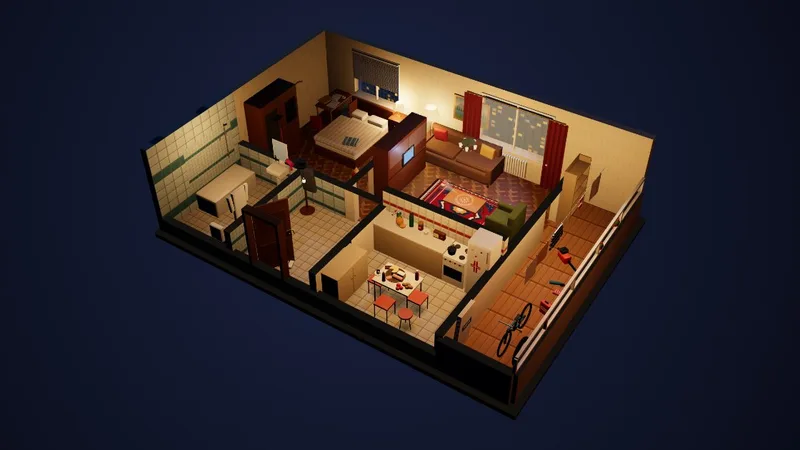
A drawn Romanian block flat at night, lamps lit, in which you tap the objects to see where their names came from: 73 words born of people (a French hatter in Bucharest), places (Faenza, Genoa, Riga), brands (a Soviet chainsaw called Friendship), mistakes and very distant languages, each checked in Romanian dictionaries and, for each foreign step, in a reference work. With the count from DEX ’98: 42 words that are the very name of a person or a place, 15 of them from Romania itself. In Romanian and English.
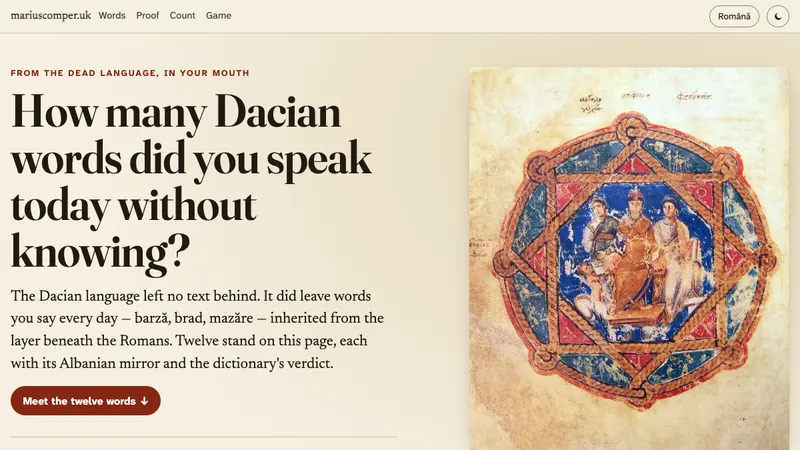
Barză, brad and mazăre are among the words traditionally assigned to a pre-Roman layer. Compare twelve Romanian–Albanian pairs, the dictionaries’ explanations and reservations, proposed inventories and manuscript plant names.
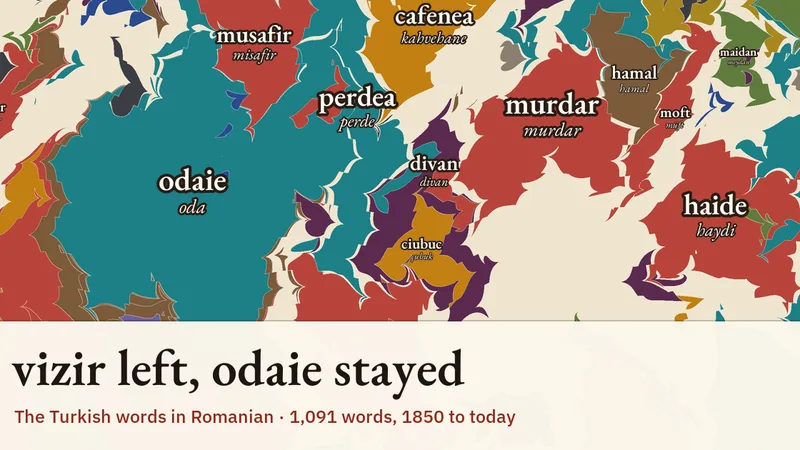
All 1,091 Romanian words that came from Turkish and Tatar, on a sheet of live ebru marbled paper: each blot of ink is a word, sized by how often it appears in Romanian books of 1850–1949 and in today's films. Between 1850 and 1925 the words of the state fell in Romanian books by 60–74%, whatever their language, Turkish, Greek, Hungarian or Slavic; the words of the house and the table stayed. With a false-friends game between Turkish and Romanian, the Turks and Tatars of Dobruja commune by commune, and five centuries of history. In Romanian, English and Turkish.
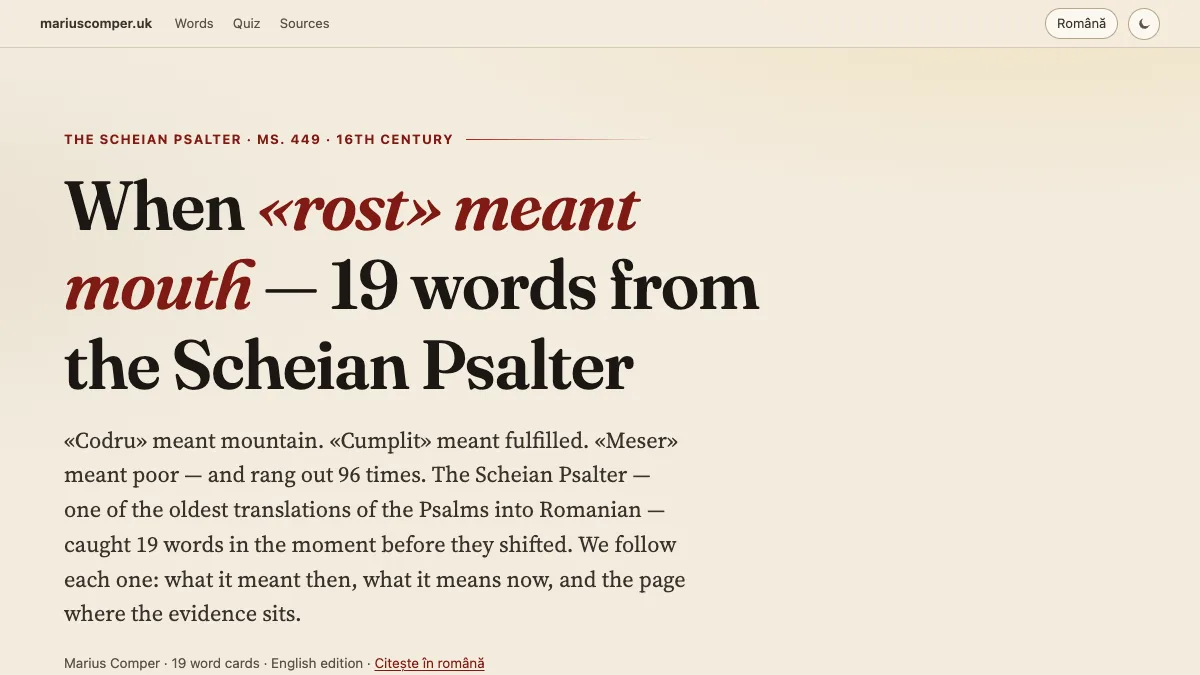
«Codru» meant mountain, «cumplit» meant fulfilled, «meser» meant poor. 19 word cards around the Scheian Psalter — shifted, lost, kept or not found in the Psalms — with evidence on show.
Compare languages and dialects
See how related words resemble one another and where dialects differ.
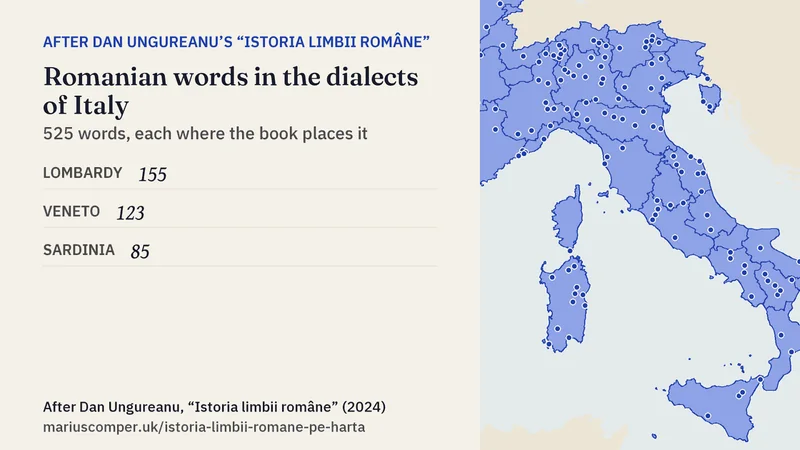
Dan Ungureanu argues that Romanian comes from north-western Italy. For 525 Romanian words, the map shows where the dialect forms his book sets beside them are found: among the regions of Italy, Lombardy has the most, then Veneto and Sardinia. With the linguistic atlas of Italy alongside and a check of what a word list can prove. In Romanian and English.
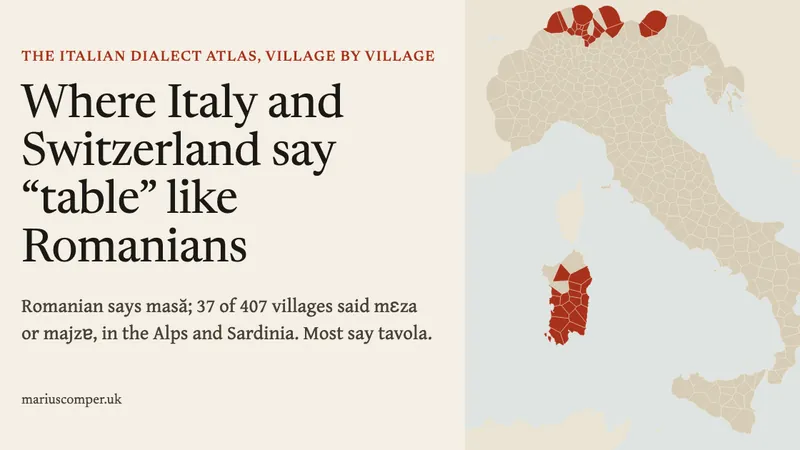
A century ago, an atlas led by two Swiss linguists wrote down how people spoke in 407 villages of Italy and Switzerland. Pick a Romanian word and see what each village said.
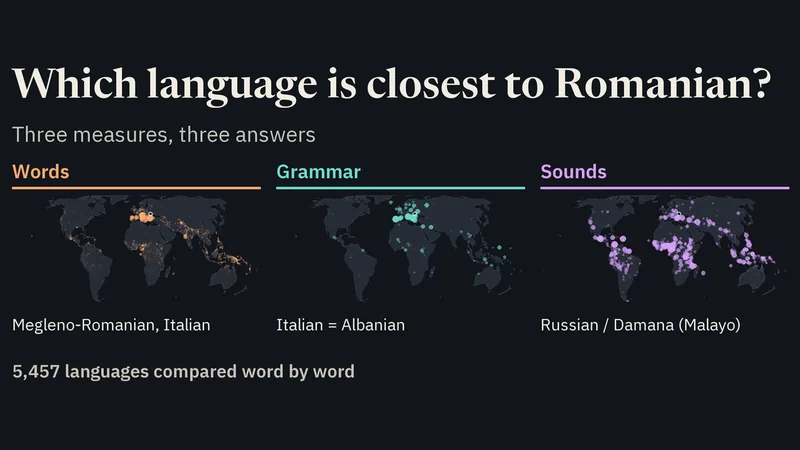
Romanian, the Romance language of Romania and Moldova, compared with the world's languages on words, grammar and sounds, using open data. On words the nearest is Megleno-Romanian, then Italian; on grammar Italian and Albanian score the same; on sounds the list depends on how Romanian is described. Any language can be looked up. In Romanian, English and Chinese.
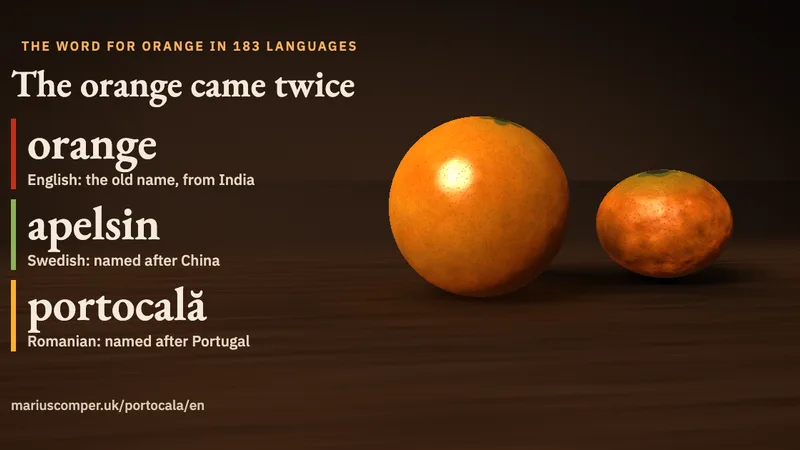
The bitter orange reached Europe first, with a name from India: naranja, arancia, orange. The sweet orange came later and was named after Portugal, China or Malta. The word for orange in 183 languages and varieties, on one map.
Explore what you know and what travels
Test your vocabulary and trace words as they move between communities.
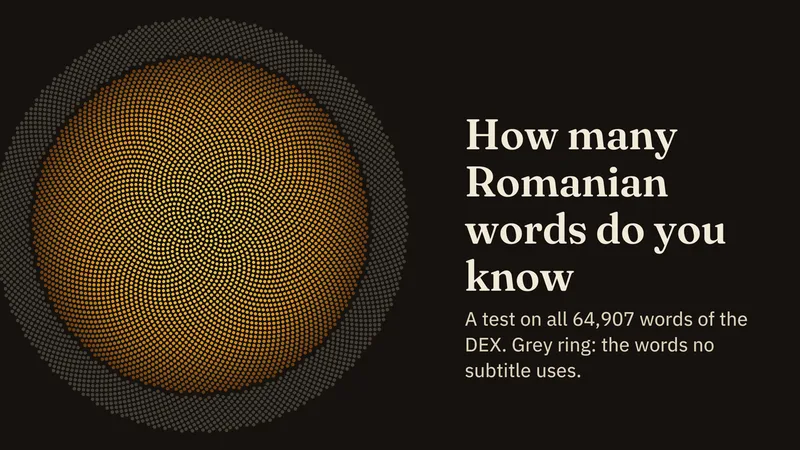
A two-minute Romanian vocabulary test: of 125 words (100 drawn at random from the DEX, 25 invented) you tap the ones you could explain and learn how many of the dictionary's 64,907 words you know, with a margin of error. The dictionary is drawn as a sunflower: the commonest words at the centre, and at the rim the 20,825 that never occur in 332 million words of subtitles. Creangă, Eminescu, Rebreanu and the Constitution sit on the same flower. For native speakers, heritage speakers and learners.
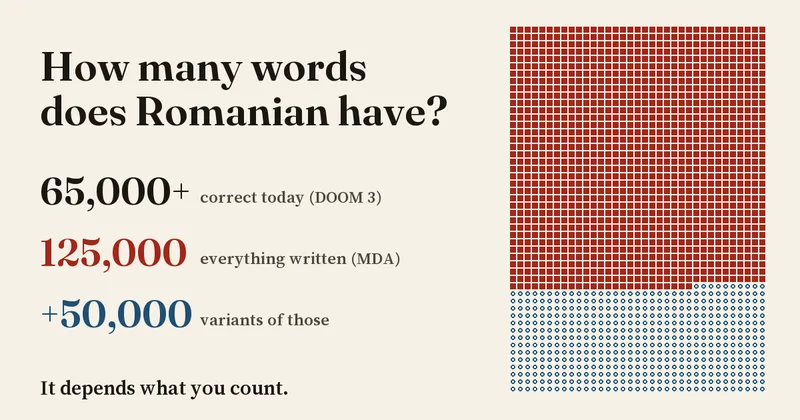
65,000 in the dictionary that decides what is correct, 125,000 in everything ever written, 175,000 if you add the variants. Choose what to count, see where the internet's other numbers come from, and guess what counts as a word.
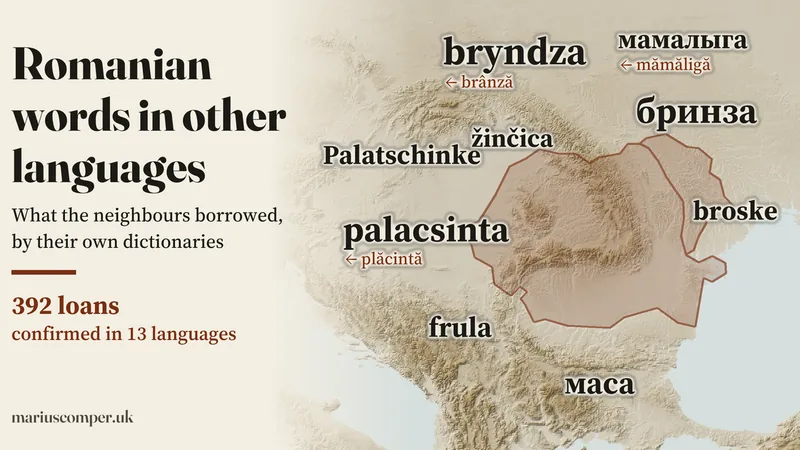
Accounts of Romanian usually list what it borrowed. This is the reverse count: 738 words in 19 languages, looked up in the dictionaries and studies of the languages that use them. 392 are counted as loans from Romanian, in 13 languages, from Hungarian palacsinta to Polish bryndza and New York pastrami; for another 162 the dictionaries hesitate or contradict each other. Each word has a card with its source and that source's verdict.
A map of 1,016 basic words in 107 languages, from Iceland to Kamchatka, starting from your own. Tea took two roads, the cuckoo names itself, the moon also names the month in 57 other languages, and in Georgian “mama” is father. Plus your own line between green and blue, across 110 languages.