
Eight in Ten
Drag the slider from Herodotus to today and watch the strata light up, then type any village or river name and read the ancient form, the etymon, the source and the parallel Hungarian and German names.
Marius Comper · Words
Latin and Slavic, Greek and Persian, river names and proverbs. Each work follows one word from its origin to your mouth.
Start here
Eight of Romania's ten longest rivers had their names written down before the year 600, centuries before any of today's villages were mentioned. A map of 18,214 settlements and 127 rivers on which the layers of names settle one by one.
Drag the slider from Herodotus to today and watch the strata light up, then type any village or river name and read the ancient form, the etymon, the source and the parallel Hungarian and German names.
Masterpieces
Six works chosen for visual power, depth and finish: maps, atlases and stories showing everything this page can do.
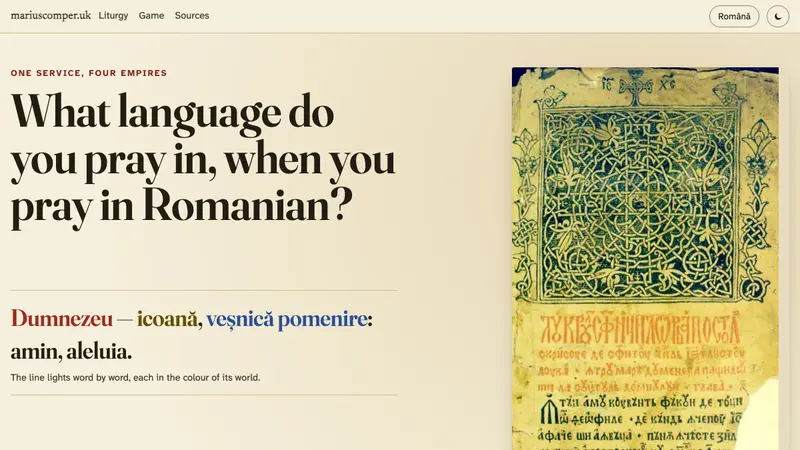
A Romanian service speaks four languages at once: Latin, Greek arrived via Slavonic, Slavic, and Hebrew arrived via Greek and Slavonic. Thirteen words with dictionary passports, a service to hear, and a game to solve.
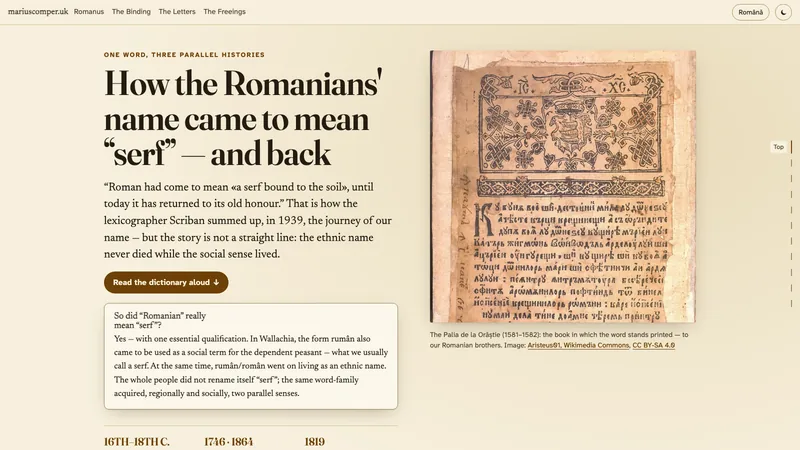
Romanus becomes rumân: an ethnic name and, in Wallachia, a social term for the dependent peasant. The ethnonym, the social status and the spelling — three parallel histories, with the 1613 deed and the 1746/1749 and 1864 thresholds. With the three-track Name Engine, the 100–1900 year finder and the “Serf or Roman?” quiz.
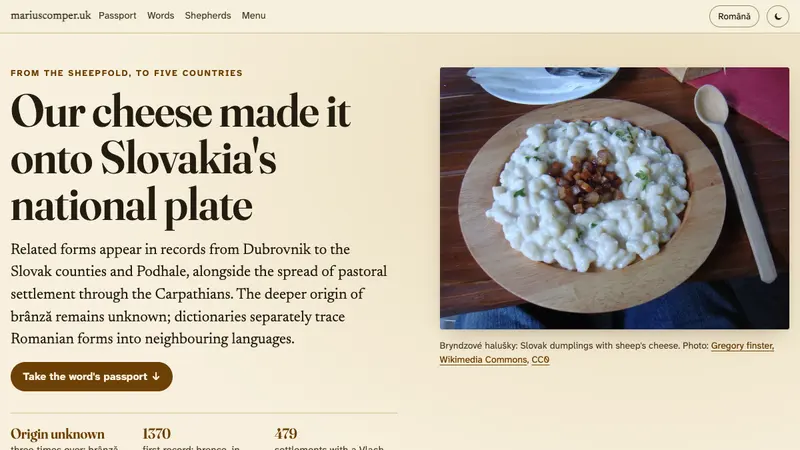
How Vlach shepherds carried three Romanian words over the Carpathians: brânză, turned bryndza in halušky, baci, the head shepherd from Poland to Moravia, and urdă, with five etymologies and no winner. Three dated attestations, six dishes, sheep climbing to 2,000 metres.
Strigoi inherits Latin through striga, while vampire is a Slavic word of disputed origin that crossed Europe inside the Austrian reports on the 1725 and 1732 exhumations and through the European press, returning to Romanian as a French and German neologism. A five-chapter map, side-by-side definitions and an eight-quotation quiz.
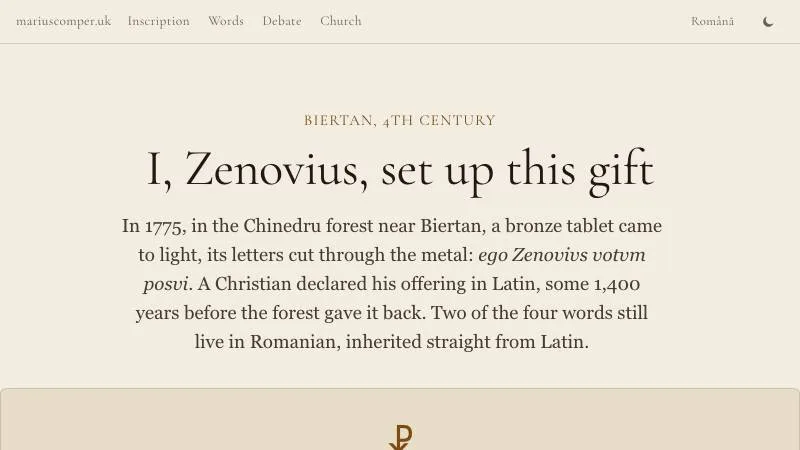
The Biertan donarium: a 4th-century bronze tablet found in 1775 near Biertan, Romania, inscribed EGO ZENOVIVS VOTVM POSVI. Four Latin words, two of which still live in Romanian.
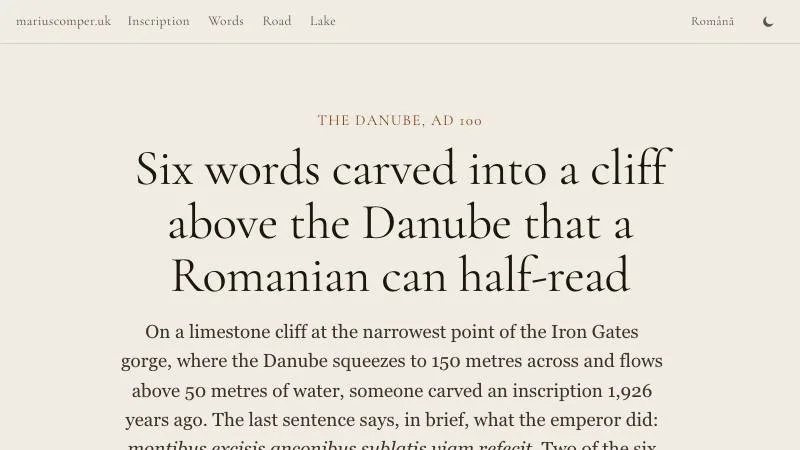
The last sentence on the Tabula Traiana, word by word: two survived into Romanian, two shifted, two vanished. Then the dam came.
Selected
Guess, listen, measure: a deciphering game, a hangman and a hearing test.
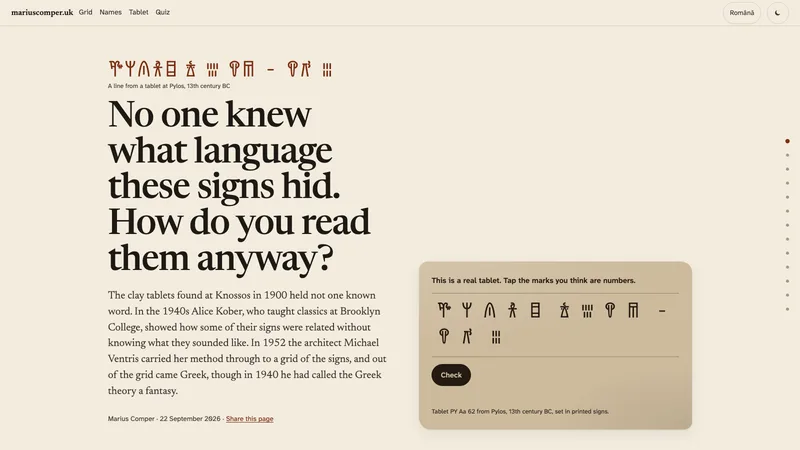
The clay tablets of Knossos held not one known word. Alice Kober, who taught at Brooklyn College, showed how their signs were related without knowing their sounds; in 1952 Michael Ventris got Greek out of the grid, though he had once called it a fantasy. Solve the three town names that opened Linear B.
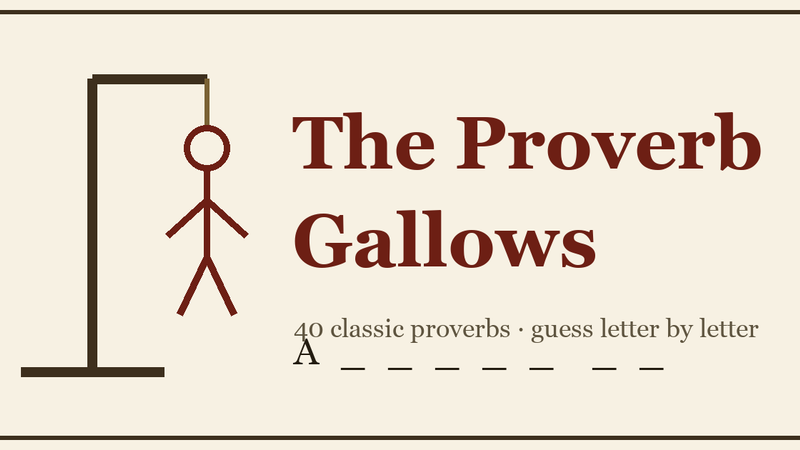
Classic hangman: 40 Romanian proverbs in the Romanian edition and 40 English ones in the English edition. Six wrong guesses, then the meaning is revealed.
Six Romanian contrasts for Chinese-speaking learners: letters, IPA and articulation (no audio), plus the perception-training paradigm and method. The test ships after validated recordings.
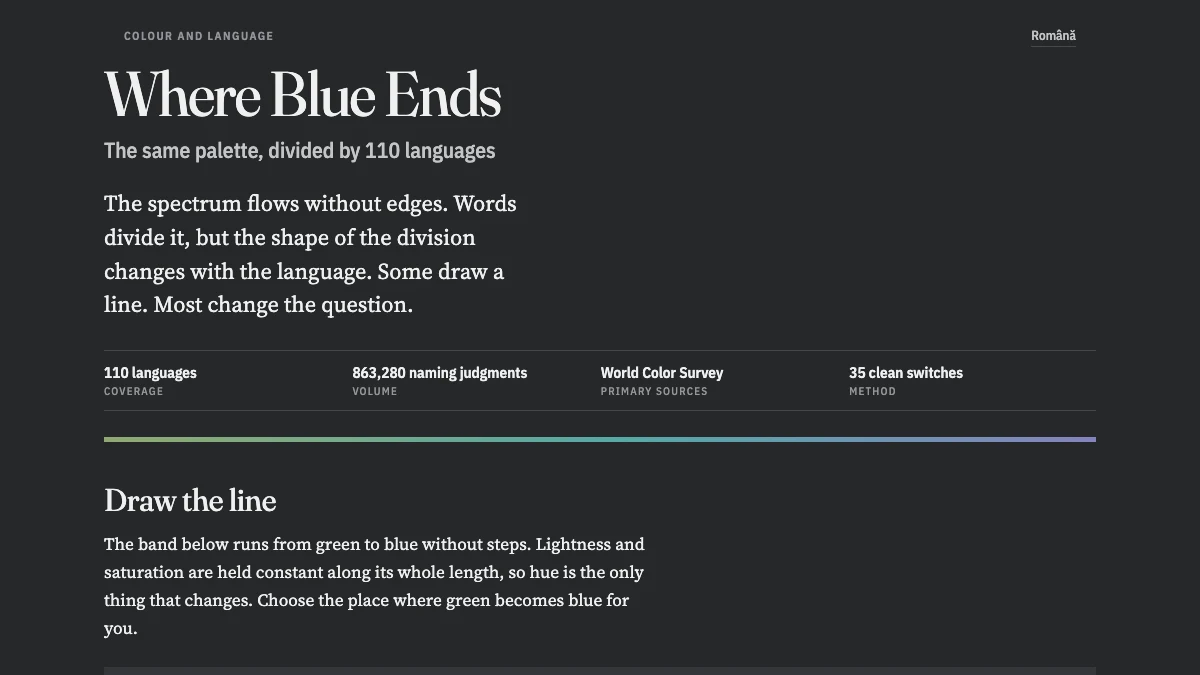
The same palette, divided by 110 languages.

Vocal folds produce only a raw drone: what we hear as speech is a chord of two frequencies. In “i”, the gap spans over 3 octaves; from “u” to “i”, the second frequency triples; and Romanian anchors two central vowels along the midline.

The biomechanical cost of typing in Romanian: 1.38 kilometers traveled by fingers for every 10,000 words, and a 57% workload asymmetry on the left hand.
Themes
Each shelf shows the theme's four finest works, hand-picked. Open any shelf to see the full list in the library.
Etymologies with dictionary passports: where they come from and how they changed.
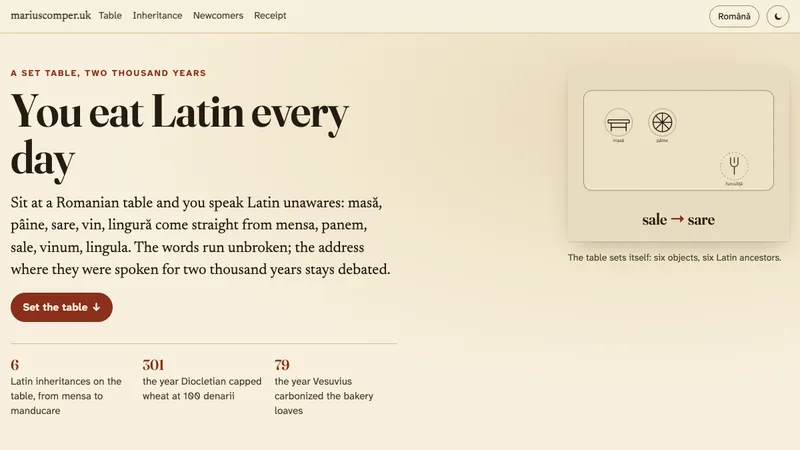
Masă, pâine, sare, vin, lingură: six Latin inheritances on the Romanian table, three newcomers and the Roman receipt of AD 301. With the table that sets itself, the etymological chains and the claims table.
In Latin, draco meant dragon. In Romanian, drac means devil. The shift happened in Christian Latin, and Romanian is the only major Romance language in which the new sense erased the old one. The same word produced Dracul and Draculea.
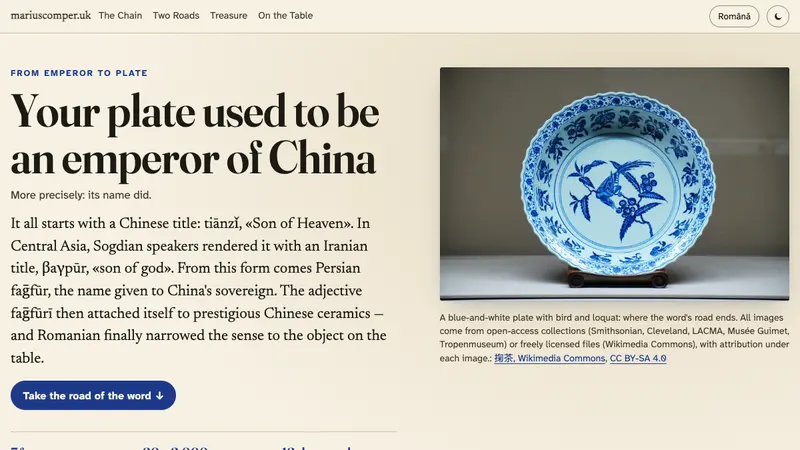
How a Chinese imperial title landed on your table: «Son of Heaven» became βaγpūr in Sogdian, faghfur in Persian, fağfurî for the Ottomans and farfurie in Romanian. With the map of the two roads — of the word and of the vessels —, Harun's gift, the Topkapi treasure, a riddle and a quiz.
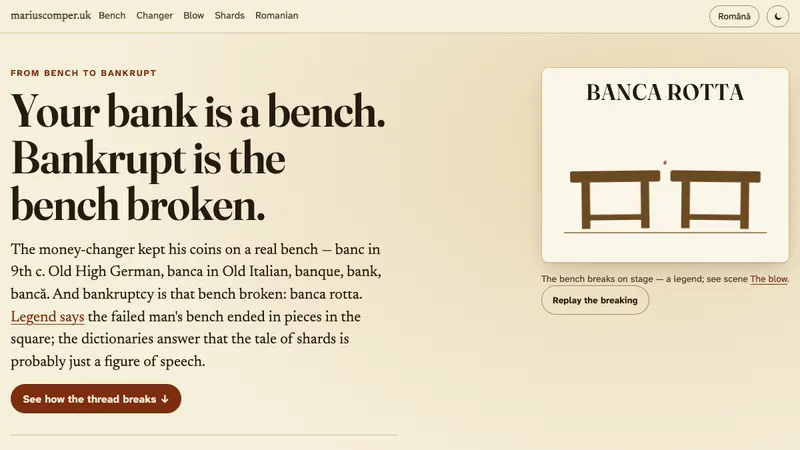
The money-changer's banca was a real bench, and bancruta is that bench broken: Italian banca rotta. Six dated European forms, from 9th-century Germanic banc to 18th-century Romanian bancă, an ordering game, and the smashing legend dictionaries file as pseudo-etymology.
River, people and village names, put on a map.
A map of Romania made of 18,214 settlement points and 127 rivers, on which the name strata are laid down in turn: ancient, Slavic, Turkic, Hungarian, German, Romanian. A time slider, a length ranking of rivers and a core sample for any name.
8,560 Romanian given names and surnames from Wiktionary, with 19 extended explanations. Search a name and trace, step by step, which words it formed from — from Ioan to Ionescu, through Church Slavonic and Greek.
Dacia 106, the 587 shout, Neacșu 1521, Vienna 1780. A Romance language 1,137 km from Rome.
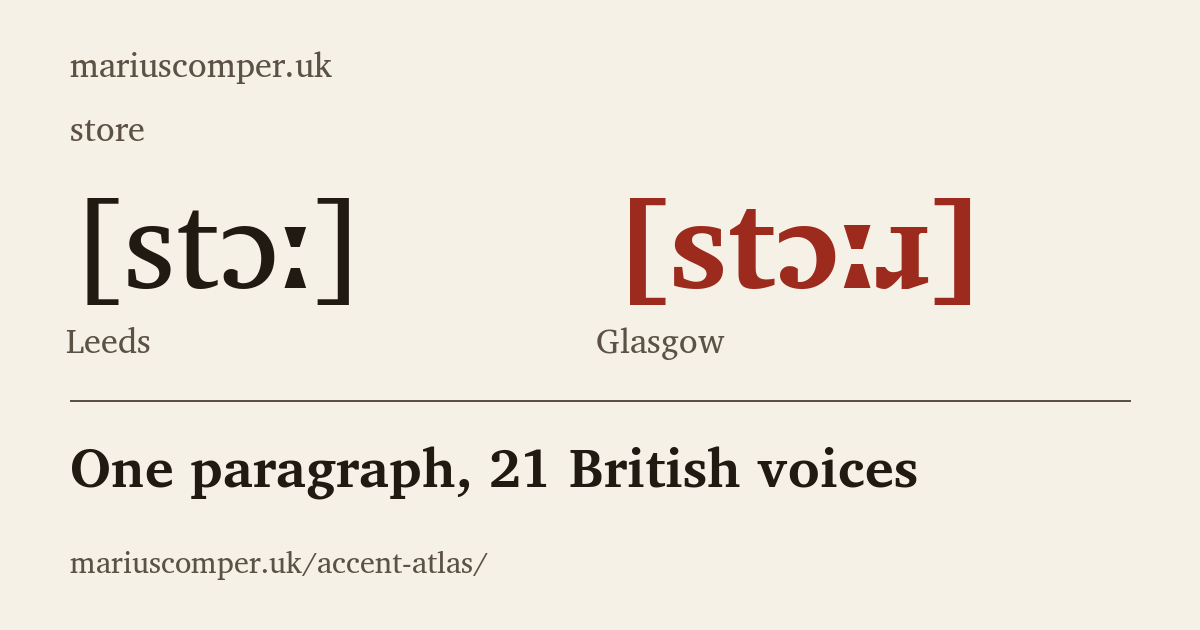
21 speakers across Britain read the same paragraph: pick a town and watch six words change shape in phonetic transcription.
Decipher, guess, tell apart: language as a game.
The clay tablets of Knossos held not one known word. Alice Kober, who taught at Brooklyn College, showed how their signs were related without knowing their sounds; in 1952 Michael Ventris got Greek out of the grid, though he had once called it a fantasy. Solve the three town names that opened Linear B.
Classic hangman: 40 Romanian proverbs in the Romanian edition and 40 English ones in the English edition. Six wrong guesses, then the meaning is revealed.
Six Romanian contrasts for Chinese-speaking learners: letters, IPA and articulation (no audio), plus the perception-training paradigm and method. The test ships after validated recordings.

Of the 799 medieval chivalric works that have reached us, 326 are attested by a single manuscript.
The life, value and journey of words, calculated.

Words used 100 times more frequently evolve 10 times more slowly. Follow the decay of vocabulary and verbs, century by century.
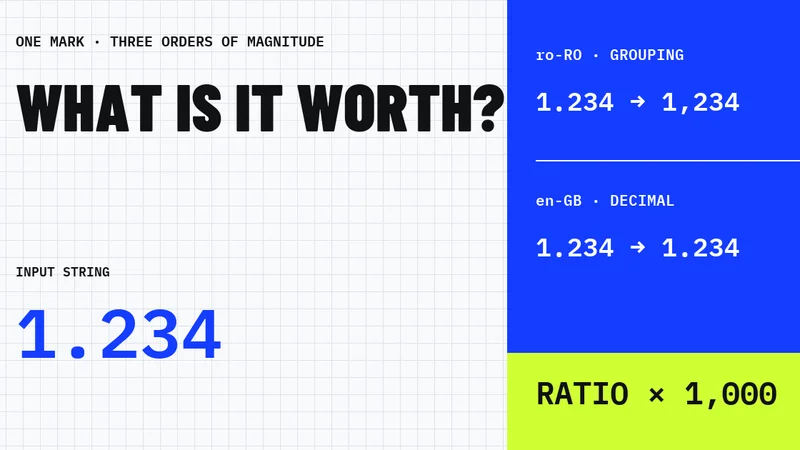
The same numeric string can mean 1,234 or 1.234, depending on its locale convention. Compare 22 Unicode CLDR profiles.
Vocal folds produce only a raw drone: what we hear as speech is a chord of two frequencies. In “i”, the gap spans over 3 octaves; from “u” to “i”, the second frequency triples; and Romanian anchors two central vowels along the midline.
The biomechanical cost of typing in Romanian: 1.38 kilometers traveled by fingers for every 10,000 words, and a 57% workload asymmetry on the left hand.
Deeds, letters, primers and dictionaries: the language on paper.
Five surviving lines, a Roman date and the name Alburnus Maior: what the wax tablet written on 6 February 131 really tells us.
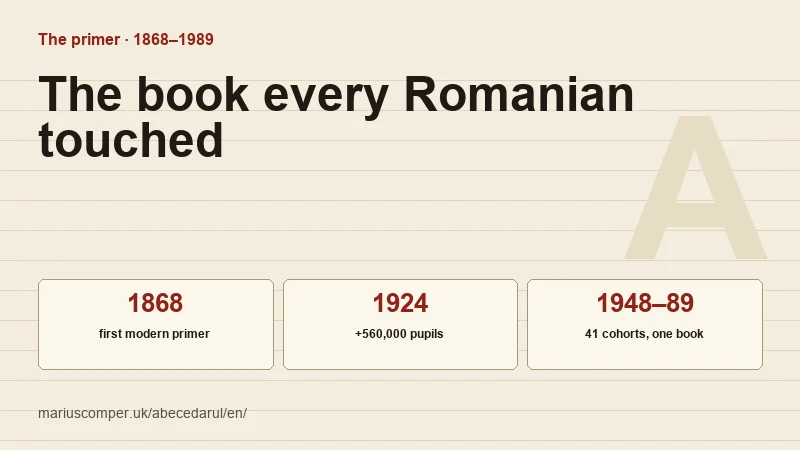
41 years, one book on every desk — and three books before it.
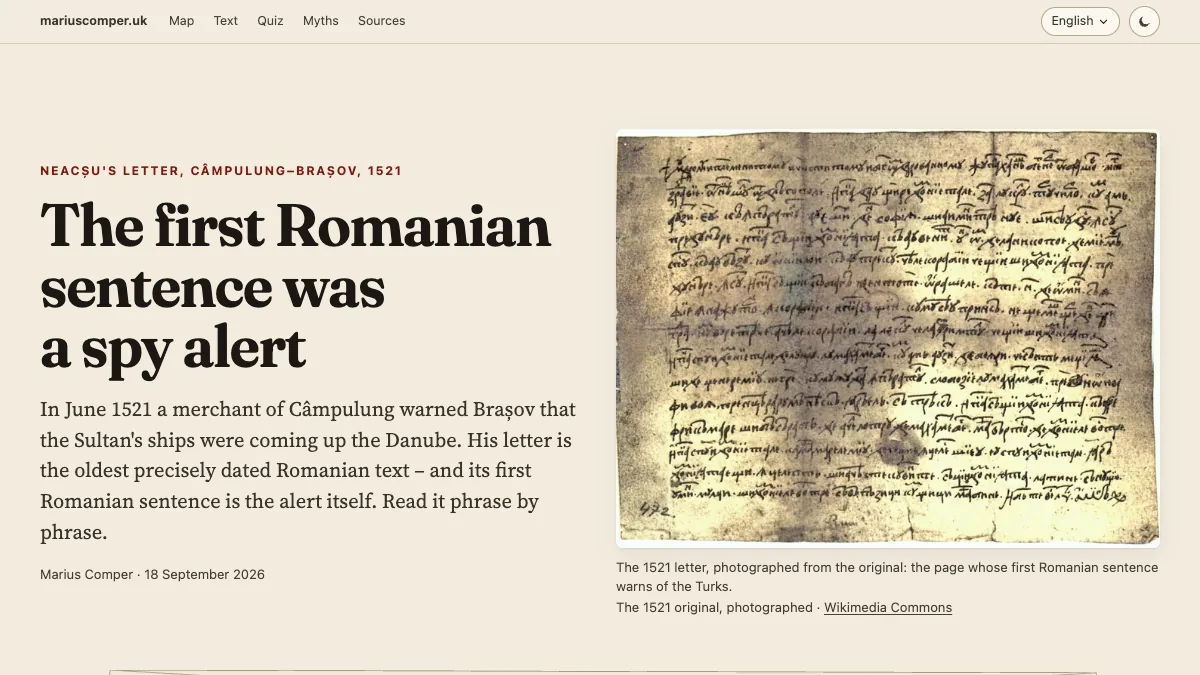
The oldest precisely dated Romanian text is a spy warning from Câmpulung to Brașov. Read it phrase by phrase, with renderings.
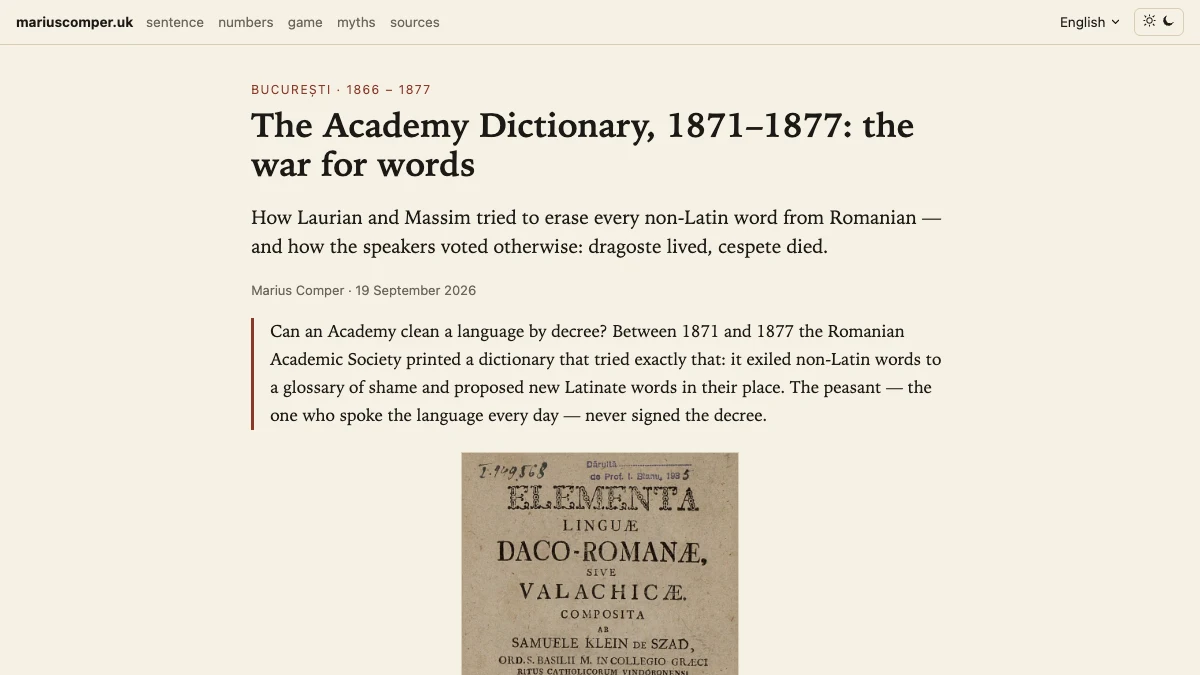
Laurian and Massim tried to erase every non-Latin word from Romanian. Dragoste lived, cespete died — one sentence, two languages, nine verdicts.
Printers, proverbs and languages with no common ancestor.
Deacon Coresi's Brașov press (1557–1583) put Romanian into print: the shop, the ten Romanian books with BRV numbers, and the shelves where the surviving copies sit today, shelfmark by shelfmark.
Romanian's basic food words trace to Latin. The heavy medieval wheeled plow's parts are mostly Slavic or Hungarian. An interactive diagram shows where the farming vocabulary splits.
Romanian, Bulgarian, Albanian, Greek and Aromanian build their future tense with the same grammatical mechanism, from a verb meaning to want, despite coming from four unrelated language families. An interactive map of the Balkan sprachbund, exceptions included.

Cuscru, fin, cumătru: relatives named in Romanian and nameless in English. The elder brother, the maternal uncle: nameless in Romanian, named in 70% of the world's languages. Ten rules of the kinship vocabulary, on a map of 1,056 languages.
Approaches
The numbers show how many works about words each approach holds.
All
The complete list in publication order, 25 at a time.
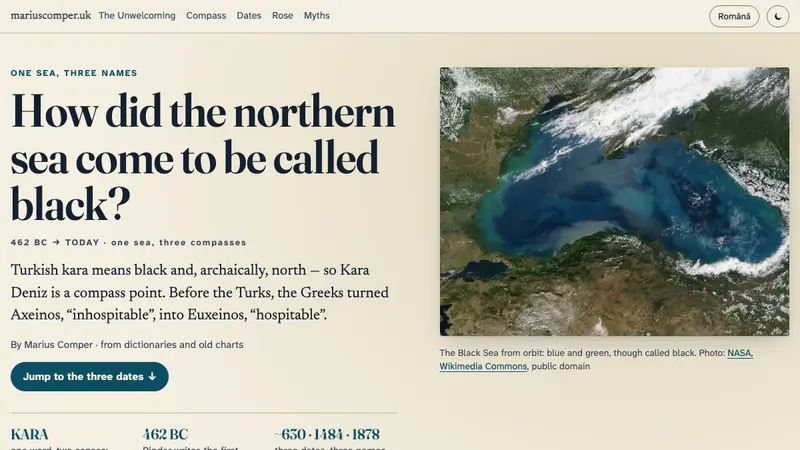
Turkish kara means black and, archaically, north — so Kara Deniz is a compass point. The Greeks turned Axeinos into Euxeinos. A word-journey from Histria (~630 BC) to the Romanian shore (1878).
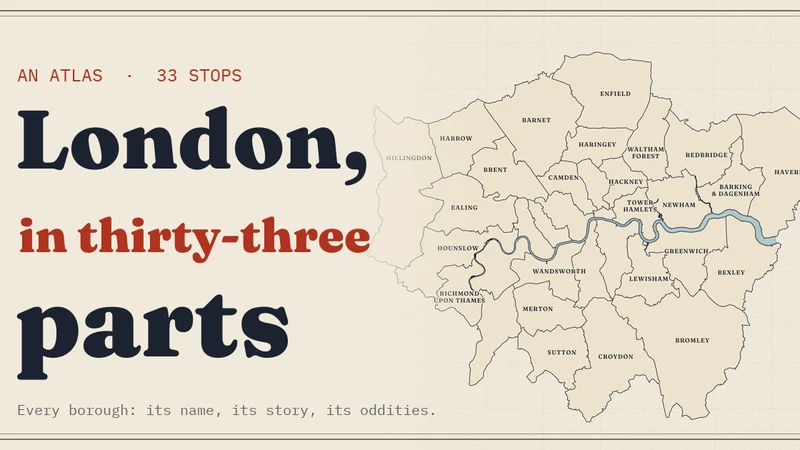
Ride a fictional Tube line through all 32 boroughs and the City: what each name meant in Old English, who built it, and the oddities it keeps — from Croydon's Mayday to Stamford Bridge being in Fulham.
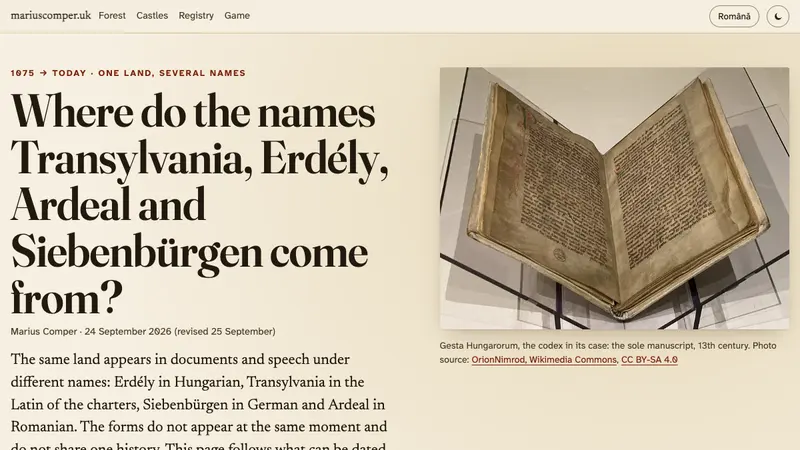
Where do Transylvania, Erdély, Ardeal and Siebenbürgen come from? A documented chronology of the region’s names, with sources, hypotheses and their limits.
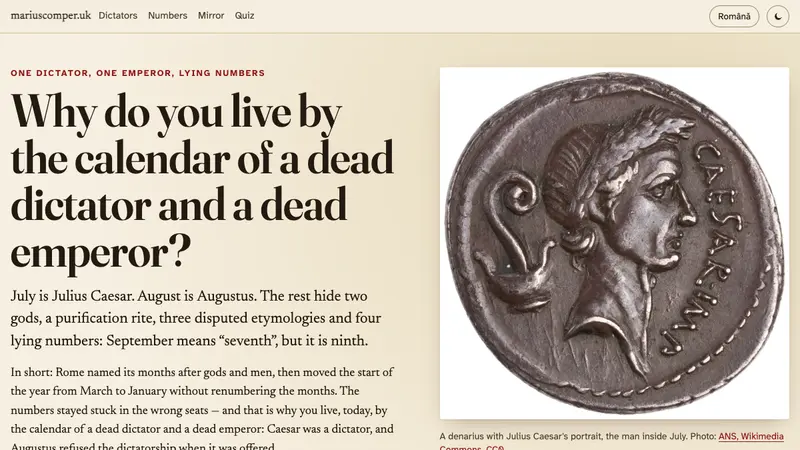
July comes from Julius Caesar, August from Augustus — one dictator, one emperor. The gods, the rite, the lying numbers and the failed renames behind the 12 months — with the Year Machine, from Romulus to today.
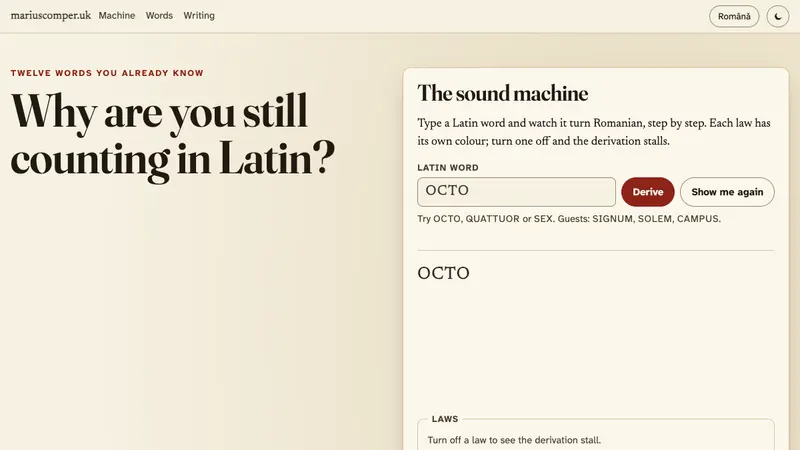
Type OCTO, get OPT: eleven numerals inherited from Latin, six sound laws you can turn off and on, one intruder, and three ways of writing a number, from wax tablets to comma-below ș.
A Romanian service speaks four languages at once: Latin, Greek arrived via Slavonic, Slavic, and Hebrew arrived via Greek and Slavonic. Thirteen words with dictionary passports, a service to hear, and a game to solve.
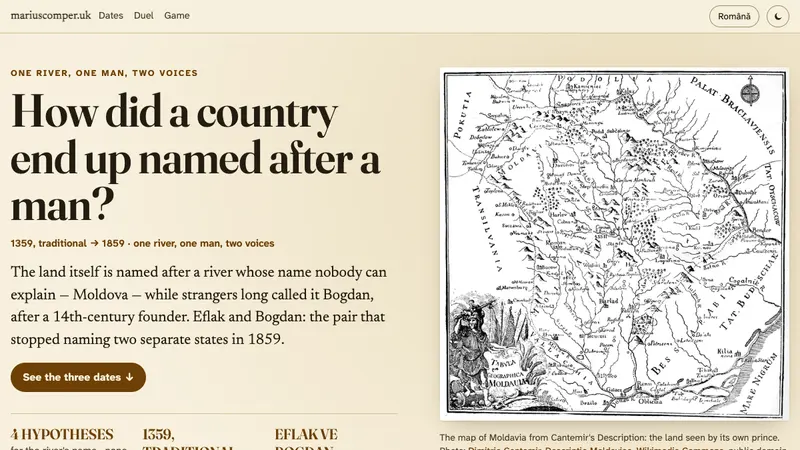
An unexplained river-name, a 14th-century founder, and the Ottoman pair Eflak ve Bogdan: two voices of one land, from 1359 to 1859 — with dated documents.
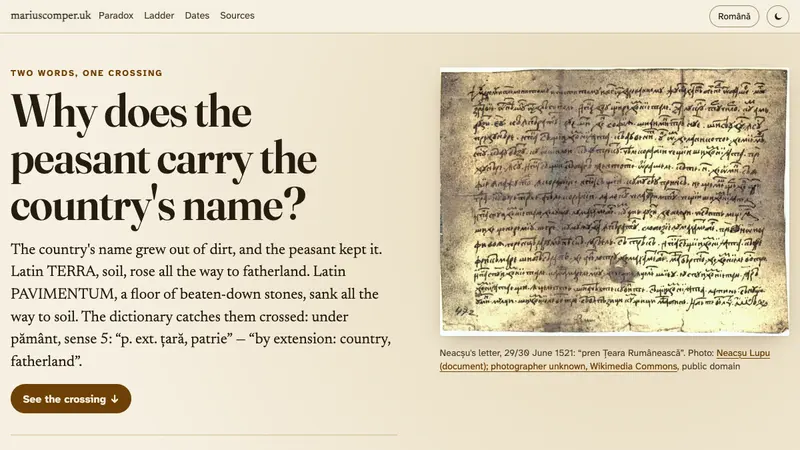
Țara grew out of soil (Latin terra) while pământ sank out of a beaten floor (Latin pavimentum): two crossed words, three dates — 1521, 1848, 1926 — and the Ladder of Senses.
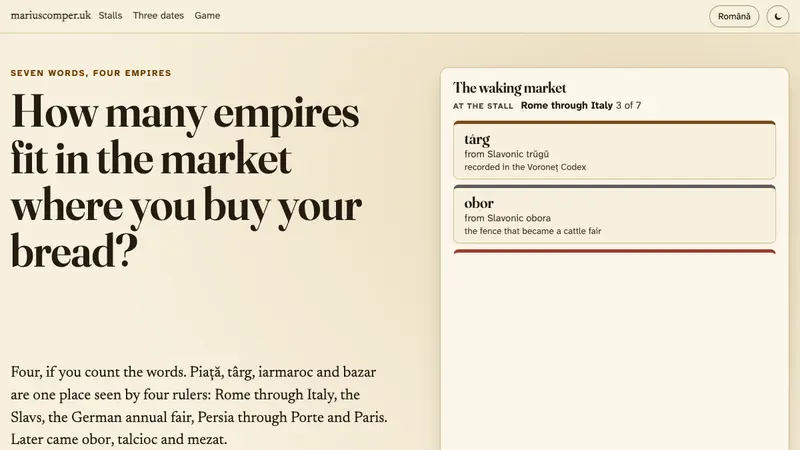
Why the same place is piață, târg, iarmaroc and bazar at once: seven words, four empires, three dates — with the dictionaries on the table and a game at the end.
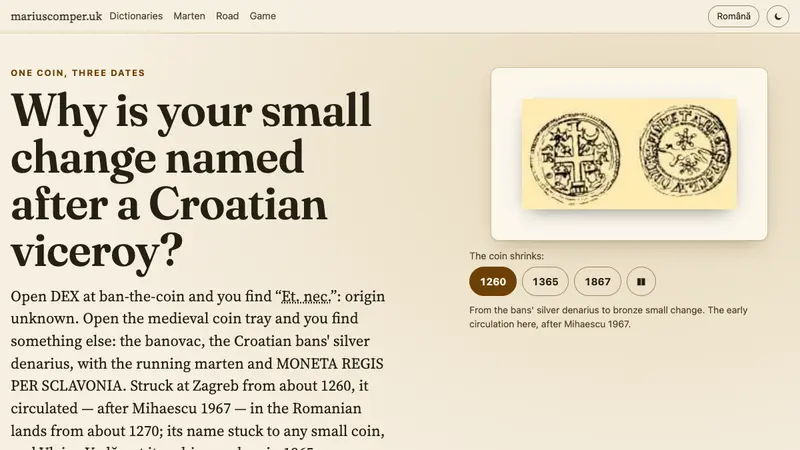
The dictionary says the ban's origin is unknown. The coins say otherwise: the Croatian marten banovac (~1260), Vlaicu's ban (1365) and the 1867 law.
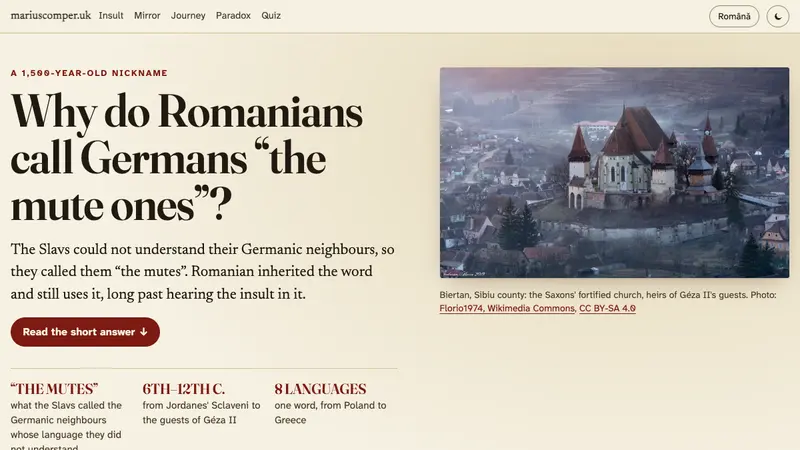
The Slavs could not understand their Germanic neighbours, so they called them “the mutes”, and Romanian kept the word to this day. The story of němьcь, the barbaros–walhaz mirror, and the witnesses from Jordanes to the Transylvanian Saxons.
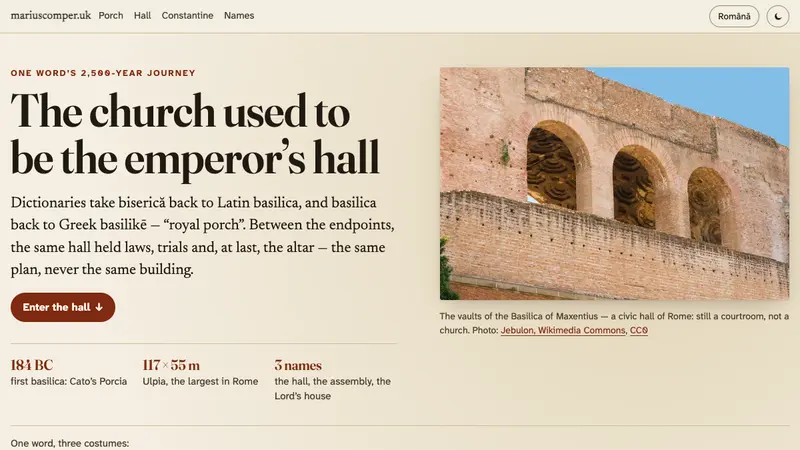
Romanian biserică descends from Latin basilica — but the word's history and the building's history run on different tracks. With the Word/Building visual, plans that actually change, and a quiz.
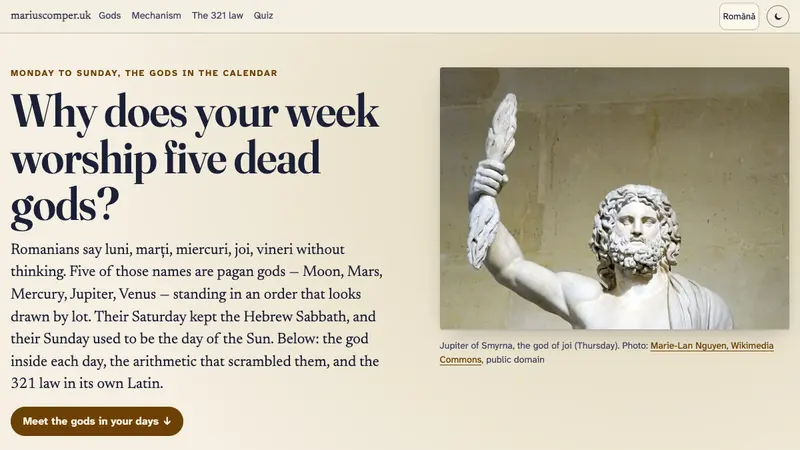
Luni comes from the Moon, marți from Mars, miercuri from Mercury, joi from Jupiter, vineri from Venus. Why the gods stand scrambled, why Saturday kept the Sabbath, and who renamed Sunday.
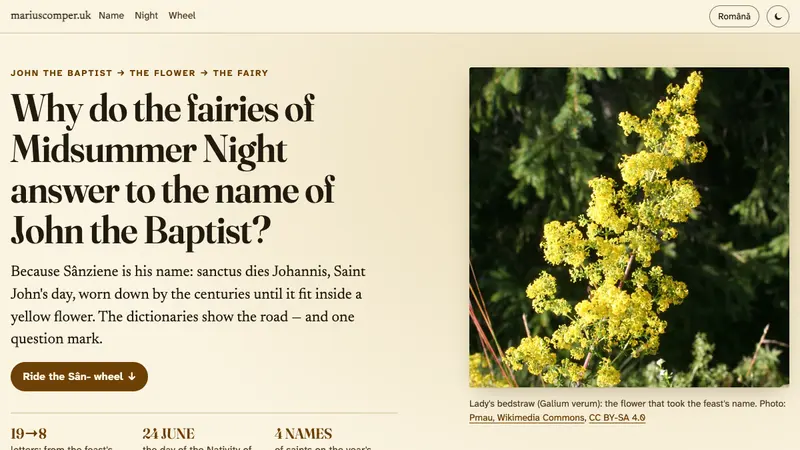
From SANCTUS DIES JOHANNIS, Saint John's day, to the Sânziene: the Sân- wheel with four saints (Sânziene, Sânpetru, Sântilie, Sâmedru), the three living senses — feast, flower, fairies — and the night of 23 June with bonfires, wreaths on water and the Drăgaica fair. With the etymology chain, the wheel-walk and quotes from DEX, MDA2, Șăineanu and Scriban.
Masă, pâine, sare, vin, lingură: six Latin inheritances on the Romanian table, three newcomers and the Roman receipt of AD 301. With the table that sets itself, the etymological chains and the claims table.
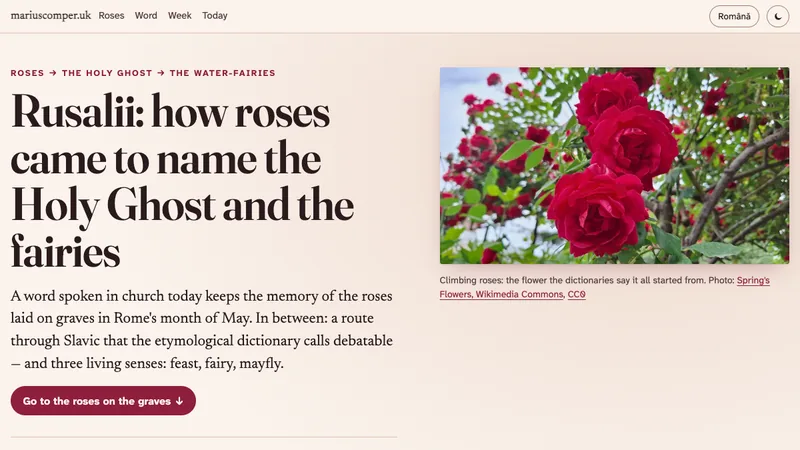
From ROSALIA, the Roman rose-feast on graves, to Rusalii: the debatable Slavic route, the three living senses — feast, fairy, mayfly — and the week between worlds, with the Saturday of the dead, walnut-branch Sunday, the healing călușari (UNESCO 2008) and the water rusalkas. With the ROSALIA→RUSALII etymology chain, the week-walk and quotes from DEX, DER, Șăineanu and Scriban.
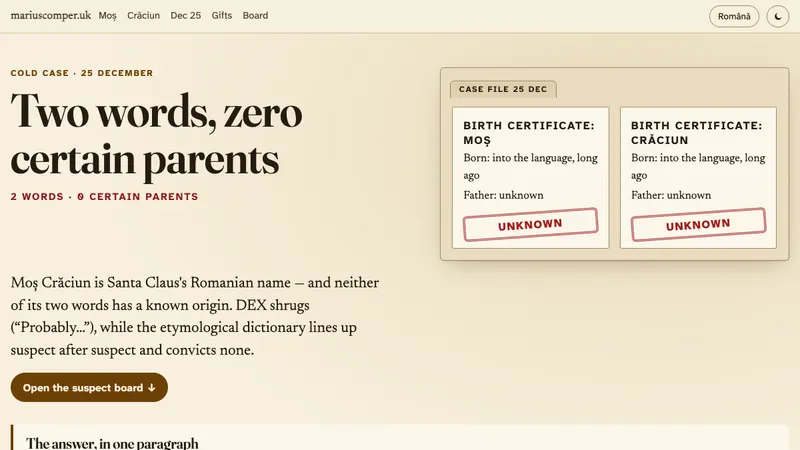
Neither moș nor Crăciun has a known origin: DEX shrugs, and the etymological dictionary lines up 18 suspects and convicts none. A cold-case file with the interactive suspect board, word/status/language-family filters, birth certificates stamped UNKNOWN and quotes from DEX, DER and Scriban.
Romanus becomes rumân: an ethnic name and, in Wallachia, a social term for the dependent peasant. The ethnonym, the social status and the spelling — three parallel histories, with the 1613 deed and the 1746/1749 and 1864 thresholds. With the three-track Name Engine, the 100–1900 year finder and the “Serf or Roman?” quiz.
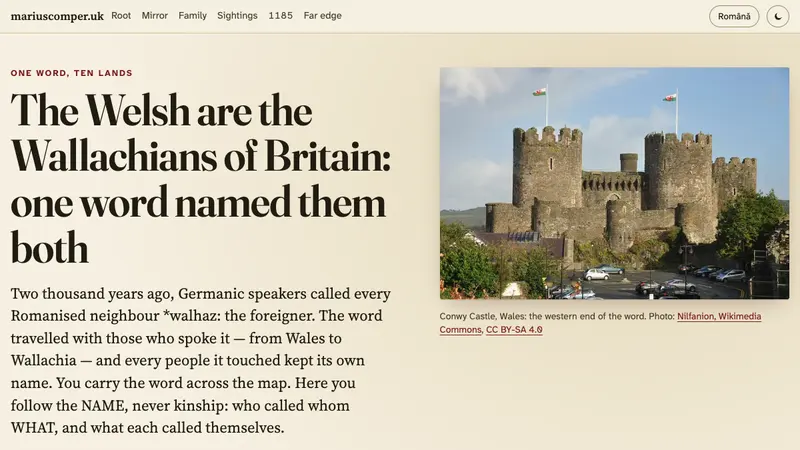
A reconstructed word — *walhaz, “the foreigner, the Roman” — named Wales, the Walloons, the Vlachs, the Oláh, Eflak and Wallachia: the story of the name, with the first Byzantine sightings, the 1185 revolt and the last valley still called Wallachia. With the sightings atlas that lights up as you scrub it, ten exonyms on the map and the word morphing across languages.
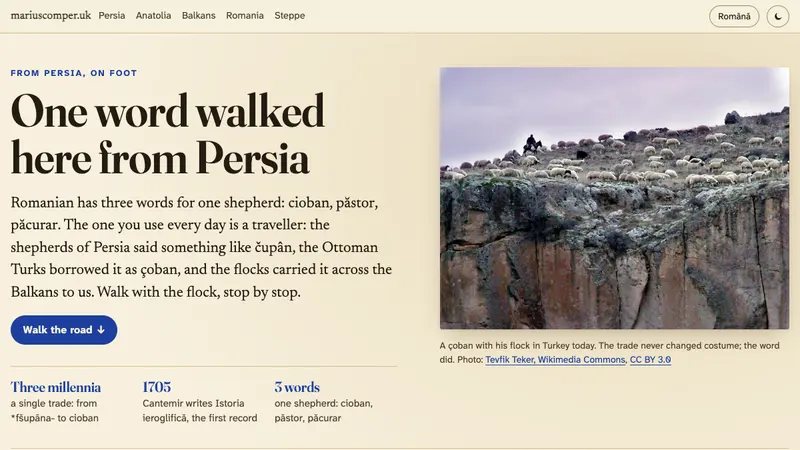
Cioban is Persian čupân, keeper of flocks, arrived via Turkish çoban and kept as the everyday word beside Latin-derived păstor and regional păcurar; three millennia of road from Persia to the sheepfold, with attestations and a living map. With the road that draws itself, the stop finder and a quiz.
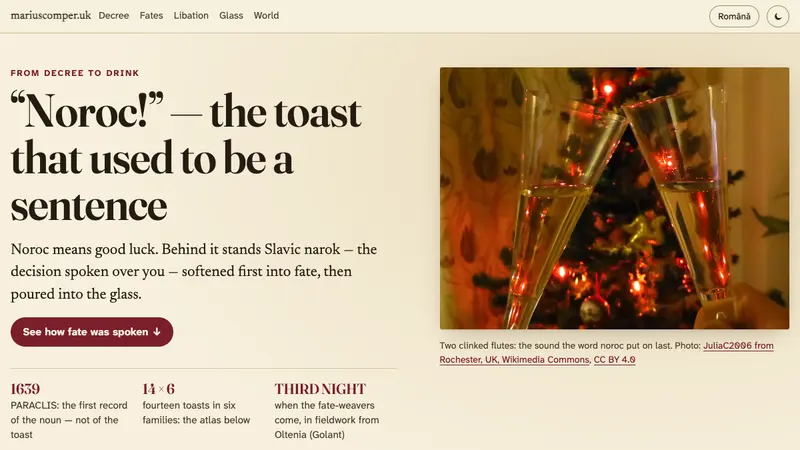
Noroc is Slavic narok, "that which was spoken", softened into good luck and then into the toast itself; the clinked glass runs from Greek libations to Prost, Şerefe and cin cin. With an atlas of the world's toasts and a quiz.
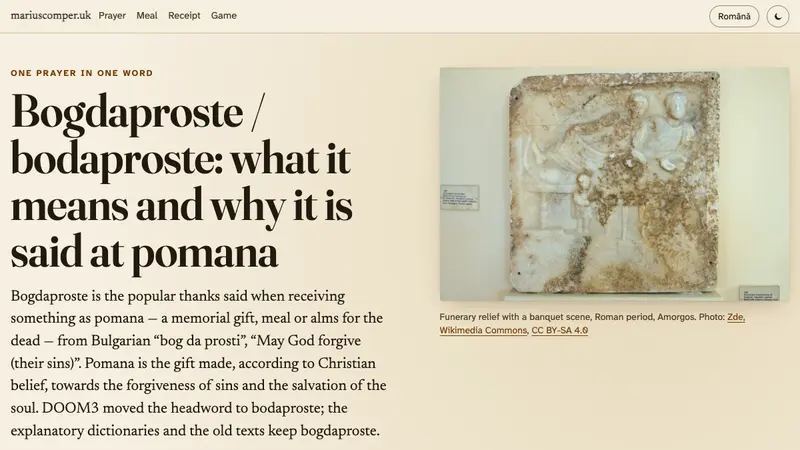
Bogdaproste is the thanks said when receiving pomana, memorial alms for the dead, from Bulg. «bog da prosti», «May God forgive»; DOOM3 moved the headword to bodaproste. Meaning, norm, stress, the 1746 attestation, today's Bulgarian formula, and a receipt engine with two scenes — Rome and the pomana.
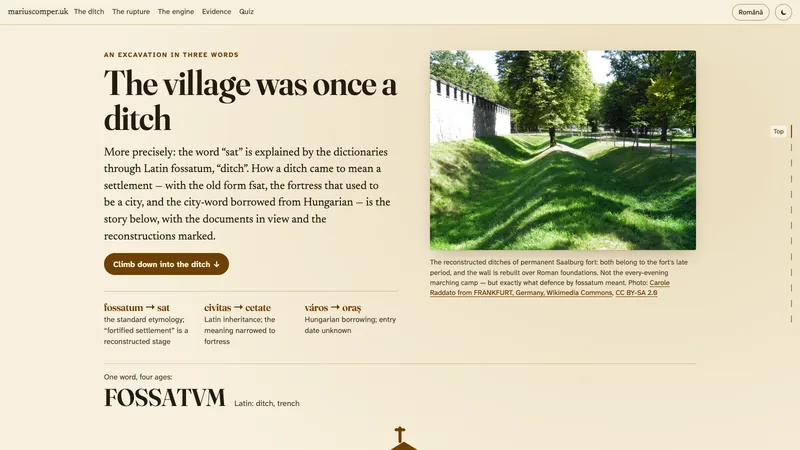
The word “sat” comes from Latin fossatum, “ditch” — but the road to “settlement” is reconstructed, not a birth certificate. With old fsat, the fortress that used to be a city, the city-word from Hungarian and the French twin fossé: an excavation in three words, documents in view.
How a Chinese imperial title landed on your table: «Son of Heaven» became βaγpūr in Sogdian, faghfur in Persian, fağfurî for the Ottomans and farfurie in Romanian. With the map of the two roads — of the word and of the vessels —, Harun's gift, the Topkapi treasure, a riddle and a quiz.
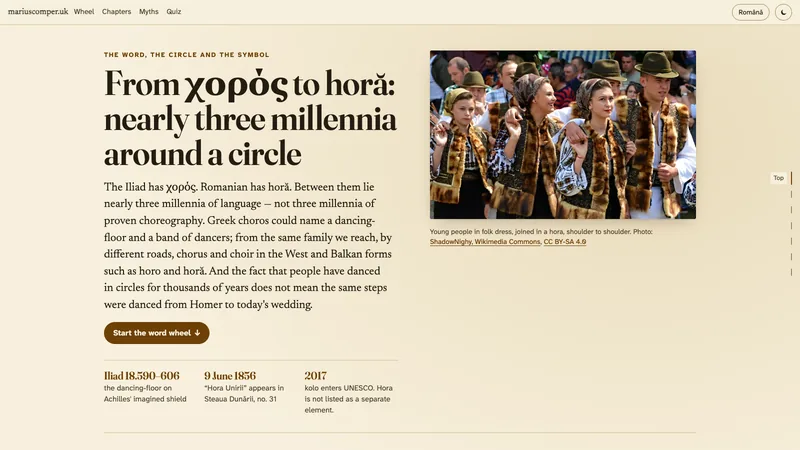
Three histories meeting in the hora — the word, the circle, the symbol — from choros on Achilles' shield through the Balkans, Hora Unirii and the horah, to 1989. With the three-thread wheel, six chapters and a quiz.
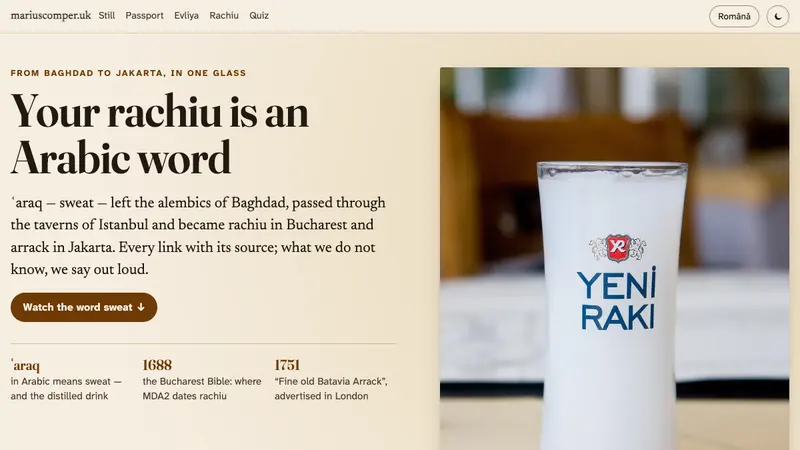
Rachiu comes from Turkish rakı — possibly via Serbian rakija —, from Arabic ʿaraq — sweat —: eight documented stops, from the 1688 Bible to Batavian arrack, a flying map, a form finder and a game about words and drinks.
Strigoi inherits Latin through striga, while vampire is a Slavic word of disputed origin that crossed Europe inside the Austrian reports on the 1725 and 1732 exhumations and through the European press, returning to Romanian as a French and German neologism. A five-chapter map, side-by-side definitions and an eight-quotation quiz.
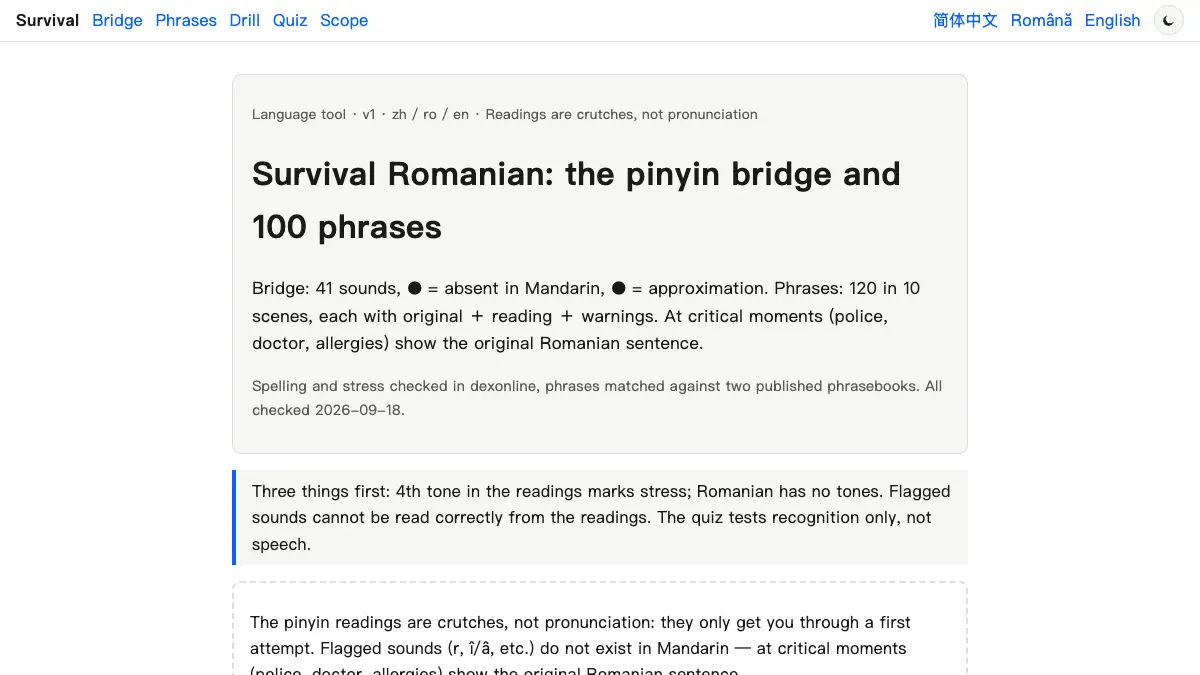
120 Romanian phrases for Chinese speakers, each with a pinyin bridge and an honest fence where the bridge breaks. Station, restaurant, pharmacy, emergencies — plus the red quiz that won't let you cheat.
The Tabula Peutingeriana, the 1265 copy of the Empire's road map, preserves the only ancient road network of Dacia. Eleven names from the Danube to Sarmizegetusa, taken one by one: none survived untouched.
The Roman pace, the passus: five standard feet, ≈1.48 m. The body named the measure; the standard gave its length. At Aiton, the AD 108 stone stands ten miles from Potaissa; pas, milă and zece stayed in the language.
A roof tile stamped LEG XIII GEM in the Alba Iulia museum: the mark of Legio XIII Gemina. Five words traced into Romanian — one survived, two came back by another road, one was rebuilt, one vanished.
The left hand counts to 99 and both hands together to 9,999, by the method Bede wrote down in 725. But a Roman would not recognize two of your five fingers.
In Latin, draco meant dragon. In Romanian, drac means devil. The shift happened in Christian Latin, and Romanian is the only major Romance language in which the new sense erased the old one. The same word produced Dracul and Draculea.
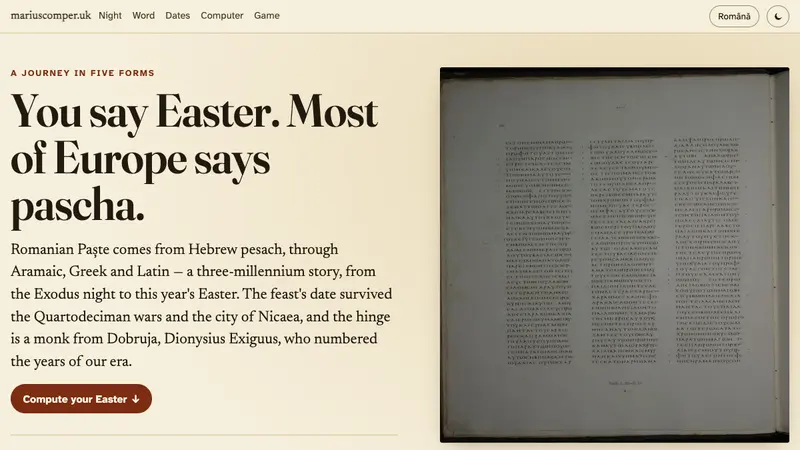
Paște comes from Hebrew pesach, through Aramaic, Greek and Latin; the feast's date survived the Quartodeciman wars and Nicaea, and the hinge is a monk from Dobruja. With a working Easter computer and a quiz.
The Biertan donarium: a 4th-century bronze tablet found in 1775 near Biertan, Romania, inscribed EGO ZENOVIVS VOTVM POSVI. Four Latin words, two of which still live in Romanian.
Romanian păgân (heathen) comes from Latin paganus, 'villager': the DER evidence, the Romance cognates, the two theories of the change of sense, and the Christian layer from Latin.
In 1961, three inscribed clay tablets came out of the ground at Tărtăria, Romania. Some call them the world's oldest writing, two millennia before Sumer. Others say the dating does not hold, the signs are no script, and the discovery story has holes.
For centuries, the story written on church walls was told in Church Slavonic. In the summer of 1636, on the freshly raised wall of the princely church in Câmpulung, the foundation story was written in Romanian. One of the first Romanian-language inscriptions.
Five surviving lines, a Roman date and the name Alburnus Maior: what the wax tablet written on 6 February 131 really tells us.
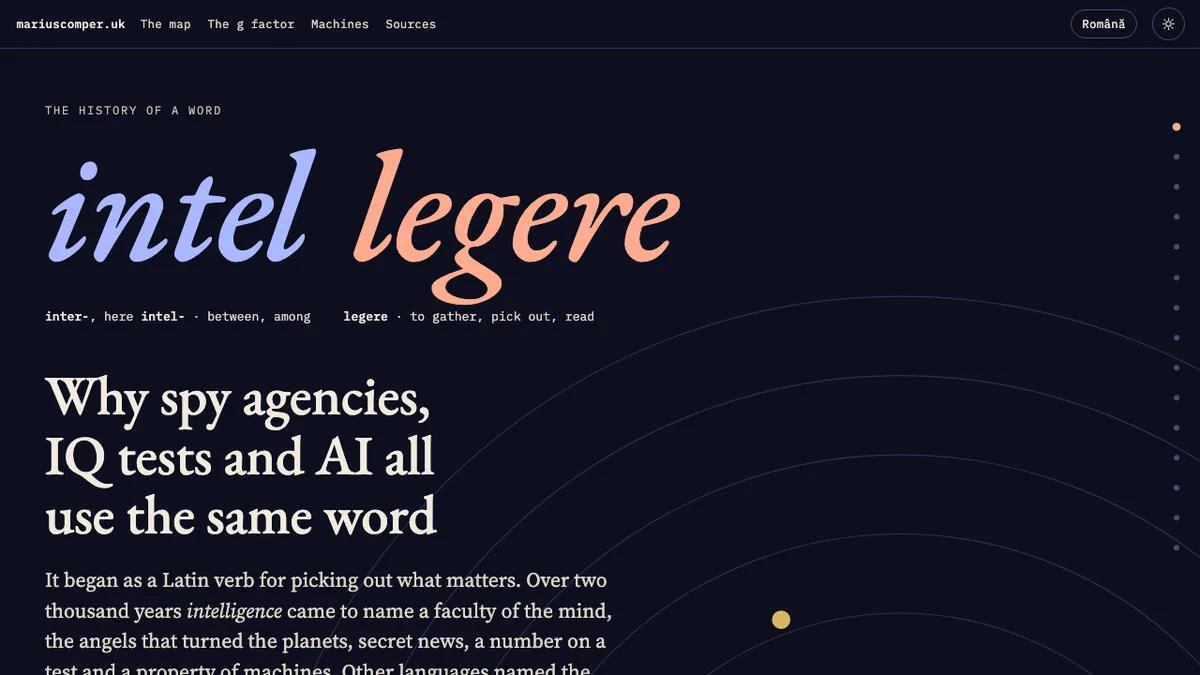
The history of the word intelligence: Latin intellegere, inherited in Romanian a înțelege and borrowed back from French; the angels that turned Dante's heavens; spies' secret news; Binet's tests, the g factor in Spearman's own table, eugenics and the Flynn effect; working memory, with a 2-back game; Turing's machines. And how other languages name the mind: waking, hearing, a camel's tether.
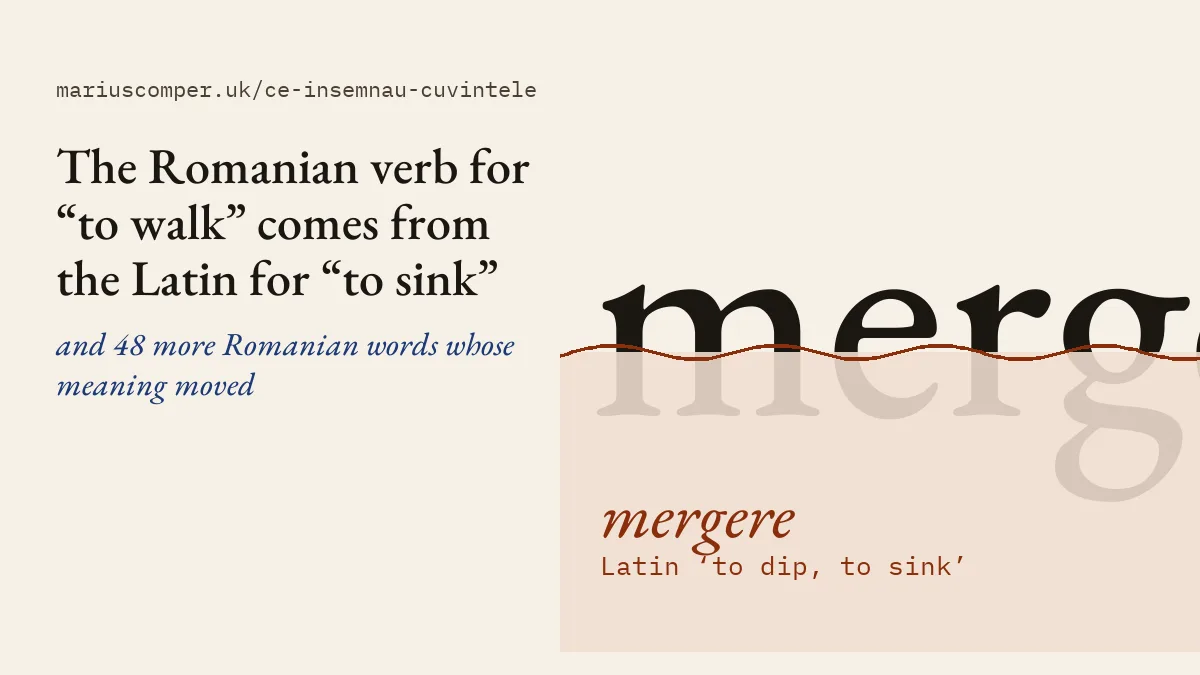
What 49 Romanian words first meant: the verb for caress (to clean), research (to go round), leave (to fold), earn (to punish), and the nouns for woman (the whole household), forest (marsh) and work (torment). Each with its dictionary source, reconstructed forms and disputed etymologies marked. Plus a guessing game and an index.
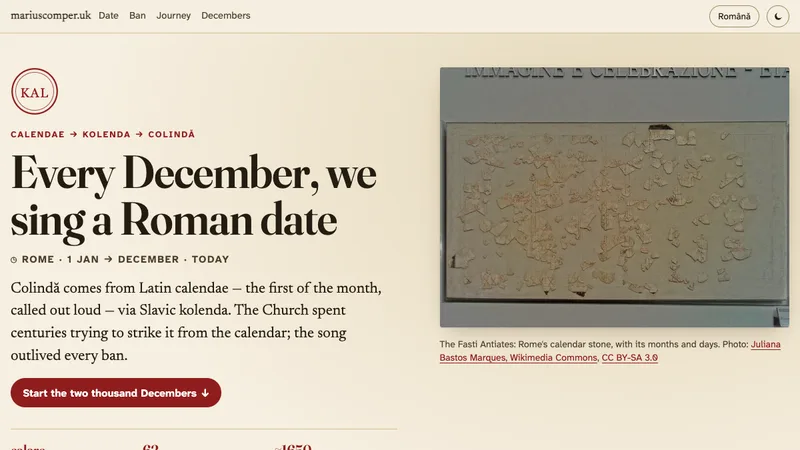
Colindă comes from Latin calendae, via Slavic kolenda: a Roman 1 January date, banned by synods for centuries and still sung every December.
The money-changer's banca was a real bench, and bancruta is that bench broken: Italian banca rotta. Six dated European forms, from 9th-century Germanic banc to 18th-century Romanian bancă, an ordering game, and the smashing legend dictionaries file as pseudo-etymology.
How Vlach shepherds carried three Romanian words over the Carpathians: brânză, turned bryndza in halušky, baci, the head shepherd from Poland to Moravia, and urdă, with five etymologies and no winner. Three dated attestations, six dishes, sheep climbing to 2,000 metres.
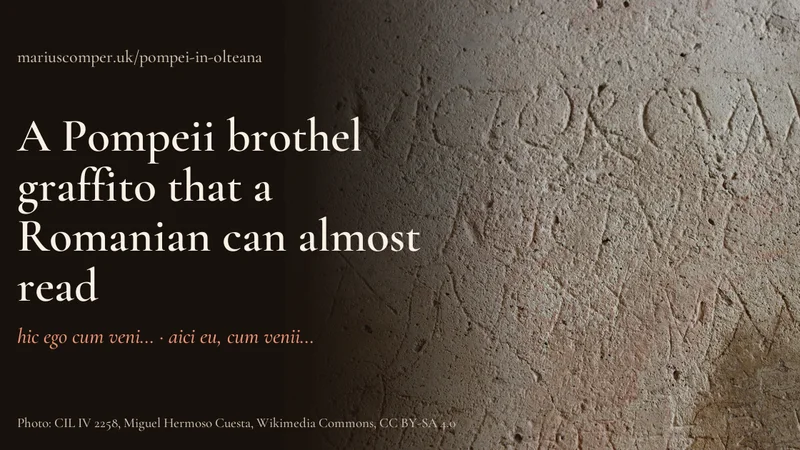
A line scratched on the wall of Pompeii's brothel, hic ego cum veni futui, taken word by word into Romanian: four words survived, one only looks alike, three were lost. How the Latin perfect became the Romanian simple past, and where people still say venii for what they did the same day.
The last sentence on the Tabula Traiana, word by word: two survived into Romanian, two shifted, two vanished. Then the dam came.
The clay tablets of Knossos held not one known word. Alice Kober, who taught at Brooklyn College, showed how their signs were related without knowing their sounds; in 1952 Michael Ventris got Greek out of the grid, though he had once called it a fantasy. Solve the three town names that opened Linear B.
21 speakers across Britain read the same paragraph: pick a town and watch six words change shape in phonetic transcription.
41 years, one book on every desk — and three books before it.
Deacon Coresi's Brașov press (1557–1583) put Romanian into print: the shop, the ten Romanian books with BRV numbers, and the shelves where the surviving copies sit today, shelfmark by shelfmark.
Laurian and Massim tried to erase every non-Latin word from Romanian. Dragoste lived, cespete died — one sentence, two languages, nine verdicts.
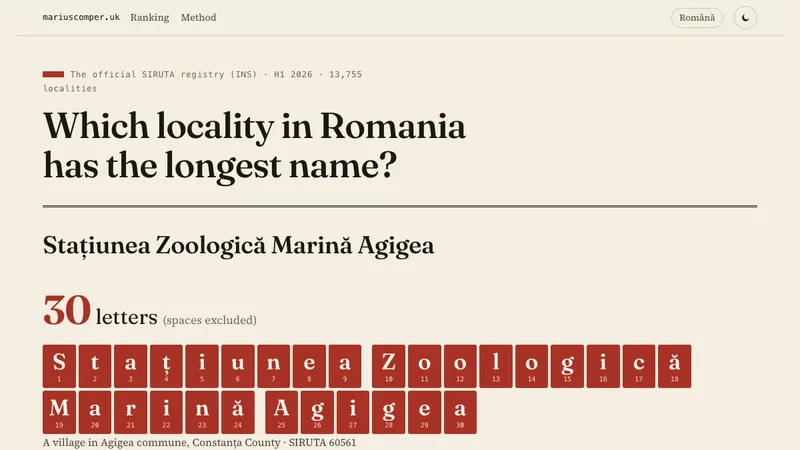
Stațiunea Zoologică Marină Agigea has 30 letters — not Sâmbăta, with 27. The ranking of all 13,755 official names, the shortest names, and a search for any village or town.
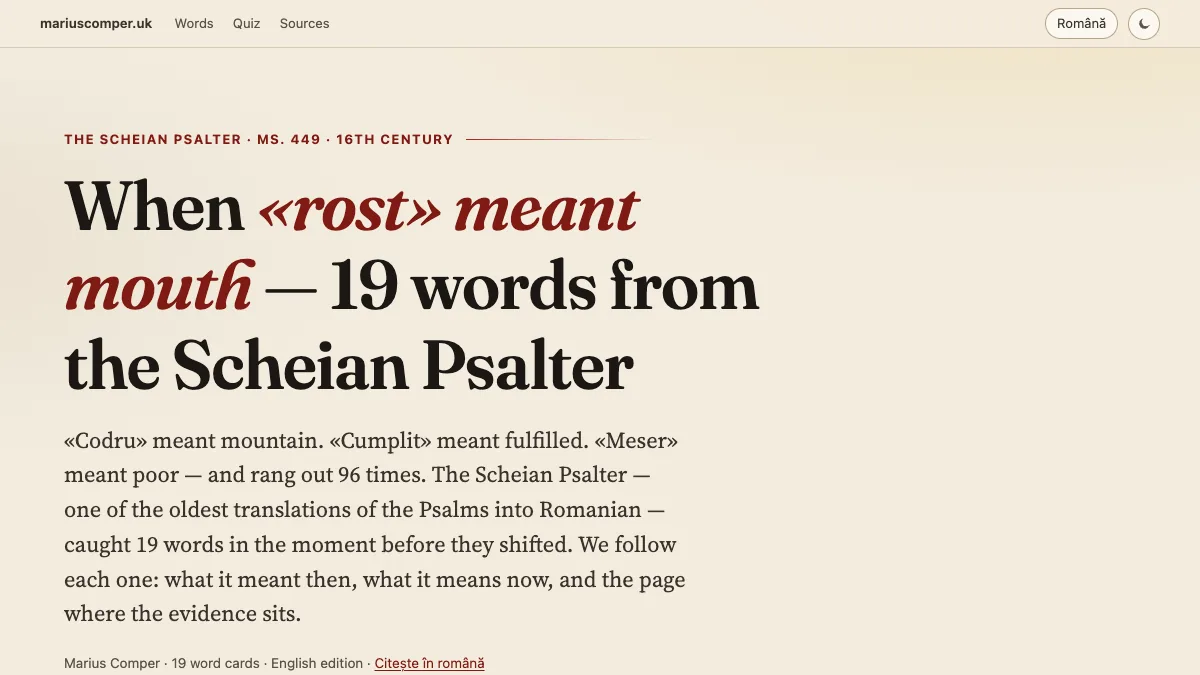
«Rost» once meant mouth, «codru» once meant mountain. 19 words from the Scheian Psalter, with their then-meaning, now-meaning and evidence on show.
The oldest precisely dated Romanian text is a spy warning from Câmpulung to Brașov. Read it phrase by phrase, with renderings.
Dacia 106, the 587 shout, Neacșu 1521, Vienna 1780. A Romance language 1,137 km from Rome.
Classic hangman: 40 Romanian proverbs in the Romanian edition and 40 English ones in the English edition. Six wrong guesses, then the meaning is revealed.
Six Romanian contrasts for Chinese-speaking learners: letters, IPA and articulation (no audio), plus the perception-training paradigm and method. The test ships after validated recordings.
8,560 Romanian given names and surnames from Wiktionary, with 19 extended explanations. Search a name and trace, step by step, which words it formed from — from Ioan to Ionescu, through Church Slavonic and Greek.

Absolute constructions are expressions of time whose head noun has nothing temporal in it — “at the rising sun”, meaning “at sunrise”.
Of the 799 medieval chivalric works that have reached us, 326 are attested by a single manuscript.

A sound change does not depend on what a word means; it happens wherever the phonetic conditions are met. Twenty-four of them rebuild forty Romanian words out of Latin, one step at a time.
Romanian's basic food words trace to Latin. The heavy medieval wheeled plow's parts are mostly Slavic or Hungarian. An interactive diagram shows where the farming vocabulary splits.
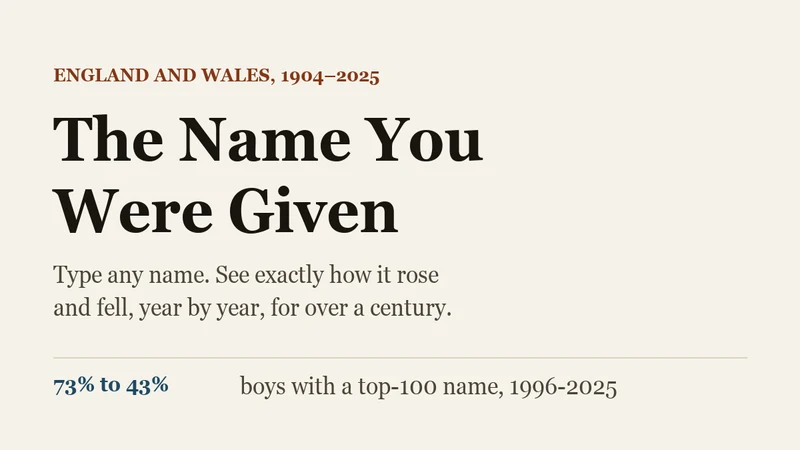
England and Wales baby-name registers, 1904–2025. Type any first name to see its exact rank and count trajectory — and how the 100 most popular names covered 73% of boys born in 1996 but only 43% in 2025.
Moscopole (Moschopolis, today Voskopoja) was a major Aromanian-speaking commercial and educational centre in the 18th-century Ottoman Balkans. Trade, schooling and languages: the story of the city and its links with Romania.
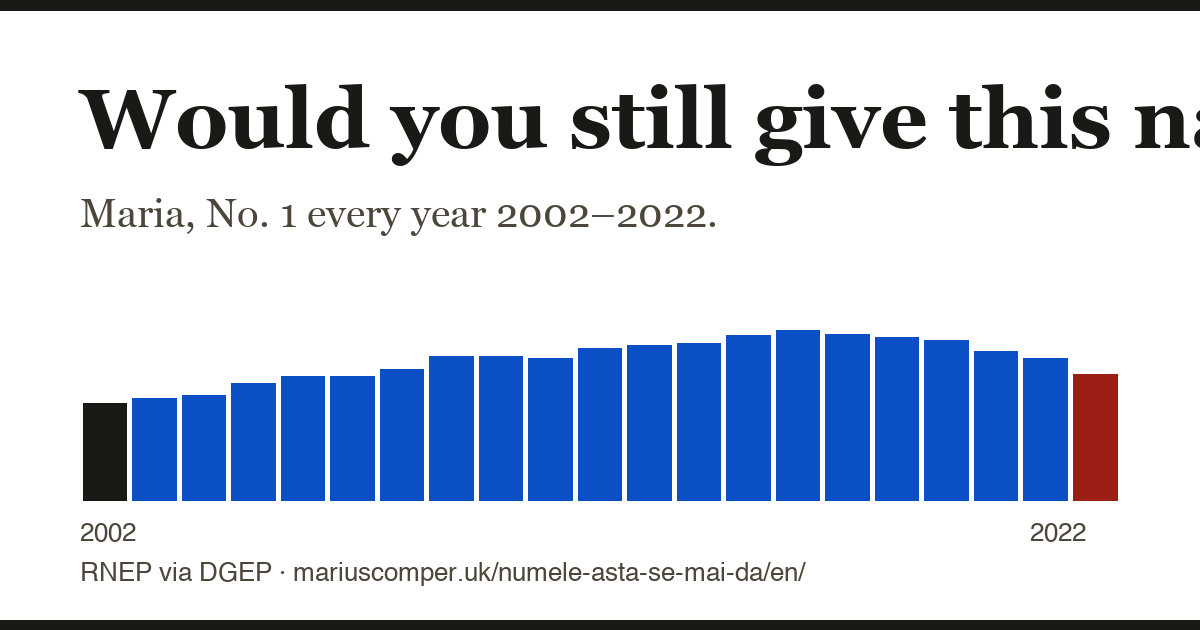
Maria ranked No. 1 in every year from 2002 to 2022. Type a first name and a birth year to see whether you belong to a crowd or a memory.
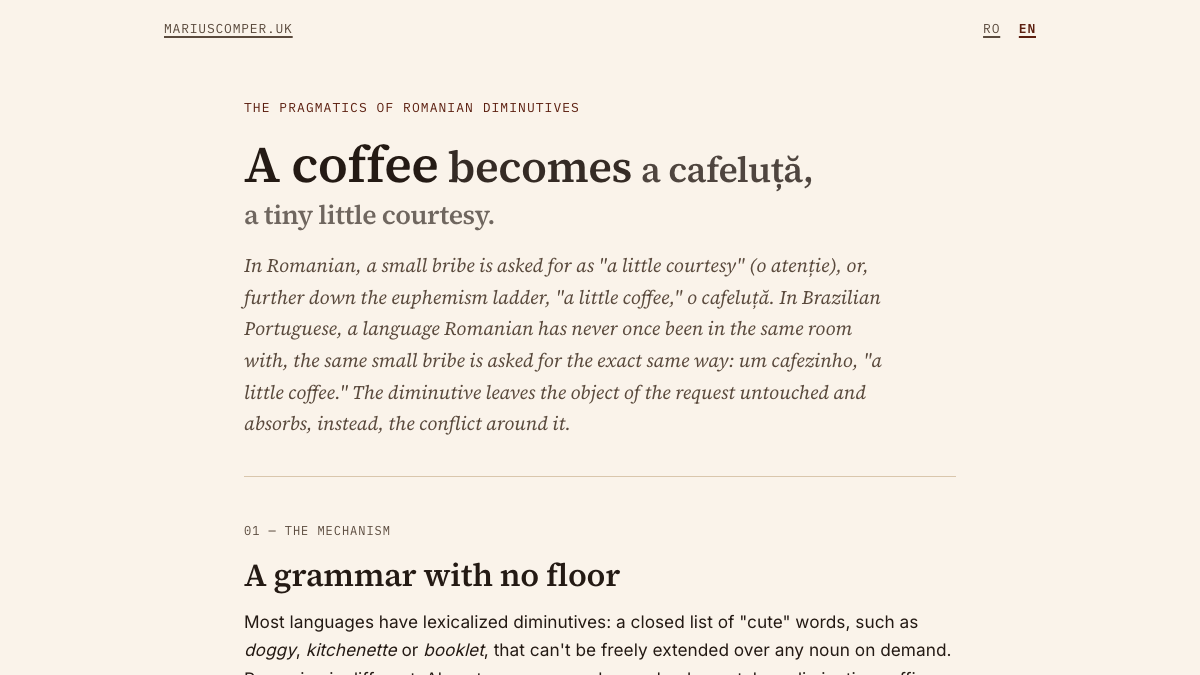
A Romanian diminutive leaves the object of a request untouched and absorbs, instead, the conflict around it. The phonetics of smallness, its reverse into contempt, contraband-coffee history, and an eleven-culture comparative atlas, with a word-by-word dissectable simulator.

A map of the Bârsa basin with 102 places, each classified by toponymic root (German, Hungarian, Romanian, uncertain). A movable waterline between 300 and 1800 m shows how the roots split by elevation; the attestation years show which villages have a real year and which microtoponyms never had a founding act.
A map of Romania made of 18,214 settlement points and 127 rivers, on which the name strata are laid down in turn: ancient, Slavic, Turkic, Hungarian, German, Romanian. A time slider, a length ranking of rivers and a core sample for any name.
Romanian, Bulgarian, Albanian, Greek and Aromanian build their future tense with the same grammatical mechanism, from a verb meaning to want, despite coming from four unrelated language families. An interactive map of the Balkan sprachbund, exceptions included.

Marian 1886, counted. The patient is named. The speaker keeps the speech. God keeps the gift.
One-eyed Pazvante, Prince Reed, a flea shod in iron. A journey through Romanian sayings that kept their characters and stories while muddling the calendar.
Cuscru, fin, cumătru: relatives named in Romanian and nameless in English. The elder brother, the maternal uncle: nameless in Romanian, named in 70% of the world's languages. Ten rules of the kinship vocabulary, on a map of 1,056 languages.
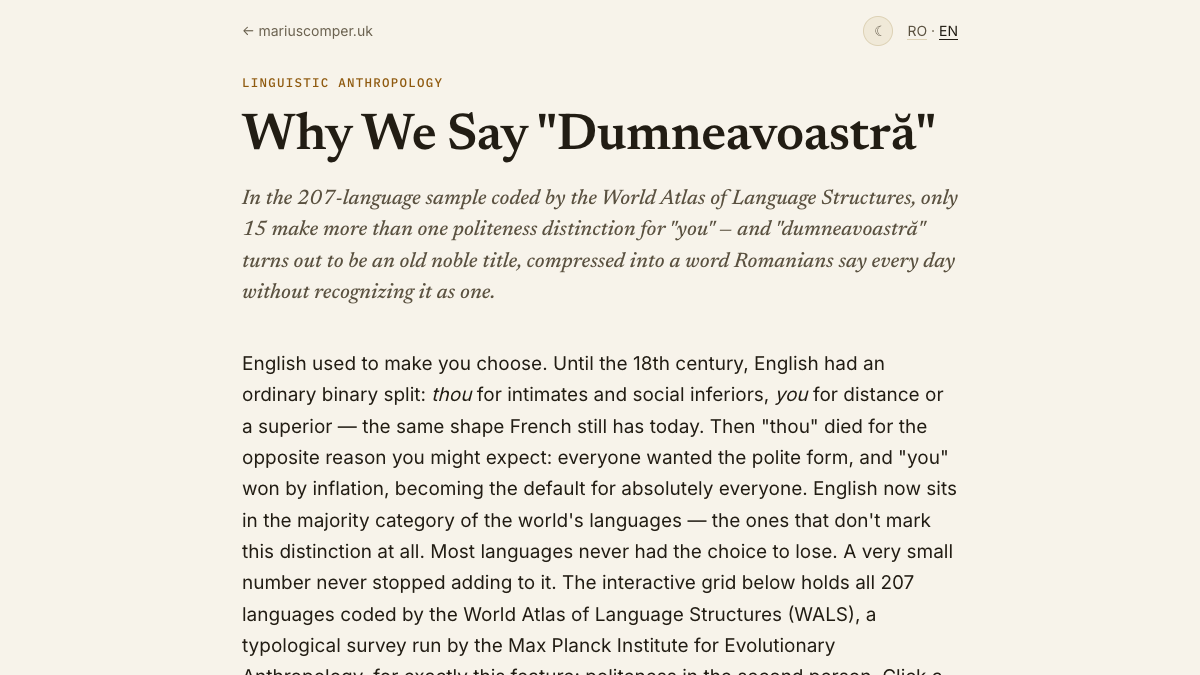
"Dumneavoastră" is a noble title compressed into a word said every day. Only 15 of the world's 207 languages make more than one politeness distinction for "you" — an interactive map of all 207, plus the feudal etymology hiding inside the word.
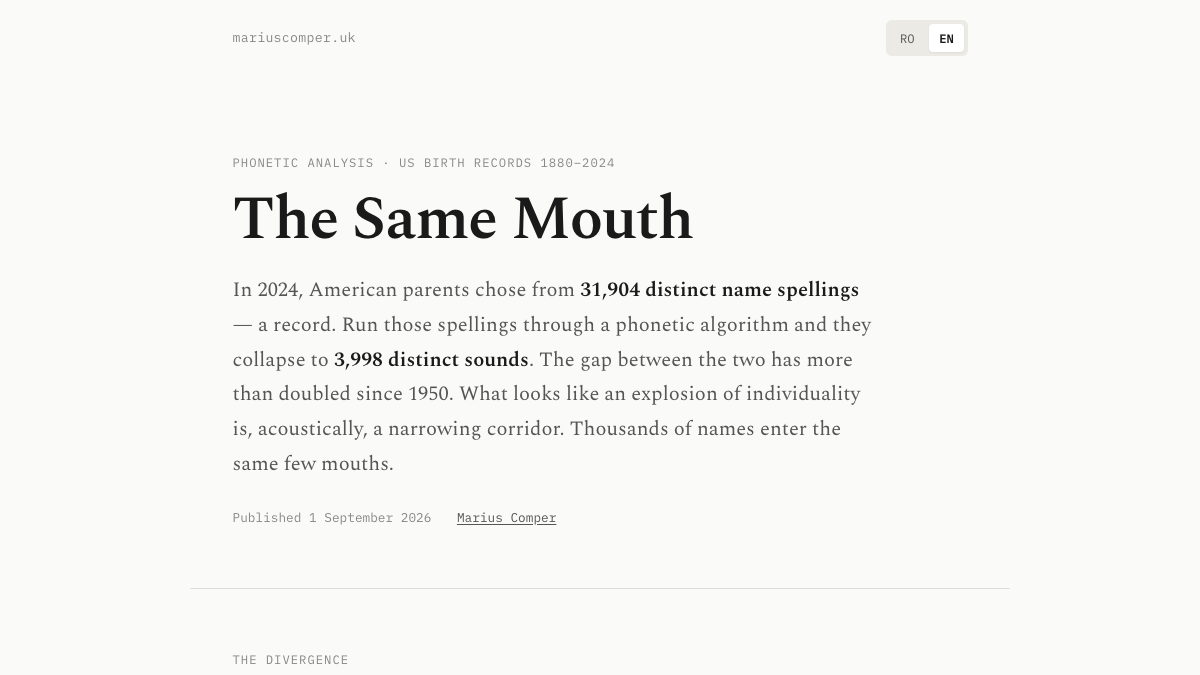
US birth records contain 31,904 distinct baby-name spellings in 2024, but a phonetic algorithm reduces them to 3,998 sounds. The interactive charts trace how the gap has widened since 1950.

Romanian says da from Slavic (11,847 per million in writing, 14,212 in speech), while Italian, Spanish and French keep Latin sic.
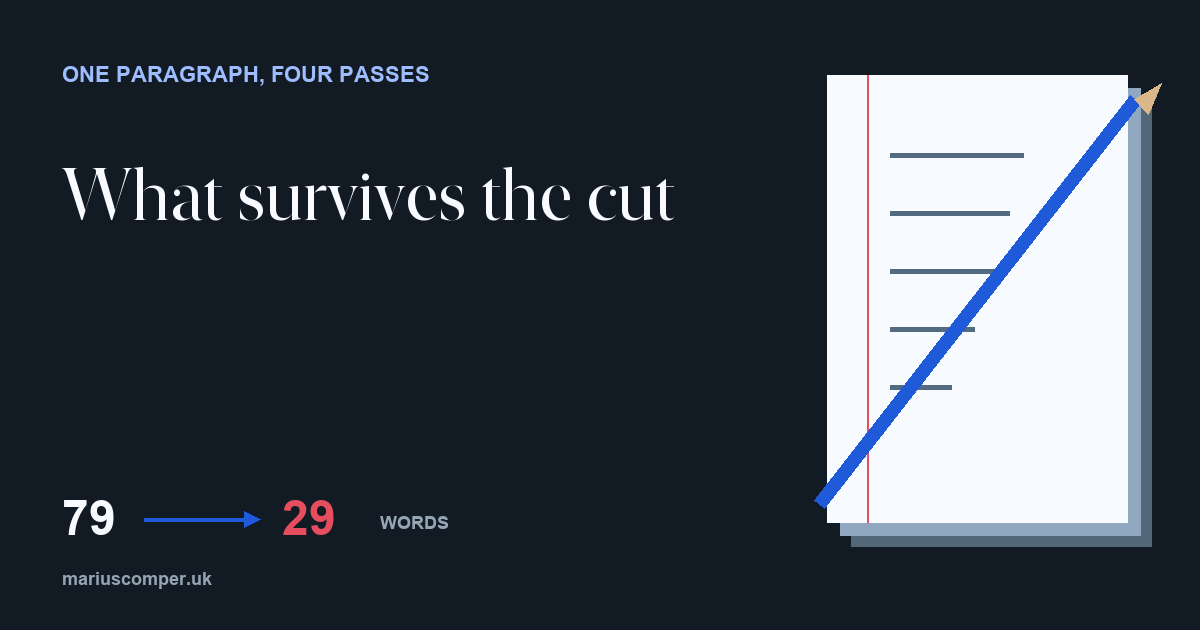
Move through four edits of the same scene and watch a 79-word paragraph become a 29-word story.
Words used 100 times more frequently evolve 10 times more slowly. Follow the decay of vocabulary and verbs, century by century.

While raw speech rates vary widely across cultures, the net information rate delivered to the brain converges everywhere to 39.15 bits per second.

Romanian's neuter gender has no shape of its own: masculine singular, feminine plural. 48 of 52 loanwords checked landed exactly there.
The same numeric string can mean 1,234 or 1.234, depending on its locale convention. Compare 22 Unicode CLDR profiles.
Vocal folds produce only a raw drone: what we hear as speech is a chord of two frequencies. In “i”, the gap spans over 3 octaves; from “u” to “i”, the second frequency triples; and Romanian anchors two central vowels along the midline.
The biomechanical cost of typing in Romanian: 1.38 kilometers traveled by fingers for every 10,000 words, and a 57% workload asymmetry on the left hand.

How an entire village chronicled a century in folk meter.

Almost a quarter of the occurrences in the CoRoLa list have two letters. Measure the word lengths in your own sentence.

63 of 68 languages mark both boundaries of “we”.

Eighty-nine thousand rhymes, counted inside stanzas.

What Romanian costs at the keyboard, keypress by keypress.

One hundred and seven languages, one thousand and sixteen words.

A toponymic atlas of the country, dot by dot.

A secure language, a lost voice. Names and one witness from 386 make up the surviving archive.

A map of names for a cheese made from whey, with milk technology and the routes of words in view.
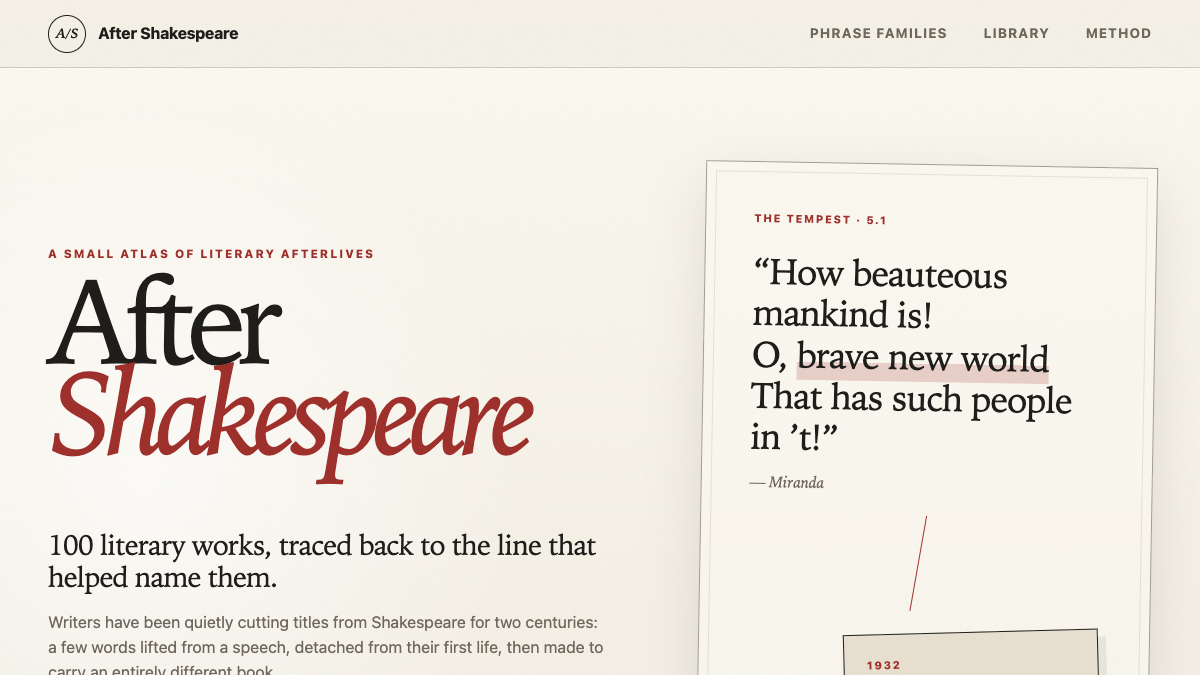
100 later titles traced back to the lines that helped name them.
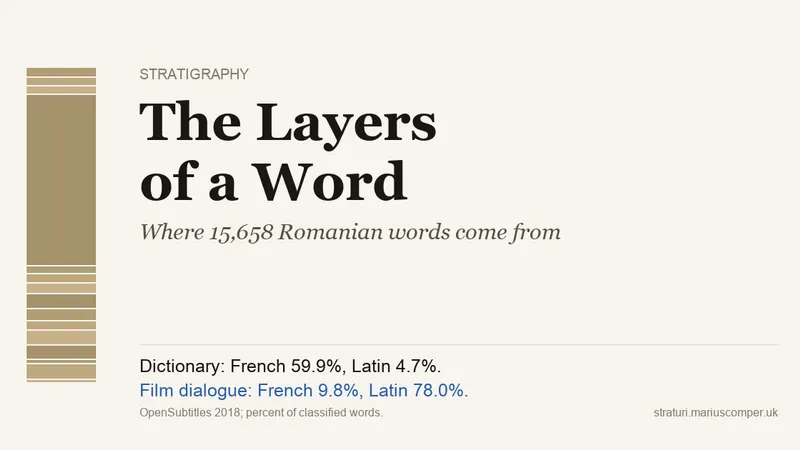
The same words change rank when you move from the dictionary to frequency.
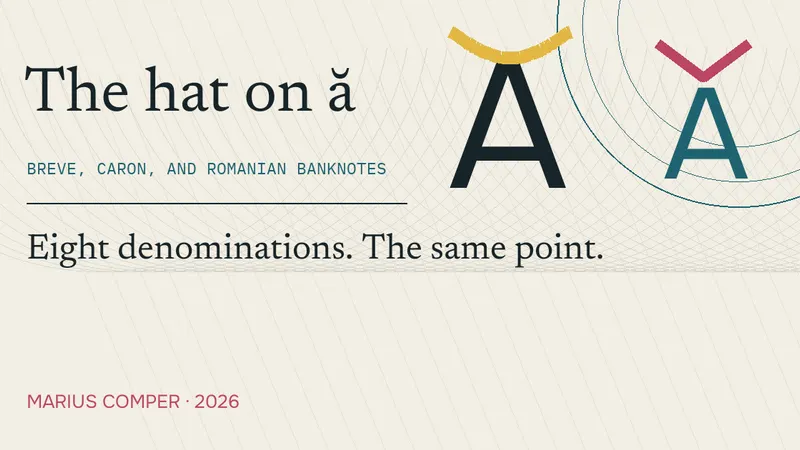
A breve in Unicode, a point on banknotes: the same letter carries two different marks.
The same palette, divided by 110 languages.
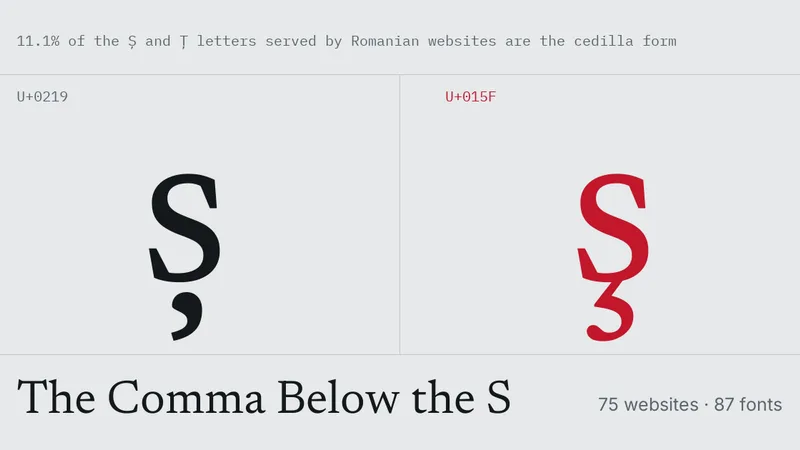
The mistake fonts fix before you ever see it.
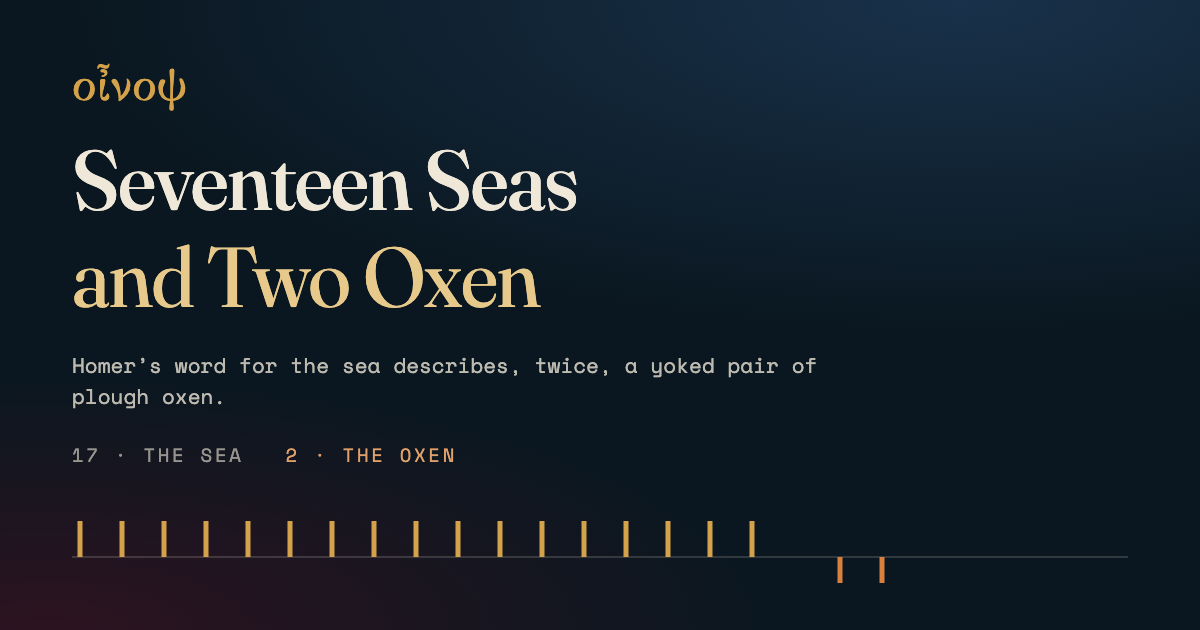
One word for seventeen seas and two oxen.
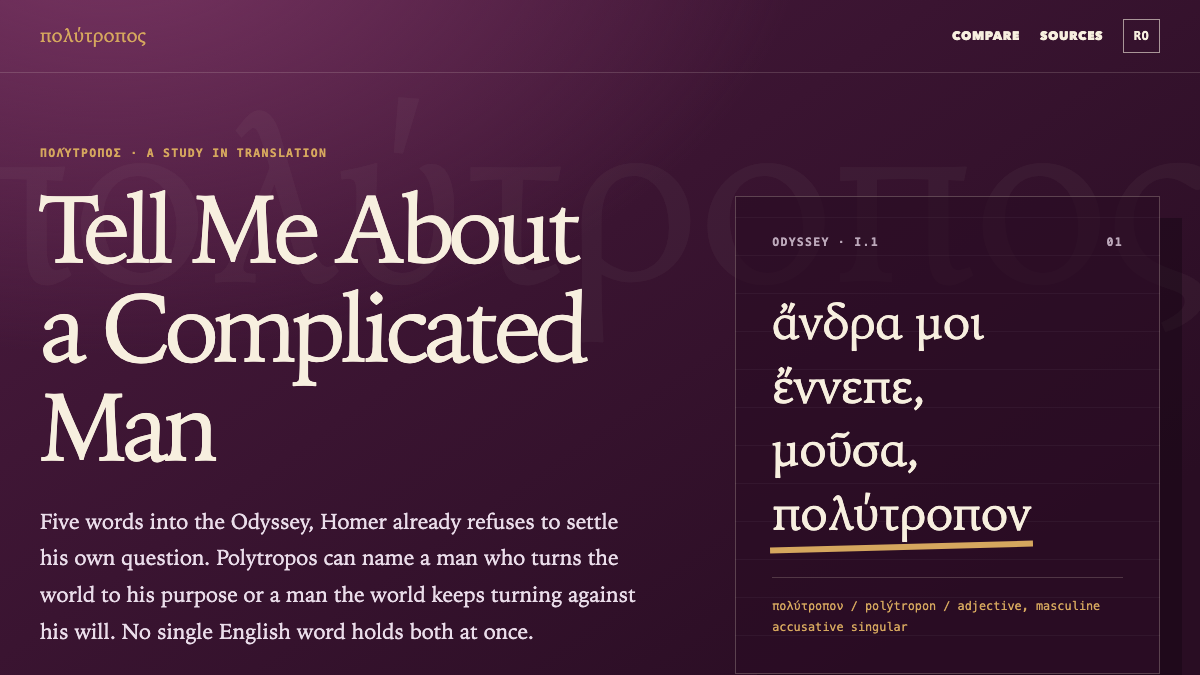
One epithet, eleven different heroes.
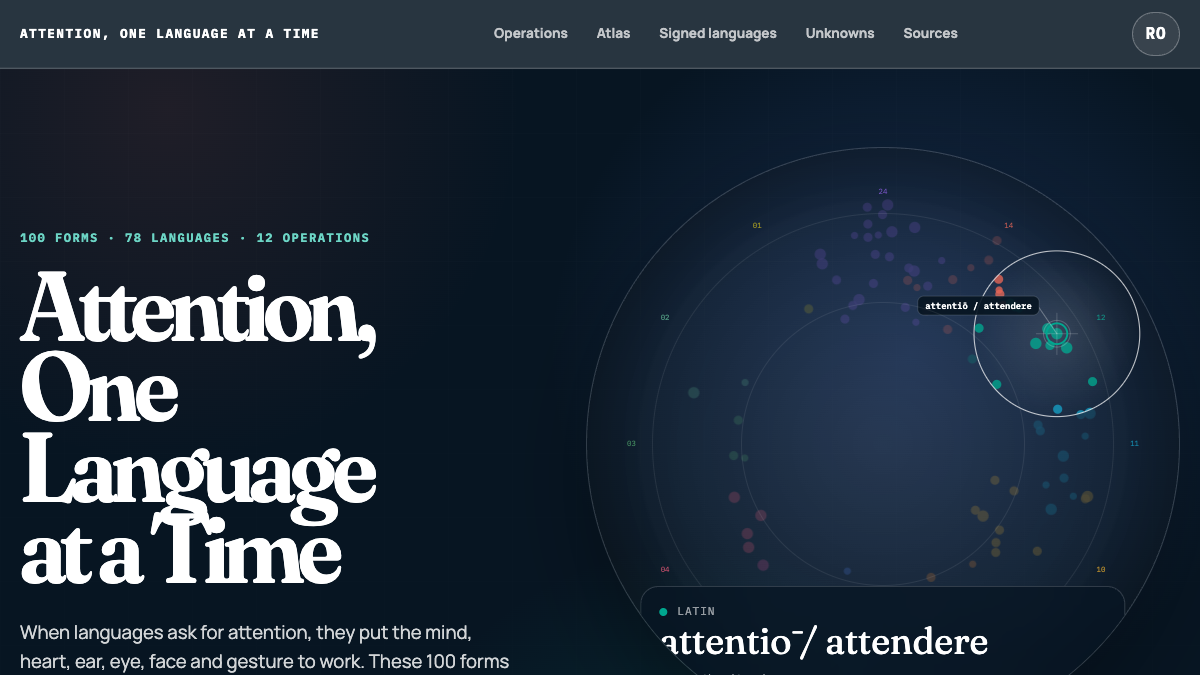
One hundred forms from 78 languages trace how attention becomes orientation, listening, care or availability to another person.