Word origins
Follow borrowings, inherited forms and competing explanations.
A lexical route from Persian, through Turkish, into Romanian. The Persian title for China’s emperor explains the meaning; no Chinese phonetic ancestor is asserted.Persian → Turkish → Romanian. China’s emperor title explains the meaning; no Chinese word ancestor is asserted.
The Slovak borrowing is presented in the project. The remote origin of brânză remains unknown in DEX; the dashed line marks that gap.The Slovak borrowing is documented. The remote origin of brânză remains unknown in DEX.
The Romanian form is inherited from Latin. Christian use of draco helps explain drac, “devil”; the histories of form and meaning belong together.The Romanian form comes from Latin. The Devil sense also appears in Christian Latin.
Etymology · names · scripts · language games
The Slovak borrowing is presented in the project. The remote origin of brânză remains unknown in DEX; the dashed line marks that gap.
Search for a word or name ↗158 projects · 1,975 records from 15 projects
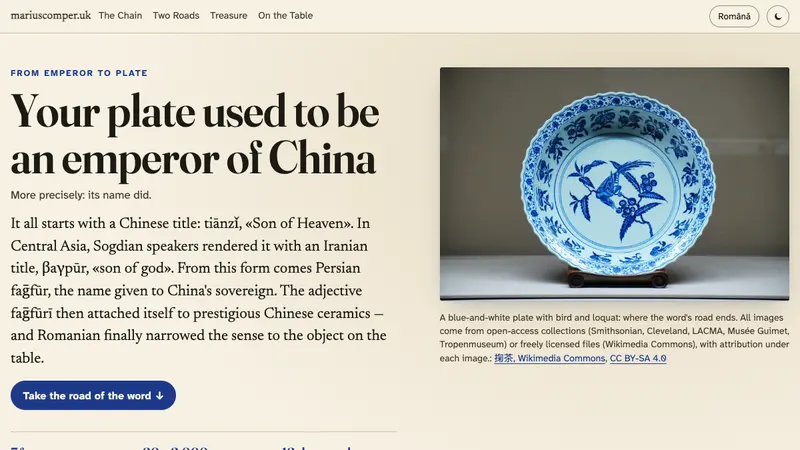
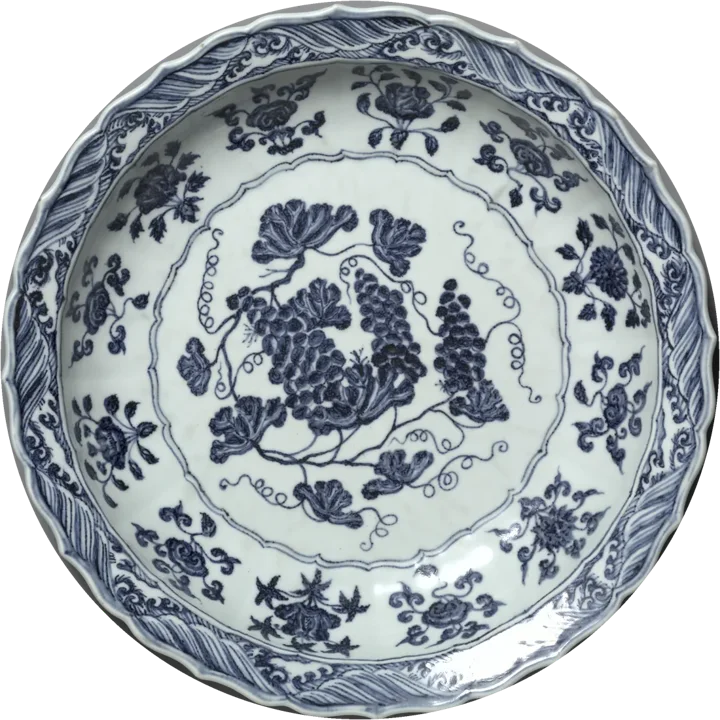
Romanian farfurie, “plate”, comes from Turkish. Its history continues back to Persian faghfūrī, associated with imperial porcelain and a title used for China’s emperor.
The arrows trace word forms. The association with China explains the meaning and object’s history; it does not make the Romanian word a direct borrowing from Chinese.
Brânză, the Romanian word for cheese, was borrowed into other languages. The project follows forms such as Slovak bryndza and dictionary discussions of their routes.
The Romanian word’s remote origin remains unknown in DEX. An old explanation or a similar-looking form does not become evidence because it makes an appealing story.
Romanian drac continues Latin dracō. In Greek and Latin, the word’s history includes serpents and dragons; in Christian Latin, draco could also refer to the Devil.
The project brings dictionaries and texts together to explain the sense change. In the atlas, documented descent, disputed proposals and reconstructed forms each keep their own labels.
Search for a word, variant, meaning or name. Results show what is recorded in the projects’ data and take you directly to the explanation and sources.
Detailed search covers 1,975 records from 15 projects. Other projects can be found by title, description and topic terms. Accented and unaccented forms are searched together; exact matches appear first.
A documented example to start with. Press Search for all matches.
Example from the collection
brânză → bryndza
The Slovak borrowing is presented in the project. The remote origin of brânză remains unknown in DEX; the dashed line marks that gap.
Examples with their own pages and covers: farfurie · brânză · drac
Place names, writing, sounds and language games belong in the same collection. Choose a theme to see every project in it.
Follow borrowings, inherited forms and competing explanations.
See what records can tell us about people’s and places’ names.
Compare scripts, documents, spelling and attempts at decipherment.
Explore sounds, accents and the ways we speak.
See how meanings and word use change.
Guess, compare and try language games.
Search freely or choose a theme. Searching for a word in the atlas also narrows this list, including projects with matching records.
158 projects
Complete lists, direct links
Names and places
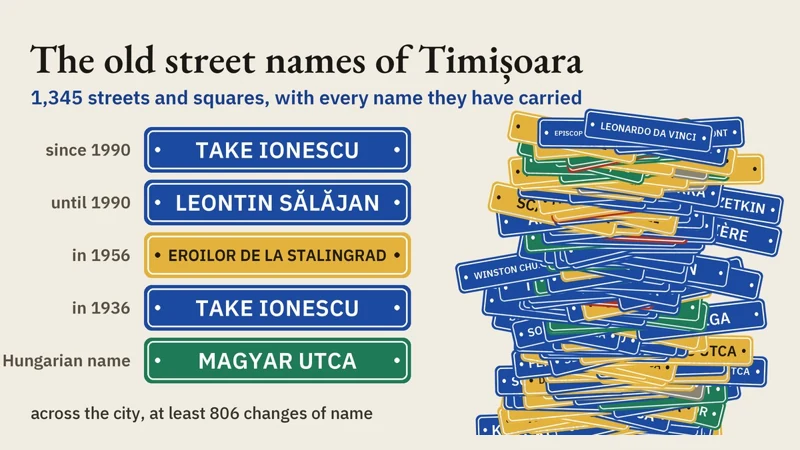
Bulevardul Take Ionescu was Magyar utca, then Heroes of Stalingrad, then Leontin Sălăjan.
Speech and sounds
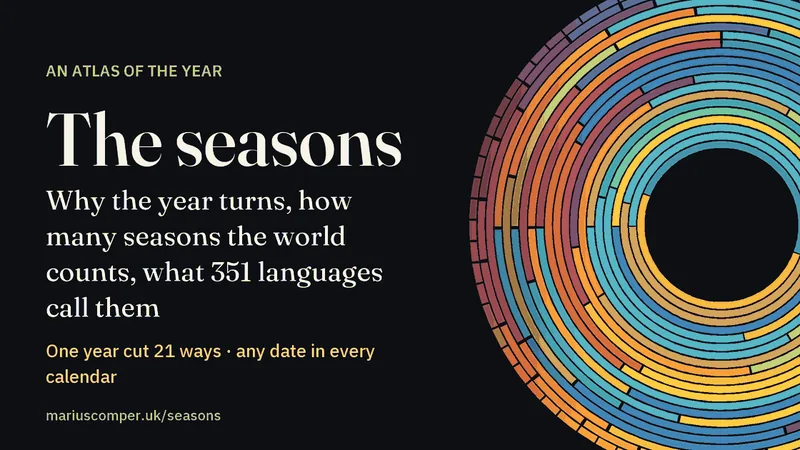
The sky gives the year four fixed points: two solstices and two equinoxes. People decided the rest: two seasons in Iceland’s old calendar, three in ancient Egypt, six in India, 24 solar terms in China and 72 in Japan’s old almanac.
Speech and sounds
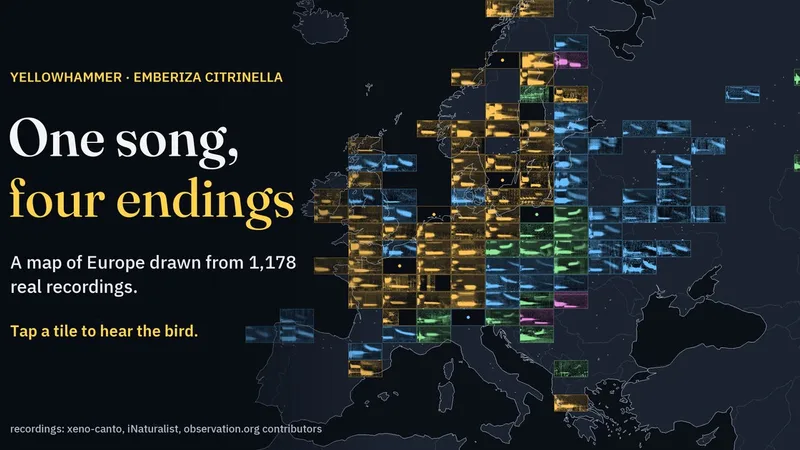
The yellowhammer ends its song differently from region to region. 1,178 public recordings, classified twice without knowing the place, on a map drawn from the birds’ own spectrograms.
Names and places
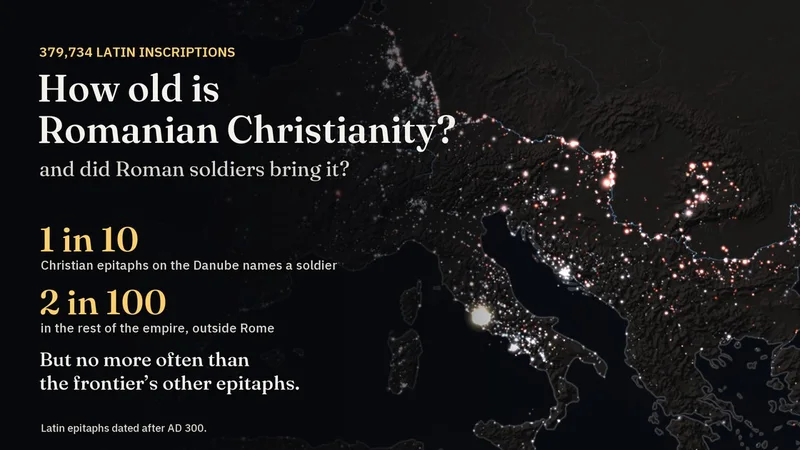
The Bulgars, the Poles and Kievan Rus have a year of baptism; the Romanians have words inherited from Latin and the idea that the faith came with Roman soldiers.
Writing and texts
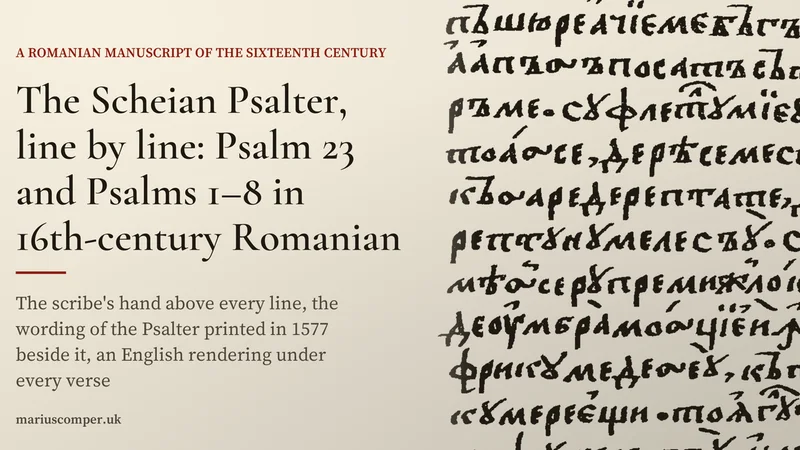
Psalm 23, “The Lord is my shepherd”, and Psalms 1–8 as they stand in the Scheian Psalter, a Romanian manuscript copied between 1573 and 1578, when Romanian was mostly written in Cyrillic letters: 345 lines with the scribe's hand above each, an English rendering of every verse and the wording of the Psalter printed in 1577 beside it. In Romanian and English.
Word origins
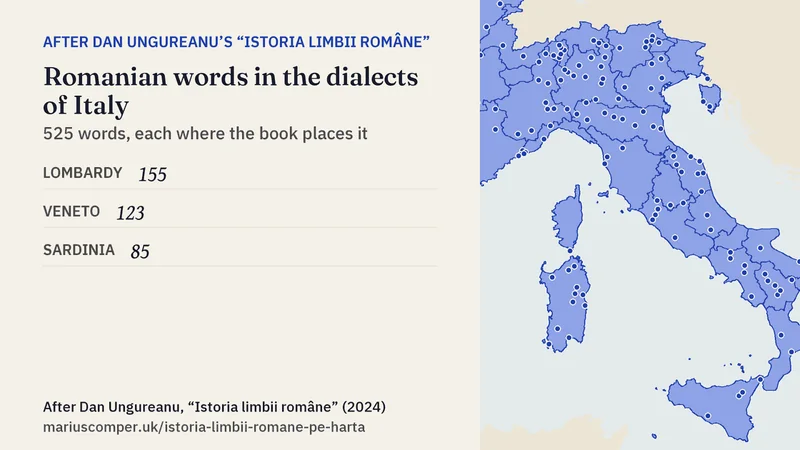
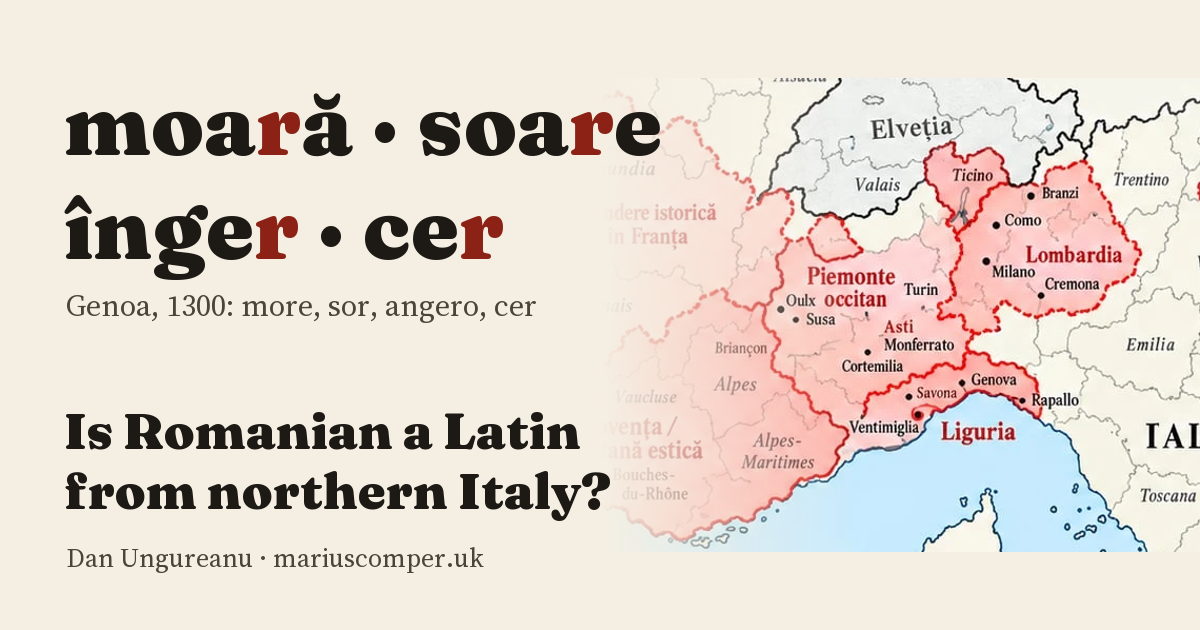
Dan Ungureanu argues that Romanian comes from north-western Italy. For 525 Romanian words, the map shows where the dialect forms his book sets beside them are found: among the regions of Italy, Lombardy has the most, then Veneto and Sardinia.
Writing and texts
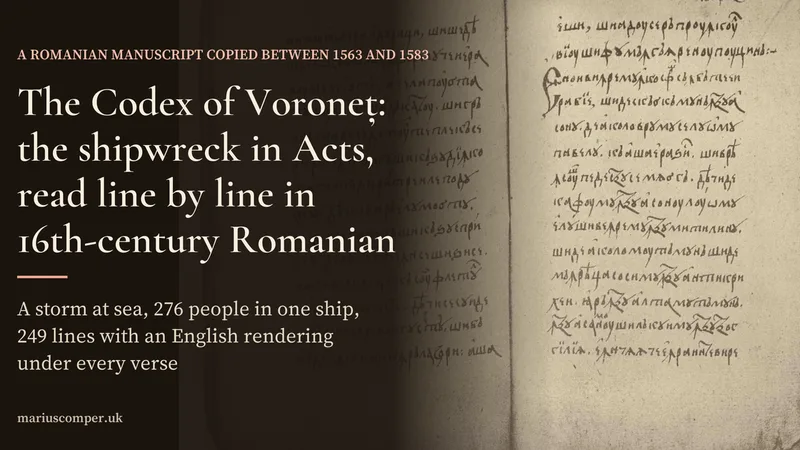
The shipwreck in Acts as it stands in the Codex of Voroneț, a Romanian manuscript copied between 1563 and 1583, when Romanian was usually written in Cyrillic letters: 249 lines with an English rendering of every verse, the old words explained, and the same verses in the translations of 1648 and 1688.
Word origins
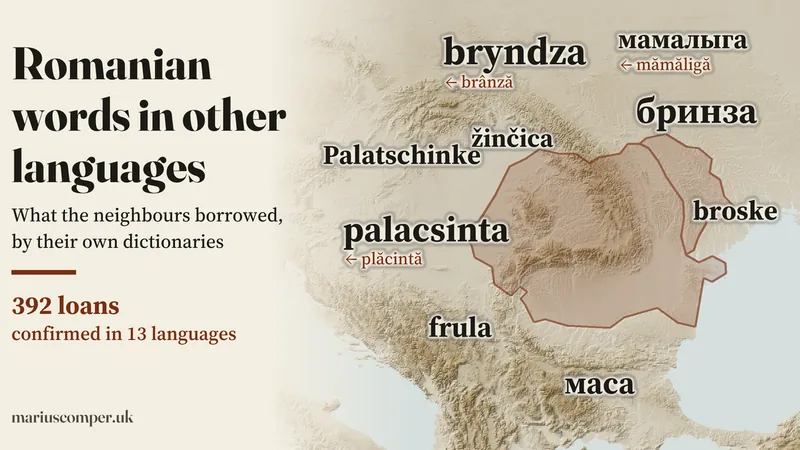
Accounts of Romanian usually list what it borrowed.
Speech and sounds
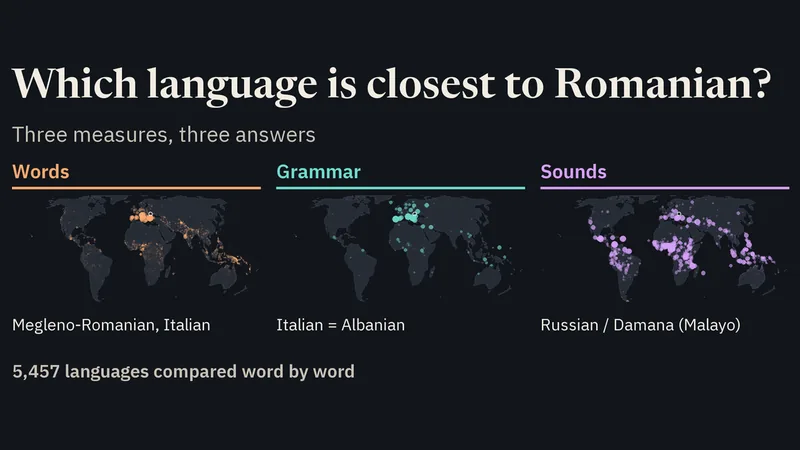
Romanian, the Romance language of Romania and Moldova, compared with the world's languages on words, grammar and sounds, using open data.
Names and places
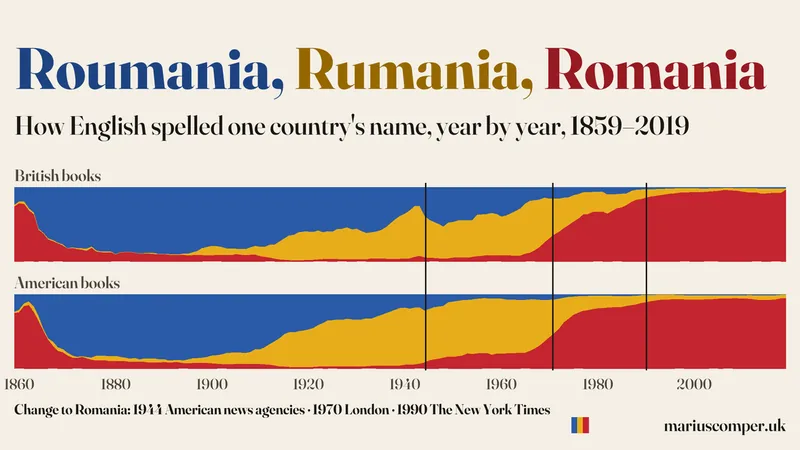
English has printed the name of Romania in three ways. The three spellings are counted year by year in British and American books, from 1859 to 2019, and in a sample of American newspapers, to 1963, beside the dated decisions of London, Washington and Bucharest.
Writing and texts
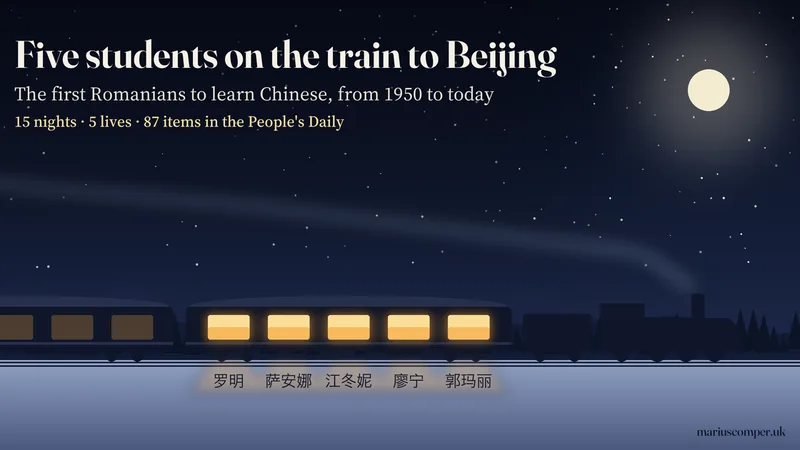
In November 1950 five Romanian school-leavers spent fifteen nights on trains from Bucharest to Beijing. None of them knew Chinese.
Wordplay
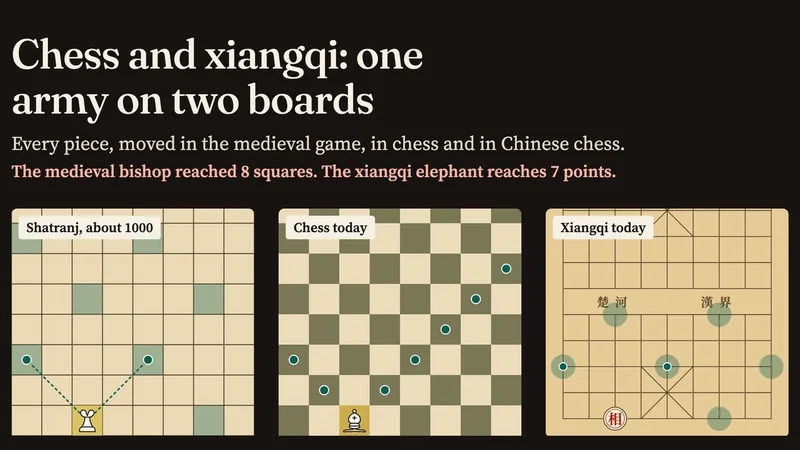
Chess and xiangqi set out the same army: chariot, horse, elephant, counsellor, king. Pick a piece and see its move on three boards: shatranj, the medieval game, chess today and xiangqi.
Speech and sounds
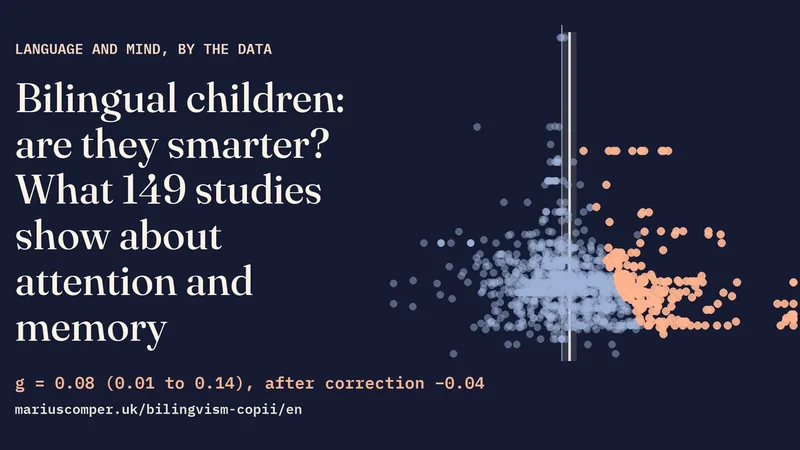
All 1,194 results from 149 studies comparing children raised with two languages to children raised with one, one dot each.
Names and places
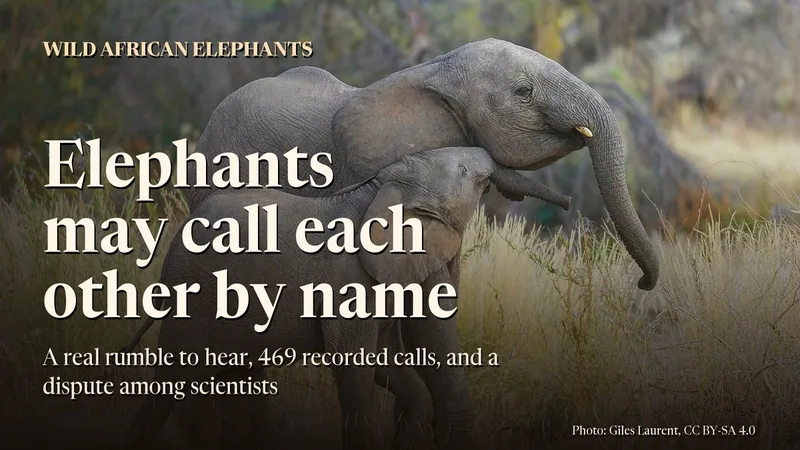
Wild elephants in Kenya seem to use calls meant for one listener.
Names and places
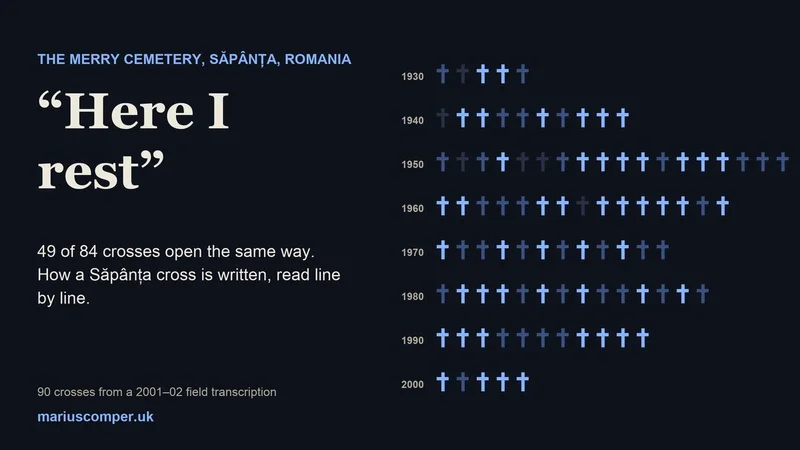
90 crosses from the Merry Cemetery, transcribed in the field in 2001–02 and read line by line: 49 of 84 verse crosses open with the same sentence and the typical line has seven or eight syllables, but spelling does not let the count prove more.
Speech and sounds
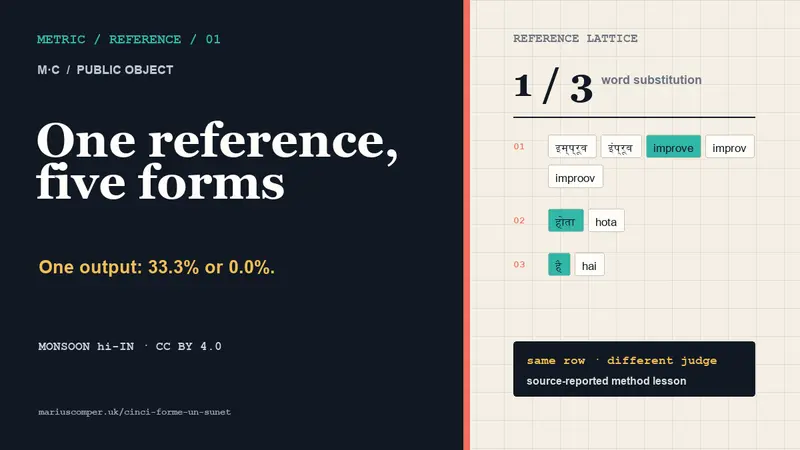
In one example from the public Monsoon collection for Hindi (hi-IN), the same transcript has a 33.3% or 0% error rate depending on which forms are accepted as the reference.
Word origins
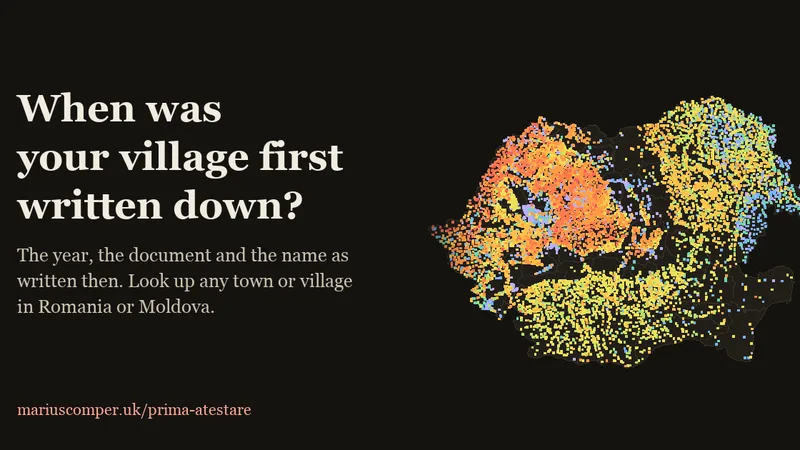
Look up any town or village in Romania or the Republic of Moldova and see the year it first appears in a document, which document, and under what name. 8,839 localities dated, each with its source, on a map coloured by the century of first mention.
Word origins
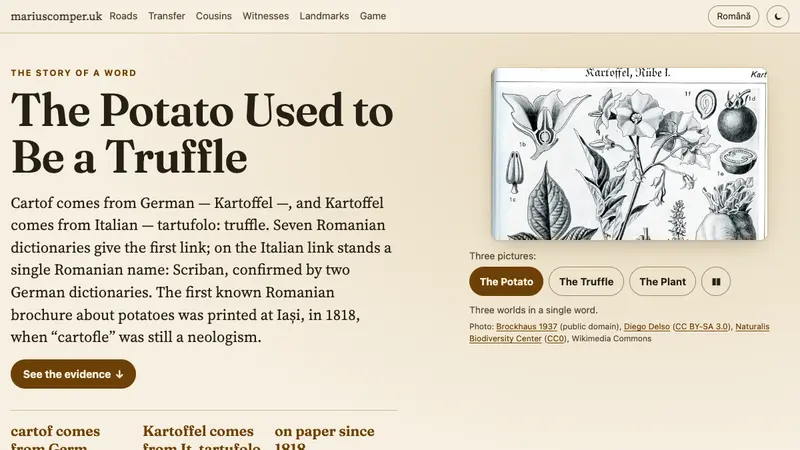
Cartof comes from German Kartoffel, and Kartoffel from Italian tartufolo: truffle. Seven Romanian dictionaries give the first link, Scriban alone the second.
Word origins
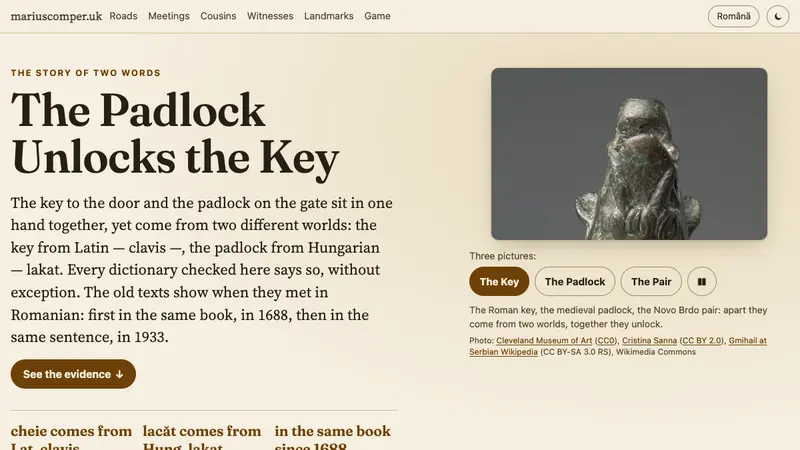
Cheie comes from Lat. clavis, lacăt from Hung. lakat: eight dictionaries say one, six the other, without exception.
Word origins
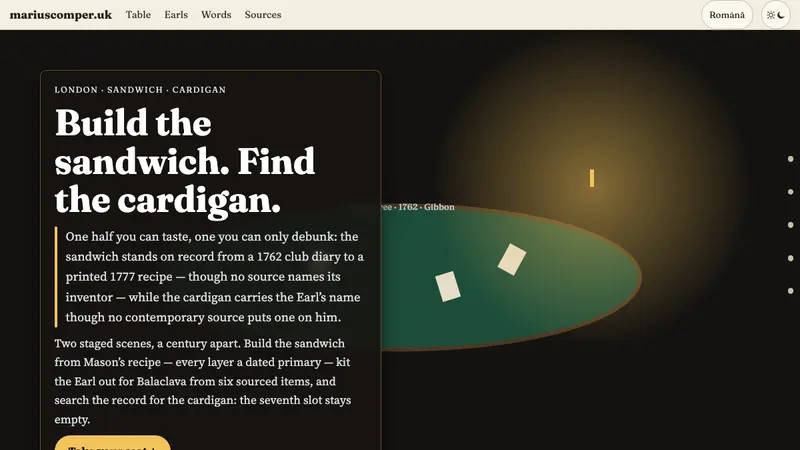
Build the sandwich from the 1777 recipe, layer by layer, and kit the Earl out for Balaclava from six sourced items — then search the record for the cardigan: the seventh slot stays empty.
Word origins
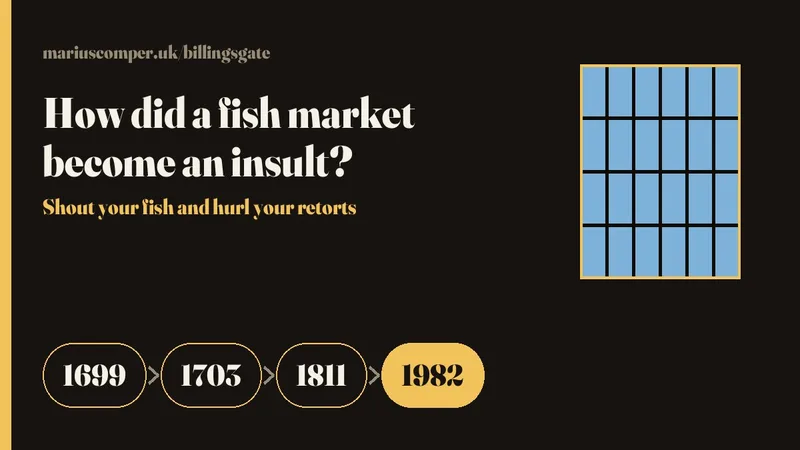
Take a stall at Billingsgate: pay the 1699 Act toll, hurl verbatim 1703 retorts, shout Mayhew's priced cries — and compare what you performed with two centuries of the word's dated uses.
Meaning and use
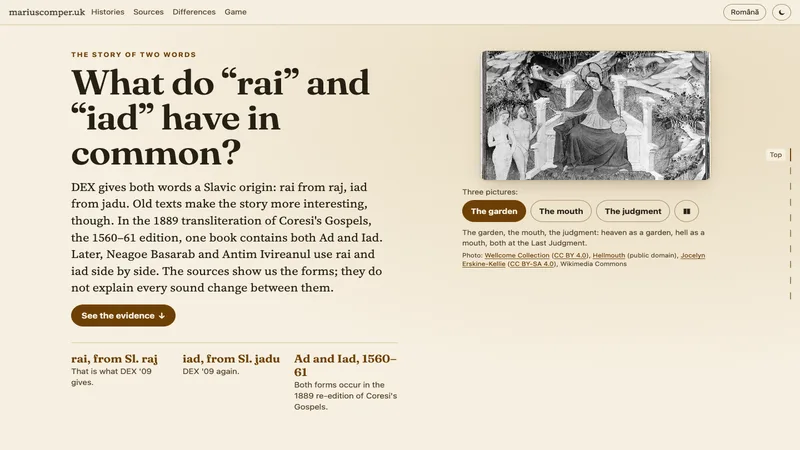
Rai and iad, two words of Slavic origin: DEX derives them from Sl. raj and Sl. jadu, and the 1889 re-edition of the 1560–61 text gives Ad in one verse and Iad in another.
Meaning and use
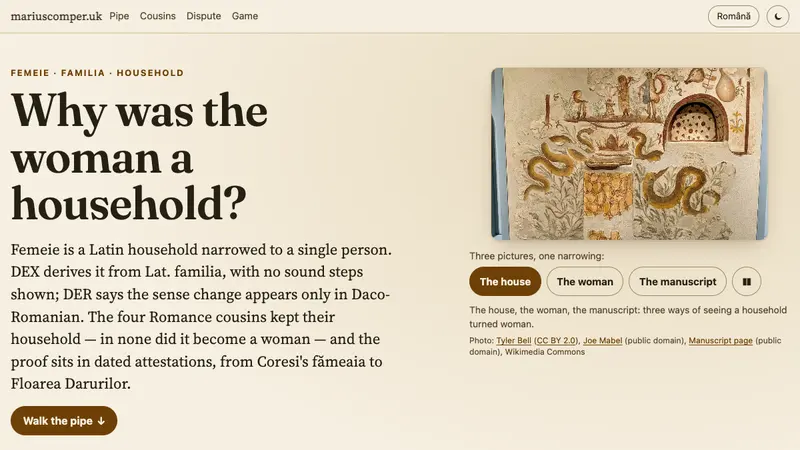
Femeie comes from Latin familia, the household: DEX derives it from Lat. familia, DER says the narrowing appears only in Daco-Romanian.
Meaning and use
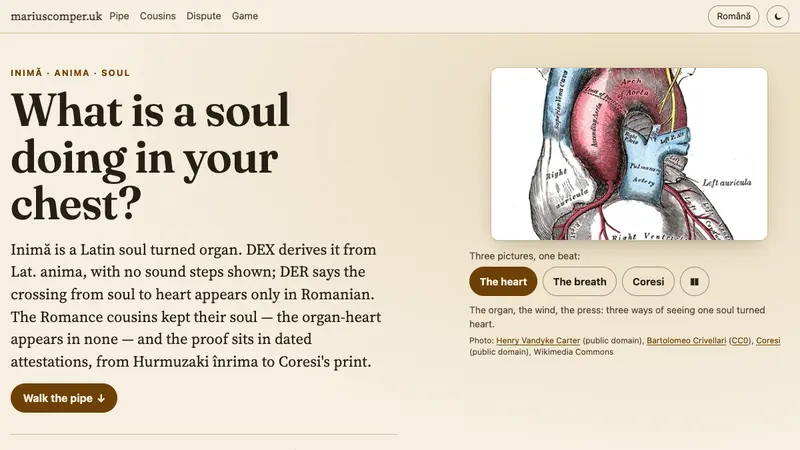
Inimă comes from Latin anima, soul: DEX derives it from Lat. anima, DER says the crossing appears only in Romanian.
Names and places
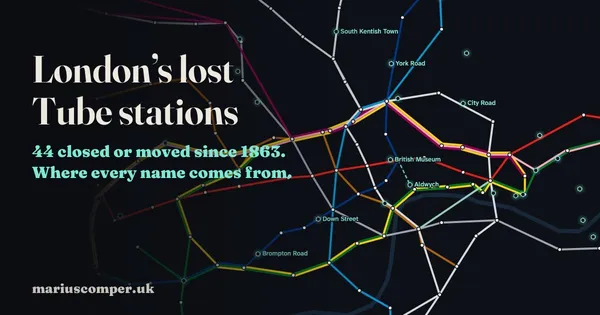
All 272 London Underground stations and the 44 that closed or moved, on a map you can drag from 1863 to today.
Names and places
204 London names parsed into stem and ending: a decoder across Celtic, Roman, Saxon, Norman and modern layers, the earliest forms ever written down, and a game of twelve folk traps.
Meaning and use
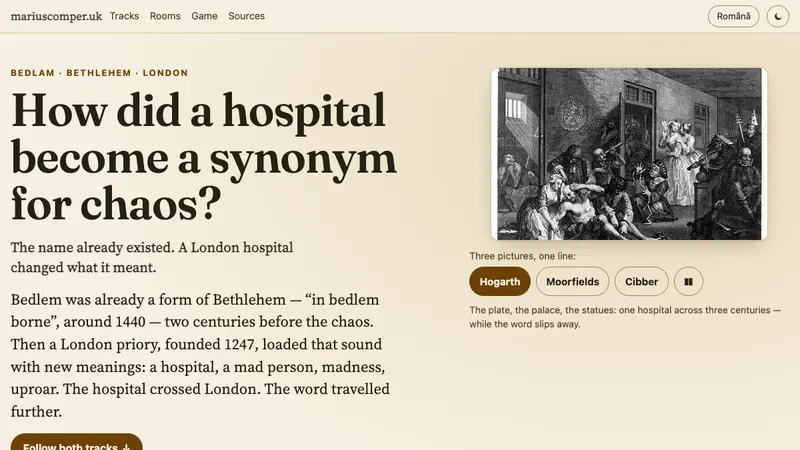
Bedlem was already a form of Bethlehem when a London priory founded in 1247 started changing what it meant.
Names and places
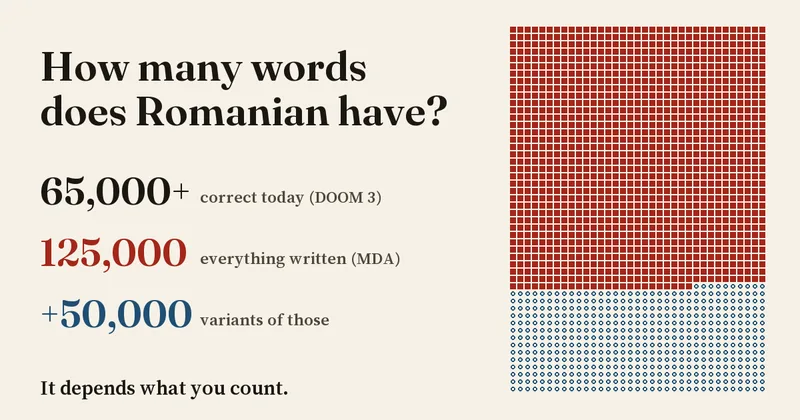
65,000 in the dictionary that decides what is correct, 125,000 in everything ever written, 175,000 if you add the variants.
Word origins
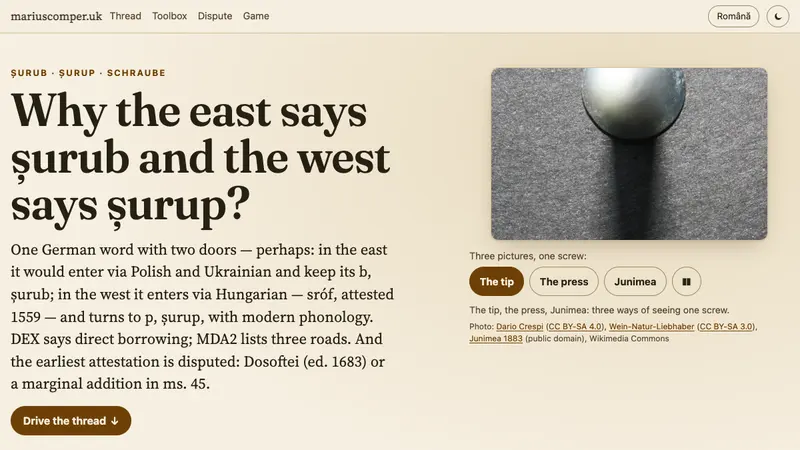
Șurub comes from German Schraube — the hypothesis says through two doors: east via Polish and Ukrainian, west via Hungarian, attested 1559.
Word origins
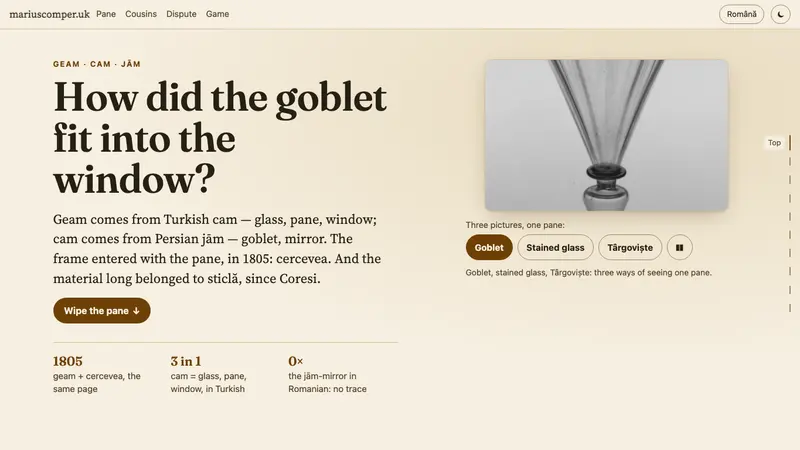
Geam comes from Turkish cam — glass, pane, window; cam comes from Persian jām — goblet, mirror.
Word origins
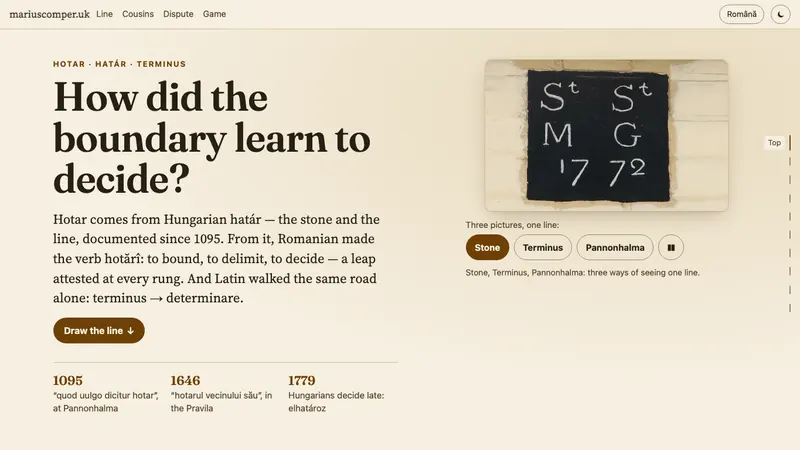
Hotar comes from Hungarian határ, documented since 1095. From it, Romanian made the verb hotărî: to bound, to delimit, to decide.
Meaning and use
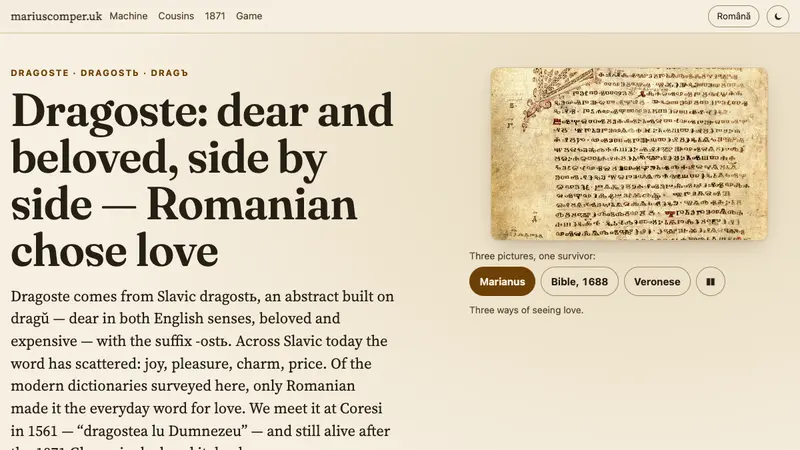
Dragoste comes from Slavic dragostь, from dragŭ «dear» + -ostь.
Meaning and use
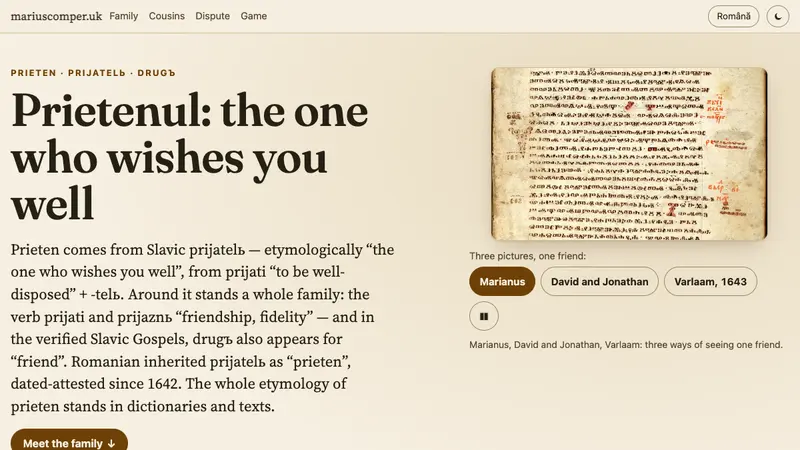
Prieten comes from Slavic prijatelь — etymologically “the one who wishes you well”.
Meaning and use
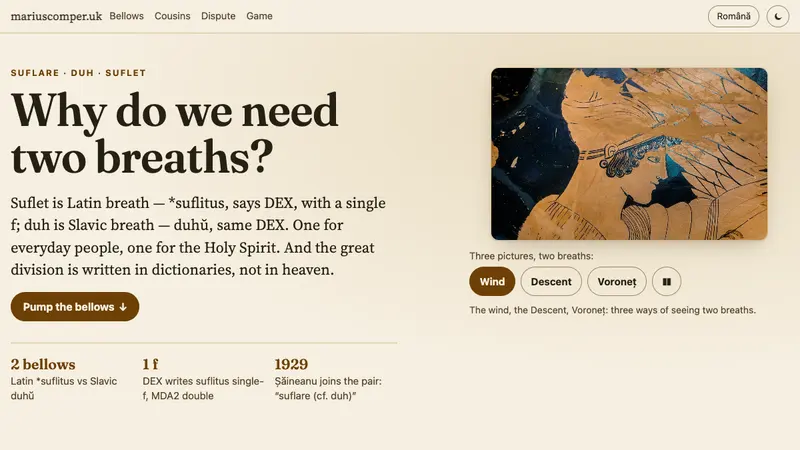
Suflet is Latin breath — *suflitus, says DEX; duh is Slavic breath — duhŭ, same DEX.
Word origins
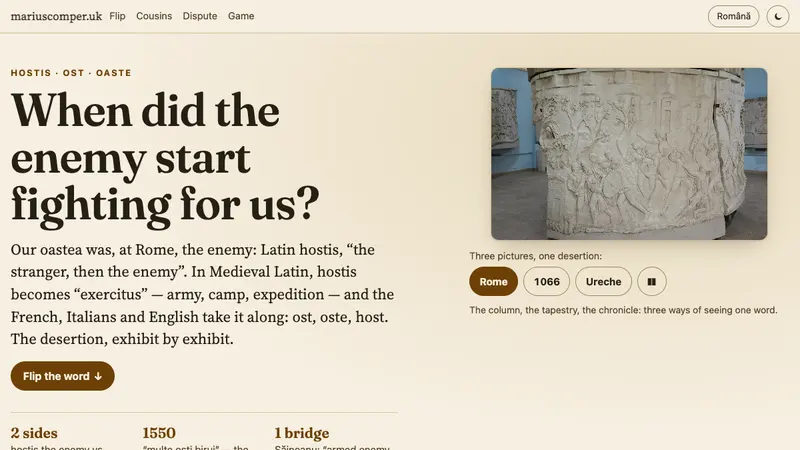
Our oastea was, at Rome, the enemy: Latin hostis, “the stranger, then the enemy”.
Meaning and use
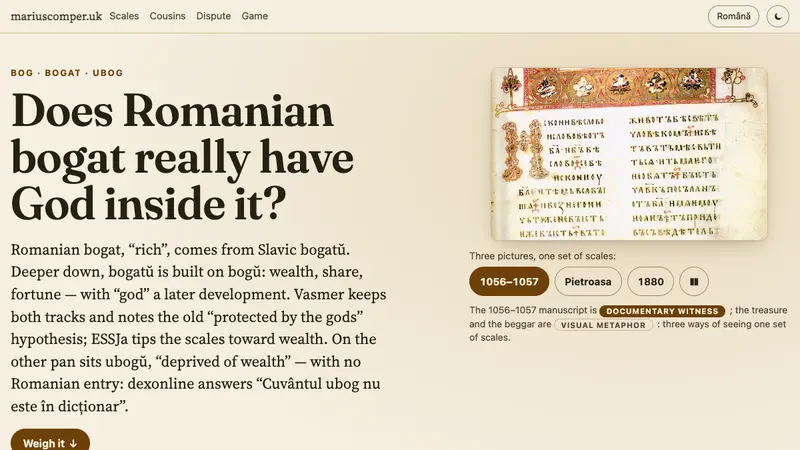
Romanian bogat comes from Slavic bogatŭ = bogŭ + -at-: wealth, share, fortune — “god” came later. Vasmer keeps both tracks; ESSJa puts its weight behind wealth.
Word origins
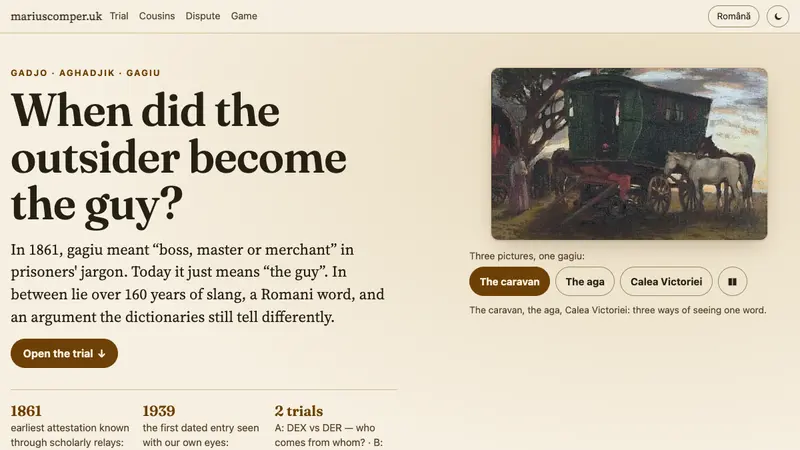
Gagiu shows up in Bucharest jargon as early as 1860–61.
Meaning and use
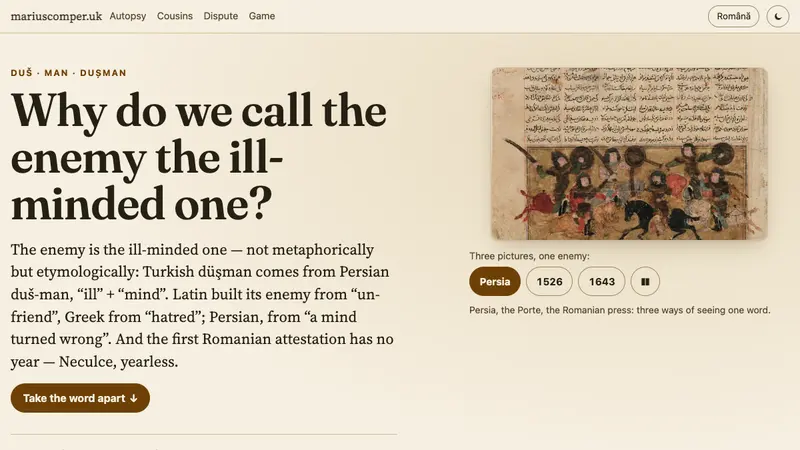
Romanian dușman came through Turkish from Persian, and its Iranian ancestor splits into “bad” and “thought”.
Meaning and use
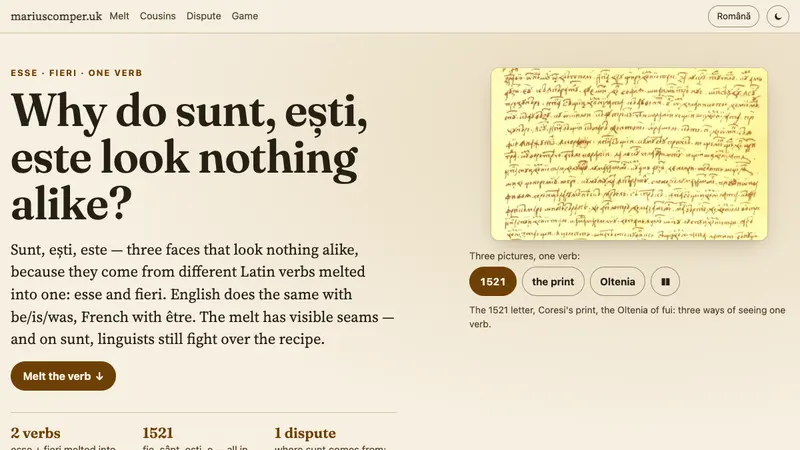
Sunt, ești, este, eram, fui, fi, fie — the forms of Romanian “a fi” come from two different Latin verbs, esse and fieri, melted into one.
Meaning and use
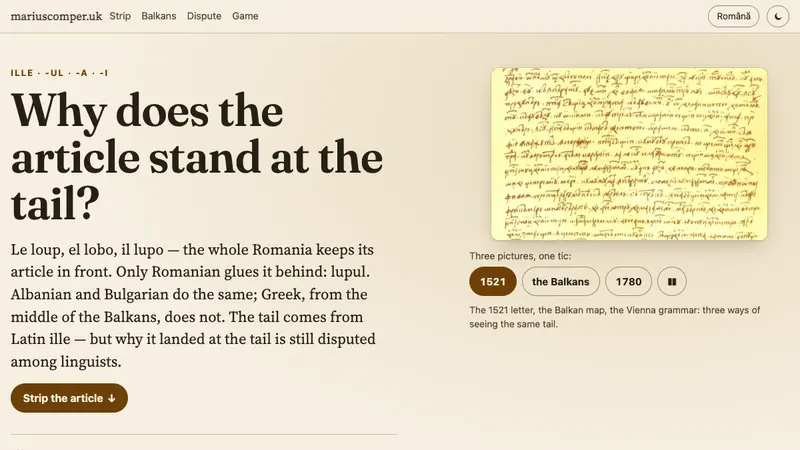
Every Romance language fronts its article — Romanian glues it behind: omul, lupul. Albanian and Bulgarian do the same, Greek does not.
Word origins
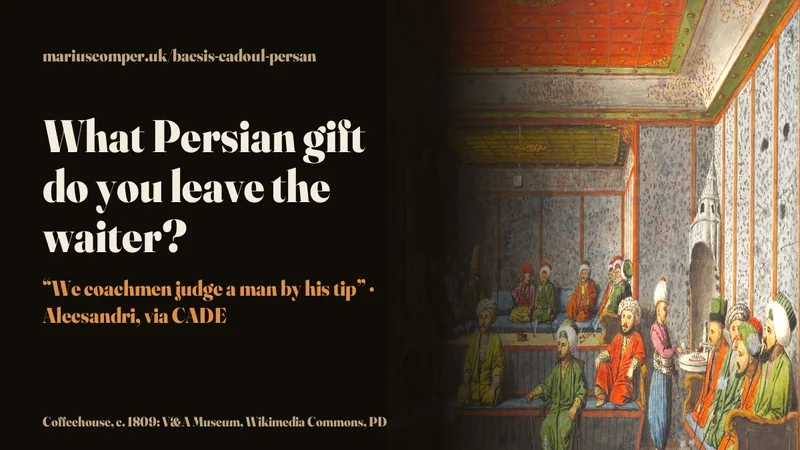
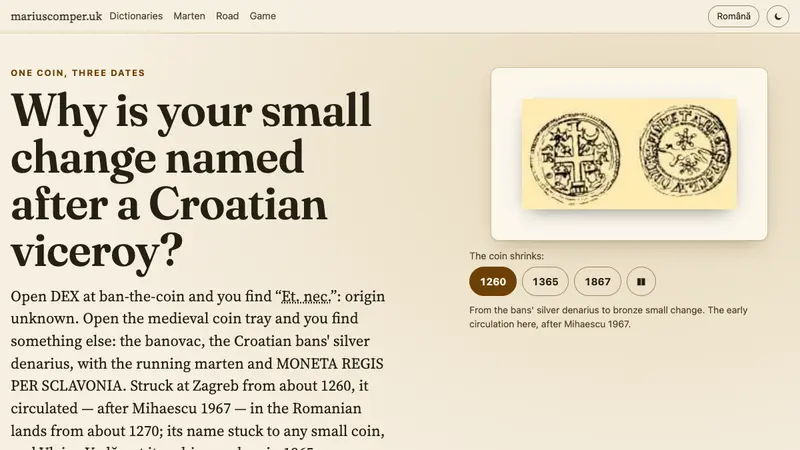
“Bacșiș” comes from Persian bakhshish, “gift”, through Turkish bahșiș — TDK's “coffee money”: one coin, five stops from gift to bribe, attested at Miron Costin.
Word origins
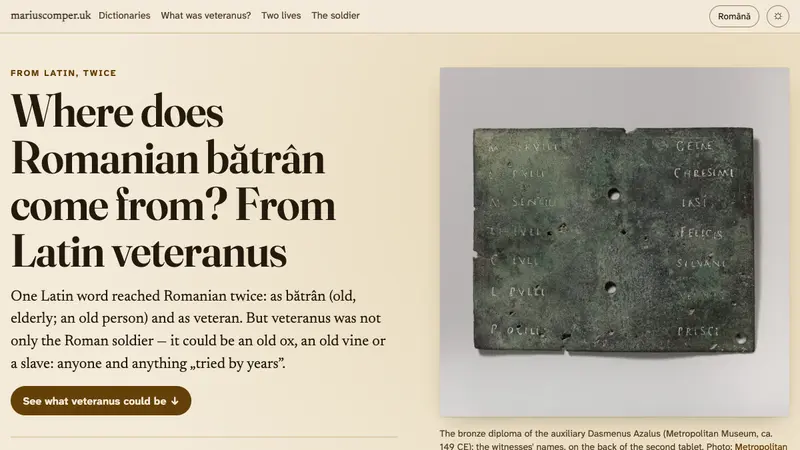
"Bătrân" comes from veteranus, the Latin adjective for old and tried — soldier, ox, vine, slave. The same word entered Romanian twice: bătrân and veteran.
Names and places
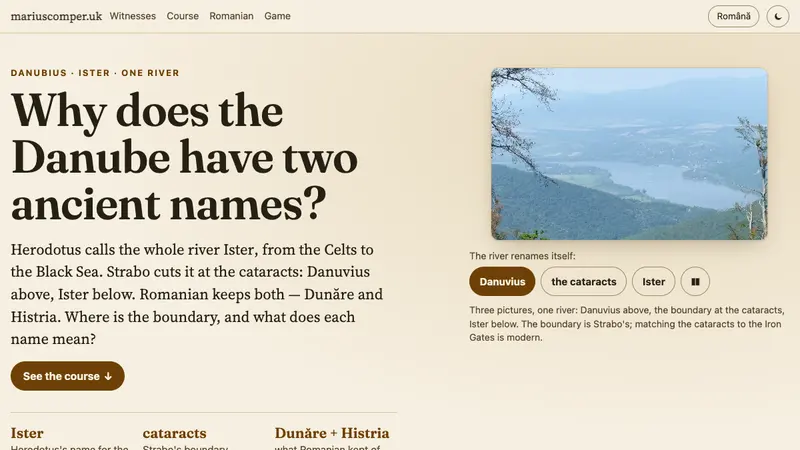
Herodotus calls the whole river Ister; Strabo cuts it at the cataracts, Danuvius above, Ister below.
Word origins
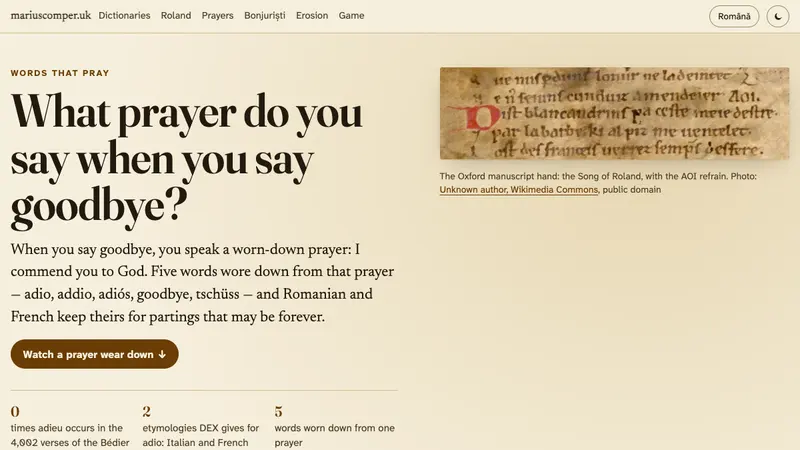
“Adio” is a worn-down prayer — I commend you to God — kin to addio, adiós, goodbye and tschüss, said when a parting might be forever.
Word origins
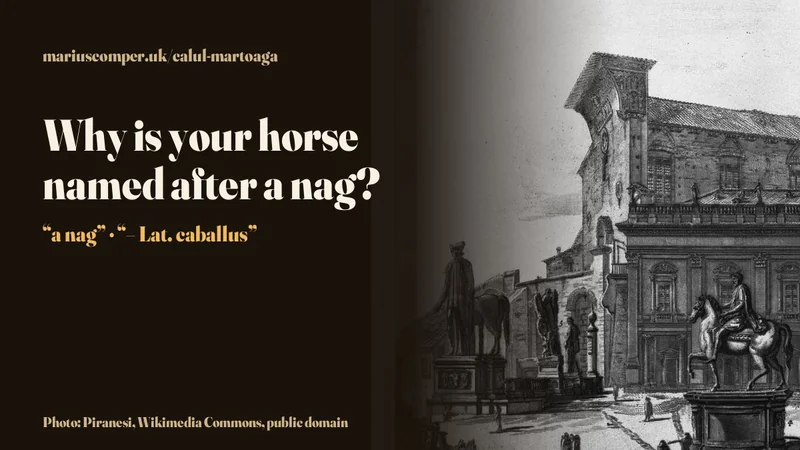
The Romanian horse-word comes from Latin caballus, “nag”: how a stable word beat Cicero's Latin in every Romance language, why the mare kept the noble word, and how English bought it back from books.
Meaning and use
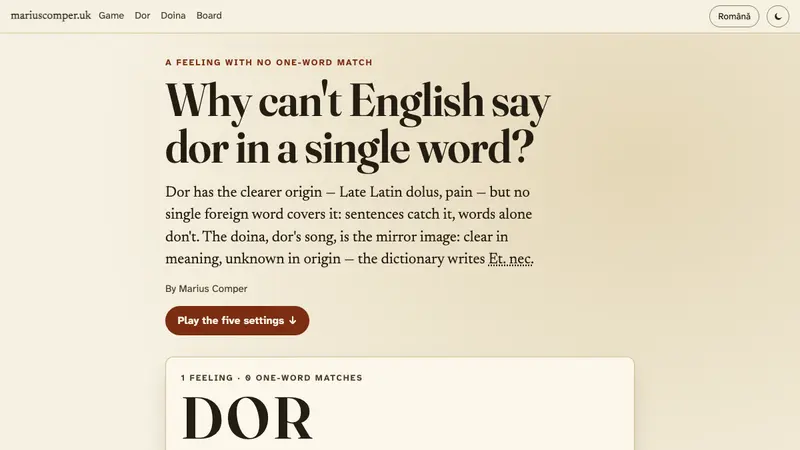
What “dor” means and how it renders in English: sentences catch it, no single word does.
Word origins
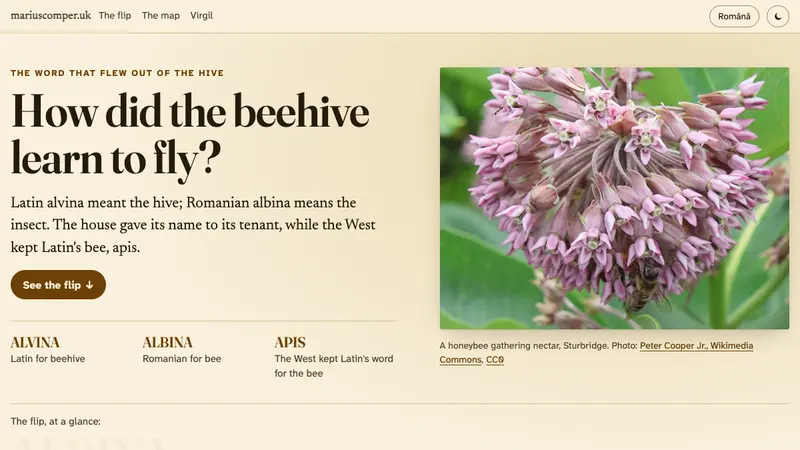
Romanian named its bee after her house: Latin alvina, the hive, became albina, the insect, while the West kept apis.
Names and places
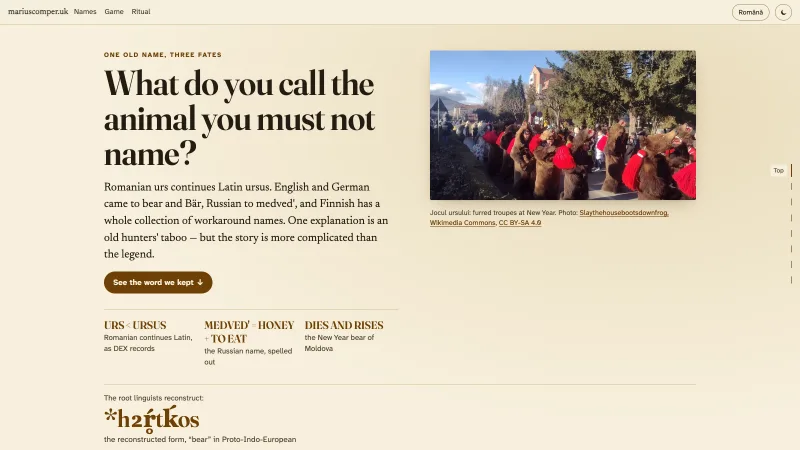
Romanian kept Latin ursus untouched, while the neighbours renamed their bear: medved', bear, Bär, otso.
Meaning and use
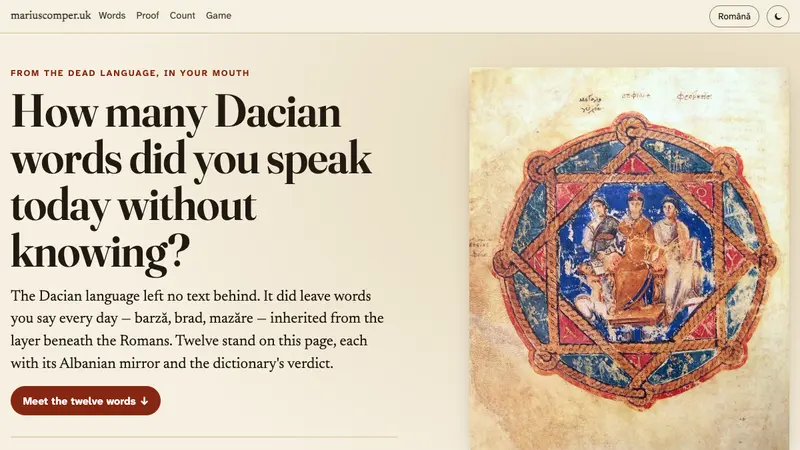
The Dacian language left no secure texts, but it left possible words: barză, brad, mazăre.
Meaning and use
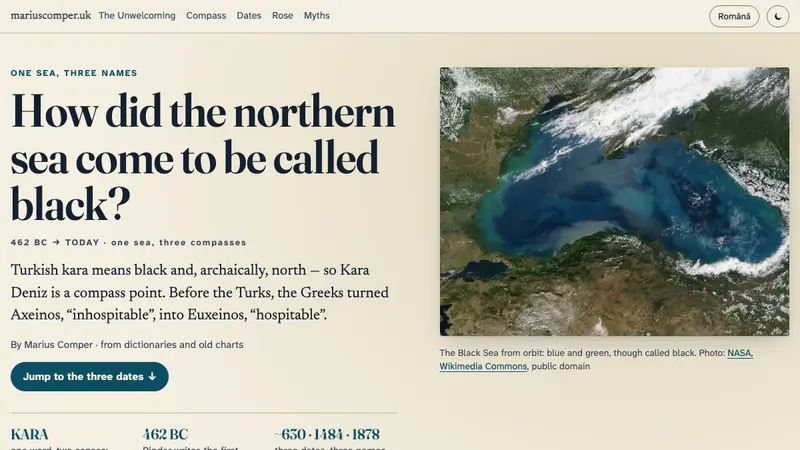
Why is the Black Sea “black”? One influential explanation says black stood for north — but the medieval documents complicate the story.
Names and places
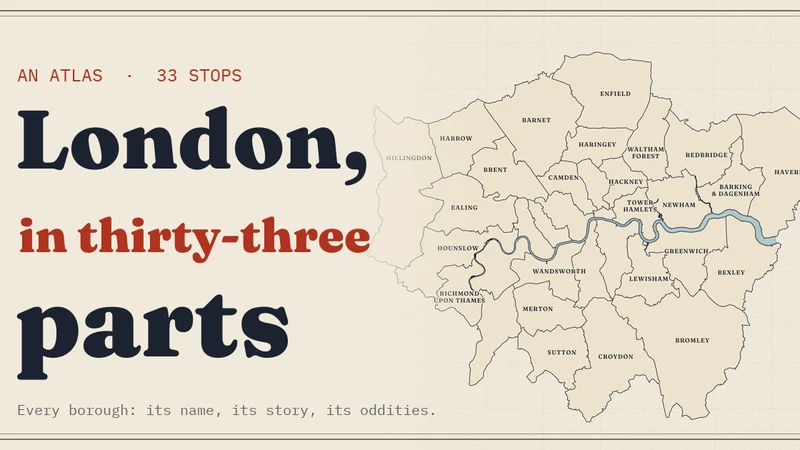
Ride a fictional Tube line through all 32 boroughs and the City: what each name meant in Old English, who built it, and the oddities it keeps — from Croydon's Mayday to Stamford Bridge being in Fulham.
Word origins
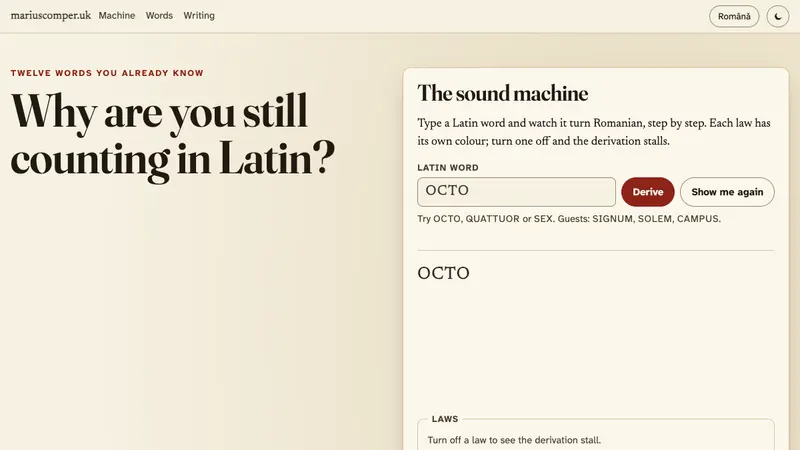
Type OCTO, get OPT: eleven numerals inherited from Latin, six sound laws you can turn off and on, one intruder, and three ways of writing a number, from wax tablets to comma-below ș.
Word origins
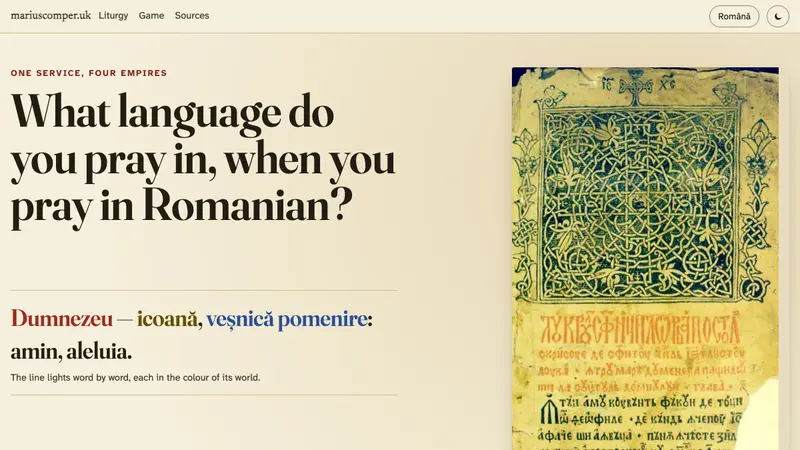
You pray in Romanian — but the words of prayer hold four strata: Latin, Greek arrived mostly via Slavonic, Slavic, and Hebrew arrived by a double route.
Names and places
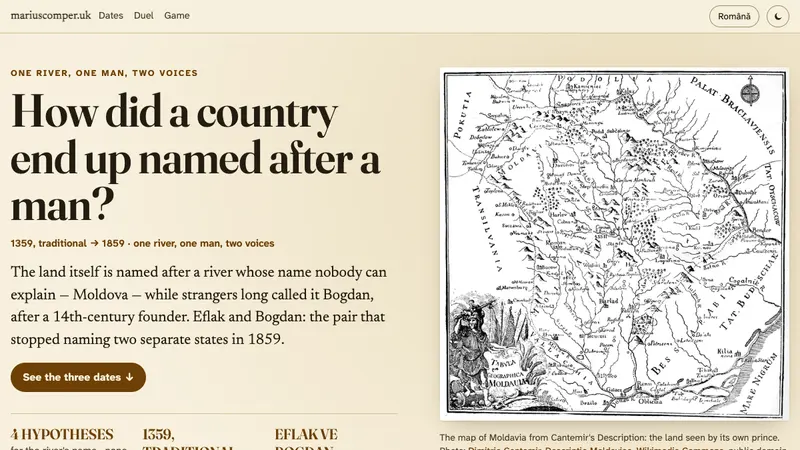
An unexplained river-name, a 14th-century founder, and the Ottoman pair Eflak ve Bogdan: two voices of one land, from 1359 to 1859 — with dated documents.
Names and places
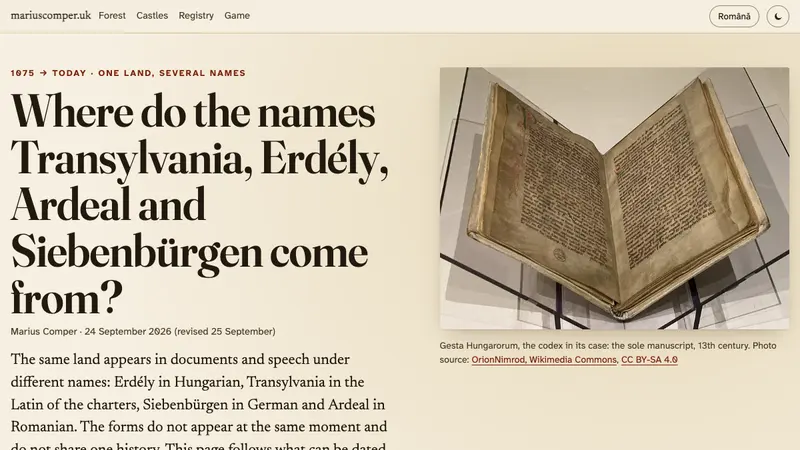
Where do Transylvania, Erdély, Ardeal and Siebenbürgen come from?
Word origins
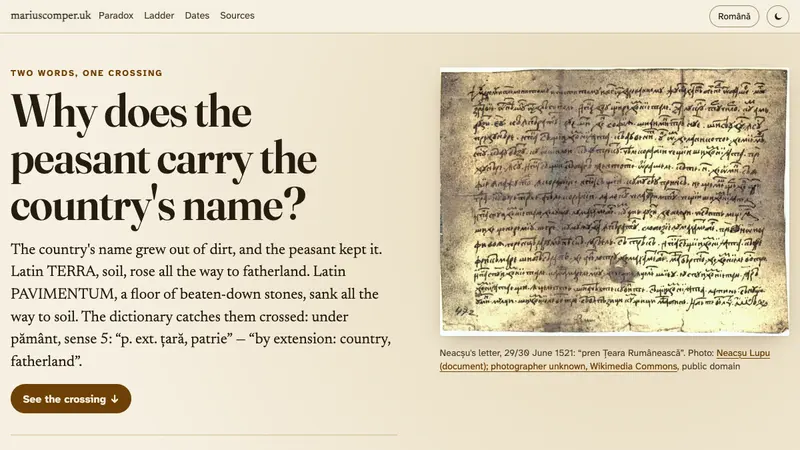
Țăran means a man of the țară: țară + -(e)an. Țara comes from Latin terra, pământ from Latin pavimentum — two crossed histories, with attestations from Hurmuzachi, Neacșu 1521, țărână c. 1550 and Moxa 1620.
Word origins
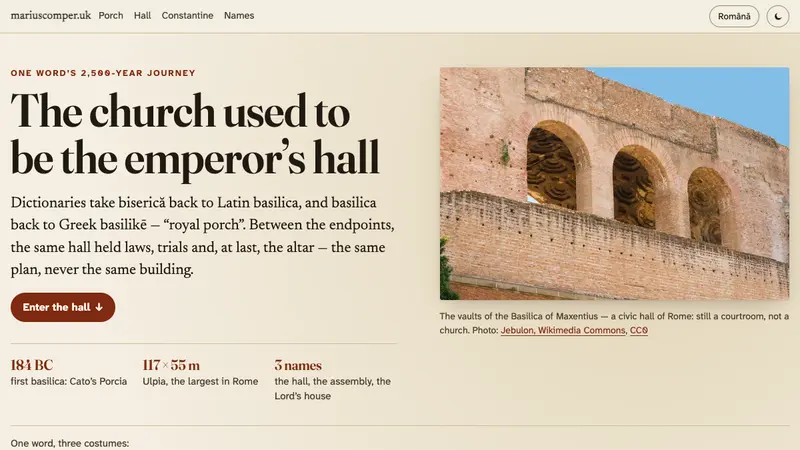
Romanian biserică descends from Latin basilica — but the word's history and the building's history run on different tracks.
Meaning and use
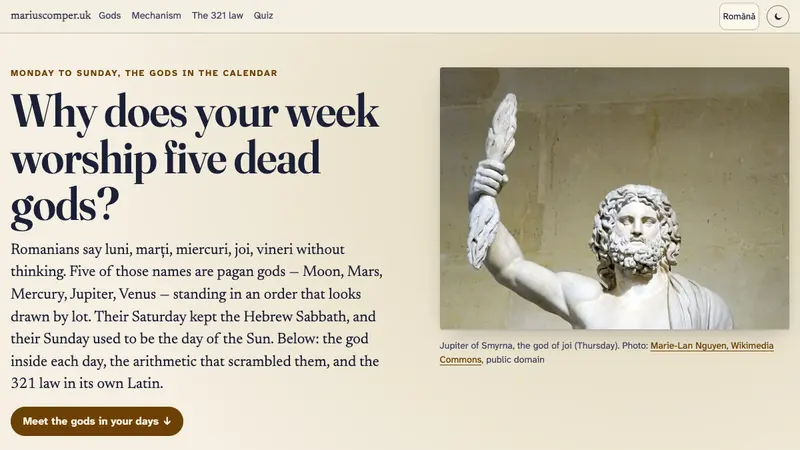
Luni = Moon, marți = Mars, miercuri = Mercury, joi = Jupiter, vineri = Venus.
Meaning and use
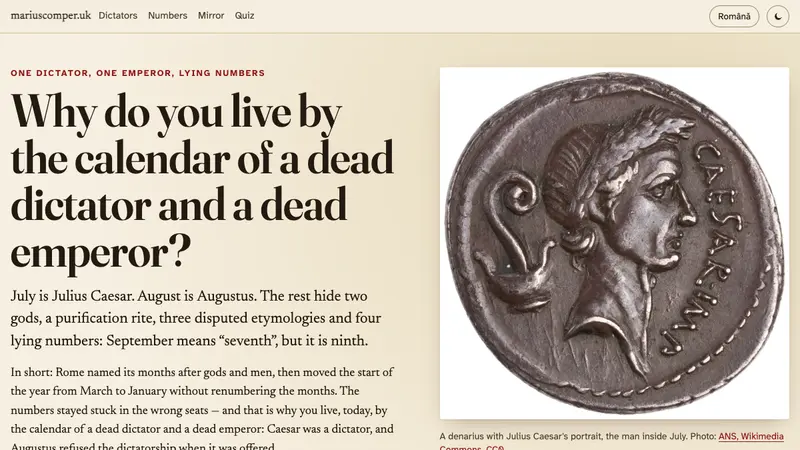
July comes from Julius Caesar, August from Augustus — one dictator, one emperor.
Meaning and use
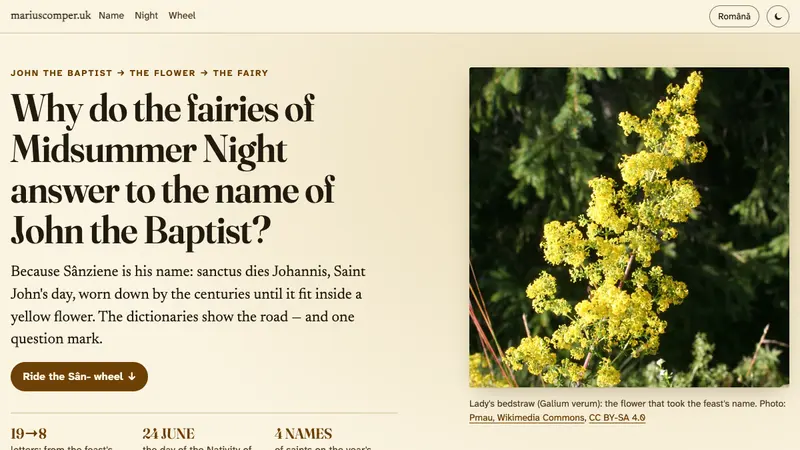
From SANCTUS DIES JOHANNIS, Saint John's day, to the Sânziene: the Sân- wheel with four saints (Sânziene, Sânpetru, Sântilie, Sâmedru), the three living senses — feast, flower, fairies — and the night of 23 June with bonfires, wreaths on water and the Drăgaica fair.
Word origins
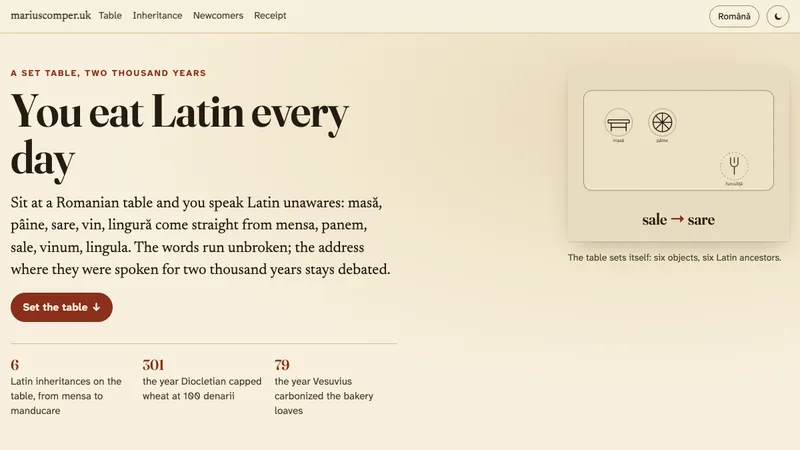
Masă, pâine, sare, vin, lingură: six Latin inheritances on the Romanian table, three newcomers and the Roman receipt of AD 301.
Meaning and use
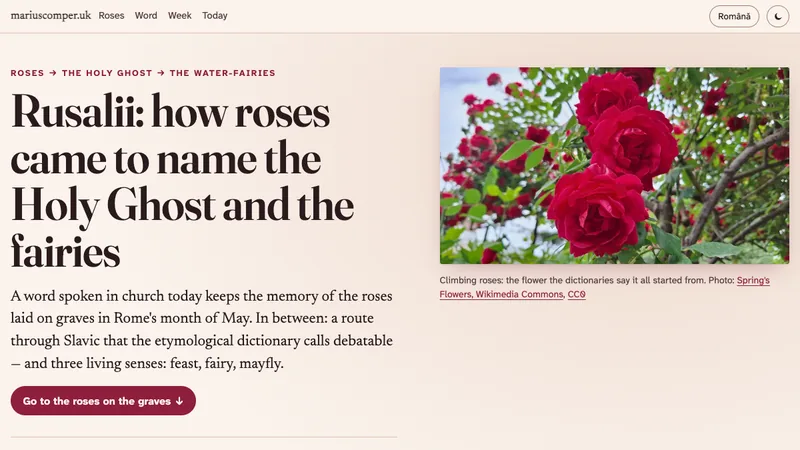
From ROSALIA, the Roman rose-feast on graves, to Rusalii: the debatable Slavic route, the three living senses — feast, fairy, mayfly — and the week between worlds, with the Saturday of the dead, walnut-branch Sunday, the healing călușari (UNESCO 2008) and the water rusalkas.
Meaning and use
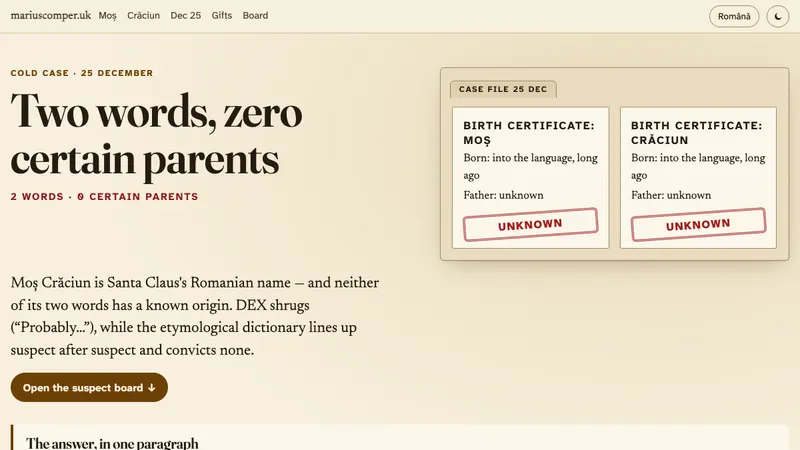
Neither moș nor Crăciun has a known origin: DEX shrugs, and the etymological dictionary lines up 18 suspects and convicts none.
Word origins
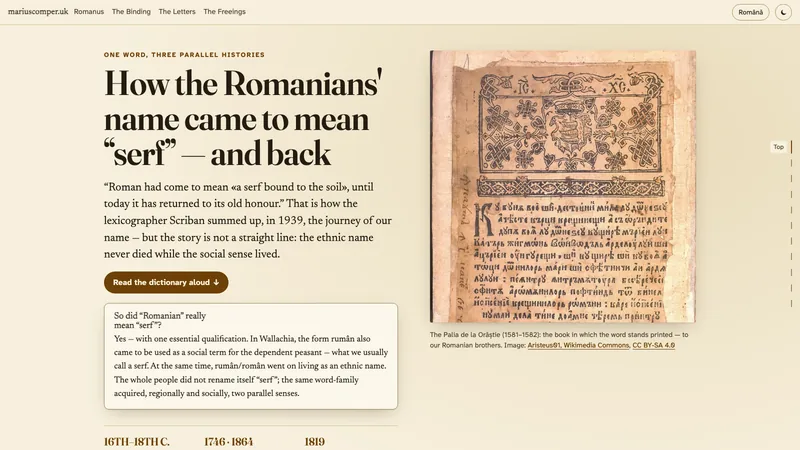
Romanus becomes rumân: an ethnic name and, in Wallachia, a social term for the dependent peasant. The ethnonym, the social status and the spelling — three parallel histories, with the 1613 deed and the 1746/1749 and 1864 thresholds.
Names and places
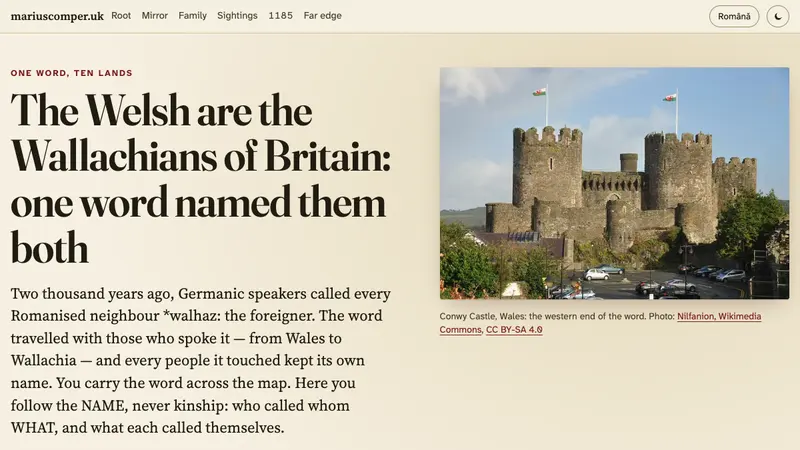
How Proto-Germanic *walhaz* became the name of the Welsh, the Vlachs, Wallonia and Wallachia — with a map, sources and the limits of certainty.
Word origins
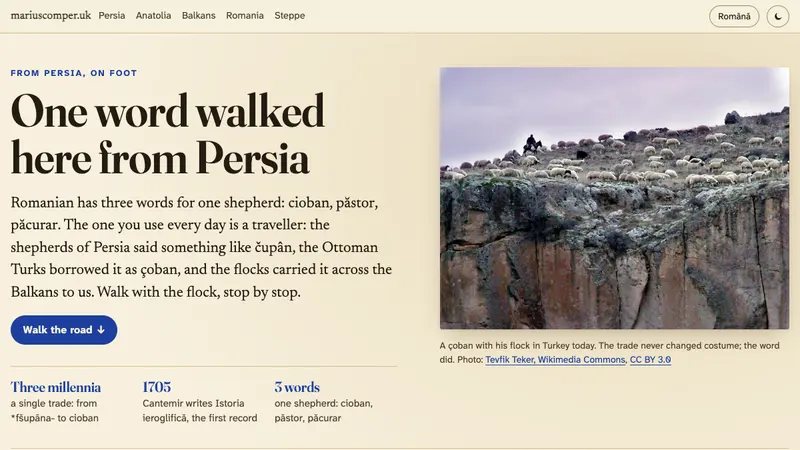
Cioban is Persian čupân, keeper of flocks, arrived via Turkish çoban and kept as the everyday word beside Latin-derived păstor and regional păcurar; three millennia of road from Persia to the sheepfold, with attestations and a living map.
Meaning and use
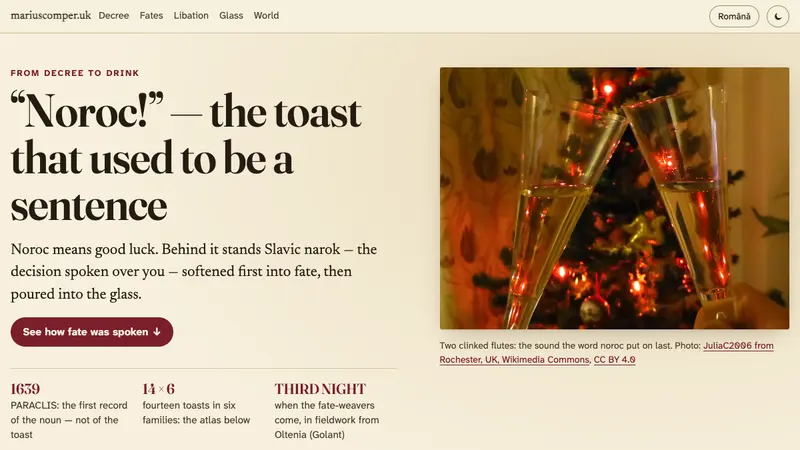
Noroc is Slavic narok, "that which was spoken", softened into good luck and then into the toast itself; the clinked glass runs from Greek libations to Prost, Şerefe and cin cin.
Meaning and use
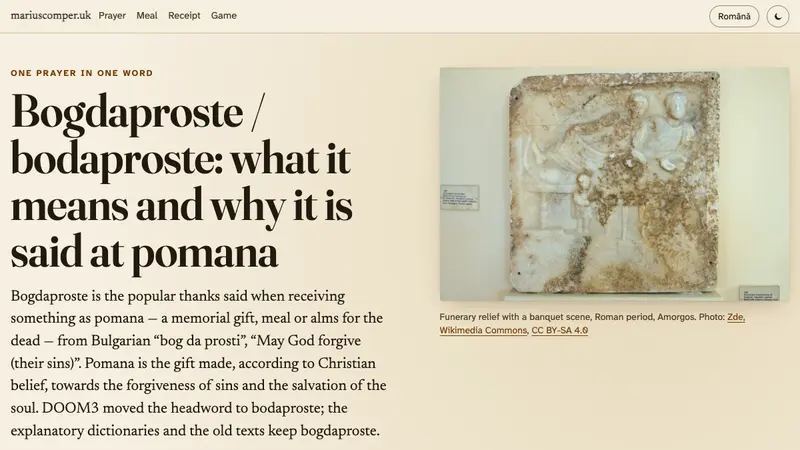
Bogdaproste is the thanks said when receiving pomana, memorial alms for the dead, from Bulg. «bog da prosti», «May God forgive»; DOOM3 moved the headword to bodaproste.
Word origins
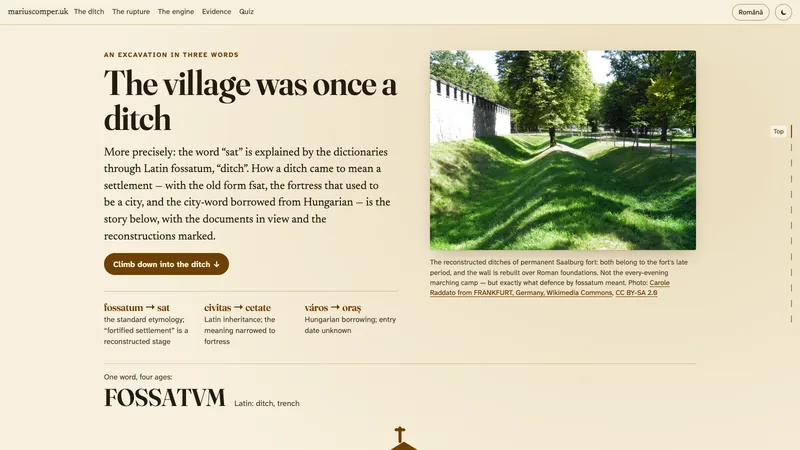
The word “sat” comes from Latin fossatum, “ditch” — but the road to “settlement” is reconstructed, not a birth certificate.
Word origins
Where Romanian farfurie, “plate”, comes from: Ottoman farfuri, “porcelain”, and before it Persian faghfūr, the title given to the emperor of China.
Meaning and use
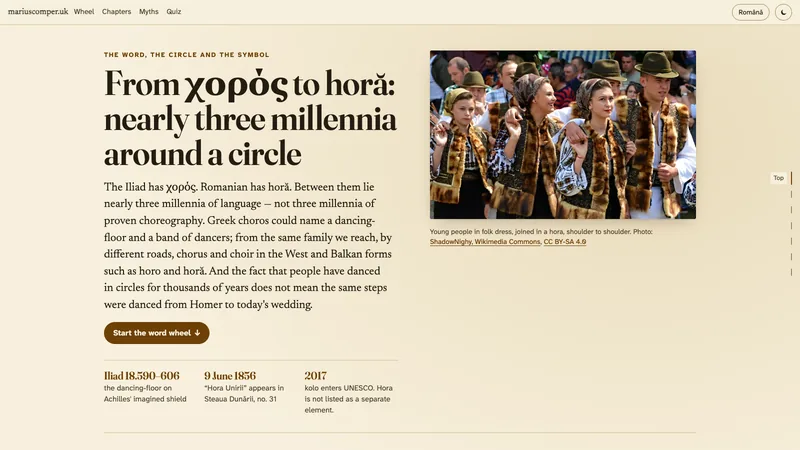
Three histories meeting in the hora — the word, the circle, the symbol — from choros on Achilles' shield through the Balkans, Hora Unirii and the horah, to 1989.
Meaning and use
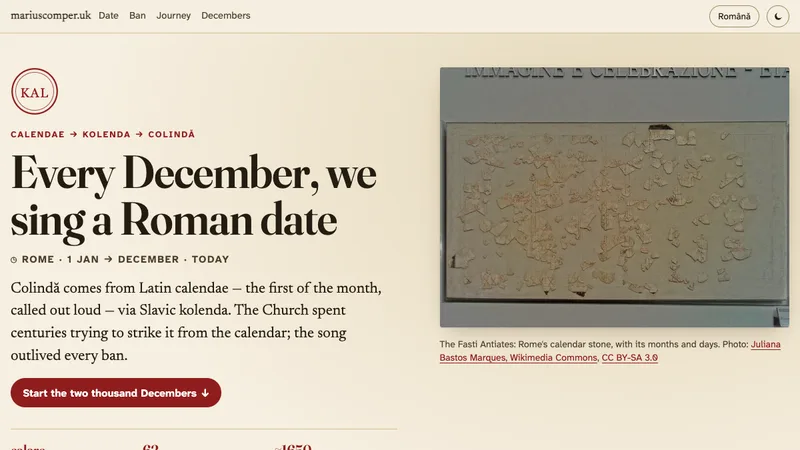
Colindă comes from Latin calendae, via Slavic kolenda: a Roman 1 January date, banned by synods for centuries and still sung every December.
Word origins
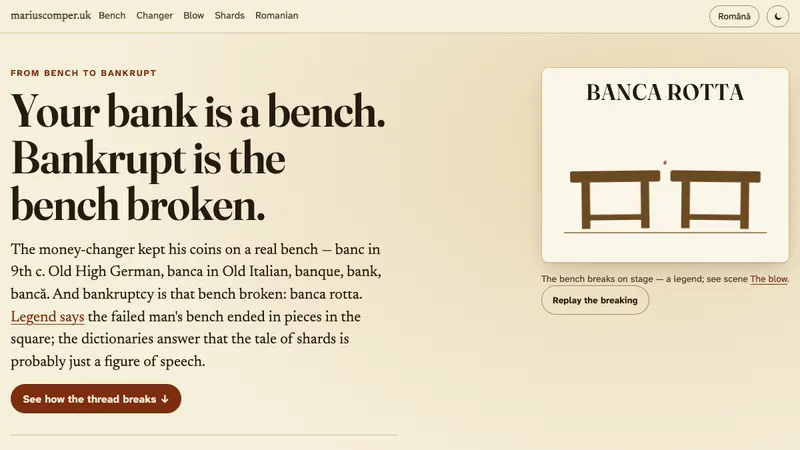
The money-changer's banca was a real bench, and bancruta is that bench broken: Italian banca rotta.
Word origins
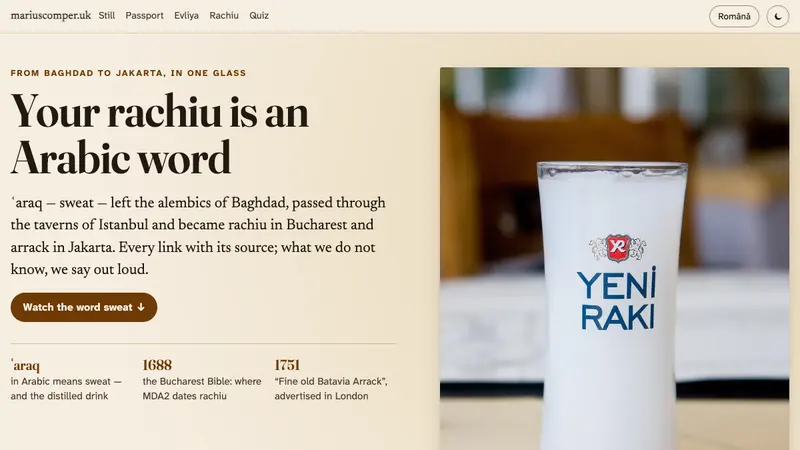
Rachiu comes from Turkish rakı — possibly via Serbian rakija —, from Arabic ʿaraq — sweat —: eight documented stops, from the 1688 Bible to Batavian arrack, a flying map, a form finder and a game about words and drinks.
Word origins
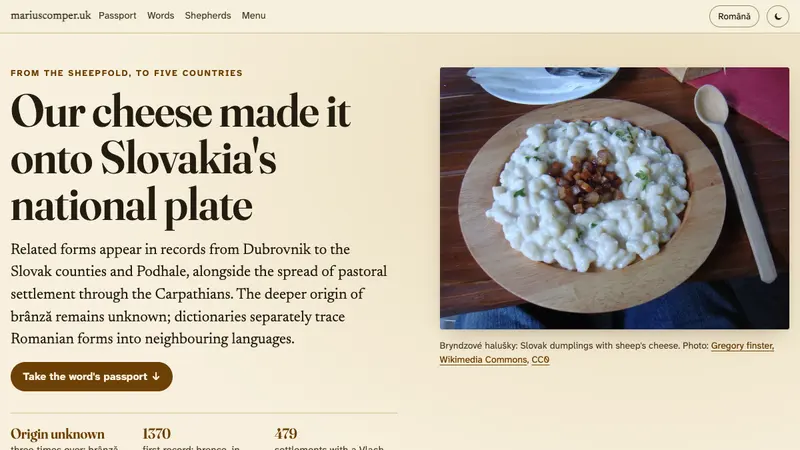
How Vlach shepherds carried three Romanian words over the Carpathians: brânză, turned bryndza in halušky, baci, the head shepherd from Poland to Moravia, and urdă, with five etymologies and no winner.
Meaning and use
Strigoi inherits Latin through striga, while vampire is a Slavic word of disputed origin that crossed Europe inside the Austrian reports on the 1725 and 1732 exhumations and through the European press, returning to Romanian as a French and German neologism.
Word origins
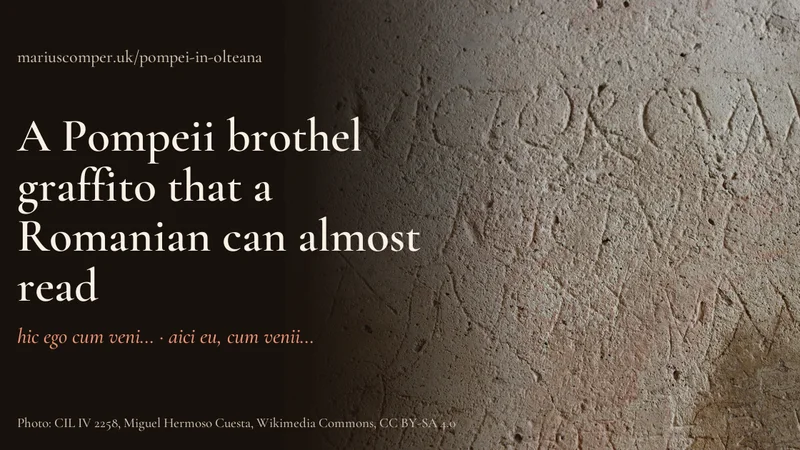
A line scratched on the wall of Pompeii's brothel, hic ego cum veni futui, taken word by word into Romanian: four words survived, one only looks alike, three were lost.
Wordplay
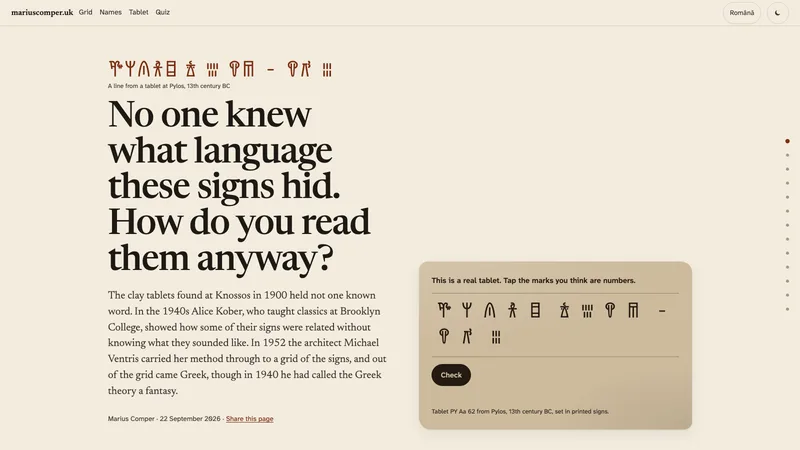
The clay tablets of Knossos held not one known word. Alice Kober, who taught at Brooklyn College, showed how their signs were related without knowing their sounds; in 1952 Michael Ventris got Greek out of the grid, though he had once called it a fantasy.
Speech and sounds
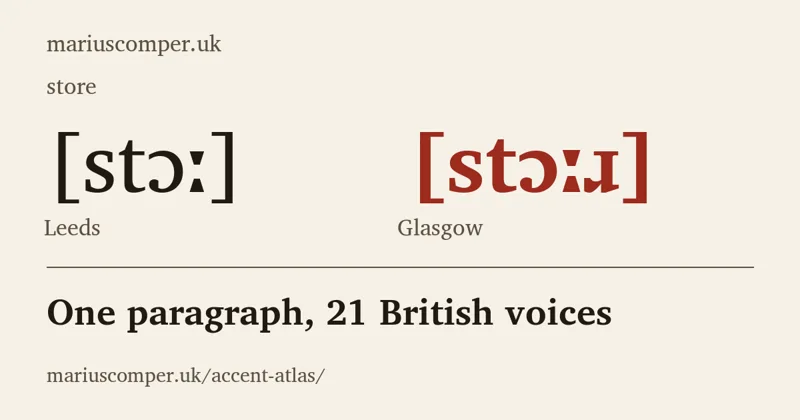
21 speakers across Britain read the same paragraph: pick a town and watch six words change shape in phonetic transcription.
Writing and texts
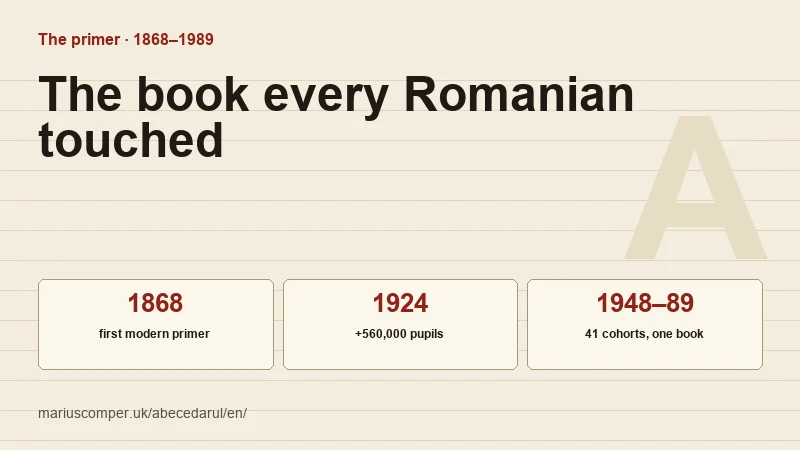
For 41 years, every child in Romania learned from the same book.
Writing and texts
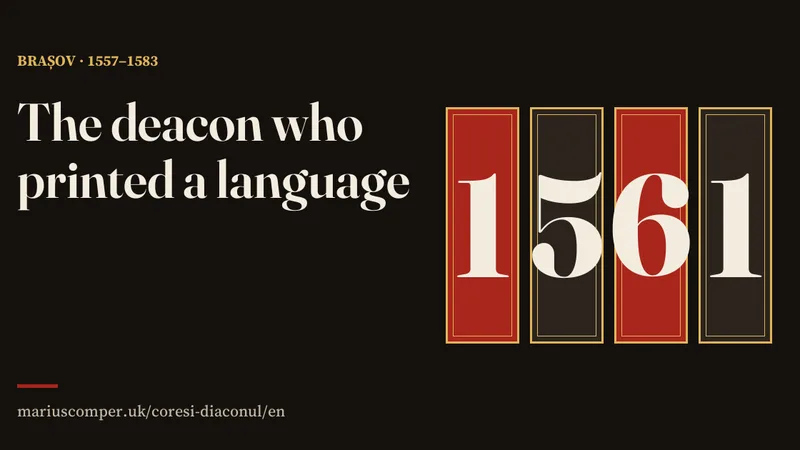
Deacon Coresi's Brașov press (1557–1583) put Romanian into print: the shop, the ten Romanian books with BRV numbers, and the shelves where the surviving copies sit today, shelfmark by shelfmark.
Speech and sounds
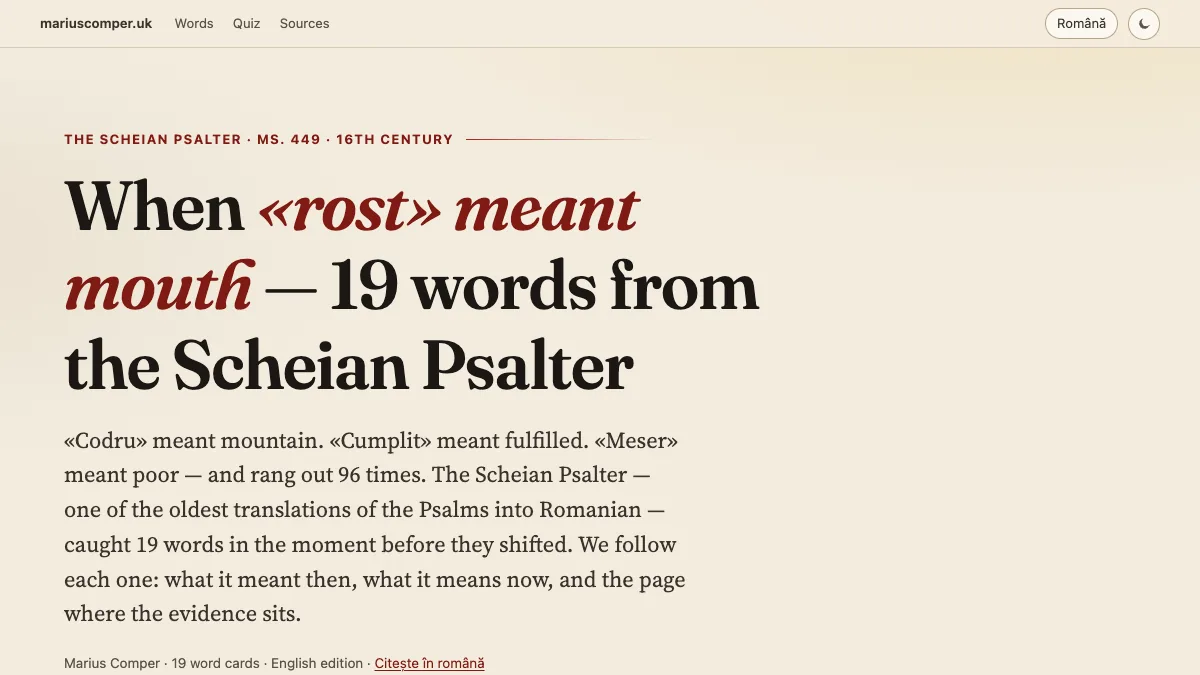
«Rost» once meant mouth, «codru» once meant mountain. 19 words from the Scheian Psalter, with their then-meaning, now-meaning and evidence on show.
Writing and texts
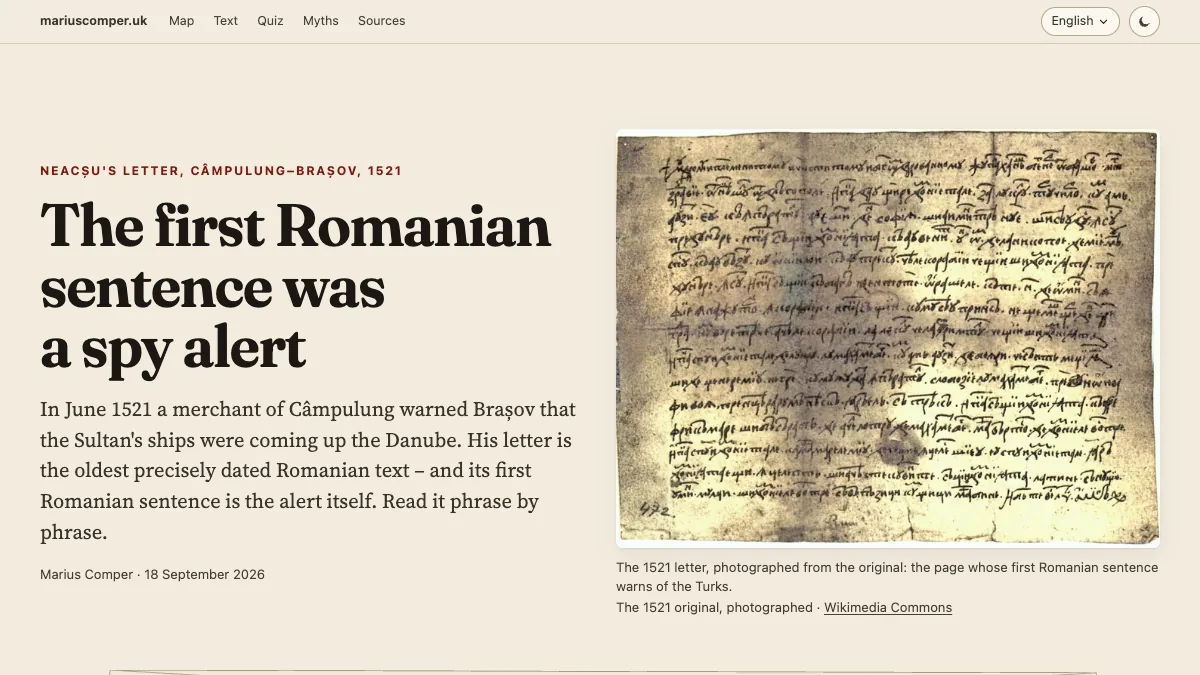
The oldest precisely dated Romanian text is a spy warning from Câmpulung to Brașov.
Speech and sounds
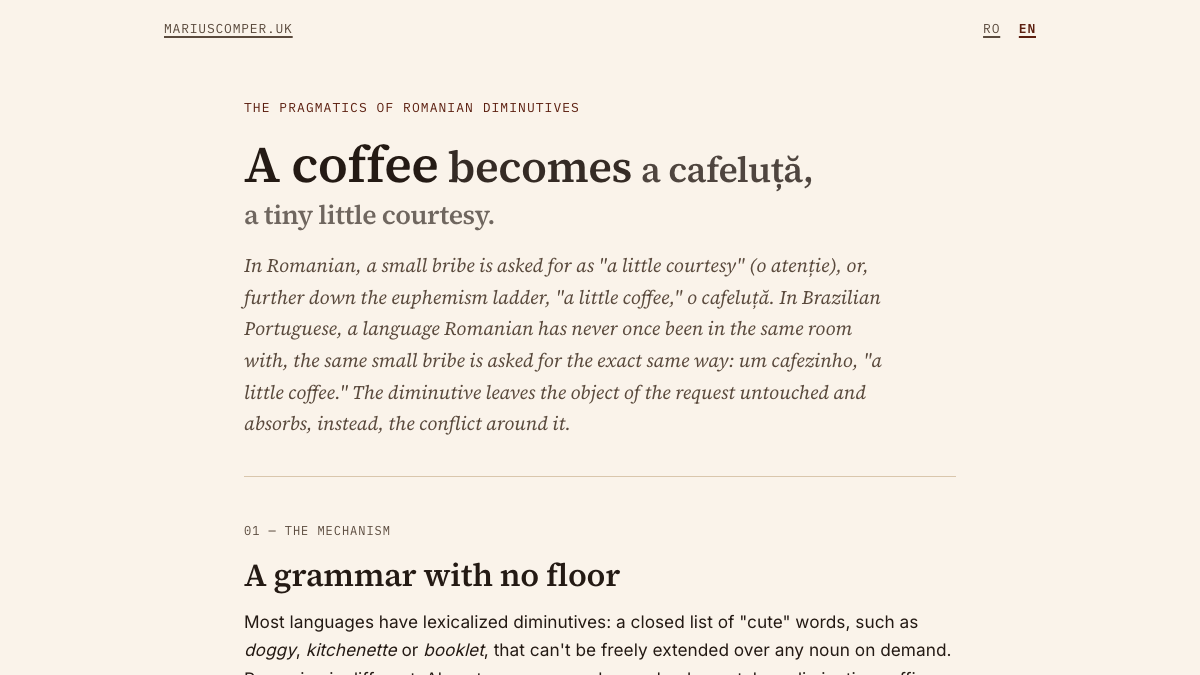
A Romanian diminutive leaves the object of a request untouched and absorbs, instead, the conflict around it. The phonetics of smallness, its reverse into contempt, contraband-coffee history, and an eleven-culture comparative atlas, with a word-by-word dissectable simulator.
Wordplay
One-eyed Pazvante, Prince Reed, a flea shod in iron.
Writing and texts
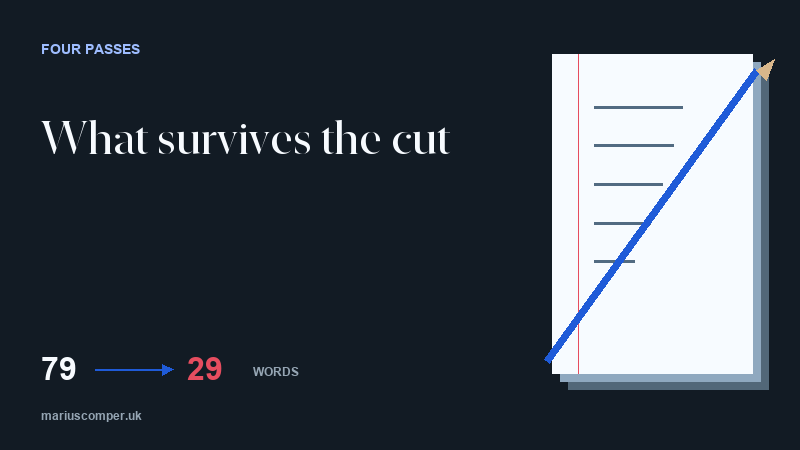
A fictional paragraph goes through four revisions and contracts from 79 words to 29. Each pass reveals what leaves: emotional labels, repeated explanation, slowing setup and a weak final image.
Names and places
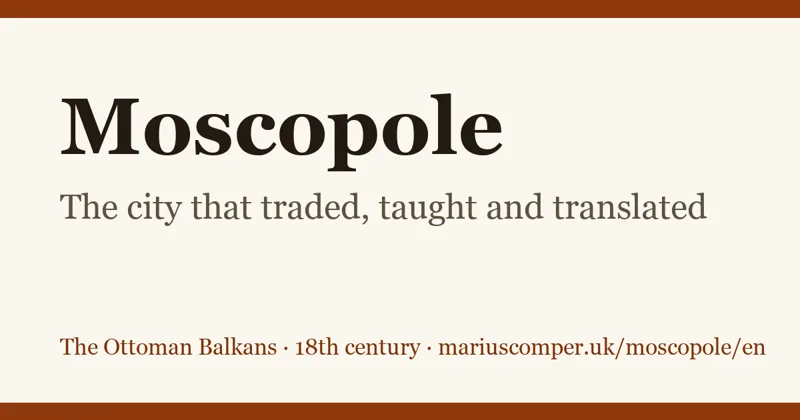
Moscopole (Moschopolis, today Voskopoja) was a major Aromanian-speaking commercial and educational centre in the 18th-century Ottoman Balkans.
Meaning and use
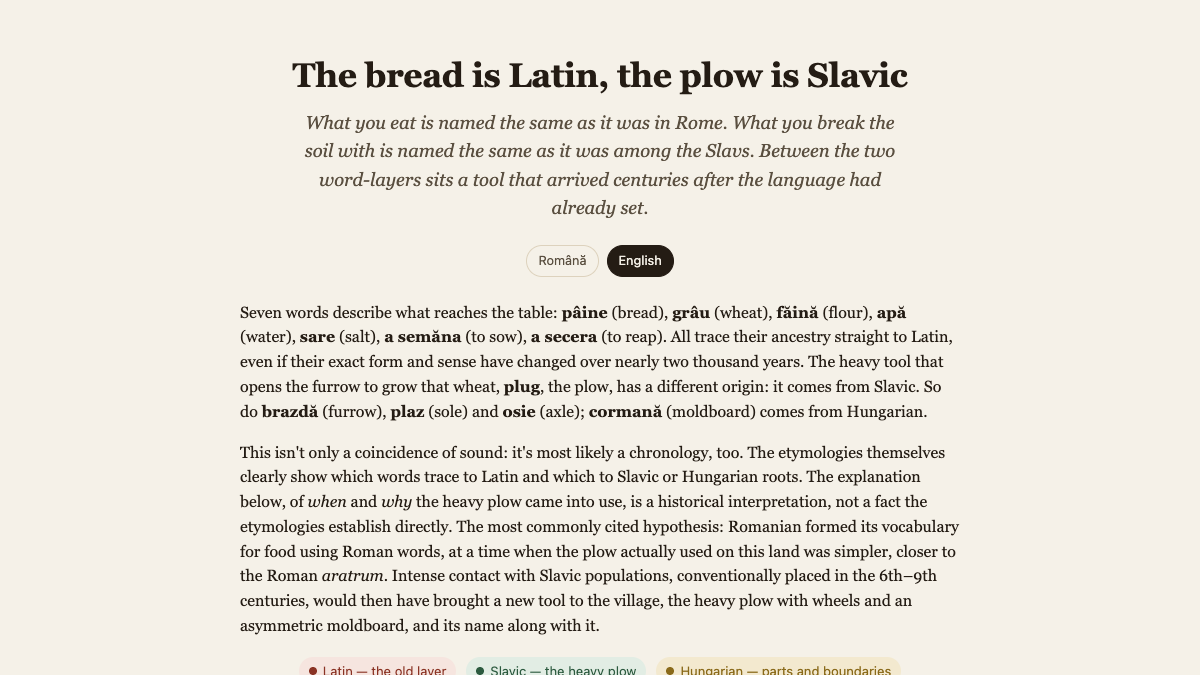
Romanian's basic food words trace to Latin. The heavy medieval wheeled plow's parts are mostly Slavic or Hungarian.
Word origins
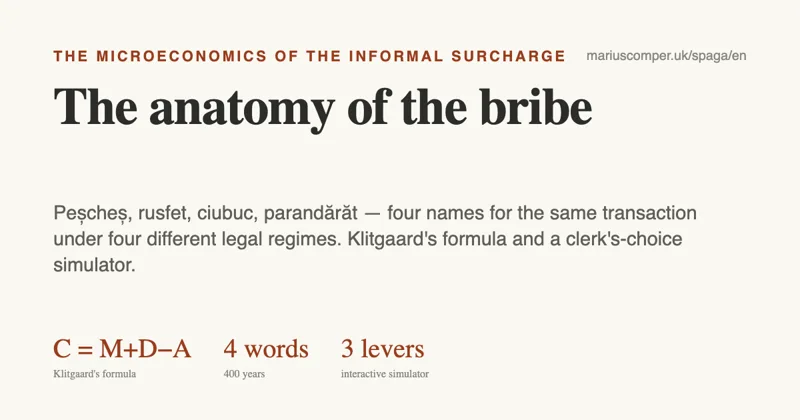
Four words, four legal regimes, one transaction: peșcheș, rusfet, ciubuc, parandărăt.
Writing and texts
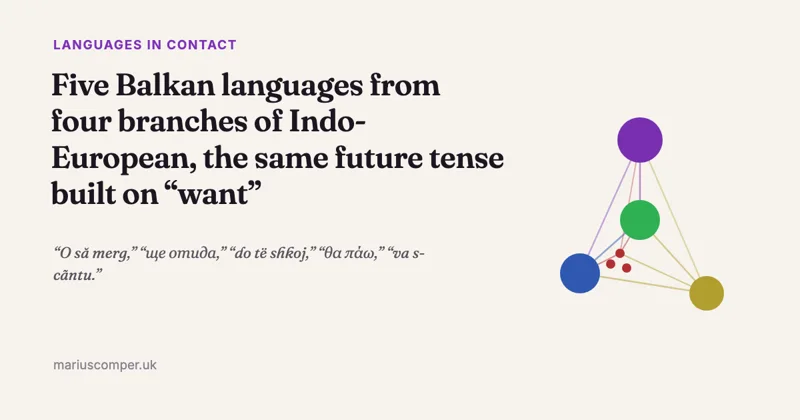
Romanian, Bulgarian, Albanian, Greek and Aromanian build their future tense with the same grammatical mechanism, from a verb meaning to want, despite coming from four unrelated language families.
Speech and sounds
At the end of her monograph on the absolute construction, Antonia Ruppel describes teaching Latin and hearing herself explain the ablative absolute exactly as it had been explained to her at eleven — the method she criticises at the start of the same book.
Names and places
In Bod, in Feldioara, in Prejmer, the valley-floor villages have carried German and Hungarian names for centuries; above them, on the slopes and pastures, almost everything is Romanian.
Names and places
Romania's ten longest rivers: eight had their names written down before AD 600, centuries before any present-day village is mentioned. Of the next 109 rivers assessed, six.
Names and places
In 1886 Marian printed the first large collection of Romanian folk charms. In 43 of 56 texts in the main collection the patient is named.
Names and places
In 1882 Simion Florea Marian read at the Academy the first Romanian book on colour, dyeing and custom. Wool turns red only after it has been yellowed.
Names and places
Romanian has words for your child's in-laws, your godchild and your co-godparent, which English cannot say, and no word for an elder brother or a maternal uncle, which 70% of the world's languages have.
Word origins
"Dumneavoastră" comes from "domnia voastră" — an old noble title compressed into a word said every day. Only 15 of the 207 languages coded by the World Atlas of Language Structures make more than one politeness distinction for "you."
Speech and sounds
US birth records contain 31,904 distinct baby-name spellings in 2024, but a phonetic algorithm reduces them to 3,998 sounds.
Speech and sounds
Romanian is the only Romance language that says da from Slavic: in CoRoLa da occurs 11,847 per million in writing and 14,212 in speech, and among the top 10 words 9 are Latin, one is Slavic.
Word origins
Like radioactive isotopes, words have a measurable half-life: words spoken 100 times more often evolve 10 times more slowly.
Meaning and use
Romanian's neuter gender has no shape of its own: masculine singular, feminine plural. 48 of 52 loanwords checked landed exactly there.
Speech and sounds
Vocal folds produce only a raw drone: what we hear as speech is a chord of two frequencies.
Word origins
The biomechanical cost of typing in Romanian: 1.38 kilometers traveled by fingers for every 10,000 words, and a 57% workload asymmetry on the left hand.
Speech and sounds
Linguist Dan Ungureanu argues that Romanian is a northern-Italian Latin that split off after AD 500, with almost no word provably Dacian.
Wordplay
The manuscript of the poem “The Battle of Maldon” burned in 1731. The poem is still read because somebody had copied it out by hand seven years earlier, and who that was is still unsettled.
Wordplay
Twenty-four rules, each a documented sound change, get forty Romanian words out of their Latin etymons.
Names and places
8,560 Romanian given names and surnames from Wiktionary, with 19 extended explanations.
Names and places
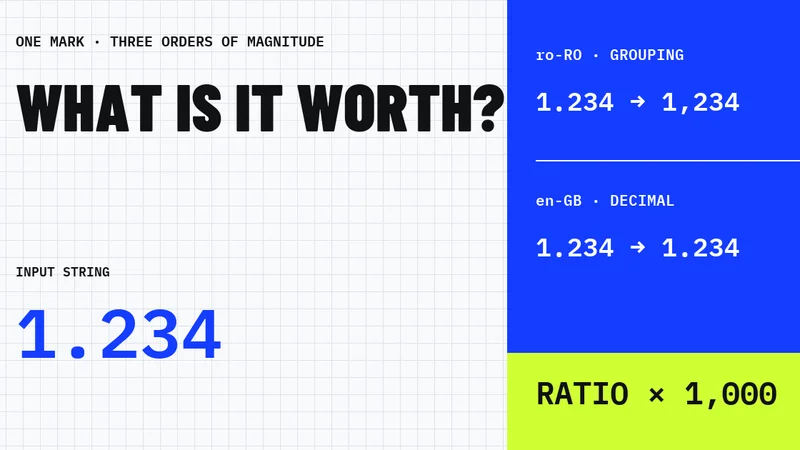
The same numeric string can mean 1,234 or 1.234, depending on its locale convention.
Wordplay
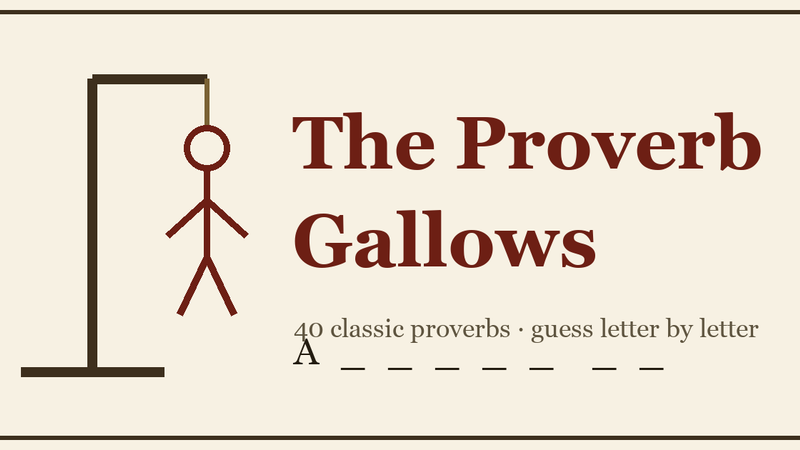
A word game built on folk proverbs: guess the letters, watch the gallows grow and learn each proverb's meaning as you win.
Wordplay
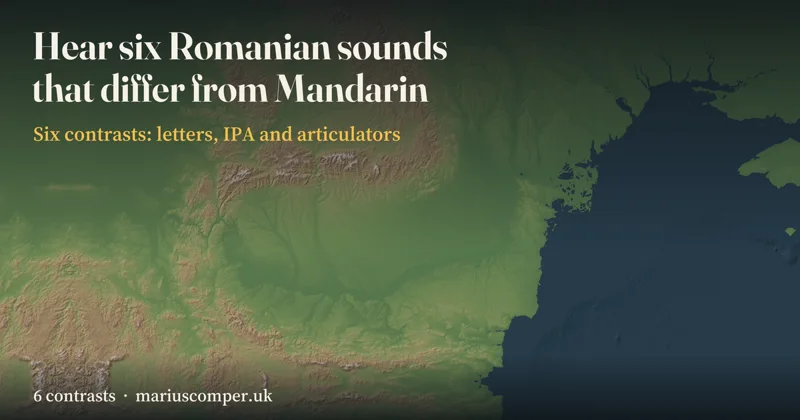
Compare six Romanian sound contrasts with Mandarin, using IPA and explanations of tongue and lip position.
Speech and sounds
Dacia 106, the 587 shout, Neacșu 1521, Vienna 1780.
Speech and sounds
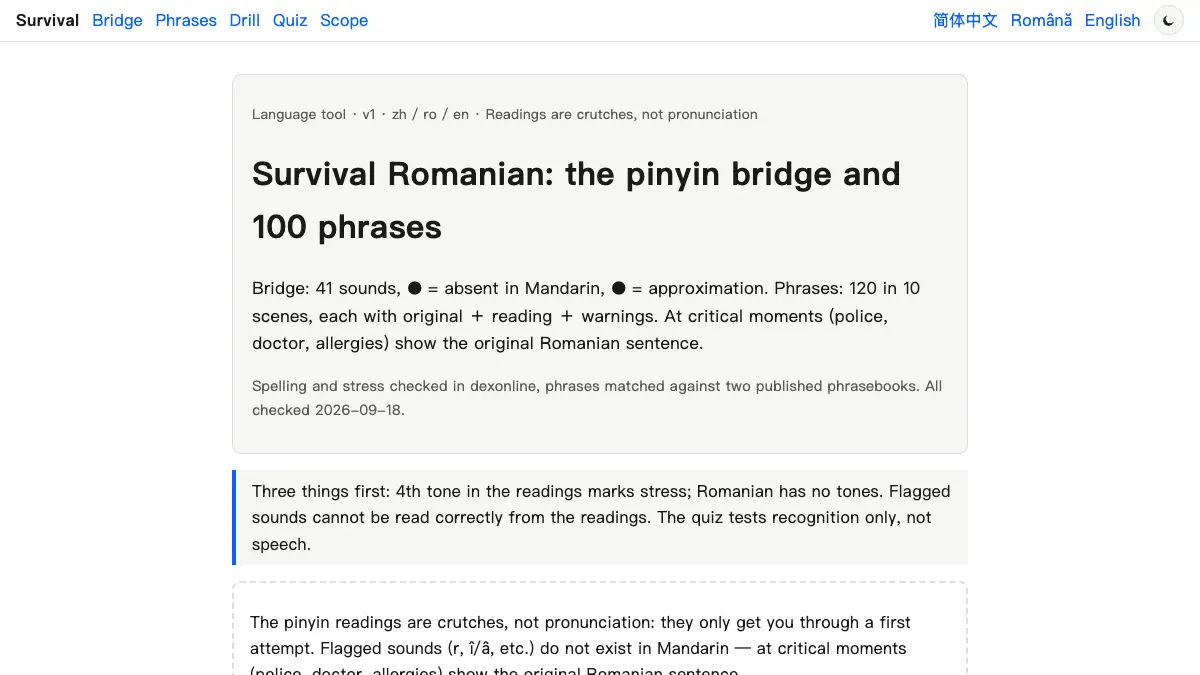
Learn 120 Romanian phrases for ten everyday situations, with Chinese translations and Pinyin reading guides.
Writing and texts
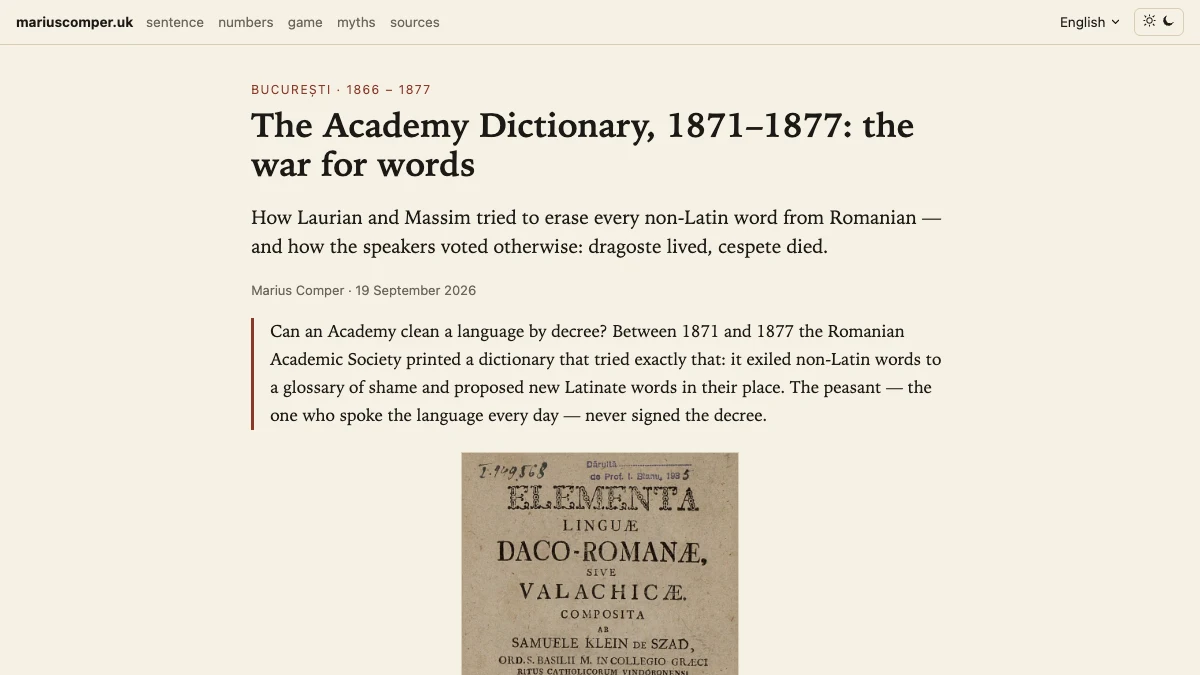
Laurian and Massim tried to erase every non-Latin word from Romanian.
Names and places
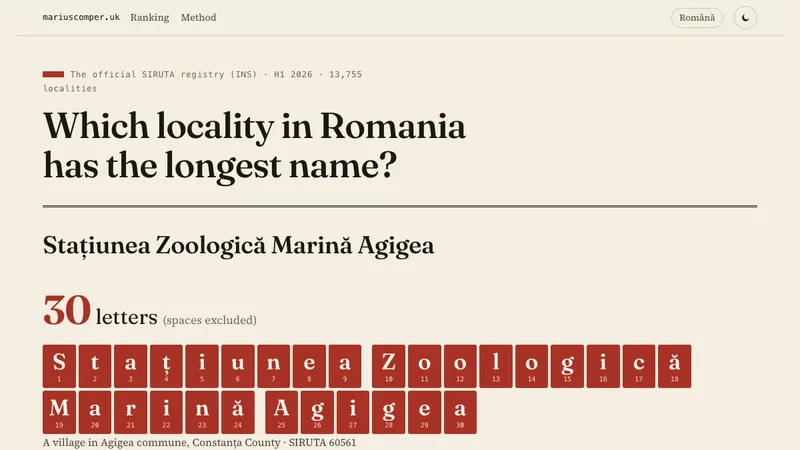
Stațiunea Zoologică Marină Agigea has 30 letters — not Sâmbăta, with 27.
Writing and texts
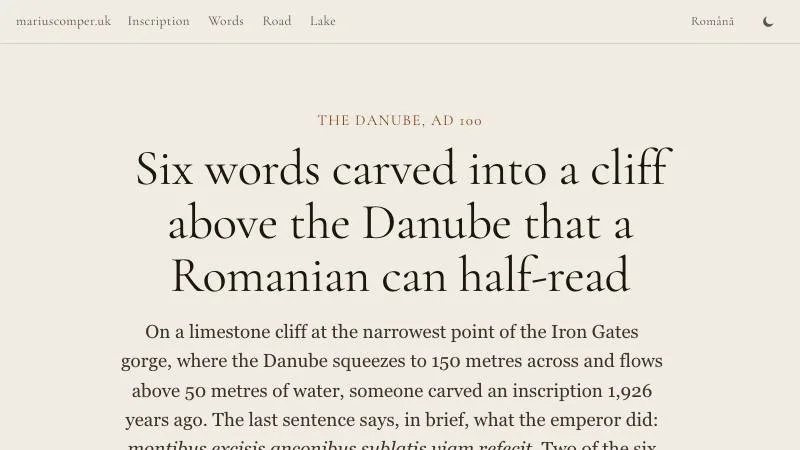
Trajan's inscription of AD 100, word by word, and the 260-tonne block lifted 20 metres in 1969 before the Iron Gates lake.
Names and places
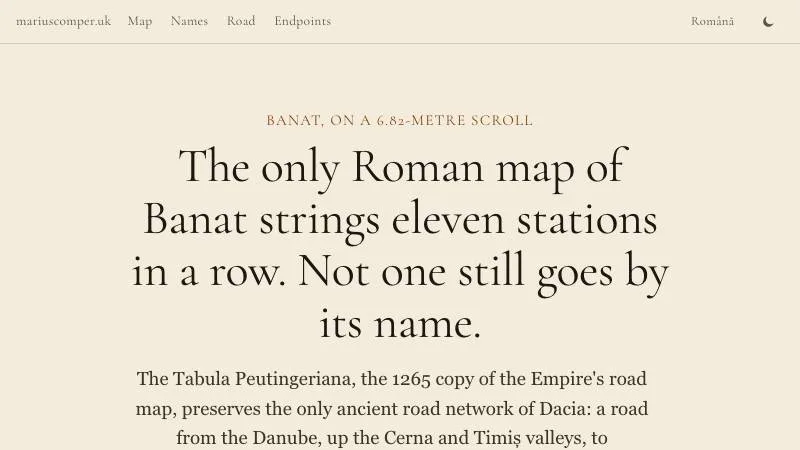
The Tabula Peutingeriana, the 1265 copy of the Empire's road map, preserves the only ancient road network of Dacia.
Names and places
The Roman pace, the passus: five standard feet, ≈1.48 m. The body named the measure; the standard gave its length.
Writing and texts
A fragment of Roman ceramic in the Alba Iulia museum carries the stamp LEG XIII GEM.
Names and places
The left hand counts to 99 and both hands together to 9,999, by the method Bede wrote down in 725.
Word origins
In Latin, draco meant dragon. In Romanian, drac means devil.
Word origins
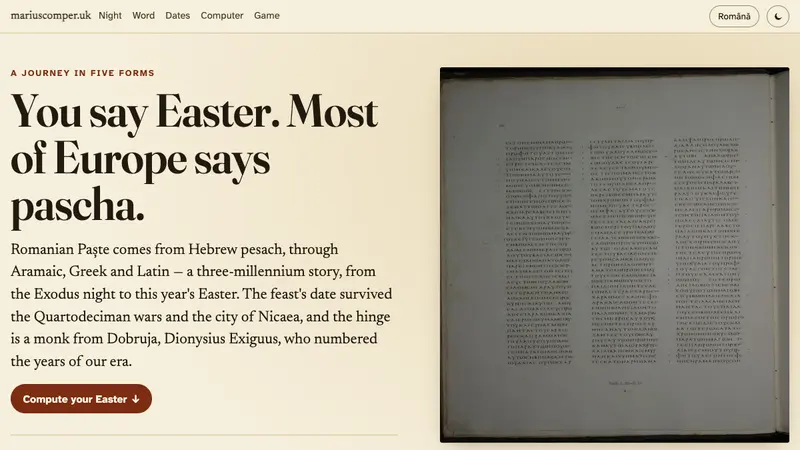
Paște comes from Hebrew pesach, through Aramaic, Greek and Latin; the feast's date survived the Quartodeciman wars and Nicaea, and the hinge is a monk from Dobruja.
Writing and texts
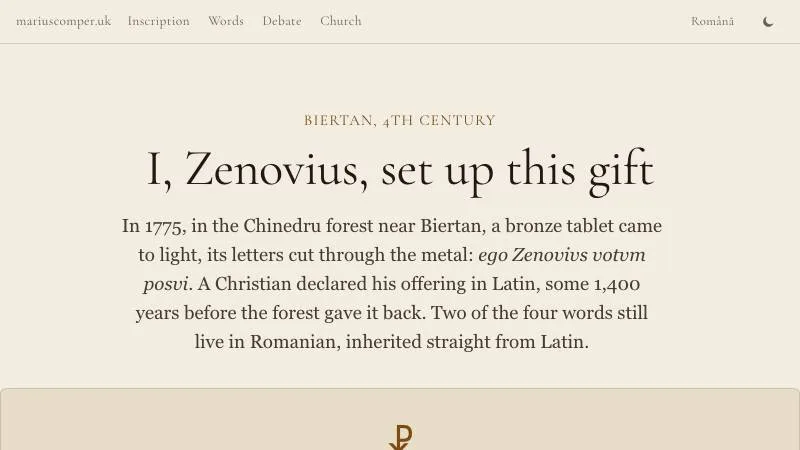
The Biertan donarium: a 4th-century bronze tablet found in 1775 near Biertan, Romania, inscribed EGO ZENOVIVS VOTVM POSVI.
Word origins
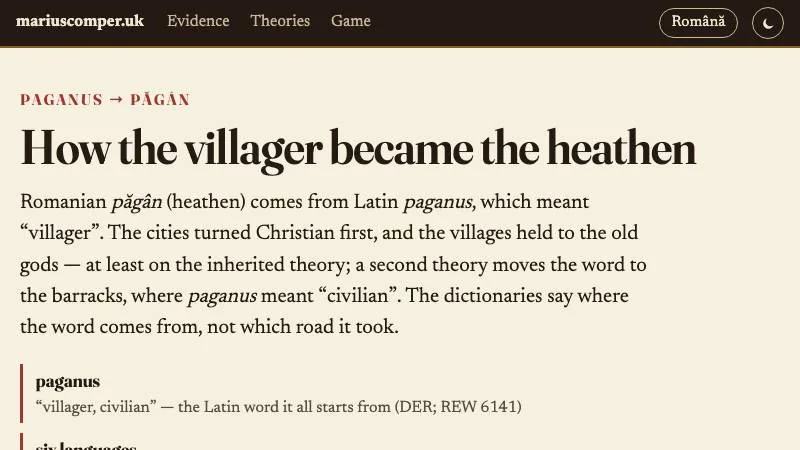
Romanian păgân (heathen) comes from Latin paganus, 'villager': the DER evidence, the Romance cognates, the two theories of the change of sense, and the Christian layer from Latin.
Writing and texts
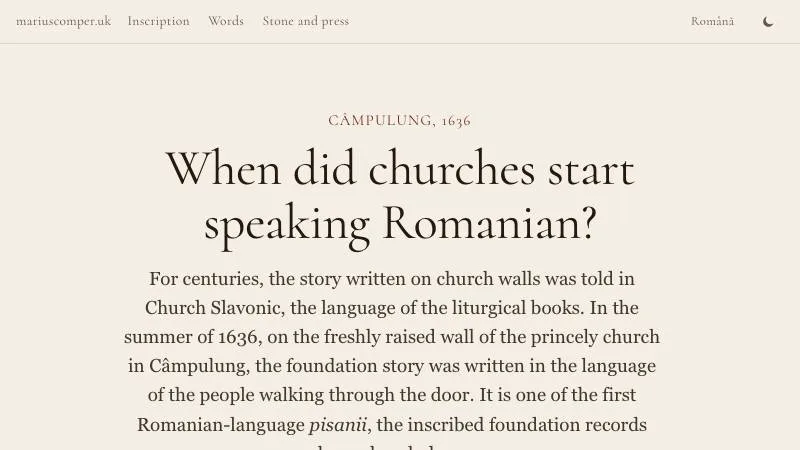
For centuries, the story written on church walls was told in Church Slavonic. In the summer of 1636, on the freshly raised wall of the princely church in Câmpulung, the foundation story was written in Romanian.
Writing and texts
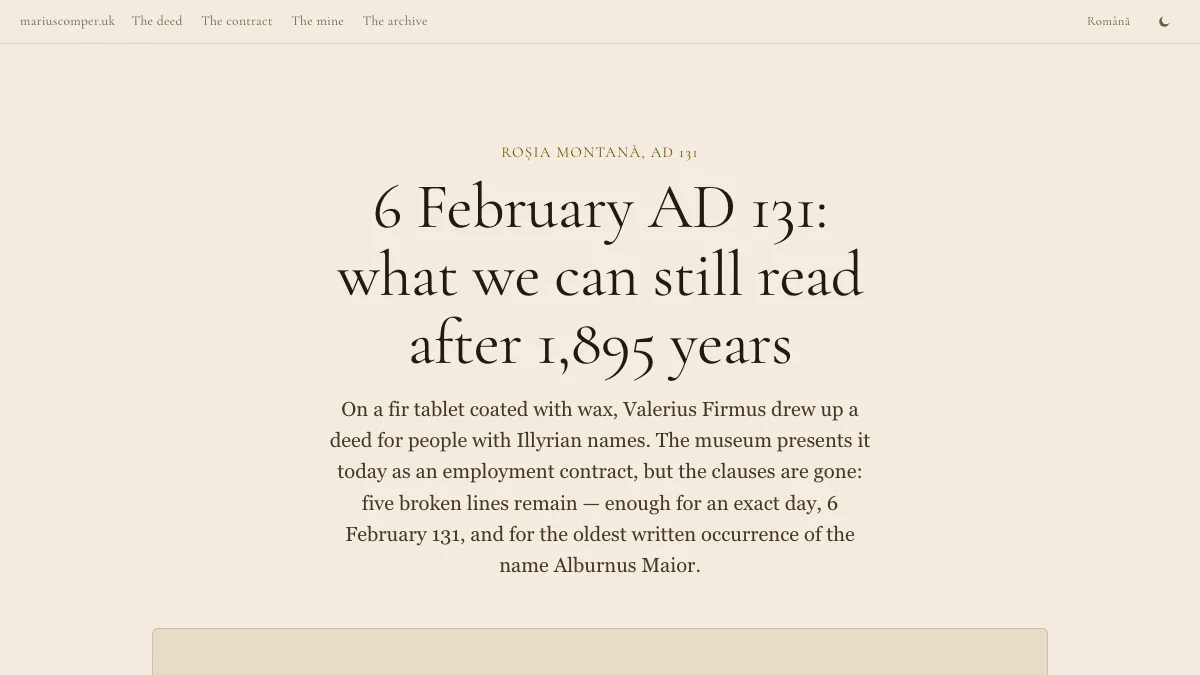
Five surviving lines, a Roman date and the name Alburnus Maior: what the wax tablet written on 6 February 131 really tells us.
Meaning and use
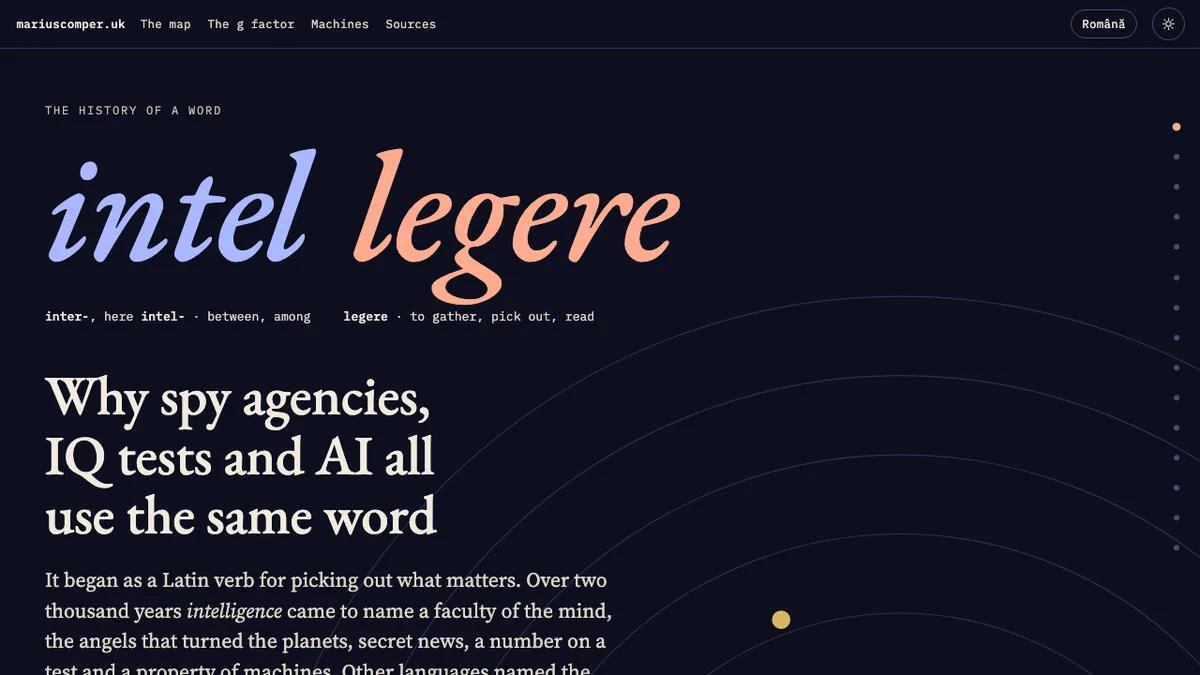
The history of the word intelligence: Latin intellegere, inherited in Romanian a înțelege and borrowed back from French; the angels that turned Dante's heavens; spies' secret news; Binet's tests, the g factor in Spearman's own table, eugenics and the Flynn effect; working memory, with a 2-back game; Turing's machines.
Meaning and use
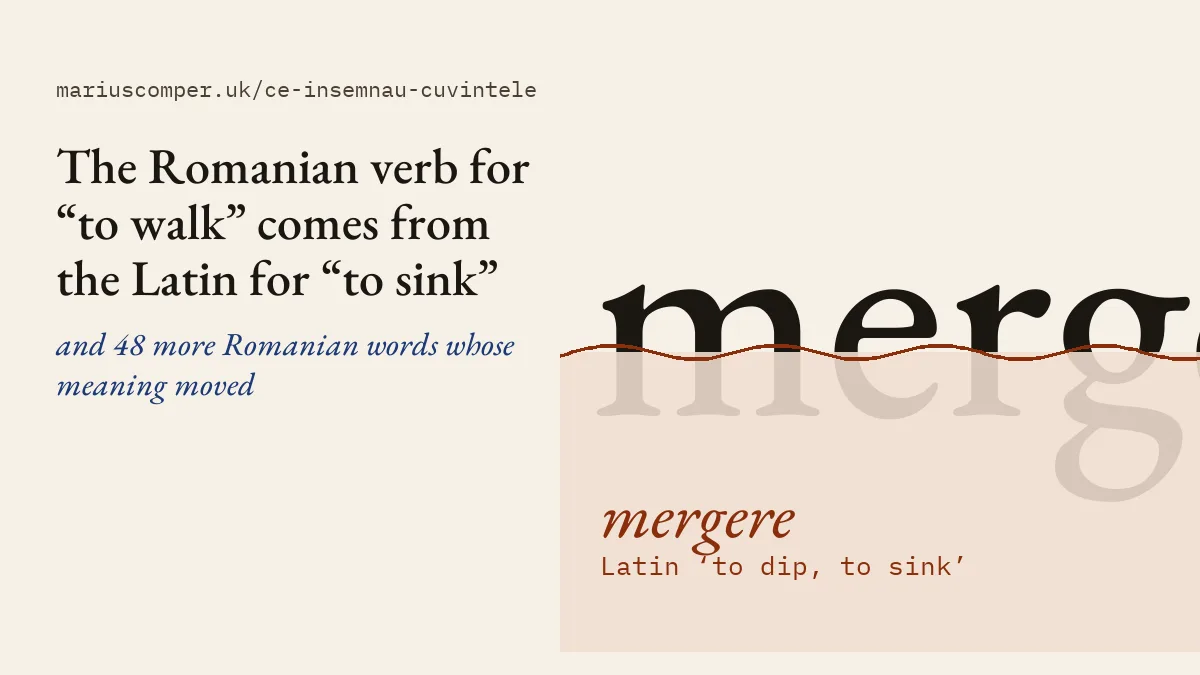
What 49 Romanian words first meant: the verb for caress (to clean), research (to go round), leave (to fold), earn (to punish), and the nouns for woman (the whole household), forest (marsh) and work (torment).
Writing and texts
Almost a quarter of the occurrences in the CoRoLa list have two letters.
Word origins
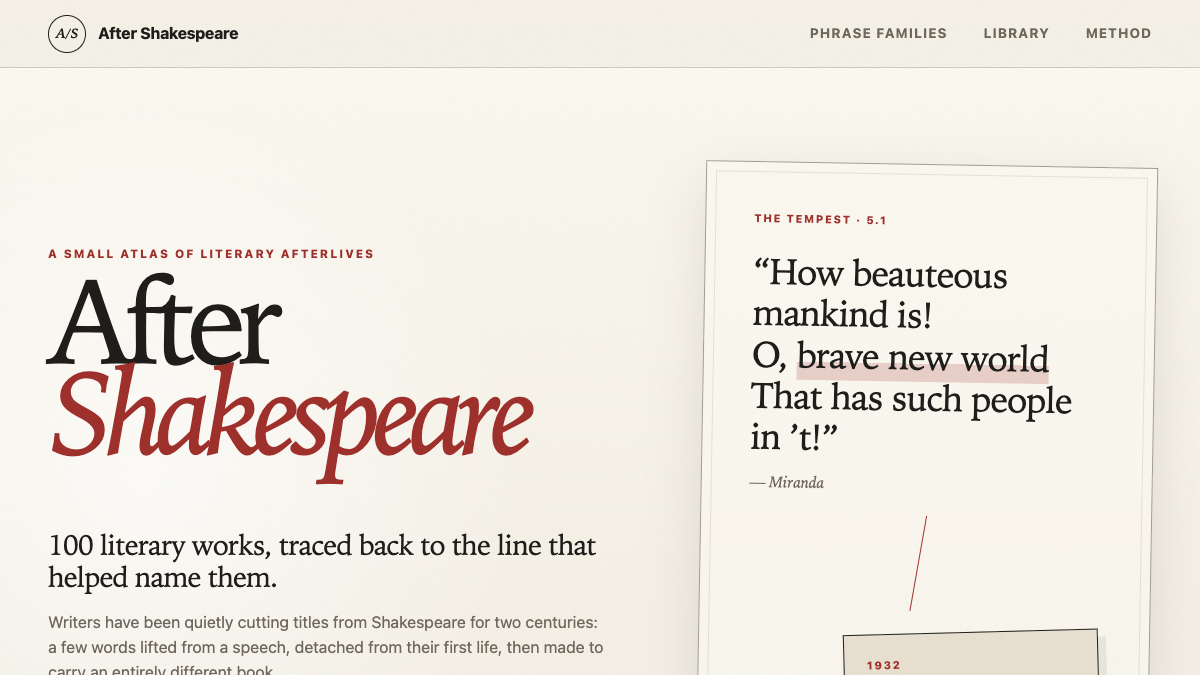
A living index of 100 books and literary works inspired by Shakespeare, with the original lines and their later afterlives.
Names and places
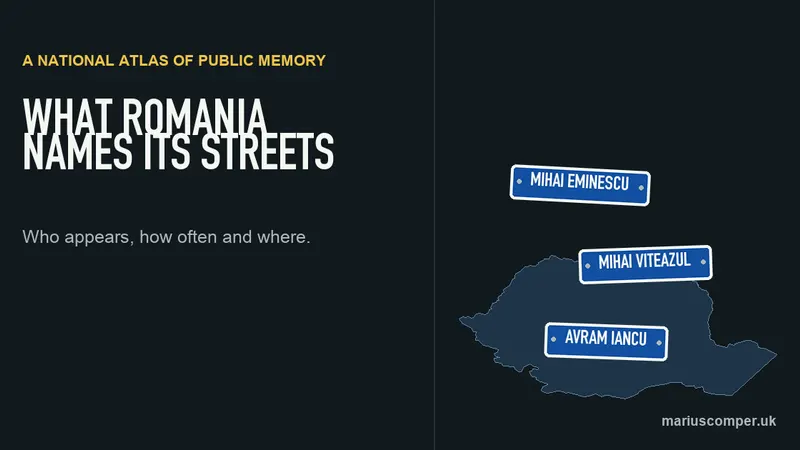
Romania’s mapped street names, ranked by the number of distinct local administrative units in which each canonical name appears.
Word origins
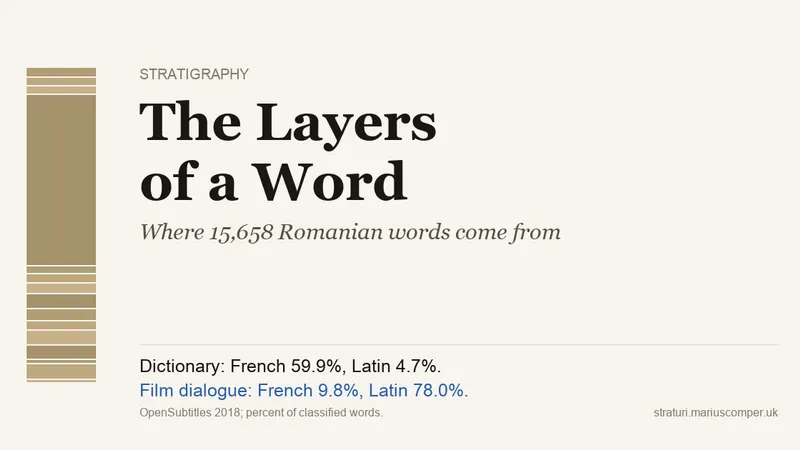
In DEX, almost half of Romanian words are French or made from French words, and 13.7% are inherited from Latin. In film dialogue, 78.8% of words are Latin.
Writing and texts
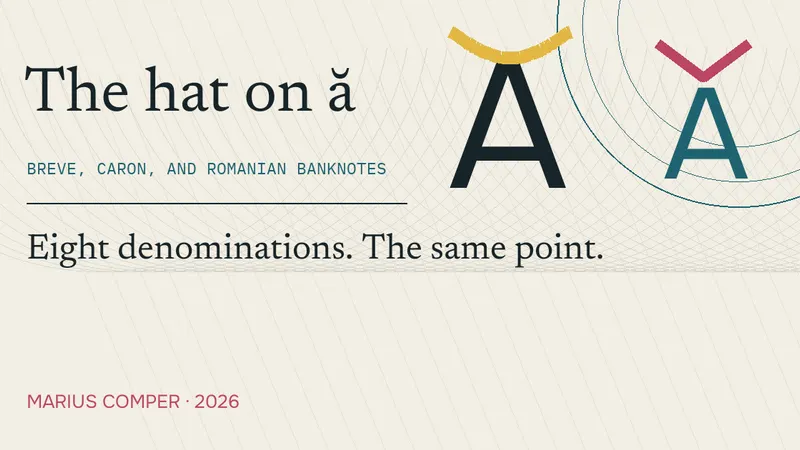
A visual investigation into the mark drawn above Ă, from Unicode and fonts to every Romanian banknote in circulation.
Writing and texts
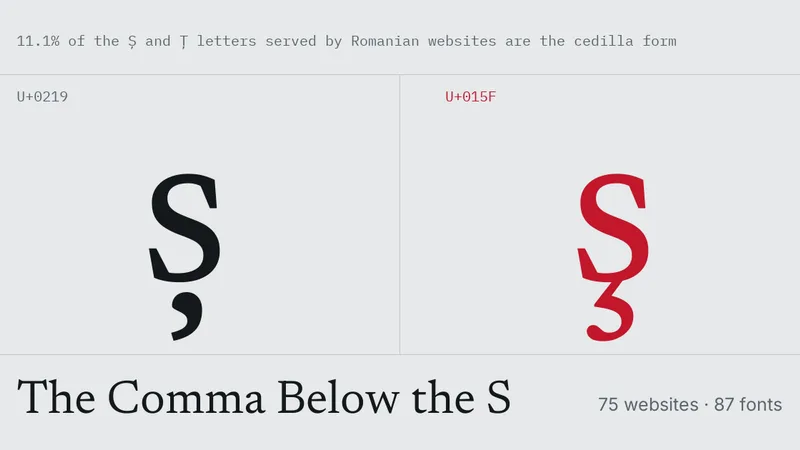
An audit of 75 Romanian-language pages and a type bench across 87 font families show how much Turkish cedilla still stands in for the comma and why the error is almost invisible.
Wordplay
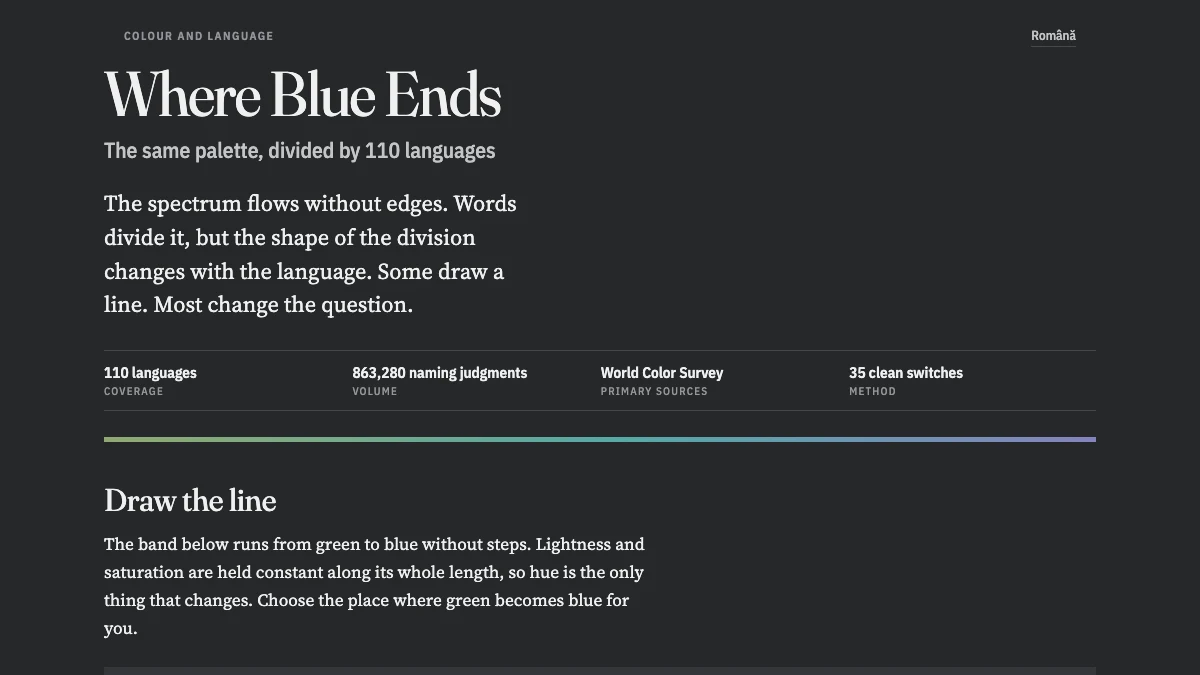
Draw the line between green and blue, then see why one clean switch describes only 35 of the World Color Survey's 110 languages.
Meaning and use
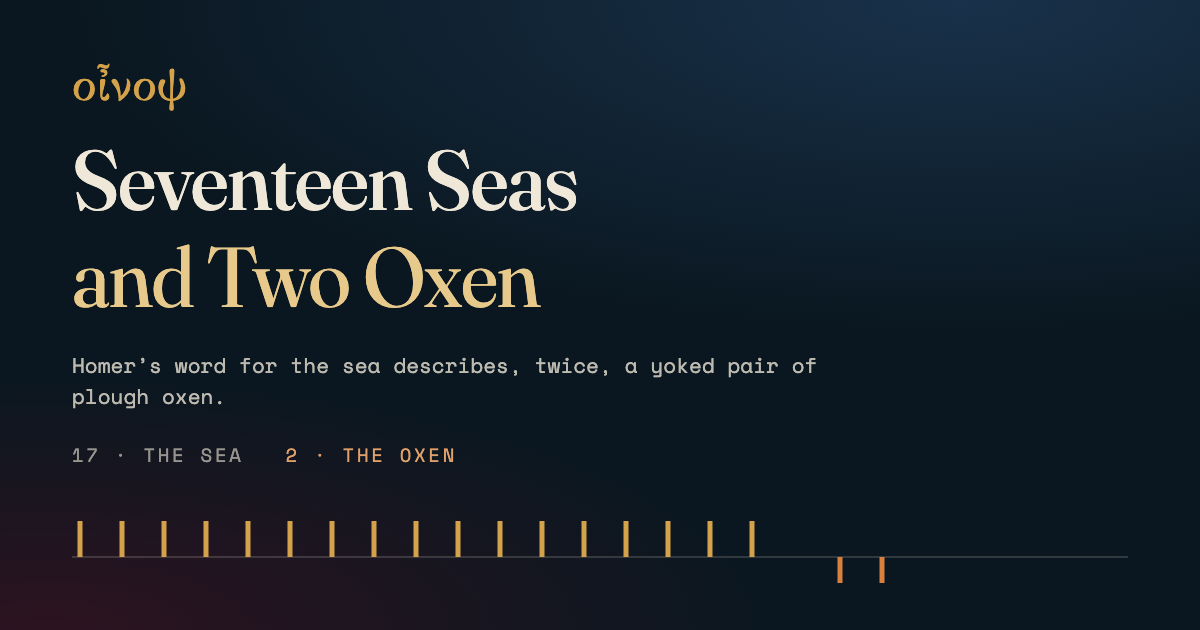
In Homer, οἶνοψ describes the sea seventeen times and, twice, a yoked pair of plough oxen.
Meaning and use
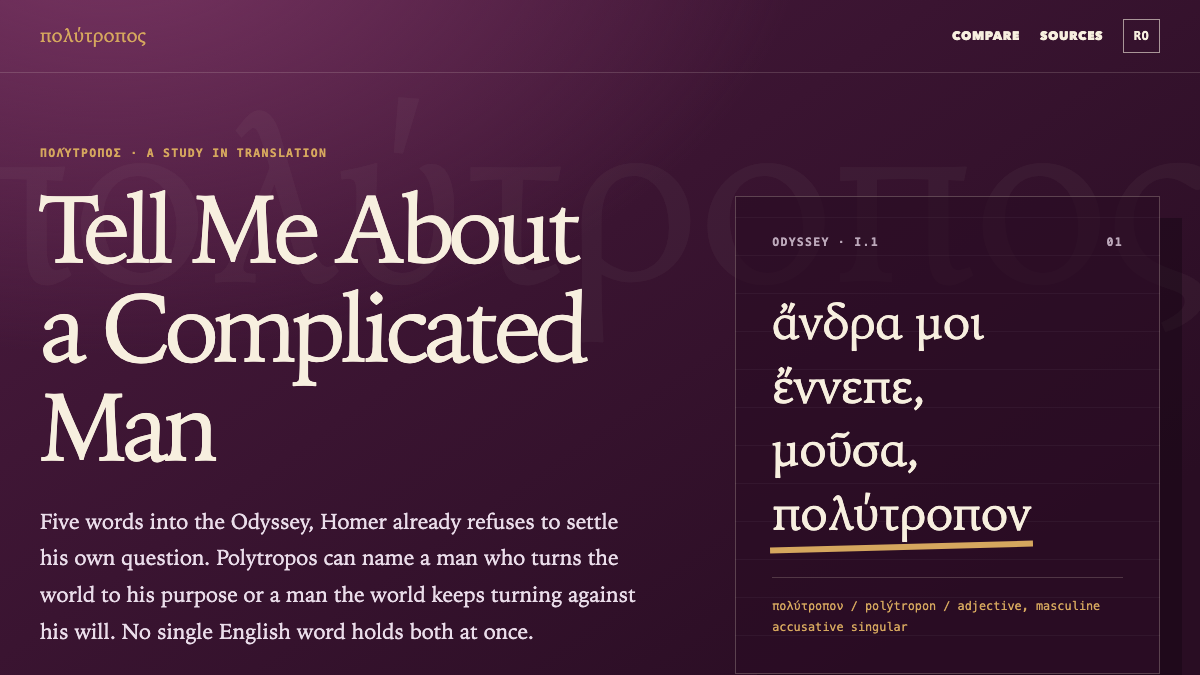
One Greek word, eleven English translations, and a hero remade before the opening line is over.
Speech and sounds
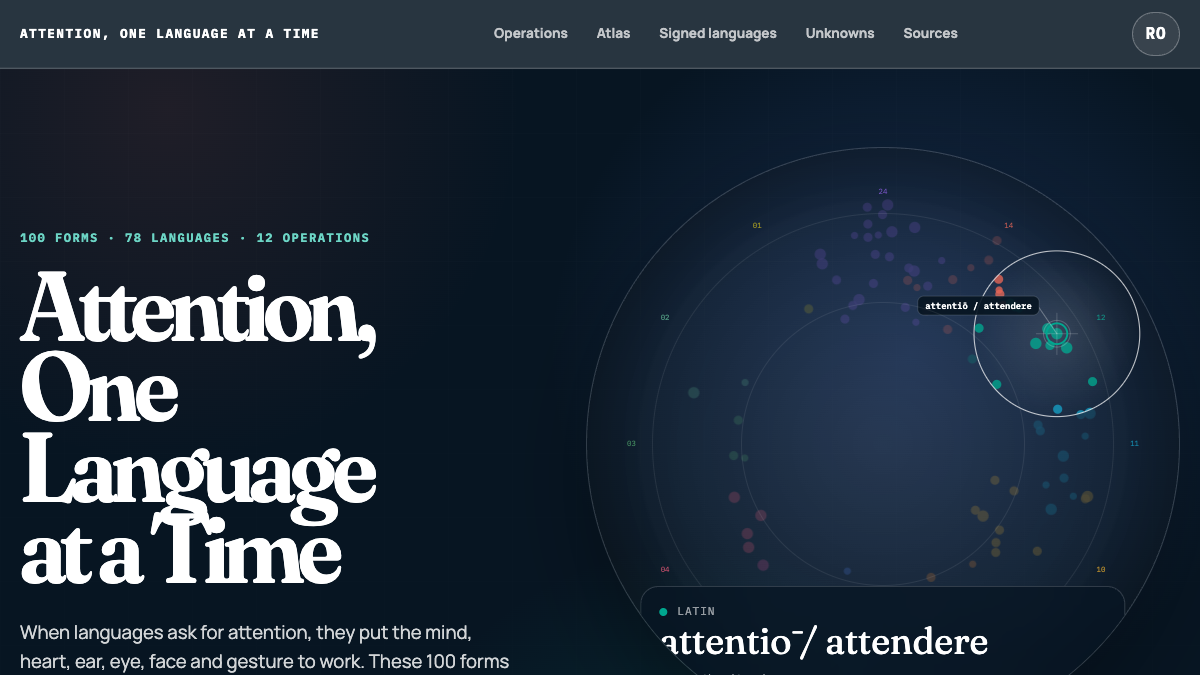
One hundred forms from 78 languages trace how attention becomes orientation, listening, care or availability to another person.
Speech and sounds
A map of urda and izvara opens three questions about whey technology, the movement of vocabulary and how a local distribution becomes history.
Names and places
How we know a Celtic language survived for centuries in Anatolia although no Galatian sentence has reached us.
Meaning and use
A map of 1,016 basic words in 107 languages, from Iceland to Kamchatka, starting from your own. Tea took two roads, the cuckoo names itself, the moon also names the month in 57 other languages, and in Georgian “mama” is father.
Names and places
18,214 inhabited places on a map with no border drawn. A quarter carry a family's name, 586 begin with Valea, and the saints never crossed the Carpathians.
Wordplay
Every rhyme in 5,794 public-domain Romanian poems: 88,997 rhymes, 79 poets, 233,276 lines and an explorer for any word.
Writing and texts
ă, â, î, ș and ț all sit along the right edge of the keyboard, where a single finger reaches: one keypress in ten of Romanian text lands on the right little finger, against one in twenty-one for English.
Word origins
In 68 of 200 languages, “we” has a form for a group that includes the addressee; 63 of those 68 also mark the group that leaves the addressee out.
Meaning and use
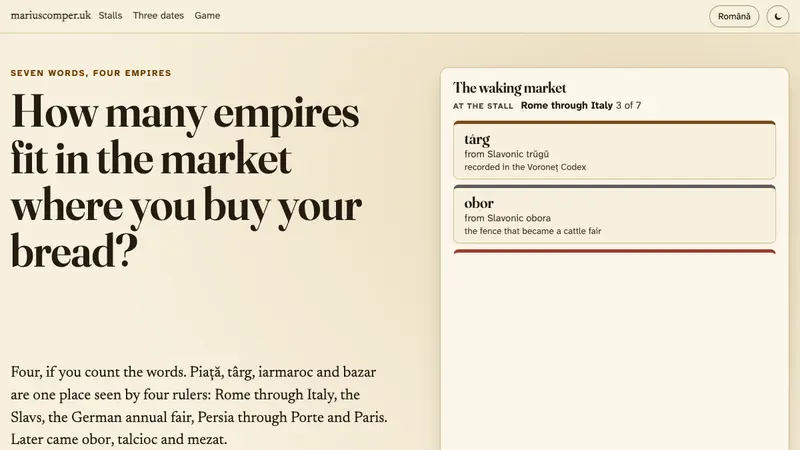
Why the same place is piață, târg, iarmaroc and bazar at once: seven words that came by seven routes, three dates — with the dictionaries on the table and a game at the end.
Meaning and use
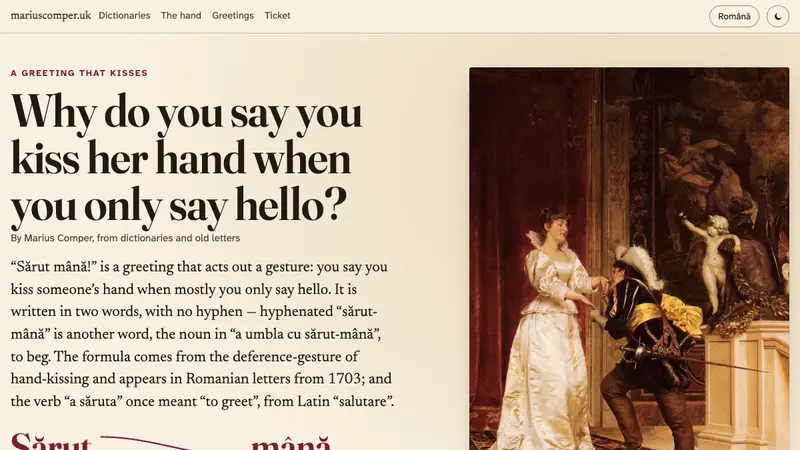
“Sărut mână!” is written in two words and comes from the hand-kissing gesture: it appears in family letters from 1703, and the verb “a săruta”, to kiss, comes from Latin “salutare”, to greet.
Names and places
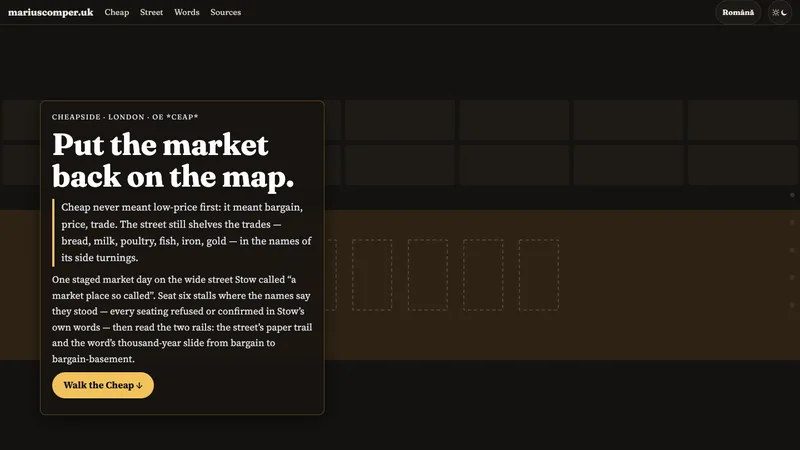
Seat six stalls on the Cheapside side streets whose names still mean them — bread, milk, poultry, fish, iron, gold — with Stow's lines for witness, then follow ceap from bargain to bargain-basement on two dated proof rails.
Writing and texts
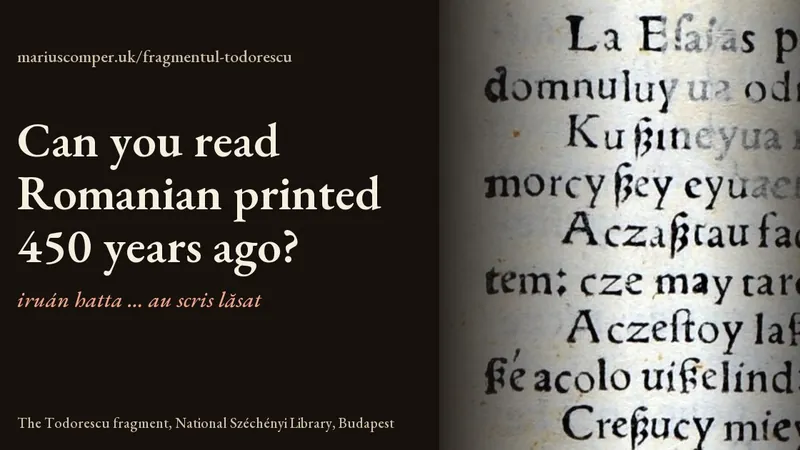
A page of Romanian printed in Cluj around 1570 in Hungarian spelling: k for c, cz for ce, ß for s.
Writing and texts
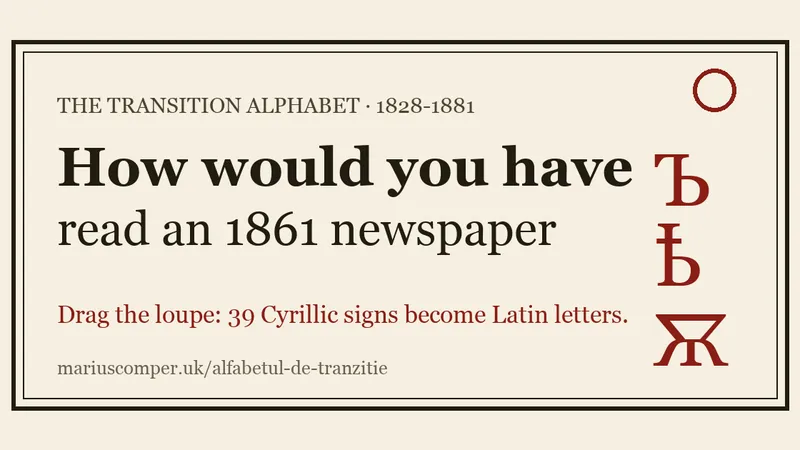
Between 1860 and 1862, Romanians wrote both Cyrillic and Latin, sometimes on the same page.
Speech and sounds
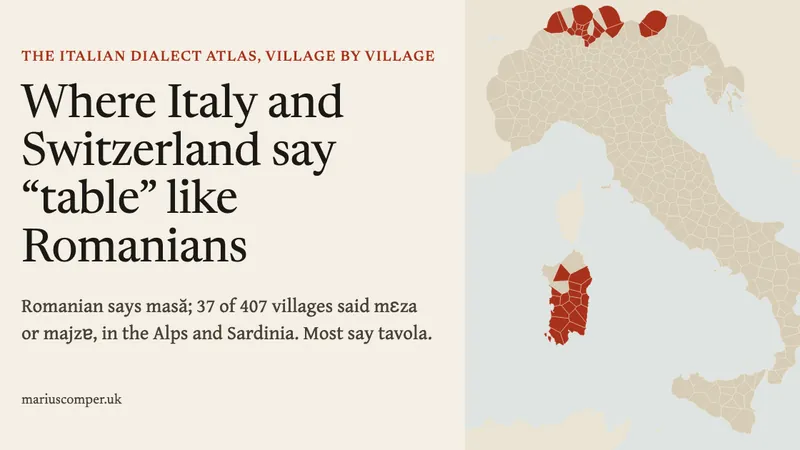
A century ago, an atlas led by two Swiss linguists wrote down how people spoke in 407 villages of Italy and Switzerland.
Names and places
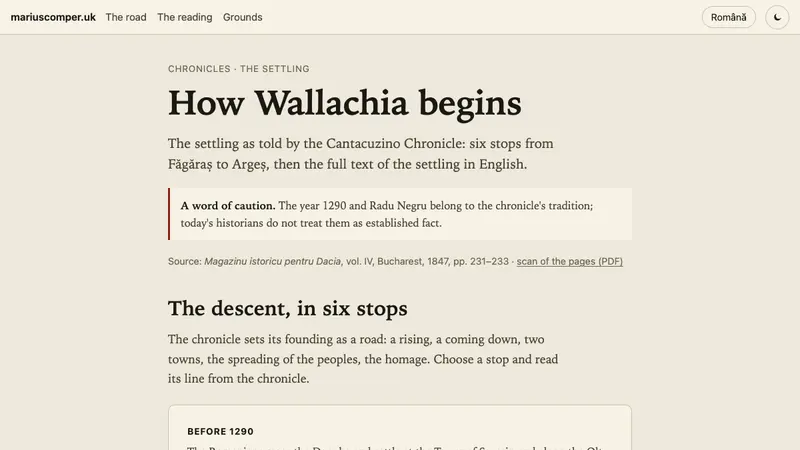
The founding passage of the Cantacuzino Chronicle after Bălcescu's 1847 edition: Radu Negru's road from Făgăraș to Argeș in six stops, plus the full text in English.
Speech and sounds
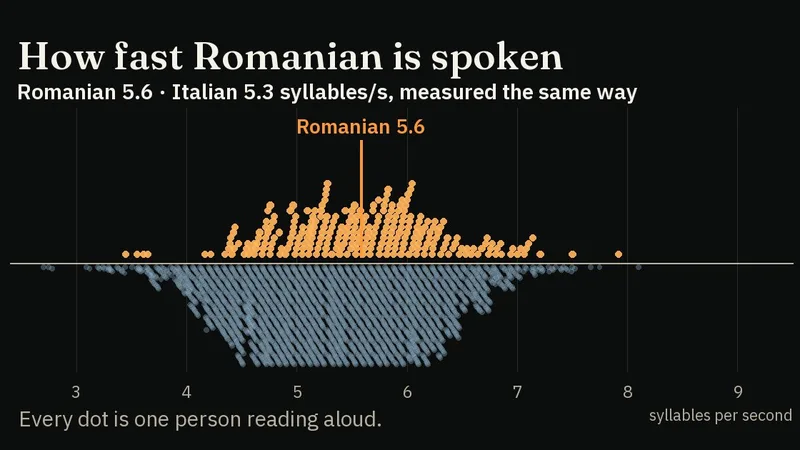
Read Romanian runs at 5.6 syllables a second, measured on 265 speakers from real recordings — the same pace as Italian measured with the same ruler.
An arrow connects forms for which the source presents a relationship. The result’s label says whether an explanation is well supported, probable, disputed or unknown. An asterisk marks a reconstructed form, not directly attested.
A country-name record may simply document a spelling in a particular language. A place name can have an attested form and reconstructed components. These cases stay distinct; similar letters do not establish common ancestry.
Records come from the projects’ data and bibliographies. Source notes may remain in their original language. Open the linked project for the full argument, alternatives and references.
Every active project classified under language, plus four reviewed inclusions on names, vocabulary and colours. Detailed search combines a borrowing dictionary, season-word etymologies, given names, London place names, historical forms and explanations from articles.
This is not a complete Romanian dictionary and does not index every article in full. A missing result is a limit of the collection. No etymology is generated on demand.
Reviewed 2026-10-14 · Collection in text format