RAI · IAD · TWO DOORS
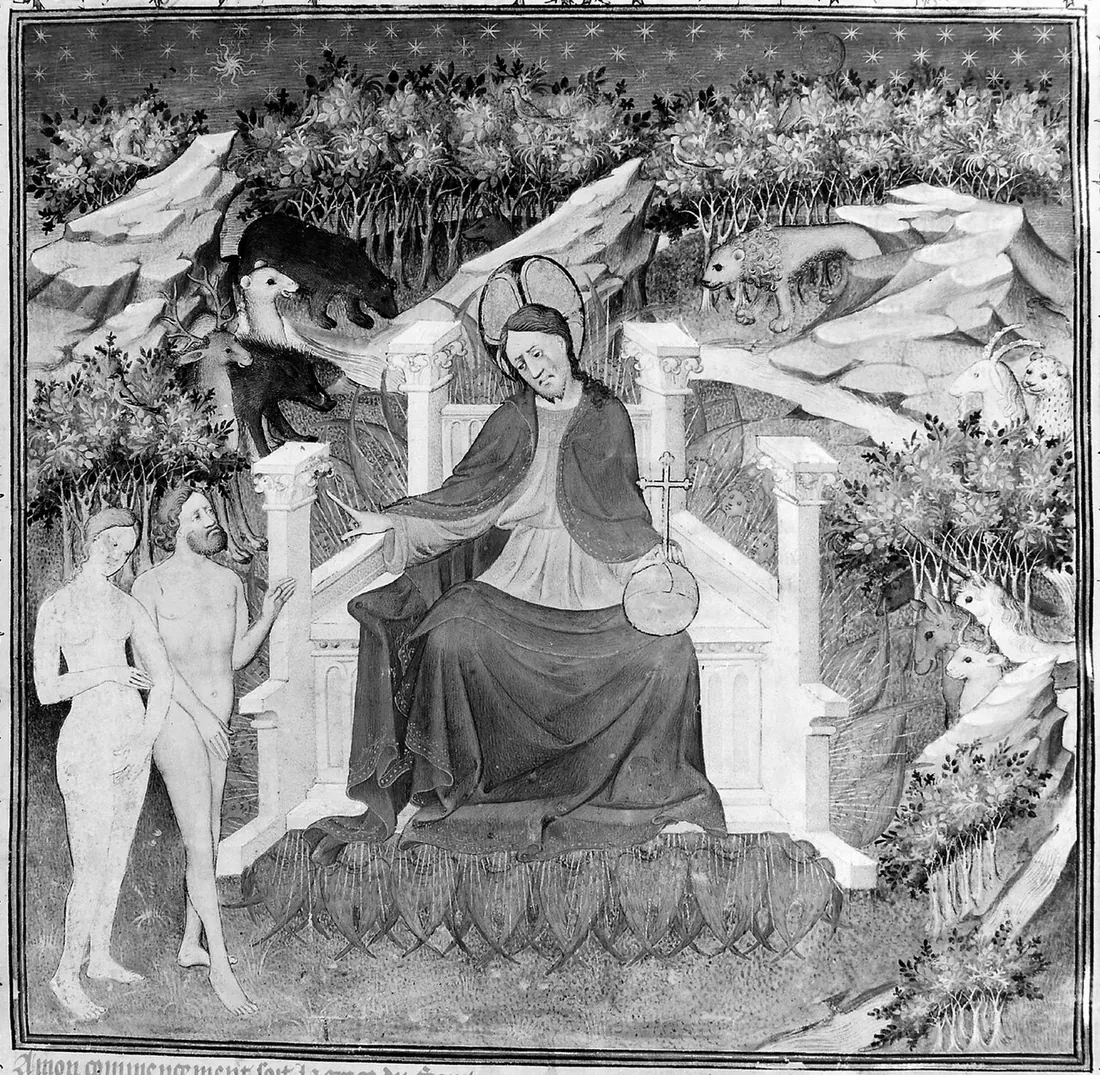
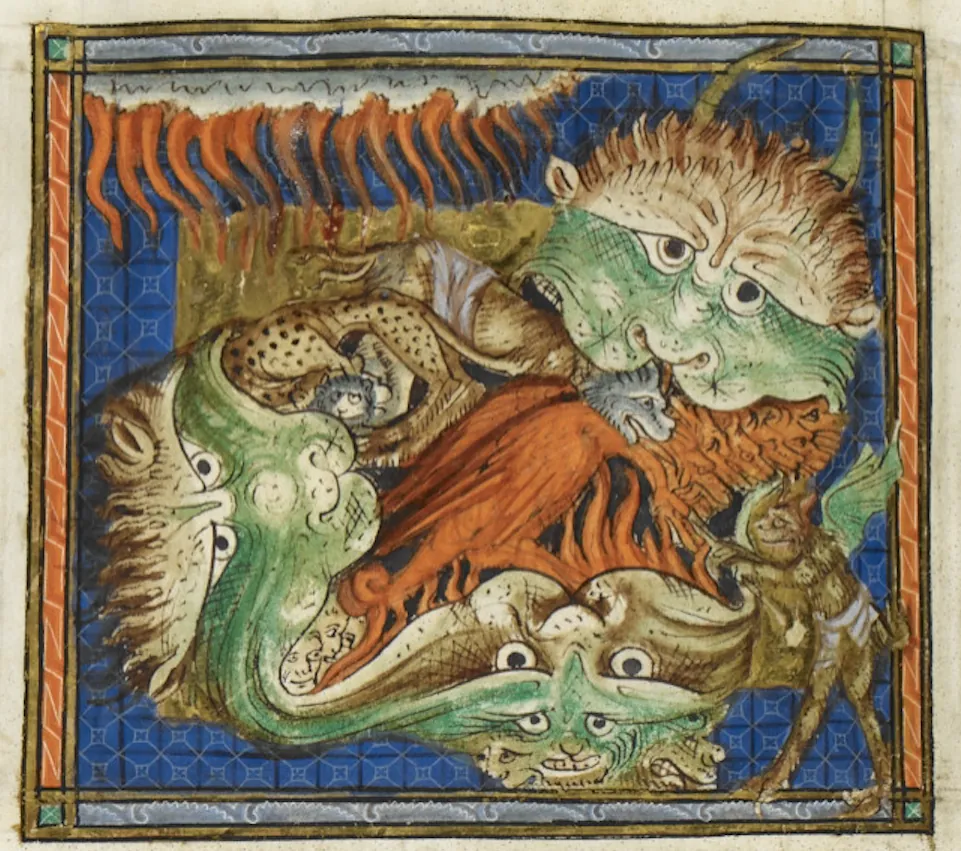
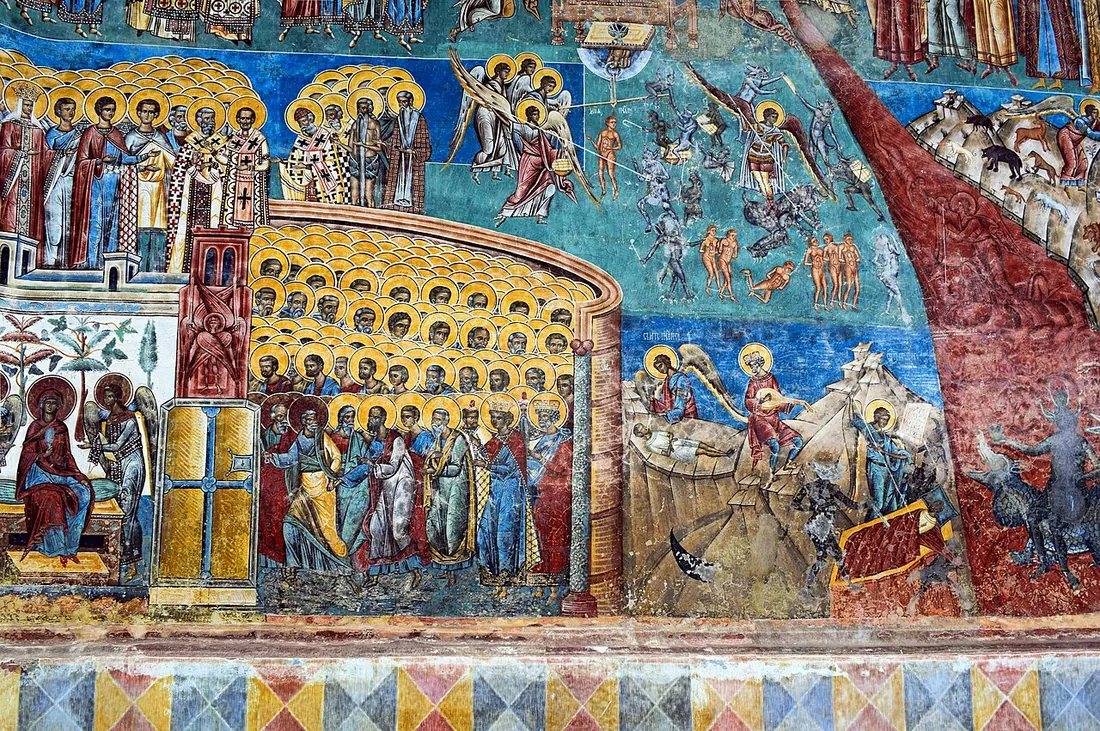
Why do heaven and hell come from the same yard?
Heaven and hell are two Slavic doors: DEX derives both from Slavonic, with no sound steps shown — raj above, jadu below. And the proof sits in dated attestations: the same 1560–61 print says Ad in one verse and Iad in another, while Neagoe and Antim hold the doors open together.
- From Sl. raj.
- DEX '09: heaven, no steps
- From Sl. jadu.
- DEX '09: hell, no steps either
- Ad and Iad, 1560
- both forms in the same print


The page machine
The pipe, joint by joint
Seven joints, two languages, three grades of tightness. Each joint wears its language on a tag, and the seals show how tight the link is: attested, etymology, hypothesis. The jot carries a question mark.
rajŭ Slavonic SL ETYMOLOGY
The Slavic paradise: Russian gives it as garden and dwelling of the righteous, after Vasmer via Wiktionary, and the Bulgarian Academy keeps it as “the place in the afterworld where the souls of the righteous go”. The upper door starts here. (RBE, Wiktionary)
Ad Coresi, 1560–61 RO ATTESTED
Mt 11:23: “şi tu Capernaum ce pănă în ceri înalți-te pănă la Ad deștinge-veri” — after the 1889 transliteration of the 1560–61 print. The old form, in a new book. (Coresi)
Iad Coresi, 1560–61 RO ATTESTED
Lk 16:23: “muri și bogatul și îngropat fu. și întru Iad deschise ochii lui” — the same book, further on, after the 1889 transliteration. Ad and Iad breathe on the same paper. (Coresi)
rai Neagoe, c. 1650 RO ATTESTED
“călcarea ce greși dentâi strămoșul nostru Adam în rai” — after the Wikisource transcription. The date is the Romanian translation's, c. 1650, not Neagoe's reign. (Neagoe)
rai + iad Antim, 1709–16 RO ATTESTED
“3 bunătăţi ale raiului … spre 3 răutăţ ale iadului” — after the text of the Didahii, preached at Bucharest or Târgoviște. The doors stand face to face, in one line. (Antim)
rai, iad Romanian today RO ETYMOLOGY
DEX '09: “RAI1, raiuri, s. n.” — “Din sl. raj.”; “IAD, iaduri, s. n.” — “Din sl. jadu.” That is all: no sound steps, no middle forms. Two dictionary etymologies. (DEX)
jadŭ or adŭ? Slavonic? SL HYPOTHESIS DISPUTED
The dictionaries do not agree to the letter: DEX '09 gives jadu, CADE gives adŭ, MDA2 and Scriban give both. Jot or no jot — it stands as a question, not a link. (DEX, CADE, MDA2)
How to read the seals: attested means found in a dated text; etymology, a route a dictionary proposes; hypothesis, a link set with a question mark. The pipe is tight on attestations and on the dictionary; how Ad became Iad, no dictionary says.
At home
From Coresi to DEX: 1560–2009
Four hundred fifty years of the written sky, in four stops. Every quotation brings its paper: the press, the papers, the century, or the dictionary.
The press
The surprise sits with Coresi: the 1560–61 Gospels say “pănă la Ad deștinge-veri” at Matthew and “întru Iad deschise ochii lui” at Luke — the old form and the new form in one book, after the 1889 transliteration of the 1560–61 edition. Scriban and Șăineanu keep ad for old; the paper proves them right.
The papers
Neagoe Basarab teaches his son with both doors: “ne dășchise porțile raiului … iar iadul îl sparse” and “Cei drepți vor mérge în mirosul cel bun al raiului, iar noi vom mérge întru împuțiciunile iadului” — after the Wikisource transcription, dated to the Romanian translation, c. 1650. MDA2 knows one more trace: “At: CORESI, EV. 369” for rai — its locator, unverified here.
The century
Miron Costin sees “céle patru ape ce ies din rai” in Viața lumii of 1671–73, after the school edition. And Antim Ivireanul preached his Didahii between 1709 and 1716, at Bucharest or Târgoviște: “3 bunătăţi ale raiului … spre 3 răutăţ ale iadului” — after the book's text, transcribed from manuscripts.
The dictionaries
Șăineanu 1929 gives “Vechiu-rom. ad = slav. adu”; Scriban 1939 sets ĭadŭ beside adŭ; DER takes iad through Slavonic to Greek Hades; MDA2 derives rai from “slv рай”; DEX '09 closes both doors with “Din sl.” — raj and jadu.


Beyond the doors
Who stood in the yard
Five neighbours hold the two doors: the Slav above, the Slav below, the Greek behind, the learned rivals, and the past episode. The proof sits in their dictionaries, not in our say-so.
The Slav of heaven
Raj is paradise across all Slavia: Russian gives it as garden and dwelling of the righteous, after Vasmer via Wiktionary; Church Slavonic keeps it раи; the Bulgarian Academy gives it as “the place in the afterworld where the souls of the righteous go”. DER parades it past Bulgarians, Serbs, Czechs, Poles, and Russians. (RBE, Wiktionary, DER)
The Slav of hell
DEX '09 says it flat: “Din sl. jadu.” MDA2 gives both forms, “vsl ꙗдь, адь”; NODEX keeps jadu; CADE keeps adŭ. And poison-iad is another word, with its own entry: MDA2 separates it — iad2, venom. (DEX, MDA2, CADE)
The Greek behind
DER takes the chain further: “Gr. ἄδης, prin intermediul sl. jadŭ” — Hades through Slavonic. Scriban sets “vgr. ῾ades” beside it, and Șăineanu says “din gr. HADES, locaș întunecat”. DEX, MDA2, CADE, and NODEX stop at Slavonic. Two dictionary schools, no quarrel. (DER, Scriban, Șăineanu)
The learned rivals
Church and school brought two more doors: paradis from French (plus German, says DEX) and infern — from Latin, says DEX; from nineteenth-century Italian, says DER. The split is reported, never settled. (DEX, DER)
The past episode
The companion piece about soul and spirit never named heaven or hell — not once; checked on the text, zero matches. It enters here as a past episode, never as evidence: the doors begin their story from zero. (sufletul-și-duhul)

In their own words
Six witnesses
The dictionaries tell the story themselves — each with its quotation, its source, and its measure.
DEX '09: rai
“RAI1, raiuri, s. n. 1. Paradis, eden. 2. Fig. Loc din natură deosebit de frumos. … – Din sl. raj.”
DEX '09 (2009), via dexonline
The upper door, in one word: Slavic raj, no steps shown.
DEX '09: iad
“IAD, (2) iaduri, s. n. 1. (În multe religii) Loc în care sufletele păcătoșilor sunt supuse la chinuri veșnice…; infern, gheenă. … – Din sl. jadu.”
DEX '09 (2009), via dexonline
The lower door, just as flat: Slavic jadu, no steps shown.
DER: iad
“iad (iaduri), s. n. – Infern, gheenă. Gr. ἄδης, prin intermediul sl. jadŭ (Cihac, II, 145; DAR; Conev 107), cf. bg., sb., rus. ad.”
DER (Ciorănescu), via dexonline
The chain taken to Hades, references and all.
MDA2: rai
“rai1 sn [At: CORESI, EV. 369 / Pl: -uri / E: slv рай] 1 (În diferite concepții religioase) Loc plin de încântare…”
MDA2, via dexonline
Its antiquity locator: Coresi, EV. 369 — unverified here.
Șăineanu 1929: iad
“[Vechiu-rom. ad = slav. adu (din gr. HADES, locaș întunecat sau invizibil)]”
Șăineanu, 6th ed. (1929), via dexonline
The old form ad, set straight onto Slavic adu.
RBE: рай
“РАЙ … м. 1. … място в задгробния свят, където отиват душите на праведните след смъртта им…”
Bulgarian Academy (RBE), via ibl.bas.bg
The donor shown at home: the Bulgarian paradise, sense for sense.
The reckoning
What we know and what we do not
Four cards on the table: two hold, one quarrels, one is missing.
We know
Both fathers are Slavic: DEX gives raj and jadu, DER, MDA2, Scriban, and Șăineanu keep time. And the forms show from the sixteenth century: Ad and Iad with Coresi, heaven with Neagoe, the pair with Antim.
The pair
The doors stand together in dated texts: Neagoe around 1650 (“porțile raiului … iadul îl sparse”, after the Wikisource transcription), Antim between 1709 and 1716 (“bunătăţi ale raiului … răutăţ ale iadului”). The title's answer sits in the pair, not in either alone.
The quarrel
One small one and two borrowed: jot or no jot (jadŭ or adŭ, the dictionaries divide); the Greek behind (Hades named or not); the rivals' infern (Latin after DEX, Italian after DER). All three are reported, none is settled.
The hole
No dictionary gives the sound steps of either door — no jot explained, no rule from Ad to Iad. And heaven before 1581 has no shown paper: MDA2's locator stands unverified. That is what is missing from the table.
The dates that hold
Four dates
Four stops hold both doors: one press, one teaching, one century, and one pulpit — each with its paper.
Coresi: Ad and Iad
1560–61
Mt 11:23 with Ad, Lk 16:23 with Iad — after the 1889 transliteration of the 1560–61 print. Both forms, one book.
Witness 1 of four
Neagoe: the pair
c. 1650
“porțile raiului … iadul îl sparse” — after the Wikisource transcription. The date is the translation's, c. 1650, not the reign's.
Witness 2 of four
Costin: heaven
1671–73
“céle patru ape ce ies din rai” — Viața lumii, after the school edition. Its contents give the years 1671–73.
Witness 3 of four
Antim: the pair
1709–16
“bunătăţi ale raiului … răutăţ ale iadului” — the Didahii, preached at Bucharest or Târgoviște, after the book's text.
Witness 4 of four
Four dates, four papers: the 1889 transliteration for Coresi, Wikisource for Neagoe, the school edition for Costin, the book's text for Antim.
The ladder of forms
rajŭ
Slavonic: paradise
rai
Neagoe, c. 1650
jadŭ, adŭ
Slavonic: hell, jot or no jot
ad
Coresi, Mt 11:23
iad
Coresi, Lk 16:23
rai, iad
DEX '09: both from Sl.
The quarrel
Three small disagreements
No great quarrel holds the doors — only three small disagreements, each with its papers. We set them face to face. DISPUTED
Jot or no jot?
DEX '09 gives jadu, CADE gives adŭ, MDA2 and Scriban give both — ꙗдь and адь, ĭadŭ and adŭ. The dictionaries do not agree to the letter, and nobody states the crossing rule. It stands as a question.
The Greek behind
DER takes the chain to “Gr. ἄδης, prin intermediul sl. jadŭ”; Scriban and Șăineanu show Hades too. DEX, MDA2, CADE, and NODEX stop at Slavonic. Two dictionary schools, no quarrel between them.
Infern: Latin or Italian?
The rivals' quarrel, not the doors': DEX derives infern “Din lat. infernus”, DER derives it “It. inferno (sec. XIX)”. Both quotations stand; the page does not judge between dictionaries.
This page settles nothing: the jot stays between dictionaries, Hades stays between schools, infern stays between DEX and DER. What stands: the Slavic fathers, the 1560 doublet, and two dated pairs.
What is NOT disputed: the Slavic fathers raj and jadu/adŭ; the 1560–61 Ad–Iad doublet; the Neagoe and Antim pairs; the learned rivals paradis and infern. These are not disputed.
Test yourself
Which is older?
Six stops from the page, from press to dictionary. Set them from the oldest to the newest.
On each card press the number of its place in the row, then check the order.
- 1709–16
Antim: the pair
Place - 1560–61
Coresi: Ad and Iad
Place - 2009
DEX: both from Sl.
Place - 1671–73
Costin: heaven
Place - 1929
Șăineanu: ad = adu
Place - c. 1650
Neagoe: the pair
Place
Score: 0 of 6
The right order, oldest first
- 1560–61 — Coresi: Ad and Iad
- c. 1650 — Neagoe: the pair
- 1671–73 — Costin: heaven
- 1709–16 — Antim: the pair
- 1929 — Șăineanu: ad = adu
- 2009 — DEX: both from Sl.
The stops stand in the order of their opening years.
Sources
Every quotation on the page points at one of the addresses below: dictionaries through dexonline, texts through scans and editions.
The Slavic doors
The Romanian years
- DEX '09: rai (dictionary)
- DEX '09: iad (dictionary)
- DER: rai (dictionary)
- DER: iad (dictionary)
- MDA2: rai (dictionary)
- Șăineanu: iad (dictionary)
- Coresi 1560–61: the Gospels (scan)
- Neagoe c.1650: the Teachings (text)
- Costin 1671–73: Viața lumii (PDF)
- Antim 1709–16: the Didahii (scan)
The rivals
Catalogue neighbours
- articolul-de-la-coada: the tail machine
- verbul-a-fi: the Latin melt
- dusmanul-gand-rau: the ill mind
- gagiu: the civilian trial
- bogatul: the god scales
- oastea: the old army
- sufletul-și-duhul: the past episode
- prietenul: the friendship ladder
- dragostea: the love tree
- hotarul: the Hungarian line
- geamul: the Turkish pane
- surubul: the two doors
- inima: the soul in the chest
- femeia: the narrowed household
Type: Fraunces and Source Serif 4, under the SIL Open Font Licence.