1867 – 2005
One birth and three deaths: the leu, 1867–2005
The name “leu” comes from a Dutch thaler with an engraved lion, circulating in the principalities since around 1600; but the currency was only born with the law of 22 April 1867, cut gram for gram after the French franc — and since then it has died three times: in 1947, in 1952 and in 2005, when it lost its last four zeros.
367 years in 17 stops
Drag the line with your finger or your eyes: every stop tells you what metal the leu was made of and what it bought. Where no price survived, it says “undocumented” — this page invents no bread.
The years and coins are the sources'; positions on the line are proportional to the years.
The line is to scale: one year is always the same stretch.
- c.1600The Dutch lion thaler: 27.68 g of .750 silver. The bread price: undocumented.
- 1831The Organic Regulations make the leu a unit of account: one gold ducat, 31 lei 20 parale.
- 1867The law of 22 April: the leu, 5 g of silver or 0.3226 g of gold. Bread: undocumented.
- 1880The NBR, 29 April; the 5 lei silver. One silver leu: 5 g, .835.
- 1900Bread: 24 bani the kilogram. A hundred francs: 100.41–101.34 lei — the “leul aur”.
- 1914White bread: 32 bani. Coin striking stops; the leu leaves gold.
- 1929The stabilization: 167.20 lei to the dollar; bread at 10 lei. “The weakest currency in Europe.”
- 1938Bread: 7.30 lei — the crisis had cheapened it. The 50 lei nickel had come in 1937.
- 1944Bread: 46 lei. One ruble is 100 lei — the Soviet occupation rate.
- 1947Bread: 20,000 lei in July; the 5,000,000 note on 25 June.
- 1952The 28 January reform: 20–400 to 1. New small change: 1, 3, 5, 10, 25 bani.
- 1989Sugar: 20 lei the kilogram; the average net wage, 3,063 lei. Currency: up to 10 years.
- 1993256.1% inflation; sugar at 500 lei the kilogram.
- 1999The 11 August eclipse: the 2,000 lei polymer note, the first in Europe.
- 2003In September one euro passes 40,000 lei — the bottom of the fall.
- 2005On 1 July, 10,000 to 1: the new leu (RON). Four zeros fewer.
- 2017Braided white bread, 600 g: 2.00 lei with VAT (IBA, April).
Chapter I
The leu without a leu
c.1600 – 1867 · the name before the currency
- Chapter
- c.1600 – 1867
- The lion thaler
- 27.68 g of .750 silver
- The Regulation
- 1831 / 1832, the leu as account
- The romanat
- 1860–1864, stopped by the Porte
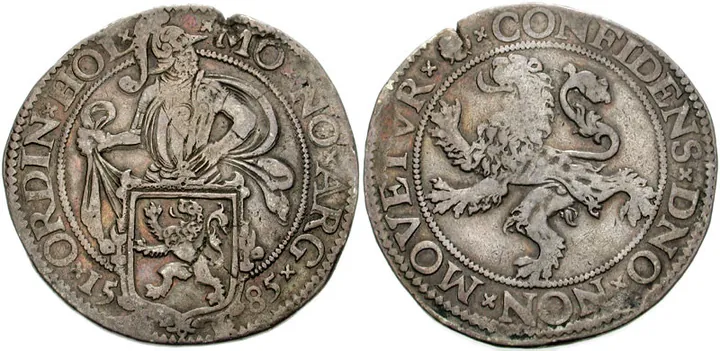
Around 1600, more than a hundred kinds of coins circulated in Wallachia and Moldavia: Turkish thalers, Hungarian and Austrian guilders, zloti, Russian carboave, Venetian zecchini. Among them the Dutch lion thaler — the leeuwendaalder — with a rampant lion engraved on the reverse: 27.68 grams of .750 silver, struck for the world's trade, come all the way to our fairs. People called it shortly: leu.

The name stayed after the coin left. The Organic Regulations of 1831 (Wallachia) and 1832 (Moldavia) made “leu” a unit of account: the gold ducat was worth 31 lei 20 parale, and the Austrian silver zwanziger 2 lei 10 parale. The leu lived in ledgers decades before it lived in pockets.
Alexandru Ioan Cuza wanted to strike it: the român or romanat, after the French franc, with a loan of 60 million francs and the Paris mint. The drafts came in a chain — 1860, 1861, 1864 — and fell in a chain: the Porte accepted no coin of its own from a vassal, and Napoleon III wanted no quarrel with the Turks. A five-sutimi pattern, struck in Paris in 1864, never circulated.
One hundred Romanians for an ox.
Ion Heliade Rădulescu and Dionisie Pop Marțian: why the name “român” would not do (translated)
Meanwhile: In Paris, France, Belgium, Italy, Switzerland and Luxembourg found the Latin Monetary Union in 1865, in force from 1 August 1866.
Chapter II
The golden leu
1867 – 1914 · the currency that kept pace with the franc
- Chapter
- 1867 – 1914
- The law
- 22 April 1867, Monitorul no. 89
- The leu
- 5 g of silver or 0.3226 g of gold
- The rate
- 1 leu = 1 franc, 1882–1914
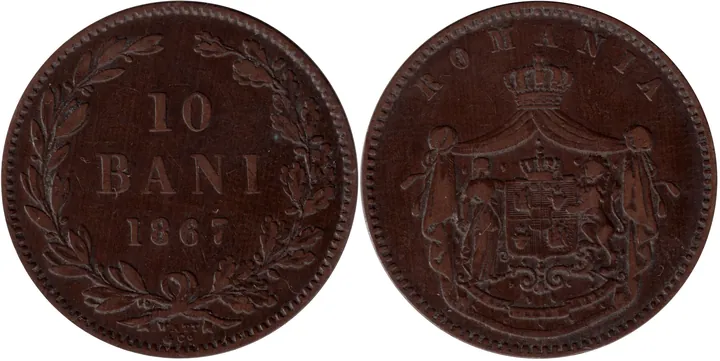
The law establishing the new monetary system, voted by the Assembly on 29 March, by the Senate on 14 April and published in Monitorul no. 89 of 22 April 1867, cut the knot: one leu meant 5 grams of .835 silver or 0.3226 grams of .900 gold, divided into 100 bani. The name “leu” is attributed to Cezar Bolliac, and “bani” to Cristian Tell. The first coins — 1, 2, 5 and 10 bronze bani — were struck in England in 1867; the one-ban piece read “banu”.

Then came the 20 lei gold pol (1868, only 200 pieces — a pattern), the State Mint (3 March 1870), the silver 50 bani (“băncuțe”), 1 leu and 2 lei, the mortgage notes under the law of 12 June 1877 — the first paper money, for the Independence War — and the National Bank, under the law of 17 April 1880 (29 April New Style), with a capital of 30 million lei. Foreign gold filled the gaps: the 20 franc Napoleon passed for 20 lei, the Turkish lira for 22.70, the Russian imperial for 20.60 and the English sovereign for 25.22.
The leu clung to the franc for more than thirty years: between 1882 and 1914, one franc changed in Bucharest for 1.000 to 1.018 lei. But market gold cost more than legal gold — the agio — so gold coins hid in strongboxes, and the law of 1890, enforced from 1892, moved the leu to gold alone (the NBR had opposed it). That was the “leul aur”, the golden leu: the strongest of its life.
The emerging difference between the two values, referred to as agio, led to the hoarding of gold coins.
Stoenescu et al. (NBR), OeNB 2008
Meanwhile: In Bucharest, the NBR palace rises between 1884 and 1889, to the plans of the Frenchmen Galleron and Cassien-Bernard.
Chapter III
The paper leu
1914 – 1947 · the war, the peace and the printing press
- Chapter
- 1914 – 1947
- Bread
- 0.27 → 10.00 lei (1914–1929)
- The dollar
- 167.20 lei, 7 February 1929
- The press
- ×2,099, 1935–1947
The war cut the anchor: coin striking ceased in 1914, convertibility was suspended in 1917, the NBR gold left for Moscow in 1916–1917 and never came back, and the monetary unification of 1920 — crowns, rubles, occupation lei — cost 7,079,000,000 lei. Bucharest bread rose from 27 bani in 1914 to 3 lei in 1922 and 10.08 lei in 1926; retail prices had risen nearly 40 times.

The February 1929 stabilization froze the collapse: the new leu was worth 10 milligrams of gold — 32.26 times less than in 1890 — and the dollar was fixed at 167.20 lei (7 February 1929). Then came the crisis, with bread cheapened to 7.30 lei in 1938, and the November 1936 devaluation: the kilogram of gold jumped from 111,111.11 to 153,333.33 lei, and the NBR stock from 11.2 to 15.46 billion.
The Second World War took inflation to the heights: bread at 46 lei in 1944 and 20,000 lei in July 1947; the 100,000 lei coin (1946) and the 5,000,000 lei note (25 June 1947) — the highest nominals in Romanian history. The money in circulation had grown 2,099 times against 1935, and living standards had fallen to one quarter of 1938. The paper leu was living its last weeks.
The Romanian leu thus became the weakest currency in Europe.
Simona-Elena Bălan, on the February 1929 stabilization (translated)
Meanwhile: In Paris, the Latin Monetary Union dissolves itself on 1 January 1927.
Chapter IV
The leu without zeros
1947 – 2005 · three deaths and a rebirth
- Chapter
- 1947 – 2005
- 1952
- 20–400 to 1, 28 January
- 1993
- 256.1% inflation
- 2005
- 10,000 to 1, 1 July
The stabilized leu did not live five years: on 28 January 1952 a new reform exchanged it at rates from 20 to 400 to 1, by kind of money — cash, deposits, debts — again without warning. Then came the coins and notes with the RPR arms, and from 1966 with the name of the Socialist Republic of Romania; from 1975 the small change was struck in aluminium. Between 1970 and 1989 the rate was set by law, and foreign currency in private hands was a crime: up to 10 years in prison.

After 1989 prices ran wild: sugar, 20 lei the kilogram in 1989, had reached 500 lei in 1993, the year of 256.1% inflation. The issues poured out — 50,000 lei in 1996, 100,000 in 1998, the 2,000 lei polymer note of the 11 August 1999 eclipse (the first in Europe) — and the zeros: in September 2003 one euro passed 40,000 lei, and the leu was for a while the world's weakest currency unit.
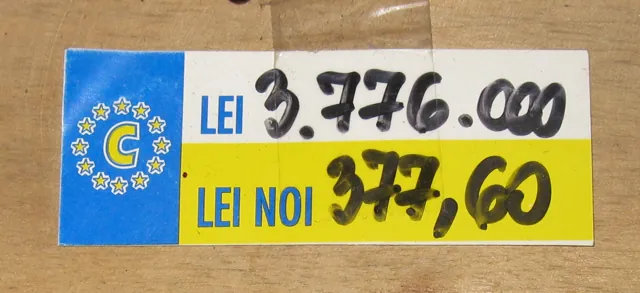
On 1 July 2005, Law 348 of 14 July 2004 cut four zeros: 10,000 old lei for one new leu (RON). Prices were shown double from 1 March 2005 to 30 June 2006, the old notes circulated until 31 December 2006, and the coins until 31 December 2005. The leu was back among Europe's normal currencies — but the language did not forget: even in 2020, a hundred lei was still called “a million”.
In Romania, a kilogram of sugar that cost 20 lei in 1989 now costs 500 lei.
Washington Monthly, December 1993
Meanwhile: In Brussels, Romania joins the European Union on 1 January 2007.
How much is a loaf?
Eight loaves in 150 years, from 1867 to 2017: guess the price, then check it against the sources.
-
1
1867, the year of the law
One kilogram of bread in Bucharest cost…
What it really was
We do not know. The oldest documented price is from 1898: 27 bani the kilogram (Dincă 2024).
-
2
1900
One kilogram of bread in Bucharest cost…
What it really was
24 bani the kilogram (Bălan 2020, Table 1).
-
3
1914
White bread, one kilogram, in Bucharest…
What it really was
32 bani (Dincă 2024).
-
4
1929, the stabilization
After the war and inflation, the kilogram…
What it really was
10 lei (Bălan 2020, Table 3) — against 27 bani in 1914.
-
5
1938
In the depths of the crisis, the kilogram…
What it really was
7.30 lei (Bălan 2020, Table 7) — the crisis had cheapened bread against 1929.
-
6
1944
Under the bombs, the kilogram…
What it really was
46 lei (Bălan 2020, Table 7).
-
7
July 1947
On the eve of the stabilization, the kilogram…
What it really was
20,000 lei (Bălan 2020, Table 7) — on the eve of the 15 August 1947 stabilization.
-
8
April 2017
Braided white bread, 600 grams…
What it really was
2.00 lei with VAT (the IBA list, April 2017).
Answer one card to begin.
Six plates of the leu
Six images, in the story's order: the thaler, the bani, the pol, the leu, the hundred thousand and the tag.
Plate 1585The thaler with a lion
The thaler with a lion Photo by Classical Numismatic Group, CC BY-SA 2.5 · Wikimedia Commons - A Dutch silver thaler, struck for the world's trade around 1600.
- The rampant lion on the reverse gave it its name: leeuwendaalder, the “lion thaler”.
- 27.68 grams of .750 silver: from it came the word “leu”.
Plate 1867Ten bani, the first issue
Ten bani, the first issue Scan by Bogdan Giușcă, public domain · Wikimedia Commons - Bronze struck in England, 1867: 1, 2, 5 and 10 bani.
- The one-ban piece read “banu”, with a u: the 1867 issue only.
- One ban weighed one gram and measured 15 millimetres.
Plate 1870The gold pol
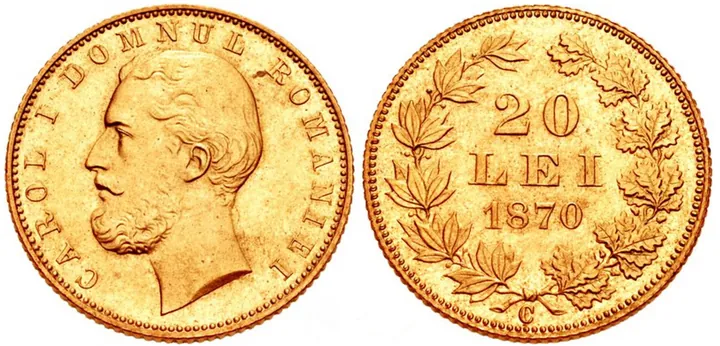
The gold pol Photo by Classical Numismatic Group, CC BY-SA 3.0 · Wikimedia Commons - Twenty gold lei, 1870: 6.45 grams (0.3226 × 20).
- The “pol”, after the French 20 franc Napoleons.
- The 1868 pieces, 200 of them, stayed patterns.
Plate 1924The leu after the war
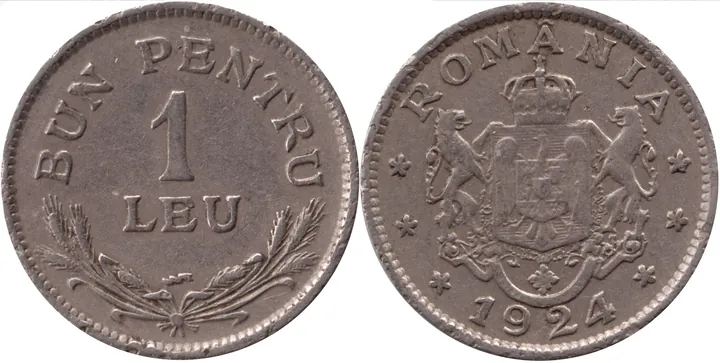
The leu after the war Scan by Bogdan Giușcă, public domain · Wikimedia Commons - One cupronickel leu, 1924: the silver had left the coins.
- Struck after the inflation that took bread to 3 lei the kilogram.
- In 1929 the stabilization would come: 167.20 lei to the dollar.
Plate 1946The hundred thousand
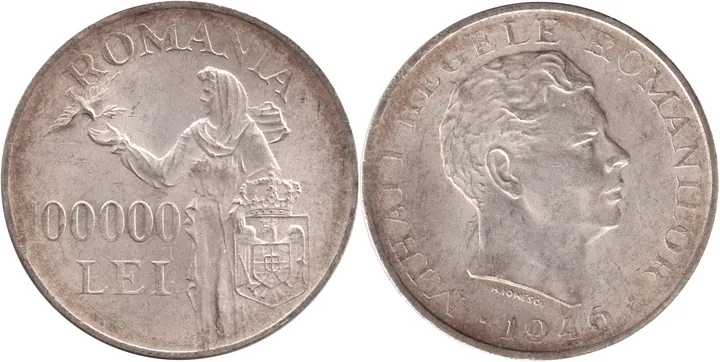
The hundred thousand Scan by Bogdan, public domain · Wikimedia Commons - A 100,000 lei coin, silver, 1946.
- One year before the 5,000,000 lei note.
- Bread had reached 20,000 lei the kilogram by July 1947.
Plate 2005The dual tag
The dual tag Photo by Zarxos, CC BY-SA 3.0 · Wikimedia Commons - Prices in old and new lei, 1 March 2005 – 30 June 2006.
- 10,000 old lei for one new leu, from 1 July 2005.
- The old notes circulated until 31 December 2006.


Images via Wikimedia Commons (public domain or CC, see credits). The dates are the plates'.
The leu in six figures
Every figure below comes from the cited sources. The game's 150 years are the editors' arithmetic: 2017 minus 1867.
- 1,867
- the year of the law: Monitorul no. 89, 22 April 1867
- 5
- grams of .835 silver in an 1867 leu
- 20,000
- old lei for one stabilized leu, 15 August 1947
- 400
- stabilized lei for one new leu, the maximum 1952 rate
- 256.1
- percent inflation in 1993, the transition peak
- 10,000
- old lei for one new leu, 1 July 2005
Three things people get wrong
“The leu is as old as the world”
The name is, the currency is not. “Leu” was the Dutch thaler with the engraved lion, circulating here since around 1600 — but the national currency was born with the law published on 22 April 1867. Between the thaler and the leu lie whole centuries of a world without a Romanian leu.
“Romania was in the Latin Monetary Union”
The leu was cut after the franc — one leu, one franc — but membership is disputed between the sources: the NBR historians write that Romania's application was rejected, while the Romanian Wikipedia lists it as admitted in 1889. What we know for sure: the parity, not the membership card.
“The biggest note was the million”
It was not. The record belongs to the 5,000,000 lei note of 25 June 1947, followed by the 100,000 lei coin of 1946. The plastic million of the 2000s is only the biggest nominal since 1989 — recorded, it is true, in the Guinness Book.
Sources and method
The story follows the 1867 law, the NBR and currency histories, the press of the day and the price statistics — with the dates checked in the cited sources. Where the sources did not reach — the 1867 bread price, the communist absolutes and the ’90s–2000s ones — the page claims nothing: the gaps are logged as undocumented in SOURCES.md.
Romanian dates before 1919 are Old Style, 12 days behind the New Style; the page gives them as the sources give them, with both styles where it matters (22 April/4 May 1867, 17/29 April 1880). The Latin Union years and sums are the treaties'.
All six images are public domain or attributed CC, verified file by file on Wikimedia Commons; no BNR-protected note or coin design appears on the page. The game spans 150 years (2017−1867), shown as its own arithmetic.
The timeline
- Stoenescu et al. (NBR), OeNB 2008: the 1867 law, 0.3226 g of gold, the NBR 1880, the 1890/1892 gold standard
- The Romanian leu: Monitorul no. 89 of 22 April 1867, the Mint 1870, the mortgage notes 1877, the 1999 eclipse
- The leu: the 1889/1914 standard, the 1929–1941 pegs, 1952 20–400 to 1, 2005 10,000 to 1
The leu without a leu
The golden leu
The paper leu
The leu without zeros
Images
- Photo by Classical Numismatic Group, CC BY-SA 2.5 · Wikimedia Commons
- Scan by Bogdan Giușcă, public domain · Wikimedia Commons
- Photo by Classical Numismatic Group, CC BY-SA 3.0 · Wikimedia Commons
- Scan by Bogdan Giușcă, public domain · Wikimedia Commons
- Scan by Bogdan, public domain · Wikimedia Commons
- Photo by Zarxos, CC BY-SA 3.0 · Wikimedia Commons