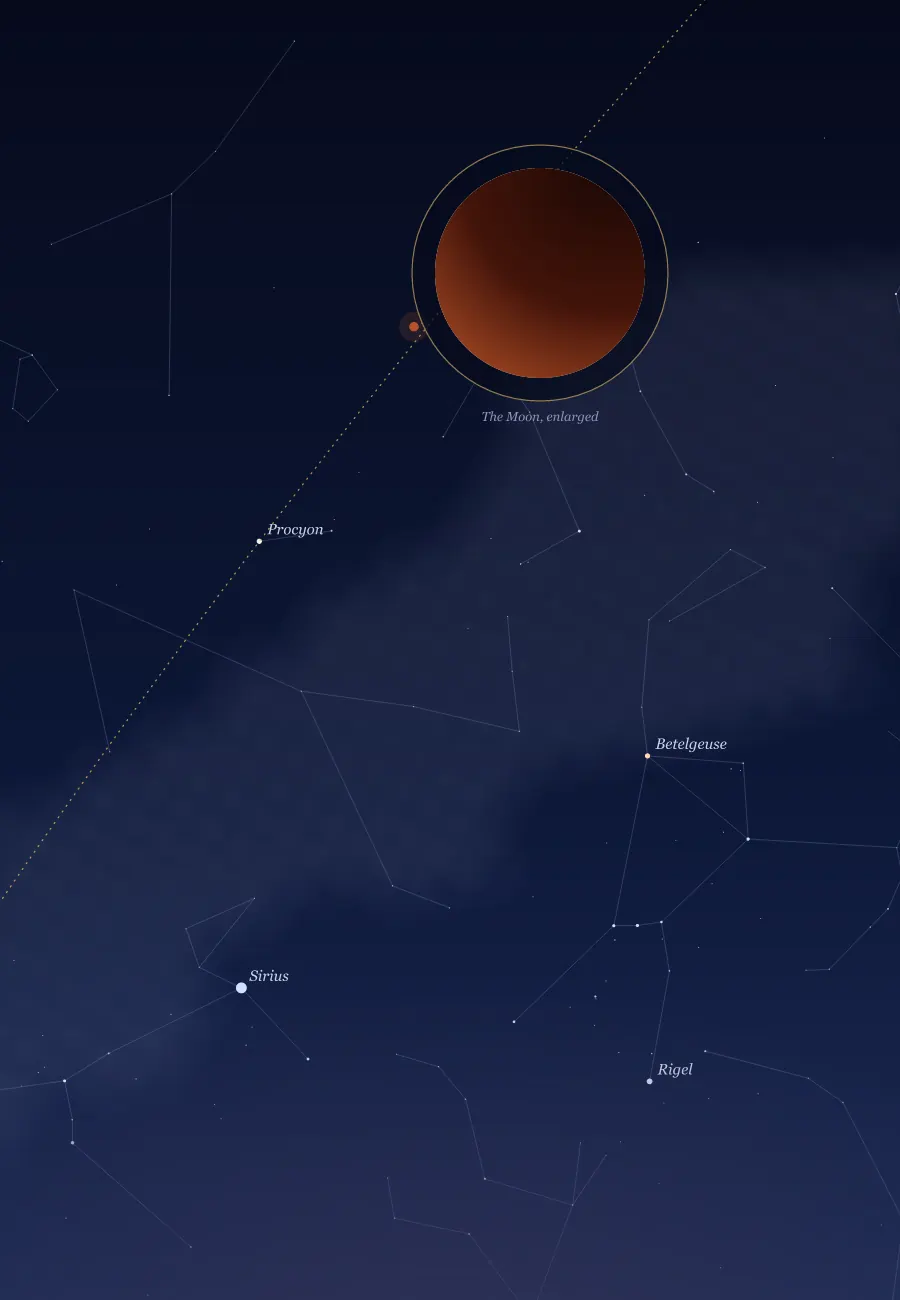
What did the eclipse of 27–28 December 1460 look like from your town?#
This is the eclipse Peuerbach chose as the worked example in his tables, and the one he and Regiomontanus watched from Vienna. The sky is computed for the town you pick: choose one from the list or click anywhere on the map. Drag the time under the sky through the night, or press “Play the night”.1
Or type a latitude and longitude
Meridians are vertical lines on this map. Gold: Oradea. Blue: Vienna. Dashed: 30 minutes of time east of Vienna, where the copy made for Oradea in fact puts its meridian. Borders are today’s.
Times are local apparent time, the time a sundial shows, which is also what Peuerbach’s tables give: they correct for the equation of time. The rotation of the Earth in 1460 is known only approximately; the times shown use one published model, and another puts every one of them 2 minutes later.7
How accurate were Peuerbach’s eclipse tables?#
Three lunar eclipses from those years were timed and written down. Regiomontanus’s book of observations, printed in Nuremberg in 1544, gives the times he and Peuerbach measured, and for July 1460 what “the tables for the meridian of Vienna” had predicted. For December 1460 the predicted times come from the worked example in Peuerbach’s instructions, as the Dictionary of Scientific Biography reports it. The fourth entry is the other worked example, the solar eclipse of July 1460; the sources used here record no timing of it. Each time is set here against the same moment computed today.123
In the December 1460 worked example the tables came close, 3 to 15 minutes late. For the solar eclipse of July 1460 Peuerbach’s worked example puts the middle 17 to 19 minutes too early, as Lars Gislén also found in a 2026 study of the tables. Together these two give the range of 3 to 26 minutes. The lunar eclipse of July 1460 stands apart: the end of that partial eclipse came 52 to 54 minutes after “the tables for the meridian of Vienna” said. Regiomontanus noted a gap of 1 hour 10 minutes between his timing and those tables, and most of it was their error. The Dictionary of Scientific Biography and MacTutor say the 1460 eclipses were compared with Peuerbach’s own tables, but the record names no tables, so the chart marks this eclipse separately and leaves it out of the range.1235
The observers’ clocks were not exact either. They found the hour by measuring the altitude of a bright star (Arcturus in December, a star of the Pleiades at Melk) and working it out by trigonometry. Their times run from 11 minutes early to 18 minutes late. In 1457 they took the middle of totality as the moment of opposition, when the Moon is 180° from the Sun in longitude, and found it 8 minutes before the time given by the Alfonsine Tables, the standard tables of the day. The modern computation sides with them: the middle of the eclipse came 2 to 4 minutes after their timing, while the Alfonsine time for the opposition was 8 to 10 minutes late.15
| Eclipse and moment | Source | In the sources | Computed today | Difference, min |
|---|---|---|---|---|
| 3 Sep 1457, Moon wholly in the shadow | eye | 22:24 | 22:33–22:35 | −11 … −9 |
| 3 Sep 1457, Middle | eye | 23:06 | 23:08–23:10 | −4 … −2 |
| 3 Sep 1457, Moon starts to leave the shadow | eye | 23:49 | 23:42–23:45 | +4 … +7 |
| 3 Sep 1457, Opposition | Alfonsine | 23:14 | 23:04–23:06 | +8 … +10 |
| 3 Jul 1460, Moon touches the shadow | unnamed tables | 19:16 | 19:57–19:59 | −43 … −41 |
| 3 Jul 1460, Middle | unnamed tables | 20:13 | 20:59–21:02 | −49 … −46 |
| 3 Jul 1460, Moon leaves the shadow | unnamed tables | 21:10 | 22:02–22:04 | −54 … −52 |
| 3 Jul 1460, Moon leaves the shadow | eye | 22:20 | 22:02–22:04 | +16 … +18 |
| 18 Jul 1460 (Sun), Eclipse begins | tables | 03:54 | 04:18–04:20 | −26 … −24 |
| 18 Jul 1460 (Sun), Middle | tables | 04:49 | 05:06–05:08 | −19 … −17 |
| 18 Jul 1460 (Sun), Eclipse ends | tables | 05:44 | 05:57–05:59 | −15 … −13 |
| 27–28 Dec 1460, Moon touches the shadow | tables | 23:32 | 23:27–23:29 | +3 … +5 |
| 27–28 Dec 1460, Moon wholly in the shadow | tables | 00:42 | 00:31–00:33 | +9 … +11 |
| 27–28 Dec 1460, Moon starts to leave the shadow | tables | 01:58 | 01:43–01:46 | +12 … +15 |
| 27–28 Dec 1460, Moon touches the shadow | eye | 23:42 | 23:27–23:29 | +13 … +15 |
| 27–28 Dec 1460, Moon wholly in the shadow | eye | 00:47 | 00:31–00:33 | +14 … +16 |
| 27–28 Dec 1460, Moon starts to leave the shadow | eye | 01:55 | 01:43–01:46 | +9 … +12 |
Times on the local sundial. The difference is given as a range because two models of the Earth’s rotation in the 15th century differ by about 2 minutes.
Method: for the lunar eclipses, the moments when the Moon meets and leaves the Earth’s shadow are computed from JPL’s DE422 ephemeris, with the shadow enlarged by 1/85 as in NASA’s eclipse canon (the durations agree with the canon to 0.1 minute), then turned into local apparent time at Vienna or Melk. For the solar eclipse, the moments when the discs of the Sun and Moon first and last touch, seen from Vienna, are computed from the same ephemeris, once under each of the two models of the Earth’s rotation. The sources count hours from noon; they are given here as clock times.67
Where was the Moon? Regiomontanus’s two star lines#
Regiomontanus also wrote down where the Moon stood. At the start of the December eclipse it was “on one great circle” with the head of the leading Twin, Castor, and the brighter star of the Little Dog, Procyon. At the end it was on a line through the head of the following Twin, Pollux, and Procyon again. Computed for Vienna, with the stars moved by their own motion since then, the centre of the Moon lay 0.12° from the first line and 0.06° from the second. The Moon’s radius was 0.28°, so both lines cross its face.1
The eye was precise about place and less precise about time. The hour had to be derived from a star’s measured altitude, and an error of one degree there costs several minutes.
Why were eclipse tables made for Oradea?#
- 3 September 1457Peuerbach and Regiomontanus time a total lunar eclipse at “the castle of Melk in Austria”, “eleven German miles west of Vienna”, as their record says. Their opposition, worked out from the middle of totality, comes 8 minutes before the time of the Alfonsine Tables, compiled in Toledo for King Alfonso X of Castile in the 13th century.
- About 1459Peuerbach finishes his own eclipse tables. John Vitéz, bishop of Oradea (then in the Kingdom of Hungary; Várad in Hungarian, Grosswardein in German), wants to learn to calculate eclipses. In an English translation of Peuerbach’s letter to him, given by Rusu and colleagues, the tables “were calculated on the basis of the meridian that passes through Oradea”, and so he named them the Tabulae Varadienses, the Oradea tables (the Dictionary of Scientific Biography spells it Waradienses).
- 1460The instructions for the tables work through two examples, the solar eclipse of 18 July and the lunar eclipse of 28 December 1460. Peuerbach and Regiomontanus also watched the December eclipse from Vienna.
- 1461 and 1465Peuerbach dies in 1461, aged 37. In 1465 Vitéz becomes archbishop of Esztergom, in present-day Hungary, and leaves Oradea with his books and instruments.
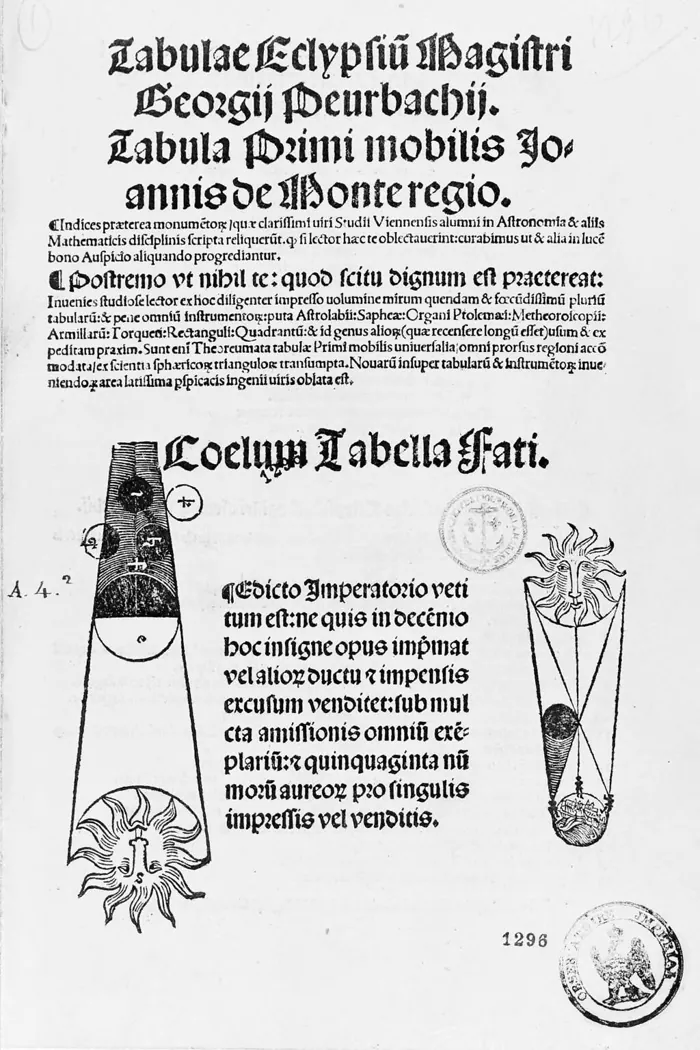
- 1514 and afterThe Vienna version is printed in Vienna, edited by Georg Tannstetter. Tycho Brahe is still using the tables, critically, near the end of the 16th century.1245
Did the Oradea copy put the meridian in the right place?#
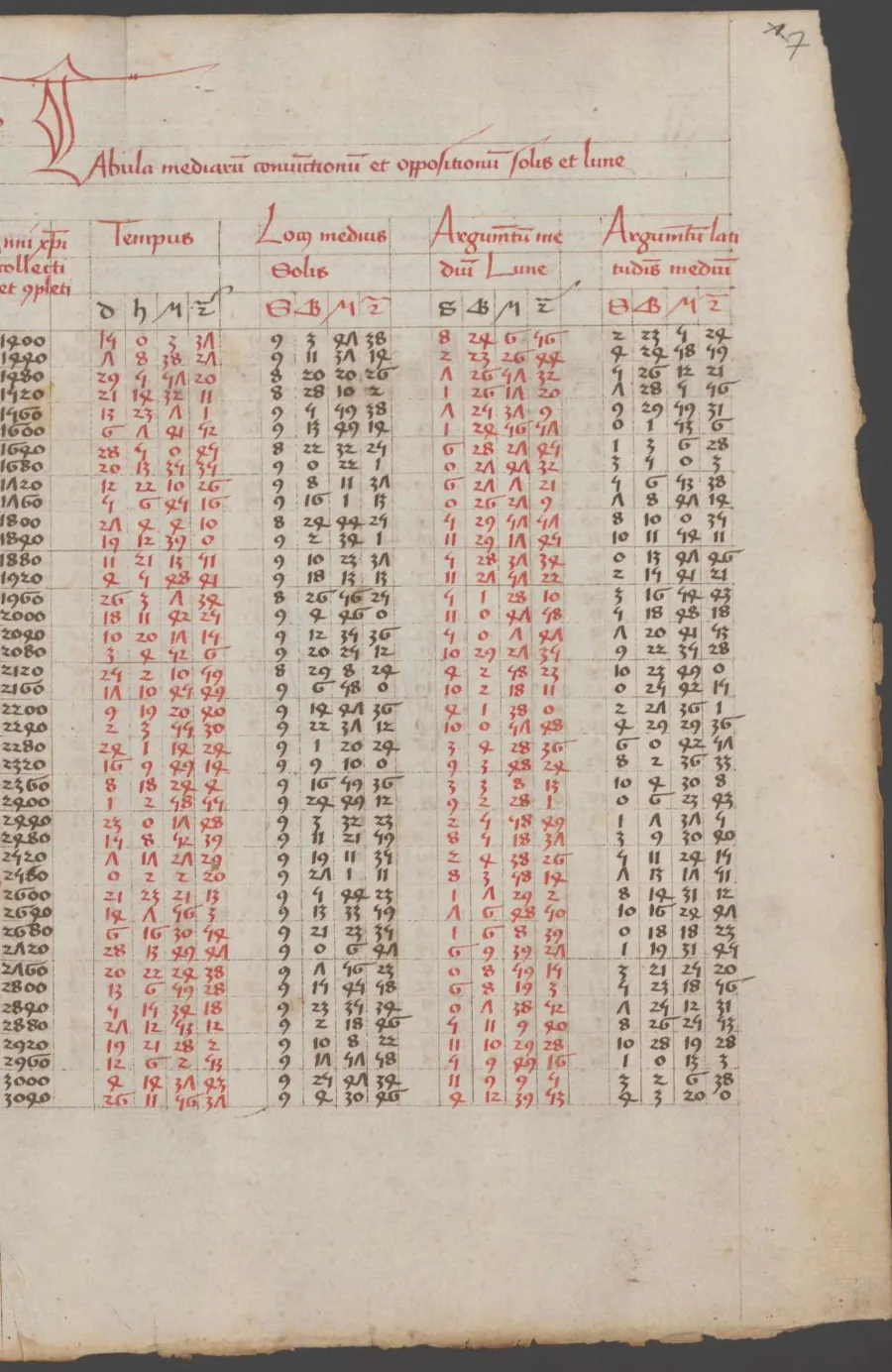
Not quite. Hellman and Swerdlow, who describe the manuscripts in the Dictionary of Scientific Biography, say the Oradea version (one copy is codex 5291 in the Austrian National Library) moves the tables’ starting positions 0;30 hours east, which is 30 minutes, and call it an error for 0;22 hours. The modern gap between the two cities is 22.2 minutes, 5.55° of longitude. Thirty minutes east of Vienna is a meridian through Transylvania, the region of central Romania, that passes 3 km west of the town of Blaj; it is the dashed line on the map.211
Neither that entry nor any other source read for this page says where the 22 comes from or how the 30 arose. A copying slip is one possibility; a longitude taken from a 15th-century list of coordinates is another, and such lists were not checked here. The Vienna version’s own reference longitude was close to the modern value: Gislén finds it set 1 hour 20 minutes east of Toledo, where the Alfonsine Tables were computed; the modern figure is 1 hour 22 minutes.3
Against the tables’ own errors the 8 extra minutes are small. For the start of totality in December 1460, the Vienna tables carried correctly to Oradea would have been 9 to 11 minutes late; the Oradea copy, as reconstructed here from the Vienna times and its 30-minute shift (no times transcribed from a copy were used), 17 to 19 minutes late.1
Was Oradea the world’s prime meridian?#
The sources checked here do not show it. English Wikipedia says Oradea “was used for maps and navigation as the prime meridian between 1464 and 1667”. The footnote for that sentence is a 2016 news report about the city’s astronomy club. No map, table or treatise consulted for this page supports those dates.10
What the sources support is narrower: one set of eclipse tables, in one of its manuscript versions, took Oradea as its reference. Any meridian could serve as zero. Hipparchus used Rhodes and Ptolemy the Canary Islands; Greenwich was chosen at an international conference in Washington in 1884.4
The same Wikipedia passage says Peuerbach “worked at the Observatory of Varadinum” and that his Tabula Varadiensis was “published posthumously in 1464”. The sources read here show neither. Rusu and colleagues put Peuerbach in Vienna, at the court of Emperor Frederick III, writing to Vitéz and sending him a celestial map, and credit Vitéz with founding the observatory in 1459. MacTutor and the Dictionary of Scientific Biography place Peuerbach’s career in Vienna and Italy and describe no stay in Oradea. The printed edition the Dictionary cites is the Vienna edition of 1514, edited by Georg Tannstetter; no source read here dates a printing to 1464. Rusu and colleagues name Regiomontanus among the professors of Vitéz’s university at Pozsony (now Bratislava), which opened in 1467, two years after Vitéz had left Oradea.10452
How Greenwich became zero, and where your true noon falls today: The Greenwich meridian and your true noon.
When can you time a lunar eclipse yourself?#
Peuerbach’s test still works: note when the Moon touches the shadow and when it is wholly inside it, and compare with the prediction. The next lunar eclipses in which the Moon enters the dark shadow, seen from Oradea with the Moon above the horizon for at least part of the time:
- 12 January 2028: partial eclipse, 7% of the Moon’s width in the shadow. The Moon touches the shadow at 05:45, Romanian time.
- 6 July 2028: partial eclipse, 39% of the Moon’s width in the shadow. The Moon touches the shadow at 20:08 (Moon below the horizon), Romanian time.
- 31 December 2028: total eclipse. The Moon touches the shadow at 17:07 and is wholly inside it from 18:16 to 19:27, Romanian time.
What is still unknown?#
- Where Vitéz’s observatory stood. The fortress was rebuilt after the Ottoman threat of the 1550s, the outer works consolidated by 1618 and the inner castle raised between 1618 and 1650; the authors of the Romanian Astronomical Journal paper propose a round tower, by their own account an educated guess.
- Whether it was the first observatory in Europe. The same paper says “arguably”; that claim was not checked here.
- The wording of Peuerbach’s letter. It was read only in an English translation, not in the Latin.
- Where the 0;22 hours in the Dictionary of Scientific Biography comes from, and how the 0;30 arose.
- Which tables Regiomontanus used in July 1460. His note says only “the tables for the meridian of Vienna”; the Dictionary of Scientific Biography and the MacTutor biography say the 1460 eclipses were compared with Peuerbach’s own tables.
- Why the 1460 timings run late. The star-altitude method, the instruments and the reckoning of noon are all possible causes; the record does not say.
- When Vitéz became bishop: sources give 1444 or 1445. He left in 1465.
Sources#
- Regiomontanus, Peuerbach, Walther, Scripta clarissimi mathematici M. Ioannis Regiomontani … Item Observationes motuum solis, ac stellarum, ed. J. Schöner, Nuremberg, 1544: the observations of 1457 and 1460. archive.org
- C. D. Hellman and N. M. Swerdlow, “Peurbach (or Peuerbach), Georg”, Complete Dictionary of Scientific Biography. encyclopedia.com
- L. Gislén, “Peurbach’s Tabulae Eclypsium: a commentary”, Journal of Astronomical History and Heritage 29(1), 2026, pp. 63–77. doi.org
- M. V. Rusu, N. Pazmany-Jianu, D. Noane, “Renaissance in Oradea and the prime meridian”, Romanian Astronomical Journal 28(3), 2018, pp. 213–233. astro.ro
- “Georg Peurbach”, MacTutor History of Mathematics, University of St Andrews. mathshistory.st-andrews.ac.uk
- F. Espenak and J. Meeus, Five Millennium Catalog of Lunar Eclipses, NASA, 1401–1500. eclipse.gsfc.nasa.gov
- JPL planetary ephemeris DE422, computed with Skyfield (B. Rhodes); the Earth’s rotation from Morrison, Stephenson, Hohenkerk and Zawilski (2021). rhodesmill.org/skyfield
- Peurbach, Tabulae eclipsium, manuscript, c. 1476–1482, Kraków, Biblioteka Jagiellońska 607. archive.org
- Tabulae eclypsium Magistri Georgij Peurbachij, Vienna, 1514, title page, Bibliothèque de l’Observatoire de Paris, digitised by the Bibliothèque nationale de France (Gallica). Wikimedia Commons
- “History of Oradea”, Wikipedia, citing Nine O’Clock, 17 September 2016. en.wikipedia.org
- Coordinates: GeoNames; Melk (coordinates of today’s abbey): Wikipedia. Map: Natural Earth. Stars, constellation figures and the Milky Way: d3-celestial (O. Frohn). Proper motions of Castor, Pollux and Procyon: SIMBAD. geonames.org · naturalearthdata.com · d3-celestial · SIMBAD
