GREAT STINK · BAZALGETTE · 1858‑1875
Run it downhill.
In June 1858 the Thames became, in Disraeli's July phrase, a Stygian pool — and Parliament funded in eighteen days the sewer system it had refused for a decade. Run one drop from a Soho drain through the 1858 sewers, then through Bazalgette's interceptors, and judge what unblocked London.
Thirty thousand cesspools abolished and all house refuse turned into the river, outfalls that could only empty at low water, eighteen stagnant hours a day — then eighty-two miles of interceptors, four pumping stations, and two reservoirs that held the flow for the ebb. Two runs, one drop, up to seven junctions.
1858: run it downhill
Soho, June 1858. Your drop leaves a house drain for sewers that only empty at low water — and the tide is coming in. Three junctions stand between the drain and the river: the cesspool question, the trunk choice, and the tide itself.
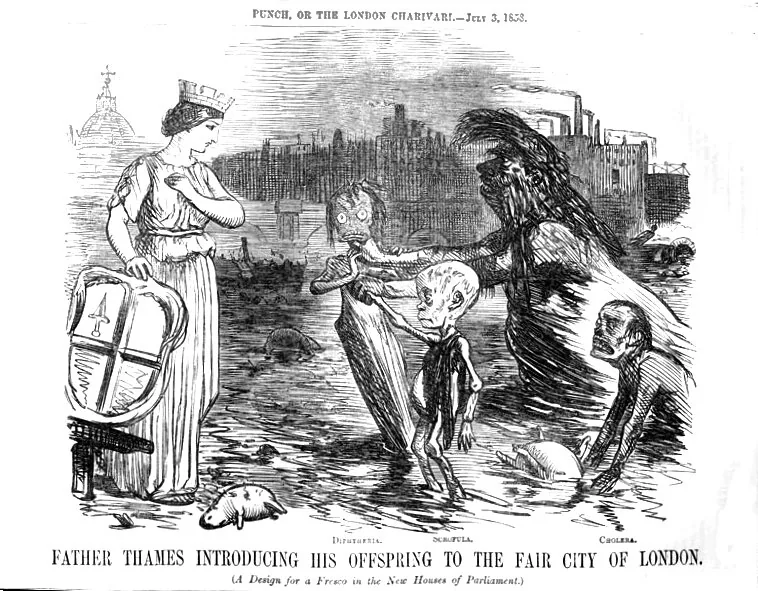
Figure receipt
3 July 1858, p.5 · Punch via Commons PD · Public domain
Run the 1858 sewer
Pick the drop's path at every junction — cesspool or sewer, high water or low, which level, when to let go. The reports judge every pick, and a wrong junction sends you back with the report's reason.
1875: flip the interceptor switch
Same drop, new city. The interceptors run east on both banks, the engines lift what gravity cannot, and Barking and Crossness hold the flow for the ebb. Four junctions — and a wall to walk through below, in the Works.
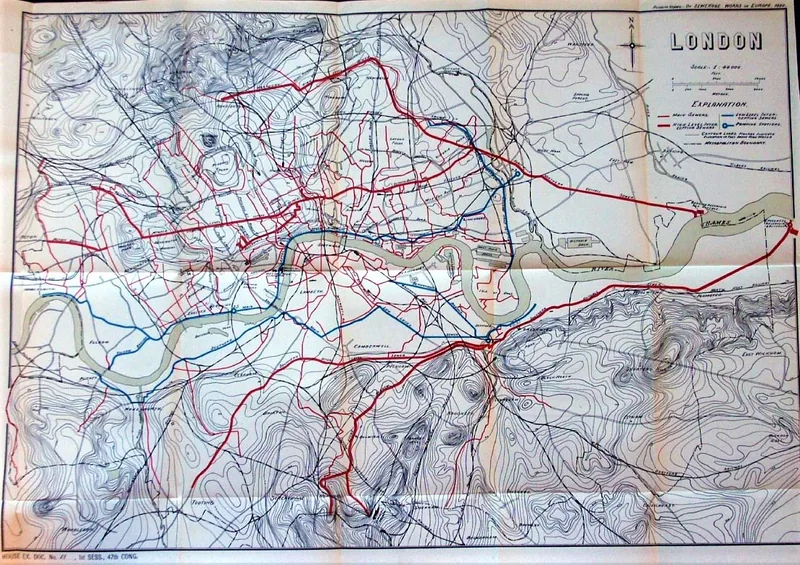
Figure receipt
1882 · Hering via Commons PD · Public domain
Run the 1875 sewer
Pick the drop's path at every junction — cesspool or sewer, high water or low, which level, when to let go. The reports judge every pick, and a wrong junction sends you back with the report's reason.
Two rails, one river
The money rail runs from the 1848 commission to the August assent; the system rail from the first spade in 1859 to the last engine in 1875. Every row dated, every row sourced.
The run set
Every correct pick, in flow order — J5 takes either level; the Low Level adds J6.
J1 — Send it to the sewer → Thirty thousand cesspools abolished, all house refuse turned into the river — Bazalgette 1865.
1858 · J1
J2 — The Fleet sewer → The Fleet falls to the Thames at Blackfriars — and at low water only.
1858 · J2
J3 — Low water → Low water — the only hour the old sewers empty, onto the mud, with the flood tide ready to carry it back up.
1858 · J3
J4 — Join the interceptor → Joined. Three lines a side run east — High and Middle by gravitation, Low by pumping.
1875 · J4
J5 — Middle Level → The Middle Level takes Oxford Street and Soho east to Old Ford — no lift needed.
1875 · J5 · Middle-Level route
J5 — Low Level → The Low Level takes it too — riverside from Vauxhall, inside the new embankment — but it needs a lift.
1875 · J5 · Low-Level route
J6 — Lift it at Abbey Mills → Lifted thirty-six feet on eight beam engines — the largest station on the works.
1875 · J6 · Low-Level route only
J7 — Hold for the ebb → Stored eleven hours, sluiced at high water — the ebb carries it seaward, past the point of return.
1875 · J7
The money rail
Eight dated rows carry what Parliament refused, smelled, and finally funded.
One commission for all the sewers of the metropolis
1848 · 11 & 12 Vict c.112 source
Two engineers of great eminence, Bazalgette and Haywood, appointed to draw the intercepting scheme
1854 · Tite in the Commons, 25 June 1858 source
No plan shall be carried into effect until the same has been approved
1855 · 18 & 19 Vict c.120, s.CXXXVI source
A plan which had its outfall within the Metropolitan area — contrary to the statute
1856 · Hall's first rejection, 18 June 1858 source
One of the noblest of rivers has been changed into a cesspool
15 June 1858 · Mangles in the Commons source
A Stygian pool, reeking with ineffable and intolerable horrors
15 July 1858 · Disraeli moves the Bill source
Both were in favour of intercepting sewers… The referees only differed as to the outfall
22 July 1858 · Stephenson in committee source
Three million pounds — borrowed by the Board, repaid by London at threepence in the pound for forty years
2 August 1858 · 21 & 22 Vict c.104 source
The system rail
Eight dated rows carry what Bazalgette built, from first spade to last engine.
The works were commenced
1859 · Bazalgette before the ICE, 1865 source
The Southern Outfall, seven and a half miles underground, completed
June 1862 · Bazalgette before the ICE, 1865 source
The south High Level lines in operation
January 1863 · Bazalgette before the ICE, 1865 source
The Northern Outfall in operation since March
March 1864 · Bazalgette before the ICE, 1865 source
The sewage is here lifted a height of eighteen feet
May 1864 · The Deptford engines source
Stored about eleven hours per tide, then sluiced out at high water
August 1864 · The Barking reservoir source
Success to the great national undertaking
4 April 1865 · The Prince at Crossness, ILN source
The Grosvenor Road pumping station of 1875 — the whole system runs
1875 · VCH Chelsea source
Your run, your verdict
One question, three answers: what unblocked London's drainage? Pick the verdict the rails support — then ask what your own city's river still carries.
Give your verdict
Three answers. The rails support exactly one.
Correct. The interceptors were ordered in 1854 and every engineer agreed on them by July 1858 — the Act funded the Board to build such plan as to them may seem proper, and enacted none. Eighteen days moved money; the engineering minds were already made up.
Refused. Parliament designed nothing — the money rail's last row says it: the Board builds what seems proper to the Board. The eighteen days are elapsed time from first reading to assent, across eight sittings, not eighteen days of engineering.
Refused. No epidemic had arrived by late June — Tite called its absence a great blessing — and Bazalgette himself said the causes were disputed. Whose proof that was belongs to another lane: the Broad Street pump, 1854.
Two runs, in brief
The same junctions, stated plainly. 1858: send it to the sewer, take the Fleet, wait for low water — the river receives it. 1875: join the interceptor, take the Middle Level, hold for the ebb at Barking — the tide carries it seaward. The verdict the rails support: the money, not the plan.
| Step | Choice | What happens |
|---|---|---|
| J1 | Hold it in the cesspool (had you picked this) | The cesspool is full — it overflows into the sewer. London tried holding it; the ground would not. Thirty thousand cesspools were abolished within six years, all house refuse turned into the river. |
| J1 | Send it to the sewer | Thirty thousand cesspools abolished, all house refuse turned into the river — Bazalgette 1865. |
| J2 | The Fleet sewer | The Fleet falls to the Thames at Blackfriars — and at low water only. |
| J2 | The Effra (had you picked this) | The Effra drains the south bank into the Thames near Vauxhall — your drop is in Soho, north of the river. |
| J2 | An interceptor (had you picked this) | Nothing intercepts anything yet. No plan has been approved — the scheme sits shelved to October. |
| J3 | High water (had you picked this) | High water. The tide shuts the outfall like a door; the sewer backs up behind it. Wait for the ebb — and smell what it leaves. |
| J3 | Low water | Low water — the only hour the old sewers empty, onto the mud, with the flood tide ready to carry it back up. |
| Step | Choice | What happens |
|---|---|---|
| J4 | To the Thames as before (had you picked this) | That outfall is filled in and abandoned. The interceptors caught this sewer upstream. |
| J4 | Join the interceptor | Joined. Three lines a side run east — High and Middle by gravitation, Low by pumping. |
| J5 | High Level (had you picked this) | The High Level runs above your street — Hampstead to Hackney. Sewage runs downhill; pick the level that can take it. |
| J5 | Middle Level | The Middle Level takes Oxford Street and Soho east to Old Ford — no lift needed. |
| J5 | Low Level | The Low Level takes it too — riverside from Vauxhall, inside the new embankment — but it needs a lift. |
| J6 | Float on east by gravity (had you picked this) | The Low Level lies below the outfall gradient. At Abbey Mills the engines lift it thirty-six feet into the Northern Outfall. |
| J6 | Lift it at Abbey Mills | Lifted thirty-six feet on eight beam engines — the largest station on the works. |
| J7 | Discharge at once (had you picked this) | Flood tide would carry it straight back to Westminster. The reservoirs hold it for the ebb. |
| J7 | Hold for the ebb | Stored eleven hours, sluiced at high water — the ebb carries it seaward, past the point of return. |
J6: Low-Level route only
The works
Refusal, stink, wall
Five beats, twenty-seven years. The river first, then the summer, then the mileage, then the roof.
Ten years earlier, the same river
In October 1848 Punch is already drawing Dirty Father Thames — “one vast gutter”, the poem calls it — and Faraday will warn the Times in July 1855 that a hot season will give sad proof of the folly of carelessness. Parliament's answer is commissions: six differently-constituted boards in nine years, unable to mature and carry out works of any magnitude — and nothing built.
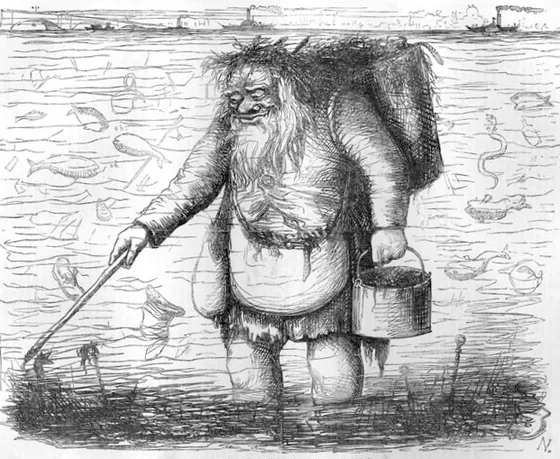
Ten years before the Stink: Dirty Father Thames, Punch, 7 October 1848. Figure receipt
1848 · Punch via Commons PD · Public domain
The summer it answered
June 1858: the Committee Rooms unusable by the eleventh; one of the noblest of rivers changed into a cesspool by the fifteenth; canvas moistened with chloride of zinc and lime at the windows, four or five boat-loads of lime on the mud, and omnibus passengers holding handkerchiefs across the bridge. The courts sit in the midst of a stinking nuisance — and Brady's proposal to move Parliament elsewhere was never adopted.
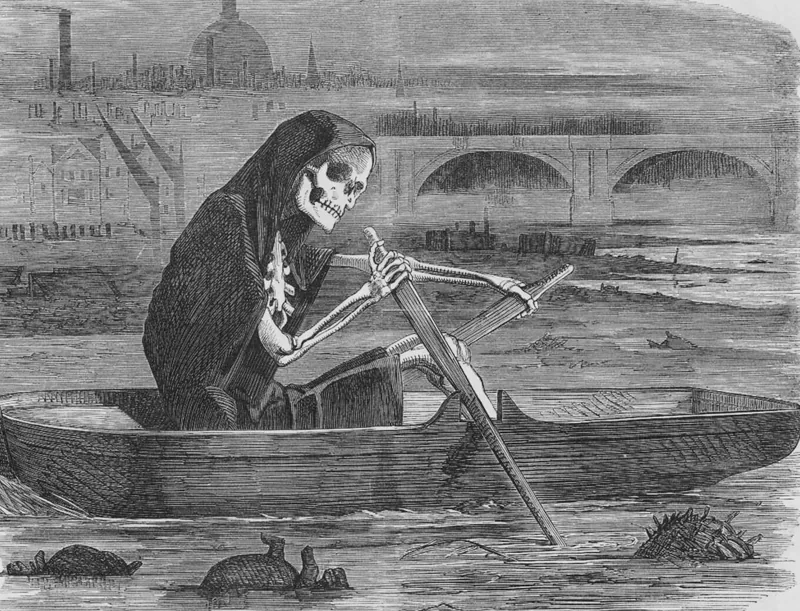
The summer it answered: Death rows the Thames, Punch, 10 July 1858, p.15. Figure receipt
1858 · Punch via Commons PD · Public domain
Eighty-two miles east
Three lines a side — High and Middle by gravitation, Low by pumping. Abbey Mills lifts the north Low Level thirty-six feet on eight beam engines; Deptford lifts eighteen; Barking stores eleven hours and sluices at high water. The account, in Bazalgette's own summary: eighty-two miles of interceptors, three hundred and eighteen million bricks, eight hundred and eighty thousand cubic yards of concrete — and provision for up to sixty-three million cubic feet a day, rainfall included, fifteen times the Serpentine.
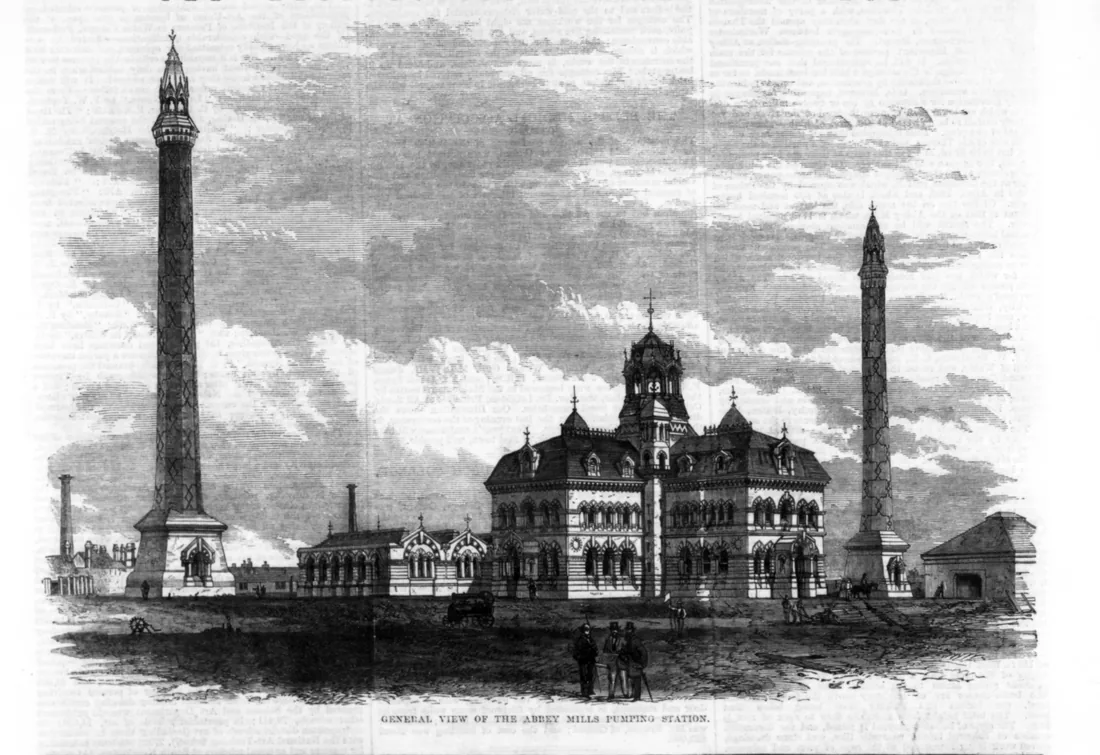
Thirty-six feet up: the Abbey Mills pumping station, ILN, 15 August 1868. Figure receipt
1868 · ILN via IA scan · Public domain
South of the river
South of the river, the same idea in heavier iron: Deptford lifts the Low Level eighteen feet into the Southern Outfall, and at Crossness four beam engines by James Watt and Co. lift the whole southern flow into the reservoir. On 4 April 1865 the Prince of Wales opens the works and starts the engines — the ILN puts it on the front page.
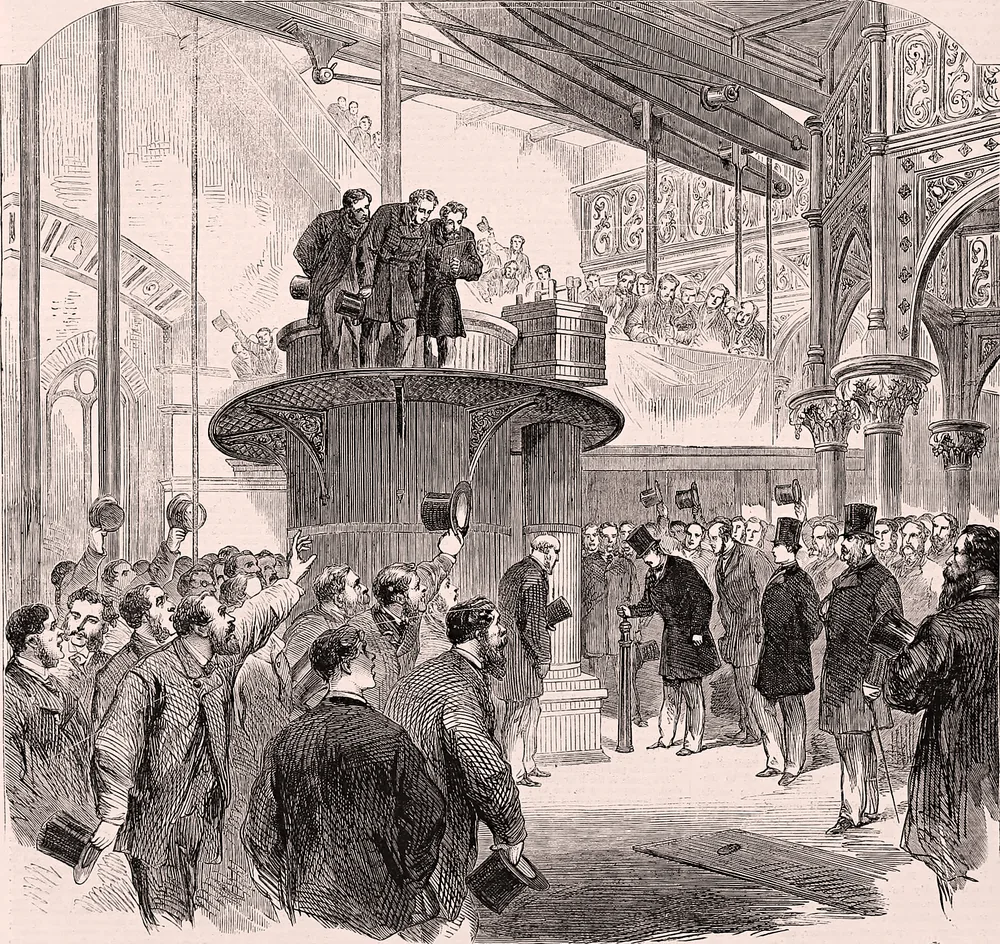
The payoff, 4 April 1865: the Prince of Wales starts the engines at Crossness — the ILN's front page. Figure receipt
1865 · ILN front page via Commons PD · Public domain
The roof of the system
On the north bank the Low Level runs inside the Victoria Embankment — interceptor, pipe subway, railway, and road in one wall, commenced February 1864, the whole opened on 13 July 1870. The Albert Embankment carries no sewer: the south Low Level runs inland, through the bed of the Thames's old second channel. Chelsea, 1871 to 1874, houses the last reach. Below, the works and the finished wall — and the section that opens it.
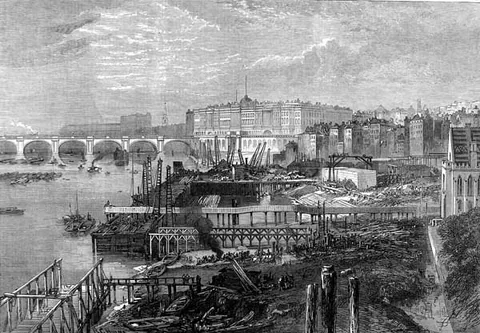
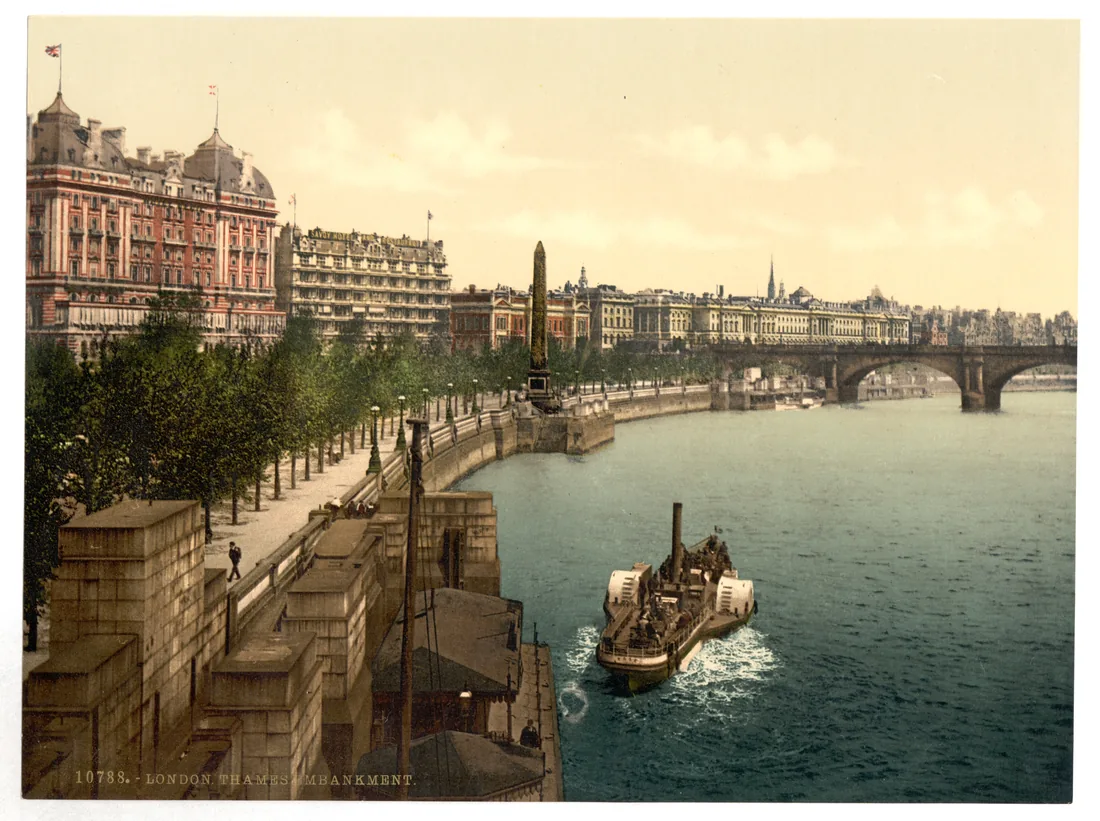
The works: cofferdam and cranes at the Temple reach, ILN, 1865. The finished wall: road, gardens, river wall, c.1890s — works and finished views, not the same spot. Figure receipt
1865 · ILN via Commons PD · Public domain · c.1890s · LoC Photochrom via Commons PD · Public domain
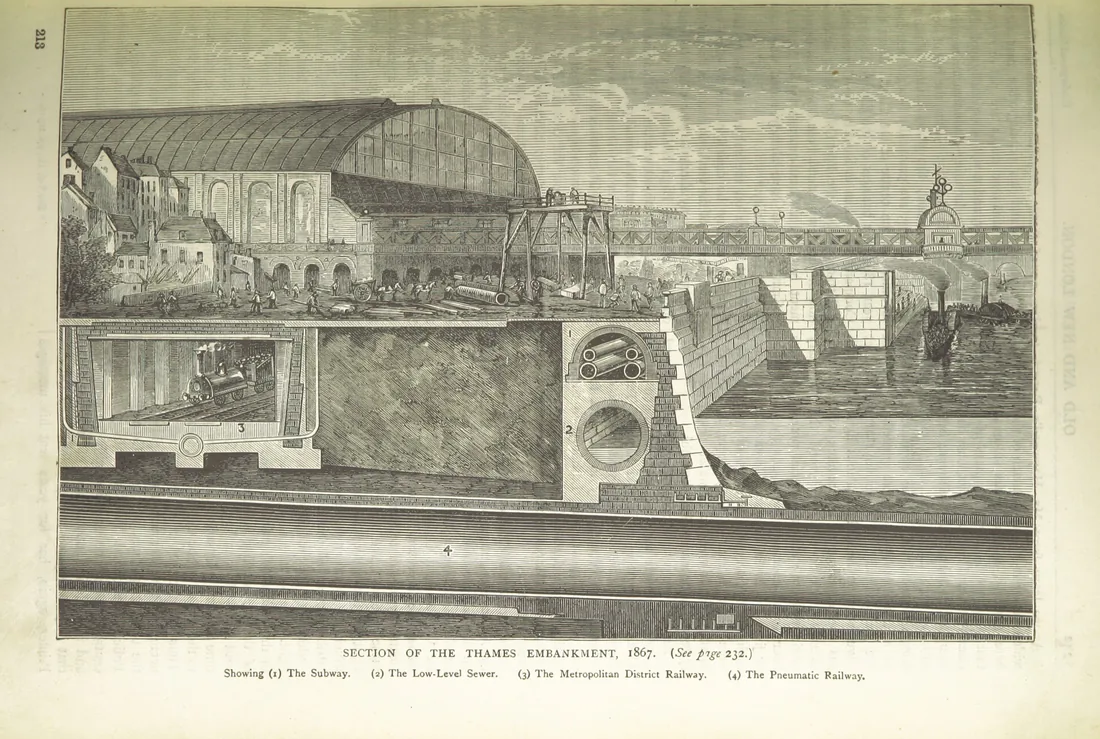
Inside the wall, numbered on the plate: the subway, the low-level sewer, the Metropolitan District Railway — and the pneumatic railway. Figure receipt
1867 · Old and New London via Commons PD · Public domain
The paper
Speech and paper
Two passages carry the whole system: the sentence that funded it and the eighteen hours that explain it.
Disraeli first, moving the Bill — then Bazalgette, seven years later.
- “That noble river, so long the pride and joy of Englishmen, which has hitherto been associated with the noblest feats of our commerce and the most beautiful passages of our poetry, has really become a Stygian pool, reeking with ineffable and intolerable horrors.”
- “As the tide rose it closed the outlets, and ponded back the sewage flowing from the high grounds which accumulated in the low-lying portions of the sewers, where it remained stagnant in many cases for eighteen out of every twenty-four hours.”
15 July 1858: Disraeli moves the Thames Bill, Hansard vol. 151. 1865: Bazalgette before the Institution of Civil Engineers.
Three years before the Stink, Punch already knew: Faraday shows his card to Father Thames, 21 July 1855.
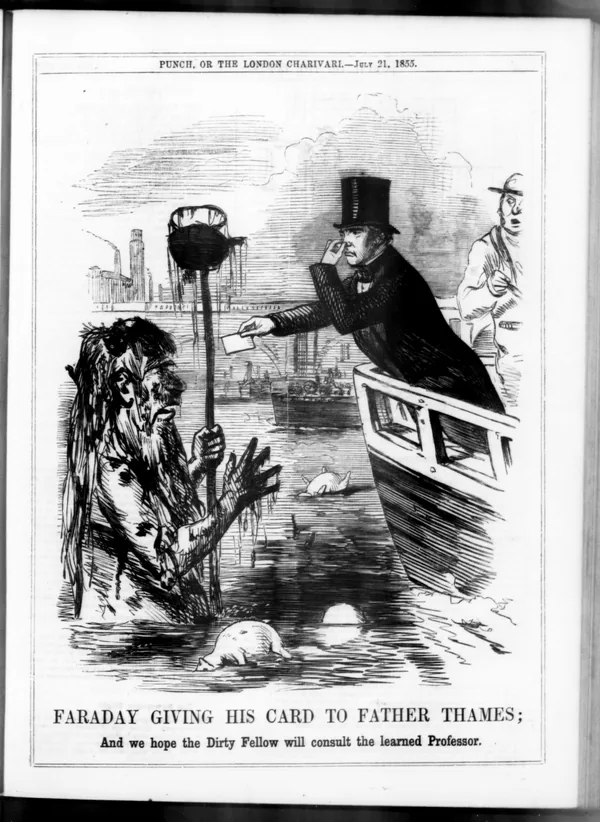
Figure receipt
1855 · Punch via IA scan · Public domain
Sources
Sources and receipts
Every claim here traces to a free text below. Hansard, the Act scans, Bazalgette's own paper, the opening-day news — read them yourself.
Debates and Acts
Reports and papers
Histories and lists
Images
- Punch, Father Thames and his offspring, 3 July 1858 (Commons PD)
- Punch, The Silent Highwayman, 10 July 1858 (Commons PD)
- Punch, Dirty Father Thames, 7 October 1848 (Commons PD)
- Punch, Faraday giving his card, 21 July 1855 (IA scan PD)
- ILN, Crossness opening, 15 April 1865 (Commons PD)
- ILN, Thames Embankment under construction, 1865 (Commons PD)
- Thames embankment Photochrom, c.1890s (LoC via Commons PD)
- Section of the Thames Embankment, 1867 (Commons PD)
- Hering, London sewerage map, 1882 (Commons PD)
- ILN, Abbey Mills pumping station, 15 August 1868 (IA scan PD)
- Ashton, The Fleet at Clerkenwell 1825, 1888 (IA scan PD)


Set in open-licensed fonts, served locally.
Go further
Three lanes only touched here:
Bazalgette counted the cholera dead and left the causes disputed. Whose proof that was — the pump, the handle, the clergyman who came to disagree — is another story.
The Fleet and Hackney Brook were filled in and abandoned — but the river had eight beats of its own first, four maps deep.
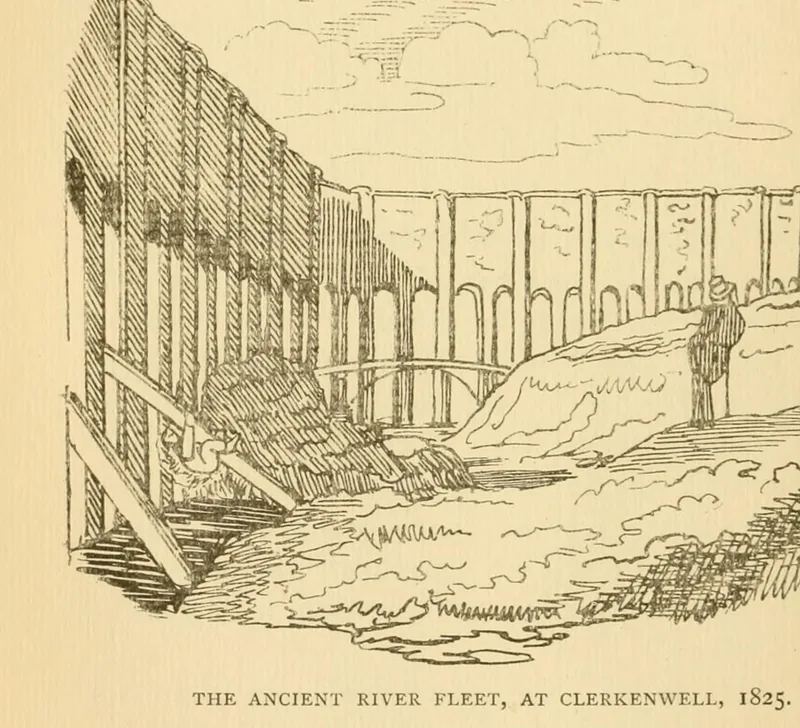
The dead sewer, once an open ditch: the Fleet at Clerkenwell in 1825, from Ashton's 1888 history. Figure receipt
1825 view · Ashton 1888 via IA scan · Public domain
The same summer from the riverbank: Faraday’s white cards, the eighteen days, and sluice gates you open yourself at Crossness.
Answers, dated
Why run the sewage before judging?
Because 1858 and 1875 are different cities — an 1858 answer fails the 1875 question. Run the drop through both systems from their own reports, and the verdict means something.
Did Parliament design the system in eighteen days?
No — and that is the trap in the verdict below. Parliament funded the Board and removed the veto; the interceptors were ordered in 1854 and every engineer agreed on them. The eighteen days are elapsed time across eight sittings, and the Act enacted no plan.
What about John Snow?
One beat, owned elsewhere: Bazalgette's paper counts eighteen thousand dead in 1849 and near twenty thousand in 1854, causes disputed. The proof — the pump, the handle, the map — is the Broad Street page's lane, linked below.
Where did the Fleet go?
Into the interceptors. The High Level replaced the open Fleet and Hackney Brook, filled in and abandoned — but the river's own burial, four maps deep, is the Fleet page's lane, linked below.