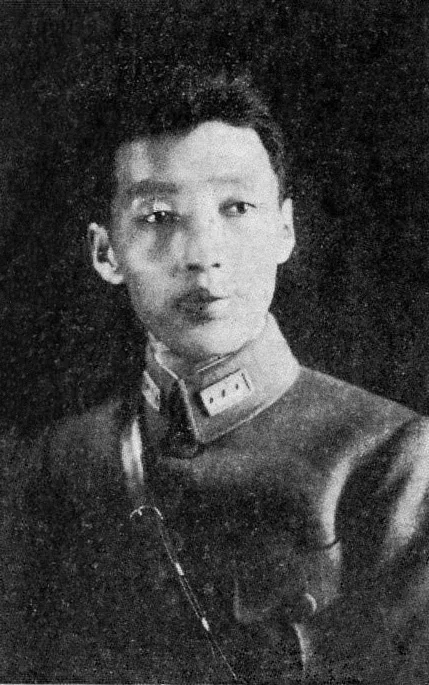
He turned on his own side seven times. Where would you have got off?
From China's warlord wars to the war with Japan, General Shi Yousan changed sides 13 times, and seven of those times he turned his guns on the side he was serving. Take his seat at nine of those forks and see which way you would have gone.
Each track is a master. The thick line is Shi Yousan. Red dots mark the seven times he turned on the side he was serving. Open circles are his other changes of side. Dotted: his hidden dealings with the Japanese.
At each fork you learn only what he could know that day. Choose, then see what he did and what came next. You can also skip the choice.
1. August 1926, Suiyuan
Feng Yuxiang's army has just been beaten at Nankou, north of Beijing. Feng himself has been away in the Soviet Union since spring. Your orders are to march west, across the desert, to Gansu. Yan Xishan, master of Shanxi province, is on the winning side. His troops facing you are commanded by General Shang Zhen, your old teacher.
What do you do?
What he did
He got in touch with Shang Zhen and went over to Yan. Suiyuan was rich; the road west was empty.
What came next
A month later Feng was back, rallied his army at Wuyuan and swore to fight alongside the Nationalists. Both Yan and Feng ended the next year on the winning side.
Feng is back from Moscow. On 17 September he gathers his army at Wuyuan, on the Suiyuan steppe, and swears loyalty to the Nationalist revolution. He sends word to those who deserted him that no one will be punished.
What do you do?
What he did
He went back to Feng. According to one Chinese biography, he knelt before him and wept. Feng told him the past would not be mentioned.
What came next
Feng joined the Northern Expedition and by summer 1927 held Henan. Yan also joined the Nationalists. Whichever way you went, your master was still standing.
Feng Yuxiang is preparing for war with Chiang Kai-shek, who now runs the government in Nanjing. You feel passed over after the Northern Expedition. Han Fuju, Feng's best general, is leaving for Chiang. Chiang's agents are offering Feng's generals money and posts.
What do you do?
What he did
He left with Han Fuju. A Chinese biography says that at a banquet in Xuchang, once he had come over, Chiang's envoy Qian Dajun handed him five million yuan. In October Chiang made him governor of Anhui.
What came next
Feng lost. By autumn 1930, after the Central Plains War, his army had been broken up and absorbed, and he withdrew to Shanxi. Chiang was the strongest man in China.
You are a governor, camped with your army on the Yangtze bank opposite Nanjing. Chiang orders you to load your men onto ships, south, against the rebels in Guangdong. At sea an army cannot defend itself. Meanwhile General Tang Shengzhi has risen against Chiang under Wang Jingwei's banner.
What do you do?
What he did
He mutinied on the night of 2 December. In the days that followed, Chinese biographies say, his guns shelled Nanjing across the river.
What came next
Tang's revolt collapsed within weeks. In January 1930 Chiang's troops were attacking Bengbu. Chiang was still standing.
You are back in Chiang's camp, under Yan Xishan's command. Now Yan himself and Feng are joining forces against Chiang and raising the largest army they have ever had. Yan's envoy promises you Shandong province. Chiang has not forgiven you for shelling Nanjing.
What do you do?
What he did
He joined the coalition and was given a front army. In August he tried to capture Chiang at Liuhe station and missed, in the rain.
What came next
In September Zhang Xueliang entered the war on Chiang's side. The coalition fell apart by October. Chiang won.
On 18 September Zhang Xueliang, master of Manchuria, announces by telegram that he backs Chiang. His armies are coming through the Great Wall. The Feng–Yan coalition is caught between two fronts. You are, like Zhang, a Northeasterner.
What do you do?
What he did
He answered at once. By early 1931 Zhang had reorganised his army, some 64,000 men, as the 13th Route Army.
What came next
The coalition lost. Zhang won the war and took North China. A year later Japan would invade Manchuria, Zhang's home base.
A government rival to Chiang has formed in Canton, with Wang Jingwei, Chen Jitang and Li Zongren. They offer you an army command and money. A cousin of Zhang Xueliang tells you Zhang has died of typhoid in a Beiping hospital and the death is being kept secret. If it is true, the North has no master.
What do you do?
What he did
He rose. On 18 July he took his oath at Shunde and marched north along the railway.
What came next
The rumour was false. Zhang was alive, and the promised allies never moved. In about two weeks Shi's army was crushed, and Chiang and Zhang Xueliang had put $20,000 and two grades of promotion on his head. The Canton government dissolved in January 1932.
You no longer have an army of your own: you handed the survivors, a few thousand or a few tens of thousands depending on who tells it, to Han Fuju in Shandong for reorganisation. In September Japan began seizing Manchuria. Japanese Army intelligence officers, led by Doihara Kenji, are looking for Chinese generals without a master.
What do you do?
What he did
He worked with them. Chinese Wikipedia says he was in touch with Doihara from November 1931 and helped with the Tianjin riots that got Puyi out of the city. Liu Gexue's biography tells it differently: only in autumn 1932 did he slip into Tianjin, disguised as a Japanese, and there he got in touch with Doihara. In 1935 a Hong Kong paper reported that the Japanese-backed autonomy plotters met secretly at his house there.
What came next
Japan was advancing in North China, but it gave him no real power. In 1933 he was shot twice in an assassination attempt in Tianjin. He survived.
China is at war with Japan. You are a Nationalist commander and for a year you have worked alongside the Communists' Eighth Route Army. You have Communist cadres on your staff and you promised there would be no clashes between you. An envoy from Chiang brings another offer: clear out the Communists and North China will be yours to run.
What do you do?
What he did
He turned on them and disarmed their companies. Chiang's offer is known from a Chinese newspaper of 2009. The sentence put in Shi's mouth, that he had used the Communists to grow and would now use the Japanese, comes from the memoir of the Communist commanders who fought him.
What came next
In February and March 1940 the Eighth Route Army beat him. According to the Communist commanders' memoir, he lost more than 15,000 men that year.
By early 1940 the Eighth Route Army had cut your army to about 17,000 men. Your brother has already signed a pact with the local Japanese commander. The Japanese offer you Hebei province, as governor, if you come over. Your subordinate General Gao Shuxun, commander of the New 8th Army and an old comrade from Feng's army, invites you to his headquarters at Liuxiatun to talk.
What do you do?
What he did
On 1 December 1940 Shi Yousan went to see Gao Shuxun. His own subordinate had invited him in order to arrest him.
Gao arrested him that same day. The war-zone commander, Wei Lihuang, replied by telegram: execute him on the spot. There was no side left to run to.
He switched every time. Three times he bet against Chiang Kai-shek: at Pukou in 1929, in the 1930 coalition and for Canton in 1931. He lost all three.
Twice, moving to Chiang's side brought him something concrete: Anhui province in 1929 and, after he went over to Zhang in 1930, an army kept whole and reorganised early in 1931. Then he changed his mind.
By 1940 he had broken with Feng, with Chiang, with Zhang Xueliang and with the Communists. The man who killed him, Gao Shuxun, served under him and came from the same army of Feng's.
Sixteen rows. The seven marked 'turned' are the moments he turned his arms or his loyalty against the side he was serving. The rest are enlistments, returns, refuges and changes made without a fight.
When
From → to
What happened
Sources
1912
no master → Feng Yuxiang
A soldier adrift after his unit mutinied, he enlists with Feng Yuxiang and starts as a groom.
A screenshot of English Wikipedia travels the internet: Shi Yousan "defected to, and subsequently betrayed, Feng Yuxiang, Chiang Kai-shek, Wang Jingwei, Zhang Xueliang, the Chinese Communist Party, and Japan, in that order."
On today's page the opening sentence no longer says "in that order", drops Japan from the list and begins with Wu Peifu. A hidden comment in its source asks editors not to put "in that order" back. Neither the old version nor the new matches the sources:
Yan Xishan is missing, though Shi went over to him in 1926 and put himself under his command in 1929.
Wang Jingwei belongs twice, not once: the 1929 revolt flew his banner, as did the Canton government of 1931.
The order is only half right. Wang first comes in 1929, between Chiang and Zhang, but the Japanese (from 1931) come before the Communists (1938).
Japan was not his last betrayal. He worked for the Japanese in the early 1930s and fought them from 1937, but his last move, in 1940, was back towards them.
The new version adds Wu Peifu, but in 1908 Shi enlisted as a private in Wu's battalion, and he left in 1912, after the unit mutinied.
A Chinese newspaper's formula from 2009 comes closer: three times he betrayed Feng; he joined Yan and turned on him (in fact he left Yan without ever fighting him); joined Chiang and rose against him; joined Zhang and rose against him; allied with the Communists and turned on them; fought Japan and went over to Japan.
The Chinese accounts agree on how it began. On 1 December 1940 Shi came to Liuxiatun, near Puyang, to Gao Shuxun's headquarters, and was arrested there.
Chinese biographies today say he was buried alive that same night on the bank of the Yellow River. Since June 1938, when the Nationalists breached the dyke at Huayuankou, the Yellow River had flowed south by another course. The old bed near Puyang carried little water until 1947.
The official announcement, issued by the Central News agency in Chongqing on 8 December 1940, says Shi and his brother were executed on 4 and 5 December, by order of the High Command, for insubordination and malpractices. It does not say how.
The order: according to a 2013 article in the history magazine Shiji Fengcai, reprinted by People's Daily Online, the war-zone commander Wei Lihuang wired that he was to be "executed on the spot". Chinese Wikipedia says the secret order came from Chiang, citing a 2015 Taiwanese newspaper report on declassified intelligence files.
Many pages repeat a coincidence: Chinese Wikipedia gives his birth date as 1 December too, in 1891. But a biographical yearbook of the time gives 1892, and the date of death is disputed. The coincidence is unproven.
There is no way to say. Nobody keeps count, and China in those years was full of generals who changed sides. Sun Dianying, a contemporary, went through at least six camps. In 1931 he complained in public that Shi Yousan had betrayed him.
Alcibiades went from Athens to Sparta, then to the Persians and back to Athens: three changes. Talleyrand served some six French regimes, but as a diplomat, with no army. What can be said of Shi: he is among the generals of his time best known for changing sides, one of the generals known as the "Turncoat General" (倒戈将军), a nickname Feng Yuxiang also carried, and seven times he turned his arms against the man he served.
We put together a list of every change of side from the press of the day (North-China Herald, China Weekly Review, the Hong Kong papers), from Boorman's biographical dictionary and from Chinese biographies. Where sources disagree, the page gives both.
Two counting rules. Every change of master, including the 1938 alliance with the Communists (when he stayed a Nationalist commander), leaving out his enlistment in 1912 and his refuge with Han Fuju in 1931: 13 moves, plus one never completed, in 1940. Only the moments he turned on the side he was serving: 7. The headline uses the second rule, the safer one.
Sources come in three kinds: the foreign press in China at the time, reference works, and popular or Party histories from China today. The last are rich in detail but partisan about the Communists. Sentences put in Shi's mouth that come only from them are marked as such.
The books by Sheridan (1966) and Ch'i Hsi-sheng (1976) could not be consulted. Places on the map are approximate, to a few kilometres.