The 3D picture cannot start on this device. The text below tells it all.
Putna Monastery · a November dawn · 346 centimetres of maple
The toaca
In a Romanian monastery the first call to a service comes from a maple board three and a half metres long, struck with wooden mallets; the bell rings after it. Every spot on the board sounds different.
In 1983 the ethnomusicologist Constanța Cristescu measured the large toaca of Putna: 346 centimetres long, 33 wide and 4 thick, with ten holes 2.5 centimetres across. That year she also measured those of Sucevița, at 377 centimetres, Moldovița, at 307, and Neamț, at 351.5.
The wood it calls for is maple. It has to be white maple, not the red-barked kind, a craftsman told her. The board is split along the grain and dried outdoors in the shade, so that it does not crack. The large toaca hangs from a support, in the bell tower or in the courtyard, and is struck with two mallets in turn.
Length
346 cm
Width
33 cm
Thickness
4 cm
Holes
10 × 2.5 cm
Wood
maple
Strike the board anywhere, with a finger or the mouse. On a keyboard: A … L from one end to the other, with Shift near the edge.
Struck, the board bends in standing waves: some points move a lot, others not at all. Each way of bending has its own frequency. Worked out for the toaca of Putna, the lowest is about 14 vibrations a second, below the threshold of hearing; the second, 38; the third, 75. What you hear are far finer bendings, of hundreds and thousands of vibrations a second, and the board twisting about its own axis.
Where it is struck decides which of them start: a bending cannot be set going from a point where it does not itself move. That is why every spot on the toaca sounds different. The toaca has no tuned notes, but it has a melody: Cristescu notes that by moving the mallets along the board the player changes the pitch.
In the picture the frost keeps count: where the wood moves hard, it is shaken off; along the lines that stay still, it remains.
The motion is slowed and enlarged. Then strike the board on a line of frost: there the chosen bending does not start.
Evening and morning, before Vespers and Matins, a monk takes the hand toaca and walks once round the church: he starts at its front, goes along the south side, past the altar, along the north side and back to the front, stopping and bowing at the places the Typikon sets down. On ordinary days the large toaca follows the circuit, and then the small bell.
The hand toaca of Putna, also measured in 1983, is 288 centimetres long: two arms of 136.5 centimetres each, 2 thick, and in the middle a place to hold it, 15 by 6 centimetres. It is carried almost level, in the left hand, level with the heart, and struck with a single mallet. The player moves the stroke from beside the hand toward the end, and the sound climbs from low to high and grows louder.
The circuit is shortened here to under a minute. The sound comes from where the toaca is, and when the church stands between it and you it is muffled. The walker is not drawn; the footprints in the frost remain.
A call on the toaca is not a beat kept up for ever. Constanța Cristescu collected 109 calls from Romanian monasteries and describes a shape that recurs in them: a free beginning that hurries, from 40–80 strokes a minute up to the first “flower”; an even middle, of 80–170 strokes, in which a basic figure, the “ison”, repeats with “flowers” woven into it; and an end that slows down.
At Putna in 1983 she recorded the monk Calinic Dumitriu on the hand toaca, and Raveca Ungureanu, Constantin Cenușe and others on the large one.
The call here is built on the shape Cristescu describes; its rhythmic figures are chosen, not transcribed from a recording.
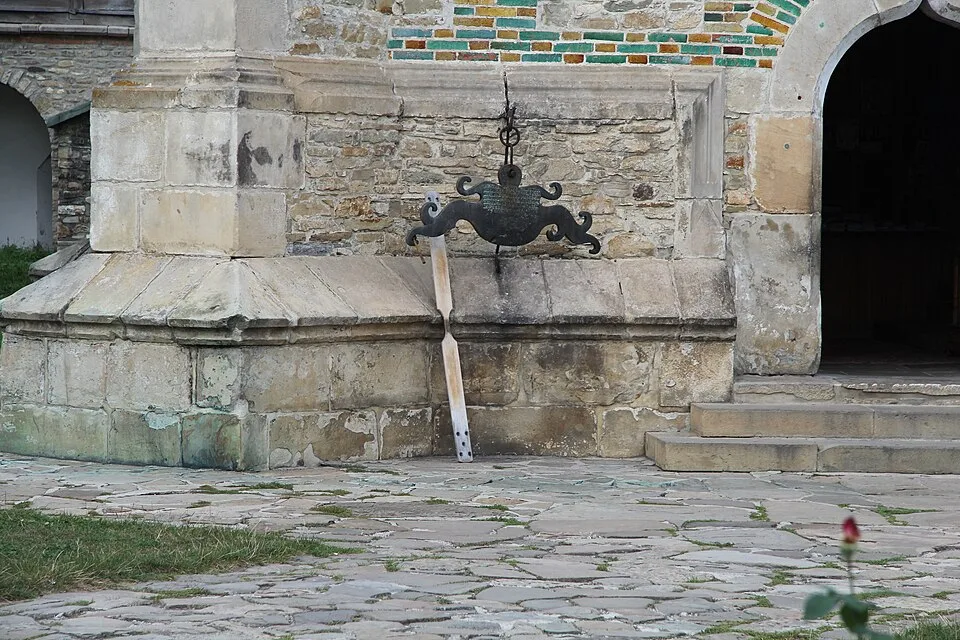
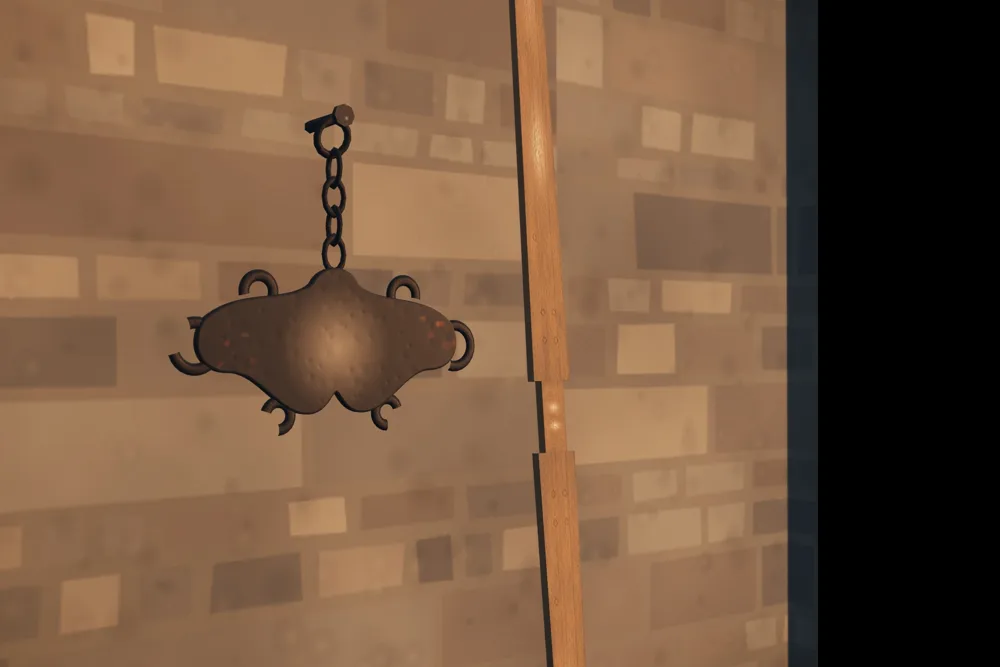
Beside the church door, usually to its right, hangs the iron toaca: a metal plate of various shapes, struck with one or two metal mallets. At Compline on ordinary days the Typikon asks for one stroke on it at each of the first three verses of “Undefiled, unstained”.
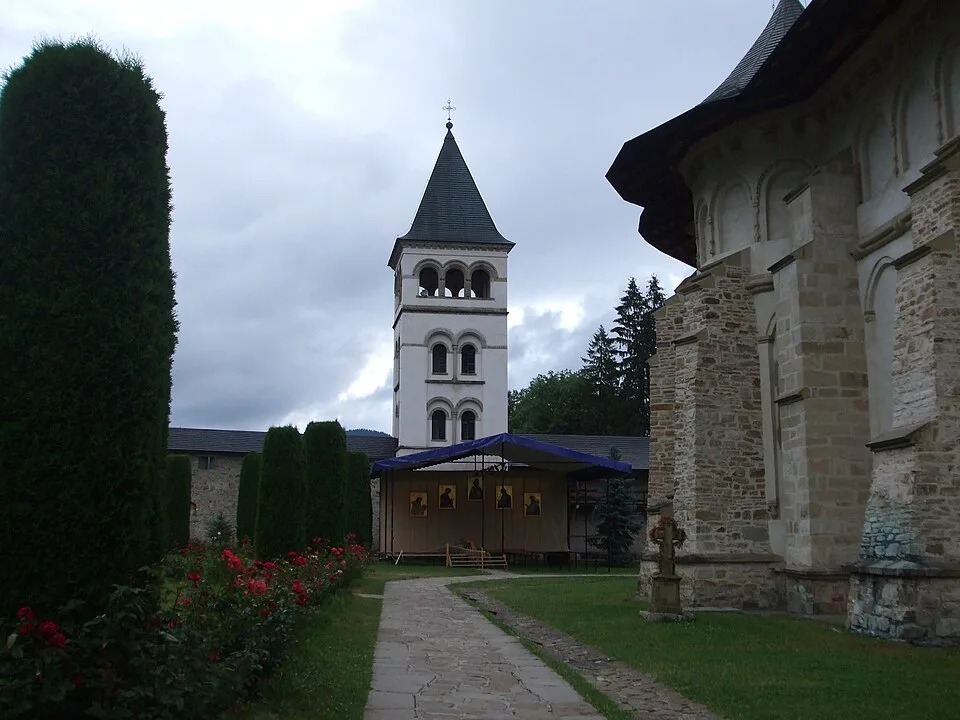
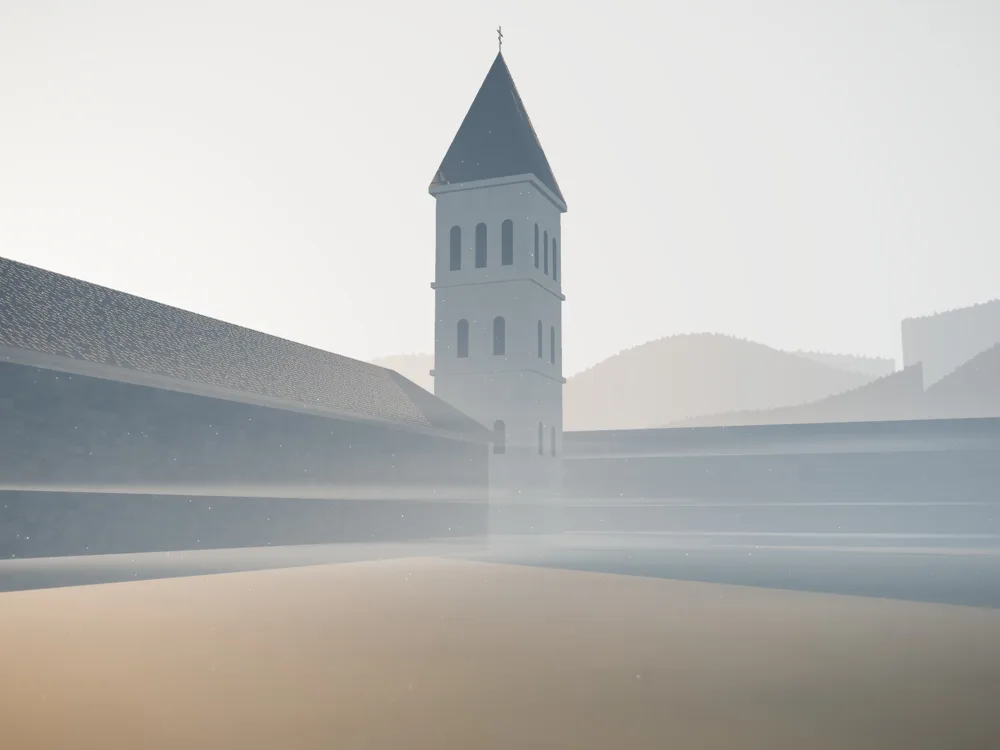
The bells come last. The oldest at Putna, Buga, was given by Stephen the Great in 1484; it broke in 1760, in 1793 and in 1818 and was cast again. Tradition says it could be heard all over Moldavia, and Eminescu recorded that it rang by itself on 1 October 1777, when Prince Grigore III Ghica was being murdered in Iași. Today it stands beside the bell tower. Of the old bells, only the Siluan, cast in 1530, still rings in its original form. The bell tower, built in 1822 on the east side of the enclosure, has housed eleven new bells since 2016; the largest weighs 5,200 kilograms.
The bell and the iron plate are models: their pitch is chosen here.
The two toacas have the dimensions measured at Putna in 1983, and the Treasury Tower has those the monastery gives: 18 metres to the eaves, a base more than 9 metres on a side. They have finished wood and dressed stone.
The rest is inferred or imagined, and it shows. Where the large toaca stands in the courtyard, and what it hangs from, is not known. Cristescu gives the number and size of the holes, not their layout. The shape of the iron plate follows the one at Neamț, and the church and the bell tower are massed from photographs. The support, the iron plate, the church, the bell tower and the walls appear as raw timber and stone with layout lines. The hills, the paving, the grass, the frost and the footprints are imagined: they turn to matt plaster or disappear. The light is chosen too.
Measuredthe two toacas, the Treasury Tower: finished wood, dressed stone
Inferredthe support, the iron plate, the church, the bell tower, the walls: raw timber, layout lines
Assumedthe hills, the paving, the grass, the frost, the footprints: matt plaster, or taken out
The iron plate and a hand toaca at Neamț Monastery. The plate in the reconstruction takes its shape from this one. Photo: GerritR, CC BY-SA 4.0, Wikimedia Commons.The iron plate and the hand toaca, in the reconstruction.
The courtyard at Putna, with the 1822 bell tower and the corner of the church. Photo: Valeria23, CC BY-SA 3.0 RO, Wikimedia Commons.The bell tower, in the reconstruction, with the cells along the east wall.
How exact the reconstruction is
The dimensions of both toacas are those Constanța Cristescu measured at Putna in 1983. She does not say how the holes are laid out; here there are two groups of four toward the ends and two through which the ropes pass. The hand toaca narrows from 10 centimetres beside the hand to 6.5 toward the end; the direction of the taper is assumed.
Where the large toaca stands at Putna, and what it hangs from, is not known from the sources read. Here it hangs under a small roof on four oak posts, its ropes passed through the holes 77.5 centimetres from the ends, close to the points where the lowest bending does not move the wood.
The sound is a model, not a recording. Every stroke is worked out from the board’s dimensions: the bendings of a bar free at both ends and its twistings, with values for sycamore maple (615 kilograms per cubic metre, an elastic modulus of 9.9 gigapascals). The shear modulus, the wood’s loss of energy, the length of the mallet’s contact and how well the board radiates low sounds are chosen here. The hand holding the small toaca damps the bendings that move its middle; for the sound its width is taken as constant.
The model makes every spot sound different and the strokes toward the ends louder, but it does not reproduce the climb from low to high that players describe on the hand toaca. That may come from things the model leaves out, such as the real shape of the arms, the grip of the hand or the mallet.
The call is built on the shape Cristescu describes: the pulse starts at 56 strokes a minute and hurries to 132, holds 132 in the middle, then slows toward 60; in the flowers the small strokes fall faster than the pulse. The figures of the ison and the flowers are chosen here.
The circuit follows the route in the Typikon, without the stops and bows, shortened to 44 seconds. The echo of the courtyard is imagined. The bell and the iron plate are model sounds, with chosen pitches.
The church, the bell tower and the walls are simplified masses after photographs, without measurements. The sun stands about 8 degrees above the horizon, so the light clears the walls and reaches the toaca. The Treasury Tower’s side is 9.4 metres here, a value chosen within “more than 9 metres”.