Where the seventh rung falls#
On the disc, 22 notes fall nearest the seventh rung. Of these, 19, in tracks that also have a note on rung 8, sit within 30 cents of the rung; 13 are in the bucium song, whose tune swings between the top note and the seventh rung.
Measured from the top note of the same track, these 19 notes sit 246 cents lower (median). A cent is a hundredth of a semitone, the step between two neighbouring piano keys. On a piano the nearest notes are 200 and 300 cents below the top note, and the notes on the disc are 46 cents from the nearer of them: nearly halfway. Of the other three, two come out pulled towards the piano, 13–14 cents from a key, one each in the hens’ and girls’ signals; the third, also in the hens’ signal, lands near a key or far from one depending on which note it is measured against.
An ideal tube would put the seventh rung 231 cents below the eighth. On the disc it sounds about 15 cents lower still, further from the nearest key. That, too, may come from the lips: these notes sag a little as they sound.
The upper octave, from rung 4 to rung 8, is 37 cents wider than a piano’s (median over the five tracks that have both). The lower one, from rung 2 to rung 4, comes out narrower in the two tracks that have it. The measurement cannot tell whether these come from the tube or from the player’s lips.
Why a horn with no finger holes has only these notes#
The tulnic has no finger holes and no valves. The player changes note with the lips and the breath alone. The air in the tube can only vibrate in patterns in which a whole number of half-waves fit along it, and each pattern’s frequency is, very nearly, a whole multiple of the base frequency: twice, three times, four times. Those are the rungs.
Rungs 2, 4 and 8 are octaves of each other. Rungs 3 and 6 give the fifth, which a piano matches almost exactly. Rung 5 gives the major third, 14 cents lower than a piano’s. Rung 7 has no partner on the piano, and neither has rung 11, which sits 551 cents above rung 8, between the keys at 500 and 600 cents.
A piano splits the octave into twelve equal steps, so that any note can lead to any other. The rungs of a tube are evenly spaced in hertz, so in pitch they crowd closer together as they climb. How the piano came to equal steps is on The 23-Cent Comma; the harmonics inside a single sound, on Inside a note.
Play on the rungs of a tube#
Press and hold a rung to blow. Drag up or down without lifting, like lips tightening or loosening: the note jumps from rung to rung and cannot stop in between. From the keyboard: Tab to a rung, then Space; the arrow keys climb and descend.
rung · cents from the nearest key
Where each rung lands on the piano keys (keys lined up with rung 8)
The sound here is synthesised: a tube with the disc’s base frequency of about 54.6 Hz that can only sound on its rungs, and the echo returns after 1.6 seconds, the time sound takes to reach a slope about 270 metres away and come back. No note on the disc climbs to rung 11; here you can hear it. The labels beside the rungs give an ideal tube’s distance from the nearest key: for rung 7, 31 cents; on the disc, its notes sit at 46 (median).
Send someone a call#
A tulnic carries across a valley; a link carries further. Record a few notes on the rungs and send them: whoever opens the link hears your call, played on the same tube.
The instrument, and who plays it#
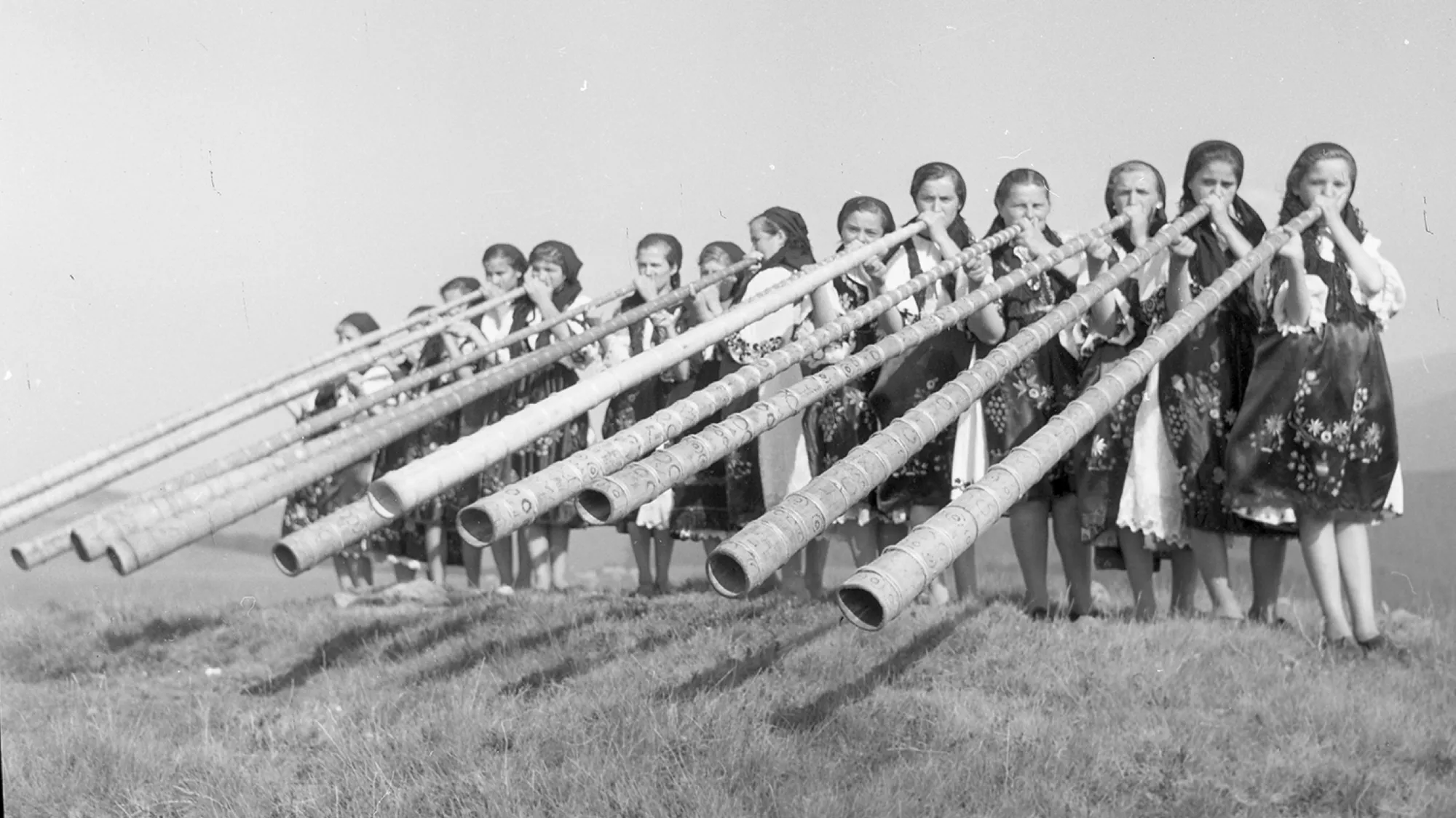
The tulnic is a long, straight wooden horn. A large tulnic in the collection of the ASTRA Museum in Sibiu, from Vidra in the Apuseni Mountains, is 284 centimetres long and, in the museum’s words, “built from fir staves, joined and bound at intervals with 25 hoops of hazel withies”. This disc’s records also call it bucium, the name of a related Romanian horn.
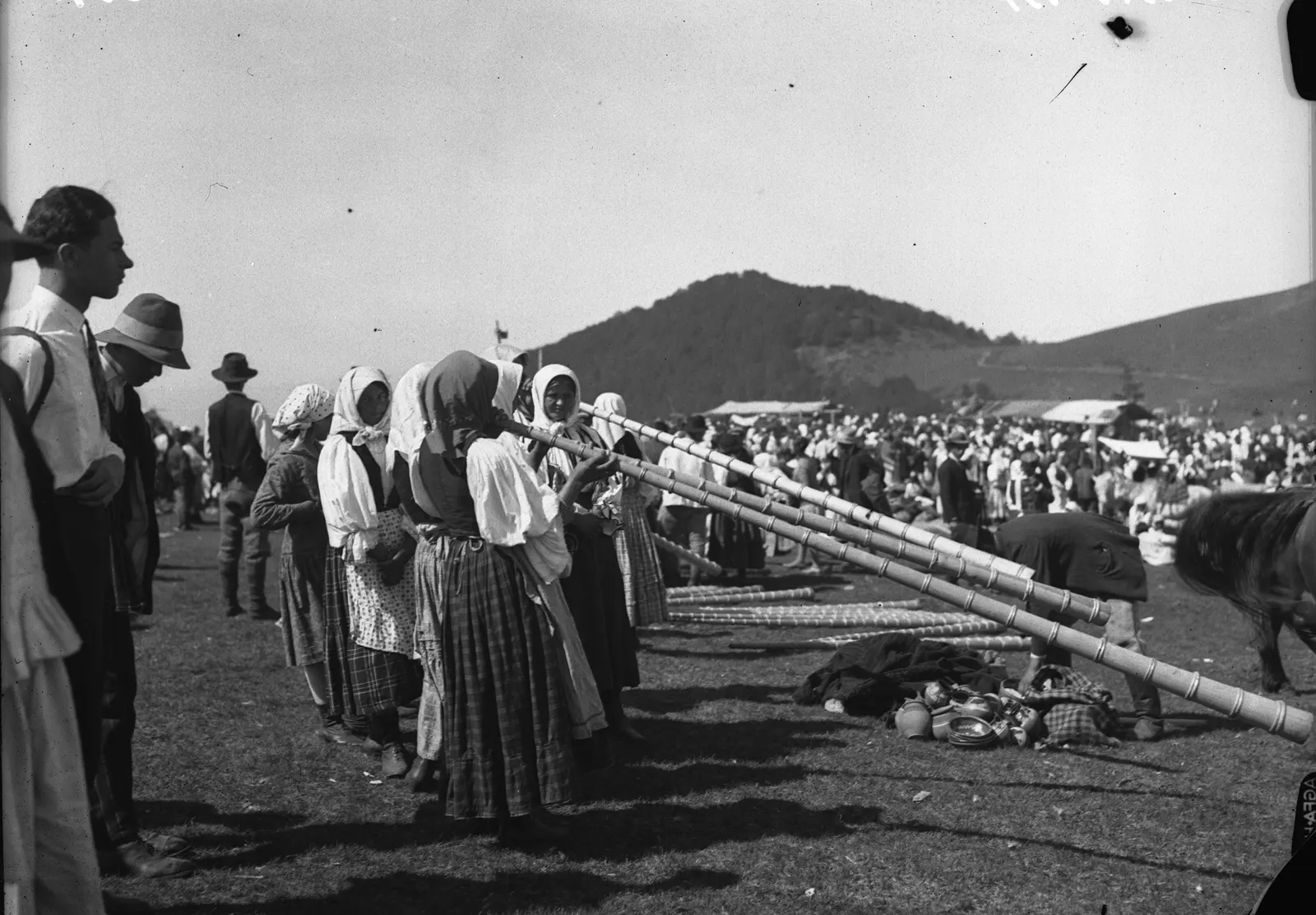
In the Apuseni Mountains, most of the people who can still play the tulnic are women, the tulnicărese. A report in the Romanian daily Adevărul describes tulnic calls as “communication codes between shepherds, between girls and boys, and also to call people to a funeral, a wedding, a christening or the fair…”. The girls’ fair on Mount Găina is held on the weekend nearest St Elijah’s day (20 July); according to a 2016 article in the local Câmpeni Info, the tulnic players of Avram Iancu open it.
The signals on the disc have names: of the sheep, of the pigs, of the hens, of the girls. In Tiberiu Alexandru’s book on the musical instruments of the Romanian people, the table of contents lists tulnic signals with the same names, “A oilor”, “A porcilor” and “A găinilor”, under “Câmpeni-Cluj”, the 1950s Câmpeni district, which included Ponorel, the village the archive gives for the bucium song on the same disc. For the four signals, though, the Radio archive’s records give Drăguș, in the Făgăraș country about 150 kilometres from Câmpeni: the village of the song for voices on the same disc. Which place is right is not clear.
How the notes were measured, and where the measurement stops#
The disc. Columbia disc EB-491, in the archive of the Romanian Broadcasting Company, published by Culturalia on Europeana under CC BY-SA 4.0. The records name the player, Anica Drăgoi, but give no year. For the four signals they give the place as Drăguș, Făgăraș; for the bucium song, Ponorel, Turda county; for the tulnic song, no place. The remaining piece, track 5, a harvest ritual song for two voices from Drăguș, is not measured here. The titles say “tulnic” and the descriptions say “bucium”; this page keeps the names in the records.
Absolute pitch is not used. Not every 78 rpm disc turned at exactly the same speed, and this one carries no reference tone, so the frequencies in hertz may be off by a few per cent. Only the distances between notes of the same track are used. All six horn tracks give a base frequency between 54.4 and 54.9 Hz, consistent with one instrument at one speed.
The rule. Pitch is read every 23 milliseconds. A note is a stretch where the pitch stays within ±25 cents for at least 120 milliseconds. For each track, the base frequency is the one between 40 and 70 Hz that puts the most note time within ±30 cents of a whole rung. The rule was written before the measurement with a 200-millisecond threshold and a different way of choosing the base frequency; that choice set aside the notes on rungs 5 and 7, so it was changed after the data had been seen. Under the rule as pre-registered, no note counted as the seventh rung. With the final base frequency but the original 200-millisecond threshold, it appears 3 times, in two tracks.
A control. The same notes moved to the nearest piano key fit the rungs almost as well (96.8% against 97.0%). Octaves, fifths and thirds are nearly the same on a piano and on a tube, so the overall fit proves nothing. The evidence is the seventh rung, measured directly against the neighbouring notes of the same track: 246 cents below the top note (half of the 19 notes between 241 and 249) and 251 cents above rung 6.
Limits. One disc, one player, probably one instrument. The notes on the seventh rung are short: most last less than a quarter of a second, and their pitch sags a little as they sound. None is a slide between rungs 6 and 8. The disc barely carries the lowest frequencies, so the lowest notes are recognised by their harmonics.
Sources#
- Muzeul ASTRA, „Tulnic mare”, Vidra, inv. 608 L, prin Culturalia/Europeana. europeana.eu
- Szabó Tamás, „Fete cu tulnic”, Muzeul Etnografic al Transilvaniei, inv. 10799 (CC BY-SA 4.0). europeana.eu
- Romulus Vuia, „Târgul de fete de pe Muntele Găina”, Muzeul Etnografic al Transilvaniei, inv. 5834 (CC BY-SA 4.0). europeana.eu
- „Tulnicul, instrumentul muzical străvechi…”, Adevărul. adevarul.ro
- „De ce Târgul de fete de pe Muntele Găina…”, Adevărul. adevarul.ro
- „Legenda și istoria Târgului de fete de pe Muntele Găina”, Câmpeni Info. campeniinfo.ro
- Tiberiu Alexandru, „Instrumentele muzicale ale poporului român”, cuprins (previzualizarea editurii). librariaonline.ro
- Anica Drăgoi, „Semnal de tulnic: 1 a oilor”, disc Columbia EB-491, Societatea Română de Radiodifuziune / Culturalia, Europeana (CC BY-SA 4.0). europeana.eu
- „Semnal de tulnic: 2 a porcilor”, același disc. europeana.eu
- „Semnal de tulnic: 3 a găinilor”, același disc. europeana.eu
- „Semnal de tulnic: 4 a fetelor”, același disc. europeana.eu
- „Cântec de tulnic”, același disc. europeana.eu
- „Cântec de bucium”, același disc. europeana.eu