Târgoviște 1462 – Nürnberg 1488 – London 1897
How Vlad Țepeș became Europe's first print villain
On the night of 16–17 June 1462 Vlad III of Wallachia raided the Ottoman camp at Târgoviște, missed the sultan's tent, and lost his throne within months. But the raid's paper trail – German pamphlets from 1488, a Russian court tale, Ottoman chronicles – made him Europe's first print villain, four centuries before Stoker borrowed his name.
The villain in four chapters
Representative route
One raid, four pens, one press
On the night of 16–17 June 1462 Vlad III of Wallachia rode into the Ottoman camp at Târgoviște with a few thousand horsemen and missed the only tent that mattered. Within months he had lost his throne; within a generation he had conquered the printing press.
Follow the campaign line from Constantinople to Brăila, then the pamphlet trail from Wiener Neustadt to Strasbourg: every stop below is a dated edition you can still open today.
Chapter I
The night
16 – 17 June 1462 · 1462, the raid
- Chapter
- 16 – 17 June 1462
- Vlad's horsemen
- 7,000 – 10,000
- The Ottoman host
- 150,000 – 300,000
- The night's dead
- 5,000 + 15,000 (Balbi)
Mehmed II demanded that Vlad come and pay homage in person; Vlad answered by ambushing Hamza Pasha's 1,000 cavalry near Giurgiu, taking the fortress in Turkish disguise, and raiding across the frozen Danube – 'some 800 kilometers in two weeks'. To Matthias Corvinus he reported 23,884 dead on 11 February 1462, counted place by place from Giurgiu to Rahova. The sultan abandoned his siege at Corinth and marched on Wallachia himself, with 15 tümens by his own letter – some 150,000 men – and 120 cannon.
The janissaries forced the Danube at Turnu Severin on 4 June, losing 300 men to Wallachian fire, then advanced through scorched earth and poisoned wells. On the night of 16–17 June Vlad rode into their camp south of Târgoviște with 7,000–10,000 horsemen, from three hours after sunset until four in the morning – and struck the viziers' tents instead of the sultan's. The Wallachian second column under the boyar Galeș never attacked.
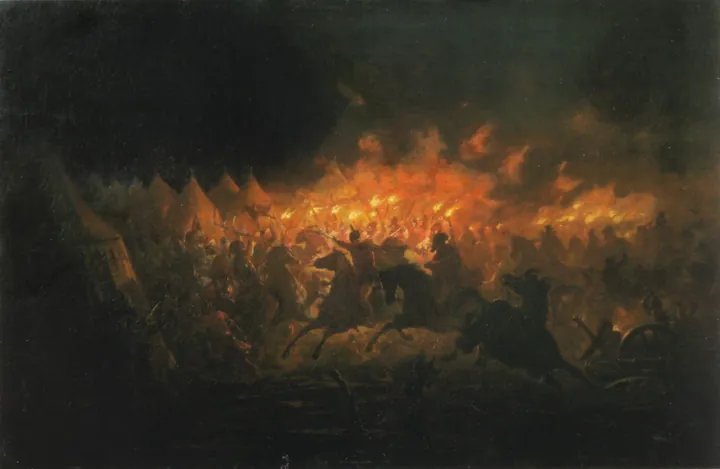

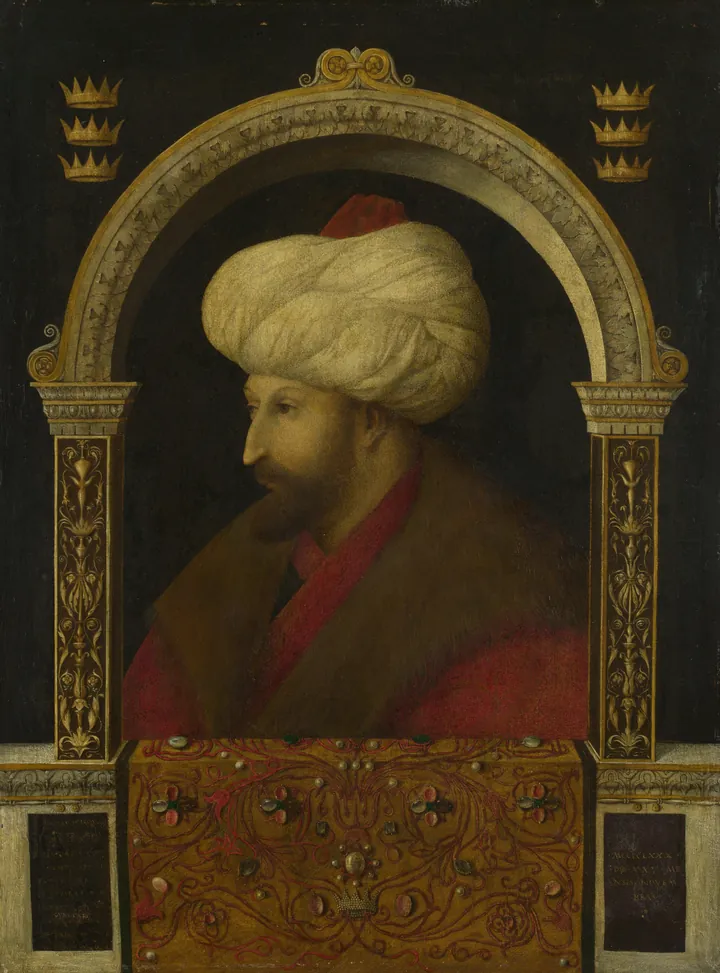

A Wallachian veteran later told Modrussa at Buda that the sultan fled his camp that night and was dragged back by his friends. The Venetian bailo Balbi counted 5,000 Wallachian and 15,000 Ottoman dead; the capital was found deserted, its road lined with some 20,000 impaled and Hamza Pasha rotting on the highest stake. Mehmed dug a trench, left on 22 June, burned Brăila on 29 June, and reached Adrianople on 11 July – but the throne was already slipping to Radu, and by late 1462 Vlad was Corvinus's prisoner.
We killed 23,884 Turks without counting those whom we burned in homes or the Turks whose heads were cut by our soldiers… Thus, your highness, you must know that I have broken the peace with him (Sultan Mehmet II).
Vlad III to Matthias Corvinus, 11 February 1462
Meanwhile: While Vlad burned the Danube ports, Skanderbeg kept Ottoman armies tied down in Albania.
Chapter II
The press
1463 – 1521 · 1463–1521, the pamphlets
- Chapter
- 1463 – 1521
- Beheim's poem
- Winter 1463, Wiener Neustadt
- Pamphlets 1488–1568
- 13, eight incunabula
- First dated print
- 14 October 1488, Nürnberg
The villain reached print before the voivode reached prison. In the winter of 1463 the Meistersinger Michael Beheim sang Von ainem wutrich der heis Trakle waida von der Walachei at Frederick III's court in Wiener Neustadt – two impaled monks and their braying donkey among the marvels – from a runaway monk's account. Modrussa had already written to Pius II in 1462, the pope put the stories in his Commentaries in 1464, and Corvinus's courtiers spread fresh horrors after the 1462 arrest. The manuscripts behind all this were Saxon, precise about churches and raid dates, and already calling Vlad worse than Nero.
Then came the presses. Marx Ayrer finished his Nürnberg quarto on St Calixtus' day, 14 October 1488 (GW 12525; the single surviving copy sits in Weimar as Inc. 609a); Peter Wagner's Nürnberg edition, undated, followed so closely that scholars still argue the order – copies survive in Philadelphia, Munich and Stuttgart. The trail runs on: Lübeck, in Low German, after 1488 (Ghotan, GW 12531); Bamberg 1491 (Sporer); Nürnberg 1499 (Huber), with the dining-among-the-stakes woodcut; Strasbourg 1500 (Hupfuff, GW 12530); Nürnberg again in 1520 and 1521 (Stuchs, Gutknecht, VD16 D 2636f). Thirteen pamphlets down to 1559/1568, eight of them incunabula, 46 stories, no complete edition – one of Europe's first bestsellers.


Readers laughed and shuddered: Trithemius, finding the booklet in circulation, wrote that its horrors move readers to risus et horror, and Hartmann Schedel shelved a copy beside his chapbooks. The prints even gave the villain an ending the manuscripts lacked – conversion, baptism at Ofen, the 1475/76 restoration. One claimed stop is missing from the map on purpose: the 1463 Vienna broadsheet some scholars posit has, as Paulus shows, not a shred of evidence.
Cuius horribilia facta circumferuntur in quodam libello dudum impressa, que et risum et horrorem legentibus movent.
Johannes Trithemius, Annales Hirsaugienses, ad annum 1454 (BSB Clm 704, fol. 193v)
Meanwhile: In 1488, the year of the first prints, some 7,000 crusade indulgences were handed out in Nürnberg alone.
Chapter III
The East
1482 – 1501 · 1482–1501, the witnesses
- Chapter
- 1482 – 1501
- Kuritsyn's embassy
- 1482 – 1485, Hungary
- Skazanie episodes
- 19, in 20+ manuscripts
- Mihailović's memoirs
- Written 1490 – 1501
At Ivan III's court the German horror stories were rewritten as statecraft. The Skazanie o Drakule voevode, 19 long episodes attributed to the courtier Fyodor Kuritsyn after his 1482–1485 embassy to Hungary, was written between 1481 and 1486; the oldest copy, made on 28 January 1490 by 'the sinner Efrosin', survives with 20+ later manuscripts. Half its episodes still drip blood, yet their moral is order: the golden cup nobody dares steal from the fountain, the 'evil-wise' (zlomudry) prince whose terror kept the peace. Only his conversion to Catholicism is condemned – it is blamed for his death.
The Ottoman side wrote too. Tursun Beg, a divan official born in the mid-1420s at Edirne who had stood before Constantinople in 1453, called Vlad Kazıklı Voyvoda – the Impaler Lord – around 1500 in his Tarih-i Ebülfeth, and put the 1462 host at 300,000. Konstantin Mihailović of Ostrovica, taken as a janissary boy at Novo Brdo in 1455, confirms the impalements in memoirs written 1490–1501, adds the noses Vlad cut from Ottoman dead and sent to Hungary, and remembers staked camps, nights of terror, and the forest of the impaled glimpsed from the rear.
_(died_1477).jpg)

The Romanian voice is the thinnest and the closest to the ground: village legends recorded by Rădulescu-Codin share the burning of the poor and the too-short shirt with the German and Slavic books – the stories really did travel by mouth – and the peasants' verdict matches the Russian one: only such cruel acts could secure public order. Vlad's own chancery letters, the 1551 letter that first calls him Țepeș in Romanian, and the historians of the 1800s complete a portrait no woodcut ever drew.
Not very tall, but very stocky and strong, with a cold and terrible appearance… the very long eyelashes framed large wide-open green eyes.
Niccolò Modrussa, papal legate, who met Vlad at Buda (modern translation, excerpt)
Meanwhile: While Efrosin copied the Russian tale in 1490, Antonio Bonfini was writing Vlad into Latin history at Buda (around 1495).
Chapter IV
The afterlife
1476 – 1897 · 1476–1897, the legend
- Chapter
- 1476 – 1897
- Reigns
- 1448 · 1456 – 1462 · 1476
- Prison years
- 1462 – 1475, no documents
- Dracula
- May 1897, London
Released in the summer of 1475 at Stephen III's request, Vlad fought in Bosnia in 1476 and retook Wallachia that November with Hungarian and Moldavian help. Weeks later Basarab returned with Ottoman backing, and Vlad died fighting near Snagov before 10 January 1477: an army of about 2,000 destroyed by some 4,000 men. His head went to Mehmed II and ended on a high stake in Constantinople; how he fell – mistaken for a Turk by his own men, says Kuritsyn; murdered by a disguised assassin, says Unrest – is disputed.
Four centuries later Bram Stoker, who had taken notes since 8 March 1890, researched at Whitby and the London Library, moved his count from Styria to Transylvania, and borrowed the name from Wilkinson's 1820 history – Dracula was published in May 1897 by Archibald Constable and Company, probably on 26 May, price 6 shillings. Stoker never visited Eastern Europe, never names Vlad in his working papers, and still had 'Count Wampyr' in his drafts. The novel was the first book ever to join Dracula to vampirism, and it has never been out of print.


What the record will not support stays out: no proven birth house at Sighișoara, no body in the Snagov grave opened in 1931, no Bran title deed – only one overnight stay in one source. The name Țepeș itself enters the record around 1500, with Tursun Beg's Kazıklı Voyvoda, and in Romanian only in 1551. The villain of the woodcuts outlived the voivode by centuries: Europe's first print villain.
Dracula means devil. Wallachians were accustomed to give it as a surname to any person who rendered himself conspicuous by courage, cruel actions or cunning.
William Wilkinson, Account of the Principalities of Wallachia and Moldavia (1820) – the footnote Stoker copied
Meanwhile: In 1979 the Ceaușescu regime commissioned its own Vlad: Doru Năstase's film <em>Vlad Țepeș</em>.
Whose pen wrote it?
Six cruelties, four pens: the German pamphlet, the Russian tale, an Ottoman-side witness, a Wallachian letter. Match each atrocity to its source before the reveal.
-
1
The cauldron
A copper cauldron is built, heads locked through a wooden lid, water boiled until the people scream themselves to death. Which pen wrote it?
Which pen
German: episodes No. 12–13 of the printed Geschichten, in the 1488 text's tradition.
-
2
The bread
Vlad dips his bread into the blood of his impaled victims. Which pen wrote it?
Which pen
German – and only a rumor: the histories flag the bread dipped in blood as legendary and unconfirmed.
-
3
The golden cup
A golden cup stands by a fountain and nobody dares steal it, so fiercely does Vlad punish theft. Which pen wrote it?
Which pen
Russian: the Skazanie's proof that terror kept public order.
-
4
The noses
Vlad cuts the noses from Ottoman dead and sends them to Hungary as a body count. Which pen wrote it?
Which pen
Ottoman-side: Konstantin Mihailović, the Serbian janissary, in memoirs written 1490–1501.
-
5
The count
23,884 Turks killed, counted village by village, 'without counting those whom we burned in homes'. Which pen wrote it?
Which pen
Wallachian: Vlad himself, writing to Matthias Corvinus on 11 February 1462.
-
6
The death
Vlad dies because his own men mistake him for a Turk in the crush of battle. Which pen wrote it?
Which pen
Russian: Fyodor Kuritsyn, who interviewed Vlad's family after 1477.
Answer a card to begin.
Six plates of the villain
Six images, in the order of the story: three title pages, the full-length woodcut, the oil portrait, the nailed turban.
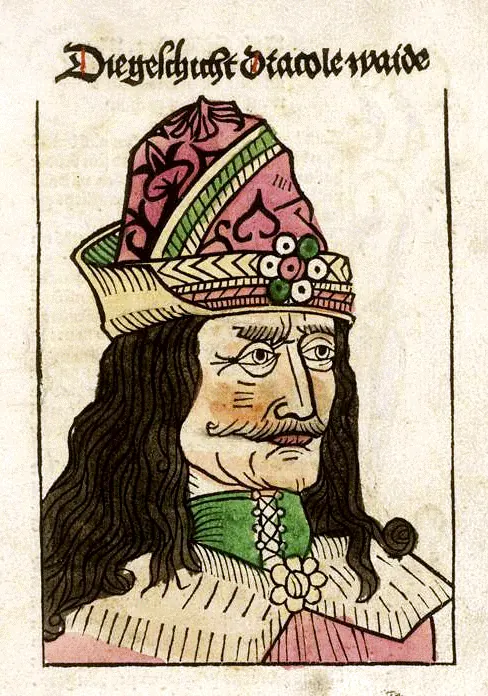
Plate 1488The Nürnberg title
The Nürnberg title Nürnberg 1488 title woodcut, handcoloured · Wikimedia Commons - The handcoloured title woodcut of Marx Ayrer's Nürnberg quarto, finished 14 October 1488.
- Research counts it the first print of the German stories (GW 12525); the only surviving copy sits in Weimar as Inc. 609a.
- The portrait block served both Nürnberg editions – Wagner's copy is cropped at the right edge.
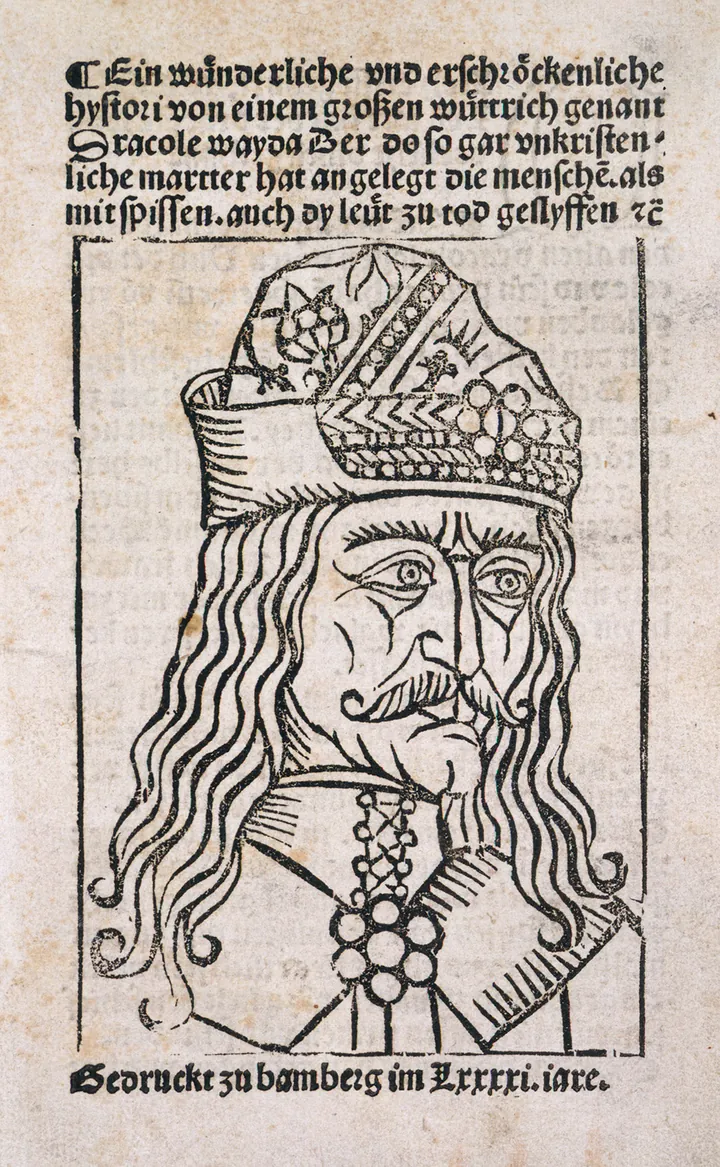
Plate 1491The Bamberg title
The Bamberg title Bamberg 1491 title page, Hans Sporer · Wikimedia Commons - Hans Sporer's Bamberg title page of 1491: <em>Dracole wayda</em> turns to half profile.
- New type, new wording, new layout – a fresh edition, not a reprint of Nürnberg.
- The British Library copy (IA.2673) is the one you see here.
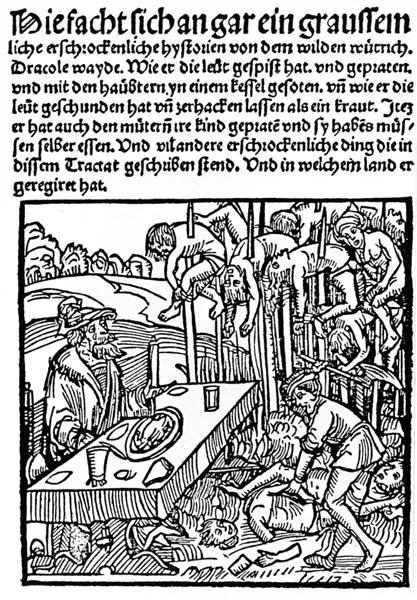
Plate 1499The dinner
The dinner Nürnberg 1499 dining woodcut · Wikimedia Commons - Ambrosius Huber's Nürnberg reprint of 1499, cut in the style of Markus Ayrer.
- <em>Dracule waide</em> dines at table while the impaled die around him – the scene that sold the pamphlet.
- The Strasbourg edition of 1500 reused the same dinner motif.
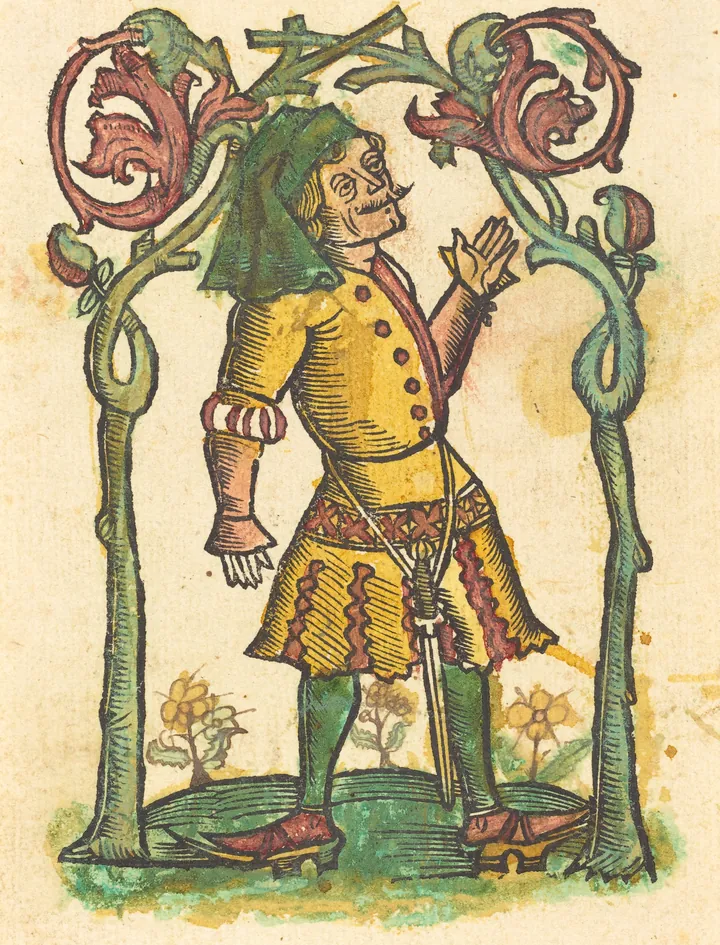
Plate c. 1500The full-length villain
The full-length villain Dracole Wajda, c. 1500, Rosenwald Collection · Wikimedia Commons - A hand-coloured full-length <em>Dracole Wajda</em>, around 1500 (Rosenwald Collection).
- Green chaperon, yellow jacket, green hose, pattens, and a dagger at the belt.
- The floral bower frames a courtier – the villain at his most splendid.
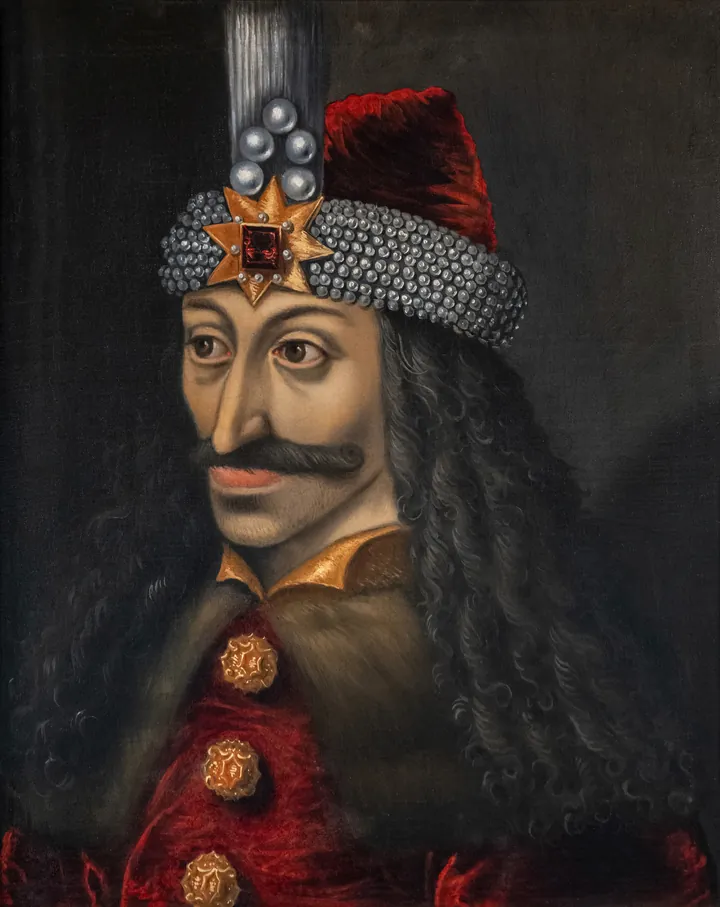
Plate AmbrasThe oil portrait
The oil portrait Ambras Castle, Innsbruck, portrait copy · Wikimedia Commons - The Ambras Castle copy of a lost original: Vlad in oils, Innsbruck.
- Florescu's verdict: 'a strong, cruel, and somehow tortured man'.
- Modrussa swore his hair was black; the portrait seems to show it fair.
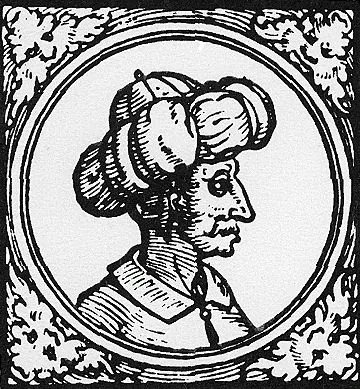
Plate 1530The nailed turban
The nailed turban Augsburg book, 1530, the nailed turban · Wikimedia Commons - An Augsburg book, 1530: the envoy who would not bare his head.
- Bonfini's version drives three spikes through turban and skull alike.
- Printed 53 years after Vlad's death – the legend needed no living witness.
Woodcuts and paintings via Wikimedia Commons (public domain throughout). Dates are plate references; see the sources for the catalogue numbers.
Vlad Țepeș in six numbers
Every figure below comes from the cited histories and facsimiles. The years run from the raid to the novel, 1462 to 1897.
- 1,462
- The night attack at Târgoviște
- 1,488
- The first dated print, Nürnberg
- 1,491
- The Bamberg edition, Sporer
- 1,500
- The Strasbourg edition, Hupfuff
- 1,897
- Dracula published, London
- 23,884
- Turks counted in Vlad's letter
Five things people get wrong
Vlad was a vampire
False: no source from the 1400s gives him fangs or blood-drinking – the bread dipped in blood is flagged as rumor even inside the German tradition. The vampire dates to Stoker's Dracula of May 1897, and Stoker never visited Eastern Europe.
Bran Castle was his castle
False: his name never appears in Bran's owners list; a single source grants him one overnight stay. The castle became 'Dracula's' through tourism, four centuries later.
He was born in the Sighișoara house
Unproven: no evidence ties his birth (1428–1431) to that house, which was built after the town fire of 1676 – two centuries later.
He lies buried at Snagov
Unproven: the 1931 opening of the alleged grave found no body, and Comana abbey claims him too. His head went to Constantinople; the rest is marsh and legend.
His lifetime name was Țepeș
False: in his lifetime he was Vlad, Dracula, Dragulya. 'The Impaler' enters the record around 1500 – Tursun Beg's Kazıklı Voyvoda – and in Romanian only with Mircea the Shepherd's letter of 1 April 1551.
Sources and methods
The story follows the English and German Vlad histories, the Night Attack history, the MGH print study with its GW/VD16 catalogue numbers, and the inspected facsimiles (Wikisource 1488, e-codices, Széchényi). All eight images are public domain via Wikimedia Commons.
Dates are given as the cited histories give them. City names follow the period – Nürnberg, Constantinople, Ofen – with the modern name at first mention where it helps.
Victim totals beyond the letter's 23,884 stay out; disputed stops and unproven graves are labeled as such. Modern translations appear only in brief attributed excerpts; the Latin and German originals are public domain.
The night
- The night attack of 16–17 June 1462: 7,000–10,000 horsemen, the viziers' tents struck instead of the sultan's, 5,000 + 15,000 dead (Balbi)
- Vlad's letter to Corvinus of 11 February 1462: 23,884 Turks killed, with the roll of places; the frozen-Danube raid
- Deserted Târgoviște: some 20,000 impaled along the road, Hamza Pasha on the highest stake; the sultan's amazement (Chalkokondyles 9.104)
- The retreat: the trench, 22 June; Brăila burned 29 June; Adrianople 11 July; the 'Great victory' feast 12 July
The press
- Beheim at Wiener Neustadt, winter 1463: 'Von ainem wutrich der heis Trakle waida von der Walachei'; Modrussa to Pius II (1462); Bonfini c. 1495
- Ayrer, Nuremberg, 14 October 1488 (GW 12525, single copy at Weimar); Wagner, Nuremberg, c. 1488 (Rosenbach, Munich, Stuttgart)
- The full text of the 1488 print (Nuremberg, 14 October 1488), original spelling
- Bamberg 1491 (Sporer); Lübeck after 1488 (Ghotan, GW 12531); Strasbourg 1500 (Hupfuff, GW 12530); Nuremberg 1499 (Huber); Nuremberg 1520/1521 (Stuchs, Gutknecht, VD16 D 2636f)
- 13 pamphlets between 1488 and 1559/1568, 8 of them incunabula; the St. Gall manuscript, Cod. Sang. 806 (facsimile)
- Trithemius on the printed booklet: 'risum et horrorem legentibus movent' (Annales Hirsaugienses, BSB Clm 704, fol. 193v)
The East
- Skazanie o Drakule voevode: 20+ Russian manuscripts, 19 episodes; attributed to Fyodor Kuritsyn (embassy to Hungary, 1482–1485)
- Written 1481–1486; oldest manuscript, 1490; Efrosin's colophon (13 February 6994 / 28 January 6998)
- Tursun Beg: divan official, at Constantinople in 1453; Tarih-i Ebülfeth ('History of the Conqueror'); 'Kazıklı Voyvoda' c. 1500
- Konstantin Mihailović: Memoirs of a Janissary, written 1490–1501; the noses sent to Hungary; some 250 janissaries at the Danube
- Romanian folklore (Rădulescu-Codin): the burning of the poor, the too-short shirt; 'only such cruel acts could secure public order'
The afterlife
- Three reigns (1448, 1456–1462, 1476); imprisonment 1462–1475; death near Snagov before 10 January 1477; the head to Mehmed II
- Dracula, May 1897, Archibald Constable and Company, London (probably 26 May); 6 shillings; the name from Wilkinson 1820; the 1899 American edition
- Stoker (1847–1912) never visited Eastern Europe; Vlad is absent from the working papers; 'Count Wampyr' in the drafts
- Bran: the name absent from the owners list; Sighișoara: the house postdates the 1676 fire; Snagov: the 1931 empty grave; the 1979 film
The six plates
Images
- Theodor Aman, The Battle With Torches (1866) · Wikimedia Commons
- Gentile Bellini, Mehmed II · Wikimedia Commons
- Nürnberg 1488 title woodcut, handcoloured · Wikimedia Commons
- Bamberg 1491 title page, Hans Sporer · Wikimedia Commons
- Nürnberg 1499 dining woodcut · Wikimedia Commons
- Dracole Wajda, c. 1500, Rosenwald Collection · Wikimedia Commons
- Ambras Castle, Innsbruck, portrait copy · Wikimedia Commons
- Augsburg book, 1530, the nailed turban · Wikimedia Commons