Chapter 4 · Membrane, osmosis, divisionLesson 4.4CS
Facilitated diffusion, active transport and vesicular transport: how ions and large molecules cross the membrane
Glucose and sodium ions cannot cross the lipid layer of the membrane on their own. So how do they get into the cell, and why do some of them move towards the side where there are already more of them?
- Size
- from 10 nm to 100 µm
- Level
- membrane and cell
- Time
- minutes and hours
Before you read: what do you think?
When you are resting, what share of all the ATP your body produces is used by a single protein, the sodium–potassium pump?
See the answer
About a third. The pump moves sodium and potassium ions against their gradients, and that costs energy. Without it, the difference in sodium and potassium between the inside and the outside of cells would gradually disappear.
In 1957 the Danish researcher Jens Skou ground membranes from crab nerves into fine fragments and found an enzyme in them that breaks down ATP and is stimulated by sodium and potassium ions. It was the first known protein that moves substances across a membrane using energy. It won him the Nobel Prize in Chemistry in 1997.
Proteins that help substances across
Oxygen and carbon dioxide pass straight through the lipid layer of the membrane. Ions such as Na⁺ and K⁺, and polar molecules such as glucose, have great difficulty crossing the lipid core of the membrane. They pass through transport proteins, which span the membrane.
Channel proteins form a water-filled pore through which a particular substance passes; some channels have a ‘gate’ that opens and closes. Carrier proteins bind the substance, change shape and release it on the other side. Each protein usually carries a single substance or a few similar ones.
Facilitated diffusion: with proteins, but without energy
Facilitated diffusion is the movement of a substance across the membrane with the help of a channel or carrier protein, down its concentration gradient, with no energy used. It is still passive transport: the protein opens the way, and the substance moves, as in simple diffusion, towards the lower concentration.
Glucose enters cells through carrier proteins called GLUT. Water passes quickly through channels called aquaporins. The first was isolated in 1988 by Peter Agre, who realised about a year later that it was the water channel; for this discovery he received the Nobel Prize in Chemistry in 2003. Because the number of carriers is limited, the rate of facilitated diffusion cannot rise for ever: once all of them are occupied, transport has reached its maximum.
Active transport: against the gradient, with ATP
Active transport is the movement of a substance across the membrane against its concentration gradient, using a pump protein and energy, usually from ATP.
The sodium–potassium pump moves 3 Na⁺ ions out of the cell and 2 K⁺ ions in for every molecule of ATP it breaks down. This leaves a lot of sodium outside the cell and a lot of potassium inside. Because more positive charges leave than enter, the inside of the cell becomes negative relative to the outside.
The sodium gradient built by the pump can be put to use in turn. In the gut, Na⁺ ions flow back into the cell through a protein that brings glucose in with them, even against the glucose gradient. This is secondary active transport: the ATP was spent earlier, by the pump.
Vesicular transport: the membrane folds
Large particles and droplets of liquid cross the membrane enclosed in vesicles. In endocytosis, the membrane sinks in around the material and pinches off into a vesicle that enters the cell. Phagocytosis engulfs large particles, even bacteria: this is how some white blood cells destroy them, once the vesicle has fused with a lysosome. Pinocytosis takes in droplets of liquid with the substances dissolved in it. In receptor-mediated endocytosis, the membrane captures only the substance that binds to its receptors, such as the cholesterol carried in the blood by LDL particles.
In exocytosis, a vesicle from inside the cell fuses with the membrane and empties its contents outside. This is how neurons release neurotransmitters, and how proteins made in the endoplasmic reticulum and packaged by the Golgi apparatus leave the cell. Vesicular transport uses energy, just like active transport.
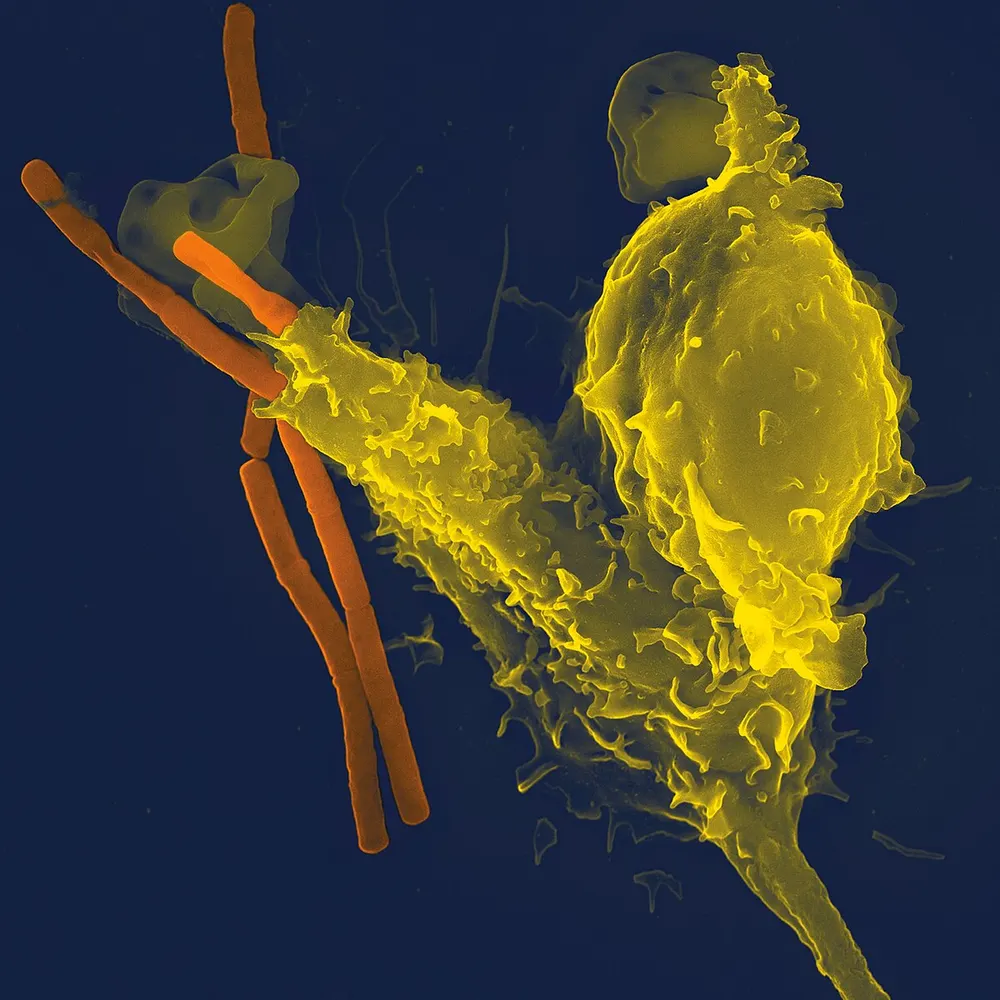
Photo: Volker Brinkmann, CC BY 2.5, source. Cropped and resized.

Worked example
Doing the sums for the sodium–potassium pump
A single pump runs through 100 cycles. In each cycle it moves 3 Na⁺ ions out, moves 2 K⁺ ions in and breaks down one molecule of ATP.
Na⁺ ions moved out: 100 × 3 = 300. K⁺ ions moved in: 100 × 2 = 200. ATP molecules used: 100. Extra positive charges moved out: 300 − 200 = 100.
The conclusion: the pump moves ions against their gradients and makes the inside of the cell more negative. If the ATP runs out, the pump stops, and the ions start flowing back through channels, down their gradients, by facilitated diffusion. The differences between inside and outside gradually disappear.
The 100 cycles are just for the calculation; the 3 to 2 to 1 ratio is the pump’s real one.
In Romania
The cholera of 1913 and Ioan Cantacuzino
In July 1913, during the Second Balkan War, cholera broke out in the Romanian army in Bulgaria. By 20 July, 2,000 soldiers were already ill. The Romanian doctor Ioan Cantacuzino vaccinated the soldiers in the middle of the epidemic, in three rounds of inoculations, with a vaccine prepared by him and his colleagues. After the third round the epidemic stopped abruptly. It was the first vaccination of this kind carried out on a large number of people.
Cholera is a disease of membrane transport. The toxin of the bacterium Vibrio cholerae enters gut cells by receptor-mediated endocytosis and holds chloride channels open. Chloride ions pour out into the gut, sodium follows them, and water follows by osmosis. The body rapidly loses water and salts.
The carrier that brings sodium in together with glucose keeps working. The oral rehydration solution recommended by the World Health Organization relies on it: glucose and sodium are absorbed together, and water follows them. Treatment is decided by a doctor.
In short
- Ions and polar molecules cross the membrane with the help of channel proteins and carrier proteins.
- Facilitated diffusion is passive transport: the substance passes through a protein, down its concentration gradient, with no energy used (glucose through GLUT, water through aquaporins).
- Active transport moves a substance against its gradient, using a pump protein and energy from ATP.
- The sodium–potassium pump moves 3 Na⁺ out and 2 K⁺ in for every ATP; at rest it uses about a third of the body’s ATP.
- Vesicular transport moves bulky materials: by endocytosis (phagocytosis, pinocytosis) they enter the cell, by exocytosis they leave; it uses energy.
Common mistakes
WrongAny substance that passes through a protein uses ATP.
RightIn facilitated diffusion, a substance passes through a protein down its gradient, with no energy. ATP is used in active transport, against the gradient, and in vesicular transport.
WrongThe sodium–potassium pump swaps one sodium ion for one potassium ion.
RightThe pump moves 3 Na⁺ ions out and 2 K⁺ ions in for every ATP, which is why the inside of the cell becomes negative.
WrongIn exocytosis, the protein leaves the cell by passing through the lipid layer, like oxygen.
RightThe protein stays inside the vesicle until the vesicle fuses with the membrane and empties its contents outside.
Check yourself
Seven questions. For the first six you see the explanation at once, with the paragraph of the lesson that supports it; for the written ones you compare with a good answer.
Glucose enters a cell through a GLUT protein, from the blood, where it is more concentrated, into the cytoplasm, where there is less of it. What kind of transport is this?
Answer
b) Facilitated diffusion, so passive transport. The substance moves down its gradient, through a protein, with no energy: facilitated diffusion. A protein being involved does not automatically mean active transport.
What does the sodium–potassium pump do for every molecule of ATP it breaks down?
Answer
b) Moves 3 Na⁺ out and 2 K⁺ in. The pump moves sodium out and potassium in, in a 3 to 2 ratio, which is why the inside becomes negative.
A sodium–potassium pump has moved 600 Na⁺ ions out of the cell. How many K⁺ ions did it move in over the same time?
ionsAnswer
400 ions. The ratio is 3 Na⁺ to 2 K⁺: 600 ÷ 3 = 200 cycles, and 200 × 2 = 400 K⁺ ions. 200 molecules of ATP were used.
A white blood cell engulfs a bacterium, which ends up in a vesicle and is then destroyed. What is this process called?
Answer
c) Phagocytosis. Engulfing large particles such as bacteria is phagocytosis, a kind of endocytosis. Pinocytosis takes in droplets of liquid, and exocytosis moves materials out of the cell.
For each situation, choose whether the cell uses energy or not.
Answer
No energy used (passive): Oxygen passes through the lipid layer; Water passes through aquaporins; Glucose enters through GLUT, down its gradient.
Energy used (active): The pump moves Na⁺ ions out of the cell; A neuron releases neurotransmitters by exocytosis; A white blood cell engulfs a bacterium.
Simple diffusion and facilitated diffusion go down the gradient, with no energy. Pumps and vesicles use energy.
In the gut, glucose enters the cell together with sodium ions, even when there is already more glucose inside the cell. Where does the energy come from?
Answer
a) From the sodium gradient, built earlier by the sodium–potassium pump using ATP. This is secondary active transport: sodium moves down its gradient and brings glucose against its own, and the sodium gradient was built by the pump, using ATP.
A cell is placed in surroundings where it can no longer make ATP. What happens over time to the difference between the concentration of sodium ions inside and outside? Explain using the terms active transport and diffusion.
A good answer
Without ATP the sodium–potassium pump stops, so active transport no longer moves sodium out of the cell. Sodium ions keep entering through channels, by facilitated diffusion, down their gradient. The difference in concentration gradually shrinks until it is close to equilibrium, and the inside of the cell loses its negative charge.
A complete answer says that the pump needs ATP, that diffusion carries on without energy and that the gradient gradually disappears.
Terms
- channel proteins
- Membrane proteins that form a pore through which a particular substance passes.
- carrier proteins
- Membrane proteins that bind a substance, change shape and release it on the other side.
- facilitated diffusion
- The movement of a substance across the membrane with the help of a protein, down its concentration gradient, with no energy used.
- aquaporins
- Channel proteins through which water crosses the membrane quickly.
- active transport
- The movement of a substance across the membrane against its concentration gradient, using a pump protein and energy.
- sodium–potassium pump
- A protein that moves 3 Na⁺ out of the cell and 2 K⁺ in for every molecule of ATP it breaks down.
- endocytosis
- The entry into the cell of materials enclosed in a vesicle formed from the membrane; it includes phagocytosis and pinocytosis.
- exocytosis
- The release of a vesicle’s contents outside the cell, when the vesicle fuses with the membrane.
Sources and link to the programme
- OpenStax – Biology 2e, 5.2 Passive Transport – facilitated transport through channel proteins (hydrophilic, specific pores, some gated) and carrier proteins (change shape, can become saturated); aquaporins; glucose through GLUT; no energy used
- OpenStax – Biology 2e, 5.3 Active Transport – the sodium–potassium pump: 3 Na⁺ out, 2 K⁺ in, ATP; an electrogenic pump, the inside more negative; primary and secondary active transport, with the example of glucose brought in by sodium
- OpenStax – Biology 2e, 5.4 Bulk Transport – endocytosis, phagocytosis (neutrophils engulf microorganisms, the vesicle fuses with a lysosome), pinocytosis, receptor-mediated endocytosis (LDL, cholera toxin), exocytosis (neurotransmitters); transport that uses energy
- Nobel Prize – The Nobel Prize in Chemistry 1997, press release – Jens C. Skou, Na⁺,K⁺-ATPase; first paper in 1957; crab nerves; at rest, Na⁺,K⁺-ATPase uses a third of the ATP formed
- Nobel Prize – The Nobel Prize in Chemistry 2003, press release – Peter Agre isolated in 1988 the protein that turned out to be the water channel; the 2003 prize for the discovery of water channels
- Leasu F., Nemet C., Borzan C., Rogozea L. (2015) – A novel method to combat the cholera epidemic among the Romanian army during the Balkan War – 1913, Acta medico-historica Adriatica 13(1): 159–170 – cholera in the Romanian army in Bulgaria, July 1913; 2,000 cases on 20 July; vaccination in the outbreak by Ioan Cantacuzino, three inoculations, the abrupt end after the third; the first vaccination of this kind on a large scale
- Binder H. J. et al. (2014) – Oral rehydration therapy in the second decade of the twenty-first century, Current Gastroenterology Reports – cholera toxin causes chloride secretion through cyclic AMP but does not affect glucose-coupled sodium absorption; the physiological basis of oral rehydration solution
- World Health Organization – Cholera, fact sheet – cholera is treated with oral rehydration solution, and severe cases with intravenous fluids and antibiotics; safe water, sanitation and the vaccine prevent the disease
From the programme: “Exchange of substances between the cell and its surroundings: facilitated diffusion, active transport, vesicular transport” (specialism, Natural Sciences). Specific competences addressed: 2.2, 4.1, 4.2.