Chapter 6 · Bacteria, protists, fungiLesson 6.4
Chromista: diatoms and brown algae
What do a cell too small to see with the naked eye and a seaweed longer than a bus have in common?
- Size
- from 100 nm to 30 m
- Level
- single-celled organisms and communities
- Time
- 20 minutes and billions of years
Before you read: what do you think?
What share of all the photosynthesis on Earth, on land and in water, is done by diatoms, microscopic single-celled algae?
See the answer
About 20%. Diatoms make 40–45% of the organic matter produced in the oceans, that is, about a fifth of the carbon fixed and the oxygen produced on the whole Earth. A fifth of the oxygen, then, comes from cells invisible to the naked eye.
Under the microscope, many diatoms look like tiny glass boxes with fine patterns: their wall is made of silicon dioxide, the same substance glass is made of. Clumps of brown algae grow on the rocks of Romania’s southern coast, and in the oceans some brown algae grow more than 30 m long. Different as they are, both belong to the group Chromista.
Algae with chlorophyll a and c
The Chromista studied in school are algae, eukaryotic organisms that photosynthesise. Like plants, they have chlorophyll a; in place of the plants’ chlorophyll b they have chlorophyll c. Alongside the chlorophylls they have a yellow-brown pigment, fucoxanthin, bound to the chlorophylls in the same light-harvesting complexes. Fucoxanthin masks the green of the chlorophyll, which is why these algae are golden or brown.
They are autotrophic: they make their organic substances by photosynthesis, from carbon dioxide and water, and release oxygen. They live in almost every kind of water, fresh and salt, from the plankton drifting out at sea to the rocks on the shore.
Chromista is a working group, made of more than one branch of the tree of life. The seven-kingdom classification defines it by the algae with chlorophyll c, but also puts organisms without chloroplasts into it, such as water moulds, split off from the fungi.
Diatoms, algae in glass boxes
Diatoms are single-celled algae. Each cell is enclosed in a wall of silicon dioxide called a frustule, made of two valves that overlap like the lid on a box. The valves have pores and fine patterns, in a huge variety of shapes. There are estimated to be around 200,000 species.
Diatoms make up a large part of the phytoplankton, the microscopic algae and cyanobacteria that drift in water. Other diatoms live on rocks, on water plants or on the bottom, and some can glide slowly over surfaces. Because they make organic matter by photosynthesis, diatoms are the food that many aquatic food chains start from: small animals in the plankton eat them, and larger ones then eat those.
They reproduce mainly by division: the cell splits in two, and each daughter cell keeps one old valve and builds a new valve inside it. Because the valves are rigid and do not grow once they have formed, the average size of the diatoms in a population shrinks from one generation to the next. Every so often, diatoms reproduce sexually, and the offspring build a whole new, full-sized frustule.
When diatoms die, their frustules sink to the bottom and pile up in layers. Over millions of years they form a light, porous rock called diatomite. Diatomite is mined and used as an abrasive and as a filter material; Alfred Nobel used it to stabilise the nitroglycerine in dynamite.
For the curious
Between the valves, the frustule also has thin rings of silica called girdle bands. New valves form at division, but girdle bands are added between two divisions, while the cell is growing. In this way the cell can lengthen between its two valves, even though the valves no longer change size.
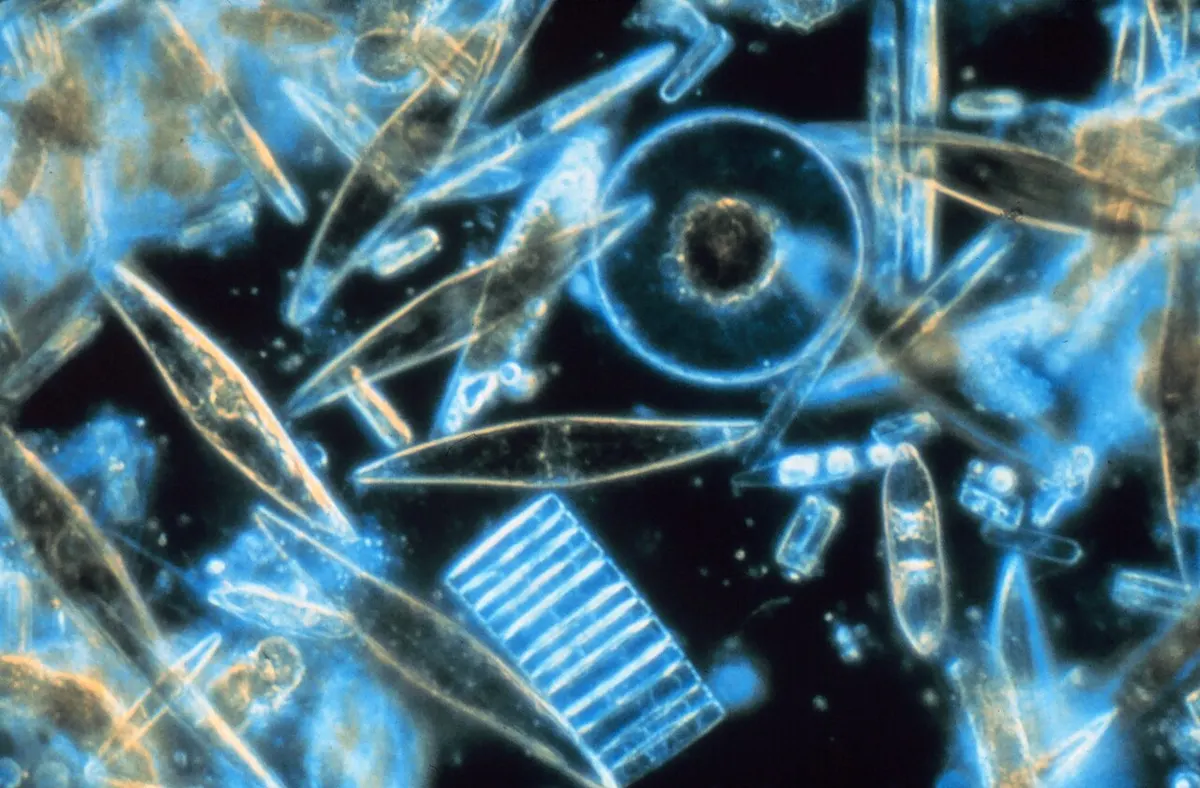
Photo: Prof. Gordon T. Taylor, Stony Brook University, Public domain, source. Resized.

Brown algae, forests under water
Brown algae are multicellular and almost all live in the sea. Their body has no true roots, stem or leaves and is called a thallus. In large species such as Laminaria, the thallus has a holdfast that grips the rock, like a root, a stalk like a stem, and broad blades that photosynthesise. The largest brown algae grow more than 30 m long.
In Fucus, the thallus is branched and has swellings on its branches in which the sex cells form. Many brown algae, such as Laminaria, reproduce by spores and by sex cells, with a cycle in which a spore-producing generation alternates with a gamete-producing one. Fucus has no such alternation: its thallus produces the gametes directly, its only haploid cells.
Large brown algae form underwater forests: they supply oxygen and food, and many animals shelter among their fronds.
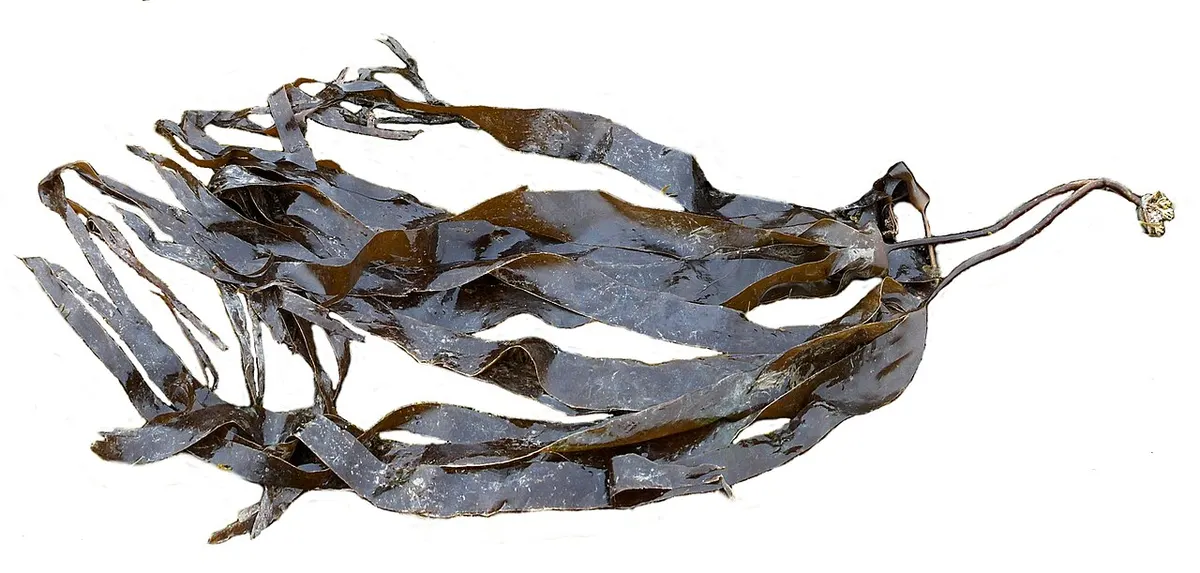
Photo: Stemonitis; derivative work: Thiotrix, CC BY 2.5, source. Resized.

Worked example
Read the comparison table
A pupil has filled in a table for the two groups. Diatoms: single-celled; wall of silicon dioxide, in two valves; chlorophyll a and c, fucoxanthin; drift in the plankton or sit on surfaces; reproduce mainly by division. Brown algae: multicellular, with a thallus; wall without silica; chlorophyll a and c, fucoxanthin; attached to rocks, mostly in the sea; reproduce by spores and gametes.
Question: which rows show why they are placed in the same group, and which rows tell them apart? The pigment row is identical: chlorophyll a, chlorophyll c and fucoxanthin are the shared feature. The rows on organisation, wall and reproduction differ.
Conclusion: diatoms and brown algae are grouped together by their pigments, not by size or shape. That is why a cell a few micrometres across and a seaweed several metres long sit in the same group, while a green alga, with chlorophyll b, does not.
In Romania
The brown alga that held on in the Black Sea
On the rocky shore of Romania’s southern coast lives Gongolaria barbata, a brown alga long known as Cystoseira barbata. Its clumps form small underwater forests in shallow water, where many small animals find shelter and food.
The researchers Oana Alina Marin and Alina Spinu, of the Grigore Antipa National Institute for Marine Research and Development in Constanța, compared the populations of the 1960s, the 1970s and 2009–2022. Of the 13 sites where the alga grew in the 1960s, only 5 were left in the 2009–2022 data. The decline began with the freezing of the sea in the winter of 1971–1972 and continued with violent storms.
At the remaining sites, the alga now has a biomass and density close to those of the 1960s. It is the only alga of its kind left on the Romanian coast, and the authors describe it as being in a fragile balance, highly sensitive to human activity.
In short
- The Chromista studied in school are eukaryotic algae with chlorophyll a and c and fucoxanthin, a yellow-brown pigment; they are autotrophic and photosynthesise.
- Diatoms are single-celled, with a wall of silicon dioxide (a frustule) made of two valves; they make up a large part of the phytoplankton.
- Diatoms reproduce mainly by division; their frustules, laid down over millions of years, form diatomite.
- Brown algae are multicellular, mostly marine; their body is a thallus, which in large species has a holdfast, a stalk and blades.
- Diatoms make 40–45% of the oceans’ production, about 20% of the carbon fixed and the oxygen produced on Earth; brown algae form underwater forests.
- Chromista is a working group, made of more than one branch of the tree of life; diatoms and brown algae are placed in it because of their pigments.
Common mistakes
WrongBrown algae do not photosynthesise, because they are not green.
RightThey have chlorophyll, but yellow-brown fucoxanthin masks its green. The brown colour comes from a pigment that helps harvest light.
WrongThe thallus of a brown alga has roots, a stem and leaves.
RightThe holdfast, the stalk and the blades look like the organs of a plant, but they are not true roots, stems and leaves; they have no vascular tissue.
WrongThe diatom frustule is made of limestone, like a shell.
RightThe frustule is made of silicon dioxide, the substance glass is made from, and has two overlapping valves.
Check yourself
Seven questions. For the first six you see the explanation at once, with the paragraph of the lesson that supports it; for the written ones you compare with a good answer.
What is the wall (frustule) of a diatom made of?
Answer
c) Silicon dioxide. The frustule is made of silicon dioxide and has two valves. Cellulose is in the wall of plants, chitin in that of fungi.
Which pigments do diatoms and brown algae share?
Answer
b) Chlorophyll a and c, fucoxanthin. Chlorophyll c and fucoxanthin are the feature by which diatoms and brown algae are placed in the same group. Chlorophyll b belongs to plants and green algae; phycoerythrin to red algae.
Why does the average size of the diatoms in a dividing population shrink from one generation to the next?
Answer
b) Because the valves do not grow once formed, and the new valve is made inside the old one. Silica valves are rigid, and the new valve is built at division, inside the old one. Sexual reproduction restores the full size.
What is the body of a brown alga, without true roots, stem or leaves, called?
Answer
b) Thallus. The thallus is the body of multicellular algae. The mycelium is the body of fungi, the frustule is the diatom wall.
The alga Gongolaria barbata grew at 13 sites on the Romanian coast in the 1960s, and at 5 in the 2009–2022 data. What percentage of the sites was lost? Round to a whole number.
%Answer
62 %. 13 − 5 = 8 sites disappeared. 8 ÷ 13 × 100 ≈ 61.5%, that is, about 62%.
Which feature belongs to diatoms and which to brown algae?
Answer
Diatoms: Single-celled; Wall of silicon dioxide in two valves; Make up a large part of the phytoplankton.
Brown algae: Thallus with holdfast, stalk and blades; Can grow more than 30 m long; Form underwater forests on rocks.
Diatoms are microscopic cells with a frustule, many of them planktonic. Brown algae are multicellular, attached, sometimes huge.
A classmate says that if every diatom in the oceans disappeared, nothing would happen, because they are too small to matter. What do you tell him?
A good answer
Diatoms are small, but there are a great many of them: they make 40–45% of the organic matter produced in the oceans, that is, about 20% of the carbon fixed and the oxygen produced on Earth. They are at the base of aquatic food chains, because they are food for small animals, which in turn feed fish. Losing them would cut the oxygen produced and leave a large part of marine life without food.
A complete answer uses a number (their share of photosynthesis), names their role as producers at the base of the food chain and explains the consequence for other organisms.
Terms
- Chromista
- A school group of eukaryotes that includes algae with chlorophyll a and c and fucoxanthin, among them diatoms and brown algae.
- fucoxanthin
- A yellow-brown pigment, bound to the chlorophylls, that gives diatoms and brown algae their colour.
- frustule
- The silicon dioxide wall of diatoms, made of two overlapping valves.
- phytoplankton
- All the microscopic organisms that drift in water and photosynthesise: algae and cyanobacteria.
- diatomite
- A light, porous rock formed from diatom frustules laid down over millions of years.
- thallus
- The body of multicellular algae, without true roots, stem or leaves.
Sources and link to the programme
- Microbiology Society – Diatoms: glass-dwelling dynamos – single-celled algae; frustule with two overlapping valves, with pores; chlorophylls a and c; about 200,000 species; 40–45% of ocean primary production, that is, 20% of carbon fixation and oxygen production on Earth; diatomite used in industry and in Nobel’s dynamite; some diatoms glide over surfaces
- Frontiers in Marine Science (2024) – Progress on the biological characteristics and physiological activities of fucoxanthin produced by marine microalgae – in diatoms, fucoxanthin forms light-harvesting protein complexes (FCP) with chlorophylls a and c
- UCMP Berkeley – Introduction to the Phaeophyta – brown algae have chlorophyll c and fucoxanthin; the largest exceed 30 m; alternation of generations; in Fucus, the swellings on the branches are where the gametes form
- UCMP Berkeley – Introduction to the Bacillariophyta – silica frustules; abundant in plankton and sediments, marine and freshwater; food for many organisms; fossil deposits mined as abrasives and filter materials
- UCMP Berkeley – Diatoms: life history and ecology – the new wall is built only at division; the average size of a dividing population shrinks over time; sexual reproduction produces offspring with a completely new wall
- Hildebrand, Lerch, Shrestha (2018), Frontiers in Marine Science 5:125 – Understanding Diatom Cell Wall Silicification—Moving Forward – in Thalassiosira pseudonana, girdle bands are made in the G1 phase, between divisions, and valves form after G2+M, at division
- Frontiers in Marine Science (2022) – review of reproduction in Fucus – Fucus has a diplontic cycle, unique among algae: its only haploid phase is the single-celled gamete
- OpenStax – Biology 2e, 23.3 Groups of Protists – diatoms with a silicon dioxide wall; brown algae multicellular, mainly marine; holdfast, stalk and blades in large algae; in Laminaria, haploid spores give multicellular gametophytes
- Ruggiero et al. (2015), PLOS ONE – A higher level classification of all living organisms – Chromista includes all chromophyte algae (with chlorophyll c, without b); oomycetes (water moulds) belong to Chromista, not to the fungi
- Marin, Spinu (2023), Periodicum biologorum 125(3–4) – Long term succession of engineering species Gongolaria barbata along the Romanian Black Sea coast – INCDM Grigore Antipa; G. barbata, the only remaining representative of the Cystoseira group on the Romanian coast; comparison of the 1960s, the 1970s and 2009–2022; of 13 areas, 5 remained; decline linked to the ice of 1972 and to storms; recent biomass and density close to the reference period; fragile balance
From the programme: “Chromista (single-celled and multicellular algae with chlorophylls a and c, diatoms, brown algae) – general features (morphology, nutrition, reproduction), habitats, importance in ecosystems” (common core). Specific competences addressed: 1.1, 2.1, 2.2.