Chapter 3 · The cellLesson 3.7CS
From DNA to protein; chromosomes: transcription, translation, karyotype
Your DNA sits in the nucleus, but proteins are built at the ribosomes, in the cytoplasm. How does the information get from one place to the other?
- Size
- from 5 nm to 100 µm
- Level
- cell
- Time
- a day in the life of a cell
Before you read: what do you think?
If you took the DNA out of the nucleus of a single one of your cells and laid it out end to end, how long would the thread be?
See the answer
About 2 metres, only 2 nm thick, inside a cell of about 10 µm. The DNA fits because it is wound around proteins and packed into chromosomes.
Your cells have about 20,000 genes that hold the instructions for proteins. The parts of them that code for proteins take up only about 1.5% of your DNA. For a gene to become a protein, its information goes through two stages: it is copied into RNA, then translated into amino acids.
The gene and transcription: from DNA to RNA
A gene is a stretch of DNA that holds the information for a protein or for an RNA molecule. The information lies in the order of the nucleotides, written with four letters: A, T, G, C.
Transcription is the copying of a gene’s information into an RNA molecule. Genes for proteins are copied into messenger RNA (mRNA); other genes yield ribosomal RNA or transfer RNA. In eukaryotic cells, transcription takes place in the nucleus. The RNA is built along one strand of the DNA, by complementary base pairing, with a single difference: in place of thymine (T) it has uracil (U). The messenger RNA then leaves the nucleus through the pores of the nuclear envelope and reaches the ribosomes.
Translation: from messenger RNA to protein
Translation is the assembly of a protein at the ribosome, following the information in messenger RNA. The ribosome reads the mRNA three nucleotides at a time. A group of three nucleotides is called a codon and corresponds to an amino acid or to the stop signal.
Amino acids are brought by molecules of transfer RNA (tRNA). Each tRNA carries an amino acid at one end and, at the other, an anticodon, three nucleotides that match the codon on the mRNA. The ribosome links the amino acids to one another, in the order of the codons.
Four nucleotides taken three at a time give 64 codons. Of these, 61 correspond to amino acids, and 3 are stop codons, which end translation. The codon AUG starts translation and corresponds to methionine. Because there are only 20 amino acids, several codons can correspond to the same amino acid. This genetic code is almost the same in all organisms. Not every RNA is a messenger: ribosomal RNA and transfer RNA are not translated into proteins.
Chromatin, chromosomes and chromatids
In the nucleus, DNA is wound around proteins called histones. The combination of DNA and proteins is called chromatin. Before division, the chromatin condenses and forms chromosomes, visible under the microscope. An uncopied chromosome contains a single DNA molecule.
Before division, the DNA is copied. The chromosome then has two sister chromatids, identical copies joined at a narrowed region called the centromere. A chromosome with two chromatids still counts as one chromosome, with two DNA molecules. The X shape in drawings is this copied, condensed chromosome, before division.
In humans, a cell has 46 chromosomes and 46 DNA molecules before copying, and 46 chromosomes with 92 DNA molecules after copying.
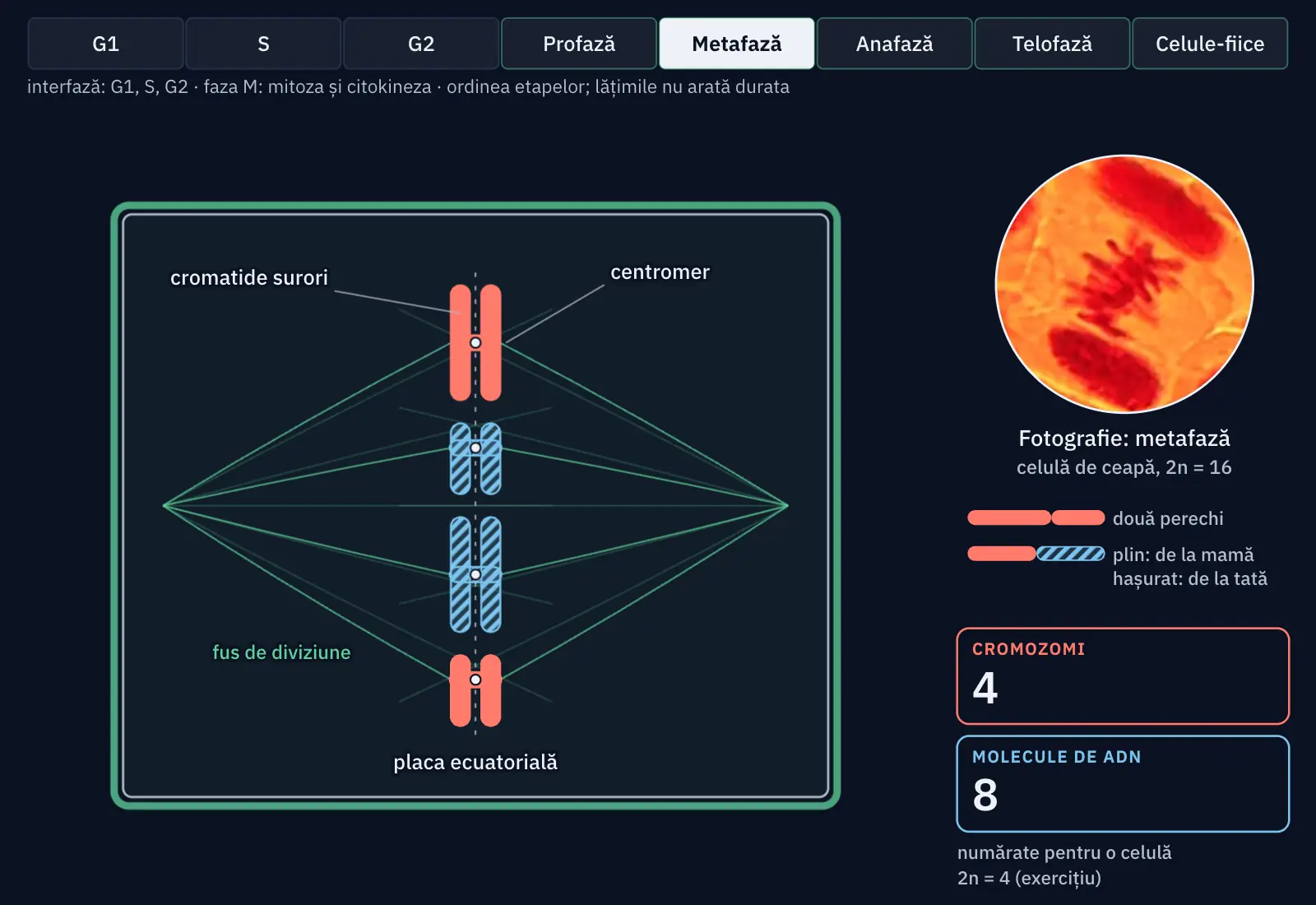
| Stage | What is seen | 2n = 4: chromosomes / DNA molecules | Human, 2n = 46: chromosomes / DNA molecules | Counted for |
|---|---|---|---|---|
| G1 | chromatin in the nucleus; one chromosome, one DNA molecule | 4 / 4 | 46 / 46 | one cell |
| S | DNA replication, at many places at once | 4 / 4→8, no fixed number | 46 / 46→92, no fixed number | one cell |
| G2 | each chromosome has two sister chromatids joined at the centromere | 4 / 8 | 46 / 92 | one cell |
| Prophase | chromosomes condense; the nuclear envelope breaks down; the spindle forms | 4 / 8 | 46 / 92 | one cell |
| Metaphase | chromosomes on the equatorial plate, attached to the spindle at the centromere | 4 / 8 | 46 / 92 | one cell |
| Anaphase | sister chromatids separate and move towards the poles | 8 / 8 | 92 / 92 | the whole cell, still undivided |
| Telophase | new nuclear envelopes; furrow (animal cell) or cell plate (plant cell) | 8 / 8 | 92 / 92 | the whole cell, still undivided |
| Daughter cells | two daughter cells, each with a complete set | 4 / 4 | 46 / 46 | each daughter cell |
In telophase the cell has not yet divided; each new nucleus has 4 chromosomes and 4 DNA molecules (human: 46 and 46). Typical durations, human cells in culture: G1 9 hours, S 10 hours, G2 4.5 hours, M phase 0.5 hours.
Diagram and photograph. The cell is a drawing with 2n = 4: two pairs of homologous chromosomes, one long and one short, with the copy from the mother solid and the one from the father hatched. The counters come from the same calculation as the table; for humans (2n = 46) only the numbers change. The band at the top shows the order of the stages, not their duration; the “Show typical durations” button displays the durations for rapidly dividing human cells in culture, with a cycle of 24 hours (OpenStax Biology 2e). The photographs are real: onion cells (2n = 16), with the phases identified by the author of the photographs; the images are cropped from “Mitosis in yellow onion cells”, Pixelmaniac pictures, Wikimedia Commons, CC BY-SA 3.0; no scale bar.
The number of chromosomes and the karyotype
Human body cells usually have 46 chromosomes, in 23 pairs: one chromosome of each pair comes from the mother, the other from the father. A cell with two sets of chromosomes is diploid (2n). The gametes, the egg cell and the sperm cell, have a single set, 23 chromosomes: they are haploid (n).
Of the 23 pairs, 22 are autosomes, numbered from 1 to 22, roughly in order of size. The 23rd pair is made up of the sex chromosomes (heterosomes): XX in a woman, XY in a man.
The karyotype is the complete set of chromosomes of an individual and, at the same time, the picture in which the chromosomes of a cell are arranged in order, by size, by their stained bands and by the position of the centromere. A karyotype shows abnormalities of number or structure. Each species has its own number: the fruit fly has 8 chromosomes, rice 24, the dog 78. The number of chromosomes does not show how complex an organism is.
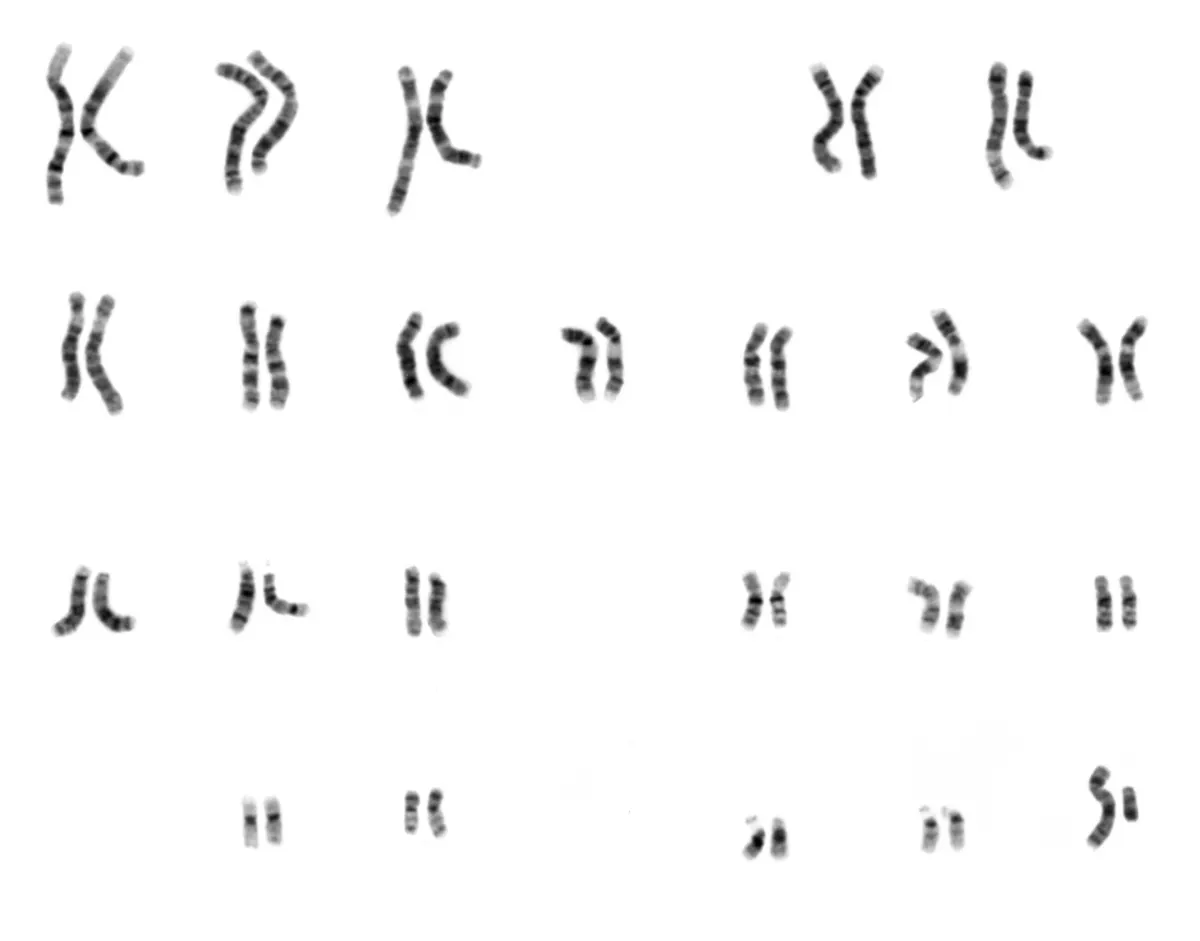
Photo: National Human Genome Research Institute, Public domain, source. Resized.

Worked example
From DNA to amino acids
The DNA strand used for transcription has the sequence TAC AAA GAT ATT. Which amino acids result?
Step 1, transcription: each nucleotide in the DNA pairs with its complement in the RNA (T with A, A with U, G with C, C with G). mRNA: AUG UUU CUA UAA.
Step 2, splitting into codons: 12 nucleotides make 4 codons.
Step 3, translation, using the genetic code table: AUG = methionine (start), UUU = phenylalanine, CUA = leucine, UAA = stop.
The result: a short chain of 3 amino acids, methionine–phenylalanine–leucine. The stop codon adds no amino acid. The anticodon of the tRNA that brings leucine is GAU, complementary to the codon CUA.
In Romania
The European bison and its 60 chromosomes
Since 2014, European bison (Bison bonasus) have been released back into the wild in the Țarcu Mountains, near Armeniș, and later also in the Poiana Ruscă Mountains, near Densuș, by Rewilding Europe and WWF Romania. The animals came from reserves and zoos in several European countries.
The karyotype of the European bison has 2n = 60 chromosomes, the same as that of domestic cattle (Bos taurus). The same chromosome number does not by itself show relatedness. Their chromosomes differ in the details: the regions that contain the genes for ribosomal RNA sit on partly different pairs of chromosomes.
The European bison has 60 chromosomes, humans 46, the dog 78. The number of chromosomes is a feature of the species, not a measure of its complexity.
In short
- A gene is a stretch of DNA that holds the information for a protein or for an RNA molecule.
- Transcription copies a gene’s information into an RNA molecule, in the nucleus; genes for proteins yield messenger RNA, and translation assembles the protein at the ribosome, following the mRNA.
- A codon has three nucleotides; of 64 codons, 61 correspond to amino acids and 3 are stop codons; AUG starts translation.
- Transfer RNA brings the amino acid, and its anticodon matches the codon on the mRNA.
- A copied chromosome has two sister chromatids joined at the centromere and still counts as one chromosome, with two DNA molecules.
- In humans, body cells are diploid (2n = 46: 22 pairs of autosomes and one pair of sex chromosomes), and gametes are haploid (n = 23); the karyotype shows the chromosomes in order.
Common mistakes
WrongWhen DNA is copied, the number of chromosomes doubles.
RightThe number of DNA molecules doubles. The two copies stay joined at the centromere as sister chromatids, so the number of chromosomes stays the same until they separate.
WrongEvery RNA is a message that will become a protein.
RightOnly messenger RNA is translated. Ribosomal RNA forms part of the ribosome, and transfer RNA brings the amino acids.
WrongThe more chromosomes a species has, the more complex it is.
RightThe dog has 78 chromosomes, the European bison 60, humans 46. The number of chromosomes characterises the species, but it does not measure complexity.
Check yourself
Seven questions. For the first six you see the explanation at once, with the paragraph of the lesson that supports it; for the written ones you compare with a good answer.
In a eukaryotic cell, where are the genes in the nucleus transcribed?
Answer
b) In the nucleus. Transcription takes place in the nucleus, where the DNA is. The mRNA made there then leaves through the pores of the nuclear envelope for the ribosomes, where translation takes place.
What matches a codon on the messenger RNA during translation?
Answer
a) The anticodon of a transfer RNA. The tRNA brings the amino acid, and its three-nucleotide anticodon matches the codon on the mRNA.
A stretch of messenger RNA has 450 nucleotides, from the AUG codon up to and including the first stop codon. How many amino acids does the resulting protein have?
amino acidsAnswer
149 amino acids. 450 ÷ 3 = 150 codons. The last one is the stop codon, which adds no amino acid, so 149 amino acids remain.
A skin cell has just copied its DNA and has not yet started dividing. How many chromosomes and how many DNA molecules does it have?
Answer
c) 46 chromosomes and 92 DNA molecules. Each chromosome now has two chromatids, each with one DNA molecule, but it still counts as one chromosome.
Put the path of information from a gene to a protein in order.
Answer
The correct order:
- In the nucleus, the gene is copied into a messenger RNA
- The messenger RNA leaves the nucleus through the pores of the nuclear envelope
- The ribosome reads the messenger RNA codon by codon
- Transfer RNAs bring the amino acid that matches each codon
- At the stop codon, the finished protein is released
Transcription in the nucleus, transport of the mRNA into the cytoplasm, then translation at the ribosome up to the stop codon.
Choose the right label for each human chromosome.
Answer
Autosome: Chromosome 1; Chromosome 21; Chromosome 7.
Sex chromosome: X chromosome; Y chromosome.
The chromosomes numbered from 1 to 22 are autosomes; X and Y are the sex chromosomes (heterosomes).
A doctor asks for a child’s karyotype. What picture does the doctor receive, what can it reveal, and what can it not reveal about a single gene?
A good answer
The doctor receives a picture of the chromosomes from one cell, arranged in pairs and in order by size, bands and the position of the centromere. From it the doctor can count the chromosomes and see whether a chromosome is missing or extra, or whether a piece of a chromosome has changed. A mistake in a single gene, a few nucleotides long, does not show up in a karyotype, because one chromosome contains hundreds or thousands of genes.
A complete answer describes the karyotype, says that it shows abnormalities of number and structure, and explains that a small change in one gene cannot be seen at the level of the chromosome.
Terms
- gene
- A stretch of DNA that holds the information for a protein or for an RNA molecule.
- transcription
- The copying of a gene’s information into an RNA molecule (messenger RNA, for example), in the nucleus.
- translation
- The assembly of a protein at the ribosome, following the information in messenger RNA.
- codon
- A group of three nucleotides on messenger RNA that corresponds to an amino acid or to a stop signal.
- anticodon
- A group of three nucleotides on transfer RNA that matches a codon on messenger RNA.
- chromatid
- One of the two identical copies of a copied chromosome, joined at the centromere.
- centromere
- The narrowed region of a chromosome where the sister chromatids are joined and where the fibres of the division spindle attach.
- karyotype
- The complete set of chromosomes of an individual, and the picture in which they are arranged in order.
Sources and link to the programme
- NHGRI – Talking Glossary: Gene – humans have about 20,000 protein-coding genes; protein-coding sequences take up only 1.5% of the genome
- NHGRI – Talking Glossary: Transcription – in humans, mRNA moves from the nucleus into the cytoplasm, where it is used to make protein
- OpenStax – Biology 2e, 15.1 The Genetic Code – the flow DNA → mRNA → protein; the three-nucleotide codon; 64 codons, 61 for amino acids and 3 stop; AUG = methionine and start; 20 amino acids; the degenerate, nearly universal code; the code table (UUU phenylalanine, UAA stop)
- OpenStax – Biology 2e, 15.5 Ribosomes and Protein Synthesis – tRNA with an anticodon that pairs with the codon; the example CUA (leucine) with the anticodon GAU; the ribosome moves on three nucleotides at a time
- OpenStax – Biology 2e, 10.1 Cell Division – 46 chromosomes in somatic cells and 23 in gametes; diploid; the DNA of the 46 chromosomes would measure about 2 m, with a diameter of 2 nm, in a cell of about 10 µm
- NHGRI – Chromosomes Fact Sheet – 23 pairs, XX and XY; an uncopied chromosome has a single DNA molecule wound on histones; the centromere; the fruit fly 4 pairs, rice 12, the dog 39
- NHGRI – Talking Glossary: Chromatid – the chromatid, one of the two identical halves of a copied chromosome, joined at the centromere
- NHGRI – Talking Glossary: Autosome – 22 pairs of autosomes and one pair of sex chromosomes; autosomes numbered roughly by size
- NHGRI – Talking Glossary: Karyotype – the karyotype as the complete set of chromosomes and as a picture ordered by size, bands and centromere position; used for abnormalities of number and structure
- Kloch M. et al. (2021) – Cytogenetic study of the Bison bonasus; I: Identification of heterochromatic regions and NORs in European bison karyotype and comparison with domestic cattle (Bos taurus), Caryologia – the European bison and domestic cattle both have 2n = 60; active nucleolus organiser regions on partly different pairs (bison: 2, 3, 4, 25, 28; cattle: 2, 3, 4, 11, 25)
- Rewilding Europe – Largest ever bison reintroduction in Southern Carpathians – the reintroduction of European bison into the Southern Carpathians since 2014, in the Țarcu Mountains near Armeniș and in the Poiana Ruscă Mountains near Densuș; Rewilding Europe and WWF Romania; animals from European reserves and zoos
From the programme: “Components of the cell – structural details and functions”; “The DNA-RNA-protein relationship - introductory notions”; “Chromosomes” (specialism, Natural Sciences). Specific competences addressed: 2.1, 2.2, 4.1.