Chapter 10 · Humans and the biosphereLesson 10.1
Humans in the environment: population, resources, waste and pollution
What weighs more heavily on the environment: how many people live on Earth, or how much each of them consumes? And where do the things you throw away end up?
- Size
- from 6 km to 12,742 km
- Level
- biosphere
- Time
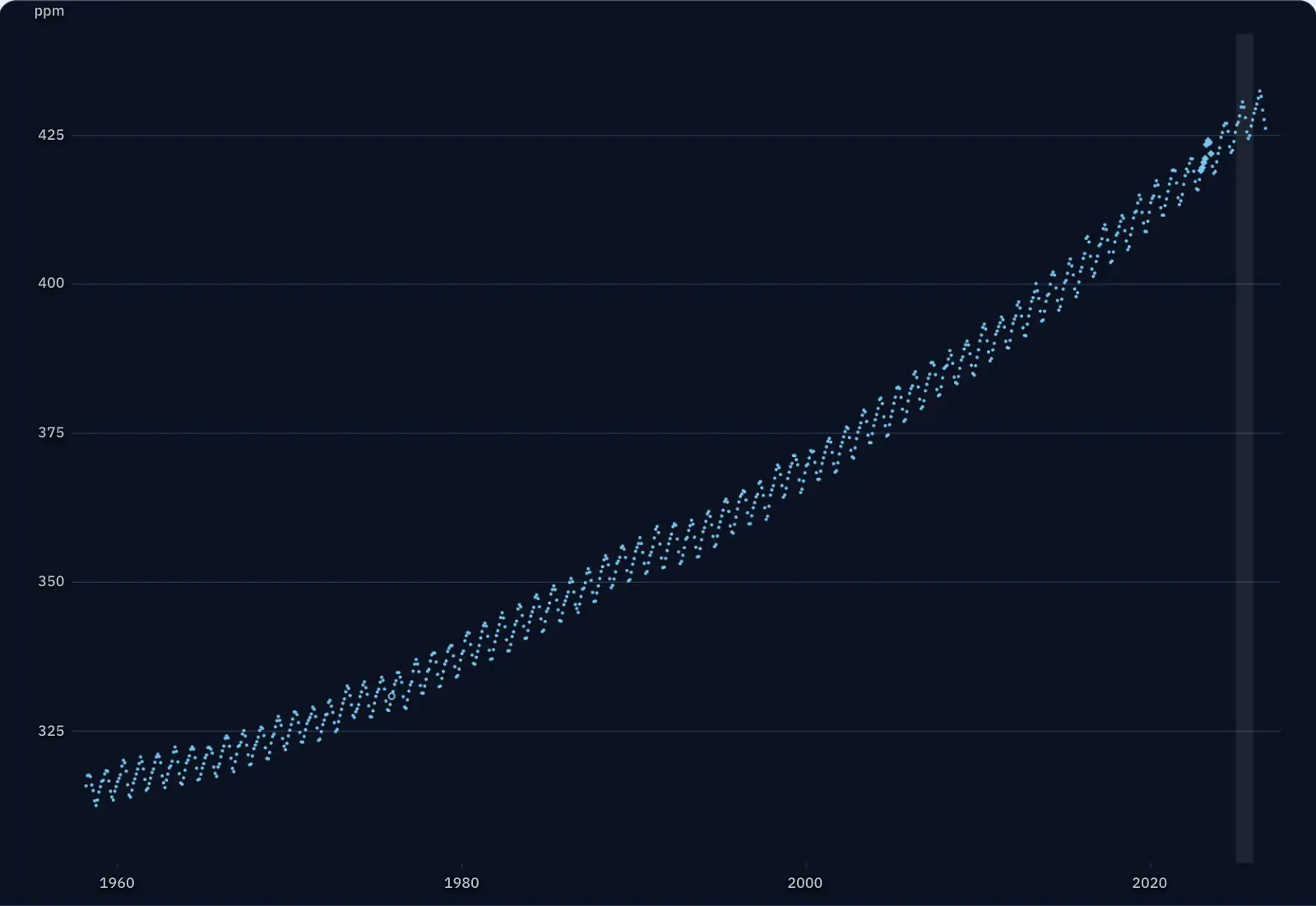
- from 1958 to today
Before you read: what do you think?
In 2019 the world produced 353 million tonnes of plastic waste. What share of it was actually recycled?
See the answer
According to the OECD, once the losses in the recycling process are counted, only 9% of plastic waste was recycled, 19% was incinerated and almost 50% went to landfill. Part of what is collected separately never becomes new material.
On 15 November 2022, by the UN’s estimate, the world’s population reached 8 billion. Every one of those people needs food, water and energy, and throws something away every day. How hard humanity presses on the environment depends on how many people there are, how much each one consumes and how things are made, used and reused.
The population is growing, but ever more slowly
Demography studies how many people there are, how they are spread across age groups and how populations change. It took humanity 12 years to go from 7 to 8 billion people, and the UN estimates that the next billion will take about 15 years, until 2037. Since 2020 the world’s population has been growing by less than 1% a year, the slowest rate since 1950, and the UN’s 2022 projections show a peak of about 10.4 billion people in the 2080s.
The number of people is only part of the story. The gaps between countries are wide: in 2023, measured as an ecological footprint, the consumption of one person in the United States needed about six times as much productive land as that of one person in India (7.14 against 1.15 global hectares). The total pressure on the environment depends on the number of people, on how much each consumes and on the technology used to make goods.
Resources that renew and resources that run out
Renewable resources renew themselves within a time comparable to a human life: fresh water, timber from forests, fish, the energy of the Sun and the wind. Non-renewable resources renew themselves very slowly or not at all: coal, oil, natural gas, metal ores.
A renewable resource can still be used up if it is used faster than it renews. A lake fished faster than the fish grow ends up with no fish, and fertile soil, once eroded, needs centuries to rebuild.
Pollution of air, water and soil
Pollution is the release into the environment of substances or forms of energy that harm living things. In the air, exhaust fumes and smoke from industry and household stoves produce fine particles, nitrogen oxides and, in sunlight, ground-level ozone. The mixture of these pollutants over cities is called smog. The European Environment Agency estimates that in 2023 fine particles, ozone and nitrogen dioxide above the levels recommended by the WHO caused about 206,000, 71,000 and 56,000 premature deaths in Europe, respectively.
Sulfur dioxide and nitrogen oxides form acids in the atmosphere that fall with rain and snow: this is acid rain, which acidifies lakes and soils and weakens forests. In water, nitrogen and phosphorus from fertilisers and sewage cause eutrophication: algae multiply enormously, their decomposition uses up the oxygen in the water, and the fish die.
Soil is polluted by heavy metals, pesticides and waste dumped at random. Plastic breaks into smaller and smaller pieces, but it does not disappear. According to the OECD, of the 353 million tonnes of plastic waste produced worldwide in 2019, only 9% was actually recycled.
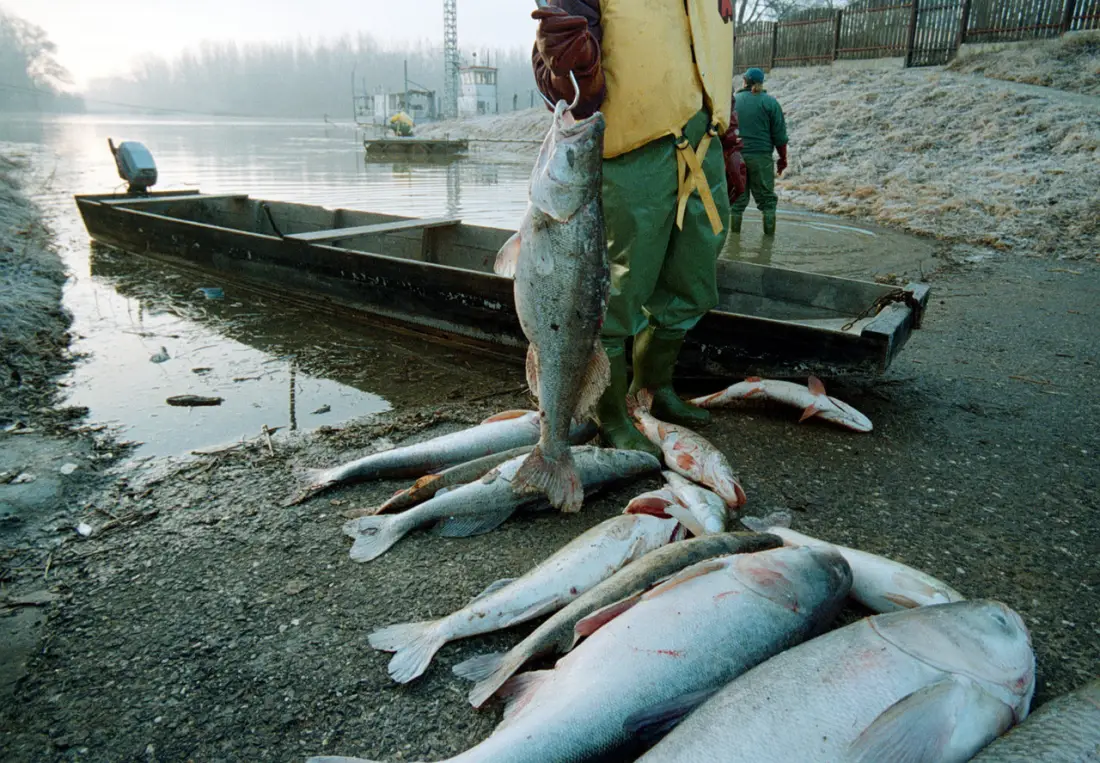
Photo: Délmagyarország/Karnok Csaba, CC BY-SA 3.0, source. Resized.

Waste: first less of it, then reuse, then recycling
European Union law ranks the ways of handling waste in five steps, from best to worst: prevention (the waste is never produced), preparing for re-use (the object is repaired and used again), recycling (the material becomes raw material for new products), other recovery, such as burning with energy production, and disposal, usually in landfill.
The recycling rate is the share of the waste produced that is actually recycled, as a percentage. In 2023 the European Union average for municipal waste was 43.3%, and the target for 2025 was 55%. Recycling has costs of its own: collection, transport, sorting, energy and lost material. That is why prevention comes before it.
Worked example
A family’s waste in one year
In 2024 a person in Romania produced on average 305 kg of municipal waste, the lowest figure in the European Union. A family of four therefore produces about 4 × 305 = 1,220 kg a year.
If Romania’s 2023 recycling rate of 12.4% is applied, 1,220 × 0.124 ≈ 151 kg is recycled. With the European average for the same year, 43.3%, 1,220 × 0.433 ≈ 528 kg would be recycled, almost three and a half times as much.
The calculation combines a 2024 average per person with 2023 rates, so it gives an order of magnitude. A real family’s result depends on what it collects separately and on what then happens to the collected material.
In Romania
The Baia Mare cyanide spill and recycling that lags behind
On 30 January 2000, after snowfall and rain followed by a thaw, the dam of the tailings pond belonging to the company Aurul SA near the town of Baia Mare gave way. About 100,000 cubic metres of water laced with cyanide flowed into the Lăpuș river, then into the Someș, the Tisza and the Danube, all the way to the Black Sea. Dead fish were reported along the way, first in Satu Mare county. The pond held residues from old mining operations, from which gold and silver were being recovered with cyanide solutions.
Waste management is a slower problem, but an everyday one. In 2023 Romania recycled 12.4% of its municipal waste, the lowest rate in the European Union, against a European average of 43.3%.
In short
- The world’s population reached 8 billion on 15 November 2022 and is growing ever more slowly; the impact on the environment also depends on consumption per person and on technology.
- Renewable resources (water, timber, fish, solar energy) renew themselves, but they can be used up if they are used faster than they renew; non-renewable resources (fossil fuels, metal ores) run out.
- Air pollution produces smog and acid rain, nutrient pollution of water produces eutrophication, and soil is polluted with heavy metals, pesticides and plastic.
- The order of waste management is: prevention, re-use, recycling, other recovery, disposal.
- In 2023 Romania recycled 12.4% of its municipal waste, against a European average of 43.3%.
Common mistakes
WrongThe impact on the environment depends only on how many people there are.
RightHow much each person consumes and how goods are made matter too. Countries with similar populations can have very different impacts.
WrongIf I put plastic in the recycling bin, the problem goes away.
RightPart of what is collected is lost in sorting and processing: worldwide, only 9% of plastic waste was actually recycled in 2019. It is more effective if the waste is never produced.
WrongRenewable resources can never run out.
RightThey run out if they are used faster than they renew, as happens in a lake that is overfished.
Check yourself
Seven questions. For the first six you see the explanation at once, with the paragraph of the lesson that supports it; for the written ones you compare with a good answer.
Which of these resources is non-renewable?
Answer
c) Natural gas. Natural gas formed over millions of years and does not renew itself on a human timescale.
Put the steps of waste management in order, from best to worst.
Answer
The correct order:
- Prevention: the waste is never produced
- Preparing for re-use: the object is repaired and used again
- Recycling: the material becomes raw material
- Other recovery, for example burning with energy production
- Disposal, usually in landfill
The higher the step, the less material is lost and the less energy is used. Recycling only comes third.
Which gases cause acid rain?
Answer
b) Sulfur dioxide and nitrogen oxides. Sulfur dioxide and nitrogen oxides form acids in the atmosphere.
Why do the fish die in a lake that receives a lot of fertiliser?
Answer
b) Algae multiply, and their decomposition uses up the oxygen in the water. Nitrogen and phosphorus feed the algae; when the algae die, decomposers use up the oxygen.
In 2019 the world produced 353 million tonnes of plastic waste, and 9% of it was actually recycled. How many million tonnes were recycled? Round to one decimal place.
million tonnesAnswer
31.8 million tonnes. 353 × 0.09 = 31.77, or about 31.8 million tonnes.
A family of three produces 305 kg of municipal waste per person in a year and recycles 12.4% of it. How many kilograms does it recycle in a year? Round to a whole number.
kgAnswer
113 kg. 3 × 305 = 915 kg; 915 × 0.124 = 113.46, or about 113 kg.
Two cities have the same number of inhabitants. In the first, each person produces 500 kg of waste a year and 50% is recycled; in the second, 300 kg, and 15% is recycled. Which city leaves more waste unrecycled? What measure would help each city?
A good answer
First city: 500 × 0.5 = 250 kg per person not recycled. Second: 300 × 0.85 = 255 kg. The results are almost equal, even though the cities look very different. The first city would gain most by cutting the amount it produces (prevention, re-use), the second by collecting separately and recycling more.
A complete answer works out the unrecycled amount per person in both cities, notices that both the amount produced and the recycling rate matter, and proposes measures tied to the steps of the waste hierarchy.
Practical work for this lesson
- Weigh up the waste problem – Audit of clean materials or case study, 35–45 minutes
Terms
- demography
- The science that studies the size, structure and changes of human populations.
- renewable resources
- Resources that renew themselves in a short time, as long as they are not used faster than they renew.
- non-renewable resources
- Resources that renew themselves very slowly or not at all, such as fossil fuels and metal ores.
- pollution
- The release into the environment of substances or forms of energy that harm living things.
- smog
- A mixture of pollutants (fine particles, nitrogen oxides, ozone) that builds up in the air over cities.
- acid rain
- Rain or snow made acidic by acids formed in the atmosphere from sulfur dioxide and nitrogen oxides.
- eutrophication
- The enrichment of water with nitrogen and phosphorus, followed by a boom in algae and a fall in oxygen.
- recycling rate
- The percentage of the waste produced that is actually recycled.
Sources and link to the programme
- UN – Day of Eight Billion – 8 billion on 15 November 2022; 12 years from 7 to 8 billion; about 15 years to 9 billion, in 2037
- UN DESA – World population to reach 8 billion on 15 November 2022 (World Population Prospects 2022) – growth below 1% a year since 2020, the slowest since 1950; a peak of about 10.4 billion in the 2080s
- OpenStax – Biology 2e, 46.3 Biogeochemical Cycles – non-renewable resources (fossil fuels); eutrophication from fertiliser run-off, with falling oxygen; acid rain from nitrogen oxides
- US EPA – What is Acid Rain? – acid rain forms from sulfur dioxide and nitrogen oxides released into the atmosphere
- European Environment Agency – Air pollution – 206,000, 71,000 and 56,000 premature deaths in Europe in 2023 attributed to fine particles, ozone and nitrogen dioxide above WHO recommendations
- VOA News (February 2022), citing the OECD Global Plastics Outlook – 353 million tonnes of plastic waste in 2019; 9% recycled after losses, 19% incinerated, almost 50% landfilled (secondary source)
- European Commission – Waste Framework Directive – the five-step waste hierarchy; the “polluter pays” principle
- Eurostat – Municipal waste statistics (data extracted in January 2026) – 305 kg per person in Romania in 2024 (the lowest figure in the EU); 2023 recycling rate: Romania 12.4%, EU average 43.3%; the 55% target for 2025
- UNEP/OCHA – Cyanide spill at Baia Mare, Romania: assessment mission (March 2000), on ReliefWeb – the failure of the Aurul SA dam on 30 January 2000; snow, precipitation and thaw; about 100,000 m³ of cyanide-laced water into the Lăpuș, then the Someș, Tisza, Danube and Black Sea; first dead fish reported in Satu Mare; recovery of gold and silver from the Meda pond
- York University / Footprint Data Foundation – National Ecological Footprint and Biocapacity Accounts, Edition 2026 – ecological footprint of consumption per person in 2023: USA 7.14 gha, India 1.15 gha
From the programme: “Human presence in the environment in the modern era (demography, development, use of resources, waste, pollution)” (common core). Specific competences addressed: 2.1, 2.2, 3.2.