Chapter 8 · AnimalsLesson 8.7CS
Invertebrate diversity: pollinators, filter feeders, pests and invasive species
How can a small animal with no skeleton change a whole sea, or a country’s harvest?
- Size
- from 1 mm to 30 m
- Level
- organism
- Time
- hundreds of millions of years
Before you read: what do you think?
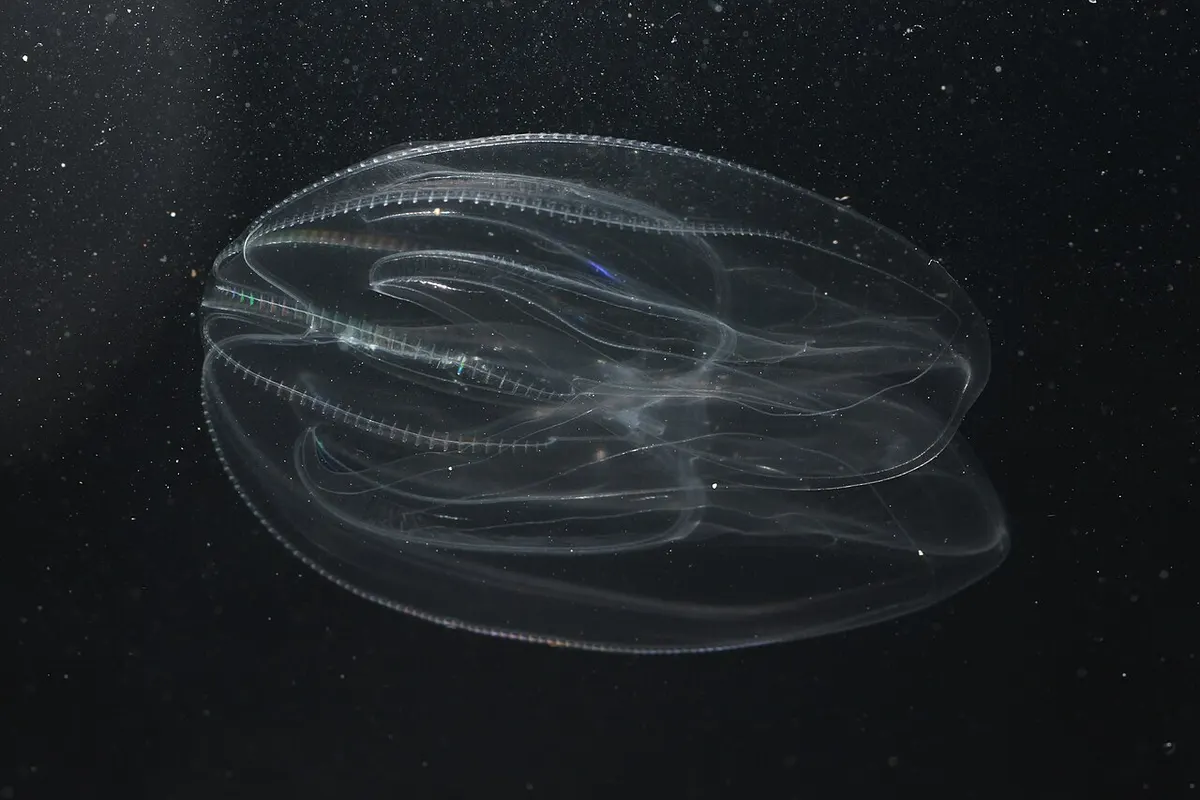
In 1982 a comb jelly from the Atlantic, Mnemiopsis leidyi, was spotted in the Black Sea for the first time. What biomass did it reach across the whole sea by 1988?
See the answer
Around a billion tonnes, according to published estimates, more than the annual fish catch of the entire world. The comb jelly ate zooplankton and fish eggs and, together with heavy fishing, helped cut Black Sea anchovy catches to a third.
Of the more than 2.1 million species scientists have described, almost 1.5 million are animals without a backbone. Insects alone account for over a million species. When you talk about animals, you are talking first of all about invertebrates.
What invertebrates do in an ecosystem
Pollination is the transfer of pollen from the anther to the stigma, in the same flower or to another flower of the same species. The yield or quality of more than three-quarters of the world’s main types of food crops depends to some degree on pollination by animals, mostly insects. Besides the honeybee, over 20,000 species of wild bees pollinate, as do flies, butterflies and beetles.
Earthworms, insect larvae and myriapods break up dead leaves and carcasses, and bacteria and fungi finish the job of decomposition. Mussels and clams filter particles out of the water and clear it; some of the pollutants, though, build up in their bodies. In warm seas, coral polyps build reefs, and the algae living in their tissue give them food and colour.
Friends, pests and human parasites
Economic importance shows up in the kitchen and in the shops: honey and wax come from the honeybee (beekeeping), silk from the silkworm, Bombyx mori (sericulture), and mussels and oysters are raised on marine farms (aquaculture). The Colorado potato beetle (Leptinotarsa decemlineata) destroys potato leaves, and locusts can eat entire harvests. The label ‘pest’ describes an effect on people in a particular place, not a group of animals.
Three kinds of relationship between species are common. In parasitism, one lives at the other’s expense and weakens it: the tick sucks blood. In mutualism, both gain: the bee takes nectar, and the flower is pollinated. In predation, one eats the other: ladybirds and their larvae eat aphids (plant lice).
Adaptations: staying unseen, looking dangerous, living in a colony
Camouflage (homochromy) is a match between body colour and surroundings: the green grasshopper sits unseen in the grass, and grey moths vanish against tree bark. Through mimicry, one species resembles another: some flies have yellow and black stripes like wasps, though they have no sting, and birds that have been stung by wasps avoid them.
Termites, ants, bees and some wasps are social insects: they live in large colonies in which individuals have different roles, such as the queen, the drones and the workers in a bee colony. The colony finds food, defends the nest and raises the young as a single unit.
Invasive species and insect decline: what the data show
An invasive species is a species brought by people to a new place, where it multiplies fast and harms the local species. The comb jelly Mnemiopsis leidyi, from the western Atlantic Ocean, probably reached the Black Sea in ships’ ballast water and was first spotted in 1982. By 1988 it had become the dominant organism in the plankton. It ate the zooplankton the anchovies feed on, and their eggs, and together with heavy fishing in the 1980s it cut anchovy catches to a third of their former level. The predatory rapa whelk (Rapana venosa), from the waters of Japan and China, was found in the Black Sea in 1947, in Novorossiysk Bay, and in less than ten years it had spread widely through the sea and reached the Sea of Azov.
Insect decline is hard to measure. In 63 protected areas in Germany, identical traps, used with the same protocol in different years over a span of 27 years, showed a 76% fall in the biomass of flying insects. Most sites were sampled for only one or two years, so the trend is calculated from many different sites, in a single country. For other regions, long data series are few and the trends differ from place to place, so the global picture is still debated by researchers.

Worked example
Which flower gets more visits?
A sample calculation, with numbers chosen for the exercise. A pupil counts the insects that land on the flowers of two bushes. At the lavender bush she sees 12 visits in 10 minutes. At the rose bush she sees 18 visits in 20 minutes.
The total is bigger at the rose, but the observation times differ, so the totals cannot be compared. Work out the rate: 12 ÷ 10 = 1.2 visits per minute at the lavender and 18 ÷ 20 = 0.9 visits per minute at the rose. The lavender gets more visits per minute.
For a reliable conclusion, you also have to take into account the number of flowers on each bush, the time of day and the weather. A visit does not automatically mean a pollinated flower, and the same bee may come back several times.
Activity: on a sunny day, watch a flowering bush in the school grounds for 10 minutes, from a metre away, and note how many visits bees, flies and butterflies make.
In Romania
Emil Racoviță and the fauna of caves
Emil Racoviță, the Romanian biologist and explorer, took part in the expedition of the ship Belgica to Antarctica from 1897 to 1899. In 1907 he published Essai sur les problèmes biospéologiques in Paris, the work that founded biospeleology, the science of life in caves and underground waters. In 1920 he set up the Institute of Speleology in Cluj, the first institute of its kind in the world.
In 1986, Movile Cave was discovered at Mangalia, in Romania. No light reaches it at all. The food of all its animals comes from bacteria that make their organic matter using energy from the hydrogen sulfide in the water, without the Sun. By 2021, 52 species of invertebrates had been found here, and 37 of them live only in the cave and the underground waters around it.
In short
- Invertebrates make up almost 1.5 million of the more than 2.1 million described species; insects exceed a million species.
- Invertebrates pollinate plants, break down remains, filter water and build reefs; they provide honey, silk and food, but can also be pests or parasites.
- Parasitism harms one species, mutualism benefits both, and predation means that one species eats another.
- Camouflage hides an animal in its surroundings, mimicry makes it resemble a dangerous species, and social insects live in colonies with fixed roles.
- An invasive species, brought by people to a new place, multiplies fast and harms local species, like the comb jelly Mnemiopsis and the rapa whelk in the Black Sea.
- Insect decline is well documented in some regions, such as Germany (−76% in flying insect biomass over a span of 27 years), but trends differ from place to place.
Common mistakes
WrongSmall animals do not matter in nature; mammals and birds are what matter.
RightOver two-thirds of described species are invertebrates, and without animal pollinators the yield or quality of more than three-quarters of the main types of crops would suffer.
WrongPests are a group of animals, like insects or molluscs.
RightCalling an animal a ‘pest’ describes its effect on human interests, in a particular place and at a particular time. The same species can be a pest in one field and food for birds in the forest next door.
WrongIf mussels filter the water, the pollution disappears.
RightMussels trap particles, but some of the pollutants build up in their bodies or stay in the water. The matter does not disappear; it moves.
Check yourself
Seven questions. For the first six you see the explanation at once, with the paragraph of the lesson that supports it; for the written ones you compare with a good answer.
What kind of relationship is there between a bee and the flower it pollinates?
Answer
c) Mutualism. The bee gets nectar, and the plant gets its pollen carried: both gain.
A fly with yellow and black stripes and no sting is avoided by birds. What adaptation does it have?
Answer
b) Mimicry. The fly resembles a dangerous species, the wasp, and predators that have learnt to avoid wasps avoid it too.
Which statement about the comb jelly Mnemiopsis leidyi in the Black Sea is correct?
Answer
b) It was probably brought in ships’ ballast water and, together with heavy fishing, helped reduce anchovy catches. The comb jelly comes from the western Atlantic and was first spotted in 1982; it ate the zooplankton that anchovies feed on, and their eggs.
The IUCN Red List (2025) gives 2,139,242 described species, of which 1,474,567 are invertebrates. What percentage of described species are invertebrates? Round to a whole number.
%Answer
69 %. 1,474,567 ÷ 2,139,242 × 100 ≈ 68.9%, which is about 69%, more than two-thirds.
Put each example with the right type of relationship.
Answer
Parasitism: A tick sucking a dog’s blood.
Mutualism: Algae that live in coral polyps and feed them; A butterfly drinking nectar and carrying pollen.
Predation: A ladybird eating aphids; A spider catching flies in its web.
A parasite lives at the host’s expense without killing it straight away, in mutualism both species gain, and a predator kills and eats its prey.
What does the study covering 27 years in Germany’s protected areas show?
Answer
b) A 76% fall in the biomass of flying insects, measured with the same protocol. The study measured flying insect biomass with identical traps, in 63 areas in Germany, in different years; on its own it does not say what is happening across the world.
How can the animals in Movile Cave live without a single ray of sunlight, when almost all food chains on Earth start from plants?
A good answer
At the base of the food chain in Movile Cave are bacteria that make their organic matter using energy from the hydrogen sulfide in the water, not light. Invertebrates eat these bacteria, and predators in turn eat the invertebrates. This forms a complete ecosystem without the Sun.
A complete answer says where the energy comes from (hydrogen sulfide), who produces the organic matter (the bacteria) and how it reaches the animals (the food chain).
Terms
- pollination
- The transfer of pollen from the anther to the stigma, in the same flower or to another flower of the same species, often carried out by insects.
- parasitism
- A relationship in which one organism lives at the expense of another, the host, and weakens it.
- mutualism
- A relationship between two species from which both gain.
- camouflage
- A match between the colour of an animal’s body and the colour of the place where it lives; called homochromy in the Romanian programme.
- mimicry
- The resemblance of one species to another, usually one that is dangerous or unpleasant for predators.
- invasive species
- A species brought by people to a new place, where it multiplies fast and harms local species.
- biospeleology
- The science that studies life in caves and underground waters.
Sources and link to the programme
- IUCN Red List version 2025-1 – Table 1a (updated 27 March 2025) – 2,139,242 described species in total; 1,474,567 invertebrates; 1,003,612 insects; 76,289 vertebrates; 5,665 coral species
- IPBES (2016) – Summary for policymakers, Pollinators, pollination and food production – more than three-quarters of the main types of food crops benefit from animal pollination; over 20,000 bee species; flies, butterflies, beetles among the pollinators
- OpenStax – Biology 2e, 28.2 Phylum Cnidaria – the mutualistic relationship between corals and zooxanthellae algae, which give reefs their colour and food to both organisms
- OpenStax – Biology 2e, 28.6 Superphylum Ecdysozoa: Arthropods – eusocial termites, ants, bees and wasps, with castes (queen, drone, worker); insects as pollinators
- Oguz (2005), Oceanography 18(2) – Long-term impacts of anthropogenic forcing on the Black Sea ecosystem – the decline of the anchovy fishery explained by predation on eggs and competition for zooplankton with Mnemiopsis, and by heavy fishing in the 1980s
- OpenStax – Biology 2e, 32.2 Pollination and Fertilization – pollination is the transfer of pollen from anther to stigma; self-pollination within the same flower or the same plant, cross-pollination between individuals of the same species
- Ivanov et al. (2000), Biological Invasions 2: 255–258 – Invasion of the Caspian Sea by the comb jellyfish Mnemiopsis leidyi – Mnemiopsis first spotted in the Black Sea in 1982; dominant in the plankton in 1988, with an estimated biomass of a billion tonnes, more than the annual world fish catch; anchovy catches fell to a third; transport in ballast water
- Smithsonian NEMESIS – Rapana venosa – the rapa whelk, native to the Sea of Japan, the Yellow Sea and the East China Sea; first collected in the Black Sea in Novorossiysk Bay (1947 in one paragraph, 1946 in another); within less than a decade, widespread in the Black Sea and into the Sea of Azov
- Hallmann et al. (2017), PLOS ONE – More than 75 percent decline over 27 years in total flying insect biomass in protected areas – a 76% fall in flying insect biomass over a span of 27 years, 63 protected areas in Germany, 96 site–year combinations, Malaise traps with a standard protocol
- Tabacaru and Danielopol (2020), Vie et Milieu 70(2) – The remarkable history of the „Emil Racoviță” Institute of Speleology (1920–2020) – Racoviță on the Belgica expedition (1897–1899); Essai sur les problèmes biospéologiques, 1907; the institute of speleology in Cluj, 1920, the first in the world
- Brad, Iepure, Sarbu (2021), Diversity 13(3):128 – The Chemoautotrophically Based Movile Cave Groundwater Ecosystem – 52 invertebrate species (21 aquatic, 31 terrestrial), of which 37 are endemic to the cave ecosystem and its associated groundwater
- GESS Lab Mangalia – Projects: Movile Cave – Movile Cave, Mangalia, discovered in 1986; an underground ecosystem based on chemoautotrophy; over 50 invertebrate species, of which 35 are endemic
- Sarbu, Kane and Kinkle (1996), Science 272: 1953–1955 – A chemoautotrophically based cave ecosystem (PubMed) – chemoautotrophic bacteria that use hydrogen sulfide as an energy source are the basis of the food supply for the cave’s invertebrates
From the programme: “Animals. The diversity of invertebrates: examples of representative species of ecological and economic importance, interactions and adaptations” (specialism, Natural Sciences). Specific competences addressed: 1.1, 1.2, 2.1, 4.2, 5.1.