Chapter 5 · Levels of organisationLesson 5.2
Levels of organisation: individual, population, community, biome, biosphere
Pelicans, fish, reeds and the water of a lake in the Danube Delta: which of them form a population, and what is the whole lake, with its living things, called?
- Size
- from 10 µm to 20 km
- Level
- from tissue to ecosystem
- Time
- a season
Before you read: what do you think?
How many pairs of great white pelicans nested in the Danube Delta in a 2020 census?
See the answer
Between 12,000 and 15,000 pairs. The Delta holds about half of the great white pelicans that nest in Europe, North Africa and most of Asia. All these birds, of the same species and from the same place, form a population.
In a 2020 census, between 12,000 and 15,000 pairs of nesting great white pelicans were counted in the Danube Delta. All these birds belong to the same species and live in the same place: they form a population. Alongside them live fish, reeds, water lilies, bacteria and fungi, while the water, the mud, the light and the warmth give all of them the conditions they need to live.
Individual, species, population
An individual is a single organism: a pelican, a beech tree, a bacterium. Individuals that resemble one another, can interbreed and have offspring that can in turn reproduce belong to the same species.
A population is made up of the individuals of the same species that live in the same place, at the same time, and can interbreed. All the great white pelicans nesting in the Delta in one year form a population. All the birds of the Delta, from more than 300 species, do not.
Species and population do not mean the same thing. A species can have several populations, separated in space. Romania has three free-living populations of European bison: in Vânători-Neamț Nature Park (north-eastern Romania), in the Țarcu Mountains and in the Făgăraș Mountains. They are the same species but three populations, hundreds of kilometres apart, and the bison of one population do not meet those of the others.
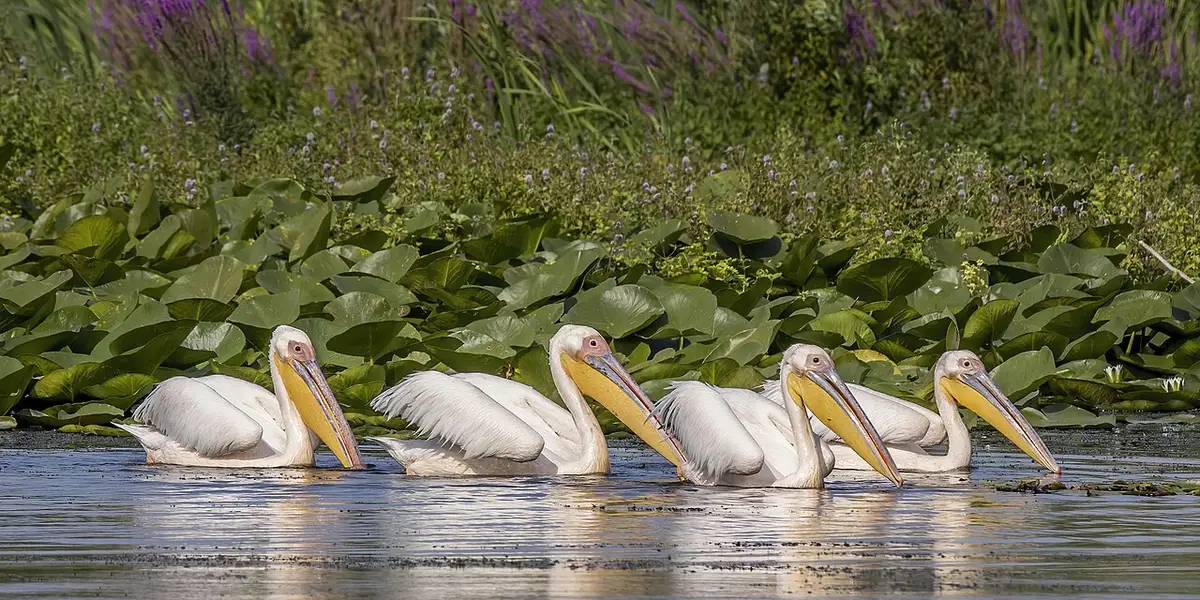
Photo: Charles J. Sharp, CC BY-SA 4.0, source. Resized.

Community and biotope form the ecosystem
The populations of all the species living together in one place make up the community (biocoenosis). The community of a lake in the Delta includes the pelicans, fish, frogs, reeds, water lilies and algae, and also organisms too small to see with the naked eye: bacteria, microscopic fungi, tiny crustaceans. The populations of a community are linked to one another: some are food for others, some compete for the same food or the same space, and decomposers turn dead remains into simple substances.
The place, with its non-living conditions, is called the biotope: the water, the mud on the bottom, the light, the temperature, the dissolved oxygen. The biotope and the community, together and interacting with each other, form an ecosystem. Matter and energy flow between them: algae take carbon dioxide and light from the biotope, and when they die the substances in their bodies return to the water and the mud.
Water and temperature are parts of the ecosystem, but they are not living things. They belong to the biotope.
The biome: same conditions, same vegetation, over large areas
The deciduous forests of Romania, Germany and the eastern United States look alike: cold winters, warm summers, fairly plentiful rain and trees that shed their leaves in autumn. The list of species changes from place to place, but the conditions and the form of the vegetation are the same.
A biome is a set of similar ecosystems spread over large areas, with the same climate and the same type of vegetation. Climate, meaning temperature and the amount of water, decides the biome. Examples: deciduous forest, with beech and oak; steppe, with grasses and no trees, where little rain falls; taiga, the coniferous forest of northern Europe, Asia and America; tundra, treeless, with soil frozen deep down; then desert, savanna and equatorial forest. In geography, the same units are called biogeographical zones.
A city park is not a biome. It is a small ecosystem inside the deciduous forest biome.
The biosphere holds all life on Earth
All of Earth’s ecosystems, with every place where life exists, form the biosphere. From top to bottom it measures about 20 km, but almost all life lies in a much thinner layer, from 500 m below the ocean surface to 6 km above sea level.
The levels of organisation rise like this: individual, population, community, ecosystem (the community together with the biotope), biome, biosphere. The same lake can be studied at several levels, depending on the question. “How many pairs of pelicans nest here?” is about the population. “Who eats whom in the lake?” is about the community. “What happens to the fish when the oxygen in the water drops in summer?” is about the ecosystem, because it links living things to the biotope.
Worked example
Which level does each statement describe?
On a lake in the Danube Delta, someone notes down: (1) a pelican fishing; (2) all the great white pelicans nesting on the lake this year; (3) the pelicans, fish, reeds, algae and bacteria of the lake; (4) the water, the mud and the temperature; (5) the lake with everything that lives in it.
(1) is an individual. (2) are individuals of the same species, in the same place and at the same time: a population. (3) are populations of several species: the community. (4) are non-living conditions: the biotope. (5) is the biotope together with the community: an ecosystem.
If statement (2) said “all the birds on the lake”, it would mean several species, and so part of the community, not a population. The deciding check is the same every time: is it one species or several?
In Romania
The Danube Delta, a biosphere reserve
The Danube Delta was declared a biosphere reserve in 1990, by a government decision, and Law No. 82/1993 officially established the “Danube Delta” Biosphere Reserve. Since 1991 it has been on the UNESCO World Heritage List. The Delta is home to more than 300 species of birds and 45 species of freshwater fish.
The name can mislead. A biosphere reserve is a protected area recognised within a UNESCO network; the biosphere is all the life on Earth. Romania has two biosphere reserves recognised by UNESCO: the Danube Delta and the Rodna Mountains.
The Delta brings all these levels together. A pelican is an individual. The 12,000–15,000 pairs of great white pelicans counted in 2020 are a population. The pelicans, fish, reeds and bacteria of a lake form a community, and the whole lake, with its water, an ecosystem.
In short
- An individual is a single organism; a species includes similar individuals that can interbreed and have fertile offspring.
- A population is made up of the individuals of the same species living in the same place at the same time; a species can have several populations.
- The community includes the populations of all the species in a place, linked to one another; the biotope is the place with its non-living conditions.
- An ecosystem is made up of the biotope and the community, between which matter and energy flow.
- A biome is a set of similar ecosystems with the same climate and the same type of vegetation (deciduous forest, steppe, taiga, tundra); the biosphere includes all life on Earth.
- The levels of organisation are: individual, population, community, ecosystem, biome, biosphere.
Common mistakes
WrongAll the living things in a park form a population.
RightA population includes individuals of a single species. The living things of all the species in the park form the community.
WrongWater and soil are organisms of the ecosystem.
RightWater and soil belong to the biotope, the non-living part of the ecosystem. They influence living things, but they are not alive.
WrongYou saw no woodpeckers on one visit, so there are no woodpeckers in the forest.
RightA single observation does not prove that a species is absent. Birds hide, move about or stay silent at certain hours; observations are repeated, with the same method, on several days.
Check yourself
Seven questions. For the first six you see the explanation at once, with the paragraph of the lesson that supports it; for the written ones you compare with a good answer.
Which group forms a population?
Answer
b) All the great white pelicans nesting in the Delta in one year. A population includes individuals of the same species, in the same place and at the same time. Several species together form part of a community; individuals living in separate places do not form the same population.
The bison of Vânători-Neamț and those of the Țarcu Mountains are:
Answer
c) the same species, but two different populations. They are the same species, the European bison. Because they live hundreds of kilometres apart and do not meet, they form different populations.
What makes up an ecosystem?
Answer
b) The biotope together with the community. Living things alone form the community, and the non-living conditions form the biotope. The ecosystem includes both, linked by exchanges of matter and energy.
A deciduous forest in Romania and one in the eastern United States have different species lists. Do they belong to the same biome?
Answer
b) Yes, because they have the same climate and the same type of vegetation. A biome is recognised by its climate and its type of vegetation. The species can differ.
In the 2020 census, at least 12,000 pairs of great white pelicans nested in the Delta. How many adult pelicans is that, at least?
pelicansAnswer
24,000 pelicans. A pair is two adults: 12,000 × 2 = 24,000. Chicks and birds that do not nest are not included in this number.
Choose the level of organisation described by each card.
Answer
Individual: a beech tree in the forest near the school; a pelican fishing.
Population: all the beech trees in that forest; the free-living bison of the Țarcu Mountains.
Community: the beeches, fungi, roe deer and insects of the forest; all the living things in a lake in the Delta.
A single organism is an individual; the individuals of a single species in one place form a population; the populations of several species in one place form the community.
A pupil wants to find out why the fish in a pond die in very hot summers. Is it enough to study the fish population? Explain which level of organisation the pupil needs to work at and what needs to be measured.
A good answer
The fish population is not enough, because the question links living things to the conditions in the pond. The work has to be done at the level of the ecosystem: measuring the water temperature and the dissolved oxygen (the biotope) and following the fish, the algae and other living things (the community). Only then can the pupil see whether the deaths of the fish are linked to changes in the biotope.
A complete answer names the ecosystem, explains why the biotope is needed as well, and proposes at least one measurement of a non-living factor.
Terms
- individual
- A single organism, for example a pelican or a beech tree.
- species
- A group of similar individuals that can interbreed and have offspring that can reproduce.
- population
- The individuals of the same species that live in the same place, at the same time, and can interbreed.
- community
- All the populations of different species that live together in one place and are linked to one another; also called a biocoenosis.
- biotope
- The place where a community lives, with its non-living conditions: water, soil, light, temperature.
- ecosystem
- A unit made up of a biotope and a community, between which matter and energy flow.
- biome
- A set of similar ecosystems spread over large areas, with the same climate and the same type of vegetation.
- biosphere
- The layer of the Earth in which life exists, made up of all its ecosystems.
Sources and link to the programme
- OpenStax – Biology 2e, 44.1 The Scope of Ecology – the levels of organisation studied by ecology: organism, population, community (biocoenosis), ecosystem, biosphere
- OpenStax – Biology 2e, 44.3 Terrestrial Biomes – terrestrial biomes, defined by temperature and precipitation: temperate deciduous forest, steppe (temperate grassland), taiga (boreal forest), tundra, desert, savanna, tropical forest
- OpenStax – Biology 2e, 18.2 Formation of New Species – the biological definition of a species: individuals that can interbreed and have fertile offspring
- OpenStax – Biology 2e, 45.1 Population Demography – the population: the individuals of a species living in a particular area
- Dănilă, Cătănoiu, Roșca, Coșofreț (2024), Geographia Technica 19(1) – GIS analysis of the spatial distribution of European bison in Vânători Neamț Natural Park – Romania has three free-living bison populations: Vânători-Neamț, Armeniș (Țarcu Mountains) and the Făgăraș Mountains
- IUCN World Heritage Outlook – Danube Delta – inscription on the World Heritage List in 1991; more than 300 bird species and 45 freshwater fish species; 12,000–15,000 pairs of great white pelican in the 2020 colony census; 50% of the Palaearctic breeding population of the great white pelican
- Radio Constanța – 1 septembrie, Ziua Rezervației Biosferei Delta Dunării (2021) – Government Decision No. 983/1990, which declared the Danube Delta a biosphere reserve
- Legea nr. 82/1993 privind constituirea Rezervației Biosferei „Delta Dunării” (consolidated text, e-guvernare portal) – the establishment of the “Danube Delta” Biosphere Reserve by law, on 20 November 1993
- Guvernul României – draft of the Strategia națională pentru conservarea biodiversității (2026) – two biosphere reserves recognised by UNESCO: the Danube Delta and the Rodna Mountains (Retezat lost the status in 2021)
- National Geographic Education – Biosphere – the thickness of the biosphere (about 20 km) and the layer that holds almost all life (from 500 m below the ocean surface to 6 km altitude)
From the programme: “Levels of organisation: from individual to biosphere (basic concepts: individual, species/population, biocoenosis, biome, biosphere)” (common core). Specific competences addressed: 1.1, 2.1, 2.2.