Chapter 4 · Membrane, osmosis, divisionLesson 4.2
Osmosis: why water moves into or out of a cell
Why does a lettuce leaf go limp once you have salted it, and why does a wilted flower perk up when you stand it in water?
- Size
- from 10 nm to 100 µm
- Level
- membrane and cell
- Time
- minutes and hours
Before you read: what do you think?
A drop of blood falls into a glass of distilled water, with no salt in it at all. What happens to the red blood cells?
See the answer
They swell until they burst. Distilled water is more dilute than the inside of the cell, so water enters through the membrane, and a red blood cell has no wall to stop it. This is called haemolysis.
Sprinkle salt on a slice of cucumber and wait ten minutes: the slice is sitting in a puddle of water, though you have not poured a drop. The water has come out of the cucumber’s cells. Nothing pushed it out; all it took was more salt outside than inside.
A membrane that lets water through and stops salt
The cell membrane is partially permeable (selectively permeable): small water molecules cross it easily, while many dissolved substances, such as salts and sugars, cross it with difficulty or not at all. The water that does the dissolving is called the solvent, and the dissolved substance is called the solute.
When two solutions of different concentrations are separated by such a membrane, water crosses it in both directions, but more water passes from the dilute solution to the concentrated one. Osmosis is the movement of water through a partially permeable membrane, from the more dilute solution to the more concentrated solution.
Osmosis is a kind of diffusion: what moves is water, from where its molecules are more numerous in the same volume to where they are fewer. The cell spends no energy on this transport. Salt does not pull water; on the saltier side, fewer water molecules simply hit the membrane at any moment.
Three kinds of surroundings, three outcomes for the cell
The solution around a cell is always compared with the cell’s inside in terms of the dissolved substances that cannot cross the membrane. A hypotonic solution has a lower concentration of these substances than the inside of the cell, so water enters the cell. A hypertonic solution has a higher concentration than the inside of the cell, so water leaves the cell. An isotonic solution has the same concentration of these substances as the inside of the cell, and the cell’s volume does not change.
In an isotonic solution the water is not standing still. It keeps moving in and out in equal amounts, which is why the volume stays the same.
For human blood, the isotonic solution used in hospitals is saline: 9 g of sodium chloride dissolved in water and made up to one litre of solution, a concentration of 0.9%.
An animal cell bursts or shrivels
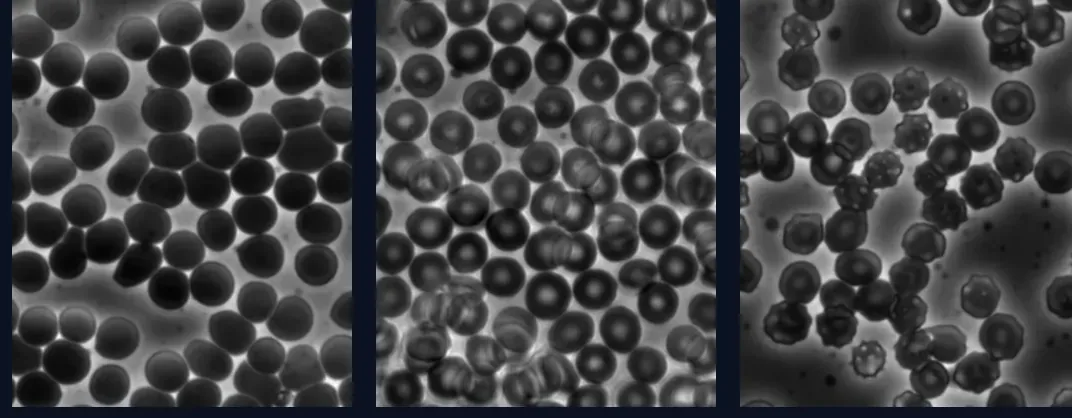
A red blood cell has no cell wall. In a hypotonic solution, water enters, the cell swells and its membrane can tear: this is haemolysis. In a hypertonic solution, the cell loses water and shrivels.
That is why distilled water is never injected into a vein, and why seawater does not quench thirst: it is saltier than the body’s fluids, so cells lose water instead of gaining it.
For the curious
Ocean water holds on average around 35 g of salts per litre, almost four times as much as saline. Human kidneys cannot get rid of that much salt without losing more water than was drunk.
A plant cell has a wall that changes the outcome
Outside its membrane, a plant cell is wrapped in a rigid cell wall made of cellulose. In hypotonic surroundings, water enters, the vacuole grows and the cell contents press on the wall. The wall presses back, and the net inflow of water slows and stops without the cell bursting. This state, in which the cell is full and firm, is called turgor, and the cell is said to be turgid. Turgor keeps leaves and non-woody stems upright; an unwatered plant wilts because its cells lose water and the pressure on their walls drops.
In hypertonic surroundings, water leaves the vacuole, and the cell contents shrink and pull away from the wall. This is called plasmolysis. In plasmolysis it is the living contents of the cell, wrapped in the membrane, that pull back; the cell wall stays where it was.
If a plasmolysed cell is put back into pure water quickly, water enters again and the contents press against the wall once more: this is deplasmolysis. After plasmolysis that lasts too long or goes too far, the cell dies and does not recover.
For the curious
At equilibrium, the inside of a turgid cell is still more concentrated than the water around it. The net flow of water stops because the pressure of the wall balances the difference in concentration, without the two concentrations becoming equal.
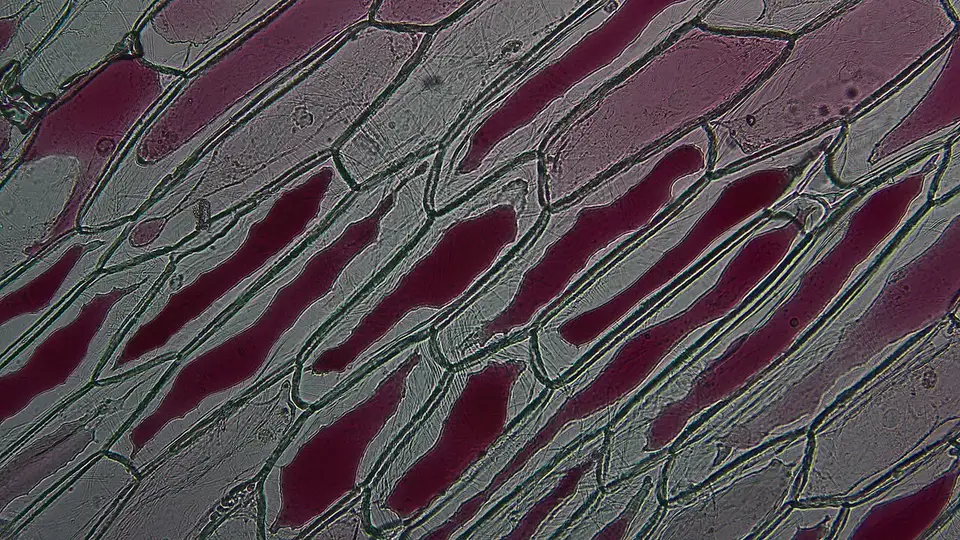

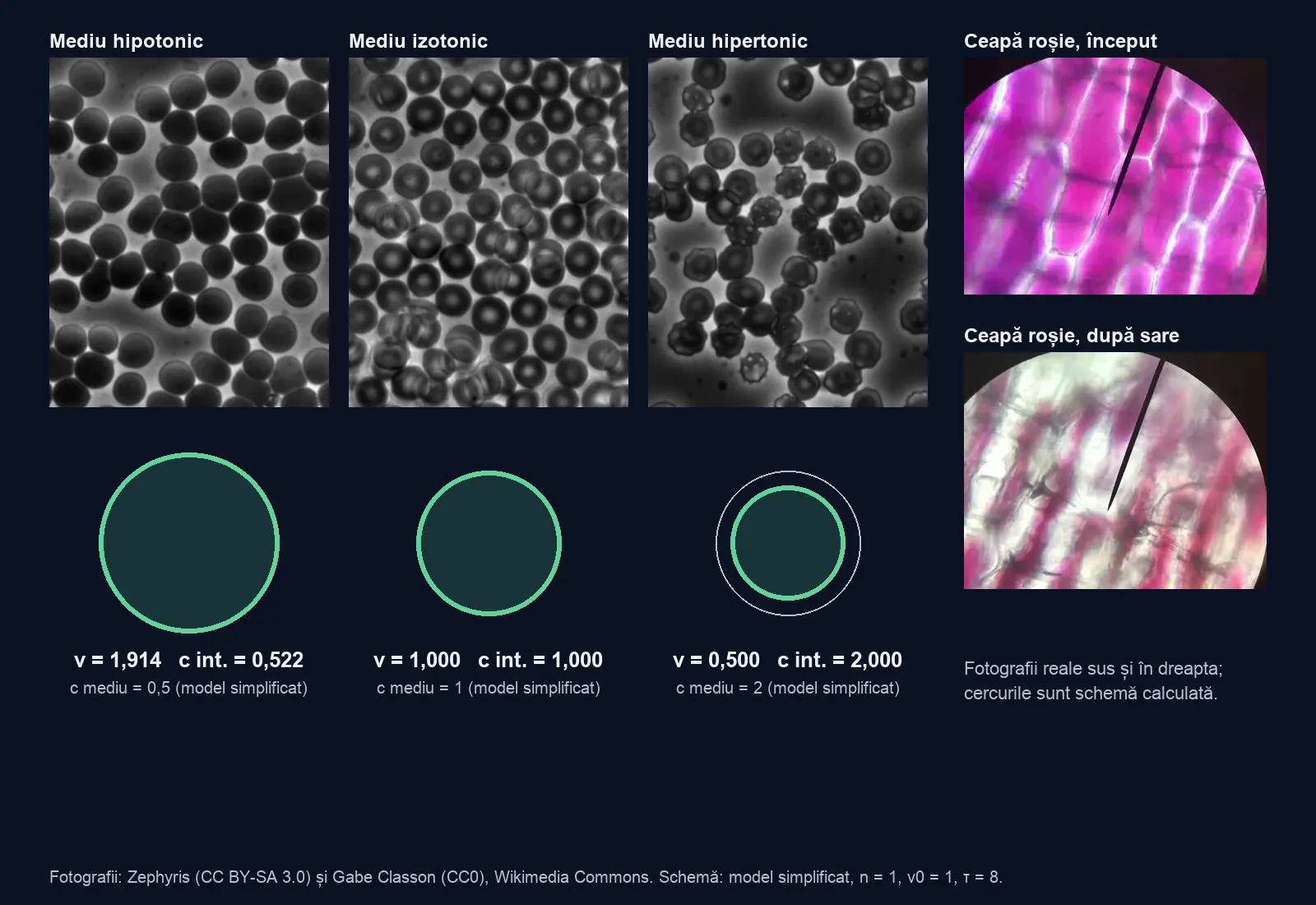
The six reference cases of the simplified model, at the end of the chart (τ = 8; values without units). The medium with concentration 0.5 is dilute, hypotonic; the one with 1 is isotonic; the one with 2 is hypertonic. Distilled water would have concentration 0, a case with no equilibrium volume in the model without a wall, which is not calculated here. One more worked example: medium 0.8, no wall, equilibrium volume 1.250.
The model’s numbers
n = 1, v₀ = 1, τ from 0 to 8; k = 0 is the cell without a wall, k = 4 the wall drawn as an elastic casing.
| Cell | Medium (external c) | v at τ = 8 | equilibrium v | internal c at τ = 8 | p | Net flow at τ = 8 |
|---|---|---|---|---|---|---|
| Red blood cell (no cell wall) | Hypotonic, 0.500 | 1.914 | 2.000 | 0.522 | 0.000 | 0.022 |
| Red blood cell (no cell wall) | Isotonic, 1.000 | 1.000 | 1.000 | 1.000 | 0.000 | 0.000 |
| Red blood cell (no cell wall) | Hypertonic, 2.000 | 0.500 | 0.500 | 2.000 | 0.000 | 0.000 |
| Onion cell (cell wall drawn as an elastic casing) | Hypotonic, 0.500 | 1.102 | 1.102 | 0.908 | 0.408 | 0.000 |
| Onion cell (cell wall drawn as an elastic casing) | Isotonic, 1.000 | 1.000 | 1.000 | 1.000 | 0.000 | 0.000 |
| Onion cell (cell wall drawn as an elastic casing) | Hypertonic, 2.000 | 0.500 | 0.500 | 2.000 | 0.000 | 0.000 |
| Real photograph | What it shows | Credit |
|---|---|---|
| Human red blood cells, hypotonic medium | rounder, swollen cells | Zephyris, CC BY-SA 3.0, Wikimedia Commons |
| Human red blood cells, isotonic medium | ordinary-looking discs | Zephyris, CC BY-SA 3.0, Wikimedia Commons |
| Human red blood cells, hypertonic medium | shrunken cells with jagged edges | Zephyris, CC BY-SA 3.0, Wikimedia Commons |
| Red onion, epidermis, frame 1 of 5 | full cells, start of the recording (the liquid before the salt is not given in the source) | Gabe Classon, CC0, Wikimedia Commons |
| Red onion, epidermis, frame 5 of 5 | the coloured contents have drawn together; white space appears between them and the edge (plasmolysis) | Gabe Classon, CC0, Wikimedia Commons |
Micrograph and calculation. The photographs are real. Human red blood cells in three media (phase contrast; Zephyris, CC BY-SA 3.0, panels cropped from the original image; the source does not give the concentrations) and red onion epidermis at 400× magnification, as stated by the author, in five frames from a recording sped up eight times (Gabe Classon, CC0, file on Commons), all from Wikimedia Commons. There is no photograph for every case, and the missing ones are marked. The drawing of the cell, the chart and the table are calculated with a simplified model: the dissolved substance does not cross the membrane, and a cell without a wall is compared with a cell with a wall drawn as an elastic casing, in three media. The values in the model have no units, τ is model time, not seconds, and the model does not calculate the bursting of the cell. n = 1, v₀ = 1; external concentration 0.5, 1 or 2; k = 0 (no wall) or k = 4 (the drawn wall); τ from 0 to 8.The model’s numbers

Sources and credits. Photographs: Zephyris, CC BY-SA 3.0, source (human red blood cells, cropped panels; source); Gabe Classon, CC0, source (red onion epidermis, frames from a recording; source). Wikimedia Commons.
Worked example
Potato in salty water
Two equally sized pieces of potato are weighed, then left for an hour, one in tap water and one in very salty water. At the end they are blotted dry with a paper towel and weighed again.
The piece from the tap water weighed 10 g and now weighs 10.6 g. The change in mass is (10.6 − 10) ÷ 10 × 100 = +6%. The piece from the salty water weighed 10 g and now weighs 9.1 g. Its change is (9.1 − 10) ÷ 10 × 100 = −9%.
The first piece gained water, so tap water is hypotonic to the potato cells. The second lost water, so the brine is hypertonic. The solution in which the mass does not change at all is isotonic to the potato cells.
The scales give a result for the whole piece. For a reliable conclusion, the experiment is repeated with several pieces at each concentration and the averages are compared.
In Romania
The shad that swims from the sea into the Danube
Every spring the Danube shad (Alosa immaculata) leaves the Black Sea and swims up the Danube to spawn. The fish thus moves from water with about 17 g of salts per litre into fresh water with almost no salts, while its blood has a concentration somewhere in between, around a third of that of ocean water.
In the sea, the surrounding water is hypertonic to the fish’s blood, and its body loses water by osmosis. The fish drinks seawater and gets rid of the extra salts through its gills. In the Danube, the surrounding water is hypotonic and enters the body by osmosis. The fish almost stops drinking, passes a lot of very dilute urine and takes up salts from the water through its gills.
Osmosis is the same in both waters. What changes is how the gills and kidneys make up for its effect, and few species can do this: most bony fish live only in fresh water or only in salt water.
In short
- Osmosis is the movement of water through a partially permeable membrane, from the more dilute solution to the more concentrated solution, with no energy used.
- A hypotonic solution is more dilute than the inside of the cell and water enters the cell; a hypertonic solution is more concentrated and water leaves; in an isotonic solution the cell’s volume does not change.
- A red blood cell swells in hypotonic surroundings and can burst (haemolysis), and shrivels in hypertonic surroundings; saline, with 0.9% sodium chloride, is isotonic with blood.
- A plant cell in hypotonic surroundings becomes turgid: the cell wall stops the swelling and the cell does not burst.
- In hypertonic surroundings, the contents of a plant cell pull away from the wall (plasmolysis); put back into water in time, the cell recovers (deplasmolysis).
- In every case it is water that moves; dissolved substances that cannot cross the membrane stay on their own side.
Common mistakes
WrongIn osmosis, salt crosses the membrane until the concentrations are equal.
RightWater is what crosses the membrane. Salt that cannot cross the membrane stays where it was; its concentration changes only because the amount of water around it changes.
WrongOnce the cell has reached equilibrium, water no longer crosses the membrane.
RightWater keeps crossing in both directions, in equal amounts. Only the change in volume has stopped.
WrongIn plasmolysis, the whole plant cell shrinks, wall and all.
RightWhat shrinks is the living contents, wrapped in the membrane, which pull away from the wall. The cell wall is rigid and stays where it was.
Check yourself
Six questions. For the first five you see the explanation at once, with the paragraph of the lesson that supports it; for the written ones you compare with a good answer.
What crosses the membrane during osmosis?
Answer
b) Water, towards the more concentrated solution. A partially permeable membrane lets water through and stops dissolved substances. Water moves towards the side with more dissolved substances.
A red blood cell is placed in a 0.2% sodium chloride solution. What happens?
Answer
c) It swells and can burst, because the solution is hypotonic. The isotonic solution for blood is 0.9%. At 0.2% the surroundings are hypotonic, water enters, and the cell has no wall to stop it. Plasmolysis happens only in cells with a wall.
Why does a plant cell kept in pure water not burst?
Answer
b) Because the cell wall presses back and stops the net inflow of water. Water enters, the vacuole grows and the rigid wall resists. The result is turgor, not bursting.
How many grams of sodium chloride must be dissolved to make 250 ml of saline?
gAnswer
2.25 g. Saline has 9 g per 1,000 ml of solution. For 250 ml, a quarter of a litre: 9 ÷ 4 = 2.25 g.
For each observation, choose the kind of surroundings the cell is in.
Answer
Hypotonic surroundings: Lettuce leaves kept in cold water turn firm and crisp; Red blood cells burst.
Hypertonic surroundings: Red onion cells have their contents pulled away from the wall; A salted cucumber slice gives off water; A piece of potato weighs less than at the start.
In hypotonic surroundings water enters the cell: turgor in plants, haemolysis in red blood cells. In hypertonic surroundings water leaves: plasmolysis, loss of mass.
A bunch of wilted parsley is stood with its stems in cold water, and an hour later its leaves are upright again. Explain what happened in its cells and why the same would not have worked with very salty water.
A good answer
The cells had lost water and were pressing only weakly on their walls. Cold water is hypotonic to the inside of the cells, so it entered by osmosis, the vacuoles grew and the cells became turgid again. Very salty water is hypertonic: it would have drawn even more water out of the cells, to the point of plasmolysis.
A complete answer names the direction in which water moves, compares the surroundings with the inside of the cell (hypotonic, hypertonic) and links turgor to the cell wall.
Practical work for this lesson
- Potato in three solutions – Guided experiment or case study with invented data, 10 minutes of preparation, 30 minutes of exposure and 15 minutes of analysis; the exposure can start before the explanation
Terms
- osmosis
- The movement of water through a partially permeable membrane, from the more dilute solution to the more concentrated solution.
- partially permeable membrane
- A membrane that lets water through and stops dissolved substances completely or in part.
- hypotonic solution
- A solution in which the dissolved substances that cannot cross the membrane are less concentrated than inside the cell; water enters the cell.
- hypertonic solution
- A solution in which the dissolved substances that cannot cross the membrane are more concentrated than inside the cell; water leaves the cell.
- isotonic solution
- A solution in which the dissolved substances that cannot cross the membrane have the same concentration as inside the cell; the cell’s volume does not change.
- turgor
- The state of a plant cell full of water, whose contents press on the cell wall.
- plasmolysis
- The pulling away of a plant cell’s contents from the cell wall, in hypertonic surroundings, through loss of water.
- haemolysis
- The bursting of red blood cells; it happens, among other causes, when they end up in hypotonic surroundings.
Sources and link to the programme
- OpenStax – Biology 2e, 5.2 Passive Transport – osmosis, tonicity, haemolysis and shrivelling of red blood cells, turgor, plasmolysis, the role of the cell wall
- OpenStax – Biology 2e, 41.1 Osmoregulation and Osmotic Balance – seawater is hypertonic to body fluids; fish in fresh water (dilute urine, salts taken up through the gills) and in salt water (drink seawater, get rid of salts); most bony fish live in only one kind of water
- Wikipedia – Saline (medicine) – saline: 9 g NaCl per litre, 0.9%, roughly isotonic with blood
- WHO / MSF – Essential drugs: practical guidelines (2016) – isotonic sodium chloride solution: 0.9 g per 100 ml of solution
- FishBase – Alosa immaculata – Danube shad: an anadromous Black Sea species that swims up the Danube
- Wikipedia – Black Sea (hydrology) – salinity of the Black Sea’s surface water, about 17
- Frontiers in Marine Science (2020) – Ontogeny of osmoregulation in teleost fishes – blood of bony fish: 280–360 mOsm/kg, around a third of ocean water
From the programme: “Exchange of substances between the cell and its surroundings: diffusion, osmosis” (common core). Specific competences addressed: 1.2, 2.1, 2.2.