
Chapter 6 · Bacteria, protists, fungiLesson 6.3
Protozoa: amoebas, flagellates, sporozoans, ciliates
How can a single cell swim, hunt, digest and get rid of excess water, without a single organ?
- Size
- from 100 nm to 30 m
- Level
- single-celled organisms and communities
- Time
- 20 minutes and billions of years
Before you read: what do you think?
A paramecium lives in a freshwater pond. What would happen to it if its contractile vacuoles stopped working?
See the answer
It would swell with water. Fresh water is hypotonic to the paramecium’s cytoplasm, so water keeps coming in by osmosis. The contractile vacuoles collect it and push it out; without them, the cell would meet the fate of a red blood cell in distilled water.
A drop of pond water under the school microscope looks like an aquarium: cells that crawl, cells that spin, cells that dart forwards and back. Each of them is a whole organism that feeds, moves and reproduces on its own. Many are protozoa.
What protozoa have in common
Protozoa are single-celled eukaryotes: they have a nucleus and organelles, like any eukaryotic cell, but their whole body is one cell. Most are heterotrophic and take their food from their surroundings, by swallowing particles or absorbing dissolved substances. They live in fresh and salt water, in damp soil or inside other organisms.
They are classified by the way they move: amoebas by pseudopodia, flagellates by flagella, ciliates by cilia, while sporozoans, all of them parasites, have no organelles for movement. This is a school group: amoebas, euglenas and ciliates sit on different branches of the tree of life, and ciliates and sporozoans are related to some algae.
Amoeba and euglena
The amoeba (Amoeba proteus) lives in fresh water and keeps changing shape. Its cytoplasm flows and pushes the membrane out into extensions called pseudopodia (false feet), which it crawls with. When it meets a particle of food, the pseudopodia surround it and close it inside a food vacuole, where it is digested.
The green euglena is a pond flagellate. It swims with its flagellum, has a red light-sensitive spot (the eyespot, or stigma) and chloroplasts, with which it photosynthesises. Kept in the dark, its chloroplasts shrink and stop working, and the euglena feeds on organic substances in the water. It is the classic example of an organism that fits neither “plant” nor “animal”.
The trypanosome, a parasitic flagellate that lives in the blood of humans and other mammals, belongs to the same group as euglena. Trypanosoma brucei causes sleeping sickness in Africa and is spread by the tsetse fly.
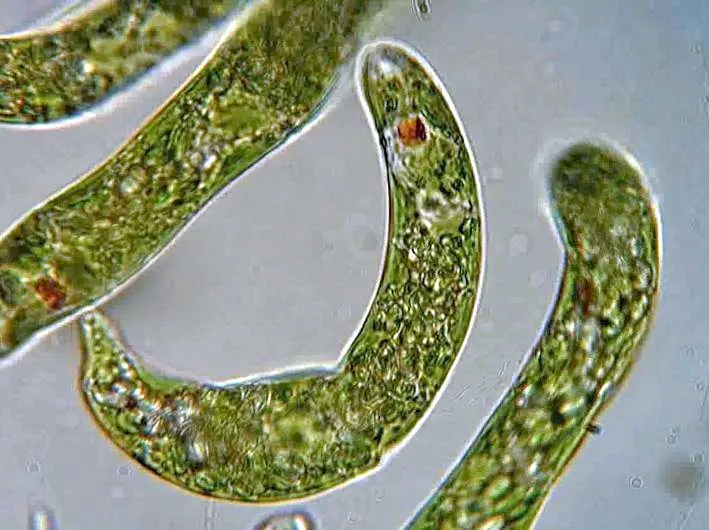
Photo: Deuterostome, CC BY-SA 3.0, source. Unchanged.

Paramecium, a ciliate with a complex organisation
The paramecium (Paramecium caudatum) is shaped like the sole of a shoe and covered in rows of cilia, short hairs that beat in coordination and drive it through the water. On one side it has a groove, the oral groove, down which the cilia sweep bacteria inwards; there they end up in food vacuoles.
The paramecium lives in fresh water, which is hypotonic to its cytoplasm, so water keeps coming in by osmosis. Contractile vacuoles (pulsating vacuoles) collect the excess water and push it out, rhythmically.
It has two nuclei: a large macronucleus, which runs the cell’s activity and division, and a small micronucleus, needed for sexual reproduction. The paramecium reproduces asexually by division, into two daughter cells. Every so often, two paramecia stick together and swap genetic material from their micronuclei: the process is called conjugation. Conjugation mixes genes, but it does not increase the number of individuals.
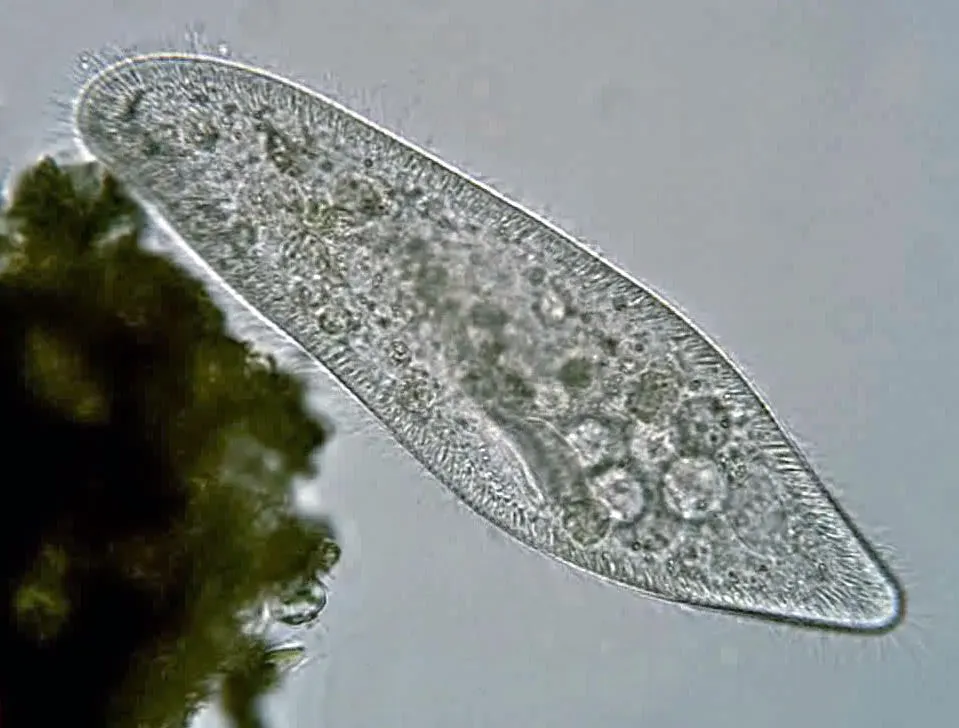
Photo: Deuterostome, CC BY-SA 3.0, source. Unchanged.

The malaria plasmodium, a sporozoan
Sporozoans are parasites with no organelles for movement; a special structure at the tip of the cell lets them get into the host’s cells. The best known is plasmodium (Plasmodium), which causes malaria (paludism).
Plasmodium needs two hosts. It is passed to humans by the bite of the female Anopheles mosquito, which is the vector. In humans it multiplies asexually, first in liver cells, then in red blood cells, which it destroys. Plasmodium falciparum is the most dangerous species. Malaria is not caught through ordinary contact with a sick person; very rarely, plasmodium passes from person to person through blood, for example in a transfusion, or from mother to child. In the mosquito’s stomach, the parasite’s gametes fuse and form zygotes, and each zygote gives rise, through repeated divisions, to many new forms, which reach the salivary glands and pass into a human at the next bite. Because sexual reproduction takes place in the mosquito, it is the definitive host, and the human is the intermediate host.
In 2024 an estimated 282 million cases of malaria and 610,000 deaths occurred worldwide, most of them in Africa. Prevention means, above all, protection from mosquito bites; for travel to areas with malaria, a doctor and the official sources (WHO, and INSP, Romania’s public health institute) say which measures are needed.
For the curious
Free-living protozoa are an important link in fresh and salt water: they eat bacteria and small algae and are in turn food for larvae, small crustaceans and fish fry. Some flagellates live in the gut of termites and help them digest the cellulose in wood.
Worked example
Four cells from a drop of pond water
A pupil describes four organisms seen under the microscope. A changes shape and moves forward by extensions of its cytoplasm. B is shaped like a sole, moves fast and is covered in tiny hairs. C is green, has a red spot and swims with a flagellum. D does not move by itself and was found in a blood smear, inside the red blood cells.
Step by step, by the organelle of movement: A has pseudopodia, so it is an amoeba. B has cilia, so it is a ciliate, for example a paramecium. C has a flagellum, so it is a flagellate; the chloroplasts and the eyespot show that it is euglena. D has no organelles for movement and lives as a parasite in red blood cells, like plasmodium: it is a sporozoan.
An activity for the school laboratory: put a handful of dry hay in a jar of pond water and leave it, covered, for a few days at room temperature. A drop from the surface, under the microscope, usually shows fast-moving ciliates. Wash your hands after the work and do not drink the water.
In Romania
The country that got rid of malaria
After the Second World War, malaria was still being transmitted in Romania. The fight against it peaked in 1947–1948, with the insecticide DDT, but the disease did not disappear then. Eradication plans followed from 1955, and the last case of malaria caught inside the country was diagnosed in 1961.
The campaign ended in 1965, and in 1967 the World Health Organization certified Romania as malaria-free, in the same year as Poland. In 1966 the WHO awarded the Romanian doctor Mihai Ciucă the Darling Foundation Prize, its award for achievements in the fight against malaria.
Between 1967 and 2014, 814 cases of malaria were diagnosed in Romania, all of them brought in from other countries by travellers. Several species of Anopheles mosquito still live in Romania, from plains with standing water to river valleys, so a case brought in from abroad remains a risk.
In short
- Protozoa are single-celled eukaryotes, usually heterotrophic, that live in water, in damp soil or as parasites; they are a school group, with members from different branches.
- The amoeba moves and catches its food with pseudopodia and digests the particles in food vacuoles.
- The green euglena swims with a flagellum and has an eyespot and chloroplasts; in the light it photosynthesises, in the dark it feeds on organic substances.
- The paramecium moves by cilia and has an oral groove, contractile vacuoles that remove excess water, a macronucleus and a micronucleus; it reproduces by division and carries out conjugation.
- Plasmodium, a sporozoan, is the agent of malaria; its vector is the female Anopheles mosquito, in which it reproduces sexually, while in humans it multiplies asexually, in the liver and in red blood cells.
- Romania was certified malaria-free by the WHO in 1967.
Common mistakes
WrongConjugation is how paramecia reproduce.
RightParamecia reproduce by division. In conjugation, two paramecia swap genetic material, and their number does not rise.
WrongThe mosquito causes malaria.
RightThe agent of malaria is plasmodium. The female Anopheles is the vector and the definitive host: plasmodium multiplies in her body, then passes to another person through her bite.
WrongEuglena is a plant, because it is green.
RightEuglena has chloroplasts, but it swims with a flagellum and, in the dark, feeds on organic substances. A single trait is not enough for classification.
Check yourself
Seven questions. For the first six you see the explanation at once, with the paragraph of the lesson that supports it; for the written ones you compare with a good answer.
What do a paramecium’s contractile vacuoles do?
Answer
b) Remove the excess water that comes in by osmosis. Fresh water is hypotonic to the cytoplasm, so water keeps coming in. The contractile vacuoles push it out; digestion takes place in the food vacuoles.
What does an amoeba move with?
Answer
c) Pseudopodia. Pseudopodia are temporary extensions of the cytoplasm; the amoeba also uses them to surround its food.
In malaria, what role does the female Anopheles mosquito play?
Answer
b) The vector, which passes on plasmodium. The agent is plasmodium; the mosquito is the vector, which carries it from one person to another after the parasite has multiplied in its body. The red blood cells destroyed are human ones.
A euglena is kept for a week in the dark, in water with dissolved organic substances. What happens?
Answer
b) Its chloroplasts shrink, and the euglena feeds on the organic substances in the water. Euglena can switch from photosynthesis to heterotrophic feeding.
Between 1967 and 2014 (48 years), 814 cases of malaria brought in from other countries were diagnosed in Romania. How many cases is that per year, on average? Round to a whole number.
cases per yearAnswer
17 cases per year. 814 ÷ 48 ≈ 16.96, that is, about 17 cases a year.
Put each protozoan in its group.
Answer
Moves by cilia: Paramecium.
Moves by flagella: Green euglena; Trypanosome.
No organelles for movement, parasitic: Malaria plasmodium.
Paramecium is a ciliate; euglena and the trypanosome are flagellates; plasmodium is a sporozoan.
A paramecium from pond water is moved into slightly salty water that is isotonic to its cytoplasm. How does the activity of its contractile vacuoles change? Explain.
A good answer
In fresh water, water keeps coming in by osmosis, and the contractile vacuoles push it out rhythmically. In an isotonic solution, water comes in and goes out in equal amounts, so there is no excess water to remove. The contractile vacuoles will pulse far less often.
A complete answer links the contractile vacuoles to osmosis, compares the two media (hypotonic, isotonic) and draws the conclusion about the rate of pulsing.
Practical work for this lesson
- Three microorganisms, three evidence cards – Case study on cards and qualitative observation, 35–40 minutes
Terms
- protozoa
- A school group of single-celled eukaryotic organisms, usually heterotrophic.
- pseudopodia
- Temporary extensions of the cytoplasm that an amoeba uses to move and catch its food.
- food vacuole
- A vacuole in which a cell digests the food particles it has swallowed.
- contractile vacuole
- A vacuole that collects excess water from the cell and expels it rhythmically.
- eyespot
- The red, light-sensitive spot of euglena, also called the stigma.
- macronucleus
- The large nucleus of ciliates, which runs the cell’s activity.
- conjugation
- An exchange of genetic material between two paramecia temporarily stuck together, with no increase in the number of individuals.
- vector
- An organism that carries the agent of a disease from one host to another, as the Anopheles mosquito does for plasmodium.
Sources and link to the programme
- OpenStax – Biology 2e, 23.3 Groups of Protists – paramecium: cilia, oral groove for bacteria, osmoregulatory contractile vacuoles, macronucleus (runs the cell’s functions and division), micronucleus (sexual reproduction), conjugation; euglena: flagellum, eyespot, chloroplasts that stop working in the dark; Trypanosoma brucei, sleeping sickness, the tsetse fly; apicomplexans named after the apical complex, Plasmodium causes malaria; the pseudopodia of amoebas
- OpenStax – Biology 2e, 23.4 Ecology of Protists – plasmodium needs a mosquito and a vertebrate; it develops in liver cells, then in red blood cells; protists as food for aquatic animals; symbiotic protists in the gut of termites, which digest cellulose
- WHO – Malaria (fact sheet) – malaria is caused by Plasmodium parasites passed on by the bite of infected female Anopheles mosquitoes; an estimated 282 million cases and 610,000 deaths in 2024; P. falciparum, the most dangerous
- WHO – Countries and territories certified malaria-free by WHO – Romania certified malaria-free in 1967, as were Poland and Cyprus
- Ivanescu et al. (2016), BioMed Research International – Climate Change Is Increasing the Risk of the Reemergence of Malaria in Romania – the fight with DDT peaked in 1947–1948; eradication plans from 1955; the last locally acquired case in 1961; the campaign ended in 1965; WHO certification in 1967; 814 imported cases between 1967 and 2014; Anopheles species of the maculipennis complex spread throughout the country
- WHO – Darling Foundation Prize, list of laureates – 1966: Professor M. Ciuca (Romania) and Professor P. G. Sergiev (USSR)
- WHO – Darling Foundation Prize – the prize is awarded for outstanding achievement in the pathology, epidemiology, treatment, prevention or control of malaria
- CDC – How Malaria Spreads – malaria is not contagious and is not caught through ordinary contact; it is rarely passed on through blood transfusions, organ transplants, contaminated needles or from mother to child
- CDC DPDx – Malaria (life cycle) – the cycle has two hosts; in the mosquito’s stomach the microgametes penetrate the macrogametes and form zygotes, then oocysts that release sporozoites, which reach the salivary glands; multiplication in the mosquito is the sporogonic cycle; the human is the intermediate host
From the programme: “Protozoa: amoebas, flagellates, sporozoans, ciliates – general features (morphology, nutrition, reproduction), examples of representative species, habitats, importance in ecosystems” (common core). Specific competences addressed: 1.1, 1.2, 2.2.